F.I.L.M. of the Week (December 28, 2012)

28 12 2012

There has been a lot of talk about Russell Crowe’s singing abilities in “Les Misérables,” and most of it has been negative.  While I will defend (although not without a few reservations) his voice as appropriate for the role, he was an excellent choice to act the part of Javert.  And if you need any reminder as to why he was cast, look no further than the brilliant drama “The Insider,” a crowning jewel of the Michael Mann canon and my pick for the “F.I.L.M. of the Week.”

As Jeffrey Weigand, a major whistleblower for Big Tobacco in the 1990s, Crowe more than adequately portrays the internal storm of a man torn by doing what is ethical and what is easy.  Dr. Weigand’s research uncovered just how addictive nicotine is and how the cigarette companies can amplify the delivery of that kick – at the expense of his own job.  Bound by a confidentiality agreement, he must sacrifice the safety and security of himself and his family in order to do the right thing.

Thankfully, that’s where Al Pacino’s Lowell Bergman comes in.  A producer for “60 Minutes,” Bergman is an expert at coaxing sensitive information out of unwilling informants.  Convincing them to sit down with Mike Wallace, played here with a firm conviction by Christopher Plummer, and spill their guts on television is no easy task, yet Bergman pulls it off with finesse by offering the vast resources of CBS to shield and protect the interviewee.

Everything seems to be working out for “60 Minutes” to run a searing exposé of the tobacco industry’s vicious practices, but the network cowardly balks just before airing, putting Weigand and Bergman both in a lot of hot water.  The journey to make the truth known the American people is made compelling in an “All the President’s Men” kind of way thanks to the bravura performances of Crowe and Pacino, a team deserving of dual Oscar glory.

And beyond the work of Pacino and Crowe, “The Insider” also boasts some of the most precise directing I’ve ever seen from the brilliant Michael Mann.  When he’s on his A-game, there is no one better than him at creating tense, thrilling moments.  His editing rhythms are enthralling and perfectly calibrated to have your heart beating to the pace he wants it.  If watching the movie makes you think of “The Dark Knight,” that’s not really a coincidence; Nolan has clearly taken good notes from a master and expounded upon what Mann does so well in films like “The Insider.”


F.I.L.M. of the Week (December 21, 2012)

21 12 2012

There are few movies in the world that can make me laugh harder than “Role Models,” my pick for “F.I.L.M. of the Week.”  An R-rated romp that slipped through the cracks for most upon release in 2008, David Wain’s riotous comedy is fantastic through and through.  It’s held up miraculously well, too – trust me, I’ve watched it dozens of times and still bust a gut.

As the two leads doing a comic man/straight man routine, Seann William Scott and Paul Rudd are absolute perfection.  Scott gets to play the absurd variation of the Stifler character for “American Pie” that made him famous, while Paul Rudd plays perhaps his best bleakly blunt pessimist yet.  Though Rudd rings real in opposition to the ridiculous Scott, that doesn’t mean he’s grim or depressing.  Rather, he’s all the funnier and relatable as Paul Rudd proves once again he might be the most adept actor at bringing all our frustrations and annoyances to comedic light.

The free-wheeling Wheeler (Scott) and Danny (Rudd) find themselves in a world of trouble after a particularly bad day on the job peddling energy drinks to kids.  But rather than go to prison for their trail of destruction, they wind up getting community service at Sturdy Wings, a Big Brother-Little Brother type program.  The two quickly find out that prison is a more appealing option than most people would consider.

First of all, Sturdy Wings is run by a crackpot ex-alcoholic and drug addict, Gayle Sweeney – played by Jane Lynch pre-Sue Sylvester (this part probably got her that character).  And to say she steals the show is a vast understatement.  You only hear every other line from her because your laughs from one line bleed over well into the next one.  She speaks in bizarre metaphors that don’t make sense and LOVES reminding everyone of her former habits to a painstakingly hilarious extent.

And Gayle pairs them with two “littles” that scared off everyone else who was volunteering.  Wheeler gets stuck with a firecracker in Ronnie, a crude and manipulative little version of himself.  Danny, on the other hand, is given Augie, an introvert with a good heart that loves nothing more than a good live-action roleplaying game.  Their adventures are strange and funny, leading them to campfires and virtual battlefields, but David Wain brings a funny-bone and a heart to every moment of it.  His “Role Models” packs an excellent message of mentoring and guidance towards becoming a better person without ever being sappy or cheesy; rather, he finds a way to get it across smoothly with laughs, smiles, and good feelings all around.


F.I.L.M. of the Week (December 14, 2012)

14 12 2012

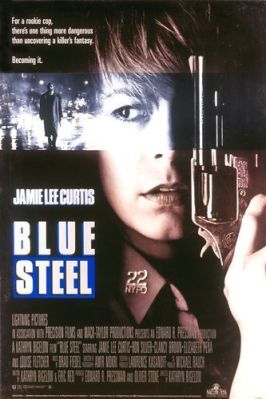
Blue Steel

It’s rare these days to find a taut, well-constructed thriller.  Usually these genre pics fall victim to throwing on cheap frills and pointless scenes that disrupt the forward momentum of the picture towards a heart-pumping finale.  Not Kathryn Bigelow’s “Blue Steel,” though.  This pick for “F.I.L.M. of the Week” is an early example of the director’s incredible ability to build tension to nerve-wracking effect, making it an interesting companion piece with her Oscar-winning “The Hurt Locker.”

Beyond just a thriller, “Blue Steel” is also a remarkable movie to watch from a feminist perspective.  Ironic that Bigelow would wind up being the first woman to win the Academy Award for Best Director as the film deals with many themes of male castration anxiety in the wake of female empowerment.  Bigelow uses a common symbol for masculinity, the phallically shaped gun, and makes many powerful and provocative suggestions in the film’s subtext.

But even if you don’t really want to do an intellectual read on the film, there’s still plenty for you.  “Blue Steel” also works as an grittier, pared-down “Fatal Attraction”-esque story, a narrative that captivates when combined with Bigelow’s remarkable ability to generate suspense.

The film begins with Jamie Lee Curtis’ policewoman Megan Turner gunning down an armed robber in a convenient store, but it quickly spirals into so much more as her bold gesture piques the interest of a bystander, Eugene Hunt (Ron Sliver).  Bizarrely inspired – or threatened – by Turner’s aggression, he begins committing strange deeds in her name to get her attention.  We never quite get a logical reason for his breakdown, but we don’t need one to be terrified and riveted by his sociopathic quest.

Even though it was released in 1990, “Blue Steel” still feels incredibly intense and gripping today.  It might have something to do with the odd parallels Megan Turner bears to Kathryn Bigelow’s journey to notoriety.  However, the more likely reason is that every scene in her film is essential towards progressing the film and not a moment seems wasted.


F.I.L.M. of the Week (December 7, 2012)

7 12 2012

The election has been over a month.

Let that sink in. I know the last thing you want to do now that the nasty rhetoric and half-truths have ceased, and you have finally begun to realize that life can exist without vicious campaign ads.  But since the political system has churned out another major crisis with the fiscal cliff, it seems that Alexander Payne’s 1999 film “Election,” a micro look at the American electoral system will never get old.  In fact, it seems to have only gotten more and more timely – and that should scare you.

Though Alexander Payne’s last two movies have won him Oscars for Best Adapted Screenplay, I would still argue “Election” is his finest script.  It works remarkably well as both a human story and an allegory for bigger things like American democracy and morality.  And after a few viewings, you start to see how brilliantly and subversively he uses American iconography to poke at the problems corroding the foundation of our great nation.

While many have lamented Payne’s insistence of voice-over in films that might not need it (such as “The Descendants“), his twisted employment of archetypical characters with a whole lot hidden under the surface really makes their narration yield some surprising revelations.  It allows us to penetrate deep into the characters beyond the functions they believe they should be functioning at Carver High School.  Not to mention, Payne writes stream-of-consciousness dialogue with a fantastic accuracy and hilarity.

By all means, the president of the student body should easily by Reese Witherspoon’s Tracy Flick.  She’s the epitome of high school perfect and has worked her butt off to be the most qualified (or at least ensures she’s the most passionate) for the office.  But there’s also something incredibly annoying about her quest, and her teacher, Matthew Broderick’s Jim McAllister, is on a mission to stop it.  As the faculty adviser for student government, he still believes it can do good – he just doesn’t want Tracy to be the one to get credit for it.

Rather than let her run for the office unopposed, Mr. McAllister manipulates popular football player Paul Metzler (Chris Klein) to challenge Tracy.  He’s rich, handsome, and an absolute moron.  But they both get more than they bargained for when Paul’s frustrated closeted lesbian sister, the frumpy Tammy, decides to run out of revenge.  Her platform of anarchy, pointing out how stupid student government elections really are, catches on with the Carver High students … and what ensues as the three duke it out for the presidency is absolutely hysterical madness.

Who do we side with though?  Who is the “right” candidate?  Sadly, we are faced with this decision all the time.  Do we vote for the appealing, good-looking candidate even though they might not be particularly qualified?  Or the overqualified one who might rub us the wrong way?  Better yet, should we go with the person who realizes how pointless and pathetic the electoral system is?  These are just a few of the questions that keep Alexander Payne’s “Election” a truly exceptional movie, one more than worthy to be featured as the “F.I.L.M. of the Week.”


F.I.L.M. of the Week (November 30, 2012)

30 11 2012

It’s once again the most wonderful time of the year … which means time to dust off the Christmas favorites again.  Though the most family-friendly choices might be “Elf” or “It’s a Wonderful Life,” and the most heartfelt movies might be “Love Actually” or the extremely underrated “The Family Stone,” sometimes you want something a little different.

If you need a raunchy comedy and a Christmas movie all wrapped up in one, you have basically only one choice: Terry Zwigoff’s “Bad Santa.”  Thankfully, it’s a really good choice and I’m featuring it as my “F.I.L.M. of the Week” to kick off the Christmas season. The movie has got laughs to spare thanks to an incredibly witty script and some kick-ass performances … and it’s even unexpectedly sweet.

Billy Bob Thornton plays a familiar sardonic role in the film, here embodying boozing con man Willie Stokes.  He makes his living as a mall Santa, but not from any salary or profits – he and his companion Marcus, a dwarf who acts as his elf, rob the mall where they work that year and then scoot out of town.

However, their year in Phoenix turns out a little differently.  Willie is a little more sex-crazed and erratic than usual, catching the attention of the pushover store manager Bob Chipeska (played with brilliant naïveté by the late John Ritter).  That also puts Chipeska’s top security guard, the stoic Gin Slagel (played by another late comic, Bernie Mac), hot on their trail.

But the more significant development is that Willie starts to develop a heart for “The Kid,” a dim-witted overweight youngster with an undying loyalty to Santa.  His kindness in the face of insult and injury at first annoy Willie yet eventually force him to see some of the error in his ways.  He even begins to give generously out of his greatest strength: his unfeeling toughness.

And isn’t that what Christmas is about?  Giving?  I’ll tell you one thing “Bad Santa” can give you this holiday season: an aching body from laughing so hard.


F.I.L.M. of the Week (November 23, 2012)

23 11 2012

It really is a shame that Mel Gibson had to go off the deep end right before the release of “The Beaver.”  The movie is a deeply powerful examination of family and interpersonal dynamics in the wake of an increasingly isolating digital world.  However, if you’ve watched E! any time over the last few years, you’ve no doubt become aware that Gibson isn’t exactly in his right mind all the time.  Thus, they were successfully able to sell Jodie Foster’s excellent film to the public as “that crazy Mel Gibson movie where he talks with a beaver puppet” as if it were autobiographical.

“The Beaver” isn’t the story of Mel Gibson; it’s the story of all of us who ever disappear into our screens at the expense of human connection.  For that reason, it’s my pick for the “F.I.L.M. of the Week.”  It cracked my top 10 last year, and the more I think on the film, the more pleased I am that I went out on a limb for it.  I think in a few years, when all the tabloids quit running their sensational stories on Gibson, there will be a massive critical reevaluation of “The Beaver.”  And I will be proud to have been a supporter since I first saw the film at an early morning showtime in May 2011.

The titular beaver puppet is actually not a product of the insanity of Walter Black, Gibson’s character.  Well, at least not in the sense that TMZ tries to paint him as insane.  Walter’s been asleep at the wheel for years, failing as a parent and husband.  After a severe bout with depression, he discovers the beaver puppet and begins living vicariously through it.  The beaver becomes a psychological distancing mechanism, allowing Walter to separate himself from the guilt of past deeds that weighs down on him like a rock.

What director Jodie Foster and writer Kyle Killen explore in “The Beaver” with such dexterity is how each of the other characters have their own beavers, so to speak.  Each erect false facades designed to convey a persona that does not match the person underneath.  Walter’s son, Anton Yelchin’s Porter, is trying to project that he is the polar opposite of his dad.  Yet in his evasion, he becomes even further disengaged from his family and increasingly abrasive – the very traits that precipitated his beaver crisis.

There’s also Jennifer Lawrence’s Norah, Porter’s high school classmate who is by all means considered to be the paradigmatic girl of their class.  Yet she’s struggling with dark issues of grief behind closed doors, and she is even willing to pay Porter to write a big speech for her to hide it from others.  While their unconventional romance is a subplot to the larger arc of the 90 minutes of “The Beaver,” it makes a big impact because Yelchin and Lawrence act from such a dark recess of their souls.  They manage what many actors twice their age cannot, a connection on both an intellectual and an emotional level.

So get over Mel Gibson, sit down with an open mind, and watch “The Beaver.”  If you are willing to really think, you’ll find some very interesting questions being raised.  What are the beavers in our life that keep us from loving others?  Jodie Foster shows you those of Walter, Porter, and Norah to devastating effect; it’s up to you to figure out your own.


F.I.L.M. of the Week (October 19, 2012)

19 10 2012

Illegal immigration is quite a hot topic, and growing up in Texas, it’s one that is discussed with flared tempers and higher stakes.  With all this talk of self-deportation and failed reforms, it’s easy to treat people like statistics and forget that what happens in our halls of legislation affects people’s lives.

“Which Way Home” reminds us of the perilous implications of our immigration policy and its failures, putting a human face on the issue.  Documentarian Rebecca Camisa cleverly avoids politics, never inter-cutting her stories of Central American children attempting to cross into the United States with shots of lawmakers in dark rooms far away.  We only get to see what directly affects the voyage of these journeymen, such as the Border Patrol and the other Mexican agencies designed to curb illegal border crossing and deport those who have made it into their country from Guatemala and Honduras.

From this perspective, we are trapped with the migrants, confined to their point of view, left to wander with them.  Camisa literally gets her cameras on top of the freight trains that transport so many immigrants to America and gently prods into the souls of the children (yes, some are even as young as 9).  She gets a peek into what motivates and scares them, what makes home so awful as to abandon it and what makes the United States so great as to flock to it.

It’s these revealing, in-the-moment revelations that give “Which Way Home” such a quiet power.  And while there are the occasional moments of sensationalism like a dead body floating in the river (that’s the opening shot), the movie draws its strength from the words and faces of the immigrants themselves.  Who needs second-rate dramatizations of the passage like “Sin Nombre” when Camisa provides a much more jarring glimpse with real life?


F.I.L.M. of the Week (October 12, 2012)

12 10 2012

casino_jack_and_the_united_states_of_moneySeveral centuries ago, William Shakespeare wrote “all the world’s a stage.”  The statement remains accurate, but perhaps the best modern revision of his quote would be “all the world’s a market” or “all the world is a product.”  Alex Gibney, the ever-ready documentarian of our times, continues his pattern of presenting a particularly disturbing episode and then explaining the cultural factors that caused it.

He did it to the luster of an Oscar in “Taxi to the Dark Side” in 2007, and in 2010, he did it again with “Casino Jack and the United States of Money” (albeit without Oscar gold).  His look at the culture of corruption running rampant in Washington, D.C. is absolutely frightening.  Seriously, it will make you want to audit your Congressman.

Lobbyists have always been very buddy-buddy with Congress, getting their foot in the proverbial door of a Representative to convince them of the benefits of passing certain legislation (that’s in favor of their client, of course).  And Jack Abramoff was the ultimate lobbyist.  A prime salesman and great people-person, Abramoff rode into Washington on the coattails of the Republican Revolution of 1994.  Sadly for Hollywood, this meant no more films from Abramoff, a producer who wrote a 1989 Dolph Lundgren jingoistic action film.

Unfortunately for Native Americans and poor Pacific Islanders, though, Abramoff got to work with the new leadership in Congress and managed to get big money for himself, for his cronies, and for his buddies in the House.  See Jack bribe, see Jack corrupt, see Jack get brought down.  And pick your jaw off the floor when it’s all wrapped up.  It takes a lot for a documentary to get you worked up, but Gibney does it with ease.  (Oh, and don’t worry, Jack is already out of prison too.)


F.I.L.M. of the Week (October 5, 2012)

5 10 2012

It’s getting down to the wire in the presidential election, meaning the facts are about to become so irrelevant it’s not even funny (that goes for both parties).  No one is going to say they want to fire teachers.  Everyone is going to say they love education and that fixing our schools is a priority for their term and for our future.  But when all that empty campaign rhetoric goes away, what then is left?

That’s the focus of “Waiting for Superman,” Davis Guggenheim’s stirring documentary about the American education is failing its students and setting up the country much bigger issues down the road.  It’s a fearless look at the issue not from a merely by-the-numbers, students as a statistics standpoint; it’s looking at education as a human calculation.  Emphasis on the human.  For that reason, it’s my pick for the “F.I.L.M. of the Week.”

The gripping documentary takes a look into the policies that aren’t working and then finds some common sense solutions.  Guggenheim provides far too many horrifying examples of dissatisfactory education, and I’ll leave the majority of them surprise you in the same way they shocked me.  But I will share some of the struggles of Michelle Rhee, the controversial D.C. Superintendent.

I do share a rather personal connection to Rhee as one of my cousins taught in her district (and to brag on my incredible relative, was feted by Rhee for her exceptional work).  She saw the biggest problem for these children was the district’s terrible teachers.  But she had to deal with the teacher’s union, which would not budge on the current agreement that provided tenure to teachers who had taught for only a few years.

Her efforts were unpopular, aggressive, and bold – but she did what had to be done in order to get rid of the teachers who were falling asleep on the job.  Thanks to people like Rhee, our school systems are making progress.  How many of us can say we are doing the same – or even doing anything to help?  As some would say, “if you aren’t a part of the solution, you’re a part of the problem.”  The future of our nation depends on it.


F.I.L.M. of the Week (September 7, 2012)

7 09 2012

It’s football season again, now officially resumed on both the collegiate and the professional level.  And while you may think the sport is only a backdrop for the campiest of film (COUGH…”The Blind Side“), “The Wrestler” scribe Robert Siegel dared to take the popular game and craft a searing small-scale ethical drama that asks some challenging questions.  I’m such a big fan of his “Big Fan” that I’m naming it my pick for the “F.I.L.M. of the Week.”

I’m convinced “Big Fan” had to have been some form of audition for “Young Adult” for Patton Oswalt because these two performances work so well in tandem.  Here, Oswalt bares his dramatic chops as Paul Aufiero, another stalled thirty-something living in his childhood home.  He may be just a lowly parking garage attendant, but Paul has one thing that brightens his life and gives him purpose: the New York Giants.

He’s a reminder that the word fan comes from the word fanatic.  Paul calls into the local sports radio station with intricately pre-fabricated monologues and sees himself as at war with the dreaded Philadelphia Eagles.  And as these types of movies often do, a single event changes everything.  In “Big Fan,” Paul takes a big hit – quite literally, at the fists of his favorite Giants player, Quantrell Bishop.

Beyond just the questions of how it affects the way he obsesses over the team, it also brings up issues of criminal liability for Bishop.  Assaulting Paul could lead to jail time and suspension, thus harming the Giants.  But is he willing to take this hit for the team?  Paul Aufiero the fan and Paul Aufiero the human being can no longer coincide peacefully … one must vanquish the other.  So what will it be?  Oswalt’s starkly meditative performance keeps us on the edge of our seat until Paul takes decisive action.


F.I.L.M. of the Week (August 10, 2012)

10 08 2012

When most people think of Edward Norton, they think “Fight Club,” “American History X,” or perhaps his brief stint as “The Incredible Hulk.”  In other words, I doubt many people would immediately classify him as a funny, light entertainer (though “Moonrise Kingdom” could change a few minds).  But take a look at Norton’s résumé and you will see that his only directorial venture was, in fact, a comedy!

His “Keeping the Faith,” my pick for the “F.I.L.M. of the Week,” is a delightful romantic comedy of interfaith understanding and rivalry.  Norton plays Brian Finn, whose best friend growing up in New York is Ben Stiller’s Jake Schram.  Fast forward to adulthood, Brian becomes a Catholic priest, and Jake is a Jewish rabbi.  Still buddies, they find hilarious commonalities between their similar positions in different religions.

But their friendship gets a shock when Jenna Elfman’s Anna, a dreamgirl for both Brian and Jake back in their teenage years, moves from California back to the Big Apple.  She may have disappeared long ago from their lives, but Anna picks up right where she left off with both men, rekindling an old flame that burns brighter than ever.  But each men presents their own problem in terms of dating: Brian is required to be celibate as a Catholic priest, and Jake has to marry a Jewish woman (which Anna is not).

Yet in spite of the occupational challenges, both men vie for her love and affection.  She’s put in the unenviable (but seemingly always optimal choice for Reese Witherspoon) situation of choosing which illicit love to pursue.  I know this sounds a little bit like “This Means War,” but give it a chance.  It’s heartfelt, funny, and truly sincere.  Plus, it’s a movie that doesn’t shy away from having a good time with religion while also taking it totally seriously.  Why Edward Norton stopped directing after “Keeping the Faith” is beyond me.


F.I.L.M. of the Week (August 3, 2012)

3 08 2012

Well, if I hadn’t taken a number of hiatuses, my 100th entry in the “F.I.L.M. of the Week” series (that’s First Class, Independent Little-Known Movie, just a reminder) would have come around June or July 2011.  But a belated milestone is still a milestone, so I’m going to celebrate by writing about “Wet Hot American Summer,” perhaps one of the most underappreciated cult comedies of recent memory.  Starring just about all your favorite comedians WAY before they were famous, it’s a hilarious time capsule that surely needs to be opened if you are a fan of anyone in the massive cast!

It’s the last day of summer at a Jewish camp in Maine – in 1981, no less – so that means everyone is trying to attend to some unfinished business.  The movie juggles a ton of storylines in an hour and a half, some of which don’t work as well as others, I’ll admit.  A number of the jokes are just so stupid, you have to wonder whether you want to laugh or just cringe.

But director David Wain, who later found commercial success and critical acclaim with “Role Models,” just never lets the relentless onslaught of over-the-top, farcical comedy end.  And for that, it could make for a “Napoleon Dynamite”-style viewing trajectory: perhaps just some chuckling the first time, and then those giggles turn into full-on belly laughs as the nuances of the humor reveal themselves over multiple viewings.

It’s certainly worth watching to see the beginnings of Paul Rudd’s caustic humor, albeit slightly more hammed up, as an airheaded horndog lifeguard who can really cop an attitude.  The object of his affection, at least momentarily, is Elizabeth Banks – until he decides she tastes like hamburgers and doesn’t like her anymore.

Amy Poehler is another scene-stealer as Susie, the bossy, controlling counselor in charge of theater intending to stage a number of “Godspell” as if she were working on Broadway.  What makes her character even better, though, is that she is flanked by preppy, Lacoste-clad minion Ben at all times.  Now, Ben is played by none other than Phil Wenneck himself, Bradley Cooper.  His PR people have done a mighty great job keeping this movie on the down low … I’ll let you find out for yourself why he probably doesn’t want many people to discover this early role of his.  I think it’s absolutely hilarious, as is the rest of the movie, and I highly recommend you find out Bradley Cooper’s surprise and many other raunchy delights I didn’t even mention in this cursory overview!


F.I.L.M. of the Week (June 22, 2012)

22 06 2012

Have you been looking for a way to fill the Lena Dunham void in your life after last week’s season finale of “Girls?”  Or have you been the idiot that hasn’t experienced the brilliance of “Girls” and thus needs to be introduced to the comedic genius of Lena Dunham?  Regardless of which person in the scenario above you are, you need to see “Tiny Furniture,” Dunham’s debut future which introduced her to talents into the entertainment world.  It’s a freshly real burst of humor into a genre characterized now mostly by vapid ribaldry and high concept hijinks, so much so that I have named it my “F.I.L.M. of the Week.”  (I realize it’s been a while, so I owe you all another unpacking of the acronym “F.I.L.M.”  It stands for First-Class, Independent Little-Known Movie.)

I often use the phrase twentysomething as a pejorative, but now that I’m three months removed from becoming one, it’s about time I start embracing it.  Thanks to Lena Dunham, I know what to expect.  I know to embrace the awkwardness, the uncertainty, the belittling, and the pockets of fun as just part of the age.  Most movies painting a portrait of an age or a specific stage of life usually wind up totally missing the mark and just make me scoff.  Yes, I’m looking at you, just about every high school movie whose title is not “Easy A.”

Dunham’s “Tiny Furniture,” on the other hand, suffers from no Hollywood-itis.  Her storytelling suffers from no illusions or fabricated myths about being twenty.  Aura, her surrogate here that yields many revelations into her character Hannah on “Girls,” is not even trying to get her footing in the professional or post-collegiate world; she’s trying to find where the ground is.  Her frustrations are chronicled with her family, her job, and her friends.  While it’s nerve-wracking for her, thankfully Dunham’s organic sense of humor makes the discontent more than just watchable – it becomes insightfully entertaining.

“Tiny Furniture,” much like “Girls,” isn’t a typical comedy where people just spout off ridiculous lines that make you think, “Gosh, whoever wrote that is wicked clever.”  Dunham’s film finds humor in the mundane and ordinary – in other words, where us regular people are forced to find it (because not everyone can wake up with a tiger in Las Vegas).  The dialogue gives us plenty of quotables but nothing too outrageous; they are the kind of things that normal people would say.  Her slice-of-life is filled with bitter cherries, tasty but not withholding the painful nature of things.  So if you are like me and had “Tiny Furniture” dwelling in the middle of your Netflix queue for months, it’s time to bump this to the top.  The furniture may be tiny, but the payoff is huge.


F.I.L.M. of the Week (March 30, 2012)

30 03 2012

Where do you draw the line between fantasy and reality?  Between art and mental illness?  Between personal and public?  This may sound like any old fictional movie at the theater nowadays, but it’s equally (if not more) fascinating when subjectivity is explored in real life.  My pick for “F.I.L.M. of the Week,” Jeff Malmberg’s “Marwencol,” provides no easy answers to these tough dilemmas in his study of a traumatized man with a bizarre compulsion.

Mark Hogancamp, the film’s subject, sees his life turned upside down by a debilitating attack by assailants outside a bar.  After emerging from a coma, he decides to dedicate his life to giving it to others.  And by others, I mean dolls.

Yes, Mark decides to build a 1/6 replica World War II-era town called Marwencol, which he designs and populates himself.  He even acts as God and narrates their lives, giving them drama, conflict, and meaning.  Take out the brain injury at the beginning, and you would be laughing your head off.

But that’s not what happens, and Malmberg makes sure that you take Mark very seriously.  His in-depth character study that really takes the time and care to show just how passionately Mark feels about the town of Marwencol.  For he from whom life was taken, this is life, and Malmberg will have us respect that.

Obviously, word gets out about Marwencol (otherwise we wouldn’t have the movie “Marwencol”), and art collectors flock to get in on the picee of the action.  Then, things start to get interesting.  Is it OK to masquerade someone’s personal therapy as art, opening it up to mockery and criticism?  Who gets to call it art, anyways?  The drama is real, and the stakes are high – Marwencol was Mark’s way of coping with the harsh realities of his existence.

Interested yet?  Mull over these issues, and many more, with popcorn and “Marwencol.”  It would make for an unconventional, but decidedly meaningful, movie night.


F.I.L.M. of the Week (March 23, 2012)

23 03 2012

Before Gary Ross was making us hunger for “The Hunger Games,” he was making thoughtful dramas with insights into society and the individual (which makes him an excellent fit to be at the helm of Suzanne Collins’ hit trilogy). He wrote Tom Hanks’ “Big” and directed a real crowd-pleasing hit with “Pleasantville,” my pick for the “F.I.L.M. of the Week.” I was expecting it to be a gentle satire of 1950s culture and television, but it wound up surprising me and insightfully looking deeper at the narrow-minded times both then and now.

The high-concept dramedy follows the adventures of 1990s teenage siblings David and Jennifer, played respectively by Tobey Maguire and Reese Witherspoon pre-superstardom, after being magically transported through the television into the world of the series Pleasantville. It’s your typical ’50s utopian small town where the sun always shines, the kids all innocently gather at the diner, mom is happy in the kitchen, and dad is bringing home the bacon. The world is as simple as the color scheme it’s shot in: black and white.

But as the Beatniks and Betty Friedan would later show us, the American Dream of the 1950s was not without a dark underside. People were still unhappy; they just didn’t have the channels to express it, so they repressed it. David slowly begins to introduce color into Pleasantville, showing people that they can see and feel as they were meant to feel.

Change is never easy, though, and it is never met without opposition. The town begins to divide on what they perceive as the shifting moral values being advocated by David and his colorful crew. Ross assembles a fine ensemble cast, including Jeff Daniels, Joan Allen, William H. Macy, and J.T. Walsh to vivify the conflict. While we relish the performances and the story during the movie, we are left to linger with the challenging thematic probing that asks us to apply the color litmus test to our own world.