F.I.L.M. of the Week (April 7, 2016)

7 04 2016

IdiocracyA new subgenre of criticism seems to have spouted up in the past few months eager to find things in culture and society to blame for the rise of Donald Trump. To be fair, I too have given him consideration on my site, but it has taken on the tenor of looking at things that might explain his popularity rather than directly cause it. A look back at the cinema of the ’00s shows various prescient takes on the underlying issues in America that have recently bubbled to the surface: xenophobia, nationalism, authoritarianism, and anti-intellectualism.

Few distill these into a frightening, humorous essence as well as Mike Judge’s “Idiocracy,” however. This comedy played as ridiculous when it was released in 2006; its studio, 20th Century Fox, regarded it as such and unceremoniously dumped it in theaters with no fanfare. But in the decade since, it becomes less and less like an imagined portrait of America and more like a plausible future. Such eerie insight, roughly as it might be presented, makes it a fitting selection for the “F.I.L.M. of the Week.”

To say too much about how “Idiocracy” hits the nail on the head would only ruin its considerable pleasures for those yet to experience the film. Judge remarkably shied away from the easy targets of the time, choosing to satirize some less obvious culprits in the dumbing down of the country. He digs into demographic trends in population and education level to find the fault lines in society. He examines the cumulative effect of the “infotainment” dominating the news media. He takes corporate influence over the government to its logical extreme.

For Luke Wilson’s Corporal “Average Joe” Bauers, a man chosen for cryogenic freezing then unceremoniously forgotten for 500 years, this strange world of 2505 seems completely foreign. Yet even from a vantage point just 10 years ahead of when Joe gets frozen, this dysfunctional America hardly seems implausible. There are almost too many ideas packed into the running time of “Idiocracy,” so many that each issue gets a slightly cursory examination. If only Judge had the budget or the time of, say, a miniseries to really unpack his social critique. Sequel, anyone?


F.I.L.M. of the Week (March 24, 2016)

24 03 2016

A Royal AffairI’ve been pressed (in person) by two loyal readers who want to know the rationale behind my aversion to period pieces, in particular the so-called “costume drama.” I do try to elucidate when I hold an entire genre or subgenre in contempt – see my pans of “The Young Victoria” and “The Invisible Woman” as well as my praises for “Mr. Turner” and “Far from the Madding Crowd” for examples.

It essentially boils down to this: save your threads for the museums and the palaces. If you have something to say about the past that has some relevance to contemporary society, then tell your story as extravagantly as you like. Nikolaj Arcel’s “A Royal Affair,” which depicts the painful struggle to enlighten Denmark, is such a film with real heft for modern times. As such, I am happy to name this lavish costume drama my “F.I.L.M. of the Week.”

Prior to Alicia Vikander winning the Oscar, and being in every other movie you see, she starred here as British royal Caroline Matilda, who gets unceremoniously married off to Danish king Christian VII (Mikkel Følsgaard). Once she produces an heir to secure the political bond between the two nations, Caroline mentally checks out in their marriage having fulfilled her duties. It’s not like she gets anything in return from the mentally unstable – and actually, quite disturbed – Christian.

Enter Mads Mikkelsen’s Johann Friedrich Struensee, originally brought in as a personal physician to Christian but ultimately a man of much greater influence. A disciple of Rousseau, his reason and rationality begins to inspire Christian to pass progressive reforms in his own country. Struensee also finds a captive audience for his learned views in Caroline, who is also in need of romantic and sexual fulfillment. The resulting fracas that plays out in “A Royal Affair” feels entirely relevant as, sadly enough, governments still reject common sense legislation and subjugate (or at least fail to prioritize) the needs of women. So, indeed, I found a reason to care about these people in lush wardrobes. Our struggles are still theirs.


F.I.L.M. of the Week (March 3, 2016)

3 03 2016

The Private Lives of Pippa Lee

Robin Wright has become an iconic ice queen thanks to her role as Claire Underwood on “House of Cards;” if looks could kill, a glance from her character would bring down Elsa’s entire crystal castle on someone. Wright has been in the industry for over three decades now, enchanting audiences in films from “The Princess Bride” to “Forrest Gump,” yet her talents only now feel sufficiently realized as she nears 50.

But away from her projects that capture the public imagination, Wright quietly turns in great performances on much smaller scales. One such film is Rebecca Miller’s “The Private Lives of Pippa Lee,” a gentle yet stirring feminist drama that showcases the full range of Wright’s talents. She shines as a wife coming to the realization of the many ways in which she is held hostage by domesticity. While Miller’s might not bring the aesthetic rigor of Todd Haynes to the so-called “women’s picture,” her keen understanding of how societal roles constrain female freedoms more than earns it the honor of my “F.I.L.M. of the Week.”

In many ways, Wright’s titular Pippa Lee is a very similar character to Claire Underwood. Both are women defined by ambition that we can sense but never see, and their faces will never truly express their deepest desires. The key difference comes from what goes on underneath those belying facades. Claire looks to seize power at all cost. Pippa just wants to know freedom outside the titles of “daughter,” “wife” and “mother” in which she has dwelled her entire life.

“The Private Lives of Pippa Lee” begins with Wright’s character coming to the realization that she no longer wishes to maintain all the charades to keep the plates spinning in her life. With an aging older husband (Alan Arkin) settling into a senior living facility, she finally has some breathing room to evaluate what she wants in life – not just what she needs. Miller also traces back her history, showing how the young Pippa (Blake Lively) learned the limited avenues available to women in American society. The primary influence, of course, was her mother Suky (Maria Bello), a flighty housewife always pretending to star in an idyllic commercial.

To watch Miller’s film is to be moved by Pippa’s journey towards self-actualization, yet pure emotional outpouring is not the entire modus operandi. Miller also illuminates the narrow categorizations into which we sort women by demonstrating the judgment they face for daring to step outside of them. Empathy is part of the equation. A broadened worldview is the larger takeaway.


F.I.L.M. of the Week (February 18, 2016)

18 02 2016

The Overnighters“They’re sending people that have lots of problems, and they’re bringing those problems with us,” Donald Trump notoriously said about Mexican immigrants. “They’re bringing drugs. They’re bringing crime. They’re rapists. And some, I assume, are good people.” The rhetoric surrounding migrants and outsiders has reached a fever pitch of incivility and inhumanity (not to mention incorrectness) in America. The current war is being waged on two fronts – against Mexicans and other Hispanics in the south and against Syrian refugees in the east.

Jesse Moss’ gripping documentary “The Overnighters” exposes the hateful animus behind such vitriolic missives that are alarmingly becoming normalized in American culture. His document of the North Dakota oil boom and bust shows what we don’t talk about when we talk about migrants by showing how a small community reacts to an influx of out-of-state visitors. Moss captures the conversations about the urban poor stripped of racial coding and immigrants without religious intolerance.

The result is one of the most important works I have ever selected for “F.I.L.M. of the Week.” I truly cannot urge enough people to watch “The Overnighters.” (Hint: As of publication, it is currently available to stream on Netflix.)

The film is equal parts inspiring and disheartening. In an election season where people of faith will turn a blind eye to religious intolerance if a candidate professes loyalty to the Bible over the Constitution, Lutheran pastor Jay Rienke’s efforts to live out the core Christian message of loving thy neighbor take on an outsized level of importance. A great deal of down-and-out workers drive up to his state in search of paying work, only to find that such jobs have become unattainable. Rather than let them suffer, Reinke opens the doors of his church in Williston, North Dakota, to help house and support these men.

But, of course, many in his community choose not to see his charity as providing any help. Motivated by fear, they impugn his aid as promoting indigence and vagrancy. The people of the town prove extremely hesitant to provide any sort of hand to these defeated jobseekers, hoping that maybe these migrant workers will just leave so that Williston can maintain some semblance of “home” to them. Change that is not wholly positive for them is just not a change they are interested in making.

Reinke calls the migrant workers “a gift” while also acknowledging “a burden that comes along with it.” The back half of the film just becomes devastating to watch as that burden begins to subsume him. Rather than substantively debate what the community’s role should be in helping the helpless, the townspeople deploy small points and broad labels to divert attention away from addressing the real issues. (Sound familiar?) The betrayal of Williston and the fall from grace make for a literary-like American tragedy unfolding in real life. And anyone who watches “The Overnighters” ought to work their hardest to make sure that Moss’ film does not become an allegory for our nation as a whole in 2016.


F.I.L.M. of the Week (February 11, 2016)

11 02 2016

I’ve made watching writer/director Richard Curtis’ “Love Actually” into somewhat of a December pastime, returning each year to remind myself that love is all around us, we are all perfect to someone and many more lessons. I should probably do the same with his latest film “About Time,” a love story that with less breadth but far more depth.

I don’t quite know or understand how the film got so overlooked when Universal released it in November 2013. (I was in London at the time, where the film was released earlier to a more solid commercial reception.) But this is Curtis at his most profound, offering not just a solid romantic yarn but a legitimately valuable guide on how to maximize happiness through life. Maybe in making it my “F.I.L.M. of the Week,” I can will myself into heeding his advice more.

The film begins with a somewhat trite, if not completely hackneyed, premise: time travel. That tired plot device feels fresh when appropriated here by Curtis, who is far more interested in humanity than any of the mechanics. The men of the Lake family possess, somehow, the ability to travel back in time to places they have already been. Bill Nighy’s patriarch passes this information along to son Tim (Domhnall Gleeson) on his 21st birthday and allows him to decide how best to deploy the gift.

Tim, who at the time has relatively few graces with the opposite sex, chooses to focus on love. Ultimately, it leads him to pin down the perfect woman for him, Rachel McAdams’ Mary. While his courtship of her is sweet and entertaining, the traditional romantic arc only forms a portion of “About Time.” Curtis goes far beyond the traditional stopping point of the first kiss, the wedding or the birth of a child, examining the manifold pains and pleasures of everyday adult life. “Happily ever after” rarely feels as earned or sincere as it does here.

The film confronts some of the core tenets of how we find contentment and satisfaction in life by offering a look at how someone with boundless time might approach them. By walking in Tim’s shoes for two hours, we get the chance to view time travel not as a means of correcting the past or preventing a future. Rather, we can see how this fanciful premise might allow us to enrich and enjoy the present.


F.I.L.M. of the Week (February 4, 2016)

4 02 2016

Medicine for MelancholyMost romances focus on the passion, the heat, the sparks and the sweet nothings. Barry Jenkins’ “Medicine for Melancholy” is not a typical romance. In an effort to seek out diverse voices in filmmaking, I stumbled into this 2009 film. Jenkins is only just now finishing up his follow-up feature, “Moonlight,” set up for production and distribution by A24. How it took 7 years for someone to give him a second chance in the director’s chair is unfathomable to me. (Well, actually, I have some idea why…)

My pick for the “F.I.L.M. of the Week” (First-Class, Independent Little-Seen Movie) is far more concerned with the silence between its would-be lovers. After a one-night stand, Micah (Wyatt Cenac) and Jo (Tracey Higgins) are simply not at the comfort level to carry out long conversations. They feel a connection, though neither is quite sure what it means or how to consummate that potential beyond physical intimacy. Picture a more awkward, grounded “Before” series.

But Higgins has more on his mind that doing a good Linklater knock-off. His film has flashes of Godard in technique and strategically uses color in a clever way that recalls “Pleasantville.” He also engages deeply with the political, not just the personal. The ambling about in “Medicine for Melancholy” takes place in San Francisco – and not the flashy ideal put forth in “Full House” or the one that gets destroyed in just about every action movie. Jenkins stares its gentrification issues plain in the face, even veering a bit into didacticism to get his point across. The conditions of inequality in the city are as much an issue for Micah and Jo as anything in their personalities.

As Todd Haynes said last year when promoting “Carol,” “Love stories need to have these obstacles between the lovers, or there’s no conflict or yearning.” Jenkins’ delicate handling of both the micro and macro level problems makes “Medicine for Melancholy” a truly magnificent love story indeed. The balance between the beauty of the pair’s flame and the ugliness of society makes the film memorable and impactful.

https://www.youtube.com/watch?v=FjK9JoHccBg


F.I.L.M. of the Week (January 14, 2016)

14 01 2016

This Is Martin BonnerRealism in cinema has a habit of rubbing people the wrong way, given that many directors who practice the style tend to pummel their audience with an abundance of brutally mundane details. But this is not a necessity, as Chad Hartigan shows in “This Is Martin Bonner.” His tender, affectionate touch throughout demonstrates how filmmakers can evoke the rhythms of the everyday without recourse to deliberate inducement of boredom.
In many ways, my pick for the “F.I.L.M. of the Week” is as straightforward as its title. “This Is Martin Bonner” follows its Paul Eenhoorn’s titular character with the precision of a “to be” verb. Hartigan allows us to observe Martin’s life as he undergoes some changes that force him to reacclimate some. He moves to Nevada to work for a religiously affiliated non-profit organization that helps released convicts rediscover their place in society.

One man that he helps, Richmond Arquette’s Travis Holloway, seems to spark Martin’s engagement more than usual. Both seek balance in a world that demands labels and extremes, though neither immediately recognizes the similarities or the ways in which they can help each other. They simply go about their lives, trying to establish some kind of human connection to restore a little normalcy.

Though we only get about 80 minutes with Martin and Travis, the time feels wholly satisfying. Hartigan balances hefty conversations about family and faith with the quiet, tiny moments that speak volumes about a person. The mini-journeys of the two characters come across as quite real indeed – and not because they meet some standard of verisimilitude. Rather, a genuine sincerity shines through every frame of “This Is Martin Bonner.” Hartigan lays on the humanity while never turning the film’s heart into a fragile object. It is, in essence, a perfect example of how to achieve natural stories without resorting to pure naturalism itself.

https://www.youtube.com/watch?v=BNPiT6Bsxws


F.I.L.M. of the Week (January 7, 2016)

7 01 2016

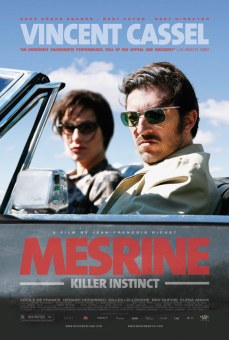
Mesrine Killer InstinctIt’s common to attribute all the attributes of high-octane, adrenaline-pumping cinema to the “Hollywood” style, as if big studios are the only entities capable of producing great action thrillers. But great classical genre films can came from anywhere in the world. Case in point: the French crime saga “Mesrine,” broken up into “Killer Instinct” (part 1) and “Public Enemy #1” (part 2).

These films may not rise to the standard of high art that normally defines my “F.I.L.M. of the Week” column, but I think it’s important to spotlight the many varieties of international cinema. Believe it or not, France has more to offer than austere Godard works or quirky Ozon films. They have people like Jean-François Richet, director of the “Mesrine” films, too! This is about as slick and thrilling as entertainment comes.

The movie makes a great showcase for Vincent Cassel, who stars as titular gangster Jacques Mesrine. After becoming disillusioned by France’s loss in the Algerian War, the ex-soldier enters the world of organized crime and quickly becomes a Pacino-like figure on the international circuit. Compared to some other recent mob movies (COUGH, “Black Mass“), Mesrine is always captivating to observe. He’s a man defined by his confidence, which earns him great success until it becomes the hubris that leads to his ruin.

When Cassel acts in English-language movies, he struggles to shed his thick French accent. That is not a knock against him, and it even served him well in “Black Swan.” But, often times, the cadences distract from the dialogue because it is so pronounced. In “Mesrine,” speaking in his native language, Cassel seems more comfortable and relaxed to act to his full capability. He sure does own the screen here.

https://www.youtube.com/watch?v=f_Ku-B5Gkws


F.I.L.M. of the Week (December 3, 2015)

3 12 2015

SightseersI must admit, I was skeptical of delving into some of the deeper cuts in director Ben Wheatley’s filmography after nodding off on two separate occasions during his cult favorite work “Kill List.” (It’s more me than the movie – I was tired both times and got further exhausted by working to understand the thick accents.) But after seeing his 2013 film “Sightseers,” I must say, I feel far more confident that I will like what I see going further back.
Funny enough, I actually saw Wheatley in person while he was promoting the film’s world premiere in Cannes back in 2012. Someone asked a question along the lines of, “What do you do while the movie plays?” Wheatley caustically responded that you could find him in a bar drinking away his nerves. Though why he would doubt that “Sightseers” could play like anything other than gangbuster escapes me. This bonkers road trip comedy is a creative, exciting blast from start to finish; as such, it’s my pick for the “F.I.L.M. of the Week.”

Alice Lowe and Steve Oram star as Carol and Chris, two lovebirds who embark on a road trip across Britain – hauling a caravan behind them, of course. Carol goes against the instructions of her well-meaning mother, who still infantilizes her at the age of 34. She’s reeling from the loss of someone special, too, and remains somewhat unstable. Though she has only dated Chris a few months, Carol seems to think he is that special someone.

That is until, of course, she realizes that he is capable of committing some intensely violent deeds while feeling very little remorse. But that does not seem to bother her. She’s along for the ride, no matter what strange turn or bizarre twist their journey takes next.

There are moments along the way when it feels like “Sightseers” will start to fall in line with some other similar movie. Yet the longer it goes on, the less it resembles something like “Bonnie and Clyde” or “Thelma and Louise.” Wheatley, working with a script by his two lead actors, manages to make a film that is wholeheartedly unique. It vibrates at such an odd comedic wavelength, mostly black but also silly and solemn in places.

Perhaps most fascinatingly, Wheatley makes sure that murder never becomes something commonplace. He presents each killing in a completely different manner, shocking us all the new and making us really think about what we are digesting. This is quite a sight to see, indeed, and I look forward to being entertained and challenged all the more by what Wheatley has to offer after “High-Rise.”


F.I.L.M. of the Week (November 26, 2015)

26 11 2015

Red Road

With the (deservedly) heightened focus on raising the profile of women directors in the film industry, one name springs to my mind among those deserving more opportunities: Andrea Arnold. If you didn’t read through all of Vulture’s 100 Women Directors Hollywood Should Be Hiring, there’s a chance you already saw her name since it falls at the beginning of the alphabet. However, you should look deeper into her imposing body of work and discover the prowess of a master.

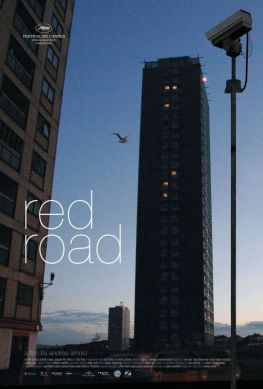
I jumped on the Andrea Arnold bandwagon after her 2010 film “Fish Tank” gave me a new vocabulary to make sense of my formative adolescent years but shamefully only just got around to her 2007 debut, “Red Road.” This sparse, tense thriller is “Rear Window” by way of “The Lives of Others” – not a bad start for a director and definitely a deserving pick for the “F.I.L.M. of the Week.”

Kate Dickie stars as CCTV operator Jackie, a woman who finds herself so lonely that she begins to internally narrativize the people she observes on her screens. But one day, she takes it a little too far after watching a man and a woman fornicating in an abandoned lot. (Don’t worry, she’s not motivated by pure perversion.) Her target is Tony Curran’s Clyde, a figure with a connection to Jackie’s painful past that she unsuccessfully attempts to bury in her mind.

To say much more would only serve to spoil the suspense Arnold builds throughout “Red Road.” But in her slow burn towards an intriguing end of the road, she gives the viewer ample time to contemplate the ethics of voyeurism and interference. And, now, it makes one wonder how she wrangled the incorrigible Shia LaBeouf for her upcoming film “American Honey.”


F.I.L.M. of the Week (November 19, 2015)

19 11 2015

Jack Goes BoatingAs I watched the climax of “The Hunger Games” series, my mind drifted away from the action on screen thanks to the presence of a fairly blatantly digitized Philip Seymour Hoffman. The resemblance was uncanny, sure, but everything about his facial expressions and mannerisms were wrong.

These pixels, as directed by someone behind a computer, went for obvious. Hoffman never went for what was expected. He always mined the ugliest parts of the soul and dredged up compellingly raw responses.

It’s a pity that he only got one chance to step behind the camera because it really showed a more sensitive, tender side than we ever saw from him. “Jack Goes Boating,” the directorial debut of Philip Seymour Hoffman, is a film of simplicity. Yet in the absence of complication comes a rushing of heart in this wonderfully touching love story.

Hoffman stars as Jack, a socially awkward but good-natured limousine driver. He’s not necessarily looking for romance, but his co-worker Clyde (John Ortiz) tries to set him up with someone. That person is Amy Ryan’s Connie, a similarly sweet woman who stands as her own greatest obstacle. (Meanwhile, little does Clyde know that trying to facilitate one relationship will put the one with his wife under duress.)

Don’t expect fireworks or cinematic bravura from “Jack Goes Boating,” but anticipate feeling unexpectedly moved as these two battered souls make their best attempt at love. Hoffman and Ryan are wholly affecting as they struggle to overcome their own personalities to make the impression and connection they so desire. It’s a real shame we did not get to see more of this vulnerable, lovable and embraceable Philip Seymour Hoffman in his all too brief lifetime.


F.I.L.M. of the Week (November 12, 2015)

12 11 2015

Boy AWe still live in a time where deeply internal, emotional performances from male screen actors are rare – especially from younger ones. Perhaps because most major roles for men are written with external, goal-driven motivations as opposed to looking within, the smart career move is to position oneself for those. But every once in a while, a miraculous turn appears.

Such is the case with “Boy A,” which features a young Andrew Garfield at his most sensitive and powerful. Before he became a household name in films like “The Social Network” and “The Amazing Spider-Man,” Garfield got a chance to get in touch with a side of himself that is seldom seen from men these days. His contemplative performance, nestled within a story that asks tough moral questions, makes this an obvious choice for my “F.I.L.M. of the Week.”

I must admit, I tried to watch “Boy A” a few years ago and turned it off after about 20 minutes. I don’t know what changed from then to now, but I am so glad I gave it a second chance. From its opening moments, I found myself riveted and drawn into the headspace of Garfield’s character, Jack Burridge. Initially, we do not quite understand why he seems unable to supersede the guilt and shame that plagues him. But we can sense the weight of the past in Jack’s every word and action, burdening him so heavily that he cannot move forward into the future.

“Boy A” doles out the specifics of Jack’s situation in a very deliberate manner. We know that he has just been released from some sort of facility and a new identity to become a productive member of society. Some flashbacks to Jack’s childhood are intercut into the action, though they pale in comparison to the information we get just from looking at his face in the present day. The raw emotion captured by director John Crowley proves nothing short of gut-wrenching to watch play out. Jack is clearly a tender, wounded soul, yet he struggles to believe he is worthy of redemption. We, the viewers, feel no such ambiguity after observing just how poignantly Garfield bares his vulnerabilities before us.

https://www.youtube.com/watch?v=1Ii_v14DNCU


F.I.L.M. of the Week (October 22, 2015)

22 10 2015

MAID_OneSheetfinalGenerally, when I read any piece of criticism that refers to a movie as some kind of “metaphor for capitalism,” I cringe inside. It usually feels like an easy fallback, a way to sound smart when they just purely enjoyed something. But in the case of Sebastián Silva’s “The Maid,” it actually applies.
My pick for the “F.I.L.M. of the Week” is a worker’s dilemma in a nutshell.  Silva, with co-writer Pedro Peirano, examine the dynamics of economic competition from the perspective of well-ensconced maid Raquel (Catalina Saavedra).  Her experience is highly personal, yet it also an excellent metaphor for what people are forced to do when efficiency trumps humanity.

Raquel has served a well-to-do Chilean family for over two decades, caring for their children and tending to their house. They have a great fondness for her, yet she also knows her place in the pecking order. After all these years, Raquel assumes a certain amount of job security, though that all changes when family matriarch Pilar decides she needs an extra set of hands around the house.

Raquel had gotten somewhat complacent and lackadaisical about her work, but this new threat jolts her into action. Knowing she needs to fight tooth and nail to keep her relatively comfortable position means the claws come out. Pilar tries out two maids to work alongside Raquel, one more seasoned and another of more spry youth. Neither is any match for the malicious attacks Raquel has in store for them as she tries to scare them off.

Somehow, Silva finds that tiny area between black comedy and borderline pathetic drama. Raquel is slightly sympathetic in her desired ends yet absolutely repulsive in her chosen means to achieve that goal. She’s ultimately only as good as the system that spawned her, one that forces her to get nasty to stay afloat.


F.I.L.M. of the Week (September 24, 2015)

24 09 2015

The epithet of “morality play” gets tossed around a lot when describing issues-based dramas – and usually in a negative connotation.  How dare a movie tell us what to believe, the undertone of their phrase rings out.  (Side note: these are often the same people who cry outrage when a film does not line up perfectly with their own worldview…)

But I believe the term can, and should, be applied positively to a movie if it offers provocative, challenging commentary on an ethical question.  Sam Raimi’s 1998 film “A Simple Plan,” my pick for the “F.I.L.M. of the Week,” offers just such an experience.  Before he offered the be-all and end-all nugget of wisdom in “Spider-Man” – Uncle Ben’s “with great power comes great responsibility” – Raimi got down in the mud with human greed.  It should come as no surprise that we often fail to live up to that infamous aforementioned maxim.

“A Simple Plan” concerns morality in the aftermath of three buddies discovering a downed plane with $4 million inside.  The trio lives in rural Minnesota where the “rich” one of the bunch, Bill Paxton’s Hank Mitchell, works as a clerk at a feed mill.  Needless to say, they could all use some extra money and are willing to contemplate the dubious decision of keeping the cash.

As they debate the right course of action, their back-and-forth tussle somewhat resembles the expressive dialogue one might find in a play.  But never does the film take on the aura of superiority that one might associate with a preaching, instructive morality play.

So what differentiates it from the pack?  Credit director Sam Raimi, who smartly emphasizes the noir-like complexity in aspects of the story’s surprising turns.  Scripter Scott B. Smith also finds a simplicity in their internal tussles that resembles a parable, like the duffel bag of money is some kind of forbidden fruit that disrupts a moral universe.  These two sensibilities may sound clashing, but they harmonize masterfully in “A Simple Plan” – no doubt aided by the performances of Paxton and Billy Bob Thornton as Jacob, Hank’s less educated sibling who harbors reserves of both resentment and nobility.


F.I.L.M. of the Week (September 17, 2015)

17 09 2015

The Edge of HeavenFatih Akin had a bit of a rough go with the film festival circuit the last time around with his Armenian genocide drama “The Cut,” which received nearly unanimous pans out of Venice.  To my surprise, the film managed to secure U.S. distribution (I had all but given up hope of ever seeing it).

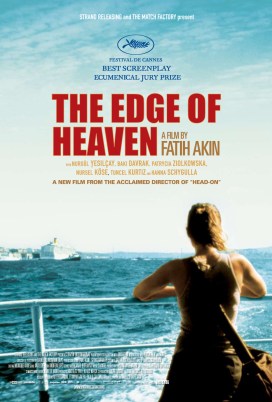
So in honor of throwback Thursday, I’ll take the “F.I.L.M. of the Week” column back to a time when Akin had much more success appealing to the festival crowds.  In 2007, his nation-hopping drama “The Edge of Heaven” took two prizes at the Cannes Film Festival and established Akin as a major name in European cinema. The film has the scope of a Soderbergh or Iñárritu multinational drama but does not aim for a grand global statement.

Instead, “The Edge of Heaven” resonates on a human scale.  Though the film jumps from Turkey to Germany and then back, the thematic focus is not on the borders that divide people.  Rather, Akin looks at the forces that unite and bind us together against the odds.  For these characters, those would be an odd combination of coincidence, missed opportunities, bad timing, and – ultimately – grief.

In its multiple segments, connected to each other by a character who appeared in another episode, “The Edge of Heaven” portrays numerous tragedies and calamities that befall people both good and bad.  There’s the tragic story of the prostitute Yeter (Nursel Köse), who just wants to help her estranged daughter Ayten (Nurgül Yeşilçay) back in her native Turkey.  But little does she know that Ayten fled Istanbul as a political dissident and seeks a country to grant her asylum.  Her quest to find a safe space ultimately draws in Ayten’s good-hearted German girlfriend Lotte (Patrycia Ziolkovska) as well as another German, Alisan (Baki Davrak), who seeks to help her as a service to Yeter.

If the web of interlocked narratives seems confusing in my verbose plot summary, it will not feel that way experiencing the nuances of story and emotion built into Akin’s script.  His is the rare film among the so-called “hyperlink cinema” trend that is more concerned with developing characters than finding ways for their paths to cross.