F.I.L.M. of the Week (April 30, 2015)

30 04 2015

A Touch of SinSadly, I missed Jia Zhangke’s “A Touch of Sin” when it screened at the 2013 Cannes Film Festival.  I caught up with the film recently from the comfort of my living room thanks to Netflix, though to just an audience of one.  What I would not give to go back and be able to experience this film with a crowd full of strangers – particularly the press screening at Cannes, which draws a diverse crowd from nations all over the globe.

The omnibus that is “A Touch of Sin” tells four stories of desperation and anger turned violent in modern China.  (And each has a real-life counterpart, to boot.)  Each explosion of rage triggers an odd mix of feelings, running the gamut from shock and disgust to schadenfreude and relief.  I would have loved to gather reactions by listening to the viewers during the screening and then stood out in the lobby to break down the responses by country.

But beyond a pseudo-social science experiment, “A Touch of Sin” still works well on an individual level.  These are not crazy vigilantes with a screw loose mentally – they are just mad as hell and not going to take it anymore.  Whether an average citizen who serves as a vocal critic of governmental abuse or a woman forced to endure constant demeaning by men, everyone has a reason for righteous anger.  Jia populates the film with a memorable cast of characters worth our attention and concern who also serve as surrogates for ourselves and the entire nation of China.

This is my pick for the “F.I.L.M. of the Week” because it manages to resonate on the personal and political wavelengths, at once specific and broad.  “A Touch of Sin” shows how the improperly, unsatisfyingly stitched social political and economic fabric of China can be ripped apart in one cathartic violent gesture.  Yet it’s easy to reimagine the action taking place in just about any country where inequalities based on wealth, power, and gender exist.  (Hint, hint, bold American filmmakers.)

https://www.youtube.com/watch?v=377D2mDpv5U


F.I.L.M. of the Week (April 23, 2015)

23 04 2015

Declaration of War

I am thankful for the arrival of the Cannes lineup every year, and not just for the great new films it promises to introduce to the world.  The official selection also serves to highlight great artists with past works that have gone unnoticed or underappreciated.  In the past, this festival has led me to encounter the cinema of the Dardennes, Andrey Zvyagintsev, Francois Ozon, and Abbas Kiarostami.  (Admittedly, these were all names I probably should have already known.)

With the 2015 edition of the festival, I am already eagerly exploring the new masters of world cinema that the Cannes programmers believe are worth our attention.  One pleasant find is Valérie Donzelli, a French actress turned director.  At this year’s festival, she will present “Marguerite & Julien” in the main competition, yet Donzelli is no stranger to the Boulevard de la Croisette.

Back in 2011, she presented her sophomore feature, “Declaration of War,” in the Critics’ Week sidebar at Cannes to wide acclaim.  Unfortunately, though, it never popped up on my radar until I was searching Donzelli’s name on Netflix after the competition announcement.  But I am glad to catch up with this remarkable film at any time, and I now absolutely count myself a fan of its director.

Donzelli tackles a decidedly unsavory topic in “Declaration of War” as two young parents grappling with their infant’s serious illness.  Yet somehow, the film manages to delight and enchant even in spite of its heavy subject matter.  Much of the success of the film stems from Donzelli’s directorial verve.  This is my pick for the “F.I.L.M. of the Week” because of her erratic, eclectic choices that adapt to meet the mood of the movie on a minute-to-minute basis.

From its opening irony of a man and a woman growing infatuated with each other at a party whose names are Romeo and Juliette to its closing nod to Truffaut’s “The 400 Blows,” Donzelli’s “Declaration of War” teems with excitement and unpredictability.  Like David O. Russell’s recent burst of work, the aesthetic changes as tonal shifts require it.  Need to convey Juliette’s trauma in the wake of devastating news regarding her son’s health?  Donzelli uses shaky cam action as she runs through the halls of the hospital.  Need to portray both Romeo and Juliette’s thoughts on an issue?  Donzelli opts for dueling voice-overs here and there.

Many directors try this mix-and-match approach, and it often results in sloppy, choppy final products.  “Declaration of War” never feels anything less than a fine-tuned, well-calibrated experience.  It conveys a poignant story rife with authentic emotion and utilizes a great deal of cinematic tools to bring that narrative to vibrant life.


F.I.L.M. of the Week (April 16, 2015)

16 04 2015

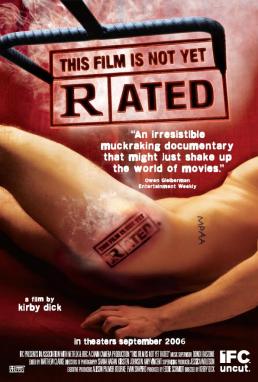
This Film Is Not Yet RatedWhen I was in eighth grade, I wrote a research paper on the controversies surrounding the MPAA and the ratings system they provide for the film industry.  As you might imagine, the sources on this topic were somewhat limited.  Much of the information I utilized came from news sites reporting on Kirby Dick’s documentary “This Film Is Not Yet Rated,” which had been released the previous fall.

It took me a few years after the paper to finally catch up with my treasured source – keep in mind, Netflix and other video streaming services were not common back in 2007 – and it did not disappoint.  Dick’s film, equal parts salacious journalism and savvy social commentary, is an urgent watch for all those who care about censorship and artistry.  By pulling back the curtain on a major force that shapes the content of cinema, Dick’s documentary is a more than deserving “F.I.L.M. of the Week.”

The film may be most famous now for the guerilla tactics employed to discern the identities of the members of the mysterious MPAA ratings board; Dick and private investigator Becky Altringer use some rather drastic techniques to get their targets.  This component of the film makes for good entertainment, sure.

But “This Film Is Not Yet Rated” is so much more than just a behind-the-scenes look at an explosive story.  Dick conducts interviews with a number of famous filmmakers who have endured notorious and public battles with the ratings agency which really serve to drive home the idea that this is an issue for everyone.  It affects our entire culture and the art it produces.  The board may claim to be reflecting the society, but they really do more to perniciously shape it.  Just watch for yourself … and hope that one day there’s a sequel.  Ten years ought to be long enough, right?!

https://www.youtube.com/watch?v=UTL3XMDwY0c


F.I.L.M of the Week (April 9, 2015)

9 04 2015

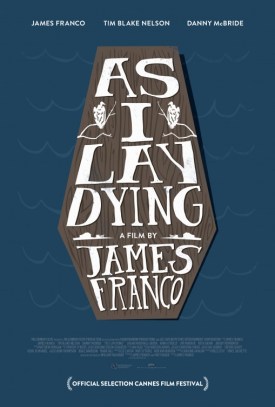
As I Lay DyingWith each passing year, it has become harder and harder not to have an opinion about the multi-hyphenate artist James Franco.  Is he a Renaissance man for our time, a master of many artistic trade?  Or is he merely an Andy Warhol, signing off on other people’s work to make it more commercially viable?  Or perhaps, is he just insane?
After the strange back-to-back pairing of “Oz the Great and Powerful” and “Spring Breakers” in early 2013, I was unsure of where to place Franco on the spectrum of genius and lunatic.  Then, I had the opportunity to hear him speak in an intimate setting at the Cannes Film Festival after seeing his “As I Lay Dying” play in Un Certain Regard (and waiting many long hours to do so), and I made up my mind.  I really think he’s a true artistic talent.

Admittedly, I have not read the William Faulkner novel on which the film is based.  And after seeing the movie, I still do not think I could provide a summary of the events that occurred and somehow make it resemble a plot.  Nonetheless, Franco turns Faulkner’s notoriously difficult prose into a fittingly challenging art film.  By finding a visual match for the author’s words, his take on “As I Lay Dying” makes for a deserving selection for my “F.I.L.M. of the Week.”

The novel, notoriously, features multiple narrators, and Franco preserves that aspect by filming those direct addresses in striking close-ups.  But such is a rather predictable choice for adapting the book for the screen, so Franco goes further and really utilizes a unique technique: split screen.  The multiple images flooding the visual field proves an effective, engaging tool to represent narrative fragmentation.  At times, the images complement each other; sometimes, they clash.  “As I Lay Dying” is Malick imagery meets Soviet montage experiments, all wrapped up in the form of a gallery installation.

This makes the story somewhat hard to follow, although I get the sense that few read Faulkner for clarity like a light beach read.  Still, I enjoyed the film on a moment by moment basis, appreciating each scene as it came.  Franco went out on a limb and really experimented with “As I Lay Dying,” a truly bold choice given the familiarity that many have with the text.  He mostly succeeds, and even when a directorial decision falls flat, it’s hard to fault the ambition behind it.  I get the feeling, too, that he might have laid the groundwork for someone to come along and create a true master work with his split screen technique.


F.I.L.M. of the Week (March 26, 2015)

26 03 2015

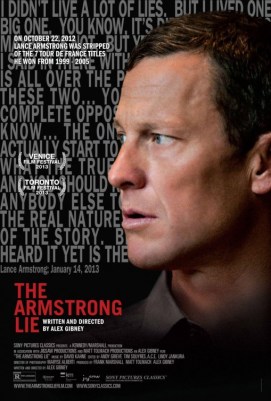
The Armstrong LieDocumentarian Alex Gibney is not only one of the most prolific directors in his field; he is also one of its most incisive.  Gibney tends to gravitate towards two extremes in his choice of subjects, macro level exposés of corrupt institutions (Enron, the Catholic Church, the U.S. military) and portraiture of fallen men (Jack Abramoff, Eliot Spitzer).  Many of his documentaries contain elements of both, but none blend them better than his 2013 work “The Armstrong Lie.”
The film plays somewhat like an ESPN “30 for 30” documentary (a series to which Gibney has contributed) yet with a killer twist.  Gibney’s initial premise for a documentary on Lance Armstrong began as an adulatory one, filming his improbable comeback with a rosy lens.  Then, a few years later, the approach changed thanks to the shocking revelation of Armstrong’s duplicity and doping.

Gibney then sits back down with the footage and examines how Armstrong was able to hoodwink him and the rest of the world.  Remarkably, Armstrong himself sits down for another interview with Gibney to bare his soul, too.  These interrogations, along with other extensive investigative reporting, constitute “The Armstrong Lie,” one of the most fascinating confessional documents ever produced.  It is my pick for the “F.I.L.M. of the Week” because Gibney puts himself in the shoes of the average viewer to tell it, trying to comprehend how we all fell victim to his deception.

As it turns out, Armstrong is basically the sporting world’s incarnation of Jordan Belfort from “The Wolf of Wall Street.”  He cheated with performance-enhancing drugs since the beginning of his remarkable run of Tour de France victories and essentially brought about his own demise with a cocky “victory lap” in 2009.  The sport of cycling needed a celebrity figure to drive interest, so the authorities looked the other way and became complicit in his scheme because they wanted him to be real.  As Armstrong says in the film, “It pays to believe in winning at all costs.”

Lance Armstrong’s story ultimately becomes a sort of microcosm for society as a whole.  He is just the latest hubristic male leader for whom power does not beget responsibility to a higher standard but rather rapacious recklessness.  Armstrong’s actions never take into account the potential effect on cancer patients, cycling fanatics, or anyone at all who ever looked to him as a symbol of hope and perseverance.  “The Armstrong Lie” does feel somewhat incomplete because Gibney assembled it in the immediate wake of Armstrong’s admissions, although it could definitely lend itself to a sequel to see if Armstrong has actually learned a lesson.


F.I.L.M. of the Week (March 19, 2015)

19 03 2015

The Jarecki family features two prominent documentarians; recently, Eugene has been the more active of the brothers.  His acclaimed 2012 film “The House I Live In” sparked some debate around the topic of mass incarceration in America.  But, all of a sudden, Andrew Jarecki has arrived with his HBO series “The Jinx” that left the entertainment page and flew onto the front page.

Andrew flew under the radar for the past decade or so, although he is the only brother with an Oscar nomination.  He achieved that feat for his 2003 feature “Capturing the Friedmans,” another documentary centered around a monstrous criminal spawned by a well-off but unusual family.  Unlike “The Jinx,” where Jarecki consciously sought to make a judgment about his subject, he stays hands-off here.

“Capturing the Friedmans” is my pick for the “F.I.L.M. of the Week” because of this observational, judgment-free style.  Though Arnold Friedman and his son, Jesse, were charged and convicted of possessing child pornography and sexually abusing minors, Jarecki never treats them as subhuman.  In fact, he even extends them the benefit of the doubt as to whether they committed these acts in the first place.  No physical evidence was ever uncovered, so the case came down to the word of the children against the word of the Friedmans.

Jarecki manages to get some of the most personal, frank testimony from the participants in the story, especially those in the Friedman family themselves.  When the state brings charges against Arnold and Jesse, the matriarch and her other two sons hardly react in a conventionally supportive matter.  Home video recorded from the time of the legal action shows their bitter disintegration as a family unit, and the interviews shed light on why it all unraveled so easily.

As it turns out, the abuse goes farther back than just the assaults Arnold and Jesse reportedly committed in their basement to children signed up for a computer class.  (Horrifying and sickening, if it’s true.)  But by highlighting the legacy of sexual dysfunction that led up to deeds which resulted in two prison sentences, Jarecki never seems like he is attempting to excuse or apologize for the Friedman men.  In “Capturing the Friedmans,” he achieves just what his title indicates: nailing them down in their very essence to allow a greater understanding of how they could have done what they did.


F.I.L.M. of the Week (March 12, 2015)

12 03 2015

Often times, the genres “action” and “adventure” get grouped together with a hyphen or a slash mark as if they were interchangeable terms.  It seems that not too long ago, Hollywood pumped out both kinds of movies in relatively equal measure.  Now, with the seemingly unstoppable rise of the comic book adaptation, action films have shoved out all the more epic, ambitious adventures.

Joachim Rønning and Espen Sandberg’s “Kon-Tiki,” on the other hand, serves as a potent reminder of just how captivating a real adventure is when done well.  It’s no surprise that Disney has quickly scooped up the directing duo to steer the “Pirates of the Caribbean” franchise back into safer waters. Rønning and Sandberg’s knack for balancing exciting storytelling and impressive set pieces makes their work a more than deserving pick for my “F.I.L.M. of the Week.”

The movie follows the simple yet truly extraordinary of Thor Heyerdal, an anthropologist whose ethnographic research on Polynesia suggests Peruvians settled on the island from the west.  His theory receives dismissal from the academic community, which suggests that such a feat was impossible with their lack of technology.  Thor, rather than giving up or just yelling, decides to disprove his detractors by sailing from Peru to Polynesia on a raft built only with the materials at the disposal of the settlers.

Thor, along with an eclectic crew of sailors and explorers, embark on a perilous, foolish, and admirable quest on the high seas that sees them facing down some of nature’s most dangerous foes.  All the while, “Kon-Tiki” makes for a refreshing movie to watch simply because it thrills without the weight of Hollywood star iconography.  Without the baggage brought to the film by well-known actors necessary to sell a film like this at a studio, we can really get to know the characters, not just analyze them in light of what we already know about the person playing them.

“Kon-Tiki” is the kind of movie that aims to do little more than entertain, but it achieves that aim without devolving into mindlessness or artlessness.  Rønning and Sandberg do not aim to leave any big questions, although I had one at the end: how did a movie with only a few lines of non-English dialogue manage to pull of an Oscar nomination for Best Foreign Language Film?!

https://www.youtube.com/watch?v=97XrASFPhF0


F.I.L.M. of the Week (March 5, 2015)

5 03 2015

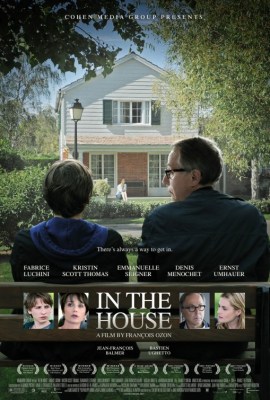
In the HouseFrançois Ozon made a big splash in 2003 with his film “Swimming Pool,” which follows the exploits of a novelist pulling generously from real life to write her next book.  A decade later, he circles back to the same themes with his adaptation of “In the House.”  It hardly feels like a rerun, however.

Ozon, here, concerns himself with the ethical position of the observer watching actuality being warped into literary fantasy.  This thrilling, dramatic work earns my nod for the “F.I.L.M. of the Week” because of the way it raises fascinating questions about the challenges and conundrums faced by all who write fictional tales.  While Ozon stops short of making the voyeuristic audience feel that moral weight, “In the House” nonetheless excites and enchants with its intellectual interrogations.

The film plays out as a serialized drama refracted through the experience of a teenage boy, the inquisitive student Claude (Ernest Umhauer).  His incisive description of the inner workings and desires of the real, banal middle-class home belonging to his socially awkward classmate Rapha Artole proves tantalizing to Claude’s teacher, washed-up writer Germain Germain (Fabrice Luchini).  Germain wants to develop and hone his pupil’s writing skills, so he begins to tutor him privately in order to discuss his compositions.

But Germain also pushes him to take surprising actions in his dealings with the Artoles to make Claude’s writing more daring in tone and content.  Thus, the always teetering fulcrum between art reflecting life and life reflecting art begins to fluctuate so rapidly that any distinction between the directionality become inpossible to discern.  Germain essentially turns Claude into a narrative Rumpelstiltskin, exploiting the beauty of the mundane for textual gold and personal gain.

“In the House” excellently illuminates the problems of narrativizing life as it plays out as well as how the writing of life ex post facto clouds and ruins the living of it.  Ozon’s smart plotting and direction makes these quandaries not only intriguing to mull over but also truly riveting to watch in action.


F.I.L.M. of the Week (February 26, 2015)

26 02 2015

As it turns out, Kevin Spacey has been training to play the role of his life, Frank Underwood, for decades now.  Back in 1995, he starred in “Swimming with Sharks,” a biting satirization of Hollywood’s corporate culture.  But, rest assured, there are no résumé requirements necessary to enjoy the film since it so perfectly captures the experience of working for a hellacious boss.  Writer/director George Huang manages the balance of the specific and the generalizable so well that his debut feature earns my nod for the “F.I.L.M. of the Week.”

This film saw release long before Meryl Streep’s Miranda Priestly cast an icy spell over the hot summer moviegoing scene in “The Devil Wears Prada,” and it even predates Spacey’s later turn as a sadistic slavedriver executive in “Horrible Bosses.”  Yet even in spite of the proliferation of the archetype, “Swimming with Sharks” still entertains and enlightens with its valid criticisms of the Hollywood system.

The subject of the film is not Spacey’s bag of hot air masquerading around in a fancy suit, Buddy Ackerman, though.  The events of “Swimming with Sharks” are seen and felt through his latest poor assistant, aptly named Guy (Frank Whaley), who has to endure constant harassment and humiliation until he amasses enough experience to move up in the business.  Buddy boasts all the pedantry and pettiness of Jeremy Piven’s Ari Gold from “Entourage,” although he appears relatively lacking in creativity and productivity to earn the rights to be such a jerk.

What inevitably follows comes with a strange mixture of pity, rage, schadenfreude, and even a little bit of surprising empathy.  Even within the confines of a fairly familiar story, Huang makes his everyman worth rooting for by stacking the odds heavily against him – as well as pitting him against a particularly devilish superior.  Spacey knows how to be scarily threatening with his words, and he also knows how to be scarily vulnerable with his emotions when the time comes.


F.I.L.M. of the Week (February 19, 2015)

19 02 2015

The Imposter

“For as long as I could remember, I wanted to be someone else.”  So begins Frederic Bourdain, the narrator of Bart Layton’s documentary, “The Imposter.”  The line may seem commonplace, but it sets the stage for a rich exploration of identity – inherited, assumed, and forged.

Here is a case where the truth is not only stranger than fiction, as the old adage goes. “The Imposter” is also more interesting and compelling than many scripted narrative films these days, thus making it a more than deserving choice for my “F.I.L.M. of the Week.”  Bourdain uses one real story to illuminate the human proclivity for deception on a much grander scale, showing the way we bury secrets through buying into our own lies.

In 1990s Texas, 13-year-old Nicholas Barclay disappears.  Three years later, he mysteriously reappears in Spain.  It’s rare to find a missing child alive years after disappearance … and even more uncommon to find that child in another country.  If the documentary sounds like a first cousin of the Clint Eastwood-Angelina Jolie film “Changeling,” the similarities end past the logline.

As the title implies, “The Imposter” is about someone pretending to be Nicholas Barclay – in this case, Frederic Bourdain.  A bum looking for any path to a better life, he falls short of a criminal mastermind, though he certainly knows how to exploit loopholes and alleyways in a lazy bureaucracy.  Somehow, he manages to circumvent each and every safeguard that should have exposed his act.

Since the film’s title makes direct reference to his deception, the through-line of suspense is the anticipation of the moment when his house of cards tumbles.  Yet just when the jig seems up for Bourdain, “The Imposter” takes one heck of a surprising turn.  Perhaps there is not only one talented artist of concealment in the film.  I’ll stop talking now, lest I spoil this gripping, entertaining, and enlightening film.


F.I.L.M. of the Week (February 12, 2015)

12 02 2015

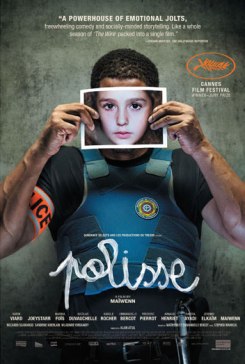
PolisseIn most stories about a workplace, colleagues become friends only with the greatest reluctance.  (Think “The Office.”)  The French film “Polisse,” however, shows co-workers in the Child Protection Unit who are so cordial that they could pass for a family.  When they eat lunch together, their conversations ring with an uncommon knowledge of and comfort with each other.
Writer/director Maïwenn makes these bonds and relationships formed in the line of duty the real subject of her story instead of the horrendous crimes against minors they have to investigate.  Sure, the film shows plenty of heartbreaking tales from the French underclass, and the woe of the children harmed feels distinctly real since Maïwenn based the script off of actual cases. “Polisse” is my pick for the “F.I.L.M. of the Week,” though, not because of the pity and disgust their cases generate but rather because of the familiarity it creates with its expansive ensemble of characters.

The children and their abusers are usually the subject when it comes to narratives like these, so Maïwenn provides a refreshing change of page by focusing on the effects of an oft-overlooked party.  There is no sense that the events of “Polisse” are anything particularly extraordinary, yet even so, they take a tremendous toll on the police unit.  No one seems capable of simply leaving their work in the office itself, and dealing with some of the worst in humanity tends to bring out the worst in them in their personal lives.

Maybe a certain kind of person is just naturally drawn to this line of work, but Maïwenn definitely suggests that their private dysfunction corresponds to their vocational hazards.  For proof, look no further than the photographer who joins the unit to document their job.  She begins as an outsider, clearly separate from the rest of the group as she timidly observes their collegial mingling.  Yet after a few harrowing experiences, she becomes one of them.  This seemingly natural proclivity for solidarity, even in the apparent absence of human kindness, provides a reassuring glimmer of hope in “Polisse” that shines brightly through the bleakness.


F.I.L.M. of the Week (February 5, 2015)

5 02 2015

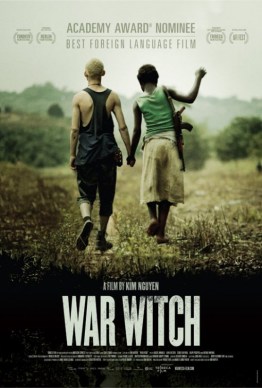
War WitchMany harrowing stories of child soldiers in Africa have found expression in art, exposing many Westerners to the ravages of the continent’s civil wars.  Few strike such a powerful and resonant emotional chord as Kim Nguyen’s “War Witch,” though.  This was one of the Academy’s five nominees for Best Foreign Language Film in 2012, and it is also my pick for the “F.I.L.M. of the Week” for the way it elevates discourse on its subject matter beyond victimization for the characters and easy pity for the audience.

Nguyen’s film, which he also wrote, tracks three years in the life of adolescent Komona (Rachel Mwanza, in a stunning debut performance) in sub-Saharan Africa.  Or, rather, Komona recounts them herself in a heartbreaking address to her unborn child.  When she foregrounds her life by stating, “I don’t know if God will give me the strength to love you,” Komona’s disembodied voice sets the stage for the depiction of some true horrors.

“War Witch” does not these nightmarish events in body count or in flowing carnage, however.  Nguyen shows his interest lies in exploring the emotional damage inflicted by the atrocities of war.  This is observable as early as the first time rebels force Komona to kill someone.  When she pulls the trigger, the camera stays fixated on her face alone.  If the film affords any attention at all to the life she took, it would be a hurried and unclear shot of the body as Komona runs away from it.

The movie mostly remains at that same level of anguish and distress, though Nguyen does allow for a few beautiful, tender moments.  “War Witch” is not about mysticism, but it finds a way to naturally incorporate its presence and influence into the proceedings.  The rebel leaders declare Komona, the improbable last person living from her village, a “war witch” since only the supernatural could explain her survival.  That status attracts the fondness of a young boy, the group’s “magician,” and his affection helps restore a small bit of hope for humanity.

But, sadly, “War Witch” is not a tender romance.  It is a film about the abominations of war, which Nguyen artistically renders with a sense of surrealism.  Often times, he takes away the soundtrack to a brutal act, simply leaving the image of what it is and nothing more.  Komona commits, and is often party to, these violent deeds, although she also suffers great losses because of them.  Her internal torment over these conflicting roles proves far more gut-wrenching than any other traumatic occurence in the movie (and “War Witch” has plenty of those to spare).


F.I.L.M. of the Week (January 29, 2015)

29 01 2015

FreewayI would count myself a big fan of actress Reese Witherspoon (see my personal anecdotes on my middle school crush in Random Factoids #49 and #88), yet I somehow managed to only learn of the existence of “Freeway” in 2015.  This film stars a younger Witherspoon as Vanessa Lutz, the daughter of a prostitute who has to do and say some unmentionables in the name of self-preservation and survival in a gritty urban environment.  She goes to prison, not to visit a client like Elle Woods but actually as an inmate.
This 1996 oddity might not fit Witherspoon’s squeaky-clean sweet Southern belle image, but it certainly gives her something out of the ordinary.  This modern retelling of the Little Red Riding Hood fairytale is a peculiar burst of energy from writer/director Matthew Bright, who has since done relatively little of note.  But his debut feature is my pick for the “F.I.L.M. of the Week” because it never holds back in its peculiar assessment of American culture as seen from the vantage point of its underbelly.

Witherspoon quickly asserts her pluckiness in “Freeway,” chaining up her social worker in order to seek refuge from her long-last grandmother.  On the way, however, she gets drawn into the clutches of the conniving serial killer Bob Wolverton.  Keifer Sutherland plays his wolf not as big and bad, but rather as eerily unsettling and deceptively meek.  (That was basically the mold of the ’90s murderer, so it makes sense.)

Somewhere on the path to grandmother’s house, “Freeway” changes up the script.  The film’s Little Red takes a step into the big leagues by gaining a welcome sense of agency, taking the film on an unexpected detour into courtrooms, prisons, and a trial by media.  The changes ought to prompt some stimulating discussion about what is and is not still relevant from the old tale.  By transplanting Little Red Riding Hood into modern society, rather than simply tweaking her story in a mythic milieu like “Into the Woods,” “Freeway” invites a freer dialogue.

Interestingly, when I went back to read reviews from the time of release, most critics reacted to the film as a satire.  “Freeway” still maintains a sense of exaggeration, sure, but it has lost a bit of shock after years of reality TV highlighting such unique specimens as Honey Boo-Boo, the Jersey Shore, and the Duck Dynasty family.  Nearly two decades after its Sundance premiere, though, its gentle mockery of the strange corners of America still entertains and excites.  Much of the film’s bite today comes from Witherspoon, who once again seems willing to explore these rough edges of her persona in “Wild” and beyond.


F.I.L.M. of the Week (January 22, 2015)

22 01 2015

The Sundance Film Festival arrives, like clockwork, at the beginning of each year to inject a fresh bit of hope into our outlook for the upcoming year in film.  While we tire of the year’s awards season crop, the system begins to harvest its plants to bloom over the months to come.  The festival is great at providing two specific kinds of films: discoveries of major new talents from completely out of the blue, and surprising indie turns from well-known stars.  (Without said talent, the films would never be able to receive any financing.)

“Kill Your Darlings” falls into the latter camp.  This 2013 film was a big step in Daniel Radcliffe’s career reinvention – or at least a full-fledged turn of the page – from only being recognized as Harry Potter.  He stars as a young Allen Ginsberg, far before “Howl” brought the beat poet into censorship as well as the national spotlight.

John Krokidas’ debut feature is so much more than just a showcase for Radcliffe’s talent, though.  It is my pick for the “F.I.L.M. of the Week” because it tells a compelling, human story that just happens to be about a renowned poet.  His script, co-written with Austin Bunn, never veers into the realm of becoming a portrait gallery for the nascent counterculture movement.  Sure, there are appearances by William Burroughs (Ben Foster) and Jack Kerouac (Jack Huston), but the script never loses sight of who they are as people.

“Kill Your Darlings” does not feel the need for reverence to the towering legacy of a figure, an advantage the film is able to possess in part because it takes place before Ginsberg and his pals went supernova.  The plot begins with a young Ginsberg entering Columbia in 1943, where he quickly bristles with the established order and the canonized poets.  Radcliffe’s performance teems with self-discovery and fully realizes the awakening of an artist; perhaps there is a meta connection responsible for

Yet Radcliffe is not even the movie’s scene-stealing performer.  That honor goes to Dane DeHaan, star of “Chronicle” and “The Place Beyond the Pines,” who has really begun to build a formidable résumé.  He plays livewire Lucien Carr, an obstreperous rebel.  He takes Ginsberg from a student merely curious about the iconoclasm of Walt Whitman into a full bohemian beatnik.  Lucien also lures him into a love triangle with an older outsider, Michael C. Hall’s David Kammerer, that turns bloody and forces Ginsberg to make a tough ethical decision.

“Kill Your Darlings” is part biopic, part drama, part thriller, and part exploration of an artistic movement’s birth pangs.  All these elements cohere marvelously into one wholly satisfying film.  It is one heck of a debut for Krokidas, and it makes a great case for Radcliffe and DeHaan to receive some meaty roles in the feature.


F.I.L.M. of the Week (January 15, 2015)

15 01 2015

Layout 1In the wake of the Charlie Hebdo shootings in Paris, the world once again finds itself in a place of anger and fear towards the Islamic faith because of a few violent radicals.  So often, the media tends to “otherize” these jihadists, completely denying them any shred of humanity because of their barbaric acts.  Needless to say, any detailed attempt to actually understand why they do these things is totally off the table.

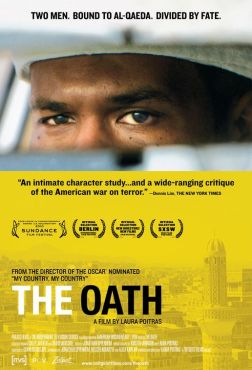
Thank goodness, though, for documentarians like Laura Poitras (who now seems almost destined to win the Oscar for her courageous and journalistic “Citizenfour“).  She dares to search inside the hearts and minds of the people often made out to be the enemy, simply portraying them for who they are without taking a judgmental stance.  Her second feature, “The Oath,” takes a long look at al-Qaeda operatists in Yemen.

Watching the film does not require sympathy with the terrorists.  Poitras simply asks that they not be deemed savages without hearing their worldview.  “The Oath” is my choice for the “F.I.L.M. of the Week” for the way it puts a human face on jihadists and Islamic fundamentalists, going beyond their violent suicide attacks.  Possessing an understanding of them based in knowledge rather than in fear and hatred can only elevate policy discussion, right?

Poitras focuses most of her attention on Nasser Al-Bahri, also known as Abu Jandal.  By day, Abu Jandal is a taxi driver in San’a.  Off the streets, however, he trains the next generation of jihadists.  As he explains, “We don’t need everyone working in TNT and C4,” and his gift of switching the primacy of mens’ paths from men to Allah makes him too valuable an asset to sacrifice.  He spreads awareness of why al Qaeda attacked, yet he is no longer actively involved in the prior planning or subsequent justifying of such attacks.

Abu Jandal is decidedly against America and the West, but Poitras does not hesitate the highlight the complexities of his background and character.  Prior to the events shown in the film, Abu Jandal had served as a bodyguard to Osama bin Laden himself.  Yet when he saw the events of 9/11, he reacted with shock and dismay.  Imprisoned at the time, Abu Jandal decided to share his knowledge with the American authorities and provided enough valuable intelligence to justify delaying an invasion of Afghanistan.

Meanwhile, Poitras also details the trial of Abu Jandal’s former companion, Salim Hamdan, who faces trial of questionable ethics in Guantanamo.  These scenes are colder and less intimate than the main narrative, playing like a classic political exposé documentary.  Nonetheless, the storylines still pair well with each other.

In “The Oath,” the subjects are neither lionized nor demonized.  Poitras simply allows to speak freely and openly about their beliefs without having to assume a defensive tone.  This is an opportunity to learn and listen like few others ever presented.

https://www.youtube.com/watch?v=XFXLhJWDMXc