REVIEW: Julieta

3 02 2017

julietaPedro Almodóvar is a master of the modern melodrama, but his latest film “Julieta” falls well below the high-water mark of prior masterworks like “All About My Mother” or “Talk to Her.” The work is technically proficient, per usual, but emotionally empty. Almodóvar gives some early hints of Hitchockian style, but they all pass sadly without consummation.

This tale of a woebegone middle-aged woman, Emma Suárez’s Julieta, as she recounts the events that led her to such a sorry state lacks any sense of stakes or dramatic tension. Almodóvar adapted the film from an Alice Munro short story, so “Julieta” does not pass without commentary about the limited roles available to women in society as well as the stifling expectations placed upon them. Julieta grapples with an unfaithful husband, an ailing mother and a daughter who grows further apart from her following a misunderstood tragedy.

Almodóvar’s observations hardly count as subversive or worthy of feature-length consideration, however. Most of “Julieta” contains elements we have seen before – and better. I had been meaning to rewatch Almodóvar’s films like “Volver” and “Broken Embraces” to complement the viewing of “Julieta.” Perhaps I should have watched them instead of “Julieta.” C+2stars


F.I.L.M. of the Week (February 2, 2017)

2 02 2017

impolexAn oft-cited dictum of Karl Marx states, “History repeats itself – first as tragedy, then as farce.” There’s a pervasive sense that living through our current time is like watching the horrors of the 1930s and ’40s refracted through a funhouse mirror, albeit with the “fun” sorely missing. By accident, Alex Ross Perry’s debut feature “Impolex” seems perfectly positioned to capitalize on the moment.

The film supposedly takes inspiration from Thomas Pynchon’s postmodern classic “Gravity’s Rainbow” (I use qualifiers because I have not read the novel). Its protagonist, American soldier Tyrone (Riley O’Bryan) lugs German rockets around the forest after the end of World War II. He follows seemingly no clear path and shares episodic encounters with everyone from an escaped prisoner to a pirate and even a talking octopus. It’s an ambling journey where each step does not seem to build on or relate to each other, in part because Tyrone is extremely malleable to the message conveyed by the people he meets. He struggles mightily inside to also hold onto some vestige of his own personality amidst these encounters.

None of this makes sense. And yet, not making sense makes perfect sense. This pick for “F.I.L.M. of the Week” feels like a sketched line from the post-war existentialist dread to our present post-truth anxiety. Even if certain moments lack some spark or some scenes drag on, this thunderous 73-minute debut from Perry showcases his deep understanding of the psychological underpinnings of the film. “Impolex” marks a scrappy debut from a writer/director whose literary ambitions have informed some of the decade’s more audacious pieces of American independent cinema.


REVIEW: Oklahoma City

1 02 2017

oklahoma-citySundance Film Festival

Barak Goodman’s “Oklahoma City” draws a line between Timothy McVeigh’s 1995 bombing of the Alfred P. Murrah Federal Building and the country’s burgeoning white supremacist movement. Long before they came to prominence in the 2016 election cycle, these reactionaries sought to recast government opposition to their far-right ideology as an attack on guns and religion. Goodman cross-cuts between the carnage of the attack and the increasingly radical movement, ultimately concluding that McVeigh failed because he put a human face on attacking the government.

Did he, though?

“Oklahoma City” is effective when connecting 1995 to the decades of militant white nationalism that preceded it, yet Goodman bungles the documentary’s relevance to the present. The upbeat ending downplays their continuing, disturbing strength. Goodman did not need to put a call to action on the closing credits redirecting viewers to the Southern Poverty Law Center’s hate groups registry. However, some acknowledgement that Oklahoma City represents the close of the chapter rather than the end of the book seems necessary.

As documentaries like “Welcome to Leith” and our literal every day life show us, white nationalism is far from done. It’s still here and scarier than ever. Now the onus is on us to understand it and defeat its hatefulness from overtaking our pluralistic, inclusive society. B2halfstars

NOTE: Portions of this review ran in my coverage of the Sundance Film Festival for Movie Mezzanine.


REVIEW: Kubo and the Two Strings

13 01 2017

It brings me no joy to make categorical distinctions like this … but I just don’t think the storytelling of Laika Entertainment is just not for me. First “Coraline,” then “ParaNorman, ” and now “Kubo and the Two Strings” have all left me grasping at straws and wanting for more. Dazzling and creative as their animation might look, the narratives and the emotions never have much of a hook.

Travis Knight’s film boasts a fairly common hero’s journey-style narrative, as the scrappy titular character goes on a search for magic armor that will fend off the evil spirits that hunt him down. Turns out, Kubo belongs to a fraught family tree where his main pursuers are actually his grandfather the Moon King (voice of Ralph Fiennes) and his aunts, the Sariatu Sisters (voice of Rooney Mara). Along the way, he must band together with allies who have been reincarnated as animals – his mother as a monkey (voice of Charlize Theron) and a beetle with a connection to Kubo’s deceased father (voice of Matthew McConaughey).

I’d rather not go too much into plot summary, which is admittedly all I have in the absence of any strong feelings one way or the other. To blather on and on about how impressive the stop-motion animation was can serve no good. These are admittedly among the hardest reviews to write: the ones where I just felt entirely neutral. Especially when everyone else seems to love it, but that’s reacting to reactions rather than the movie. Guess I’ll just continue in my position on the outside looking in at Laika love. C+2stars


F.I.L.M. of the Week (January 12, 2017)

12 01 2017

it-felt-like-loveAs anyone who has taken an introductory-level film theory class can tell you, the camera is not just an object. It is an organism (most commonly referred to as the eye) responsive to the impulses and instincts of the person who wields it. The majority of current cinema reflects a male gaze, and the emphasis on diversifying talent sadly does not seem to be taking strides – a new report released this week shows that female filmmakers lost ground in 2016.

But outside the mainstream, there are some voices and visions who need to be amplified. One such talent is writer/director Eliza Hittman, whose feature debut “It Felt Like Love” only recently came to my attention as I did research on filmmakers presenting their newest films at this year’s Sundance Film Festival. It’s a shame that this film got buried because Hittman’s work, my choice for the “F.I.L.M. of the Week” is nothing less than transporting. She picks us up from wherever we are and puts us in the perspective of a teenage girl, Gina Piersanti’s Lila, as she tepidly steps into her role as a sexual being.

The roughly 8o minutes of the film are devoted more to Lila’s feelings than they are to any one thing that happens to her. Hittman masters conveying a female gaze, the way girls process the pleasures and pains of looking at an object and feeling rapt with emotion. There’s a special attention to the tactility of puppy love, a need to touch constantly as a display of infatuation. Lila’s tongue lacks the language that bodies trade in so fluently, and she frequently trips trying to express herself. But as she tries to impress her female friends and woo her male peers, we don’t need those words to tell the story of her anguish and confusion. We see the world through her eyes and eventually come to share in the emotions with her.


REVIEW: Live by Night

11 01 2017

A few years ago, some lawmakers courted controversy by hyping themselves up for a debt ceiling showdown with a scene from Ben Affleck’s “The Town.” In the clip shown, a character flatly states, “I need your help. I can’t tell you what it is. You can never ask me about it later. And we’re going to hurt some people.” When asked for comment, Affleck was easily able to brush it off as willful misreading; no one could accuse his film of making a pure glorification of criminal enterprise.

Yet if someone were to do a hype session with a scene from Affleck’s latest film “Live by Night” – using what scene, I have no idea – the same dodging maneuver would not be so easy. This Florida-set, Prohibition-era gangster tale feels like less of a movie and more of a fantasy realized with tens of millions of Warner Bros. dollars. Though a novel by Dennis Lehane may form its backbone, make no mistake that the only shape the film takes is the splattered vomit of its directors influences all over the screen.

One could invent an “Affleck Homage” Bingo game to liven up the experience of watching the jumbled mess. One scene might be a clear nod to Gordon Willis’ photography in “The Godfather” with heavy shadows and amber/sepia lighting. Another, a Steadicam journey through a hotel’s back corridors similar to the notorious “GoodFellas” tracking shot. But all the hat tips are masking Affleck’s true fascination in “Live by Night” – himself.

Don’t be fooled by the lack of a gratuitous shirtless shot that led to chuckles both in “The Town” and “Argo.” Affleck’s insistence on slow pushes of the camera in on his stoic face signal an obsession with the undeveloped interior life of deal-making gangster Joe Coughlin. The world around him, which involves a show of force by the KKK, proves far more interesting. Yet Affleck would rather dwell in a tormented state of displaced Boston accents, ethnic conflicts and a scenario where what we now consider to be “white people” could be victims of persecution and discrimination.

At least it’s not all bad – he pretty much gives Chris Messina, playing Coughlin’s portly henchman Dion Bartolo, free range to unleash the full range of his charm and humor. It doesn’t exactly work within the rest of “Live by Night,” but given that so little else works in the film … maybe the film should have been just all Chris Messina. C2stars


REVIEW: Don’t Breathe

10 01 2017

What separates Fede Alvarez’s “Don’t Breathe” from a standard-issue horror flick? Technical proficiency, primarily. It’s hard to watch the film and not be aware of the way sound, image and camera movement are being used to produce an aura of fear and dread. But therein lies the issue with its effectiveness: I was so cognizant of the ways in which I was being manipulated that I could never fully let the atmosphere overtake me.

At this level of critical distance, it’s easy to see the film for what it is: an average heist film, a run-of-the-mill haunted house flick and a mediocre final girl narrative. Said survivor Rocky (Jane Levy) is among a band of robbers in Detroit who preys on easy targets to make some cash. It’s a classic case of doing the wrong thing for a noble reason since Rocky’s ultimate goal is to escape from a horrible family situation – her mom’s boyfriend has a swastika tattooed on his hand – with her much younger sister.

But she and her pals meet their match when they rob a blind army veteran (Stephen Lang) whose home has its fair share of surprises. Perhaps it was my loss not to experience it as intended in the dark of a theater, but “Don’t Breathe” hardly affected my respiratory system. Alvarez clearly knows what he’s doing, though he lost me somewhat by showing what he’s doing. C+2stars


REVIEW: Miss Stevens

9 01 2017

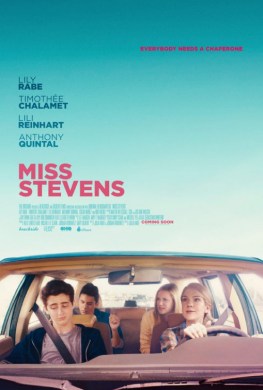
miss-stevensThere’s something about young adults staring at each other from across the chasm of their twenties that inspires odd, imbalanced and fascinating relationships. Not enough films investigate these strange connections; Julia Hart’s “Miss Stevens” joins a league that only includes Lynn Shelton’s “Laggies,” at least to my knowledge. (I’m not counting Hannah Fidell’s “A Teacher,” primarily because of the sexual dimension present there.)

I’ve seen it a bit from both sides now, as a student and as a loose authority figure of sorts while serving as an intern in youth ministry back in college. Each party wants to impress the other, obtaining their approval and then feeling connected with an age group they secretly aspire to become. They get “older,” not old; “younger,” not young.

“Miss Stevens” understands this reciprocal exchange as it plays out between its titular character Rachel Stevens, played by Lily Rabe, and her rambunctious student Billy, played by Timothée Chalamet. The script from Hart and co-writer Jordon Horowitz understands that there is something more at play in their increasingly raw, personal interactions. Rachel and Billy are old souls (they connect over the rock band America on a car ride) trapped in younger bodies, and they come to resemble inverse images of each other. While the story might not hold up towards the end, the genuine spark in their scenes never dissipates.

On a drama trip chaperoned by Rachel, a former actress herself until a politicized moment of theatrical authenticity sidelines her, she allows herself to see more of Billy than his public-facing front and blasé reputation. Though medically diagnosed with a personality disorder, he is deemed stable enough to self-medicate – a prospect that scares Rachel thoroughly. He craves opportunities to spend time with her for attention and validation, yes. But most importantly, he seeks a more mature connection than the ones he can forge with his fellow classmates on the trip. Lili Reinhart’s prim Margot is far too focused on the thespian tasks ahead for his taste, and Anthony Quintal’s openly gay Sam (who Billy fully accepts) gets fixated on the convention’s hookup culture.

I know this character, in part because I was him to some extent. Chalamet’s instincts are superb in bringing Billy to life – being smarter than the character but never letting that on while making boneheaded decisions. He resists lazy conventions of the sullen goth propagated in teen fiction, turning Billy into a beautiful set of contradictions. He’s moody, but he smiles; it’s not far-fetched to believe that he could mature into Casey Affleck, who played the adult version of his character in “Interstellar.” B2halfstars


REVIEW: Fences

8 01 2017

The measure of a successful theatrical adaptation is often how far it can distance itself from the conventions of the stage. The underlying expectation is that untethered from the limitations of sets, the suspension of disbelief, the necessity of projection, the primacy of dialogue, and so on, only then will the play will become a film. But that logic does not explain Mike Nichols’ “Who’s Afraid of Virginia Woolf?,” nor does it explain Denzel Washington’s “Fences.”

August Wilson’s play takes place in the family home and yard of Troy Maxson (Denzel Washington), a ’50s-era Pittsburgh patriarch. The concentrated location makes sense logistically for the stage to minimize scenic design costs, but it also fits thematically for a story so immediately concerned with matters of domestic concern. As Troy works through his past shortcomings, his present stagnation and his future worries for his wife Rose (Viola Davis) and children, his blustering and ruminating does not really work anywhere but his house. Opening it up to other locations or breaking up his long, aimless rambling would distill and distort the very essence of “Fences.”

August Wilson is not alive to see how Denzel Washington tended to the script he left behind (though his estate likely saw to his wishes being met), but he would almost certainly be proud to see how the essence of the theatrical experience remained in tact. “Fences” keeps the power in the word and the performance, leaving many important events shaping their current woes and strife unvisualized. We don’t need flashbacks to show us what an expert line reading can tell us, both about the event and the way its ramifications still affect even the smallest of decisions in their lives.

Read the rest of this entry »


REVIEW: A Monster Calls

7 01 2017

A generation raised post-Spielberg’s “E.T.” has come to expect a certain amount of catharsis or salvation from stories in which an unhappy child is visited by a fantastic creature. J.A. Bayona’s “A Monster Calls,” to its credit, resists a lot of the sentimentality and focuses largely on the pain that cannot be diminished or wiped away by some kind of paranormal visitation. If the film makes you cry, Bayona is certainly not there waiting a hug, tissue and reassurance.

Patrick Ness’ screenplay, adapted from his own novel, takes a deceptively familiar premise and finds creative ways to subvert our expectations. The young protagonist, Lewis MacDougall’s Conor, is “too old to be a kid, too young to be a man” yet forced to grapple with the rapidly progressing cancer of his mother (Felicity Jones). At the same time, he receives visitations from a giant talking tree (voice of Liam Neeson) who reads him what appears to be an instructive fairy tale.

But as the story progresses, unfolding before our eyes in creative animation, the true purpose is revealed. It’s a tragedy, not an inspirational fable, and the tree is preparing him for an inevitable loss. Conor’s resistance to the message illustrates the human capacity for deluding ourselves into comforting lies and delusions to shield ourselves from the pain of reality.

His worldview shifts from black and white to gray as well as from sensical to paradoxical over the course of the film, two journeys we commonly associate with the coming-of-age genre. But “A Monster Calls” dwells in the messiness, hurt and loss rather than glossing over it – often times at the cost of being traditionally satisfying or crowd-pleasing. The maturity suggests a film perhaps more aimed at adults looking with retrospection rather than children viewing with a forward glance. B+3stars


REVIEW: Under the Shadow

6 01 2017

under-the-shadowBabak Anvari’s “Under the Shadow” would make for ideal viewing in the setting of a college seminar on horror films. It’s the kind of flick where personal and political anxieties are present, well-established and easily reflected in the monster that terrorizes the film. No academic text performing a close read to perhaps stretch the significance of certain elements is necessary to appreciate the deep connection between the real and the fantastic.

In the film, Narges Rashidi’s Shideh is haunted by the specter of her own feminism in 1988 Tehran. The activism of her student years in the wake of the Iranian Cultural Revolution becomes a liability as a dean prevents her from returning to finish her medical degree after taking a leave to mother her child. As if this setback were not enough, she must also contend with a brewing war between Iran and Iraq as well as a ghost in the household. This spirit threatens to uproot her position as the providing matriarch, exacerbates her feelings of guilt for her attempts to abandon traditional caregiving role.

In its brief 83 minutes, Anvari gives too much time goes to laying the groundwork and setting the stage – not enough to actually consummating the air for horror. Without foreshadowing or a more equitable distribution of scares, the last 20 minutes of “Under the Shadow” feel like an odd addendum rather than the fulfillment of the film’s promise. In this sense, the film’s ripe-for-analysis setup becomes a liability as well as a strength. B / 2halfstars


F.I.L.M. of the Week (January 5, 2017)

5 01 2017

old-joy“Vicky Cristina Barcelona” was one of the first movies to teach me that it’s entirely possible for characters to go on a journey and end up exactly where they started from, learning nothing. It’s an ending that has really stuck with me over the years, and I always admire filmmakers with the guts to acknowledge a fundamental truth about humans. We don’t always learn, adapt or change. We often times remain stubbornly ourselves.
Kelly Reichardt’s 2006 film “Old Joy” is one such film that offers little in the way of optimism about human relationships. Two friends, careerist Mark (Daniel London) and nomadic Kurt (Will Oldham), head into the mountains to escape their lives and reconnect. They go through the motions in seeming expectation that something they see, do or experience will move them – or, at the very least, jolt them out of numbness. No such luck. Things happen, just as they do in everyday life. They are not transformed.

Meanwhile, on talk radio that’s simmering on car radios, we hear Bush-era talk about liberalism in exile and bemoaning the hopelessness of the moment. The action on screen is, of course, connected to the droning, disembodied voices. Everyone in Reichardt’s universe seems paralyzed by the seeming inability of our actions and desires to noticeably alter the reality we must face. So, in other words, no reason to dust this movie off now. Clearly just a relic of its mid-aughts moment. (*chuckle*)


REVIEW: Hidden Figures

4 01 2017

Hidden Figures” features three black female protagonists – or, rather, the film features what feels like a single protagonist with three different facets all fighting different incarnations of the same struggle. During the heat of the space race, this trio of women little known to history played a tremendous role in boosting the fortunes and morale of a nation that still treated them like second-class citizens.

The mathematical calculations of Taraji P. Henson’s Katherine Johnson helped ensure that John Glenn could orbit the earth safely, but she had to contend with institutional racism and sexism that hampered her performance. Octavia Spencer’s Dorothy Vaughn learned how to work NASA’s first IBM computer, primarily because discriminatory hiring practices prevented her from traditional professional advancement. Janelle Monáe’s Mary Jackson became one of the agency’s most brilliant engineers, although in order to do so, she had to fight segregation in the courts to get the education she needed for the job.

While Henson might get the most screen time of the three – she’s the one whose romantic interests that writers Theodore Melfi and Allison Schroeder care to develop – the film really does feel like it possesses a set of co-leads. Their day-to-day struggles might be different, as are the people keeping them from reaching their full potential. Yet together, they provide each other with the strength to tear down the limitations holding them back: first within themselves, then in their workplace, and soon enough the world.

Even as “Hidden Figures” hews closer to the sentimentality of “The Help” than the strategizing of “Selma,” the film gives specificity and definition to each character. Though their hurdles might look the same, Melfi’s direction never allows them to become flattened out or treated as one in the same. The film could have foregone many scenes so obviously built around a vamp up to a Civil Rights-era declaration of humanity, but the cumulative effect of this inspiration and representation is tough to deny. These women were owed respect in their time, not only for their work but also for all they had to do in order to perform that work. It’s wonderful that the film brings their lives into the limelight. B+3stars


REVIEW: Tower

3 01 2017

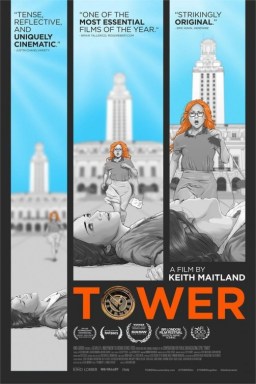
towerIt’s hard to imagine a time when mass shootings were not a regular part of our national diet as Americans. Though I was shielded from the horrors of Columbine, ever since Virginia Tech, the country feels like it’s been on a treadmill of horrors. We even have a routine that’s so predictable that it can be satirized by The Onion.
Keith Maitland’s largely animated documentary “Tower” takes us back to 1966, when a shooter’s bullet did more than cause a momentary pause along with a call for thoughts and prayers. The film takes a look at how a sniper punctured the psyche of a town from his perch atop the bell tower at the University of Texas in Austin. It’s worth noting that the documentary has nothing to do with the shooter, whose name might not even be mentioned. Certainly his motivations are never analyzed, his actions never flimsily justified or excused. This is a film about the innocents he killed, the survivors he scarred, and the campus he changed.

“Tower” makes shootings shocking again by putting us in the shoes of those who experienced the day. Through the technique of rotoscoped animation, Maitland makes archival (and a smidgen of recreated) footage and audio feel vibrant and alive. He clears away the mothballs from history, making it feel both contemporary and immediate. We connect with the panic of experiencing what it feels like when violence feels appropriately senseless and unjust – almost like having to learn about your first mass shooting once more.

I very nearly ended after that last paragraph but stopped myself before publishing. This overview of the film sounded almost unspeakably grim. While Maitland does not shy away from the darkness, his embrace of small acts of courage and monumental acts of resilience reminded me of an all-time favorite quote from Mr. Rogers: “My mother would say to me, ‘Look for the helpers. You will always find people who are helping.’ To this day, especially in times of disaster, I remember my mother’s words, and I am always comforted by realizing that there are still so many helpers — so many caring people in this world.”  B+3stars


REVIEW: A Man Called Ove

2 01 2017

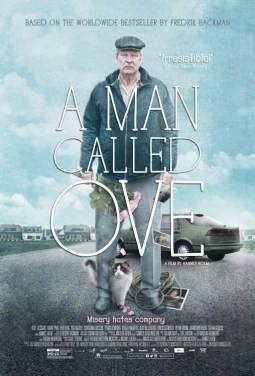
a-man-called-oveIf you are looking for a droll remake of “A Single Man” featuring a geriatric Swede … then you have very specific tastes, first off. You would also be in luck because that’s essentially what Hannes Holm’s “A Man Called Ove” is.

The titular downcast protagonist played by Rolf Lassgård is a downcast widower  who tries repeatedly to kill himself, only to end up finding more reasons to live. With his wife gone, he has few reasons to live except his job, which is of course trying to gently nudge him into retirement. He’s a model worker with an industrious devotion to his profession, and he now bemoans that “soon everyone in this country will be out to lunch.”

But the insular curmudgeon finds human connection with an immigrant from Iran, whose difficulty to adapt to local customs initially gives him a reason to get incensed. Without a workplace in which to enforce standards, he becomes a stickler for rule enforcement in his own neighborhood. Although when it comes to the kindly mother Parvaneh (Bahar Pars), Ove can step back and realize that her pain and isolation outmatches his own. The two slowly bond as he gets a new temporary lease on life.

If the beats sound familiar, that’s probably because they are. There is very little in Holm’s film that feels particularly original, especially not the forced flashbacks that provide a clear biography of the lead character. But if you just want a little bit of prickly cheer, then “A Man Called Ove” might just do the trick. B2halfstars