REVIEW: Voyage of Time

11 12 2016

voyage-of-time“As you watch these passing scenes, how does it seem to you?” This epigraph aptly sets the tone for the experience of letting Terrence Malick’s “Voyage of Time” wash over you. It’s clear that our cinematic philosopher has clear ideas about what each image means and how camera movement, shot duration and musical accompaniment can enhance that visualization. But there’s a place for us in this film. Our observations and feelings count because humans, albeit for an exceedingly brief time, are a part of this story.

Malick does not merely explain or demonstrate the journey of the universe from Big Bang to apocalyptic death. He thematizes it, expanding on the creation sequences from his 2011 film “The Tree of Life” (some images look quite familiar) but reduces them to pure form. This elemental treatment of the material frees his aesthetic from narrative, which then allows it to function something like Godfrey Reggio’s “Koyaanisqatsi” – a cinematic symphony playing in a heavenly chord.

Fans of Malick’s Texan opus will no doubt pick up on the director’s favored dialectic between the ways of nature and grace. Various stages depicted in “Voyage of Time” resemble the violence of the former and the gentleness of the latter. When humans make their appearance late in the film, his convenient gendering of the duality even resumes. Primitive early men are focused on hunting and killing, while women provide a nurturing alternative.

It’s easy to get caught up in the grandeur of the firmament as ethereally envisioned by Malick and a battalion of special effects gurus. Yet he and cinematographer Paul Atkins place as much value on the slowly batting eyelashes of a small child as they do on the vast expansion of the universe. How does it seem to me? It seems as if we are not to lose sight of the importance of our own role in the voyage of time.

And the recurring motif of a child running around the low grass in undeveloped land behind a suburban office park only serves to further reinforce this notion. As she traipses about, weeds break up through old concrete slabs long since forgotten by the people who laid them. We are given but a small chance to leave our mark on this story – are we to treat the gift of our earth with violence or gentleness? B+3stars


REVIEW: Jackie

10 12 2016

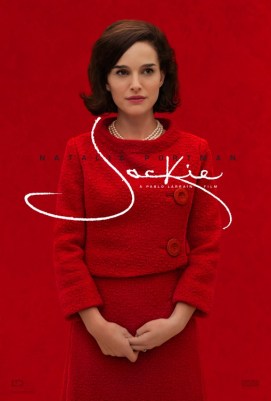
jackieNew York Film Festival

Biopics are for the fans. No matter how revisionist the narrative or inventive the form, the genre exists to privilege the audience over the subject. Instead of learning facts from a biography or textbook (but more likely Wikipedia), the biopic lures us in with a promise of approximated intimacy. It strips away the mythology built around a figure to make them more human to us.

This approach makes sense for certain subjects in narrative film, particularly those who audiences can observe with relatively little pre-existing baggage. If we know but an accomplishment here and a footnote there, a film does not have to override our assumptions. Instead, it can provide a frame of reference for us, establishing the structure by which we judge a person. (If this sounds too abstract, picture recent successful examples like “The Social Network” or “American Splendor.”)

But what about those biopics who must confront the enduring legacy of figures who loom so large in our imaginations before the first frame appears? In recent years, filmmakers have resurrected presidents, actors, musicians, inventors and more who continue to occupy space in our heads. The dominant approach has been to ignore the patina of notoriety surrounding them, opting instead to focus on our shared humanity.

These films so often fail because they forget something that Pablo Larraín’s “Jackie” does not. The mythology informs the humanity for these people. At a certain point, knowing that you lead a life that could one day be recounted in a biopic seeps into every fiber of your being. It’s not enough to go back to a time, either in childhood or pre-fame, that can connect us with them. By virtue of receiving this kind of treatment, they are different people. We all have some sense that we are performing for an audience in our daily lives, but these icons must wear their public face so much that it ultimately seeps into the consciousness of their private face.

Read the rest of this entry »


REVIEW: Miss Sloane

9 12 2016

“Lobbying is about foresight,” observes Jessica Chastain’s high-powered Washington lobbyist Liz Sloane at the outset of “Miss Sloane.” It’s a statement she delivers in direct address to the camera, practically breaking the fourth wall. Such a revelation recalls a magician movie like “The Prestige” or “Now You See Me” more than a garden-variety political thriller.

Indeed, the intrigue in “Miss Sloane” plays like an inside-the-Beltway tale of congressional arm-twisting, fundraising wizardry and reality manipulation through the media. We’re very well aware of the fact that the movie is working one step ahead of us, that another shoe is always ready to drop in the next scene. For those willing to accept that each conclusion will be overturned by a future development, the film plays like a snappy tale of intrigue.

While the heightened political gamesmanship can lead the film to some hammy acting and some soapbox script moments, “Miss Sloane” is a remarkably grounded film about the cost of principles in the sludge of the system. Chastain’s Sloane is a remarkable figure – a pro-business conservative with a George W. Bush photo on her mantle who, for a complex web of reasons, decides to take on a challenging job lobbying for common-sense gun safety measures. With a Blackberry as her third hand, she chips away at the Senate deadlock on the issue until she very nearly fractures it.

Chastain is one of the industry’s most vocal feminist activists, now working behind the scenes to put the stories about women she wants to see into the culture. “Miss Sloane” is probably her most successful work to date in this regard (perhaps excepting “Zero Dark Thirty“). The film portrays an environment controlled by crusty old white men and the effect it has on limiting the roles available to women and tailoring the expectations they set for themselves. There’s no need to declare “FEMINIST” in bold letters, much less #ImWithHer. The understanding of gender is baked into every scene of Jonathan Perera’s script.

That extends to Sloane’s final speech, a contemporary Capra monologue that coats American idealism in the appropriate cynicism of the moment. Gone are the innocent outsiders of old affecting change by holding onto their flyover-state romanticism. Instead, the film suggests, we might need someone entrenched in the slime of the Hill to bring about the will of the people. In which case, the fits of Sorkin-esque shine in “Miss Sloane” make perfect sense. B+3stars


F.I.L.M. of the Week (December 8, 2016)

8 12 2016

three-timesAfter the head-scratching experience of watch Hou Hsiao-Hsien’s “The Assassin,” which wowed me with resplendent visuals but baffled me with its labyrinthine plot, I wasn’t exactly eager to dig further back in the director’s canon – even in spite of the critical superlatives. It took a pre-show bumper card at this year’s New York Film Festival to convince me otherwise; Barry Jenkins cited Hou’s 2005 film “Three Times” as a major influence on “Moonlight.” So, naturally, I had to see what was up.
Turns out, “Three Times” is much more my style. No arcane knowledge of the Chinese wuxia genre is necessary to appreciate Hou’s craftsmanship. All it takes is some grasp of love and the frequent breakdown of communication when expressing it. This triptych of love stories between Shu Qi and Chang Chen is unique among films of its type – calling the connections between the three panels “thematic” doesn’t quite seem to grasp what Hou does here.

It’s as if the concept of love were a gemstone, and he shines a bright, pointed light at it from three different angles. Hou then delicately films the refractions, observing how this small shared moment between would-be lovers reflects back on the larger idea. The result is a tender but devastating work, one that easily rises to the level of  my “F.I.L.M. of the Week.”

In all fairness, nothing tops the first segment of the film. In 1966, a Taiwanese soldier falls for a pool-hall attendant in a reserved fashion befitting their time. They express their passion to each other in epistolary fashion, and Hou magnificently films their quiet longing as these separated sweethearts yearn to consummate their connection. When the man undertakes an arduous, patient journey to reunite, it’s nothing short of sublime.

The other two sections have their charms and insights as well, to be sure. The middle portion, a fraught relation between a courtesan and political firebrand set in 1911, is staged in the style of a silent film – title cards and all. It’s a significantly less rosy look at love, one where backgrounds and baggage play a determining factor in limiting the choices available to the lovers. This is most interesting to consider in tandem with the film’s final portion, set in then-modern 2005, where text messages inhibit the expression of desire between a rock singer and her romantic partner, a photographer.

How much or how little one wishes to draw parallels between segments seems mostly left to the viewer’s discretion; for me, “Three Times” is best appreciated as three discrete stories with a loose thread tying each together. Finding that string is important. But tugging on it too much disrupts the delicate juxtaposition.


REVIEW: Nuts!

7 12 2016

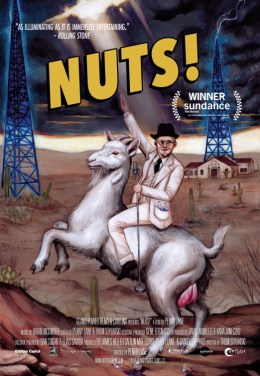
nutsFor anyone shocked by the results of November 8 who is looking for something both escapist and enlightening, “Nuts!” is your go-to movie. Penny Lane’s documentary tale of a forgotten American sensation, Dr. John Romulus Brinkley, feels too absurd to possibly be true. And yet, when you step back and consider it in light of a country that elected Donald Trump, perhaps nothing in it is all too surprising.

Think about the story this way: “Nuts!” is a Lincoln-esque rags to riches crossed with a story of a huckster rising in perfect step with a new medium of distraction and mass communication: radio. He exploited male weakness by proposing an absurd cure for impotence through the surgical transplanting of goat testes. When it appears to work, the professional class threatened by Brinkley’s ascendancy seek regulation of his media coverage.

Not to worry, though – Brinkley uses controversy to launch a media empire and brief political career. His supporters, many of whom come to him in a state of threatened and fragile masculinity, rally against elitism and federal government control when confronted with the facts about Brinkley. In his failed campaigns, Brinkley spoke to the dispossessed masses by promising a realignment of political fortunes and restacking the deck to favor his devotees. They clamor for states rights in the face of perceived cultural assault.

Sound a little familiar? The parallels are scarily uncanny, although at least the stakes are low in “Nuts!” Allow yourself to enjoy the JibJab aesthetic that Lane brings to the film, a pretty appropriately bonkers way to bring such a story to life. But don’t allow yourself to forget that history repeats itself because no one listens the first time. Listen now. B+3stars


REVIEW: Office Christmas Party

6 12 2016

As sad as it may be, if one movie from 2016 could serve as a (non-polemical) time capsule for what it was like to live in this year, that movie might be “Office Christmas Party.” From top to bottom, the film is chock full of time-specific references to technology: iCal, Uber, 3D printing, frustrating Wi-Fi. Imagine watching this in 30 years with your kids. They are likely going to ask a lot of questions about what certain terms mean.

But beyond the minutiae, very little about “Office Christmas Party” feels specifically tied to the year. Unlike television’s “The Office,” whose episodic structure dictated it ignore the ravages of time, cinema’s unique capability to provide a snapshot of a particular cultural moment has led to some invaluable representations of corporate America. Particularly in the wake of the 2008 recession, movies from “Up in the Air” to “The Company Men” to “The Internship” serve as documentation to the hopes and anxieties of the average blue-collar worker in their time.

The premise of the film seems to provide a great launchpad into some topical territory. Jennifer Aniston’s Carol Vanstone, a Miranda Priestly impersonation spiked with a Grinch attitude, rolls into the Chicago branch of her family business to announce a 40% reduction in employees and total cancellation of Christmas bonuses. There’s an initial wave of panic, anger and frustration from the managers in the office, especially from Carol’s entitled brother, branch manager Clay (T.J. Miller). But once that subsides, there’s no 2016-specific fuel to their actions, no sense of worry that the climate is unforgiving. “Office Christmas Party” could have been written at just about any time in the last 40 years and simply spruced up with current cultural products.

Read the rest of this entry »


REVIEW: The Intervention

5 12 2016

the-interventionI watched most of Clea DuVall’s “The Intervention” while working out recently – it met my qualifications for entertainment that was breezy enough without any nudity – and found myself committing a major gym foul. I had figured out exactly how the movie was working to the point where I could predict the next line of dialogue. And then, it happened. I caught myself involuntarily reciting the next line out loud. (I was right, for the record.)

This wannabe Gen X version of “The Big Chill” features indie stalwarts like Melanie Lynskey, Jason Ritter and Cobie Smulders on a weekend retreat in Savannah (likely for the tax credits) to stage an intervention in a failing marriage. But, of course, in a grouping of four couples, that one relationship is not the only one in need of some axle grease. Be it a fissure between siblings, lovers or friends, no one can escape the squabbling – including us.

Not every relationship drama needs to be an Edward Albee play, but a little bit of subtlety could have gone a long way in “The Intervention.” No fraying connection can be discovered naturally; instead, it must be laid out a scene of two characters discussing it first in whispered, vague terms. The conversation topics around the dinner table or porch seats could not be more provocative if they tried. If everyone in the film were truly as miserable as DuVall would have us believe, no one would brooch these subjects.

Naturally, the band-aid gets ripped off, opening the floodgates for the closeted resentments to spill out into open conflict. Yet once the truth comes to light, the result is neither cathartic nor enlightening. With every chance, DuVall would rather end a scene with an explosion instead of concluding it honestly or dwelling in the messy irresolution that often defines the sparring between friends and lovers. In “The Intervention,” the easy way is apparently the only way. C2stars


REVIEW: Nocturnal Animals

4 12 2016

Did I outsmart “Nocturnal Animals,” or is it just a fairly surface-level psychological thriller? Both – or neither – may be true. But the longer I sat watching Amy Adams’ Susan Morrow taking in the manuscript of her ex-husband, Jake Gyllenhaal’s Edward Sheffield, the more I wondered if this was really it.

Director and adapter Tom Ford names both Kubrick and Hitchcock as influences on the film, and it shows in his meticulous attention to the organization of the frame and the calibrated cutting between them, respectively. He deftly cross-cuts between three storylines: the events leading up to the relationship fissure between Susan and Edward, the visualization of Edward’s novel that blows up the essence of their acrimonious split into a Western revenge tale centered around the taunting and torturing of an emasculated family man, and then Susan reading the text and carrying the weight of those words through her jaded days as a Los Angeles art dealer in decline. When the biggest problem is selling the 36-year-old Gyllenhaal and 42-year-old Adams as old enough to have been split for 20 years, that’s a good sign that a lot is working correctly.

But once the connection becomes clear that the novel is a roman à clef about the effects of the divorce on Edward, the pressure mounts for “Nocturnal Animals” to do something more with its intertwined narrative. For the most part, Ford keeps it fairly straightforward. The beautiful surfaces do say so much about the characters, particularly Susan’s sterile, well-coiffed home and wardrobe that reflect the belying calm facade she presents to the world.

Read the rest of this entry »


REVIEW: White Girl

29 11 2016

white-girl2016 has been a year to debate and deflect identity like few in contemporary history. Who has it too good in America? Who still has to fight for their dignity? And who can transgress these boundaries while naively thinking they are transcending them?

The point of reference for that last question, which was not rhetorical, is Morgan Saylor’s Leah, the subject of Elizabeth Wood’s scalding social commentary in “White Girl.” This well-off Oklahoma import begins the film moving into an apartment straddling Brooklyn and Queens. It’s clearly not a problem for her to pay rent as she works as unpaid intern at a magazine, and she does not seem particularly concerned with professional development. No, Leah’s main interest is written on her necklace: “Cocaine.” (No, that is not a joke.)

She continues to flaunt her privilege around the neighborhood by crossing the traditional class barrier between drug dealer and consumer. Leah invites the street corner hustles up to her place, risking the exposure of their thin cover, to get high off their own supply. She befriends them, beguiles them … even seduces the good-hearted Blue (Brian ‘Sene’ Marc). Her pleasure is their economic livelihood; her recreation, their income. Leah can turn around one day and write off her involvement with drugs as an immature phase. If discovered, it would mark the lives of Blue and his associates forever.

Leah ultimately comes face to face with this brutal reality after a bust lands Blue behind bars – a fate that she manages to escape largely because of her own race leading the officers to presume her lack of involvement. Struck by a mixture of guilt and puppy love, she works to remedy the situation by achieving justice through the legal system. The experience sobers her up and forces her to acknowledge the presence of hierarchies of class, race and wealth that she could safely ignore while ensconced in a sheltered enclave.

Read the rest of this entry »


REVIEW: Things to Come

28 11 2016

Things to Come

“I’ve found my freedom,” Isabelle Huppert’s Nathalie flatly states about halfway through Mia Hansen-Løve’s “Things to Come.” This declaration comes about in the wake of fundamental alterations in her relationships with husband, mother and children. The phrase has never sounded so depressing.

Since older audiences are among the last reliable demographic blocs to still attend movies in theaters, we’ve seen a veritable cottage industry of AARP-approved films that celebrate the freedom that comes with advanced years. Most, such as “Hello, My Name Is Doris” or “I’ll See You In My Dreams,” carry a fun, uplifting tune about these new realities. Hansen-Løve certainly does not rule out such a fate for her protagonist in “Things to Come,” but one gets the sense that such fancy-free contentment will only come after a great internal tussle.

Nathalie begins the film assuming her biggest battle will be proving her continued commitment to the political causes which define her life and teaching. She began her adulthood as a hardcore leftist and resents accusations from striking students that she has sold out her ideals to contribute to the ruling system. They see compromise; she claims pragmatism.

Turns out, the intricacies of Rousseau, Foucault and Adorno prove the least of Nathalie’s worries after a series of small tragedies accelerates her break from the routines she so nimbly mastered. She comes to long not for harmonizing and synthesizing the philosophy she already knows; rather, Nathalie looks for God or some system of thought that can provide order to her universe once again. To find oneself in a new stage of life, one must be set adrift. Hansen-Løve lingers in the moments of uncertainty, the painful longing that occurs while wayfaring between stations. Patriotism isn’t the only context in which the phrase “freedom doesn’t come free” can apply, turns out.

Huppert settles into the rhythm of the film marvelously, emphasizing neither the journey nor the destination for her character. Natalie is such a thinker that her terrain of action is in the mind. The biggest changes take place there as she internalizes her new set of circumstances and begins to formulate plans to proceed. Huppert’s virtuosity shows in her ability to turn an intellectual proposition into an emotional voyage for the audience. With her mental process so clear, we are able to contemplate not what Nathalie registers in any given moment but rather how such a development might resonate in our own lives. A-3halfstars


REVIEW: Moana

27 11 2016

My first film in theaters, officially, was Disney’s “Pocahontas” as an impressionable young 3-year-old. But the first movie I really remember seeing was another animated gem from the Mouse House – “Hercules.” I distinctly remember the energy of the sneak preview crowd, the toe-tapping jams and the inspirational journey of a hero finding his place in a cosmic plan.

Nearly 20 years later, I found much of those same elements at work in the latest Disney animated feature, “Moana.” (It’s probably no coincidence that the two films share the same directing pair, Ron Clements and John Musker.) Both films thrive on theatricality, creativity and sincerity. Their stakes might tip towards the fate of entire civilizations, yet they never lose track of their human factor: a longing for self-actualization that unites us all.

This story of a young Hawaiian chieftess, Auli’i Cravalho’s titular character, seeking both her higher calling and salvation for the villagers that count on her shares a similar mythic dimension as “Hercules.” In a sign of evolution for the studio, though, they take the time to learn and care about the culture in which they place their narrative. From tattoos to topography and language to lore, Disney portrays Hawaii’s traditions respectfully and without exoticizing. There’s more to this Hawaii than one might gather from dinner theater at a resort, in other words.

Read the rest of this entry »


REVIEW: Allied

26 11 2016

When asked how she has kept up a ruse among Nazis in Morocco, Marion Cotillard’s Resistance agent Marianne Beauséjour offers one trick of the trade: keep the emotions real. Precision is important – and she has plenty – but the feeling matters most.

In “Allied,” director Robert Zemeckis might not be trying anything nearly as daring as the espionage mission undertaken by Marianne and her Canadian companion, Brad Pitt’s Max Vatan, yet he heeds that core dictum all the same. His Old Hollywood throwback is a classically styled delight that succeeds largely on the dynamism of the two stars. Their transition from partners in crime to partners in life is gradual, then sudden, and it works because Zemeckis creates an environment where a series of sparks can believably ignite a blaze.

The golden-age romance turns on a dime in the film’s second half when British intelligence officers inform Max of their belief that Marianne is, in fact, passing classified information back to the Nazis. At this point, “Allied” shifts registers into an old-fashioned thriller; Zemeckis masterfully deploys his craftsmanship here. Small sonic details become searing motifs that comment on the tension ratcheting up between the couple. Brisk cuts sweep us from one scene into the next, echoing the whiplash Max must feel. In both themes and content, the film feels like it shares a close kinship with Hitchcock’s early American work in the 1940s.
Read the rest of this entry »


REVIEW: Aquarius

25 11 2016

aquariusBrazilian writer/director Kleber Mendonça Filho does not stray far from home in his latest film, “Aquarius.” The setting, once again, is the coastal city of Recife – Mendonça’s place of birth as well as the backdrop for his 2012 directorial debut “Neighboring Sounds.”

Rather than providing the same kind of panoramic compendium of his prior film, Mendonça keeps his focus tight on Sonia Braga’s Clara, a retired music critic and widow occupying a piece of prime waterfront real estate. Her memories and livelihood come from the apartment in which she resides, so she naturally resists the incursions of bloodthirsty real estate developers who will do anything to scoop up the property from underneath her. “Over her dead body” is no exaggeration when it comes to Clara’s tooth-and-nail fight to hold on to her home in the building dubbed Aquarius.

Mendonça abandons the breadth of “Neighboring Sounds,” but he does not necessarily replace it with depth in “Aquarius.” Where his ensemble drama had a sociologist’s eye for the way city life and modernity acted upon different classes of people, his character study overloads on allegory and skimps on personality. Though we spend nearly two and a half hours with Clara, she never takes on much of a life beyond her tenacious battle against the rapacious capitalist scourge. Erroneous scenes that attempt to clarify her character apart from this central conflict end up contributing little to our understanding of her. Braga gives a forceful performance, to be sure, but that can only go so far with a script that never fully provides her what she needs to dazzle. B2halfstars


F.I.L.M. of the Week (November 24, 2016)

24 11 2016

meeks-cutoffWith “Certain Women,” Kelly Reichardt took a move back toward the kind of stories that made her career – the quiet routines that define and confine the lives of Pacific Northwesterners. But earlier this decade, Reichardt made some notable forays into the world of genre filmmaking with 2014’s “Night Moves,” an eco-thriller, and 2011’s “Meek’s Cutoff,” a revisionist and feminist take on the Western.

I caught the former at the 2013 London Film Festival, which forced me to abandon all ties to the outside world and dive headfirst into her carefully constructed universe. I was not so lucky to see “Meek’s Cutoff” in a theater, however, which meant years of putting off watching the film since I knew it would command so much of my attention. I stopped and started the film several times, knowing that anything that took my brain out of the experience would make the viewing a wash. When I had the chance to interview Reichardt earlier this year, I knew I could wait no longer.

Once I finally plunged myself into “Meek’s Cutoff,” my latest selection for “F.I.L.M. of the Week,” I was rewarded handsomely for my patience and attentiveness. Reichardt does not subvert genre tropes, as many revisionist filmmakers do in a self-congratulatory exhibition of their own cinematic knowledge. Rather, she inverts them, ascribing the same respect and earnestness normally accorded to heroic white men to their muted female companions and Native American guides.

Reichardt tells “Meek’s Cutoff” from a woman’s point of view, which includes making certain information obscured or downright off-limits. When the men in charge are talking, she makes things intentionally hard to hear or keeps the camera at such a distance that we cannot help but feel entirely removed from the decision making process. When Michelle Williams’ Emily Tetherow is privy to some information from her husband, Will Patton’s Solomon, she receives it in a whisper during the utter blackness of the prairie nights.

Tensions of all kinds flare on this 1840s journey along the Oregon Trail as the wagon caravan’s guide, Bruce Greenwood’s Meek, inspires doubts among the group. Amongst themselves, the settlers begin to wonder if he has intentionally led them astray to their demise. Supply begins to run as low as spirit, leading to rash decisions and some surprising assertions of authority. As survival instincts kick in, the clamor of wisdom from the women grows louder and harder to ignore. While an adjective like “thrilling” or “exciting” may not apply given the pace of Reichardt’s film, “compelling” sure does. Anyone willing to stop everything and simply live in the frame will find a textured, intelligent and unique take on the Old West.


REVIEW: Evolution

23 11 2016

evolution

Fantastic Fest, 2015

If empirical proof was needed to verify the adage that opposites attract, one could look at Lucille Hadzihalilovic’s “Evolution” – a stylistic 180° from the work of her partner, Gaspar Noë. While both are provocateurs in their own way, Noe loves to tout his virtuosity and flaunt his taboo breaking. In “Evolution,”Hadzihalilovic works in methods equally as disturbing and unnerving, yet she maintains a much more controlled temperament.

Her on-screen world is a sea of blues and greens along a waterfront town occupied only by young boys and women of maternal age. Young Nicolas begins to explore the mysteries of the island and question some of the oddities – the strange creatures in the sea, the unexplained medical treatment to which the children are subjected. As Nicolas begins the process of discovery, it is, to him, like a normal coming-of-age narrative. To his mother, however, the reaction to his inquiries takes a much stronger form.

“Evolution” keeps an even keel as it delves into the terrain of body horror and pre-adolescent malaise. But rather than foment dread, Hadzihalilovic primarily inspires ambivalence. Too many ambiguities go unexplored, which may stem from the film’s abbreviated runtime of just 81 minutes. The beautiful and oft-haunting imagery far too often are scares in search of a story. B-2halfstars