REVIEW: The BFG

28 06 2016

The BFG PosterThink back to your favorite Spielberg movie. How did it open?

Jaws” began with the shark taking its first victim. “Raiders of the Lost Ark” had our hero creeping through the forest towards an unknown bounty. “E.T” started with the titular creature evading the authorities for the first time. “Saving Private Ryan” plunges us into war with the immersive, innovative D-Day sequence. Many chide the director for choosing stories that wrap up neatly and morally, but he certainly knows how to kick things off with a bang.

So given this penchant for great beginnings, it feels more than a little disorienting when Spielberg’s latest directorial outing, “The BFG,” opens on a relative whimper. The first fifteen minutes operate as an introduction to our two main characters, young London orphan Sophie (Ruby Barnhill) and the towering “Big Friendly Giant” colloquially known as the BFG (the personage of Mark Rylance). Yet in that period, scarcely nothing comes to light about them.

We see that Sophie lurks around her orphanage unhappily in the wee hours of the morning. We can discern that the BFG quietly lurks around the streets of London, performing some unspecified action. It’s likely Sophie has sensed his presence before, and “The BFG” merely begins on the night in which they first make contact. But in order to sell her wonder and fear – or his menace – something else is needed. The first 10 pages of Melissa Matheson’s script might well have slipped out upon delivery to Spielberg. It just does not feel complete.

Without this base-level emotional entry point, “The BFG” must be experienced through the events rather than the characters. In this case, that might not be such a good thing. The film is probably Spielberg’s most sparsely plotted work since his first feature gig, 1971’s “Duel” (or, if you really want to dig deep in his archives, the most thinly plotted since the short film that provided the name for his production company, “Amblin'”). Most, if not all, of his movies thrive on a constant forward momentum that propels characters through physical, emotional and supernatural perils. “The BFG” mostly boils down to a spunky young girl exploring a new world with a timid, lovable giant who speaks as if his lines were spat out like a bad Google Translate result.

Read the rest of this entry »


REVIEW: Our Kind of Traitor

27 06 2016

Pop culture seems to be reaching a point of saturation with espionage tales, no doubt due in large part to Daniel Craig making James Bond cool again and Tom Cruise finding some new life in the “Mission: Impossible” franchise. It has also led to a revival of appreciation for British spy novelist John le Carré, whose career began in the Cold War and has stretched into the post-9/11 world.

Our Kind of Traitor,” the latest adaptation of the author’s work, comes at the tail end of a big spate from le Carré. 2011 brought the feature-length version of “Tinker Tailor Soldier Spy;” 2014 saw the release of “A Most Wanted Man;” earlier in 2016, his novel “The Night Manager” got the prestige mini-series treatment. Given what else has recently been dredged from his oeuvre, it’s hard not to see this new film as second-shelf le Carré.

For a writer whose strength lies in the grounded nature of his stories, the turn of events in “Our Kind of Traitor” is remarkably improbable. Large, bizarre narrative leaps work fine in a larger-than-life series like James Bond. This level of suspension of disbelief and stretches of plausibility feel odd and out of place in this realistic world.

The film’s protagonist, Ewan McGregor’s Perry Makepeace, just happens to be in the wrong place at the right time when he meets Stellan Skarsgard’s Dima, a Russian money launderer looking to go straight, in Marrakesh. Dima wants to get out of the criminal underworld and takes a gamble on the first Englishman he can find. And of course, the dominos just so happen to fall in a way that involves MI6 and produces a number of intriguing plot points. Susanna White’s film is an intelligence movie with fairly little intelligent craftsmanship, neither reflecting on the state of modern back-room diplomacy nor providing a particularly fun cinematic outing. C+2stars


REVIEW: The Neon Demon

26 06 2016

Many working directors can lay claim to being a “man’s director,” but few own it quite like Danish pornographer of violence (his words, not mine) and general provocateur Nicolas Winding Refn. The films that have thrust him into mainstream attention on the stage of global cinema have all centered around tough, masculine men exerting their dominance over other people and their environment. Seriously, the narrative throughline is practically flowing with testosterone.

Women, meanwhile, take backseat to these public displays of machismo. In “Drive,” Carey Mulligan’s Irene fulfills the classic archetype of damsel in distress, and Christina Hendricks’ brief appearance in the film as Blanche is far more memorable for her character’s bloody exit than anything she does. Was there a woman in “Valhalla Rising?” Honest question. “Bronson” gets a slight pass since it takes place in a single-sex prison, though the same cannot be said for “Only God Forgives,” which grants Kristin Scott Thomas’ Crystal only a mere foul-mouthed scenery chewing bit amidst a marathon of close-ups on emotionless Ryan Gosling.

In Refn’s latest film, “The Neon Demon,” women move front and center as he peers into the nasty, competitive void where one might expect to find a heart in the fashion industry. But after witnessing Refn’s misogynistic, insulting views of the opposite sex, it’s safe to say they might be better left on the sidelines in his films.

In the aforementioned Refn films, he conveys the idea of masculinity as a renewable resource. One can earn their stripes through hard work and a strong exhibition of power. As time goes by, the essence of one’s manhood can grow in size. “The Neon Demon” shows that he believes the exact opposite about women. Their chief currency, that of beauty, is finite and withering away with each passing moment. To maintain their status, women have to either cheat, steal or lie. Some can buy time for themselves by trading sexual favors with men, but what takes those girls to the top is what will also ultimately make them drop.

Read the rest of this entry »


REVIEW: The Invitation

25 06 2016

The InvitationKaryn Kusama’s “The Invitation” always feels like a well-executed genre flick, but which genre exactly? That question seems wide open. Over the course of its runtime, the film can resemble a claustrophobic domestic psychodrama, a tense thriller and a dramatic examination of guilt. The whole cult aspect of the plot is practically the most normal thing about it.

“The Invitation” unfolds as secluded couple David and Eden (Michiel Huisman and Tammy Blanchard) formally invite over some friends for a dinner party. The guest list is a multicultural melting pot, though two guests really stand out – Eden’s ex-husband Will (Logan Marshall-Green) and new girlfriend Kira (Emayatzy Corinealdi). The unspoken consequences of a past some would rather forget loom large over the proceedings, as much as they try to pretend no elephant has parked its carcass in the room.

As they raise a glass to new beginnings, it might also be the end for some of the unsuspecting visitors. David and Eden proudly yet quietly herald their new membership in a fledgling religious group. Like many such fringe groups, the leaders seem to have preyed on their vulnerable states to induce loyalty and faithfulness. And now, they proselytize with surprising normalcy.

Phil Hay and Matt Manfredi keep details about the cult scant in their script, instead focusing on the effects it has on the characters who have accepted or scoffed at it. While a jarring tonal shift in the final act somewhat belies the normalcy they so carefully establish, “The Invitation” still provides a chilling, exciting twist on a wide variety of stories. B2halfstars


REVIEW: Wiener-Dog

24 06 2016

Wiener-DogSundance Film Festival

The dachshund seems to reside among the most loved dog brands these days, no doubt due in part to how social media-friendly these pint-sized canines are. I’ve fielded a number of inquiries from friends in the past few months about the film “Wiener-Dog,” which proudly touts its four-legged star. And to each of them, I have issued a profound warning to stay away.

Writer/director Todd Solondz plays on those shared cultural feelings of fondness for wiener-dogs, and the marketing/advertising echoes such associations. But Amazon Studios and IFC just want to harness these to sell you tickets or get you to rent the movie. Solondz wields this power with a much more perverse intent. He wants to sell you a nihilistic vision of a cruel world with no sympathy or concern for even a cute dog. The wiener-dog is the vessel for drawing in the unsuspecting, the naive and the hopeful.

Most of this does not become apparent until the last of the film’s four parts (no spoilers, but stay away if animal cruelty bothers you.) Prior, “Wiener-Dog” finds some fun in its blunt, cynical assessment of life. Each section of the film, connected only by the presence of traveling dachshund Doodie, serves as a commentary on a different season of life: youth, adulthood, middle-age and, ultimately, senility. The first half, featuring lovably quirky turns from actors like Greta Gerwig and Julie Delpy, expresses Solondz’s worldview without resorting to outlandish measures.

But once the film passes its musical-filled intermission, which feels gratuitous for a 90 minute movie, things take a turn for the worse. Danny DeVito’s section about a film professor who all but gives up on life gets unbearably mopey. And when Ellen Burstyn’s Nana arrives on screen, practically in the grave, Solondz veers into a turn that feels downright mean to the audience since it is so unearned

I have my views on big existential dilemmas, and so does Todd Solondz. We can agree to disagree, as I frequently do with filmmakers, and still enjoy the work in question. I find it very hard to table my differences, however, when it comes to “Wiener-Dog.” Solondz so clearly illuminates his thoughts on the absurdity of being when he executes a shockingly beautiful pan over a heap of diarrhea or crafts a droll, deadpan line. His parting gestures abandon the nuance of his artistry in favor of shocks and screams, collapsing the film under the weight of its own pessimism. C / 2stars


F.I.L.M. of the Week (June 23, 2016)

23 06 2016

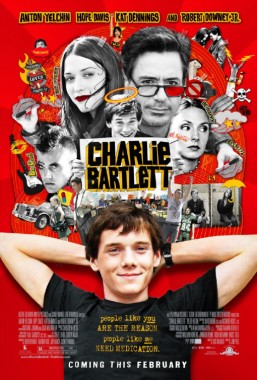
Charlie BartlettFor no apparent reason save their rapid appearance on Netflix, I’ve been devouring large quantities of turn of the millennium teen movies. While many have charmed and entertained me, most tend to fall in line and preach the same kind of message. Popularity is a sham, inner beauty is what matters, yada yada…
Then, after the tragic accident that claimed the life of Anton Yelchin, I took a detour to the mid-2000s for “Charlie Bartlett.” It was one of the actor’s first of far too few star turns, and despite my professed fandom for Yelchin, it remained a blind spot for me. That all changed within hours of learning he was no longer with us.

And wow, what a refreshing break this was – heck, is – from most high school movies. “Charlie Bartlett” tackles a key aspect of today’s youth culture that has been elided or entirely omitted from movies to date: overprescription. Though I thankfully never needed drugs to help with my mood or focus, I know plenty of people who struggled to find the right balance of medication. I also know a fair share who used those same pills for less than noble purposes. This important corrective to a whitewashed narrative makes for an ideal “F.I.L.M. of the Week.”

Yelchin’s titular character possesses a lethal combination of access to such stimulants and the brazen gall to resell them to students at his new high school. Thanks to his wealthy and largely absent mother, Charlie essentially has a family pharmacist to prescribe anything he wants. Armed with an outsized self-confidence, he settles into his role as the benevolent campus drug dealer with ease after getting largely rejected upon first foray into his latest private school.

Charlie could easily have devolved into a snarky, sniveling jerk or just become insufferable to watch as he goes more Walter White on us. But that’s not the case at all; in fact, quite the opposite occurs. Yelchin makes Charlie more humane with each passing scene as he becomes increasingly aware of the deeper psychological needs of the student body. He is always present in a scene – listening, responding and playing off the other actors. Yelchin clearly did not just memorize lines to be shot in close-up. He was there to make the other actors, and the film itself by extension, the best they could be. Here, he succeeded wildly.


REVIEW: The Fundamentals of Caring

22 06 2016

The Fundamentals of CaringSundance Film Festival

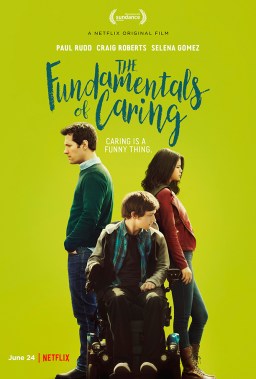
Caring. It’s what Paul Rudd’s character, Ben, gives in his profession as a caretaker for Craig Roberts’ sardonic, wheelchair-bound teenager Trevor. Ironically, it’s also what he needs personally given that his marriage has fallen apart and his aspirations as a writer have dried up.

That’s about as deep as the insights go in Rob Burnett’s “The Fundamentals of Caring.” Not to damn with faint praise – but let me damn with faint praise – the film will sit nicely on Netflix along with countless other TV-movie style dramedies. Seeing it on the streaming platform probably makes far more sense than watching it at a major film festival.

The primary joys of the film come from the bickering and bantering between Ben and Trevor. Each tries to one up each other with practical jokes that plunge into some truly black territory surrounding death and illness. Rudd dons a more melancholy hat as Ben, playing someone demonstrably more introspective than his usual acid-spitters. Roberts, quite the comedic talent in his own right, can surprisingly stand toe to toe with Rudd for laughs.

Most of the film is just the two of them (save a brief spell where Selena Gomez’s Dot joins the fun), enduring one another as Trevor tries to make Ben’s job as difficult as possible to make himself feel somewhat powerful. Burnett can find the connection in these moments but never quite gets beneath the skin for either. And that does not even change, mind you, when they take a medically risky road trip to visit some questionable American landmarks. C+2stars


REVIEW: Finding Dory

21 06 2016

I was pretty much the target audience for “Finding Nemo” as an impressionable 10-year-old cinephile when Pixar debuted the film in 2003. It was back in the time when movies could stay in theaters for months, not just weeks, and I think I saw it five times that summer before fifth grade. I was rapt by the wit, creativity and storytelling sophistication.

But, as my mom was quick to point out, the film might frustrate or confuse viewers slightly younger. With its frequent cross-cutting between the split storylines of Marlin/Dory and Nemo, the delicate back and forth is a far cry from most children’s entertainment with a singularly focus and strict linear plot.

I can only imagine how some of them reacted to the sequel, “Finding Dory,” which is so frenzied and frenetic in its storytelling that I often wondered if the Pixar brain trust was attempting to replicate the scattered mind of its memory-troubled protagonist. The film moves quite jarringly about, cramming every scene full of joke lines, plot points and sentimental reflections. It is frequently fun and enjoyable, but the tagline of the movie should have been Dory’s oft-repeated mantra, “Just keep swimming.” The film requires constant motion to keep up and stay afloat.

Still, this is a Pixar product, so it still manages to provide all the typical stirring and sweet moments that define the studio. (Even “Cars 2” had these.) As Ellen DeGeneres’ Dory fights her way through a labyrinthine aquarium unit – as well as her own mind – to find her parents, she has many an opportunity to reflect on the importance of family. This means not only where they are, but who they are; always a step or two behind are Marlin and Nemo swimming to keep up with her.

“Finding Dory” celebrates these improvised families and impromptu units, proclaiming what makes them different is what makes them beautiful. This message might ring a little more profoundly were it not cheapened by silly shenanigans like an octopus driving a truck, but I’m willing to let that one slide given that there are more clever running jokes. For example, frequently throughout “Finding Dory,” a male and female pairing will appear on screen to provide directions or information. Each offers slightly different information; they bicker; the woman wins out. In many ways, these duos provide a mirror of Marlin and Dory’s character dynamics offered up in hilarious microcosm. B2halfstars


REVIEW: The Angels’ Share

20 06 2016

The Angels' ShareDirector Ken Loach is often a polemicist more than a storyteller, and the tendency seems to get only more aggrieved with age (or the general state of the world). Lucky for us, “The Angels’ Share” marks a rare occasion where Loach takes his foot off the progressive political throttle and shifts into a more humanistic gear.

The film follows the uphill battle faced by Paul Brannigan’s Robbie, an ill-behaved chap from Glasgow who manages to narrowly avoid prison time for his misdeeds. Instead, he gets assigned community service, and the act winds up giving him the perspective to start getting his house in order. With his girlfriend recently bringing their child into the world, Robbie finds reason to walk the straight and narrow.

“The Angels’ Share” can be quite moving in these scenes centered around truth, consequences and redemption. But towards the end, the film starts to veer off course as it devolves into a chipper heist film. Robbie takes an ill-advised step in the wrong direction for the right reason, and the film follows him down the rabbit hole. The lighter tone might have worked were it not so inconsistent with the raw emotional honesty of earlier portions of the film. As such, Loach’s film comes across as messy but sincere – just like Robbie and his gang. C+2stars


REVIEW: 5 to 7

19 06 2016

5 to 7It’s going to be weird to start talking about Anton Yelchin in the past tense, but here goes … deep breath.

Among the many roles I wish Yelchin had the opportunity to play, the nebbish Woody Allen surrogate shot to the top of the list the moment I saw the beautiful, magical “5 to 7.” The actor captures all the confusion and frustration over unpleasant romantic configurations without all the nerve-inducing anxiety of someone like Jesse Eisenberg. His leading man type was the perfectly agreeable mix between matinee idol and real person.

Unlike an Allen protagonist, however, Yelchin’s Brian Bloom is a hopeless monogamist who cannot fathom the bohemian open relationship held by the object of his desire, Bérénice Marlohe’s Arielle. She’s married to a French diplomat with whom she shares two beautiful children, but between the hours of 5 and 7 P.M., she has the freedom to carry out her own romantic pursuits. That she can be so steadfastly committed to her marriage but cavalier in her affairs baffles Brian to no end.

Better yet, the relationship status marks only the surface level of differences between the two lovers explored by writer/director Victor Levin. Age, social strata and success markers provide friction to complicate the passion. Brian struggles to gain traction in the insular New York publishing world, while Arielle’s standing as the wife of an established community leader lends an air of comfort to her every action. In many ways,”5 to 7″ inverts the romantic cliché of the knight in shining armor saving the damsel in distress by having Arielle pull Brian upwards professionally.

The subtext might be nice to examine in a review, but the real pleasures of “5 to 7” come from simply taking in the film’s gently paced, wonderfully measured charms. Levin never hurries a scene, always allowing information and emotion to spring naturally from the dialogue and blocking. While clocking in at only 97 minutes, the film feels like spending years with these characters. Watching them endure the growing pains of a relationship with the additional complications of not subscribing to typical social norms makes for a delightfully witty and sincere journey. B+3stars


REVIEW: Valhalla Rising

18 06 2016

Valhalla RisingCall director Nicolas Winding Refn what you will (and I can think of a few things), but the man is never short on ambition. He has always worked to incorporate avant-garde elements into familiar genres like the prison film, the heist film and the gangster film. Each worked in varying degrees, often depending on the extent to which Refn decided to push the pre-established boundaries.

His 2010 film “Valhalla Rising,” however, might be the most purely effective of all his recent work. That’s not say it makes for the most entertaining or provocative watches. But this five-chapter tale of Norse mythology does mark his most sparse, stylistic work.

Story frequently takes a backseat to form, tone and mood, all of which Refn controls quite nimbly. The director has often called himself a pornographer of violence, and he certainly delivers the action. Yet “Valhalla Rising” does show him willing to engage in courtship, flirtation and foreplay before getting onto the hard stuff.

Of course, as is often the case with stylized exercises, the show gets old rather quickly. With little beyond the subdued fury of Mads Mikkelsen’s one-eye to carry the brutal, hallucinatory tale, “Valhalla Rising” sags under the weight of its own grand zeal to arouse. Still, it makes one wonder what Refn could produce if he went down a path even more uncommercial than this. B-2stars


REVIEW: A War

17 06 2016

A WarTo begin, Tobias Lindholm’s “A War” toggles between a father (Pilou Asbæk’s Claus Michael Pedersen) at war and the mother (Tuva Novotny’s Maria Pedersen) fighting her own battles on the homefront. It’s nothing revolutionary – not unlike an “American Sniper” that takes the time to flesh out the female character left behind with actual scenes, not just crying into the phone.

Then, a controversial incident occurs, and the film abruptly shifts gears into a courtroom drama that puts Claus on the defensive over an action he took in Afghanistan. Perhaps some of this aversion is culturally conditioned, but wow – those Danish courts are some kind of sterile. This fluorescent-lit chamber serves little function other than to recap the film’s first half, just through different perspectives. Most works that delve into legal procedure attempt to make audiences go back and forth on a character. “A War” feels content to tell them what they already know.

Lindholm underplays the entire movie, which works fine when he needs to mine a scene for authentic anguish and desperation. But it more often has the effect of making “A War” play as bland and without any kind of unique vantage point. This is particularly apparent in the film’s wartime scenes, where tension and danger seem almost entirely absent. Claus and his troops act extremely honorably, even helping a villager’s daughter repair burnt arm. Without a palpable threat, however, they feel less like soldiers and more like glorified humanitarians. C2stars


F.I.L.M. of the Week (June 16, 2016)

16 06 2016

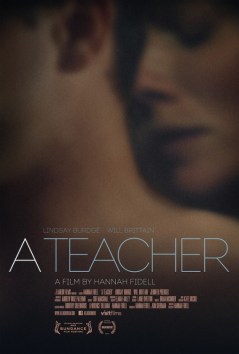
A TeacherMany people, it seems, saw the title of Hannah Fidell’s “A Teacher” and focused almost exclusively on … well, the teacher. Perhaps as they should. It’s certainly easy to get drawn into the confused, muddled mind of high school professor Diana Watts (Lindsay Burdge) given that she is having an affair with one of her students.

We’ve seen variations of the illicit sexual relationship before and quite often from the perspective of someone like Diana, a person struggling with the push and pull between inescapable guilt and undeniable passion. What we have not seen (at least not that I can recall) is something like the perspective of her pupil, Will Brittain’s Eric Tull.

Besides the obvious difference in their ages, a more subtle rift divides Diana and Eric: socioeconomic class. When they rendez-vous, she pulls up in a rundown, decades-old sedan. He cruises in with a Texas-sized truck. She goes home to a tiny apartment, which she shares with another friend. He can either go back to his palatial home or a sprawling ranch in the countryside.

Their relationship feels like it satisfies more than just a lustful teenager’s libido. Their tryst becomes rather symbolic of the kind of power wealthy students can wield over their instructors, who take home fairly measly salaries. Eric’s opulent background combined with a libidinous braggadocio (which recalls far too many people I knew in school) creates the ultimate one-sided exchange. He continues the affair less because he wants to and more because he can. It becomes proof of his superiority that he can turn a typical idle schoolyard fantasy into reality.

The reason for Diana embarking on such a foolhardy escapade seems unknown even to her, though that doesn’t stop her – and us – from trying to find out. No such quest was necessary for Eric. Every second Brittain spent on screen rang authentic to the swaggering Texas teen, and for that reason, “A Teacher” is my pick for the “F.I.L.M. of the Week.”


REVIEW: Taxi

15 06 2016

TaxiWant to know any country, city or geographic unit? Take a look at its transportation. Mobility is a necessity in every corner of this planet. Particularly in urban areas, it is through transportation where one can gauge the pulse of a society.
This is particularly apparent in “Taxi” from Jafar Panahi, the Iranian director still technically banned from making films for decades. Through hidden cameras, he traverses Tehran, garnering different perspectives from each of his many passengers as he goes. Even in just 80 minutes, he manages to jam the film full of potent commentary on everything from gender dynamics to cultural isolation and even the state of film distribution.

This verité-fiction hybrid proves a far more intriguing artistic gambit than his anti-film “This Is Not A Film,” a fairly obvious and pointed jab at his then-recent filmmaking ban. “Taxi” offers up an equally defiant middle finger to the regime without resorting to obvious polemic. This observational landscape film both acknowledges the harsh climate in which he must illicitly make art and agilely navigates it. B+3stars


REVIEW: Valley of Love

14 06 2016

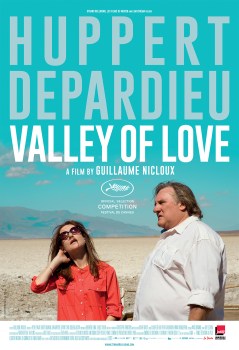
Valley of LoveTrying to find an angle from which to critique Guillaume Nicloux’s “Valley of Love” proves quite frustrating. It’s neither particularly good nor egregiously bad. It features well-calibrated but not quite stunning performances from its two leads, Isabelle Huppert and Gerard Depardieu. Cinematography, editing and directorial choices are present, interesting but nothing to add much flavor to the bland proceedings.

The film finds its characters, exes Isabelle and Gerard, as they convene in Death Valley following the instructions of their estranged son’s suicide note. His cryptic message indicates that he will, somehow, resurface. The setup sounds interesting, but Nicloux never really does much to take it beyond a “Waiting for Godot”-lite exercise of futility for the former lovers. The movie is content to let them mill about in their present misery, making lateral movements rather than directional ones.

Without giving away the ending itself, “Valley of Love” concludes with a back-and-forth of close-ups between Isabelle and Gerard. I can imagine a version of this film where such faces could be laden with such intense meaning, loaded with such passion or informed by the iconography of these two stars. Instead, the end just plays like the kind of thing made by someone who watched one too many cinephile video essays. With so many intriguing pieces at hand, the final arrangement fails to impress. C+ / 2stars