
REVIEW: Maggie’s Plan

23 05 2016

Maggie's PlanNew York Film Festival

Writer/director Rebecca Miller’s “Maggie’s Plan” makes for the kind of madcap, ensemble-driven romantic comedy that Woody Allen has not churned out since his relationship with Mia Farrow turned sour. And it’s certainly the kind of screwball comedy abandoned by studios altogether. But lest this review devolve into nothing but comparison to other works, it must be said that this is a wonderfully crafted and involving film in its own right.

Miller is the first person not named Noah Baumbach who seems to have a clue what to do with Gerwig’s considerable charm. Beneath her hip, ultra-modern exterior and droll delivery lies reservoirs of deep feeling and humanity still largely unexcavated. Miller might be the figurative Daniel Plainview to figure out the means to pull it out of the ground and siphon it to power other characters.

Gerwig stars as the titular Maggie, who might think she has a plan – but then life happens. Or fate happens. Or, heck, Maggie happens! Some odd mixture of time, self-realization as well as cosmic meddling seems to guide the proceedings of “Maggie’s Plan” as she stumbles and soars through a unique romantic escapade.

While trying to become pregnant to raise a baby alone, she falls in love with Ethan Hawke’s John Harding, a nebbish professor who feels like a wallflower in his marriage to Julianne Moore’s Georgette Norgaard. He struggles to complete a novel long in the works yet faces nothing but stern rebukes at home from his critical theorist wife. Both John and Maggie seek to seize the narrative of their lives … so they begin a relationship together.

Unlike so many stories involving older men who fall for younger women, Maggie never loses her agency in the courtship. In fact, it is far more often she who levels with John than the other way around. So it should come as no surprise that whenever things take a turn for the worse, it is Maggie who takes the initiative to grow out of their relationship.

Read the rest of this entry »


REVIEW: A Bigger Splash

22 05 2016

ABS_1Sheet_27x40_MECH_03.04.16_FIN11.indd“Interesting.” It’s the catch-all phrase for critics and reviewers, simultaneously meaning everything and nothing.

The word is often used in place of legitimate commentary, an adjective appended to an observation meant to prove the writer has two eyes but not two minutes to unpack the greater meaning of something. It’s a judgment with no value system to back it up.

When used before a comma and a negating conjunction, the word grants faint acknowledgement to what others might perceive as a strength – only to obliterate that argument to shreds.

Now, having said all that, “A Bigger Splash” is ever an interesting movie. The term here is not applied liberally or lazily. The entire film, from David Kajganich’s script to Luca Guadagnino’s direction, falls perfectly into the realm of the “interesting.” They play with stock melodramatic character types, the exotic European travel subgenre and plot developments both predictable and borderline outlandish. Their slight revisions draw attention and intrigue, sure, but they never come close to shock and awe.

It’s just … interesting. Enough to justify the retelling of a familiar type of erotic quadrangle – and expend the efforts of four in-demand actors to do so. Enough to cohere the romance, the suspense, the quiet political backdrop and the behind-the-scenes of rock ‘n’ roll – albeit not without some creaky tonal swings. Enough to draw out engagement and entertainment. Just maybe not enough to drive anything home.

Read the rest of this entry »


REVIEW: What Our Fathers Did

21 05 2016

What Our Fathers DidWhat Our Fathers Did” contains perhaps the ultimate divide between its subjects. Philippe Sands is the children of European Jews who saw his family devastated by the Holocaust. Niklas Frank and Horst von Wächter are the children of high-ranking Nazi Party officials. Truly, this is the kind of matchup that seemingly only a screenwriter could dream up.

But the three men are cordial – friendly, even! That is, until Sands decides to press the two men on how they can disavow the ideology and methodology of their fathers’ party while also justifying their actions. They can still love their parents because the now-grown men delude themselves into believing that their fathers were far removed from any kind of genocide or terror.

Sands tests just how far familial allegiance will go, even presenting them with incontrovertible evidence that their ancestors gave orders for mass exterminations. Still, they remain unmoved and unconvinced. It feels like an exercise in futility, however noble a task it might be.

Director David Evans could have matched Sands’ forceful case with hard-hitting technique, extensive historical contextualization or critical commentary from unexpected experts. Instead, “What Our Fathers Did” plays like a bloated television magazine profile. It feels glossy when it should be penetrative, cursory where it should be weighty. Seriously, did anyone involved in this movie even look at the Wikipedia page for “banality of evil?” Our world is witnessing what appears to be the rebirth of fascism. We deserve a better look at its first incarnation than this. C+2stars


REVIEW: Winter Sleep

20 05 2016

Winter SleepNuri Bilge Ceylan certainly loves the sound of his own writing; in “Winter Sleep,” we get virtually nothing but it for well over three hours. To quote Jerry Seinfeld, “Not that there’s anything wrong with that…”
Plenty of great movies (nay, many of my favorites) are excessively talky. But “Winter Sleep” does not just talk a lot. It talks in circles. In the sleepy Turkish mountain town of Cappadocia, hotel owner Aydin (Haluk Bilginer) spars with his newly divorced sister Necla (Demet Akbağ) and his younger wife Nihal (Melisa Sözen) during the slow season. Their conversations cover deep, profound philosophical territory. Like many such dramas, however, one has to wonder when the character stops speaking and the writer starts bragging.

And, to top it off, they spend the whole time talking and scarcely any time doing. In a sense, this is life. How often do we talk big and steadfastly avoid action? But if stasis were the point, Ceylan could at least spruce up the stillness. Most conversations are filmed in a bland shot/reverse shot pattern that makes each successive dialogue exchange feel longer and more grueling than the last.

Perhaps this style represents Ceylan’s method of making form correspond to content. But with his chosen aesthetic, form made me rather uninterested in content. B-2stars


F.I.L.M. of the Week (May 19, 2016)

19 05 2016

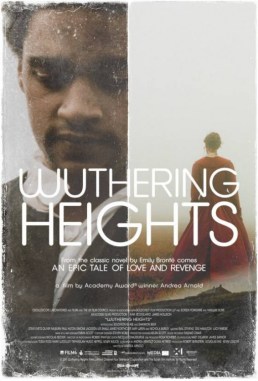
Wuthering HeightsI’m not sure I could give you a plot summary of Emily Bronte’s novel “Wuthering Heights” based on the 2012 film adaptation by Andrea Arnold. High school English students looking for the newest movie version so they can avoid reading this classic tome of British literature will find themselves sorely disappointed. Film lovers, however, ought to rejoice.

As far as cinematic adaptations of novels go, this might set some kind of record for fewest lines spoken. And “Wuthering Heights,” at over 400 pages, makes for no small feat to pull off in this style. But the absence of words is never felt.  The impressionistic visual cutaway replaces the long dialogue exchange or the superimposed voiceover, effectively substituting prose with the poetry of Arnold and her cinematographer Robbie Ryan. This novel (pun fully intended) approach to filming a classic work like a textual look book and not an instruction manual earns my respect and my plaudits for as “F.I.L.M. of the Week.”

Since Arnold and co-writer Olivia Hetreed eschew a faithful transposing of words to screen, perhaps a review of their movie ought to do the same. Far more important than plot in any given moment is feeling. Be it the ever unconsummated passion between the taken-in black orphan Heathcliff and well-to-do Cathy or the unbridled jealousy of Heathcliff emanating from the men of the house, the film is all in the visuals. A jarring handheld shift or a quick change of camera focus speaks far more powerfully than words.

Maybe most impressively, the social constraints that most period films just tiptoe around receive forceful stylization. With tight close-ups in the limitations of the 4:3 aspect ratio, the wide vistas or the set/costume department exhibition take a firm backseat to the given emotion of any moment. All the 1800s flourishes feel like the final addition – not the springboard – into “Wuthering Heights.” An old story like this has rarely ever felt so modern.


REVIEW: Neighbors 2: Sorority Rising

18 05 2016

There’s a time in a person’s life when they feel like they lag behind everyone else their own age. More people seem to progress to that next echelon of adulthood with each passing day. Stagnation meets anxiety, which then causes resistance. And a kind of paralysis sets in.

Well, maybe “time” should be plural. The above scenario describes the world in”Neighbors 2: Sorority Rising” that greets both Zac Efron’s Teddy Sanders after college and Seth Rogen’s Mac Radner after his wife (Rose Byrne’s Kelly) announces her pregnancy with their second child. Each has made small steps towards some kind of maturity while still feeling like their phoning it in prohibits them from leveling up in life.

If the first “Neighbors” was about finding humor and truth in the irreconcilable differences between fraternity guys and family men, then the sequel pivots to finding heartfelt connections that can be forged between ludicrous antics over shared feelings of inadequacy and ineptitude. More than the pure humor value of the original’s Abercrombie-set epilogue, Teddy and Mac forge a more durable bond here over a shared interest in shutting down the insurgent Kappa Nu sorority that set up next door.

Granted, their motivations are quite different. For the same reasons as the film’s predecessor, Mac needs to ensure the house stays appealing to prospective buyers. Teddy, on the other hand, helps the cause because he needs to feel needed. Originally, he got that appreciation from the sorority sisters, who relied on his expertise to help establish their organization. (Teddy ironically knows more about real estate than the Radnor family, proof that Greek organizations actually do teach at least some valuable life lessons.)

While not quite a student and not quite an adult, Teddy naturally gets caught back in the gravitational pull of the college life; it can be quite alluring to stay in a place where your expertise and skills count for something. Once they turn on him, he feels no shame switching sides. Efron masterfully portrays that confusing moment in time where identifying with adults seems easier than identifying with kids. As it turns out, he shares quite a bit more in common with the Radnors than previously imagined. Their express aim is to ruin the fun of the youth, though latently, envy for their freedom drives such animosity.

The specifics of post-grad assimilation into the so-called “real world” might look quite different than planting one’s flag firmly in the “adult” and “parent” category. But when teetering on the fence between life stages, the importance of age fades away some. It sounds like the kind of deceptively deep philosophical lesson one might impart from a Richard Linklater film. Instead, it’s sandwiched between jokes about Bill Cosby, men’s rights activists and the Holocaust. (Yes, it even goes there.)

Read the rest of this entry »


REVIEW: The Nice Guys

17 05 2016

“Kids these days know too much,” bemoans Russell Crowe’s private enforcer Jackson Healey at the start of “The Nice Guys.” It’s the classic set-up for a film noir – a world-weary narrator imparts an unsolicited bit of cynical wisdom about the current state of affairs. Granted, Healey has the misfortune of cruising around 1977 Los Angeles, the city where the genre was born, at its smoggiest and smuttiest.

The setting is the perfect playground for writer/director Shane Black to collide many different scenes and styles into one another. There’s the pre-AIDS pornography crowd so memorably profiled in Paul Thomas Anderson’s “Boogie Nights,” the Philip Marlowe detective escapades of “Inherent Vice” or Robert Altman’s “The Long Goodbye,” along with the ominously pervasive civic corruption of Roman Polanski’s “Chinatown.” And all the madness of the era gets filtered through the main narrative engine of a buddy cop film, the very genre that put Black’s writing on the map with 1987’s “Lethal Weapon.”

The film might sound like an odd grab-bag of references or – worse – an uninspired remix. “The Nice Guys” is anything but. Black, along with co-writer Anthony Bagarozzi, puts together a wild ride for two private eyes that tours the landscape with fun, laughter and insight to spare.

Though the unspectacularly effective Healey may be the first character introduced, Ryan Gosling absolutely steals the show as bumbling private eye Holland March. He whips out comedic chops that were only faintly glimpsed in previous films like “Crazy Stupid Love” and “The Big Short.” Remarkably, however, Black makes his incompetence and lacking masculinity a font of great humor – but rarely the punchline. Gosling willingly and gleefully sends up the hyper-macho persona he cultivated so carefully in films like “Drive,” adding a nice meta level to the performance as well.

March might blunder far more than his unwitting companion, yet “The Nice Guys” never falls into a simple comic man-straight man routine. Each characters gets their successes and their setbacks; not knowing whose will come at what moment makes the film even more exciting to watch.

Read the rest of this entry »


REVIEW: Money Monster

16 05 2016

Money Monster“You don’t have a clue where your money is,” quips George Clooney’s Jim Kramer-esque TV pundit/entertainer Lee Gates at the start of “Money Monster.” He’s not wrong. His sarcasm-laced lecture on the process of making money virtually invisible in the name of faster trades and higher returns provides a simplified primer on the transformations in financial markets – money is, more than ever, just a holder of value that serves as a means to an end.
No wonder, then, that the American justice system has such a hard time prosecuting activity in the financial system. As money becomes even more fleeting, it gets harder to pin down wrongdoing with it. The crimes may be bloodless, but they are far from victimless.

The premise of “Money Monster” springs from an attempt to make that fact known. Jack O’Connell’s Kyle Budwell, a rough-hewn youngster, decides to hold up Gates’ television program to exact revenge on IBIS, a multinational corporation whose algorithmic hiccup depleted his life savings. The idea is interesting, combining residual post-recessional anxiety with a hijacking of the media-industrial complex. But the film’s problems derive from uncertainty over what to do after the logline.

Budwell is, to steal a phrase used to describe Travis Bickle in “Taxi Driver,” a walking contradiction. On the one hand, he possesses the ideological resolve of 2016’s Twitter trolling Bernie Bros, fiercely committed to making a passionate case for justice. The media trial he holds against IBIS is a largely symbolic one; he demands not just the $60,000 he lost but also the entire $800 million that magically disappeared from the company’s coffers.

Yet Budwell is also a hair-brained firebrand who feels like an extra pulled from the background of a Southie-set Ben Affleck film. Once he bursts onto the set, he seems incapable of planning a strategic, intelligent next move. O’Connell’s performance, with its heavily laden accent and manic physicality, makes the character come across as more aloof than enlightened.

Read the rest of this entry »


REVIEW: Summer Hours

15 05 2016

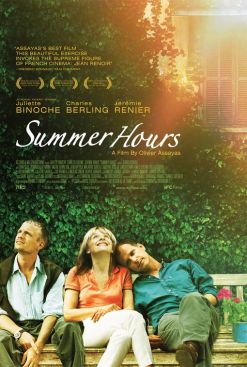
Summer HoursFrom the opening series of scenes in Olivier Assayas’ film “Summer Hours,” the direction of events appears quite clear. An ailing matriarch (Edith Scob) invites her three children – COUGH, heirs to the estate – to get her affairs in order. Her eldest son (Charles Berling’s Frédéric) stayed in France, while one daughter (Juliette Binoche’s Adrienne) went west to the U.S. and her younger son (Jérémie Renier’s Jérémie) headed eastward to China.

When it comes down to the inevitable decisions about what to do with her formidable collections of art and decor, guess who pulls rank and opts to donate/sell rather than keep everything in the family heritage? If you guessed the siblings living abroad, well … slightly obvious spoiler alert, if you catch my drift. “Summer Hours” is a simple yet effective rehashing of the dialectic between continuing a legacy and punting on one’s heritage.

It may seem familiar, in part because these questions are important. Every communal unit, from the family to the nation, must continue to ask itself what debt it owes to past ancestors and what paths it must boldly blaze for itself. In films as wide-ranging as Derek Jarman’s “The Last of England” and Alexander Payne’s “The Descendants” (two extremely random examples but they were the first to pop into my head), we see such issues debated.

Assayas is a worthy artist to work through these conundrums, and he sets up the tensions quite deftly in “Summer Hours.” Problem is, by about halfway through the film, he seems to run out of new things to say. None of this discredits the fine work to begin with; it just softens the impact by the close. B2halfstars


REVIEW: The Meddler

14 05 2016

The MeddlerKnow that person who has a heart of gold but lacks a silver tongue? Or has valuable wisdom but tends to share too much information? Who would be the greatest conversationalist in the world if they could just cut themselves off one sentence earlier?
That would be Susan Sarandon’s Marnie Minervini in “The Meddler,” though the beauty of her performance is that the character rings broadly true for so many people. For plenty, it will probably recall their mother or other family member. The meat of the film does focus on Marnie’s relationship with her adult daughter Lori (Rose Byrne), still a bit of a hot mess professionally and romantically. Marnie tries to intervene, as most mothers do, but Lori gives an unsubtle hint for her newly widowed parent to find a different hobby.

Rather than mope, whine or cause unnecessary tension between the two of them, Marnie essentially takes her charge. For decades, she played few roles besides “mother” and “wife.” This free time grants her the opportunity to be a friend, a surrogate parent, a mentor … and maybe even a lover. There’s certainly not a dull moment with Marnie, though sometimes the organization of her interactions leaves a little to be desired. Some secondary characters play pivotal roles only to drop off for big chunks of the movie.

Marnie’s adventures in role playing provide irresistible fun and joy, though they are always tainted with a slight sadness. These all serve as convenient distractions from the one person who really needs tending to: herself. Scafaria, in one of few script-level missteps, delivers this revelation through on-the-nose observations by Marnie’s therapists. But as it plays out in the events of “The Meddler,” her journey of self-discovery through (some perhaps unwarranted) service is altogether charming. B+3stars


REVIEW: Everyone Else

13 05 2016

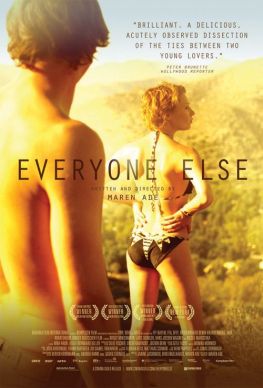
Everyone ElseMaren Ade’s “Everyone Else” begins most resembling Richard Linklater’s “Before” series as it chronicles the conversations between young lovers Gitti (Birgit Minichmayr) and Chris (Lars Eidinger). They squabble and connect over small things, but these minor chats reveal grander insights into their relationship through naturalistic scrutinization.

Then, its second act feels more like “Who’s Afraid of Virginia Woolf?” As Gitti and Chris venture outside themselves, they rendezvous with Hans and Sana, a couple who could be them had more lucky breaks gone their way. Hans has found real success, where Hans mostly just dreams about success. Their uncomfortable dinner and houseguest interactions rip the band-aid off of open sores in their relationship, unleashing some captivating drama.

As for its concluding portions … well, Ade has something much more singular in store. She breaks in favor of an obtuse European art-house style, which is not exactly congruous with the rest of her film. It’s there in bits and pieces, but she goes all-out by the close. Perhaps another viewing, more attuned to the nuances of her observations and less focused on the will-they-or-won’t-they of the relationship, would yield more insight into the stylistic break. Yet even the perceived unevenness aside, “Everyone Else” still finds meaningful moments from start to finish. B2halfstars


F.I.L.M. of the Week (May 12, 2016)

12 05 2016

Neighboring SoundsFrom the opening archival photos in “Neighboring Sounds,” writer/directorKleber Mendonça Filho positions the story in a long history of extreme wealth inequality. We see the construction of palatial estates for the wealthy, which were of course built on the backs of workers who made practically nothing.
The fault lines of class in America are felt, but not always seen. Such is not the case in the Brazil of this film, where wealth inequality in a coastal city is starkly defined by staggering differences in property. The wealthy and the poor are not stratified in different spheres on influence; instead, they live in close proximity. Even quite literally bordering on each other.

This setting might seem the perfect one for a battle of the haves and the have nots. But in the hands of Mendonca, the story of “Neighboring Sounds” focuses less on clashes and more on coexistence. After all, it’s the default setting for their society. This approach leads to fascinating observations, enough to earn its status as my pick for “F.I.L.M. of the Week.”

From a rich realtor contending with CD player thievery that weirds out his latest fling to a strung-out homemaker who just wants the dog on the other side of the fence to shut up, everybody in Recife really wants the same things. Safety and privacy are the two concerns at the top of mind, yet both are indicative of a larger issue. Everyone wants some elbow room, the hottest commodity in town. And, perhaps not by accident, virtually all of it remains in the control of a wealthy, landed aristocrat festering away on a platation outside the city.

Little happens in “Neighboring Sounds,” save the introduction of a new private security firm into the neighborhood. Created to fill a perceived need for existential protection, they uncover many of the sleeping giants lurking inside the community that awaken to cause friction. All the while, Mendonca remains remarkably attuned to the minutiae that define modern urban life. His film has the same intersecting lives feel as Alejandro G. Iñárritu’s 2000 Mexico-set film “Amores Perros,” but without that director’s suffocating and forced projection of cosmic fate onto the proceedings. It’s natural how these tales intertwine and overlap, forming a discordant but honest city symphony.


REVIEW: The Man Who Knew Infinity

11 05 2016

The Man Who Knew InfinityStop me if you think you’ve heard this one before…

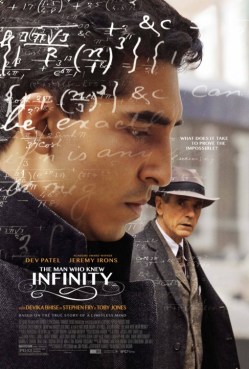
A bright man enters a new space as outsider, establishes his genius as a mathematician but then comes undone by some kind of illness. Did I just describe the plot of “A Beautiful Mind,” “The Imitation Game,” or “The Man Who Knew Infinity?” Not so trick question: it was all three. I guess it makes sense that these mathematician-based films all follow formulas – what other class has you memorize them?

To fill in some of the mathematician Mad Libs of the plot, Dev Patel stars as Srinivasa Ramanujan, a brilliant Indian student who overcomes adversity and lands a spot to study at Cambridge University during World War I. Hey, could you guess this story involved British racists? We get a derisive dismissal of him as “you people” within the first THREE minutes!

Ramanujan bonds with his mentor, Jeremy Irons’ Hardy, over their outsider status in the elite university environment and eventually share profound conversations about the immovable mover. In other words, Hardy is just like the Keira Knightley character in “The Imitation Game!”

At least for that film, I had 13 years to slowly forget the details of its comparable predecessor. “The Man Who Knew Infinity” arrives less than two years after “The Imitation Game” and cannot even hurdle the lowest bar that film set. No matter how hard Patel and Irons try, they can never elevate the material. It’s like they are punching a long equation into the calculator, and we see a “divide by zero” almost immediately. At that point, you know this will not turn out well. C2stars


REVIEW: A Hologram for the King

10 05 2016

A Hologram for the KingWhen the eventual biographers take stock of Tom Hanks’ career, something tells me that “A Hologram for the King” will inevitably get lumped in a grouping with 2011’s “Larry Crowne.” Both films, in spite of all else they offer, serve primarily as vehicles to continue Hanks’ romantic leading man status well into the back half of his fifties.
An “Eat Pray Love” comparison feels somewhat apropos given the exotic setting as backdrop for personal issues, yet that story took the trouble to connect the dots. Tom Tykwer’s “A Hologram for the King” takes no such efforts. It’s as if the work of Hanks’ Alan, a recently divorced American IT salesman, has no function other than to get his body in Saudi Arabia. The professional and the personal never tie into each other, which is a shame given all the potential in presenting the eponymous task – hologram technology to the king of the kingdom. The ultimate form of presence in pixels. Ripe for metaphors, no?

Instead, the best the movie has to offer is a benign tumor that sprouts on Alan’s back. Get it? The tumor is a physical manifestation of his growing anxieties and midlife crisis! How middle school English class.

“A Hologram for the King” is adapted from a novel by Dave Eggers, a wonderfully profound author whose inspired touch appears seemingly only in fragments throughout the movie. Bits of irony and hard-fought humanism slip through the cracks occasionally, but these take a backseat to the Tom Hanks show. Admittedly, there are much worse shows to see. But we have copious video evidence of Hanks being Hanks. Let him continue to explore his craft, a la “Captain Phillips” and “Bridge of Spies.” These pixels are only slightly less hollow than the ones in the title. B-2stars


REVIEW: Heart of a Dog

9 05 2016

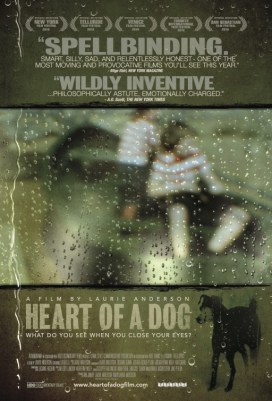
Heart of a DogA mourning of a lost husband and pet. A celebration of their lives.

An elegy for the innocence and purity of pre-9/11 New York City. A lamentation for the rise of the surveillance state.

A visually eclectic documentary. A simply told personal tale.

These are some of the many contradictions that make up Laurie Anderson’s film “Heart of a Dog,” a film chock full of ideas in its 75 minute runtime yet somehow manages to never feel dense. The whole experience is rather ethereal, guided perhaps by Anderson’s deep conviction in Buddhist teachings. It’s hard to fault her logic when she seems so sure of the deeper psychic connections motivating each decision.

Occasionally, Anderson does seem to bite off more than she can chew in the film. She runs in circles around recurring themes while rarely exploring them deeply, though perhaps that is her point – sensation over intellect, natural consciousness over synthetic thought. “Heart of a Dog” is at its best when immensely personal, particularly when recounting the extraordinary life of her dog, Lolabelle. Anderson is no ordinary artist, so of course, she had no ordinary dog; her rat terrier went blind but picked up playing the piano in her final two years on earth.

Some of the extrapolations Anderson makes from Lolabelle get a little dicier, and the internal resolution of the conflicts by asserting the superiority of her beliefs leaves a bit of a sour taste. But in spite of its flaws and roughness, “Heart of a Dog” remains quite intriguing. At the very least, watching an artist so willing to throw out the rulebook with picture, sound, content and tone is always worthwhile. B2halfstars