REVIEW: Green Room

18 01 2016

This review originally appeared on Movie Mezzanine, for whom I covered Fantastic Fest in Austin, TX.

Jeremy Saulnier’s breakout film Blue Ruin depicted violence as an elemental force; a practically innate disposition of the human condition. In that spin on a classic revenge tale, Saulnier metes out precious little information on the characters hell-bent on destruction to highlight how shockingly natural these primal acts are.

His follow-up, Green Room, also takes violence as one of its major subjects – but here, the filmmaker shifts gears, depicting the savagery of human conflict as something aberrant to our very nature. As a punk rock band, barred off in a green room, wars against the group of neo-Nazis that hosted their show, acts of brutality take on an almost cartoonish tenor. For instance, someone’s mangled arm looks like a candy cane of flesh and blood, a sight Saulnier milks for all it’s worth to the tune of disgusted groans.

Green Room

This unnatural, unsettling violence provides heightened stakes for what otherwise might play like a simple hodgepodge of tropes from final girl” captivity or siege-style thrillers. Throwing in a group of white supremacists helps to add weight (especially when these groups are currently coming out of the woodwork to endorse Donald Trump’s presidential run). But while their violence may be exaggerated, Saulnier never strips them – or their trained attack dogs – of basic dignity. He even includes a sequence, beautifully shot by director of photography Sean Porter, which manages to find a bit of impressionistic poetry in the writhing bodies of their mosh pit.

To be clear, Green Room never condones the group’s ideology. The skinheads are still clearly the villains, but Saulnier’s choice to withhold immediate and unflinching condemnation allows some insight into what holds the group together. Their leader, Patrick Stewart’s Darcy, hardly matches the model of the charismatic authority figure. Instead, along with his tactical right hand man Gabe (Blue Ruin star Macon Blair), he evinces a magnetism of the calm and collected variety.

Green Room 2

That disposition stands in stark contrast to the manic array of rockers that constitute “The Ain’t Rights,” led by Anton Yelchin’s Pat and Alia Shawkat’s Sam. Even though their music pushes them to the fringes of performance venues, the group still lacks common sense and self-defense mechanisms. Still, Saulnier clearly feels a good deal of kinship with the punks and gives them dynamic personalities that prove oddly compelling. These vibrant characters ensure more colors are at play than just the red that dominates Green RoomB2halfstars


REVIEW: Inside Llewyn Davis

17 01 2016

Inside Llewyn DavisCannes Film Festival – Official Competition, 2013

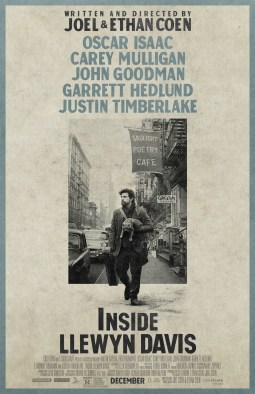
“If it was never new and it never gets old, it’s a folk song,” explains Llewyn Davis (Oscar Isaac) after yet another gig strumming his guitar at Greenwich Village’s Gaslamp in”Inside Llewyn Davis.” The film is full of folk tunes in its soundtrack as it recreates the pre-Dylan early 1960s scene in New York. Yet, in many ways, the Coen Brothers’ film itself is a folk song, if judged by the definition they provide.

Llewyn’s story is all too familiar – and one that hits close to home for anyone yet to achieve the lofty success they were promised with every participation medal. Most stories of musicians trying to enter into the business involve some measure of pain and frustration, but for Llewyn, the bad breaks seem almost cosmic. He’s always a smidgen too early or a moment too late to shake off the funk that seems to set a tone of frustration and misery for his life. “King Midas’ idiot brother,” his ex-flame Jean (Carey Mulligan) describes him, and by the end of the film, such a mythological explanation for Llewyn’s woes seems entirely possible.

It proves frustrating to watch him endure trial after tribulation, though not because the beats are tired. The doomed slacker routine may have been done before, but certainly not like Joel and Ethan Coen do it. Insomuch as the duo would ever make something so straightforward as a “personal” film, “Inside Llewyn Davis” addresses the price a person can pay for trying to maintain the purity of their art. Llewyn decries the easy, the accessible and the crowd-pleasing, lamenting anyone who panders to these attributes as sell-outs or careerists.

Read the rest of this entry »


REVIEW: Joy

16 01 2016

“Hands, give me the hands,” Bradley Cooper’s Neil Walker vehemently instructs a cameraman filming Jennifer Lawrence’s Joy Mangano as she sells her Miracle Mop on QVC. For Walker, the consummate showman (and perhaps the stand-in for writer/director David O. Russell), these appendages are the attribute that sets stars apart from the average person. Hands are important because, in his words, “that’s what people use.”

Russell uses hands as a motif running throughout “Joy,” a hymn to ingenuity and perseverance inspired by true stories of daring women. To him, hands mean physical labor, the kind of work traditionally delegated to men. But that traditional division of duties never stopped Joy, who built kingdoms out of paper as a child, dog collars as a teenager, and finally a self-wringing mop as an adult. Her knack for creation, when coupled with her practicality and pragmatism, means she has real potential for success.

Indicative of just how overextended Joy is among her large family, her hands spend most of their time at home doing household repairs like plumbing which would normally be left to the male authority figure. (Her ex-husband, Edgar Ramirez’s failed singer Tony, spends most of his day crooning in the basement.) On top of all the emotional labor of caring for the physical and emotional well-being of her two young children, she has virtually no time to pursue a path that could bring fulfillment and fortune. Yet another mess Joy must clean up enables her to dream up the revolutionary mop after shards of glass lead to gashes all over her hands.

In order to turn her flailing life around, Joy has to compete in the man’s world of business to get her product in front of customers. She has virtually no cues as to how to operate in this sphere; repeated asides from a fictional soap opera show the kind of cues from which Joy can draw. Boys get “The Godfather.” Girls get puffed-up camp like “The Joyful Storm.”

Read the rest of this entry »


REVIEW: Winter on Fire

15 01 2016

Winter on FireNetflix seems to be building a sort of auteurist curatorial attitude in their documentary pick-ups. Evgeny Afineevsky’s “Winter on Fire” resembles the streaming service’s 2013 doc “The Square” in many ways – beyond just the fact that both scored Oscar nominations. The two films take a democratic approach to people’s protests calling for democracy, mostly outsourcing the video to footage taken in the popular uprisings and presenting context where necessary.

Afineevsky, however, might have done well to stick by a more verité, found footage style of documentary filmmaking. Context is important to understanding the 2013-2014 Euromaidan Revolution, and he presents it succinctly and clearly during the opening credits. But he overloads the explanatory retrospective interviews throughout “Winter on Fire,” which both disrupts the narrative and detracts from the power of the images. When the police beat a citizen’s head so brutally that his brains have spilled on the street, the visual is strong enough to speak for itself.

He also might have been smart to pick a protagonist or some person that the audience can follow throughout the 93 day demonstration – besides ousted Ukranian president Viktor Yanukovych, that is. It makes sense given the collective nature of the protest, which united the country against Yanukovych’s maneuverings to align Ukraine with the interests of Russia rather than heed the will people to join the E.U. “Winter on Fire” is the story of all, not the story of one. But the lack of entry points into experiencing the fight for freedom as something more than a citizen-journalist news report demonstrate the limitations of turning that spirit into a narrative. B / 2halfstars


F.I.L.M. of the Week (January 14, 2016)

14 01 2016

This Is Martin BonnerRealism in cinema has a habit of rubbing people the wrong way, given that many directors who practice the style tend to pummel their audience with an abundance of brutally mundane details. But this is not a necessity, as Chad Hartigan shows in “This Is Martin Bonner.” His tender, affectionate touch throughout demonstrates how filmmakers can evoke the rhythms of the everyday without recourse to deliberate inducement of boredom.

In many ways, my pick for the “F.I.L.M. of the Week” is as straightforward as its title. “This Is Martin Bonner” follows its Paul Eenhoorn’s titular character with the precision of a “to be” verb. Hartigan allows us to observe Martin’s life as he undergoes some changes that force him to reacclimate some. He moves to Nevada to work for a religiously affiliated non-profit organization that helps released convicts rediscover their place in society.

One man that he helps, Richmond Arquette’s Travis Holloway, seems to spark Martin’s engagement more than usual. Both seek balance in a world that demands labels and extremes, though neither immediately recognizes the similarities or the ways in which they can help each other. They simply go about their lives, trying to establish some kind of human connection to restore a little normalcy.

Though we only get about 80 minutes with Martin and Travis, the time feels wholly satisfying. Hartigan balances hefty conversations about family and faith with the quiet, tiny moments that speak volumes about a person. The mini-journeys of the two characters come across as quite real indeed – and not because they meet some standard of verisimilitude. Rather, a genuine sincerity shines through every frame of “This Is Martin Bonner.” Hartigan lays on the humanity while never turning the film’s heart into a fragile object. It is, in essence, a perfect example of how to achieve natural stories without resorting to pure naturalism itself.


REVIEW: Anomalisa

13 01 2016

AnomalisaI have often thought of writing a screenplay, taking a Woody Allen-like approach of stashing all the ideas away in case one of them seems relevant or worth pursuing later. Different germs of ideas reach different stages of development, and often when I consider putting fingers to keyboard, my mind drifts to a Charlie Kaufman script. I think about a “Being John Malkovich” or “Adaptation” and wonder why bother writing when it would doubtfully reach the tremendous heights he scales.

Kaufman’s scripts possess levels of depth that might as well be subterranean. His genius of self-awareness and reflexivity consistently put other writers to shame. So I was taken aback when his latest effort, the stop-motion animated “Anomalisa,” marked something radically different. It was simple.

Most of the film’s complexity comes from the manipulation of the 3D-printed puppets, not from Kaufman’s script. “Anomalisa,” which he co-directed with Duke Johnson, tells a fairly conventional story of one man’s isolation and how an affectionate connection can melt the layers of ice around the heart. When stated as a logline like that, the premise sounds rather like a familiarly dull British dramedy. But Kaufman has a unique angle on it, one better left for each viewer to discover. Don’t read about it before, if at all possible.

Kaufman gradually reveals the central conceit that makes the film special, and then unleashes a tidal wave of sincerity and emotional honesty from lonely business lecturer Michael Stone (voice of David Thewlis) and Lisa Hesselman (voice of Jennifer Jason Leigh), the woman whose voice penetrates his soul. The rapport they share feels so authentic, which causes some intentional cognitive dissonance as their bodies are not human.

But once Kaufman comes out in the open with the train of thought powering “Anomalisa,” fans of his work may wonder where the twist comes into play. For a subversive writer who nearly always delights in blowing up storytelling conventions, such a straightforward story with just one major revelation of authorial intent seems strange. Perhaps knowledge of his prior scripts even serves an impediment to fully experiencing “Anomalisa” as viewers would otherwise have no reason to doubt its earnestness and purity. The final product is truly sweet and fulfilling – though whether something this quaint really merited years of Kaufman’s attention is another subject altogether. B+3stars


REVIEW: 13 Hours: The Secret Soldiers of Benghazi

12 01 2016

What happens when you send Bay to do a Bigelow’s job? You get “13 Hours: The Secret Soldiers of Benghazi,” an account of the 2012 siege of the Libyan embassy that proves both thrilling and frustrating.

Director Michael Bay honors the memory of the fallen and exalts the survivors in a way that recalls “Lone Survivor” or “Black Hawk Down.” When he turns his attention towards human beings and away from clanging clumps of pixels known as transformers, the man can sure craft a compelling action scene. Of course, his consistently shaky camera and manic editing patterns can result in some massive confusion, but he sustains the momentum of mounting dread for nearly two and a half hours. That’s no hack job.

But Bay falls short of Peter Berg, Ridley Scott and especially Kathryn Bigelow by painting in some questionably broad strokes. The expectation of any American war movie is that the troops are de facto heroes; to Bay’s credit, he has them earn their nobility rather than just assume the audience grants it to them. The titular “secret soldiers,” a paramilitary group of private defense contractors, act decisively to protect American interests. They are heroes for what they do, not simply for who they are.

Bay does not, however, grant the same level of thought to any other characters in the film. I’ll leave an analysis the sexist attitudes towards the lone female character present in Benghazi to thinkpieces on Jezebel, though I imagine Bay finds it progressive because he did not introduce her legs-first. (Credit on that joke goes to Kyle Buchanan at Vulture.) Anti-intellectual themes also run deep in the film’s veins, but I will again refrain from retaliating simply because I disagree.

Read the rest of this entry »


REVIEW: Carol

11 01 2016

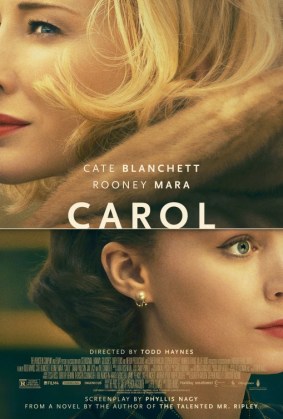
CarolEarly in Todd Haynes’ “Carol,” a group of young adults sits up in the projection booth a movie theater. As Billy Wilder’s “Sunset Boulevard” flickers on the screen, one astute observer sits taking notes while the others fool around. He remarks that he seeks to find “the correlation between what they [the characters] say and how they feel.”

Most people watching “Carol” will find themselves in a similar position. With the film’s gentle pace gradually yet methodically moving the action along, every moment becomes dissectible. Haynes, however, does not simply stop conveying the souls of his characters with words. (Neither, for that matter, did Wilder.) Each composition is a delicate painting, gracefully staged to emphasize, contradict or contextualize the action taking place within it.

The frames throughout “Carol” tell a rather perverse narrative. On the one hand, Carol Aird (Cate Blanchett) and Therese Belivet (Rooney Mara) are given vast amounts of space to move about on screen. The surroundings do not seem to claustrophobically encase this pair of illicit lovers, though the pressures of a disapprovingly baffled society try their best to do just that. Yet, at the same time, both are given so much “headroom” at the top of the frame that they become minimized within it.

So free, but so small. This paradox resonates for both the 1950s setting of the film as well as the 2010s audience viewing it.

“Carol” finds Todd Haynes working once again in his sweet spot of recreating a photorealistic past while addressing entirely contemporary concerns. Though he has yet to make a film set in the present day, he continually finds ways to evoke a sense of immediacy with forms of storytelling otherwise regarded as outmoded and the disregarded. Working within the so-called “woman’s film,” the classical melodrama as well as the romance, Haynes finds rich emotionality in reorganizing various elements to focus on female experience and pleasure.

Read the rest of this entry »


REVIEW: The Revenant

10 01 2016

Alejandro G. Iñárritu communicates powerfully in two registers throughout “The Revenant” – visceral violence and serene stillness. Working with director of photography Emmanuel Lubezki, he masterfully navigates between these two extremes. When the film needs to do so, it shifts registers from portraying the beauty of nature like Malick’s “The Thin Red Line” to showing how that same environment can harshly impose its fierce will such as in Coppola’s “Apocalypse Now.”

Lubezki enhances the naturalism by ditching the fluorescent lamps and employing only the light present at the shoot. Additionally, he stages many an elaborate long take with Iñárritu meant to keep the intensity moving forward as if the lens of the camera was the eyes of the audience. When these two elements mesh perfectly, “The Revenant” provides some of the most pulse-pounding, adrenaline-pumping cinema of recent memory.

But there are times in the mad rush of blood to the head where Iñárritu seems in a little bit over his head. As with “Birdman,” his reach occasionally exceeds his grasp. Though his movies all but scream their production values, they never come out quite as important or revolutionary as he thinks they are. For example, the tracking shots convey the intricacy of their planning as much as they provide an immersive plunge into the unforgiving American frontier. Each moment of greatness has some accompanying gloat visible down the road.

Leading man Leonardo DiCaprio matches this pattern in many ways. He stars as fur trapper Hugh Glass, enshrouded in a Kurtz-like mystery to his group of fellow hunters. They know little about him other than that he has spent a great deal of time among the indigenous people in the Louisiana Purchase, which thus makes him more in harmony with their harsh surroundings. Just how deep that connection with the land goes, however, gets a trial by fire as the team’s leader, Tom Hardy’s ruthless John Fitzgerald, essentially leaves Glass for dead in the brutal winter.

Read the rest of this entry »


REVIEW: The Hateful Eight

9 01 2016

Snappy dialogue and intricately planned-out scenes put Quentin Tarantino on the map as a generation-defining talent, so it sure is nice to see him once again embracing that spirit in his eighth film, “The Hateful Eight.” After the bloated, mangled mess of “Django Unchained,” operating within his usual wheelhouse of tension ratcheting conversations and raucous bloodshed feels more welcome than usual.

In many ways, however, “The Hateful Eight” is somewhat of an anomaly in Tarantino’s canon. Sure, it bears the usual stamps of expressive language, scrambled chronology and unapologetic gore, but he appears to eschew his favored postmodern pastiche in favor of a more classical vibe.

This proclivity appears most obviously in his selection of music. Apart from “Kill Bill,” Tarantino has never commissioned a composer to score his films. Repurposing aural cues from other films or cultural products has served as a thread running throughout his filmography, reinforcing Tarantino’s DJ-like position as director. He blends, appropriates and remixes to unify and synthesize disparate styles and genres into something entirely new.

Tarantino does not abandon this approach completely in “The Hateful Eight,” although the majority of the sonic landscape in the film comes from a brand new Ennio Morricone score. The very musician whose compositions Tarantino has deployed to great effect in each of his films made this millennia gets to express himself on his own terms. Morricone grants the production a heightened level of prestige and legitimacy with his participation, allowing it a certain measure of independence. “The Hateful Eight” does not rely on referencing other films to imbue the proceedings with meaning. Rather, Tarantino casts his gaze inwards toward the dark, beating heart of his own work.

Read the rest of this entry »


REVIEW: Tangerines

8 01 2016

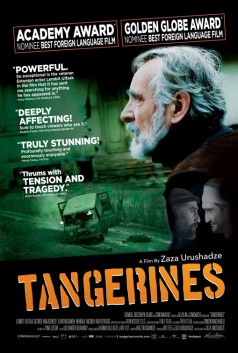
TangerinesZaza Urushadze’s “Tangerines” clearly possesses a big, beating heart, but – otherwise – it lacks much of a pulse. This wartime drama about civil unrest between Georgia and Estonia presents a fascinating situation: carpenter and tangerine farmer Margus (Lembit Ulfsak) nurses two men on opposite sides of the conflict back to health after a firefight in front of his house. As they mend physically, they also mend as neighbors.

If this sounds only slightly more nuanced than a campfire kumbaya, that’s because it is. “Tangerines” has a message as simplistic than any American film that tries to solve tribal conflicts with the “why can’t we all just be friends?” argument. Urushadze finds common ground by minimizing or ignoring differences, not by finding the elusive harmony between such disparities. Such reductive logic is more likely to impede progress.

The film has nice moments scattered here and there, and Margus’ internal conflict as a non-native whose family has already fled the area makes for some good character revelations. But overall, “Tangerines” tastes underripe. C+2stars


F.I.L.M. of the Week (January 7, 2016)

7 01 2016

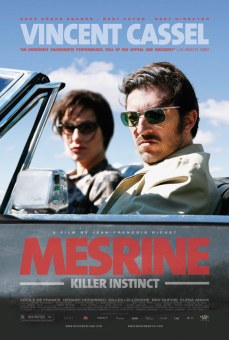
Mesrine Killer InstinctIt’s common to attribute all the attributes of high-octane, adrenaline-pumping cinema to the “Hollywood” style, as if big studios are the only entities capable of producing great action thrillers. But great classical genre films can came from anywhere in the world. Case in point: the French crime saga “Mesrine,” broken up into “Killer Instinct” (part 1) and “Public Enemy #1” (part 2).

These films may not rise to the standard of high art that normally defines my “F.I.L.M. of the Week” column, but I think it’s important to spotlight the many varieties of international cinema. Believe it or not, France has more to offer than austere Godard works or quirky Ozon films. They have people like Jean-François Richet, director of the “Mesrine” films, too! This is about as slick and thrilling as entertainment comes.

The movie makes a great showcase for Vincent Cassel, who stars as titular gangster Jacques Mesrine. After becoming disillusioned by France’s loss in the Algerian War, the ex-soldier enters the world of organized crime and quickly becomes a Pacino-like figure on the international circuit. Compared to some other recent mob movies (COUGH, “Black Mass“), Mesrine is always captivating to observe. He’s a man defined by his confidence, which earns him great success until it becomes the hubris that leads to his ruin.

When Cassel acts in English-language movies, he struggles to shed his thick French accent. That is not a knock against him, and it even served him well in “Black Swan.” But, often times, the cadences distract from the dialogue because it is so pronounced. In “Mesrine,” speaking in his native language, Cassel seems more comfortable and relaxed to act to his full capability. He sure does own the screen here.


REVIEW: What Happened, Miss Simone?

6 01 2016

What Happened, Miss Simone?In 2008, I was captivated by the trailer for “Revolutionary Road,” due in large part to the music chosen to augment its effect: Nina Simone’s “Wild is The Wind.” Ever since then, I have continually returned to her work when I am in need of haunting by art. Her raspy, husky serenading has an effect unmatched by any performing today.

The continual problem with art about artists is that the new work always has to measure up to that of the subject. Such is the case of Liz Garbus’ documentary “What Happened, Miss Simone?” It’s an informative look at this singular blues singer through the lens of her art, politics and personality. But does anything in Garbus’ narrative come close to approximating the raw power of just absorbing one of Simone’s songs? The answer there is no.

In a way, the film’s shortcomings are foreshadowed in its title. Garbus is preoccupied with the “what” of Simone, dutifully tracing a chronological story of her life from cradle to grave. “What Happened, Miss Simone?” is practically her Wikipedia page as a movie, with the occasional click away to events or personalities with which she frequently interacted. The film stays fairly surface-level throughout, never really interrogating the art or the society that spawned it. I so craved a foray into the “who” or the “why” questions that her music raises. Guess I’ll just have to keep listening there to find the answers. B2halfstars


REVIEW: The Treasure

4 01 2016

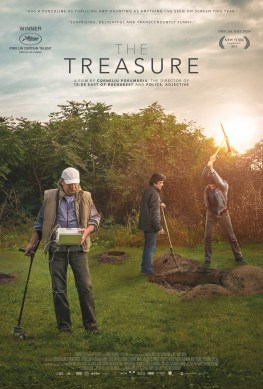
The Treasure posterNew York Film Festival, 2015

The financial collapse of 2008 might have originated in the United States, but it triggered a truly global recession. As in most instances of art reflecting life, the narratives we consume mostly resemble our own. Since these kinds of tales are primarily relegated to the independent or art-house realms, they tend to reflect the composition of that audience: American, well-educated, upper-middle class.

Yet it is fascinating to peer into how other cultures deal with the fallout of the recession through art. Admittedly, these require some intense seeking out, but Corneliu Porumboiu’s Romanian wonder “The Treasure” is worth all the effort. His film is not one that overtly grapples with the recession like, say, the Dardennes’ “Two Days, One Night,” but it nonetheless provides a fascinating setting for the events that unfold.

Cuzin Toma’s Costi is weathering the storm along with many working-class Romanians, though he is far from resigned to his fate. When his zany neighbor Adrian (Adrian Purcarescu) stops by with a get-rich-quick scheme, Costi is all ears. This plan, however, is far from the average hair-brained antics that have claimed the dignity of many a great film character. Adrian lets Costi in on a family secret about a buried treasure out in the countryside that he needs help excavating and unearthing. The job requires not only manpower but also an element of stealth as the Romanian authorities could seize its contents.

Adrian needs the riches to pay off a bad mortgage stemming from the financial meltdown. Costi could use a little extra money to support his family, and with Adrian offering a generous 50-50 split, he loses very little time yet has great rewards to gain. So the two set off, metal detector and all, to locate this buried bounty.

Read the rest of this entry »


REVIEW: The Riot Club

3 01 2016

The Riot Club“I am sick to [expletive] death of poor people,” exclaims Sam Claflin’s Alistair Ryle as he tops off a liquor-powered rant during a madcap evening of debauchery. It’s perhaps the most obvious moment in Lone Scherfig’s”The Riot Club” where pointed satire and heightened drama become so blurred that they are practically indistinguishable. But the film is chock full of such instances where the unbelievable and the believable intersect, making its vanguard of posh college-aged British males both entertaining and odious.

The sharpness of its social commentary is no doubt related to the story’s origins on the stage; Laura Wade adapts her own play for the screen. At times, the roots show as easily half the film transpires in one protracted scene at a single location. While this might count as a liability for many movies, it actually comes out as a net positive for “The Riot Club.” Once this long dinner gets set up, the focus can remain solely on the words and how they express simmering tensions as well as larger themes.

The film proves plenty interesting leading up to this climactic reckoning, too. “The Riot Club” begins as a tale of two aristocratic young men, in many ways foils for each other. Claflin’s Alistair enters Oxford as entitled as they come, though without the protection of his older brother on campus, he begins somewhat sheepishly. Max Irons’ Miles Richards, however, seems to draw out the smugness in Alistair with his laissez-faire attitude towards the nobility he can expect to claim with his social status.

Read the rest of this entry »