REVIEW: Unfriended

3 10 2015

Movies – in particular the horror genre – are great at tapping into our digital anxieties, and “Unfriended” may very well be the ultimate representation to date.  The action unfolds entirely on a computer screen in real time over the course of roughly 85 minutes, following a group of teenagers who get terrorized by an online presence. This omnipotent force takes the name of a girl, Laura Barns, who everyone thought had committed suicide after some particularly vicious bullying.

Laura threatens them primarily with the disclosure of secrets that each individual kept from the group, usually of duplicitous or just plain malicious nature.  In particular, she uses the leverage from social media where images can be deleted but never really die.  If ever there was any doubt why teenagers are flocking to apps like Snapchat where images supposedly disappear, “Unfriended” has the answer.

Writer Nelson Greaves and director Leo Gabriadze execute the daring formal conceit well, even managing to throw in some interesting micro-observations about the way people communicate with divided attention and crossed alliances.  Yet no clever presentation can hide the fact that the story plays out like an episode of “Pretty Little Liars.”

At its core, “Unfriended” is still a bunch of whiny, obnoxious adolescents clawing at each other because of someone unknown, supernatural force.  The film is sure to make Laura some kind of technical wizard, able to control the computer’s mouse and rewire the Internet at will.  This makes her a little bit more frightening but a whole lot more ludicrous and unbelievable.

Still, “Unfriended” emerges as more positive than negative.  This feels like the best case scenario for the kinds of assembly-line horror movies cranked out overt at Jason Blum’s prolific Blumhouse Productions.  It’s entertaining and lowbrow enough to satisfy the lowest common denominator of moviegoers while also offering a little something to chew on for those who need a more existential terror to really scare them.  B-2stars


REVIEW: Finders Keepers

2 10 2015

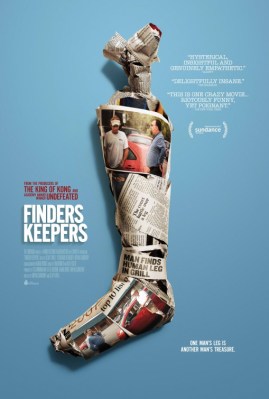
Finders KeepersThe people who populate the documentary “Finders Keepers” might look like the people from a reality show in the rural South.  But if you hope for moments of YouTube-worthy laughs at their expense, look elsewhere.  Directors Bryan Carberry and J. Clay Tweel are not interested in allowing the audience to look down at their subjects.

Instead, they request and allow empathy for folks who might otherwise get derided as a circus-like sideshow.  And given the dispute they document, this is a lofty task.  Small-town North Carolina dweller Shannon Whisnant just thought he bought a grill at a flea market, but when he opened it up, he also found a human foot.  To say he gets more than he bargained for is an understatement.

The foot is not just any human foot but one that belongs to a still-living person, John Wood, who ambles now with a prosthetic.  He wants the amputated limb back, though not for the reason anyone would expect.  Wood lost the foot in a plane crash that also took the life of his father, so it represents the last little bit of him that he can keep on earth.  For many filmmakers, this anecdote might be played for laughs or scorn.  In “Finders Keepers,” however, Wood’s story gets to play as sincere as he means it.

Whisnant does not oblige his request, invoking the legal concept of finders keepers and ginning up the kind of local broadcast publicity that would make any low-polling Republican presidential candidate green with envy.  Once the tussle gets settled (by Judge Mathis, no less), the rest of the film lacks the same level of intrigue.  Without the foot to drive a wedge between the principal personalities and represent a microcosm of their differences, Whisnant and Wood are not nearly as compelling to observe.  But the first hour of “Finders Keepers” deserves lauding for its relatively radical humanism towards people who usually receive little of it.  B2halfstars


REVIEW: Hot Pursuit

25 09 2015

The easy insult to hurl at “Hot Pursuit” is that of a hot mess – because you know how us writers love wordplay, especially in movie titles that seem to invite clever barbs.  But in this case, such a label fails to describe what really goes wrong.

A hot mess implies there is something interesting or oddly compelling in its failure.  Anne Fletcher’s film could not be farther from that.  Within minutes, it becomes obvious that everyone involved just wants to play it safe.  And that makes for one wickedly boring 87 minute pursuit of mediocrity.

“Hot Pursuit” pits the formidable talents of Reese Witherspoon and Sofia Vergara against each other but fails to realize either of their potential.  Vergara, as often seems to be the case, gets reduced to her looks and her naturally thick accent.  She plays Daniella Riva, the widow of a drug lord, who agrees to testify in a case against a kingpin.  But when her police transport goes haywire, she gets stuck with Witherspoon’s straight-laced cop Rose Cooper.

To get a frame of reference on Rose, imagine Tracy Flick levels of Type A behavior without all the self-confidence and a thick, put-on fake Texan accent.  (As a native Southern belle, Witherspoon could have just used her regular vocal cadence and no one would have batted an eyelid.)  I can see how maybe the star’s entourage thought “Hot Pursuit” might make for an interesting career move since Rose is a veritable man repeller.  For Witherspoon, who so often plays heroines forced to choose between two men, perhaps this character marks her attempt at subverting her own image?

She should just stick to “Wild,” though, as “Hot Pursuit” offers her nothing but a tired, predictable premise and one-note jokes.  The comedic pairing with Vergara yields disappointingly little heat.  For a fraction of the price tag, they could have just gone on talk shows together and gotten more laughs.  C2stars


F.I.L.M. of the Week (September 24, 2015)

24 09 2015

The epithet of “morality play” gets tossed around a lot when describing issues-based dramas – and usually in a negative connotation.  How dare a movie tell us what to believe, the undertone of their phrase rings out.  (Side note: these are often the same people who cry outrage when a film does not line up perfectly with their own worldview…)

But I believe the term can, and should, be applied positively to a movie if it offers provocative, challenging commentary on an ethical question.  Sam Raimi’s 1998 film “A Simple Plan,” my pick for the “F.I.L.M. of the Week,” offers just such an experience.  Before he offered the be-all and end-all nugget of wisdom in “Spider-Man” – Uncle Ben’s “with great power comes great responsibility” – Raimi got down in the mud with human greed.  It should come as no surprise that we often fail to live up to that infamous aforementioned maxim.

“A Simple Plan” concerns morality in the aftermath of three buddies discovering a downed plane with $4 million inside.  The trio lives in rural Minnesota where the “rich” one of the bunch, Bill Paxton’s Hank Mitchell, works as a clerk at a feed mill.  Needless to say, they could all use some extra money and are willing to contemplate the dubious decision of keeping the cash.

As they debate the right course of action, their back-and-forth tussle somewhat resembles the expressive dialogue one might find in a play.  But never does the film take on the aura of superiority that one might associate with a preaching, instructive morality play.

So what differentiates it from the pack?  Credit director Sam Raimi, who smartly emphasizes the noir-like complexity in aspects of the story’s surprising turns.  Scripter Scott B. Smith also finds a simplicity in their internal tussles that resembles a parable, like the duffel bag of money is some kind of forbidden fruit that disrupts a moral universe.  These two sensibilities may sound clashing, but they harmonize masterfully in “A Simple Plan” – no doubt aided by the performances of Paxton and Billy Bob Thornton as Jacob, Hank’s less educated sibling who harbors reserves of both resentment and nobility.


REVIEW: The Intern

23 09 2015

If I could live within the universe of a single filmmaker, I would probably choose Nancy Meyers.  For the two hours or so when I watch one of her movies, the noise of the world goes silent and her soothing presence reassures me that good people and common decency will ultimately prevail.  Her latest cinematic creation, “The Intern,” continues her grand tradition of optimistic wisdom worth embracing with wide arms and an open heart.

In a cynical age, dismissing such a hopeful vision as naive or simplistic would be all too easy, but Meyers’ film never feels facile.  If “The Intern” seems like sunshine and rainbows, it’s merely a retraining of the eye to see the sunshine through the clouds and rainbows through the rainstorm.  Her characters know pain and must draw the strength from within to come out on top.

Meyers’ protagonist of choice is Ben Whittaker, played by Robert DeNiro as the polar opposite of Travis Bickle or Jake LaMotta.  A 70-year-old widower, Ben tires of retirement and looks for a way to become needed once more.  He finds that at About the Fit, an e-retail start-up with an internship program for senior citizens.  After an inspiring video lands him the position, the old company man quickly charms the entire company.  Ben even manages to command a trio of younger workers, including Adam DeVine’s chummy Jason, into a posse that Meyers often photographs like the boys in an “Entourage” episode.

The only person unenthused by Ben’s presence is the site’s embattled founder and CEO Jules Ostin, who is played by Anne Hathaway.  She had the right idea at the right time yet struggles to inspire confidence among investors.  They think a more seasoned executive can help sustain the company’s growth, and try as she might, they do not buy that Jules has the business acumen of a Mark Zuckerberg.

Still, she is an enormously capable businesswoman just trying to find a more sustainable balance between the demands of work and home life.  Ben sees right through her smoke screens, and it absolutely terrifies Jules.

Read the rest of this entry »


REVIEW: Goodnight Mommy

22 09 2015

Goodnight MommyLike many a great horror/thriller film, Severin Fiala and Veronika Franz’s “Goodnight Mommy” makes for tough conversation around those yet to experience its unnerving power.  Key twists and turns dominate the conversation after the film’s disturbing final shot, but they alone are not responsible for the overall impact. The shocking conclusion does not need to redeem what comes before; it just gets to further drive home the prior eerie effectiveness.

Fiala and Franz pack “Goodnight Mommy” full of red herrings and MacGuffins to throw us off the scent of what is actually going on in the film.  (That’s all I have to say – see it for yourself, don’t let me spoil anything.)  At a certain point, it becomes clear that the writer/director pair do not intend to answer all the bizarre occurrences in the film.  Those include, but are not limited to, kids keeping a tank of live cockroaches and traipsing through a cave full of presumptively human skulls in their Crocs.

Twin brothers Lukas and Elias (played by the two Schwarz kids who bear those names) lash out in an increasingly disturbing manner at the occupying force in their household who wears a veritable headdress of bandages.  She (Susanne Wuest) claims to be their mother, but the children remain unconvinced.  As tension mounts between the opposing parties, both sides act with increasingly erratic behavior.  Over time, however, Lukas and Elias clearly begin preparing for an all-out war against their so-called mommy.

Fiala and Franz shooting style adapts with the twins’ bellicosity, beginning with an apparition-like remove from the proceedings and then moving to an all-out cinema of cruelty approach that rivals the best of Michael Haneke.  They also love the quick cut to black after a tense scene, which also mimics the general sensation of watching “Goodnight Mommy.”  We follow along, treading carefully, only to have our stomachs plunged into the abyss by a startling punctuation mark.  Good luck getting a good night’s sleep after this one…  B+3stars


REVIEW: Pawn Sacrifice

21 09 2015

Pawn SacrificeThe tortured, abrasive genius has gotten a lot of play recently – the 2014 Toronto Film Festival alone saw the premiere of “The Imitation Game,” “The Theory of Everything,” and “Pawn Sacrifice,” all of which played with these tropes to some degree.  The final of the three is the last to see release because it is the most conventional of the bunch and thus the most boring.
Picture “A Beautiful Mind” sans any beauty and you’ll arrive at Edward Zwick’s biopic on Bobby Fischer.  So, in other words, just “A Mind.”  Tobey Maguire stars as Fischer, a chess whiz who also happens to harbor serious mental health issues that convince him the Jewish people are conspiring to bring him down.  (Never mind that Fischer himself was Jewish.)

After some obligatory introductory scenes that set up Fischer as a prodigy from his youth, the majority of the film concerns his 1972 match against Soviet heavyweight Boris Spassky (Liev Schrieber).  Zwick and screenwriter Steven Knight want you to believe that this is the thinking man’s version of the 1980 Miracle on Ice – “World War III on a chessboard,” as one observer calls it.  Yet for something supposedly so important, “Pawn Sacrifice” feels like it has remarkably low stakes and tension.

Part of that comes from investing so much energy in Fischer’s supposed mental deterioration, which Maguire plays like a histrionic marionette.  We can see the strings, so nothing can really surprise us about the turns Fischer takes.  Any more exposition would have made the film intolerable, but it might have been necessary to contextualize his genius.  Without that, the whole film feels played at the intensity of an emotional meltdown in “Spider-Man.”

But a lot of the film’s dullness is due to Zwick’s direction, which is so tasteful that it forgets to entertain or engage.  It’s hard to believe “Pawn Sacrifice” comes from the same man who directed great historical films like 1989’s “Glory” and 2006’s “Blood Diamond.”  This film just feels remarkably drained of any intensity, something it desperately needed in order to make a convincing case that the man and the event depicted are worthy of our time and attention.  C / 2stars


REVIEW: The Second Mother

20 09 2015

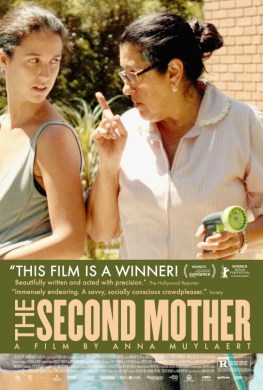
The Second MotherAnna Muylaert got more than a great performance by casting Regina Casé as Val, the old-fashioned house maid to a wealthy Sāo Paolo family, in her drama “The Second Mother.”  She subverted an entire media personality as Casé holds a position in Brazilian culture similar to that of Oprah Winfrey in America.  But even for those international audiences unaware of the iconography Casé carries, the film still works marvelously.
Muylaert’s film functions as an insightful, incisive look at modern class dynamics on the strength of its script and the characters who populate it.  While countless film relegates household workers like Val to background characters, “The Second Mother” grants her protagonist status and a rich, complicated interior life.

After decades of care for her upper-class family – and essentially serving as the surrogate mother for their teenage son Fabinho – Val has grown quite comfortable in her role.  She has internalized the rules and divisions that govern the household, accepting the arrangements as practically natural.

That all changes, however, with the arrival of Val’s biological daughter, Jéssica (Camila Márdilao).  After years being raised by relatives, Jéssica seeks a stable place to live while she applies to college and ultimately decides the best option is to move in with her estranged mother.  The family matriarch Barbara insists Jéssica will be welcome in the house, even going out of her way to make sure the newest arrival feels welcome and comfortable.

But everyone gets a little more than they bargained for with Jéssica, who pushes the boundaries of acceptable behavior for the household help.  She resists acquiescing to the second-class citizen position to which Val resigns herself, acting as if she deserves equal access to the house in the same way as Fabinho.  To Val’s surprise, the family scarcely kicks up a fuss!

As Jéssica tramples the usual separations between classes and generations, “The Second Mother” exposes the divisions in society.  In doing so, Muylaert asks if they have any place in a system that supposedly fosters meritocracy and upward mobility.  Her exploration is both gripping to watch in the moment and fascinating to ponder after the film finishes.  B+3stars


REVIEW: Prisoners

19 09 2015

Denis Villeneuve’s “Prisoners” possesses a remarkable precision in nearly every aspect of its execution.  It is palpable in the mood, the performances, the script from Aaron Guzikowski, and especially the photography by Roger Deakins.  As the abduction of two children forces a father (Hugh Jackman) to extreme measures of extracting vengeance, the film patiently and methodically follows his descent into an inhumanity on par with his daughter’s abductor.

At times, Villeneuve’s realization of this unraveling feels so airtight that it comes across almost as stifling and constrictive.  Somehow, the film feels like it needs to breathe.  Yet on further inspection, that is not the case.  Villeneuve knows exactly how much oxygen “Prisoners” needs to survive and refuses to dole out any more of it than is necessary to give each scene a pulse.  This makes his film burn not only slowly but also consistently, illuminating the depravity of cruelty to children with its steadfast flame.

His exactitude directly counters the nature of the narrative, a complicated ethical story with neither an easy outlet for sympathy nor a character that lends his or herself to identification.  The closest figure offered for a connection is Jake Gyllenhaal’s Detective Loki, whose adherence to rationality and order makes him the most level-headed presence in “Prisoners.”  He retains a rather detached perspective on the case of the missing girls rather than allowing himself to succumb to the levels of hysteria from the grieving families.  If everyone else in the film yells, Loki speaks in a whisper.

In a way, that soft-spoken approach makes for the only major flaw of “Prisoners” that I could find.  The film’s audio mix is all over the board; the sound goes in and out, then up and down.  I watched it twice at home on two different television sets, but the problem persisted.  I often had to rewind and jack up the volume to catch a line of dialogue muttered under someone’s breath.  This sotto voce technique makes the film chillingly clinical – so make sure you can hear it in all of its complexities.  B+ / 3stars


REVIEW: Peace Officer

18 09 2015

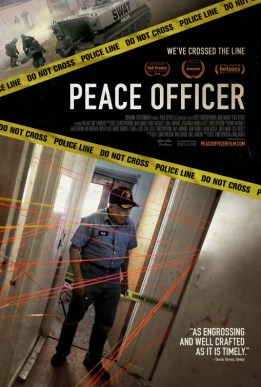
Peace OfficerIf you noticed your screening of “Straight Outta Compton” erupted in nervous laughter at the sight of a military-grade tank rolling down the streets of Los Angeles like it were Baghdad, then you need to add “Peace Officer” to your watchlist immediately.  Brad Barber and Scott Christopherson’s documentary tackles the troubling trend towards aggression in the American police state, surveying the human cost of their violence.

For an initial briefing for how this state of affairs came to be the norm, preface the film with John Oliver’s superb segment on police militarization.  But unlike Ferguson, an area that is majority minority, the rural Davis County, Utah, in “Peace Officer” appears primarily white.  Separated from racial rhetoric, the issue of police brutality comes into an even starker light as its own problem in need of instant remedy.

Officers should serve and protect a people, not occupy or terrorize them.  This simple distinction is the message of the film’s subject, Dub Lawrence.  He founded his county’s SWAT Team but now stops at nothing to see the unit held accountable for taking the life of his son-in-law, among others.  The case of that family members makes up the backbone of “Peace Officer,” but Barber and Christopherson make sure to include countless other stories of families brutalized by the police and forced to comply with whatever force they mete out.  Oh, and they also intercut with the tone-deaf responses given in interviews by local officials, who of course find it ludicrous to say the police has come to resemble the military.

Lawrence identifies the larger issue at play here as one of civil rights.  How can we have an equal society when the law’s permissiveness essentially allows one group can act essentially without risk of repercussion?  The question is one every American needs to ponder because the next victim could be someone you know – or you.

“Peace Officer” is hopefully the closest thing the United States could ever produce to an equivalent of “The Act of Killing,” Joshua Oppenheimer’s frightening documentary exposé on the effects of impunity in Indonesian society.  But if we continue on our current course, future films will make it look tame by comparison.  B+3stars


F.I.L.M. of the Week (September 17, 2015)

17 09 2015

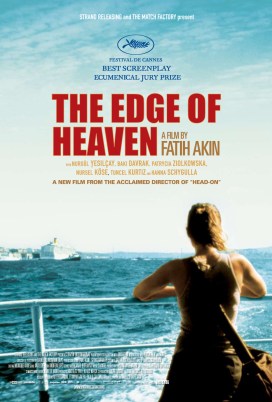
The Edge of HeavenFatih Akin had a bit of a rough go with the film festival circuit the last time around with his Armenian genocide drama “The Cut,” which received nearly unanimous pans out of Venice.  To my surprise, the film managed to secure U.S. distribution (I had all but given up hope of ever seeing it).

So in honor of throwback Thursday, I’ll take the “F.I.L.M. of the Week” column back to a time when Akin had much more success appealing to the festival crowds.  In 2007, his nation-hopping drama “The Edge of Heaven” took two prizes at the Cannes Film Festival and established Akin as a major name in European cinema. The film has the scope of a Soderbergh or Iñárritu multinational drama but does not aim for a grand global statement.

Instead, “The Edge of Heaven” resonates on a human scale.  Though the film jumps from Turkey to Germany and then back, the thematic focus is not on the borders that divide people.  Rather, Akin looks at the forces that unite and bind us together against the odds.  For these characters, those would be an odd combination of coincidence, missed opportunities, bad timing, and – ultimately – grief.

In its multiple segments, connected to each other by a character who appeared in another episode, “The Edge of Heaven” portrays numerous tragedies and calamities that befall people both good and bad.  There’s the tragic story of the prostitute Yeter (Nursel Köse), who just wants to help her estranged daughter Ayten (Nurgül Yeşilçay) back in her native Turkey.  But little does she know that Ayten fled Istanbul as a political dissident and seeks a country to grant her asylum.  Her quest to find a safe space ultimately draws in Ayten’s good-hearted German girlfriend Lotte (Patrycia Ziolkovska) as well as another German, Alisan (Baki Davrak), who seeks to help her as a service to Yeter.

If the web of interlocked narratives seems confusing in my verbose plot summary, it will not feel that way experiencing the nuances of story and emotion built into Akin’s script.  His is the rare film among the so-called “hyperlink cinema” trend that is more concerned with developing characters than finding ways for their paths to cross.


REVIEW: Everest

16 09 2015

EverestTowards the end of the lengthy expository section of “Everest,” journalist Jon Krakauer (Michael Kelly) asks the question on everyone’s mind: “Why Everest?”  The film recounts a harrowing climb under the tutelage of mountain guide Rob Hall (Jason Clarke), who leads a group that does not necessarily look a typical band of sport climbers.  Knowing what exactly motivates them to reach the planet’s highest peak is a reasonable thing for an audience to wonder.

In this one moment perfectly set up for characters to bare their souls – the writer makes for a reasonable excuse to pose such an inquiry – “Everest” pretty much whiffs.  When accomplished scripters William Nicholson and Simon Beaufoy cannot deliver on an obvious occasion to answer what deeper meaning this mountain has, it cannot help but disappoint.

So, in the absence of a satisfactory answer to Krakauer’s question, I would like to pose it myself – albeit with slightly different punctuation and inflection.  Why, “Everest?”

Why, “Everest,” must you include a maudlin, manipulative score that tells us exactly how to feel when we should feel it?  Granted, at least they got Dario Marianelli, so it sounds pretty.  But as I watched the film, my mind often drifted to thinking about how much more intense and visceral the experience would be with the score for “Gravity.”  Such impressionistic sounds and frightening dissonances could make the environment seem dauntingly alien.  The music meant to represent climbing the world’s tallest mountain should not resemble the score for any old drama.

Why, “Everest,” must you stubbornly insist on just portraying things that happen to people?  As Hall’s group summits, they face treacherous weather conditions that put their lives in peril.  But the snowstorm is just a snowstorm.  The film lacks any sort of overarching structure of conflict, like man vs. nature or man vs. man, to imbue the challenges with deeper meaning in the mold of “127 Hours.”  The struggles remain in the realm of the personal, not tapping some greater sense of collective fear.  It’s danger without any sense of dread for the audience.
Read the rest of this entry »


REVIEW: Black Mass

15 09 2015

A movie like “Black Mass” is essentially the cinematic calendar whispering, “Winter is coming.”  It’s a gentle reminder that we are inching ever closer to a glut of prestige dramas filling screens across the country but that the best is still yet to come.  (Of course, if you read this in 2016, the last paragraph probably means nothing.)

Director Scott Cooper’s film works fine as a tiding over of sorts.  Most 2015 films so far that have provided this level of drama were low budget indies, and anything with this amount of violent bloodshed must have been a giant franchise flick.  “Black Mass,” made from a well-structured script by Mark Mallouk and Jez Butterworth, boasts a thrilling experience packaged in some remarkable production values.  It all just feels so Scorsese lite.

And for the most part, that made for an entirely satisfactory evening at the movies.  I got a film that was perfectly good.  It just never approached greatness.

The marketing of “Black Mass” makes the film look like The Johnny Depp Show, and to a certain extent, it is.  Anyone who slithers around a film with such amphibian-like eyes and a Donald Trump combover just naturally draws attention, even when not playing a notorious gangster like James “Whitey” Bulger.  But, at heart, Bulger is just a boy from South Boston (“Southie”) trying to rule its biggest business – organized crime – by any means necessary.

That involves cutting a strange deal with a former childhood acquaintance, FBI agent John Connolly (Joel Edgerton).  According to Connolly, Southie is the only place where kids go from playing cops and robbers in the schoolyards to playing it on the streets, and he gets into Bulger’s racket just like some sort of game.  As a part of their deal, Bulger goes on the Bureau’s books as an informant yet essentially gets carte blanche to take out his competition.

Depp might get the more ostensibly interesting character to play, and he certainly plays up just how intimidating and downright creepy a figure Bulger truly was.  But its Edgerton who steals the show, essentially playing a Beantown rendition of Bradley Cooper’s Richie DiMaso from “American Hustle.”  Connolly is the inside man who gets played like a harp by a key asset meant to bring him professional glory.  What motivates him to continue helping Bulger even when the jig seems up proves the heaviest and most complex part of “Black Mass,” and it certainly kept weighing on me after the film ended.  B2halfstars


REVIEW: Heaven Knows What

14 09 2015

Heaven Knows WhatJosh and Benny Safdie often draw comparisons to filmmakers like John Cassavetes for their sluggishly paced realism.  In their 2010 film “Daddy Longlegs,” I found this stylistic choice little more than a conceit.  Slow, ambling scenes tied together by little more than the whims of life were simply a method of communicating the frequent failures of a single father.
But in the Safdie brothers’ latest work, “Heaven Knows What,” that meandering quality feels integral to the experience.  The film follows Arielle Holmes as Harley, a fictionalized version of herself, as she experiences various challenges related to homelessness and drug addiction.  To have a conventional plot driven by goals and forward motion would feel disingenuous for a world populated by characters whose compulsions have them running in circles.

The movie pulses along as Harley does, from score to score, motivated by nothing little more than getting to the next high.  It makes for a unique window into a world rarely seen on screen with any sense of veracity.  “Heaven Knows What” allows us not only to stare the depravity of heroin addiction in the face on screen but also to experience the listlessness and danger that comes along with it.

Stripped of sensationalism, the Safdies endow the material with a scrappy, grimy tenacity.  Holmes’ story proves a natural match for their aesthetic sensibilities.  Hopefully they continue in this vein and reinvigorate the “social problem” drama for the better.  B+3stars


REVIEW: Breathe

13 09 2015

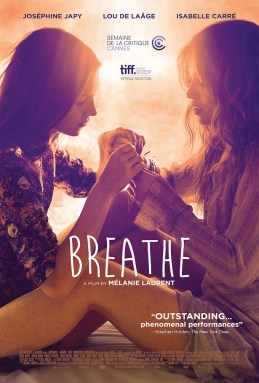
Breathe_1sht_final.inddBreathe,” a film directed by international actress Mélanie Laurent (Shoshanna!), is located somewhere between the adolescent angst of “Fish Tank” and the exploratory joys of “Blue is the Warmest Color.”  It seems counterintuitive, but Laurent is not at her best when coaxing great performances out of her young actors.  Rather, her film succeeds most when she photographs them in silent anguish, isolated in large crowds of exuberant people.

Laurent charts an age-old teenage tale in “Breathe,” the journey from companionship to the moment when the waters of friendship begin to run green with envy.  The rather unremarkable Claire (Joséphine Japy) finds relief from the mundanity of home and school by hanging out with her class’ newest addition, wild child Sarah (Lou De Laâge).  While initially fast friends, their bond breaks slowly – then suddenly.

“Breathe” has its moments of intrigue and insight, particularly whenever one character finds it difficult to perform the action described in the title.  But overall, Laurent brings little new to a fairly familiar tale.  It’s worth supporting a film by a woman, about women, yet for everyone – just don’t expect to have it take your breath away.  C+ / 2stars