REVIEW: Tom at the Farm

12 08 2015

Tom at the FarmXavier Dolan has earned a reputation as one of the most exciting rising stars in world cinema in no small part due to his directorial verve.  “Tom at the Farm” showcases a different side of him, though: restraint.  This pastoral chamber drama plays like a spare Polanski thriller with a hurried, impatient modern bent.

While this only sees release in the United States after “Mommy,” Dolan shot it before that film as the follow-up to “Laurence Anyways.”  This confirms my suspicion that the latter, a nearly three-hour opus, contains two movies worth of stylistic flourishes from the director.

Tom (Dolan, in front of the camera) arrives at the rural abode his late boyfriend Guillaume’s family, but the grieving mother has no clue what kind of friend Tom was.  Ta-da, tension! The conflict does add a few wrinkles with Guillaume’s brother and a female friend thrown into the mix, although it never really seems to reach the level of weightiness that the aesthetic suggests Dolan thinks the story possesses.

Sometimes, “Tom at the Farm” feels like Dolan just building tension for its own sake. He’s good at it because he’s a talented filmmaker. But this is more of an exercise than an epiphany. It serves Dolan by broadening his repertoire more than it serves the audience as entertaining, provocative cinema.

This is him cutting his teeth, not flexing his muscles.  Consider “Tom at the Farm” a placeholder, an unfulfilled promise of a great thriller Dolan could make – should he choose to return to the genre, of course.  B- / 2stars


REVIEW: The Man from U.N.C.L.E.

11 08 2015

Director Guy Ritchie got to where he is today – directing major studio action films – by never shying away from style.  At times, this tendency manifested itself in an almost enfant terrible fashion by flashing pizzaz when not necessarily required.  This was the Achilles’ heel of the “Sherlock Holmes” series, which suffered under the weight of his excessive flourishes.

Ritchie’s latest film, “The Man from U.N.C.L.E.,” finds the writer/director on his best behavior.  Along with a gaggle of other writers, he adapts 1960s television series for the screen in a manner completely fitting for a Cold War-era property.  It has subtle modernizing twists but always feels like a throwback to a bygone age of unimaginable suaveness.

Leading the charge, perhaps more than Ritchie himself, is leading man Henry Cavill as CIA operative Napoleon Solo. From the second he first struts across the frame, Cavill radiates an old-school electricity. He owns the screen, and he knows it. Cavill’s Solo feels cut from the cloth of debonair screen legends, and coupled with his completely self-assured booming vocal inflections, he excitingly recalls a Cary Grant or a Humphrey Bogart.

The film sees him paired with an equally formidable force, Armie Hammer as the sculpted stoic KGB agent Illya Kuryakin.  Trained to remain unmovable and unflappable, Kuryakin makes a worthy counterpoint to Solo.  The two are archrivals by nature of their countries’ ongoing diplomatic stalemate yet must become buddy cops by necessity to prevent the last holdouts of the Nazi regime from activating a nuclear weapon.

Read the rest of this entry »


REVIEW: Lorna’s Silence

10 08 2015

Lorna's SilenceFor fans of the Dardennes (a group that probably exists only at the very fringes of cinephile circles), “Lorna’s Silence” functions as an interesting bridge between two stages of the brothers’ career.  Their first few movies, which include two Palme D’Or winners in “Rosetta” and “L’Enfant,” feature hardscrabble protagonists forced to learn tough lessons in an uncaring society.  Their latest two films, “The Kid with a Bike” and “Two Days, One Night,” allow some pyrrhic victories for characters willing to fight tooth and nail for them.

“Lorna’s Silence” falls somewhere in between these dueling worldviews, both evincing the past and presaging the future.  Perhaps it feels somewhat wishy-washy as a result, but Jean-Pierre and Luc Dardenne never hit a false note in their grim portrayal of what happens to Lorna, a fundamentally good-natured woman, when she makes her own life harder by having compassion.

In order to gain Belgian citizenship so she can start a business with her boyfriend, the Albanian emigre Lorna allows herself to become a pawn in a mafia game.  She endures a sham marriage to a junkie to avoid the messiness of divorce proceedings; local boss Fabio (Fabrize Rongione) thinks Lorna can kill off her husband Claudy (Jérémie Renier) by staging an overdose.  Lorna, however, finds herself torn between her personal desires to realize her dreams and the desire to help someone clearly struggling.  The push and pull, as well as how she attempts to create some kind of balance between the two opposing forces, proves brutally compelling to watch unfold.

The film may come across as slight in comparison to the brothers’ other work, but the impact of “Lorna’s Silence” is still hard to shrug off.  If this is the toll of trying to remain upright in a world that rewards self-service, then why would anyone ever want to do the charitable thing?  The Dardennes confront some of the tough dilemmas that face the working-class, daring us to feel the pain with their beleaguered, woebegone protagonists.  B+ / 3stars


REVIEW: Ricki and the Flash

8 08 2015

The knives come out in “Ricki and the Flash,” the latest big screen outing written by “Juno” scripter Diablo Cody.  The film stars Meryl Streep as the titular character, a rock musician who ditched parenting her three children to entertain a half-full dive bar.  When her daughter Julie (Streep’s own daughter, Mamie Gummer) suffers a breakdown after getting unceremoniously dumped by her husband, Ricki is called off the bench and get in the family game once more.

Not unlike Cody’s 2011 effort “Young Adult,” articulate characters relish in shanking each other with particularly cutting remarks.  Decades of resentment get dredged out in the wake of Ricki’s reappearance with each of her estranged children as well as her ex-husband Pete (Kevin Kline) and his new wife Maureen (Audra McDonald) seeking to land the final blow.  “Ricki and the Flash” plays out much like a theatrical family melodrama that packs an especially potent load of venom.

Director Jonathan Demme’s last fictional feature, “Rachel Getting Married,” featured a similar set of conflicts hashed out between relatives.  He could have settled for directing “Ricki and the Flash” on autopilot, repeating the same techniques to produce a similarly effective result.  Yet rather than replicating his verité-style camera, heavy on observational close-ups to glean emotional breakthroughs, Demme opts for something a little more standard here.

Normally, that might make for a sticking point.  But it feels like the right choice to convey Cody’s story.  Though no subgenre of “deadbeat dad” dramas exists, she seems to make a sort of gender-swapped revision to the stock character.  Presenting Ricki within a more traditional framework, ironically, draws attention to how she bristles with the established conventions of storytelling.

Read the rest of this entry »


REVIEW: Dark Places

7 08 2015

Dark PlacesDark Places,” the latest cinematic adaptation of novelist Gillian Flynn, provides a similar ride to her smash hit “Gone Girl” on a smaller and slower scale.  Satisfactory yet not sensational, it will play just fine for the shut-in cinephile looking for a modest recreation of Fincher’s phenomenal film.

Like “Gone Girl,” “Dark Places” shuffles back and forth between two timelines.  The first takes place in the present day, where Charlize Theron’s Libby Day grapples with a little bit of survivor’s remorse but far more money issues.  The second, set in 1985, depicts the infamous events that gave her fifteen minutes of fame: the slaughter of her mother and two sisters.  Her good-natured but incorrigible brother, Ben, takes the rap for the crime.

Arguably, there are more balls in play during “Dark Places.”  The present day story centers on Libby almost exclusively as she begins to question her recollection of the murders and her testimony that put Ben behind bars.  Her quest to re-examine the truth comes after honest probing – and cash bribing – by Nicholas Hoult’s Lyle, a fanatical devotee of the case’s minutiae.

Meanwhile, on the Day’s rural turf, the film follows more than just Ben (Tye Sheridan) as he gallivants between some Satanist burnouts and his ill-tempered girlfriend Diondra (Chloe Grace Moretz).  It also shows the travails of the embattled matriarch, Christina Hendricks’ Patty, as she fights tooth and nail to preserve her family’s dignity and land.

Read the rest of this entry »


F.I.L.M. of the Week (August 6, 2015)

6 08 2015

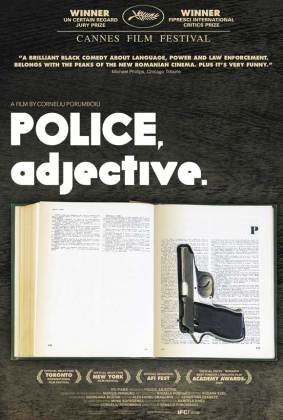
Police, AdjectiveHow has someone yet to remake the Romanian New Wave film “Police, Adjective” for an American audience?  Seriously, this needs to happen.  Though the action of the film takes place on another continent, this could easily be a film about the United States with just a quick change of language and setting.

“Police, Adjective” follows just who you think it would – Cristi, a police (noun) officer.  He gets assigned to nab a low-level drug dealer, which involves a lot of tedious tracking, observation, and then logging his notes.  The bureaucracy he faces proves soul-crushingly oppressive, and writer/director Corneliu Porumboiu lightens up these portions of the film with a pitch-black comedic tone.

But this is not a movie about the investigation itself.  “Police, Adjective” goes further into the profession beyond the duties required to police (verb) a population, inquisitively asking who gets policed and why.  Cristi, in all the time he spends tailing his target, cannot help but wonder why he wastes his time on the little guy rather than a drug kingpin.  (Sounds oddly similar to the rationale behind the American “War on Drugs,” if you ask me.)

Cristi starts arguing that the police miss the forest for the trees and begins to see the myopia play out in the law, in language, as well as in systems of institutionalized and internalized thought control.  It all leads up to a rip-roaring climax of … reading the dictionary.  But never has that act seemed so gripping.  Porumboiu’s film gives primacy to the written word, a predilection emphasized by the use of tilts down Cristi’s police reports instead of a conventional voiceover.

He wants nothing less than to force his audience to deeply consider what they think the word “police” should mean.  And that conversation is so vital, apparently in Romania as much as in the United States.  Every time I hear about another senseless death at the hands of the police – be it Michael Brown, Eric Garner, Tamir Rice, Walter Scott, Freddie Gray, or Samuel DuBose – my mind comes back to “Police, Adjective.”

Corneliu Porumboiu’s film is certainly not for everyone, to be clear.  He uses long shots that conceal more than they reveal, which ultimately it difficult to get invested in Cristi’s crisis of conscience with such limited access to his headspace.  In addition, he uses some brutally long takes in the early portion of the film that consist of Cristi meandering just out of sight from his target; they convey his tedium by making us feel it.

But I truly cannot shake this movie.  In spite of its flaws and its oft-impenetrable surface, it has struck a nerve somewhere within me.  That alone is enough to qualify it for the “F.I.L.M. of the Week.”  And I hope it is enough to qualify “Police, Adjective” for an American remake that will compel a greater number of people to grapple with these important questions about the role of police in modern society.


REVIEW: Fantastic Four

5 08 2015

Fantastic FourIn an world where comic book adaptations are becoming bigger and louder, “Fantastic Four” stands out.  Somehow, it manages to turn exciting material – which worked just fine a decade ago, I might add – into a dull movie that arrives stillborn and never gains a pulse.

Despite a cast of rising stars whose accomplishments and skills easily outweigh their counterparts in the 2005 iteration, writer/director Josh Trank never lets them achieve liftoff.  Miles Teller, Kate Mara, Michael B. Jordan, and Jamie Bell are all better actors than “Fantastic Four” lets them be.  Every scene plays out like they were each slipped an Ambien right before the camera started rolling, inhibiting chemistry and numbing emotion.

Their energy would have served as a necessary component to make the film pass as even remotely serviceable.  Trank, working with frequent “X-Men” writer Simon Kinberg as well as Jeremy Slater, essentially stretches the plot of a typical Marvel first act to feature length.  What should take about 20-30 minutes plays out over 100 minutes in “Fantastic Four,” and the pace feels appropriately molasses-like.  Trank’s big climax would function as a precipitating event in a normal film.

Apparently no one at Fox paid attention to the cratering of fellow Marvel property “Spider-Man” when Sony rebooted it in 2012.  The diminishing returns of that franchise are largely attributable to the fact that audiences do not want to sit through a slightly altered retread of a story they liked just fine ten years ago.  “Fantastic Four,” like “The Amazing Spider-Man,” returns to the tale of heroic origins to issue a slight corrective that will eventually set the series on a different course.

There is simply too much vying for audiences’ attention, not only on the silver screen but also on televisions, tablets, and mobile devices.  If the creative minds that be want to do something new with familiar material, they had better go ahead and do it.  No one wants to wait around for them to get their act together as they rejuvenate it.  So, naturally, “Fantastic Four” inspires listlessness as it makes us consciously realize the drain on our time as it slips away from us.  D1star


REVIEW: Trainwreck

4 08 2015

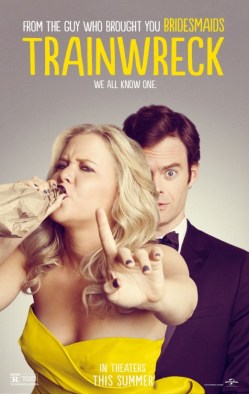
Trainwreck PosterAt roughly the midpoint of “Trainwreck,” writer Amy Schumer sets up a remarkable parallel between two scenes at the same baby shower.  The character Amy, played by Schumer herself, has to endure a brutal game of “Skeletons in the Closet” where posh young mothers spill dark secrets … that actually reveal themselves as pathetically and predictably tame.

Meanwhile, Amy’s boyfriend, Bill Hader’s Aaron Conners, recounts details of the many athletes he has helped rehabilitate in his sports medicine practice.  He rattles of name after name to the same awe-struck reaction from a crowd of unfamiliar men … until he drops the name Alex Rodriguez.  Among this set of New Yorkers, this blasphemy inspires a sudden outburst of profanity.  But then, Aaron goes back to some more agreeable athletes, and the peanut gallery resumes the standard call-and-response.

These scenes, juxtaposed as they are, communicate a central tenet of “Trainwreck.”  Both genders, when taking cultural stereotypes of gender to the extreme ends of their performance, deserve mockery for their folly.  (This also includes John Cena, who briefly appears as Amy’s bodybuilding boyfriend who talks about the gym like many women talk about the nail salon.)  Schumer’s feminist intervention into the romantic comedy genre aims to level the playing field for men and women, not by putting the latter on any kind of pedestal but through suggesting the common humanity that unites them.

Her on-screen persona in “Trainwreck” arrives at the perfect moment, a time where many female characters are either monotonically strong or practically invisible and silent.  The “approachable” Amy, as her boss (played by a bronzed Tilda Swinton) condescendingly deems her, is a romantic comedy heroine cut from the cloth of contemporary society.  The hard-drinking, truth-telling, free-wheeling character benefits from the assertiveness in romance that women gained through the sexual revolution, yet she also pushes up against the lingering constraints left unconquered by that unfinished movement.  Amy also embodies the spirit of a generation scared to death of commitment, an era when the only thing scarier than the sea of possibilities is the choice to settle on one of them.

She meets her match in Aaron, an equally plain-spoken person who falls for Amy as she profiles him for the men’s magazine S’nuff.  The big difference, though, is that he possesses self-confidence where she shields her insecurities with self-deprecation.  Aaron, notably, never becomes a human incarnation of a “Mr. Wonderful” doll.  While exceedingly nice and admirable, Amy exposes a few of the buttons he might not like people pushing.

“Trainwreck” does not place Amy in the position of damsel in distress, nor does it make her some kind of prize for winning once tamed.  Amy’s impetus to change, although partially spurred by Aaron, seems to derive from an internal desire to stop numbing herself to the world.  And even in her triumphs (including the grand finale), Schumer always makes sure her Amy still shows some amusing, endearing flaws.  She is allowed to have flawed, circular logic, and it does not mean she is crazy; it just means we embrace her all the more.

Read the rest of this entry »


SAVE YOURSELF from “Horns”

2 08 2015

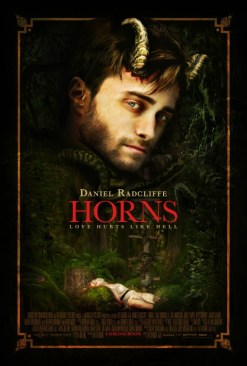
HornsLast summer, a friend of mine posted a cringe-worthy Huffington Post article on my wall that was titled “8 Movies From The Last 15 Years That Are Super Overrated.”  How on earth this piece managed to secure publication on a website of that caliber is beyond me since it included such memorable phrases as, “The problem with 2011’s ‘The Descendants‘ is that it sucked.”  Beyond being a terribly constructed and redundant sentence, it is also clearly NOT film criticism.

I try to avoid poor writing and potshots in my own reviews (although sometimes the devil on my shoulder manages to win).  But wow, I sure am tempted to pull out some low blow for Alexandre Aja’s “Horns,” one of the most wretched movies I have watched in quite some time.  So rather than drop to the level of that piece, I just decided to revive an old column … “Save Yourself!”

I can understand why Daniel Radcliffe and his management team might have thought this film seemed like a good idea on paper.  What better way to shed the squeaky clean image of The Boy Who Lived than to play someone who literally sprouts horns and basically functions as a Satanic figure?  “Horns” is basically his equivalent of Miley Cyrus twerking on Robin Thicke at the VMAs, though turns in “Kill Your Darlings” and “What If” accomplish the goal far better by just letting Radcliffe play convincing, real people.

Aja essentially lets Radcliffe off the leash in the role of Ig Parrish, letting him play the entire movie at the energy level the actor rapped “Alphabet Aerobics” on “The Tonight Show.”  After being falsely accused of raping and murdering his girlfriend, Ig’s horns serve as a supernatural blessing (or curse) to divine the real killer because – get this – the protuberances force people to spill all the skeletons from their closets.  Every moment feels so incredibly over the top and overblown, be it for comedy or for violence.  Actually, come to think of it, the violence even becomes perversely (and appallingly) comic in its heightened proportions.

“Horns” is not like a film in the vein of Sam Raimi’s “Drag Me to Hell,” where the ambiguity and ambivalence leave an exhilarating void for the viewer to supply their own reaction.  It’s just an indecisive tonal scramble, not sure whether it wants to be an all-out festival of gory horror or a black comedy.  Aja does neither effectively, and the film becomes a brutal slog to endure.  It’s not even overdone to the point of “so bad it’s good.”  This is just pain bad.  D1star


REVIEW: 10,000 km

1 08 2015

10,000 km10,000 km” puts a modern twist on the age-old conundrum known as the long distance relationship.  The Catalonian couple of David Verdaguer’s Sergi and Natalie Tena’s Alex finds itself rent asunder when the latter receives an artistic residency in Los Angeles.  Having made their union work for several years, they figure they can make it one more while Sergi remains in Barcelona.  Besides, with Skype and other text messaging services, they can remain in touch regularly.

Though the majority of Carlos Marques-Marcet’s film plays out as a two-hander centered around their conversations, yet “10,000 km” is best at capturing the loneliness of their arrangement.  While they may carry out talking with nothing mediating their connection but a screen, they still feel alienation effect of approximated presence.  They have each other, almost – and that tiny missing piece feels amplified by the number of kilometers separating them.

Nothing about Sergi and Alex’s ups and downs makes for particularly gripping cinema since their obstacles are fairly standard and predictable.  Their drama recalls Richard Linklater’s “Before” series with less developed characters and fewer profundities about the nature of love. But the way in which Marques-Marcet decides to let the story of “10,000 km” play out does prove quite absorbing for those who want to look beyond the chain of events.

As the scenes play out in rather drawn-out fashion, ponder a few questions: Why did he choose to show just the screen rather than the character’s full environment? Why depict a conversation from this person’s vantage point as opposed to the other’s?  “10,000 km” is a great environment to think about more than what the director says and move on to how he chooses to say it.  B2halfstars


REVIEW: A Lego Brickumentary

31 07 2015

A Lego BrickumentaryA Lego Brickumentary” gets part of its title by clever wordplay on the word “documentary,” appropriating about half of the letters it contains.  Fittingly, that roughly approximates the amount of content in the film that resembles non-fiction cinema.

As fun and engaging as the film might be to watch, directors Kief Davidson and Daniel Junge essentially do the bidding of the Lego brand.  This amounts to a shinily mounted piece of corporate propaganda, the kind of CNBC special that highlights the global reach and outreach of the company.  Lego comes across as a product deeply responsive to the needs and desires of its fans across all age groups – and, of course, the corporate social responsibility aspect gets trumpeted big time.

The film, with its friendly and funny narration provided by Jason Bateman in CGI Lego form, feels like it is not meant for consumption in the fashion of a normal documentary like “Citizenfour.” Discretely contained portions could play across multiple rooms at a Legoland exhibition, which may very well be its ultimate destination. (In which case, the feature format makes for a particularly egregious cash grab.)

But the puff piece elements notwithstanding, “A Lego Brickumentary” actually makes for pleasantly informative viewing. How people use the bricks for art, physics, and social connection proves very unexpected and fairly intriguing. Disentangling the reality from the corporate PR spin makes for a small concern, sure, yet getting to see how the Legos make such universal creative building blocks from geeks to math professors actually makes for quite an eye-opening watch.  B / 2halfstars


REVIEW: Mission: Impossible – Rogue Nation

30 07 2015

The “Mission: Impossible” series, now spanning nearly two decades with its five installments, somehow manages to sustain a childlike sense of adulation for its leading man.  Tom Cruise, perhaps the biggest movie star in the world when the franchise launched in 1996, has seen his ups and downs both personally and professionally in the years that followed.

But watching “Mission: Impossible – Rogue Nation,” it seems like his star has miraculously managed to lose no shine.  These movies see no parallels between the furious arm-pumping intensity of Tom Cruise’s movie run and the limber legs that propelled him to jump on Oprah’s couch.  Never does his stardom feel laced with irony or constrained by public perception.  The film treats Cruise like the greatest thing since sliced bread … or at least since Harrison Ford.

Cruise makes his first on-screen appearance by dashing into frame after a quick cut on his unexpected opening line, and it feels triumphant.  This is the cinema’s closest approximation to the kind entrance that Bernadette Peters or Idina Menzel can make when they walk on stage – which is to say, it mandates a pause to let the audience applaud simply on sight.  Cruise, working on assignment for writer/director Christopher McQuarrie and co-writer Drew Pearce, so thoroughly owns his superstardom here that he gains the power to push “Going Clear” completely out of mind for two hours.

Read the rest of this entry »


F.I.L.M. of the Week (July 30, 2015)

30 07 2015

Code BlackLeave your feelings about Obamacare at the door and enter with nothing but your humanity for “Code Black,” my pick for the “F.I.L.M. of the Week.”  This documentary takes one of the most hotly politicized issues of our time and makes it about people again.  Healthcare is a far too important topic to blindly accept a party line, director Ryan McGarry suggests, and we all ought to seriously consider what steps are really necessary to ensure the simplest way to preserve the doctor-patient relationship.

The film follows a class of ER doctors in America’s busiest facility, Los Angeles County Hospital.  And not only do they have the highest patient volume, but they also take on some of the toughest clients that get dismissed by private facilities – in particular, the mentally ill.  On top of it all, their operating budget gets determined by county officials who can easily choose to allocate less to the hospital (and usually do).

The residents all enter with a great sense of hope and integrity in their chosen career path, much of which gets slowly drained out of them over the course of a year.  They all speak eloquently of how they want to spend time with the sick, getting to know what causes their pain and quickly determining treatment.  But the reality, they come to find, is just mountains of paperwork to comply with crushing privacy regulations as well as defense against malpractice lawsuits.

Is this the ideal resting heart rate of America’s healthcare system?

“Code Black,” at the very least, hands the microphone over to the doctors and lets them describe the situation from the frontline.  No Beltway blustering allowed here, just trained professionals trying to live their calling and do their jobs in spite of all the obstacles placed in their way.  If what McGarry captured in his film represents even half the truth, then anyone who wants to become a doctor in this climate must be some percentage crazy.

Let’s just hope the population of crazies stays replenished for a while, lest we end up in the position of one of the rare patient interviewees in the film.  The 58-year-old attorney, who appears to have attained a relative amount of success, saw her business go up in flames and her insurance evaporate with it.  When we see her in the film, she waits for treatment at LA County with plenty of the urban poor.  McGarry asks her what she’s going to do next, and she can only reply, “I don’t know.”  The look of utter panic in her eyes ought to scare the living daylights out of everyone watching.  Thank goodness the doctors profiled in “Code Black” care.


REVIEW: Tangerine

29 07 2015

TangerineThe big headline surrounding “Tangerine” after its premiere at the Sundance Film Festival concerned its radical filming techniques.  Director Sean Baker made the decision to shoot his entire project on an iPhone using anamorphic lens adapters, which makes it the first widely legitimated film made with such mobile cameras.  As he later explained in interviews, this choice largely came about due to budgetary concerns.

But to relegate this aesthetic selection simply to fiscal matters does the film a disservice.  The iPhone does not merely capture the events of “Tangerine.”  It heightens them, lending a sense of ceaseless motion and excitement to the proceedings.  Unlike a larger camera, the untethered iPhone as a recording mechanism can float more freely through a scene.

With such a camera, Baker (who also co-shot the film with Radium Cheung) has the freedom to quickly jump around a moment to find the most interesting component at any given time.  This enhanced capacity makes a perfect match of form to content as “Tangerine” follows a day in the life of two transgender sex workers in Hollywood.  Their activities, which are covert and shady by nature of their illegality, lead to many dramatic and surprisingly hysterical situations.

At first, “Tangerine” seems content to just portray its two leads, Kitana Kiki Rodriguez’s Sin-Dee and Mya Taylor’s Alexandra, shooting the breeze in swear-heavy vernacular.  Both are fast-talking chicks quick to erupt in anger over the backhanded dealings of their pimp, Chester.  The camera mostly follows as their mouths and egos lead them across town, resembling a collection of anecdotes.  It glides by on novelty for a while but fully redeems itself when a number of the threads connect in one uproarious climax.

Sneakily, “Tangerine” also comes full circle in the end and reveals itself as a rather touching chronicle of friendship through thick and thin.  Sin-Dee and Alexandra are two indelible creations who will likely linger in the cinematic landscape far longer than the battery of an iPhone.  B+3stars


REVIEW: Irrational Man

27 07 2015

Irrational ManThe summer of 2015 will likely go down in the record books as one that saw long overdue leaps and bounds for women in cinema.  They fought back against the patriarchy in “Mad Max: Fury Road,” ruled the roost in comedy with the one-two punch of “Spy” and “Trainwreck,” and the girl power in front of (as well as behind) the camera in “Pitch Perfect 2” made for the most overperforming sequel of the summer.  Even the two highest-grossers, “Avengers: Age of Ultron” and “Jurassic World,” could not escape harsh scrutiny for the way they treated their leading ladies.

Apparently, Woody Allen did not get the memo.  The legendary writer and director deposits ideas as they come in a shoebox, often returning there for inspiration at a later date. His annual feature for 2015, “Irrational Man,” could not be a more inopportune grab from the pile.  Coming at a time where people finally expect female characters to resemble fully-fleshed people, his writing feels hopelessly retrograde and outdated.

The dynamic between his two leads feels quite familiar to anyone even slightly versed in Allen’s work.  At the center lies a man of conventional looks yet unconventional smarts, a role played here by Joaquin Phoenix as Abe Lucas.  His performance thankfully resists the easy temptation to resemble a Woody Allen caricature; Phoenix appears as if he is still emerging from the haze of “I’m Still Here.”  His depressive, alcoholic philosophy professor also looks about seven months pregnant, to boot.

In the universe according to Woody Allen, such a brilliant intellect should naturally draw the interest of women – young, attractive, nubile ones in particular.  Emma Stone assumes this part in “Irrational Man,” and no amount of her charm or grace can effectively mask just how one-dimensional her character Jill really is.  Allen makes it so her mind singularly focuses on Abe and only provides her the range of good-natured academic interest in Abe to full romantic pursuit.  Reconciling the fact that this character comes from the same writer who gifted us “Annie Hall” and “Blue Jasmine” proves a tough task.

Read the rest of this entry »