REVIEW: The Beguiled

2 07 2017

I’m accustomed to having strong reactions to Sofia Coppola’s films, both positively (“The Virgin Suicides,” “The Bling Ring“) and negatively (“Lost in Translation,” “Somewhere“). So perhaps the most shocking part of her latest work, “The Beguiled,” was how ambivalent I felt towards it. Most moments landed, others didn’t … but nothing really had much magnitude.

I can attribute some of this to my subject position as the viewer; “The Beguiled” is not a movie for me as a male. And that’s ok! There are no shortage of movies that indulge my viewpoint and gaze. (Like, basically all of them.)

After finding and rescuing Colin Farrell’s “blue belly” Corporal McBurney in the Virginia woods, a group of Confederacy-supporting women residing in a schoolhouse must toe the delicate line between rehabilitation and accommodation. Is he their prisoner? Guest? Somewhere in between? Everyone from the matron Miss Martha (Nicole Kidman) to the more withdrawn instructor Edwina (Kirsten Dunst) and even the eldest student, the precociously flirtatious Alicia (Elle Fanning), must draw the line for herself.

Coppola opts for a studied minimalism in “The Beguiled,” emphasizing the natural surroundings of the estate rather than any lavish decoration or dress. Most of the film focuses on the very thin veneer of southern gentility covering over the women’s pent-up sexual desires. The presence of a man, even the enemy, is enough to stir up some strange sensations not normally experienced in a single-sex environment.

At times, Coppola does let the libidinous activities overpower the psychodrama; it’s as if her characters slowly become little more than their sensual stirrings. And approaching the story with little first-hand experience of Southern culture, the coastal-based Coppola does tend to exoticize their particular strain of desire. But I’m happy to watch her explore these women’s impulses. They deserve treatment as subjects of erotic fantasy, not merely its objects. B


REVIEW: Nerve

1 07 2017

Henry Joost and Ariel Schulman’s “Nerve” instantly makes us aware that, for today’s high schoolers, life is not lived alongside a screen so much as it is lived inside one. Devices are not an embellishment to reality but rather a replacement for it altogether.

The story, adapted from Jeanne Ryan’s YA novel, fashions a new kind of social media frenzy for young people called – well – Nerve. In this game, participants can enter either as watchers observing the dares or as players performing them. Cash incentives encourage increasingly bananas stunts, which both groups are forbidden to report to law enforcement.

The player/watcher divide becomes an all too convenient dichotomy for passive/active, but the Nerve game is a bit more complicated than high school cliques. It’s more like bystanders and perpetrators as shown by the misadventures of Emma Roberts’ Vee, who uses the game as an escape for a debilitating family life after the death of her brother. She’s a person of good intentions egged on by a crowd of people whose motivations are not as pure.

Not unlike Joost and Schulman’s cultural landmark debut “Catfish,” the film starts off with promising, incisive commentary about what social media does to people … only to devolve into bizarre theatrics that veer wildly off-message. “Nerve” makes excellent points about how easy it is to manipulate us with personal information that we willingly provide, and that deserves more of a horror/thriller ending than just another banal action set piece. B- /


REVIEW: Mother (2010)

28 06 2017

I’ll give director Bong Joon Ho credit for avoiding a lot of maternal tropes in his mysterious thriller “Mother,” specifically any bludgeoning Oedipal allusions. In the film, an unnamed widow (who we first meet as she dances alone, oddly and blithely, in a field of wheat) cares deeply for her stunted son Do-joon. So deeply, in fact, that she takes it upon herself to play detective and investigator when he is arrested for murder.

Their sleepy South Korean town is not accustomed to any sort of crime, so a body turning up in public view threatens to turn over a lot of stones to which authorities had cast a blind eye. One such item is the unlicensed acupuncture practice run by the mother. Yet for all the risks the situation poses, she is more than willing to exploit the turmoil so she can find a way to exonerate her son … or destroy the evidence.

“Mother” works a lot better in its first act, an exciting chain of events with more of Bong’s dark humor. (A moment of replicating the crime scene with a doll, only to have the head fall off in front of a crowd, had me in stitches.) After the mother doubles down and dedicates herself to deliver a personal version of justice, it gets a little too grim and somber. As a director, he makes more interesting when he embraces the quirks rather than suppressing them. Solid genre effort though this might be, it’s missing a little bit of spark as it comes to a close. B /


REVIEW: Okja

27 06 2017

Director Bong Joon Ho took oblique shots at social malaise through allegory in his films “The Host” and “Snowpiercer,” but he goes in for a more direct kill shot with his latest, “Okja.” The film is a blistering sendup of multinational corporations’ hunt for profit and the ridiculous measures they take to appear responsible while pursuing policies that cause harm.

The story is a bit disjointed, but that seems to be by design. After a brief prologue introduces the Mirando Corporation’s bio-engineered “superpig” program to the world, Bong cuts to ten years later where a well-adjusted creature, Okja, lives happily with her owner Mija (An Seo Hyun). The idea, perfectly engineered by company public relations, is to lease out these new creatures to farmers across the world who can raise them humanely. Then, the bells and whistles of sleekly-produced, insidious infomercials featuring Jake Gyllenhaal’s reality TV star  Johnny Wilcox – essentially Steve Irwin on smack – will convince the public that the meet made from these animals is safe for consumption. And delicious, to boot!

The farm-to-slaughterhouse pipeline gets disrupted when an animal rights group intervenes to save Okja. They call themselves the Animal Liberation Front (ALF) and establish their non-militancy before their ideals, a hilarious sendup of politically correct protest culture. These young idealists involve Okja and Mija in their plan to inflict economic damage on the Mirando Corporation and its CEO Lucy Mirando, played by Tilda Swinton as a woman who talks like she’s forcing every word with the energy of someone trying not to drown.

Read the rest of this entry »


REVIEW: Cars 3

26 06 2017

LPixar, like any purveyor of family entertainment, tells stories laden with themes. They do a better job than most at letting those life lessons arise naturally from an ingeniously derived plot rather than letting the morals dictate the proceedings. For whatever reason, the “Cars” franchise has been an outlet for some of the animation studio’s most blatant sermonizing, and “Cars 3” is no different.

As champion racer Lightning McQueen (voice of Owen Wilson) faces obsolescence in his sport thanks to an influx of “Moneyball“-esque stats and data, he has to take his game back to the basics. At the new racing facility, his trainer Cruz (voice of Cristela Alonzo) tries pulling some Mr. Miyagi style mind tricks on him as she eases him into their high-tech treadmills and simulators. Yet for all Cruz’s fancy techniques, Lightning shows how little she knows when taking her outside to race. There’s something to say for real-life experience as opposed to simulations of it.

But lest we think that Lightning is the pinnacle of senior sagacity, the duo eventually links up with some pals of his mentor, Doc Hudson. (Paul Newman’s character from the first film keeps appearing in so many flashbacks that you’d think he died in 2016, not 2008.) These vintage autos help Lightning realize that joy and promise lie beyond our youthful days, though they also help raise his game with some of their classic, road-tested techniques. The limitations of older generations gave them different, not less, skills, and we’d all be wiser to heed their lessons.

It’s not a radical message, and Pixar did better conveying intergenerational understanding with “Up.” Still, it’s harmless to see repeated and beneficial to remember. B


REVIEW: The Little Hours

25 06 2017

Sundance Film Festival

Raunchy comedies set in a distant past always run the risk of relying too heavily on anachronistic humor. (Cough, “A Million Ways to Die in the West.”) The humor that arises from performers in period garb rattling off profanities or talking in the present-day vernacular is the definition of low-hanging fruit.

Jeff Baena’s “The Little Hours” tends to lean on this dissonance to generate comedy. Aubrey Plaza dropping F-bombs in a nun’s habit is inherently pretty darn funny. Whether it leans too heavily on the ahistorical humor is up to the individual viewer – I found it a little overloaded – but thankfully it’s not the only trick Baena has up his sleeve.

The film’s story, adapted from the Medieval novella “The Decameron,” finds laughs from sending up the era’s sexual repression and religious rigor. Three naughty nuns (Plaza, Alison Brie and scene-stealer Kate Micucci) toil away in their convent under the watchful eye of John C. Reilly’s Father Tommasso, lamenting their inability to act on certain desires. Luckily, Dave Franco’s chesty handyman Massetto arrives to light their flames.

This feudal Rudolph Valentino escapes one manor, where as servant he beds the master’s wife, and gets smuggled into the nunnery pretending to be a deaf mute. Thinking him unable to hear them, the sisters let loose with some of their wildest sexual fantasies – some of which they consummate to his delight and horror. “The Little Hours” is certainly a one-of-a-kind sex comedy, worth seeing for its brazenness alone and worth staying for Fred Armisen’s Bishop Bartolomeo, who arrives at the end to scold them all with a poker-faced gall. B


REVIEW: The Hero

24 06 2017

“I know we were hoping to get good news from this biopsy,” begins the doctor of Sam Elliott’s Lee Hayden. “Unfortunately, I don’t have good news.” The scene happens so early in Brett Haley’s “The Hero” that I held out hope this kind of dialogue was not indicative of the rest of the movie and the doctor just had terrible bedside manner.

I was wrong.

“The Hero” is a stale rehash of cliches surrounding estranged fathers, aging Hollywood actors and ailing elderly people coming to terms with illness. Most of the film entails Lee avoiding the disclosure of his pancreatic cancer diagnosis so he can continue chugging away on film sets and toking his marijuana to feel the slightest hint of contentment. He’s moving slightly closer to a younger romantic interest (Laura Prepon’s Charlotte Dylan) and rapidly farther from his daughter (Krysten Ritter’s Lucy).

The one interesting bit of the movie comes when Lee sees his stock rise after a viral lifetime achievement award acceptance speech that’s sincere, thoughtful … and also the result of a Molly trip. It puts the wind back behind his sails for a brief moment, landing him an audition for one of the hottest parts in town. As he prepares, the part inspires at outpouring of feeling and emotion that he hasn’t tapped into in years since he started phoning it in.

What a shocker, life can lead to inspired art, and art can lead to an inspired life! While Elliott chewing on something more than an archetype with his distinctive drawl is a pleasure, it’s a shame that he gets such banal material to work with for his moment in the spotlight. (Haley did such a great job crafting a unique and charming story for the AARP crowd in “I’ll See You In My Dreams,” but he does not recreate that magic here.) Elliott has more to give than welling up with tears by the ocean and spouting bland platitudes of regret. Hopefully someone else lets him. C


REVIEW: The World’s End

23 06 2017

Edgar Wright might be known for his visual comedy and genre pastiche, but he’s also not afraid to throw in a little social commentary with his trademarks. Like many contemporary directors, he’s concerned with the effect of cell phones and technology on society. Part of the joke in Wright’s “Shaun of the Dead” was how little separated the undead zombies from the barely living humans on a treadmill of electronic stimulation.

His 2013 feature “The World’s End” takes that comparison to newly absurd heights. In this reunion comedy-cum-apocalyptic action flick, cell phones are the tool that’s turning residents of a sleepy British town into robotic versions of themselves. (Hit them hard enough in the head, and they’ll spew blue liquid!)

Wright’s clever twist on the genre is to focus on replacement over annihilation. As an exposition-heavy section of dialogue tells us, “They want to make us more like them.” Social change happens not as an invasion or hostile takeover, although the horror films that speak to our anxieties about it usually portray it as such. Rather, the decline of civility takes place as a gradual erosion until our humanity is barely recognizable.

Wright (and co-writer Simon Pegg) are smart to set this observation against the backdrop of the pub tour of five estranged friends brought back together by Pegg’s lonely alcoholic. As he yearns for the mythical past of his glory days, he finds the present-day changes to the people of the town make his nostalgia impossible. Yet the social commentary, which is not anything particularly monumental, comes at the expense of Wright’s usual cheeky fun. It’s nice to get a reminder that friends and happiness are two things worth fighting for – these characters just aren’t always the best merchants for that moral. B


F.I.L.M. of the Week (June 22, 2017)

22 06 2017

I’d been a little iffy on Edgar Wright as a brand-name director for years … that is, until I saw his latest film, “Baby Driver,” which was so good that it inspired me to go back and revisit his entire filmography. I’d given “Shaun of the Dead” and “The World’s End” second chances before but never returned to “Hot Fuzz,” his 2007 crime caper. Wow, was I missing out.

A second watch revealed “Hot Fuzz” to be an obvious “F.I.L.M. of the Week.” It’s smart, stylish and subversive – all the things that mark Wright’s best cinema. He can successfully play with genre like few other working directors, and this re-teaming of Wright with comedic muses Simon Pegg and Nick Frost exhibits his most seamless blend.

The adventure starts as a fish-out-of-water comedy when the impressively efficient London Metro Police officer Nicholas Angel (Pegg) gets transferred to the sleepy country town Sandford. He’s used to his presence being necessary to enforce the law in the big city. Here, Angel finds that the police have made themselves largely ornamental. There’s a strong amount of social trust in the community, and the existing police officers take a hands-off approach to handling any misbehaviors and misdemeanors they observe. Not Angel, though, who takes thwarting underage pub drinking as seriously as foiling a terrorist plot.

But lurking under the blissful bucolic facade is a cabal that threatens the townspeople by exploiting their trust and naïveté. They’re certainly lucky to have Angel around for this, although he’s hamstrung by the provincial local police chief (Jim Broadbent) and his aloof son Danny Butterman (Frost) … who just so happens to be Angel’s partner. Danny’s chief preparation for the job, aside from his lineage, is watching lots of ’90s action movies. As it turns out, that proves most helpful for combating the menace facing Sandford.

Wright pulls off the tricky task of paying homage to a series of influential films (“Bad Boys,” “Point Break”) while humorously sending them up and one-upping their antics. His comedy goes far beyond the lazy “Scary Movie” spoof; Wright works in how people interact with film and how it tints their view of the world to hilarious ends. Furthermore, he’s not just cribbing an incident or a feel from the genre and calling it a take on them. He’s mimicking their aesthetic with loud, smashing cuts and big pyrotechnics. Just appropriately adjusted for the real world.


REVIEW: The Bad Batch

21 06 2017

Fantastic Fest

I watched Ana Lily Amirpour’s “The Bad Batch” late at night as the fifth movie in a single day at Fantastic Fest – and there was still one after it – so my grasp on its granular details is admittedly not as strong as usual. Yet experiencing the film in a state of altered consciousness where I had to fight against my body’s impulses to understand what was happening in front of my eyes feels oddly fitting.

“The Bad Batch” unfolds in a richly textured dystopian Texan wasteland where even the crows do battle. The authorities leave the condemned Arlen (Suki Waterhouse) to fend herself in this wasteland where she almost immediately becomes aware of its perils after a group of cannibals take her arm. Talk about initiation by fire!

From there, the film follows Arlen’s search for revenge and answers in the unforgiving territory. But Amirpour’s interests do not lie in mere plot progression. She’s all about exploring textures, details and atmospheres – far more than in the flat, staged tableaus of her debut “A Girl Walks Home Alone at Night.” The film amounts to more than just a series of thematically interconnected music videos. “The Bad Batch” is a sustained two-hour trip, wildly unpredictable, utterly gonzo yet completely controlled. I’ll have to revisit it in a more composed state of mind, although a part of me does wonder if that will tinker with its delicate chemistry. B+ /


REVIEW: Pain & Gain

20 06 2017

Michael Bay’s “Pain & Gain” features characters who misinterpret “The Godfather,” “Scarface” … and “Pretty Woman.” So is it any surprise that the film on the whole has no idea what it’s talking about when it comes to the American Dream? The concept gets so much lip service throughout that it becomes bludgeoning. Most high school juniors could write something more insightful from their American history classes alone.

Its idea of upward mobility is really just commodity fetishism and capitalistic greed masking itself as aspiration. With their synthetic, steroid-enhanced hardbodies, the would-be Robin Hoods of South Beach feel like Reaganite heroes washed up in the wrong era. Some elements of stealing from an undeserving, coddled elite have resonance in a post-Occupy world; as one gym rat puts it, “I don’t just want everything you have, I want you not to have it.” But the political considerations feel ancillary at best.

“Pain & Gain” is at its best when Bay just embraces the physical comedy of his bulky Goliaths. Some decent humor arises from their ignorance and impotence – as “swoll” as Mark Wahlberg’s Daniel Lugo and Dwayne Johnson’s Paul Doyle may be, their common sense as men is almost entirely absent. It’s too bad that screenwriters Christopher Markus and Stephen McFeely, rather than standing outside and sizing them, choose to drop to their level and assume their intelligence level. C+


REVIEW: The Book of Henry

19 06 2017

Let’s be clear: Colin Trevorrow’s “The Book of Henry” is a strange, overstuffed movie. Its roughly 100 minute runtime manages to pack in as many traumatizing dramatic plot points as a season of network TV. I can imagine the pitch for Gregg Hurwitz’s script going something like a Stefon sketch. “This movie has everything: quirky families, a precocious prodigy, child abuse, brain tumors, premature death, a love story and a murder plot!”

Just one of its outlandish plot points would be enough to sustain a film of its length. Instead, we get one about every 15 minutes, leaving us no time to recover before the next one happens. “The Book of Henry” thus becomes unnecessarily strung out, which is a real shame as Hurwitz and Trevorrow do manage to capture some candor and earnestness with the story. Their good intentions get clouded out by how busy the film is, however.

In particular, a good portion of the film resonates when Jaden Lieberher’s titular character struggles with being helpless to enable action against injustice. “The Book of Henry” grasps the frustrating limitations of being a child, no matter how smart and well-adjusted you are. (Henry, by the way, is what I imagine the E-Trade baby would look like once he graduated from the crib.) Yet even this gets undermined when the term “child” gets trotted out as a form of dismissal in the climax. This is the film’s confusion in microcosm: a concerted effort to understand a complex problem sabotaged by the need for sensationalism. B-


REVIEW: Beatriz at Dinner

16 06 2017

The 2016 election was not just a political event. More than any one before it in the United States, the election was also a cultural event. Across Europe and other democracies, it’s long been considered normal to bring up politics in conversation. In America, however, politics rarely made their way into average dialogue. As a teacher once told me, the only safe topics of conversation with a stranger on an airplane were sports and the weather.

But now the spillover is unavoidable. We must talk about them. We can avoid it no longer. In Miguel Arteta’s “Beatriz at Dinner,” we get cinema’s first big movie about how those conversations will look – faux pas and all. (I specify “cinema” because television, with its shorter production schedule, struck while the iron was significantly hotter.)

The movie runs just 83 minutes but manages to cover a lot of ground as it leads up to the rupture of its titular character, Salma Hayek’s massage therapist and apparent “miracle worker.” After providing services for a long-standing client, Connie Britton’s well-meaning Cathy, Beatriz’s car breaks down in the driveway. Cathy, rather than shooing her off to wait with the help, invites her to dine with the family as her husband celebrates a big deal with business partners.

Well-intentioned though the offer from Cathy is, the wincing that ensues shows just how hollow her notion of cross-class communication stands at our current moment. John Lithgow’s unapologetic capitalist boor Doug Strutt makes the obvious cinematic mistake of mistaking Beatriz for a server and asks for another drink. (Of course, this has to happen.) But more than just casual racist biases emerge over the course of the evening. We see the pain of microaggressions against Beatriz as they roll casually off their tongues and jab into her dignity, many of which come courtesy of the younger married couple who we’d believe should “know better.” We observe the different feeling rules they maintain, both in terms of personal greetings as well as in the larger sense of who deserves sympathy and consideration.

Read the rest of this entry »


F.I.L.M. of the Week (June 15, 2017)

15 06 2017

We all know the stereotype: the quirky indie movie character who’s got some social anxieties and manages to perturb the calm facades of more well-adjusted peers. It’s a stock character by this point. But back at the turn of the millennium, it was probably quite novel – and maybe even a little radical. (I wasn’t watching indie films then, so I do have to guess.)

So I can only imagine what it would be like to watch “Chuck and Buck” when it premiered in 2000. Even for a first viewing in 2017, it still resides in “F.I.L.M. of the Week” territory. In a pre-“Brokeback Mountain” era, director Miguel Arteta and writer Mike White dove head into an unrequited homoerotic love story of an awkward man (White’s Buck) and the childhood friend (Chris Weitz’s Chuck) who outgrew him.

That might count as a bit of a spoiler because the nature of their relationship comes as a slow reveal. Their nature of their past relationship begins in barely perceptible undertones but gradually begins to come to light. When Buck is planning for the funeral of his mother, who he cared for well into adulthood, he calls Chuck out of the blue to attend. It seems like a reasonable action for someone reeling through tragedy at the time, and Chuck (along with his girlfriend) are decent enough to come and comfort him.

But then the film continues. Buck decides to pack up and head to Hollywood, where Chuck lives and works. After awkward hangouts don’t result in the rekindling of their friendship to adolescent levels, Buck strikes out with a strange act of attention-grabbing desperation. He stages a play at a community theater that’s a very clear allegory of he and Chuck’s relationship and the resulting feelings stemming from their estrangement.

Many a moment in the film is utterly cringe-inducing as Buck runs amok of so many social niceties and norms considered necessary for social interactions. Yet they are also tinged with the sadness, loss and confusion of a gay man stuck in a society and a self that could not accept such a thing. Where other filmmakers might try to dull his edges, Arteta and White do no such ting in “Chuck and Buck.” The film is all the more remarkable for it.


REVIEW: Made in Dagenham

14 06 2017

You don’t have to like every movie you agree with, and you don’t have to dislike every movie you disagree with. In fact, some of the most interesting film watching experiences come from wrestling with feelings that result from this dissonance. (The latter of the two options is far more challenging, though, in my opinion.)

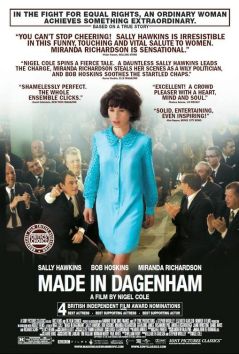
Made in Dagenham” is a classic example of that first type of cinema, a message movie that reaffirms many basic beliefs about social progress. As working-class sewing machine operators in suburban London fight for equal pay, led by Sally Hawkins’ plucky Rita O’Grady, the film invites us to applaud the struggles and advances towards ending sexism. It asks relatively little of us, instead reassuring us with the familiar storyline of white women saving the world – and doing little to motivate us to continue closing the gender pay gap.

The film has great performances to spare and proves amusing, even rousing, entertainment. But it never challenges, nor does it provoke. “Made in Dagenham” plays into the notion that the arc of history bends towards justice because of the efforts of our ancestors. It does little to incite the next generation to continue exerting force to keep the shape of that bend. C+