REVIEW: Lucy

26 07 2014

Lucy” may well be the most peculiar movie of summer 2014.  Director Luc Besson strangely amalgamates high-brow ambitions with B-movie antics.  It amounts to a simple-minded film about big ideas, something far less than Besson achieved on “The Professional,” but I’d be lying if I didn’t have a decent amount of fun on the ride.

Clearly Besson feels more comfortable in the realm of the non-human, staging vibrantly kinetic car chases and action sequences with flashy visuals.  These sequences have a definite panache to them, which is good given that they largely have to power the entire film.

Besson keeps “Lucy” moving at a swift clip, so brisk that you almost don’t have time to think about how excruciatingly bad his inane dialogue is.  It’s obvious that he views words as means to the ends of expression and plot development, not ends in and of themselves.  Worst of all, these unimaginative lines are delivered by Scarlett Johansson and company with feeling equivalent to rote recitation, rendering the film’s human element unintentionally laughable.

The film’s editing could have used some work, too.  Besson begins the film by heavy-handedly intercutting animals and prey with the events of the story (a clumsy attempt to be artful).  Then, he cross-cuts an intellectual lecture given by a professor played by Morgan Freeman (an obvious ploy to be taken seriously on an intellectual level) between multiple scenes of Lucy.  If you think about it, the edit really makes no sense as it either has no sense of time … or Freeman’s Samuel Norman is giving the world’s longest address!

Read the rest of this entry »


F.I.L.M. of the Week (July 25, 2014)

25 07 2014

Even the RainApparently, everyone from NPR to CollegeHumor is trying to make “Columbusing” a thing.  The phrase is used to describe the act of false discovery and claiming it as your own.  So in the spirit of trying to be trendy, my pick for the “F.I.L.M. of the Week” is Iciar Bollain’s “Even the Rain,” a Spanish film that quite literally looks at the original act of “Columbusing” and its ramifications.

Bollain’s film takes off from a story where life quite literally begins to imitate art.  In “Even the Rain,” Gael García Bernal stars as Sebastian, a Spanish director looking to film a movie about the Spanish conquest of Latin America on the cheap in Bolivia.  He ultimately gets quite a bit more than he bargained for in his location, however.

At the same time as his picture is shooting, great civil unrest and riots are rocking the community.  The workers are suffering at the hands of multinational corporations that are charging exorbitant fees for access to water.  Sebastian and his creative team find themselves drawn into the conflict, against their desires and wishes, when one of the Bolivian stars of their film leads vehement opposition against their exploitation.

Bollain’s film raises important questions about colonialism, both ancient and modern.  And thanks to fine performances from Bernal (who always seems to pick the best Spanish-language projects – no offense, “Letters to Juliet“) and Carlos Aduviri as the Bolivian firebrand, “Even the Rain” is more than just a political diatribe.  It’s gripping cinema with a real conscience.


REVIEW: Under the Skin

24 07 2014

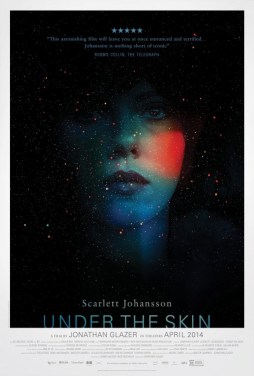
Under the SkinUnder the Skin” has the perfect title, since it reflects not only the events of the film itself but also its effect on the audience.  Jonathan Glazer’s third feature, which has been nine years in the making, features Scarlett Johansson as an alien who quite literally steps into human skin to observe us and carry out a cryptic mission.  In the process, the film seeps underneath our own skin, lingering there for quite some time and demanding to be pondered.

Glazer absolutely beguiles with his unique bending of cinematic syntax to his will, compiling what amounts to a masterclass of technical control.  Through his unique confluence of image, montage, and sound, “Under the Skin” pulsates with a dreamlike cadence.  Several of the film’s most striking sequences unfold in solidly white or black spaces, furthermore contributing to a sense of hyperreality.

Though perhaps Glazer’s intentions are not always immediately clear, he keeps us beguiled throughout – and often ravished.  He follows Johansson’s siren of the Glasgow streets, picking up and picking off men with the assistance of a strange motorcyclist, with an attention that’s languorous rather than laboriously plotted.

Our access into her head comes not through any words penned by screenwriter Walter Campbell; it arises from the curious gaze of Johansson.  Or, it surfaces from Mica Levi’s hauntingly hypnotic score, which feels like a second script for “Under the Skin” in itself.  Though it may not spark a connection in your heart, it will send a tingle up your spine.

Read the rest of this entry »


REVIEW: Magic in the Moonlight

23 07 2014

Magic in the MoonlightAt a Cannes Film Festival press conference back in 2010, writer/director Woody Allen opined rather extensively about his views on life.  Among the misanthropic murmurs, he remarked, “I do feel that it [life] is a grim, painful, nightmarish, meaningless experience, and that the only way that you can be happy is if you tell yourself some lies and deceive yourself.”

Four years later, “Magic in the Moonlight” arrives in theaters to once again hammer home Allen’s personal philosophy as expressed in the quote above.  You know, just in case we happened to miss it in any of his other four dozen or so films.

This pessimistic fatalism goes down, however, quite palatably here because Allen casts two leads far more charming than himself: Colin Firth and Emma Stone.  Though they’re spouting lines that could make Nietzsche chuckle, the film never loses its mirthful mood thanks to the effervescence that the duo radiates.

“Magic in the Moonlight,” similar to 2009’s “Whatever Works,” has the feel of an undeveloped comedy from Allen in the ’70s.  That tenor is achieved by the nature of the concept, yet it’s also due in large part to the spell that Stone casts over it.  Allen clearly sees in her the same kind of alluring wit and personality that Diane Keaton immortalized in his films; it’s simply delightful to watch a wide-eyed Stone revel in one of his creations.

Read the rest of this entry »


REVIEW: For Colored Girls

22 07 2014

For Colored GirlsIf anyone thinks Tom Hooper’s “Les Misérables” was a feckless and bumbling adaptation of a theatrical show, let me direct you to Tyler Perry’s “For Colored Girls” to see a real failure.  Granted, it’s a bird of a different color as Perry sets out to adapt Ntozake Shange’s “choreopoem” with the mouthful of a title “For Colored Girls Who Have Considered Suicide When The Rainbow Is Enuf.”  But Shange’s bold and experimental work is transmuted into a set of clichés by Perry’s uninspired writing and direction.

To start, who thought Perry was a good choice to take on this work?  What qualifies the director of crude comedies like “Diary of a Mad Black Woman” to take on an iconoclastic work of theatre?  For all those who would argue that the quintessential Tyler Perry films have elements of drama, I raise the point that those sections are by far the weakest sections of his movies.  Perry’s movies play well with audiences because of the outrageous humor of Madea and his characters, not because of anything serious.

I am not familiar with the play, but there has to be some reason it has stuck around for decades.  I can only imagine Shange as a colored woman brought a certain amount of authenticity and urgency to the struggles of black women.  If what I suspect is true, Perry has turned the play’s strengths into unwatchable melodramatic mishmash.  The faux and unearned sympathy the movie tries to evoke fails on just about every level, and the two hours of “For Colored Girls” are thus miserable and interminable.

And I think Perry doesn’t even understand what the story is about in the first place.  He does less empowering of black women than he does evisceration of black men.  “For Colored Girls” should have been a celebration of the tenacity of African-American females and the community they always form during hardship.  Instead, it’s an opportunity for some of the best black actresses working in Hollywood to chew scenery in disconnected vignettes that Perry can’t make click.  D1star


REVIEW: I Origins

21 07 2014

I OriginsThe flaws of writer/director Mike Cahill’s “I Origins” have become more apparent as I have thought about the movie more in retrospect.  But remarkably, this awareness has not led me to think lesser of the product as a whole.  I still find the film’s aspirations noble, and Cahill manages to achieve his objectives even while stumbling (unlike his prior feature, “Another Earth,” which tripped out of the gate and never recovered).

The film is rather disjointed, feeling like two separate movies conjoined in the editing room – similar to Stanley Kubrick’s assemblage of “Full Metal Jacket.”  The first half of “I Origins” follows Dr. Ian Gray (Michael Pitt) as he attempts to disprove God with his studies of the human eye while romancing the free-spirited and spiritually inclined Sofi (Astrid Berges-Frisbey).  In this section, Cahill’s dialogue is extremely overwrought and overwritten, yet it does manage to communicate the themes of the piece with great cogency.

After a mid-film climax that ultimately proves to be the apex of the entire story, “I Origins” forks off in an entirely different direction as the possibility of spiritual phenomena such as reincarnation.  This segment is quieter and more understated, perhaps leaving some things unsaid that ought to have been spoken.  In spite of those shortcomings, though, Cahill manages to ensnare us in a largely open-ended cosmic mystery.

The end does come rather abruptly, almost as if a projectionist had forgotten to show the last reel of the film (to use an illustration from a now bygone era).  Still, “I Origins” feels more or less complete even without a conventional resolution.  The film’s nearly two-hour runtime flew by – faster than most entertaining trifles being mass produced on the studio assembly line, I’d like to add.  In that period, Cahill raises a great deal of intriguing questions about tough subjects and discusses them with a fairly satisfying thoroughness.  B+3stars


REVIEW: Blue Ruin

20 07 2014

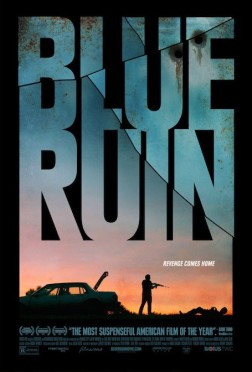
Blue RuinIn a current moviemaking climate where thrillers keep getting bigger, louder, and more involved, “Blue Ruin” provides a welcome change of pace.  Rather than rev his film’s engine to see how hard he can push it, writer/director Jeremy Saulnier holds his movie back with immense restraint.  It’s a fascinatingly controlled slow burn that’s executed with the utmost precision, resulting in a chillingly minimalist piece to watch.

At times, Saulnier’s extreme exactitude does come off a little cold.  We never really connect to the characters, nor do we really understand the psychology motivating them.  But that seems to be Saulnier’s modus operandi with the film, and it works just fine because he commits to it fully.

It’s not about this specific story but rather about what compels people in general to seek violent retribution.  (When they’re both available for home viewing, “Blue Ruin” would make a fascinating double bill with summer 2014’s “The Rover.”)  Saulnier provides precious little backstory on what’s compelling the film’s main character, Macon Blair’s Dwight, to seek revenge at all costs.  We keep thinking some giant explanation is coming, but it never does.

Normally, such vagueness in a film is equivalent to noncommittal or pure lack of imagination.  In “Blue Ruin,” though, it means exactly the opposite.  Rarely has so little meant so much.  B+3stars


REVIEW: The Congress

19 07 2014

The CongressAri Folman’s “The Congress” certainly cannot be faulted for any lack of ambition.  The director has fiddled with some seemingly unthinkable products in the past. “Waltz with Bashir,” after all, seems like an oxymoron (an animated documentary?!).

In that film, he used animation to explore questions of personal memory and conscience in the wake of a decades-old conflict between Israel and Lebanon.  Here, he’s shifted his focus westward to Hollywood.  Folman places his finger on the pulse of some very real anxieties in the City of Angels: motion capture replacing real actors, lingering fears of digitization, and the commoditization of celebrity, to name a few.

To explore these, he makes us of actress Robin Wright to play a fictionalized version of herself.  In “The Congress,” she’s an actress standing on the precipice of obscurity (the film was shot before “House of Cards” sparked a career revival) faced with a decision to sell her persona to the studios for digital “sampling.”

Folman’s commentary enters the realm of the satirical on many an occasion, recalling a justifiably little-seen film “Antiviral” where fans would inject themselves with viruses from stars to experience them further.  “The Congress” similarly follows its beginning concept, which doesn’t seem entirely out of the realm of possibility, logically into absurdity.  Along the way, Folman doesn’t hesitate to dole out copious amounts of shame to both the business that condones these developments as well as the public that consumes them.

Read the rest of this entry »


F.I.L.M. of the Week (July 18, 2014)

18 07 2014

GatekeepersWith flaring tensions between Israel and Palestine back on the front page, perhaps there is no better time to Dror Moreh’s Oscar-nominated documentary “The Gatekeepers.”  This selection for the “F.I.L.M. of the Week” is a rather unique look at the conflict from 1967 onwards, told through the eyes of six former heads of the Israeli internal security agency Shin Bet.
“The Gatekeepers” marks the first time that these important geopolitical figures have ever told their stories publicly, and their honest accounts show some of the reason why.  This account of history doesn’t hold back, showing fault and folly from all perspectives.  His subjects critique the effectiveness of their own actions as well as offering commentary on the successes and drawbacks of various leaders who ran the state.

While this is undeniably a film about Israel, the lessons learned from “The Gatekeepers” ought to hit home for American audiences as well.  We find ourselves in a position not unlike Israel’s as we strap in for the long haul in our war against terrorism.  They’re fighting what increasingly resembles a war of attrition, not a war to bring about peace – a situation which feels awfully familiar to us.

The frank discussions of these Shin Bet leaders about taking out their targets, even if it means collateral damage of innocent lives, are certainly not specific to their nation alone.  And as Moreh takes us through their tales, he makes us question how effective fire really is at fighting fire.  “The Gatekeepers” is remarkable in the way it takes one specific clash and makes us think about the nature of conflict in general.  Such deliberation and careful thought is perhaps now more important than ever.


REVIEW: The Purge: Anarchy

18 07 2014

Purge AnarchyWhen I was 6 years old, I visited my grandparents’ house while they were riveted to CSPAN coverage of the growing scandal embroiling then-President Bill Clinton.  Curious about what could possibly be so interesting, I asked everyone I came across who Monica Lewinsky was and what Clinton had done.
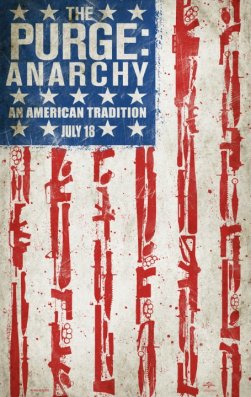
Just because I knew vague terms relating to what was happening in the headlines did not mean I was qualified to talk intelligently about political issues.  The same is true of “The Purge: Anarchy,” the sequel to last summer’s surprise horror hit.  This film, which went from studio greenlight to the multiplex in little over a year, tries to fool you into thinking it has some intellectual to say about contemporary society.

In reality, though, its social commentary isn’t half as deep as the ridiculous plot holes that mire the proceedings.  If the premise – all crime becomes legal for one night to ensure harmony for the other 364 – felt absurdly simple in “The Purge,” imagine a film where the studio puts the writer on such a time and money crunch that there’s no real time to think it through.  That’s “The Purge: Anarchy” in a nutshell.

Writer/director James DeMonaco really runs with the spirit of 2011, creating a film that would make many an Occupy member giddy with its vitriol directed towards the one percent.  He hints at tackling gun violence, economic inequality, and corporate control of government, but he’s incapable of forming a coherent thought about any of them.

Perhaps most tellingly of how facile “The Purge: Anarchy” really is, DeMonaco completely collapses the issue of class conflict into race war.  The rich are all white, and the poor are almost entirely black (and are led by a Samuel L. Jackson impersonator).  While race is undeniably a large part of discussions of social status, it cannot account for it entirely.  By discounting all other factors, DeMonaco squanders a chance to get his audience thinking about pressing questions.

It’s not likely they would do so, anyways, given how ridiculously the rest of the film plays out.  The proletariat protagonists are all too simple to elicit sympathy or our worry for their survival.  The rich villains, in DeMonaco’s rush to indict them, turn out to be little more than parodic figures.  The storyline does nothing to expand up on the original; in fact, “The Purge: Anarchy” really only serves to dumb down the future franchise so the films can be churned out like Big Macs.  C2stars


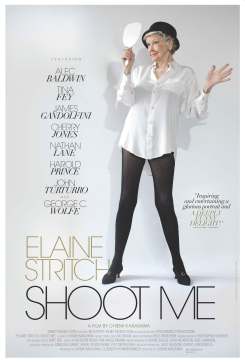
REVIEW: Elaine Stritch: Shoot Me

17 07 2014

Elaine StritchJust last weekend, I curled up in bed with my laptop to watch “Elaine Stritch: Shoot Me” on Netflix.  I found myself pleasantly entertained, but in the midst of an onslaught of new releases, I didn’t have a chance to bang out a quick review.  Then, I was checking the news at work this morning and saw the sad news that Elaine Stritch had passed away at the age of 89.

Suddenly, a review the documentary that had her at its center felt like the most important thing for me to write.  Though I may have to write in a different tense about Stritch’s life now, her legacy lives on and will certainly never be forgotten.  “Elaine Stritch: Shoot Me” gives Stritch the proper bow for her twilight years, and fans of an old era of Broadway stars will no doubt find it rousing.

Chiemi Karasawa’s film captures some of her final years as she prepares for a swan song cabaret of Steven Sondheim’s classic tunes.  Her camera catches the infamously blunt Stritch at her most cantankerously acerbic best on many an occasion, generating quite a few great laughs.  But as Tina Fey puts it, people are willing to put up with her curmudgeonly charm because she’s so great at what she does.

Karasawa does a great job of showing Stritch’s incredible work ethic.  Even though disease and age hampered Stritch from being at full capacity, she still pushed herself to play a recurring role on “30 Rock” and give her fans one last chance to see her perform live.  The back half of “Elaine Stritch: Shoot Me” consists of mostly watching Stritch belt out some Broadway melodies, a delight for fans of musical theater (and likely a bore for anyone else).

The true strength of the documentary, though, is not watching Stritch’s pantless performances.  “Elaine Stritch: Shoot Me” is so much more than filmed theater; it’s a look at a performer confronting her own mortality.  Stritch preferred to say that she was not getting old – she was getting older, just like everyone else.  She approached the prospect of her aging with humor in public, often quoting Bette Davis’ maxim “getting old is not for sissies.”

Karasawa’s extreme close-ups, however, penetrate deeply into Stritch’s psyche and show a startling vulnerability.  These moments are nothing short of stirring as they reveal her deep fears of disappointing her audience.  Fans of Stritch will undoubtedly be moved by seeing a consummate actress let her guard down.  Playing herself was perhaps the most gripping part she ever had.  B+3stars


REVIEW: Wish I Was Here

16 07 2014

Wish I Was HereZach Braff’s “Wish I Was Here” caught a lot of flak for raising additional funds through crowdfunding on Kickstarter, so I found myself watching the film with an especially sharp eye on how the budget was being spent.  My friend and I found ourselves, perhaps cynically, coming to the conclusion that Braff was using the fans’ money on less necessary frills like a Maserati or the sporadic CGI-heavy sci-fi reveries.

Yet if these somewhat excessive flourishes are what it takes to get an otherwise deeply felt movie like this made, I will make that trade-off every day of the week.  “Wish I Was Here” is an uncommonly thoughtful dramedy about life and death, a breed of film that has sadly become an endangered species.  What Braff crafts is something akin to a Woody Allen film scored to the Bon Iver Pandora station.

That’s not to say, however, that Braff has quite the effortless mastery of Allen’s best.  He doesn’t quite grasp the often tricky economy of ensemble comedy, bungling subplots involving Josh Gad and Kate Hudson.  And at times, the film gets a little bit uncomely in its wild fluctuations of tone.

But even so, “Wish I Was Here” is rather endearing.  Its brand of messy is a lifelike one, not a lazy or sloppy filmmaking one.  Braff throws everything he’s got against the wall – I like to believe it’s everything he’s been thinking in the decade since “Garden State” – and not all of it hits.  What does stick, though, teems with such raw and poignant emotion that it’s easy to overlook the film’s faults.

Read the rest of this entry »


REVIEW: Sex Tape

15 07 2014

Sex Tape” plays (pun fully intended) like a filmed first table read of the script in many ways.

All the plot holes, inconsistencies, and just plain implausibilities have yet to be ironed out of the story.  You can see the promise of the premise, but it just hasn’t been realized yet.  Not to mention, someone needs to sit down and bang out another draft or three of the screenplay.

Some of the good jokes are there, too.  “Sex Tape” features a quite entertaining supporting cast, topped by Rob Lowe as a ridiculously eccentric and bizarre corporate exec, that carries the film.  It lifts gags liberally from other films (stealing rather egregiously from “Father of the Bride”), some of which work when grafted into the storyline.  Others feel rather tired and could have been replaced with fresher, more memorable laughs.

Perhaps the biggest indicator, though, that the film is stuck at table read status is the energy level.  “Sex Tape” is an hour and a half of unbridled energy, particularly from leads Cameron Diaz and Jason Segel.  Normally, that would be a compliment, but it’s a critique here as director Jake Kasdan mistakes yelling and exaggeration as a substitute for humor and humanity.

Hypothetically, if I had a sex tape of myself in the hands of friends’ iPads, I’d probably be ending all my sentences with five exclamation points like Segel and Diaz’s characters Jay and Annie.  But they are so over-the-top that it’s hard to connect to them in any way.  They don’t feel like real people, so it limits how much we actually care about whether or not they can keep friends and family from seeing their three-hour sexual odyssey.

In fact, if I had to guess, Segel and Diaz spoke all their lines in excitement after seeing the bonus check they were getting from Apple for all the blatant product promotion.  It would certainly explain why “iPad” is every other word in the movie; even reality TV writers can hide their corporate sponsors more subtly.  C2stars


REVIEW: Boyhood

14 07 2014

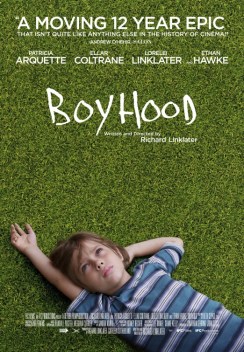
BoyhoodWriter/director Alexander Payne has said of cinema’s advent, “I think that mankind had been looking for this magnificently verisimilar art form which really mirrors life.”  And like an answer to an unspoken prayer, “Boyhood” arrives after over a century of narrative cinema to show that the medium has far from exhausted its capabilities of wondrously recalling life beyond the screen.

Richard Linklater’s film is at odds with notions of conventional fictional cinema, resembling a curated ethnography in its creation.  “Boyhood” condenses twelve years of shooting a young boy growing up through his grade school years into under three hours, not into a prescribed narrative arc but into a singular sort of time capsule.

It’s not crossing off significant life experiences of childhood and adolescence from a preordained bucket list.  It’s not out to provide an alternate cultural history through a child’s eyes.  It’s not trying to make some grand statement about the ever-changing nature of boyhood (nor about the various things that seem to stay the same).  It’s not even necessarily moving towards any sort of dramatic climax other than the ultimate one we all have to face, that of the end of time.

Instead, “Boyhood” focuses mostly on the mundane moments and the routine conversations, so literally portraying “slices of life” that no film can really lay claim to the phrase anymore.  Yet in the sheer act of capturing these everyday occurrences, Linklater elevates the profane to the level of sacred.  These brief and otherwise insignificant flashes of childhood are nothing, yet they are also somehow everything.

Read the rest of this entry »


REVIEW: Chef

13 07 2014

Summer 2014 might host the documentary “Life Itself” that exalts critics, yet it also boasts Jon Favreau’s “Chef” that tears them down.  In the film, director Jon Favreau steps in front of the camera as Carl Casper, a chef whose meteoric rise in the culinary world has coasted to a plateau preparing dishes for the elite by the time we meet up with him.  Critics help build his reputation, but they are also apparently responsible for tearing it down.

Forced by his boss to prepare a rather formulaic meal when an influential foodie blogger Ramsey Michel (Oliver Platt) stops by and subsequently receives a write-up indicating disappointment.  In his eyes, however, Casper might as well have received a review similar to that one of Guy Fieri’s restaurant penned by Pete Wells of The New York Times.  The now-notorious lambasting featured the critic mercilessly hurling rhetorical questions at the chef to the point where it seems like a personal vendetta.

Favreau bakes his opinions on the critical establishment following the roasting of his 2011 film “Cowboys & Aliens” into “Chef,” indicating an almost personal affront to the negative notices.  His attitude towards reviewers resembles that of a petulant child refusing to believe he can do anything wrong.  And despite a slapped-on ending to redeem the critics, Favreau never seems to acknowledge that he might just share a common goal with them – that of promoting and advancing a craft.

Read the rest of this entry »