REVIEW: The Unknown Known

28 06 2014

The Unknown KnownMost great documentaries about political malfeasance features countless interviews with academics and reporters, the majority of whom are extremely knowledgeable about the topic.  Yet rarely do you see direct participants sit down and talk with filmmakers about their role in the events.  (We can thank their cautious PR people, worried of a negative soundbite in a nonstop news cycle.)

None of the big names in the financial crisis, on Wall Street or in Washington, sat down for “Inside Job.”  (Prominent decliners are even listed on the film’s website.)  SeaWorld didn’t talk to the makers of “Blackfish.”  Yet for some odd reason, Donald Rumsfeld actually faced off with documentarian Errol Morris in an extensive interview that forms the backbone of “The Unknown Known.”  Yes, the man with his hands in the cookie jar during events from Watergate to the war in Iraq agreed to sit down with a documentarian whose work has literally gotten someone off Death Row.

The very fact that “The Unknown Known” exists is dumbfounding in and of itself.  Rumsfeld is no idiot, and he surely must have realized that the film was not going to be some puff piece to exonerate him in the annals of history.  In fact, it was more likely to be a hatchet job than anything.

Morris, however, does not indulge all those who would love nothing more than to have the documentary serve as an unofficial trial for war crimes.  He largely lets Rumsfeld spin his own narrative, occasionally interjecting with objections or pointed questions.  At least from what we see, Morris and Rumsfeld never engage in an all-out shouting match like you’d see on “The O’Reilly Factor.”

Read the rest of this entry »


REVIEW: Obvious Child

27 06 2014

Obvious ChildRiverRun Film Festival

If Woody Allen and Joan Rivers ever had a love child, it would probably sound a whole lot like Jenny Slate’s Donna Stern in “Obvious Child.”  This stand-up comedian proves to be a magnet for unfortunate events – losing her job and her boyfriend in rapid succession – and handles it with indefatigable humor, both macabre and self-deprecating.  Slate refashions a best friend archetype into a leading lady, and it works marvelously.

Donna might not work quite as well as a character had she not appeared in a film with the refreshing candor of writer/director Gillian Robespierre.  Pleasant interactions at a bar lead Donna into the bedroom with the charming Max (Jake Lacy, recognizable to fans of the last season of “The Office”) … but what grows inside her isn’t love or desire for a relationship.

It’s a baby, one thing Donna knows she can’t handle in her crazy life.  So she does what plenty of women across the country do: signs up to get an abortion.  In the spirit of stand-up, Donna and the film tackle the issue head-on.  She even incorporates it into her routine on stage, not to poke fun at it but to use humor as a vehicle to really explore the way we feel about abortion.  The real injustice, Robespierre seems to argue, is the way we traipse around the issue when we talk about it.

“Obvious Child” plays out like a feminist take on “Knocked Up,” another film that explores the consequences of unplanned pregnancy with poignant honesty.  All the characters speak with such refreshing candor, particularly about what it means to be a woman both physically and emotionally.  As Donna’s confidante and roommate Nellie, Gaby Hoffman brings down the house with her free spirit and untamed tongue.

Read the rest of this entry »


F.I.L.M. of the Week (June 27, 2014)

27 06 2014

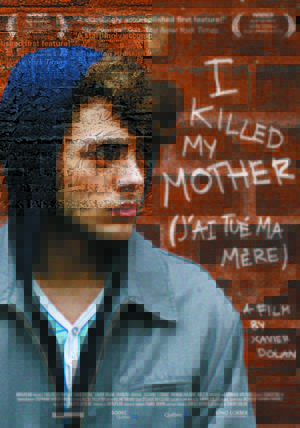
I Killed My MotherXavier Dolan has had quite a run over the past few years.  This May, the 25-year-old wunderkind not only cracked the official competition slate at Cannes, but also won the Jury Prize.  Just five years ago, his debut feature “I Killed My Mother” announced his arrival on the international scene at the Cannes sidebar Director’s Fortnight.

Thought it took that film a whopping four years to wash up on American shores, it’s an incredibly accomplished first feature with the confidence that it takes many filmmakers years to develop.  “I Killed My Mother” is visually daring, emotionally satisfying, and narratively compelling.  As such, it is my pick for the “F.I.L.M. of the Week.”

Despite what the title might have you think, there is no murder in the film.  That’s not to say, however, that Dolan’s angsty 16-year-old character Hubert doesn’t contemplate offing his mother a great deal.  She pushes his buttons just as he pushes hers, resulting in plenty of bickering and nasty quarrels.

It’s not just a rant against mothers, though.  Dolan’s film contemplates the very root of mother-son tensions, the subject of stories for millennia.  “I Killed My Mother” feels like a courtroom drama at times as we weigh who is culpable for all the drama occurring before our eyes.  The answer isn’t ever entirely clear as we’re presented with a dilemma resembling the chicken-and-egg question.  Which came first?

Anne Dorval, playing the eponymous matriach Chantale, provides the pitch-perfect performance for the inquisitive Dolan.  She channels the essence of the matron nicely in the way she tries to provide tough love for her defiant son.  But as hard as she tries to provide consistent care, she lapses as all humans do.  Dorval’s deeply humane portrait of a woman torn by these two forces makes “I Killed My Mother” all the more fascinating to watch unfold.

While Dorval steals the movie on screen, it’s Dolan who commands it off screen.  His remarkable aesthetic flair mixes various styles of filmmaking deftly, giving “I Killed My Mother” an appropriately fractured feel.  The form matches the content remarkably well, for what better way to tell a story about conflicting feelings than with conflicting methods of presentation?  This has all the makings of a masterful film for any director; it’s merely compounded by the fact that it’s a debut for Dolan, who couldn’t even legally buy alcohol in the United States when he made it.  (He’s Canadian, anyways, so that fact doesn’t really matter.)


REVIEW: Happy Christmas

26 06 2014

Happy ChristmasJoe Swanberg had a modest little hit on his hands last summer with “Drinking Buddies,” a more mainstream-friendly comedy.  And thanks to all the stars he packed into the film (and thus the cover art), it seems to have found some nice legs on Netflix.

Happy Christmas” seems unlikely to win over those new fans once more, and it may not even wholly satisfy those more tolerant of the mumblecore style.  Swanberg shows his talents, sure, but the whole enterprise just feels slight and disposable.

It’s a slice of not particularly interesting life that gets in and out within 82 minutes.  During that runtime, the film doesn’t really have much to say, either.  Anna Kendrick gets to have some fun as Jenny, a hapless twentysomething who moves in with her brother Jeff (Swanberg) and his wife, the sometimes-writer Kelly (Melanie Lynskey).

She brings headache and heartache along with her, as plenty of our own family members are capable of doing.  This familiar narrative device yields little new to ponder or even laugh about.  Unwrapping “Happy Christmas” is like opening the gift from that random aunt of yours … and realizing it’s the same thing you got from her last year.

Though the film is ultimately less than the sum of its parts, that’s not to say it doesn’t boast some great facets.  The “cool girl,” seemingly down-to-earth Kendrick is a perfect fit for Swanberg speak.  She stammers like a natural, fumbling over “like” just as any of us would and reacts to her surroundings with startling authenticity.  Kendrick brings the honesty and fun to “Happy Christmas” where everyone else just seems kind of dour and depressed.  At least we can say we spent some time basking in her aura of awesomeness.  B-2stars


REVIEW: The Rover

25 06 2014

The RoverUnlike many “apocalyptic” movies of our era, David Michod’s “The Rover” does not weigh itself down in giving the audience details of the calamity that befell civilization.  We get a few vague hints along the way, sure, but Michod lets us know all we need to know the characters populating the frame.  An opening close-up of Guy Pearce’s Eric, sitting motionless with anguish while flies land sporadically on his face, tells us far more than fake stock footage ever could.
For once, it’s the characters, not the catastrophe, that drive the action.  Without highly specific circumstances explaining their actions, “The Rover” assumes the feel of a tone poem.  It mulls over the trials of the human spirit amidst a desolate landscape as well as the need for connection in isolating times with its sweltering cinematography and pared-down screenplay.

Michod’s script, co-written with Joel Edgerton, follows Eric as he hunts down his stolen car in the unwelcoming Australian desert.  We don’t know why he wants the car back until the very end of “The Rover,” and a part of me almost wishes his motivation wasn’t realed.  Since Eric doesn’t seem to place any extreme importance on the vehicle, the quest takes on an existential dimension that yields far more insights into Eric’s character.

Read the rest of this entry »


REVIEW: Jersey Boys

24 06 2014

Clint Eastwood ends his film adaptation of “Jersey Boys” with a Broadway-style curtain call so unabashedly corny and theatrical that it might make the creative team behind the “Mamma Mia!” movie blush.  It is, however, just about the only concession Eastwood makes to the stage.  (Unless you want to count casting mostly stage actors.)

Eastwood’s desaturated color palette and starkly observed realism always felt like a strange pairing with a crowd-pleasing hit from the Great White Way.  Although among those shows, “Jersey Boys” seems like it could mesh decently well with his style. It’s a jukebox musical, where characters break out in song not just as a form of heightened expression (as in “Les Misérables“) but simply to fulfill the act of singing.

Yet even with this natural method of presenting tunes, Eastwood’s film still opts to minimize the music.  It feels as if Eastwood ran out of quarters to feed the jukebox since we get nearly all the music from the prologue (8 minutes on the soundtrack dragged out to a 35 minute expository sequence) and then the first three show-stopping hits from Frankie Valli and the Four Seasons: “Sherry,” “Big Girls Don’t Cry,” and “Walk Like a Man.”

What little we get to hear sounds good, a product of both Eastwood’s decision to sing live (thanks, Tom Hooper!) and picking voices that have the requisite pipes to do the numbers justice.  The joy of hearing a great, natural harmony recalls the authenticity of a pre-AutoTune era nicely and without drowning in nostalgia.

Read the rest of this entry »


REVIEW: Nothing Bad Can Happen

23 06 2014

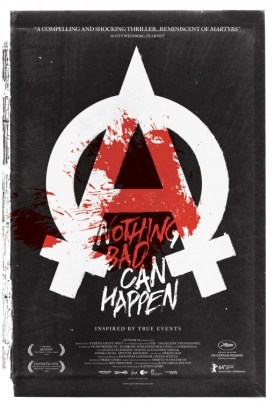
Nothing Bad Can Happen posterCannes Film Festival – Un Certain Regard, 2013
I was on a bit of a moviewatching bender that day I saw “Nothing Bad Can Happen” at the Cannes Film Festival.  (It’s still a bit of an ignominious personal record – I saw four movies in that day alone.)  I began the day with a 9:00 AM screening James Gray’s sublime “The Immigrant” and then quickly hit a mid-morning Director’s Fortnight showing of the instantly forgettable French film “Henri.”

Looking for something else to do with my day, I began to peruse the trades looking for yet another film to see.  As I perused Un Certain Regard, the section of the official competition for edgier and less renowned talent, I noticed a plot description that included the phrase “test of faith.”  Intrigued by that line alone, I went and tried my luck for the line at a repeat projection of “Nothing Bad Can Happen.”

Having very few ideas of what to expect save that brief synopsis, I entered the film rather naively and exited in a form of cinematic shellshock.  In her debut feature, director Katrin Gebbe got deeply underneath my skin and really disturbed me with her unflinching portrayal of the horrifying violence humans are capable of committing.  Her film lingers in my imagination, unsettling me profoundly still with just the thought of it.

Read the rest of this entry »


REVIEW: Blood Ties

22 06 2014

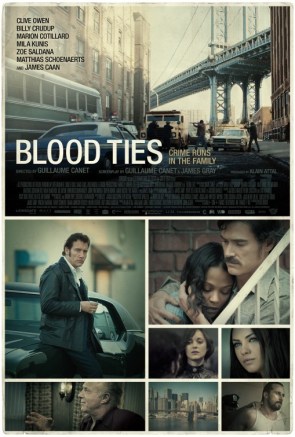
Blood TiesCannes Film Festival – Out of Competition, 2013
It’s clear from the beginning of “Blood Ties” that Guillaume Canet’s English-language feature debut is a Scorsese-lite New York ensemble drama.  Still, to so successfully channel a modern master right out of the gate is pretty impressive.  While Canet’s direction is hardly novel, he always keeps the film fun and compelling.

His ’70s saga follows the exploits of the two Pierzynski brothers squaring off on opposite sides of the law, Chris (Clive Owen) the criminal and Frank (Billy Crudup) the cop.  If the premise sounds familiar, well, it is.  In fact, the film is co-written by Canet with the help of James Gray, who himself wrote/directed a very similar tale of fraternal opposition called “We Own the Night” back in 2007.

Yet even though it felt like I knew these characters from other movies, they still thrilled me.  Gray, a consummate crafter of familial tension, completely nails the tricky dynamics between Chris and Frank.  They have always been pitted against each other, so a natural rivalry has been fostered between them.  Yet underneath it all, there’s the undeniable pull of – wait for it – blood ties that every so often overpowers all else.

Clive Owen is once again dastardly convincing in a brutish role, recalling his gripping performance in “Inside Man.”  However, it’s Billy Crudup who really carries the movie with a quiet strength.  He never really got a role to showcase all the talent he showed in “Almost Famous,” and now, 14 years later, Crudup arrives again with a bang. Read the rest of this entry »


REVIEW: Enemy

21 06 2014

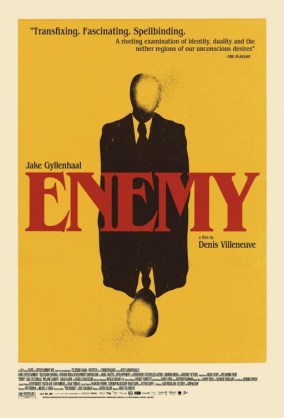
EnemyIn a discussion about the film “Enemy” a few days after seeing it, someone referred to it as “a particularly accomplished thesis film.”  To a certain extent, I do have to agree.  Denis Villeneuve’s film seems fixated on communicating mood and tone, doing so with such an intensity that it could easily be mistaken for his first time playing with it.

“Enemy” is far more successful at making you feel an overarching sense of gloom than it is at making you connect with its characters.  But that unrelenting dread in and of itself is a pretty remarkable achievement.  It’s more than just an atmospheric score recalling “Taxi Driver,” or the grays and faded yellows that dominate the color palette.  The film is the cinematic equivalent of a yoga pose held for 90 minutes straight, something to be admired for sheer poise alone.

Villenueve also manages to compliment his visual style with an equally controlled and subdued performance from Jake Gyllenhaal.  “Enemy” follows a meek history professor Adam Bell as he discovers an actor who looks exactly like him, Anthony Claire.  Both characters are played by Gyllenhaal, and they each feel distinct in demeanor as well as in the way that the events affect them.

The film is the definition of a slow burn, and Javier Gullón’s script keeps revelations rolling out at a similar pace.  Even when “Enemy” doesn’t have you completely emotionally engaged, it keeps you tense with its smoggy disposition and cryptic imagery.  Not that Villeneuve ever really loosens up in the film, but he does channel David Lynch on a few occasions.  So now that he’s accomplished this film, maybe it’s time to dabble in the surreal.  B+3stars


F.I.L.M. of the Week (June 20, 2014)

20 06 2014

Rian Johnson was announced this week as the next major architect in the “Star Wars” franchise, which was met with cheers from the fanboys.  And understandbly so, as Johnson is a brilliant creative mind who has recently given us the ingenious “Looper” as well as some of the best episodes of “Breaking Bad.”

But as for me, on the other hand, I found myself rather peeved.  The house that Lucas built will require non-stop attention for several years, leaving the cinemas without Johnson’s voice in peculiar but always memorable films.  He’s a master of mining subgenres for unexplored territory, be they high school movies or time travel sci-fi pics.  Johnson’s “The Brothers Bloom,” not your average heist flick, is a unique and underappreciated film that earns my pick for the “F.I.L.M. of the Week.”

Not unlike this year’s Best Picture nominated “American Hustle,” the film uses the art of the con as a means to explore individual identity as well as the nature of storytelling.  Filmmakers and hustlers often pull from the same theoretical toolbox, using the art of illusion to manipulate us into feeling exactly what they want us to feel.  As Mark Ruffalo’s Stephen puts it at one point in “The Brothers Bloom,” the perfect con is the one where  everyone involved gets just what they wanted.

While I’ll stop short of calling this a perfect movie, it’s certainly a very, very good one.  It’s thoughtful and entertaining, a mix that seems to be increasingly less common.  The performances are great, too – Ruffalo and Adrien Brody star as the titular fraternal con artists who pull bizarre stunts with the help of Rinko Kikuchi’s silent pyrotechnics companion Bang Bang.  The three make a hilarious pair, lighting up the screen with their off-kilter chemistry.

But the real dynamo of “The Brothers Bloom” is their target, Rachel Weisz’s cooped-up heiress Penelope Stamp.  Brody’s Stephen manages to win her affection, luring the quirky loner right into their trap.  They let her in on their chosen profession, and Penelope eagerly jumps right into scheme.  Who’s conning who and who’s being honest often gets a little hazy, but every moment is thrilling as we see simultaneously more and less of who the characters really are.  Johnson’s writing gives them so much to work with, and it saddens me to think we won’t be seeing another one of his movies like this for a long time.


REVIEW: Venus in Fur

20 06 2014

Venus in FurCannes Film Festival – Official Competition, 2013

We’re now witnessing the late films of Roman Polanski, whether we like it or not.  The director gave us one of the all-time great horror films (“Rosemary’s Baby“), neo-noirs (“Chinatown”), and Holocaust films (“The Pianist”).  Yet now, he seems content to draw his legacy to a close with a sort of artistic retreat into filmed theater.

His latest film, “Venus in Fur,” has more than a few similarities with Polanski’s previous directorial effort, 2011’s meekly received “Carnage.”  They are both adaptations of a stage play with a small set of characters locked in a continuous scene restricted to a single space.  And Polanski, who proved to be quite the consummate visual filmmaker in decades past, seems content to just yell “action!” and have the actors do their work.

He controls the chaos a lot better in “Venus in Fur,” although that could be due in part to the cast of only two – one of which is his wife, Emmanuelle Seigner, who he’s presumably on the same wavelength with to begin.  She plays Vanda, an aging actress who invites herself to audition for the director, Thomas (Mathieu Amalric).  He’s adapting the novel “Venus in Furs,” which is notable for introducing the phrase sadomasochism into the world brain.

Over the course of an hour and a half, Vanda and Thomas play a game of verbal chess over sexual politics and gender identity.  They arrive at more than a few interesting conclusions as their power dynamics and roles begin to shift.  Seigner and Amalric’s acting keeps “Venus in Fur” interesting whenever the location starts to feel boring or the whole enterprise just feels a little bit stalled.

“Venus in Fur” feels like many things, none of which is a Polanski film.  Although I have to give credit to a director who, at 80, is making us reconsider what exactly his movies are.  B-2stars


REVIEW: Dear White People

19 06 2014

Dear White PeopleLos Angeles Film Festival

Dear White People” calls itself a satire.  But quite often, the film has its finger on the pulse on such a vivid reality that it could pass for a straight drama.  The object of scorn at the center of the film is a controversial party on a fictional Ivy League campus where whites parade around as Obama, Nicki Minaj, or just a generic gangster rapper stereotype.

This hardly feels like an exaggerated universe: I’ve known two white girls who donned blackface to be Venus and Serena Williams for Halloween, and I’ve seen a ridiculously racist fraternity party invitation at my own university.  So what is intended as Juvenalian satire winds up sounding somewhat like the blistering, screaming anger of a Spike Lee joint.

A part of me wishes writer/director Justin Simien, making his feature debut with “Dear White People,” had dropped all pretenses of satire and just embraced the Lee model of didactic criticism.  He has a lot to say about the state of culture and race relations, much of it voiced through the film’s motormouthed protagonist Samantha White (played by Tessa Thompson).  Plenty of it is valid, though for those currently on college campuses, most of it will sound very familiar.

If the film is intended to start a conversation, the back-and-forth will only start once Simien is done airing all his grievances.  At times, conversations in the film are just superfluous scenes for him to further show off all he has observed.  He doesn’t pick fights he can’t win, save perhaps explaining the inexplicable success of Tyler Perry movies.

When he doesn’t talk at his audience, however, and just lets the characters be, “Dear White People” is actually quite intriguing.  Simien crafts an ensemble film with several interesting black archetypes that prove to be far more complex than just characters sketches with witty lines.  Be it the wannabe reality star Coco, the non-threatening male Troy, the anarchist Samantha, or the quiet observer Lionel, there’s surprising depth in their development that highlights the complexities of identity and identification.  They’d make the backbone of a great, hard-hitting straight dramatic piece, a mood I often wished the film would have just embraced. B-2stars


REVIEW: The Two Faces of January

18 06 2014

two_faces_of_january_ver5Los Angeles Film Festival

Hossein Amini makes his feature film debut by directing an adaptation of “The Two Faces of January,” an adaptation of a novel by “The Talented Mr. Ripley” author Patricia Highsmith. The film is understandably a natural cousin to Anthony Minghella’s Oscar-nominated 1999 dramatic thriller made from the latter of the aforementioned books. Amini did not, however, have to be so hopelessly indebted to the playbook that made that film work.

That’s not to say he made a carbon-copy; the two stories are very different. “Ripley” has shades of “The Great Gatsby” as it explores the psychology of the jaded upper class and one ambitious upstart whose desire to join them turns dangerous. “January,” on the other hand, is much more about the events and their sequence. There’s far less complex psychology or layered characterization to be found as a result.

The film’s three leads each play more of a type than a person. Oscar Isaac’s expatriate tour guide Rydal is quite a bit like Matt Damon’s Ripley but played with a penchant for larceny. He stumbles upon the MacFarlands, an American couple visiting Eastern Europe, and finds himself hopelessly drawn towards them.

Kirsten Dunst, as Collette MacFarland, has even less to do. She’s little more than an item for a childish game of tug-of-war between Rydal and her husband Chester, played by Viggo Mortensen. The film takes place in the early 1960s, and it would have been refreshing to see Dunst channel a screen icon of the time (say, Grace Kelly or Janet Leigh) to lend the film the feel of the period. But alas, Dunst retains the same sort of turn-of-the-millennium acting sensibility she normally brings to a part.

Mortensen also does a familiar act, although for him, what it recalls is his superb work in 2005’s “A History of Violence.” He’s great at playing collected everymen who prove themselves shockingly capable of savage outbursts, though it’s somewhat less exciting as a repeat in “The Two Faces of January.” His Chester sets the film in motion by retaliating brutally against an investigator sent on behalf of scorned clients, and he later carries the film by engaging in a battle of wits with Isaac’s Rydal.

Though Amini can get his actors to engage with each other, his direction doesn’t quite provide the spark necessary to light the fuse of the film. The tension dissipates quickly after the precipitating event of the film and then devolves into histrionics and cliches. Formulaic action film, beautiful European backdrop – sounds far less like “The Talented Mr. Ripley” and more like “The American.” Or dare I even say it … the much reviled (yet inexplicably Golden Globe-nominated) “The Tourist.”  C+2stars


REVIEW: Frank

17 06 2014

Los Angeles Film Festival

Early on in Lenny Abrahamson’s “Frank,” Domhnall Gleeson’s character Jon poses a question that might as well be on behalf of the audience: what’s the deal with the paper-mache head that Michael Fassbender’s Frank won’t take off?  Scoot McNairy’s Don, who has been working in a band with Frank for many years, tries to explain but ultimately admits, “You’re just going to have to go with this.”

The same mantra could apply to the rest of the film, where Abrahamson and screenwriter Jon Ronson string us along for a bizarre ride that offers very little explanation for itself.  It sometimes teeters on the verge of being a Dadaist piece, but it mostly just fizzles with forced quirkiness that never connects.  The scattershot tone of the piece makes it a real head-scratcher, too.

Frank

“Frank” is not without its amusing moments, nor is it an entirely meandering film.  At times, it feels like an ultra indie-fied version of “Almost Famous” as Jon attempts to be taken seriously by Frank’s bonkers band.  He takes over for a keyboardist who attempts to drown himself, presumptively because he is so frustrated with the unnecessarily rigorous creative process Frank demands.  I’ll stop short of saying I wished I could be in his position, being carted off in an ambulance rather than being forced to endure the whims of the giant head, but it’s overall pretty brutal.

I think many of the issues I had with “Frank” arose from the relatively minor progression of the plot.  It’s not a film carried by the characters; they all feel as if they’ve escaped from some “Saturday Night Live” skit mocking the esoteric kinds of hipster bands that play at Coachella.  (Not kidding, one song in the film sung by Maggie Gyllenhaal begins, “I want to marry a lighthouse keeper.”)

The performances aren’t particularly strong either, not even from Fassbender.  We don’t get to see him emote underneath the mask, which just made me realize how crucial his face is to conveying the inner turmoil of characters.  His nondescript body movements don’t communicate well in “Frank” either, and I found my thoughts drifting to ponder whether it was in fact Fassbender at all.

I don’t want to spoil the film, but there is brief confirmation that the Oscar-nominated actor did film a scene for the film.  Though a part of me does have to wonder if maybe the real joke of “Frank” is pulling a fast one on its audience by putting someone else under the big head.  It would certainly be in line with the odd sense of humor that pervades the rest of the film.  C2stars


REVIEW: Jimmy P.

16 06 2014

Jimmy PCannes Film Festival – Official Competition, 2013

Every year, Cannes is known to select a dud or two for its official selection, an honor bestowed upon “Jimmy P.” at last year’s edition.  Arnaud Desplechin’s English-language debut, sometimes subtitled “Psychotherapy of a Plains Indian,” is a tedious bore whose two hour duration feels like two years.  I found myself dozing off repeatedly throughout the film, yet I felt like I hardly missed a thing when I would wake up.

Psychotherapy doesn’t have to be boring – just look at the films of Woody Allen, which incorporate the process humorously and insightfully into their proceedings.  (Heck, even the forgettable “A Dangerous Method” made it somewhat intriguing.)  Desplechin’s snooze-fest, on the other hand, is a clunky procedural that focuses on the nitty-gritty psychology.  The film adapts unconventional source material – essentially a textbook on psychotherapy – and fails to find what’s cinematic about it.

Furthermore, it yields little revelatory light on either of its characters, therapist George Devereux (Mathieu Amalric) or patient Jimmy Picard (Benicio del Toro).  Amalric and del Toro are both great actors, so it’s disappointing that Desplechin has them playing at such an understated level.  Del Toro gets a few shining moments given the fact that his character sustained traumatic injuries in World War II, but Amalric is absolutely affectless.

Not every great performance has to be over-the-top scenery chewing, but it always feels like “Jimmy P.” is holding back the big moment we need to fully make sense of the characters.  Aiming simultaneously too high with its adaptation and too low with its excessively cautious directing, the film is a fairly thorough misfire.  C-1halfstars