F.I.L.M. of the Week (January 21, 2011)

21 01 2011

Melissa Leo seems to have emerged as the frontrunner for Best Supporting Actress for her work in “The Fighter.”  I wasn’t a huge fan, but if you want to see her in a performance that does deserve an Oscar, look no further than her turn in 2008’s “Frozen River,” which earned her an Oscar nomination for Best Actress.  My pick for the “F.I.L.M. of the Week,” the ultra-indie tale of how far a single mother will go to provide for her family will knock you out with its raw power.

Living along the New York-Canada border, Ray Eddy (Leo) is scrapping to get by, pulling coins out of furniture to pay the bills.  Her job at the Yankee Dollar hardly pays enough to feed her kids, and she’s often forced to resort to feeding them popcorn and Tang for multiple meals.  But she has hope enough to put down a sizable deposit for a bigger trailer, something which would substantially improve their quality of life.

However, Ray can’t pay what’s left on the trailer since a promotion at her job has yet to materialize and her husband has gone missing with some crucial cash.  Thanks to a chance encounter, she meets Lila (Misty Upham), a Mohawk Indian involved in smuggling foreigners across the border through reservation lands.  Ray has a car with a trunk big enough to fit three people, and she begins making regular runs for the money.

The movie would be just any other woman-on-the-edge movie if it weren’t for Leo’s incredible performance. She makes Ray’s desperation practically tangible with her raw and real approach to the character.  The powerhouse performance that put her on the map is still her best work, two years and potentially an Oscar win later.


REVIEW: Blue Valentine

20 01 2011

Blue Valentine” is a story about a couple told in two different parts: how they come together and ultimately how they fall apart.  Like the yin and the yang, they complement each other to create a picture of broken marriage with vivid and heartbreaking color.  Writer and director Derek Cianfrance uses the broken narrative to provide the story with a harrowing sense of perspective as we observe what once sparked attraction between the two fuels repulsion six years later.

The movie opens on a scene of Dean (Ryan Gosling) and Cindy (Michelle Williams) six years into their marriage, and no screaming match or fight is necessary to show that their relationship is crumbling.  With the demands of their daughter, the hassle of a lost pet, and the tension between their disparate jobs, the strain in their love is perfectly illustrated by their body language towards each other.

Cold, cruel, and distant they have grown – and Cianfrance doesn’t indulge us by telling where and when it all went south.  Is what we observe with the dog simply the straw that broke the camel’s back?  Was it having a child?  Or did their love gently erode over time?  “Blue Valentine” doesn’t offer us an easy answer, leaving it up to the audience to discuss in the theater lobby and the parking lot.

However, the question I asked wasn’t what caused them to fall out of love; I wondered if they were ever in love in the first place.  Strategically interspersed among their separation are flashbacks of Dean’s courtship of Cindy, which came as she was losing a dear relative and trying to shed an abusive father and boyfriend.  Perhaps it was just a perfect storm of circumstances that brought them together, not love.  And again, there’s no easy answer to that, which makes the heavy “Blue Valentine” land a little softer.

Read the rest of this entry »


REVIEW: Animal Kingdom

19 01 2011

A poor man’s version of Martin Scorsese’s crime classic “GoodFellas” with Australian accents, “Animal Kingdom” is a tale from down under that’s quite a few rungs down from the movies it so desperately wants to be.  Considering that it’s a debut film from writer/director David Michod, it’s somewhat more impressive, and I have a feeling that we can look for big things in the future.  But for now, we’re left with a movie that’s filled with one-dimensional characters played by actors without any gusto.

After the death of his mother, twenty-ish J (James Frecheville) is forced to take up residence with his estranged grandmother “Smurf” (Jacki Weaver), the matriarch of a crime family who’s grizzly enough to make Sarah Palin cower.  He unwittingly gets caught up in the exploits of his uncles, whose activities jeopardize his chances for a normal life with his girlfriend.  J is recognized by a cunning police officer (Guy Pearce, the movie’s only familiar face) as pliable, and he is faced with the choice between blood loyalty or the comforts available within the law.

The problem with “Animal Kingdom” is that it starts off really slow, and it takes a long time to get acquainted with the characters enough to care about them.  The movie starts getting really interesting around the hour mark, but by then, it feels like we’ve spent an abysmally long time in the Aussie underworld.  Michod throws plenty of action and twists at us in the second half, yet without dynamic characters, it ultimately goes in one ear and out the other.

As for Jacki Weaver, the reason I plopped this movie in my DVD player, I saw why she needed an Oscar campaign but not why she deserved a campaign.  She plays a one-note character that doesn’t play much of a part in the storyline until the conclusion.  Her big emotional scene falls pretty flat, unless, of course, you consider changing her facial expression ever so slightly compelling enough for an award.  Had I not heard all the buzz around Weaver, I would have forgotten about her as quickly as I’ll forget “Animal Kingdom.”  Neither have any teeth, something necessary to make a crime thriller bite.  B


REVIEW: City Island

18 01 2011

There have been plenty of dysfunctional family movies inundating movie theaters in recent memory, both of the dramatic and comedic variety.  “City Island” is of the latter type, which often tend to be more cliched and forgettable.  While I hate to make the claim that this is some fantastic entry into the genre that will forever stick out in my mind, it did make for one really great watch that I thoroughly enjoyed.

It’s nothing highly original, but the movie is presented with enough panache for it to be entirely excusable.  The weapon of choice in writer/director Raymond De Felitta’s arsenal is dramatic irony, or for those of you rusty on your literary terms, the art of the secret.  Everyone in the Rizzo family is guarding one closely, and it mediates their interactions with all the other family members.

Patriarch Vince (Andy Garcia) works as a prison guard but is an aspiring actor attending classes without his wife’s knowledge.  Mother Joyce (Julianne Marguiles) has lost all feelings of affection in her marriage and seeks outlets for her disillusionment.  Daughter Vivianne has become a stripper.  Son Vince Jr. has a fetish for obese women.  And then there’s the strange houseguest Tony (Steven Strait), who Vince brings home from the slammer without telling his family that it’s his illegitimate son from a past relationship.

We know the Rizzo family’s business, but they have no idea what’s going on with each other.  The movie is crafted carefully to bring revelation upon revelation until it all boils down to one heck of a comedic climax where all comes out into the open.  You can see the scene coming from a mile away, yet it’s still exciting and hilarious to watch.  The climax represents “City Island” in a nutshell: predictable but fun against all odds.  B+


REVIEW: Greenberg

17 01 2011

Noah Baumbach set the bar sky-high with his incredibly personal and deeply moving 2005 movie “The Squid and the Whale,” a very funny but very serious look at divorce from the perspective of the affected children.  Ever since then, he’s struggled to raise that bar.  It’s hard to live up to expectations when they are so big, and because comparison is inevitable, every Baumbach movie to follow his Oscar-nominated effort will have to live in its shadow.

Greenberg” isn’t terrible, but it’s a confused mixture of comedy and drama that strikes strange and unpleasant chords one too many times.  The movie emulates the mayhem of the mid-life crisis as 40-year-old Roger Greenberg (Ben Stiller) pathetically wanders through life without aim.  His brother tries to get him on track by letting Roger housesit while his family relocates to Vietnam to open a hotel, and the escapades that follow boil down to the misanthtropic Roger running in circles around his own neuroses.

He tries to make peace with his past, particularly an old love (Jennifer Jason Leigh, who co-wrote the movie).  He tries experimenting with a relationship again, and it’s thankfully with someone off-color enough to tolerate his antics (Greta Gerwig in a charming breakout role).  He stupidly indulges in his own self-pity and self-centeredness.

Roger Greenberg is an unpredictable and volatile character that Ben Stiller plays with a fair amount of pathos and humor.  Yet there’s little development of the character and an even smaller arc, which could be the point.  Even with Stiller trying his best, he can’t keep “Greenberg” from being a barely likable movie about unlikable people.  Try again, Noah Baumbach.  C+


REVIEW: Wall Street: Money Never Sleeps

16 01 2011

I have no problem with Hollywood approaching the 2008 financial collapse; look no further than my “A” for Charles Ferguson’s documentary “Inside Job.”  But it’s a slippery slope to walk on, and Oliver Stone’s slanted “Wall Street: Money Never Sleeps” does a total face-plant as its blatantly pointed activism destroys any legitimacy the movie might have.  Compared to Ferguson’s fascinating investigation and research, Stone’s allegory is a cowardly and vicious attack on the system of greed that the original film highlighted in 1987.

There was no reason to resurrect Michael Douglas’ Oscar-winning character Gordon Gekko at all, and Stone’s haste to use him as an instrument in unleashing a tirade against Wall Street renders his transformation senseless.  In the first film, he was a slimy representation of greed and excess, and an antagonist meant to be deplored.  Yet in 2010, he has been conveniently reassigned to the voice of the writer and his liberal sensibilities.  No matter where you fall on the political spectrum, this move just doesn’t work under the basic conventions of storytelling.

The movie’s main plot is mostly independent of Gekko, tying him in through a broken relationship with his daughter Winnie (Carey Mulligan).  She’s engaged to Jake (Shia LaBeouf), a young upstart banker who gets caught up in the idea of creating something from nothing that he ultimately winds up without anything.  After the suicide of his mentor, he finds himself reeling and very lost.

Sure, it has its entertaining moments, but the whole movie just reeks of a misplaced sense of political vindication.  Stone doesn’t challenge, inform, or educate, and there’s nothing left for the audience to ponder.  The deranged manifesto that is “Wall Street: Money Never Sleeps” is just a series of thinly veiled pot-shots on everyone involved in the financial meltdown, less based on the facts than on the opinions and convictions of its hardly neutral filmmakers.  C-


REVIEW: The Green Hornet

15 01 2011

The Green Hornet” is half-heartedly “Iron Man,” half-heartedly “Kick-Ass,” but wholeheartedly a moronic waste.  It’s already begun to fade into the white noise that is the superhero movie genre, which seems to churn out a new entry with every passing minute, thanks to its reliance on the recently popularized “not-so-super” hero.  With a director fully capable of creating something of great artistic merit, writers fully capable of spinning familiar formula into fresh comedy, and stars fully capable of entertaining, the movie is a letdown simply for settling.

The typical stoner/slacker combo that is Seth Rogen remains unflinchingly true to form as Britt Reid, the heir of a media empire thanks to being the son of an incredibly successful newspaper man (Tom Wilkinson).  When his father’s death leaves him a twenty-something orphan, he’s more than a little confused as to how he can reconcile the party and the business.  Britt discovers the incredible hidden talents of Kato (Jay Chou), who can do quite a bit more than make coffee.

Together, they become a crime-fighting team with Britt known as the Green Hornet but Kato doing all the actual fighting.  They masquerade as villains but act as heroes, and their clueless escapades only get attention because Britt uses the newspaper to overhype them.  Otherwise, they would be about as legitimate as the movie’s script, which in its eagerness to take the classic heroes to a new level winds up as a cheap imitation of them.

Christoph Waltz, so frightening as the treacherous Hans Landa in “Inglourious Basterds,” abandons what won him the Oscar for a Snidley Whiplash, cartoonish approach to villainy.  His Chudnofsky fits in well with the ridiculous background of the movie, but it sure leaves one heck of a stain on his filmography.  And while most people would not say this is the first strike against Rogen, it’s the first time that I’ve found his routine getting old.  The same old schtick might be refreshing in a superhero movie had it not been so overdone in his raunchy comedies first or if “The Green Hornet” were released a few years earlier before real actors transformed stock characters into complex ones.

The movie is also a waste of Michel Gondry, who brings his auteurist vision and impressionistic flair to the table.  He does craft some really cool scenes that popcorn-munching multiplexers aren’t accustomed to seeing.  The movie’s visual panache is striking, yet it needed to be overwhelming to atone for all the movie’s jokes that fell flat.  Without a decent script to back up Gondry’s artistic sensibilities, “The Green Hornet” becomes about as worthwhile to watch as a Stanley Kubrick directed episode of “Jersey Shore.”  C


F.I.L.M. of the Week (January 14, 2011)

14 01 2011

As a stage actor in high school, I’ve gained a certain appreciation for how in-tune the performances have to be.  The actor must always be acting as any member of the audience can simply shift their gaze on him at any time.  Cinema has marked a new era for the actor, where he doesn’t have to be finely in-tune for hours at a time.  The camera can cut away from him when he doesn’t speak, finding something that the filmmakers believed that impatient audiences will be more interested in than a mouth not sputtering out dialogue.

Yet it’s in those stray moments where we really see the power of the actor.  It’s in these moments that usually get left out of movies where we can truly visualize an actor’s vision for their character.  Through extensive use of split-screen, “Conversations with Other Women,” my pick for the “F.I.L.M.” of the week, is able to capture those moments and bring them to a largely unfamiliar destination: the silver screen.

After spending 80 minutes with Aaron Eckhart and probable 2010 Oscar nominee Helena Bonham Carter in “Conversations with Other Women,” you’ll have no doubt that they have complete understanding and mastery of not only their characters, but of the craft of acting as well.  They play unnamed people, but just because we can’t identify them through nomenclature doesn’t mean that we can’t connect with them.

Eckhart and Carter strike up amicable conversation at a wedding reception, but the dynamic slowly changes to reveal that these aren’t just perfect strangers.  The methodical unraveling makes for a fascinating watch, as does their banter, which is very much like something that would be performed on stage.  Eckhart and Carter’s two-actor conversation works marvelously well, and the fact that they can keep us drawn in for the entire movie without ever letting go or letting up is nothing short of astounding.  With comedy, drama, and intrigue, “Conversations with Other Women” is a quirky but immensely satisfying showcase of two actors doing what few screen actors dare.


REVIEW: Tangled

13 01 2011

The Disney charm gets cranked up to 11 in “Tangled,” the studio’s 50th animated feature in its illustrious history.  The retelling of Rapunzel earns its place in a lineup of classics by combining the strengths of the many films that came before it.  Combining the familiarity of a fairy tale, some toe-tapping musical numbers, and the boundless possibilities of computer animation, the movie is an undeniable joy to watch.

Every Disney tale has a twist from the storyline which takes it in a more dynamic direction, and what lifts Rapunzel (voiced by Mandy Moore) off the page and onto the screen is the revelation that her long hair has healing and rejuvenating powers.  Of course, this means that the old hag who desires to be youthful forever hoards her away in a tower so that only she can exploit the hair.  She yearns for contact aside from her lizard Pascal and greedy stepmom almost as much as she wants to get out and see the city and kingdom for herself.

Enter Flynn Rider (voice of Zachary Levi), an outlaw with a more gorgeous nose than wanted posters give him credit for and a love of stealing from the exceptionally wealthy and privileged.  After snatching the crown jewels, he hides in Rapunzel’s tower and from there, the adventure begins.  It’s a fun journey with the two of them that begins with her exaltation of grass, trees, and the earth since she has never experienced anything other than the tower.

There are plenty of other interruptions along their trip to the castle for the magical floating lights, often times accompanied by fun, engaging songs from Alan Menken (“The Little Mermaid,” “Beauty and the Beast” among others).  While you don’t leave the theater whistling them, you sure get into the rhythm while watching.  Great supporting characters are hardly in short supply, with a group of jolly giants, a diaper-toting dwarf, and a proud horse with a personality through the roof leading “Tangled” to heartfelt hilarity.  While it may not be quite at a classic level, it leaves a trail of happiness as long as Rapunzel’s hair.  A-


REVIEW: The Dilemma

12 01 2011

The whole premise of deciding whether or not to tell a friend that their wife is cheating on them sounds like something that would make a good episode of “Full House” or “Everybody Loves Raymond.”  The whole thought process is something perfectly suited to sustain a 22-minute sitcom episode.  However, “The Dilemma” takes that setup and stretches it out to nearly two hours, and all it does is prolong the pain.

Ronny (Vince Vaughn) catches Geneva (Winona Ryder) two-timing her husband and his best friend Nick (Kevin James).  Unsure of whether to meddle or not, he weighs his options carefully but finds physical pain instead of answers and decisions.  The choice is harder to make since the two buddies are business partners under a great deal of stress to deliver big and Ronny is also wrestling with proposing to his girlfiend Beth (Jennifer Connelly).

The longer he delays, the harder it gets to make the decision.  It ultimately results in all four parties revealing and uncovering long-held secrets, which are of course nothing surprising or profound to viewers.  For this reason, “The Dilemma” is quite a bit darker and more solemn than most comedies hitting theaters nowadays.  Perhaps the strange tone is what attracted Ron Howard to direct the film, an Academy Award winner with a curious fascination at having a versatile resumé.  He’s much better at directing such unremarkable and controlled period pieces, where he’s actually capable of making a decent connection with the audience, than he is at directing comedy.

Both Vaughn and James bring a game face to the movie, but their physical and vocal humor is ultimately stifled by an artificial layer of dramatic importance and a poor script.  They get into it, sure, yet they are undermined by either poor dialogue or ridiculous situations.  It’s like these two dynamite comedic forces are trapped in sitcom reruns and aren’t sure whether to escape or adjust their acting style.  The duo desperately needs to return to the R-rated comedy genre which is perfectly able to harness their energy and turn it into side-splitting laughter.  (And, for that matter, Channing Tatum needs to leave acting altogether and just go back to modeling.)

It’s pretty sad for any movie when its legacy will ultimately be not what’s on film, but the fuss over an unsavory epithet for homosexuals in the trailer will likely be the only thing worth remembering about the movie in the years to come.  Ron Howard and Universal gave us a conversation topic in October 2010, yet in January 2011, they didn’t follow up by delivering a quality movie.  By the time you escape from the tepid grasp of “The Dilemma,” you’ll feel as if you’ve watched a highlight reel of failed jokes and cringe-worthy moments.  C-


REVIEW: Catfish

11 01 2011

In honor of the DVD release of “The Social Network,” I figure this would be as good a time as ever to review two documentaries with incredibly powerful insights into the digital age and social media.  The second movie of this two-day spotlight is Ariel Schulman’s “Catfish.”

The filmmakers behind “Catfish” did what no sane person in 2011 would do: pursue people in real life that they had only made digital contact with.  Yet after Nev Schulman develops what he believes is a legitimate relationship with the family of 8-year-old painting prodigy Abby, that’s exactly what they do.  With camera crews documenting each step of the bizarre journey, the lines between reality and sensationalism are once again blurred like many 2010 films.

Obviously, the creepy factor is through the roof as they get a reminder that you can be anyone you want on the Internet, especially not yourself.  Without giving too much away, the movie makes you want to go double-check your list of Facebook friends and think twice about how you interact online.  It shows a flip-side to the coin that tells us that social media helps us communicate more easily with the people we know; it’s easier for people we don’t know to communicate with us.  And these people are desperate and without boundaries, willing to go to extremes to get what they want.

If “Catfish” were fictional, the second half would have played out much differently, probably with a whole lot more taut suspense and cheap thrills.  I don’t suspect it will be long before fake Facebook creeper movies infiltrate the theater, and those will make us fear.  As a documentary, “Catfish” makes us think, and its social commentary is unique and valuable.  Perhaps this darker side of the Internet has its uses, and perhaps people who don’t want to be themselves online have the right to do so.  It raises some unconventional questions about net privacy and identity, although with a little bit too much compassion for the culprits to truly challenge the audience to make up their own minds.  B+


REVIEW: We Live in Public

10 01 2011

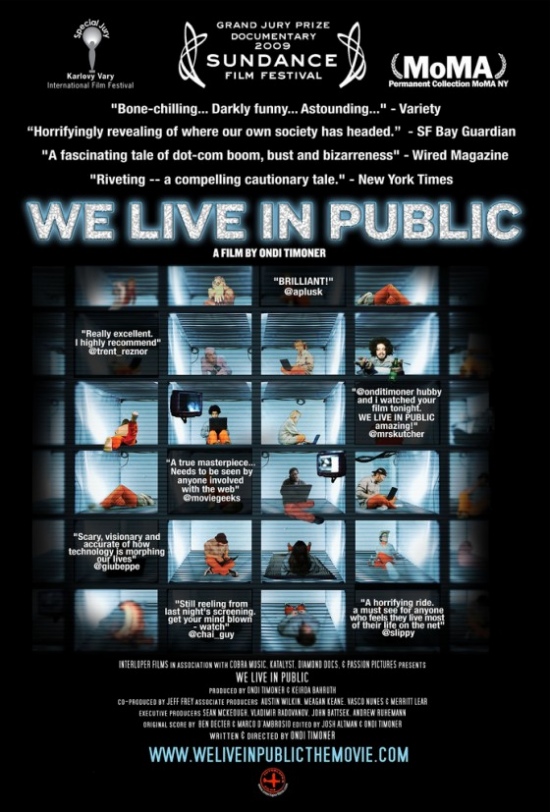
In honor of the DVD release of “The Social Network,” I figure this would be as good a time as ever to review two documentaries with incredibly powerful insights into the digital age and social media.  The first movie of this two-day spotlight is Ondi Timoner’s “We Live in Public.”

Calling Mark Zuckerberg ahead of his time is about on target; calling Josh Harris ahead of his time is a true understatement.  This obscure Internet pioneer was at the height of his power and influence during the dot-com bubble, yet he predicted with a frightening accuracy the effects of the social networking age.  “We Live in Public” is a chronicle of his bizarre experimentations in the late 1990s, which were misunderstood then but had implications so incredibly accurate that the movie’s 10-year-old social commentary is pertinent enough to be labeled both mind-blowing and jaw-dropping.

Looking back from the Facebook-saturated 2011 culture, Harris seems to be a sort of digital prophet.  He founded Pseudo in the mid-’90s, an Internet television network that he predicted could put CBS and other major networks out of business.  Nowadays he’s looking a whole lot less crazy with television suffering from the rise of YouTube and Hulu and other sites that provide entertainment on the viewer’s own schedule with significantly less advertising interruption.  However, the movie focuses more on his social experiments dealing with exposure, privacy, and attention on scales the 20th century was simply not prepared to handle.

If you take a step back, his art project “Quiet: We Live in Public” is like a living, breathing version of Facebook.  Harris took 100 willing volunteers and stuck them in a basement where their activities were monitored constantly by camera.  People slept in close quarters with a monitor situated in each bunk that could be turned to watch any other person in the group.  Call it the birth of the Facebook stalker, the Facebook whore, the excessive Facebook status-updater, and just about any sort of social media stereotype you can come up with.

When you look at the psychological impact of literally living in public was from Harris’ experimentation, the results are shockingly similar to those of digitally living in public.  We begin hesitant to share and give up our privacy, but once we spend time interacting with people in this sort of manner, our reluctancy fades away.  We become more prone to do things that we wouldn’t normally do in the “real world,” and any notion of boundaries flies out the window.  Eventually, we enter a state where we desire nothing more than to be noticed and are willing to do anything to get it.

It’s the ultimate writing on the wall for the Facebook and Twitter generation, and the smug genius Harris seemingly kicks back and implicitly imparts “don’t say I didn’t tell you.”  And if “Quiet” isn’t enough to scare the living daylights out of you as to where we are headed as a society addicted to social media, Harris taking the project home with him to capture every moment of his life on camera for an Internet audience will.  The haunting invasion of the last sanctum we see as truly ours – the house – makes the fear of an overbearing connected society so palpable that it sends chills up your spine.

With the man then proclaimed ahead of his time now incredibly disillusioned, anyone who watches “We Live in Public” won’t be able to resist questioning how long it is before the rest of the world catches up with him.  Harris has been spot-on so far; if the catastrophe he lived through is any indication of how society is heading, we all have reason to fear.  A


REVIEW: Country Strong

8 01 2011

Unintentionally hilarious, “Country Strong” is a wannabe rehash of “Crazy Heart,” “Walk the Line,” and “Dreamgirls.”  It’s ridiculously melodramatic and populated with four stock characters who go through alarmingly little growth throughout the movie.  With no reason to care, it’s easy to kick back and enjoy some surprisingly classy country music.  That means there’s none of that soulless pop-country blend that Taylor Swift has pushed into the mainstream; it’s the country music you’ll hear in the saloons and bars in the heart of America.

Gwyneth Paltrow’s Kelly Canter plays a shamed superstar country singer pulled out of rehab early by her demanding husband and manager James, played by Tim McGraw.  Neither are in love with each other anymore, as Kelly has her eye on small-time singer Beau (Garrett Hedlund) and James goes after the much younger Chiles Stanton (Leighton Meester), a beauty queen turned country-pop star who seems to be a Taylor Swift parody in herself.  As you can imagine, the two upstart country singers Beau and Chiles, whose relationship begins rocky, ultimately find each other in love.

I’m not going to give the movie the benefit of the doubt when it comes to the humor; I assume it was really poorly made and acted.  Denim-clad Paltrow is pretty dreadful when it comes to playing the rehabbing drunk apparently based on Britney Spears, tripping over cliches just like the movie itself.  She could have taken a few notes from Anne Hathaway in “Rachel Getting Married,” who totally nailed the confusion and disillusionment of the not-quite-rehabbed woman.  McGraw is fine playing a tough guy, and Hedlund feels natural on stage and behind the mic.  Leighton Meester, on the other hand, is comedic dynamite – which is probably attributable to her sub-par acting skills.  Funny, I thought she would have really picked up some great technique on “Gossip Girl.”

As long as you aren’t looking for a story or acting, you’ll enjoy the first hour and a half of “Country Strong.”  It’s corny, campy fun in country style.  But beware of the world’s worst ending, so bungled and poorly written that it derails the entire experience and leaves you with a bitter taste in your mouth at the end.  It’s almost like in an effort to avoid predictability, they chose the most bizarre ending even though it didn’t fit with the movie’s tone or events.  So, in order to get the optimal experience out of a crummy movie, stop watching “Country Strong” after Kelly’s big concert in Dallas.  Make your own ending to the movie and just be satisfied with the dumb melodrama.  C


F.I.L.M. of the Week (January 7, 2011)

7 01 2011

It’s a new year for the “F.I.L.M.” column, but more importantly, it’s the home stretch of the Oscar season!  Soon enough, the intense politics will start to die down and we will just be left to reflect on the performances and the movies.  To celebrate the season, the next seven weeks of the “F.I.L.M. of the Week” series will be devoted to covering little-seen and underrated gems from the 2010 nominees.

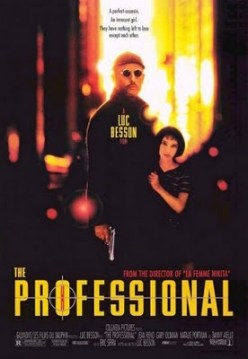
This week, I’m unequivocally recommending “The Professional,” Natalie Portman’s first movie, made when she was just 12 years old.  It’s an especially fun watch for any of Portman’s fans who have followed her work for many years as most of the mannerisms and techniques she still uses are on full display here.  It’s a little rougher, sure, but “Black Swan” was hardly the first time she commanded the screen.  16 years ago, she delivered a stunning performance of incredible mastery for someone so young.

As Matilda, Portman plays a tough young girl out to get revenge on the ruthless and merciless hitman, Stan (Gary Oldman), after he massacres her family including her four-year-old little brother.  While she hated her abusive and neglectful parents, the thought of someone slaying her younger brother makes her run to the assassin across the hall, Leon (Jean Reno).

The “cleaner” on the floor is a bit of a loner, executing his jobs with professionalism and precision.  Leon takes Matilda in at first for her own protection but reluctantly keeps her after she wins a sliver of his affection.  But she wants something more than shelter; Matilda wants training so she can take out Stan.  Again with reluctance, he agrees, and their time together brings Leon a sort of paternal pleasure.

This intense action movie directed by Luc Besson stands out among stacks of other movies in the same vain because it’s not a movie about the action; it’s about the performances, characters, and the story.  Aside from Portman’s incredible debut, there’s also solid work for Jean Reno, who truly deserves better and prominent roles than he usually takes nowadays.  And Gary Oldman also shines as the borderline demented killer Stan, so frightening and so brash that he makes for one heck of a villain.  Oldman really is one of the most utilitarian actors working today, and “The Professional” really does show that off.

Yet somehow, even at 12, Portman steals the movie in a manner indicative of how she would rule the screen for the next 17 years.  Sure, it’s child’s play compared to “Closer” or “Black Swan,” but anyone who made a bet back in 1994 on her becoming an Academy Award-winning actress could be cashing in big time pretty soon.


REVIEW: Restrepo

6 01 2011

We see the situation in Afghanistan all the time on the news, usually only to report that two soldiers have died or that we should just get out now.  It’s been a very impersonal experience for those of us on the homefront, a far cry away from the patriotic surges that struck America back in World War II or even the flag-flying defense after 9/11.

Restrepo,” on the other hand, changes all of that.  It puts a human face on the conflict in Afghanistan by reminding us that it’s not some sort of digital war like on “Call of Duty.”  It’s a real war fought by real people, and the movie probes into their deepest feelings and fears to produce a psychological profile of soldiers fighting in Afghanistan that is truly harrowing.

It’s not easy to follow on an event-by-event basis, and for those not familiar with military jargon, it might be a little bit like watching a foreign language film without subtitles.  But directors Sebastian Junger and Tim Hertherington make “Restrepo” a movie of emotions, not a movie of events.  The movie follows a platoon in the Korangal Valley, one of the most dangerous and volatile regions in Afghanistan, and the toll it takes on them physically and mentally.

The events are mildly exciting but they serve a purpose: to illuminate the interviews with the soldiers that survive.  What they say with their words, their faces, and even their silence makes the conflict in Afghanistan so undeniably real that it’s scary.  It could easily become a defining movie of American involvement in the Middle East, and it’s certainly much better to watch than any of the overly cynical fictional films trying to capture a zeitgeist.  “Restrepo” doesn’t have to capture that; the soldiers lived it.  B+