REVIEW: Queen of the Desert

5 04 2017

“You will not scare men with your intelligence,” warns an elder to the young Gertrude Bell at the outset of Werner Herzog’s “Queen of the Desert.” It’s the kind of “nevertheless, she persisted” moment that would spur on a great feminist tale. Instead, the line represents the tease for a story that never materializes.

This story of an accomplished archaeologist who provided valuable research on tribes in the Ottoman Empire as their empire collapses is all too eager to define her life in relation to the men whose path she crosses. There’s T.E. Lawrence (Robert Pattinson) of “Lawrence of Arabia” fame, a more professional acquaintance, but she sets off on her quest primarily in grief-stricken anguish at the loss of Henry Cadogan (James Franco). While in the Middle East, she spends as much time on screen rebuffing offers from Charles Doughty-Wylie (Damian Lewis) as she interacts with the native tribes.

This becomes an issue later on when Herzog tries to land the film with an anti-imperialist message as Winston Churchill arrives from the British Empire to help break up the Ottoman Empire. Gradually, Bell does grow into a bit of an anti-imperialist as she increases her understanding of the region’s tribes. But in her embittered farewell, knowing that her advice will likely be discarded, Bell expresses a kind of fondness for the people she loves that also reeks of a white savior complex.

The only thing to recommend in the film is Pattinson’s turn as Lawrence; he does the self-effacing British elite routine with aplomb. Otherwise, “Queen of the Desert” sits on a hollow throne. C


REVIEW: Miss Bala

4 04 2017

The concept of “Miss Bala” is horrifyingly compelling: beauty queen (hence the ironic title, translated into English as “Miss Bullet”) turned drug mule. Everything about that just sounds awesome, like Quentin Tarantino remaking “Maria Full of Grace” – and I didn’t really even like that movie.

Yet while the violence and carnage of “Miss Bala” further convinces me that the Mexican drug trafficking trade is a brutally dangerous one, it felt a little like preaching to the converted. At least, it felt that way for me being from Texas where stories of bloodshed along the border make the local news more often. Perhaps it will strike more of a cord with different audiences less familiar with the drug trade. But for me, I just found “Miss Bala” a boring albeit bloody slog through a thinly-plotted script. It somehow manages to feel interminably long despite many sequences of extreme violence.

The performance of Stephanie Sigman as Laura, the movie’s protagonist, is weak at best. To carry the movie and really drive home the horror, she needed to be a lot stronger and more emotionally forceful.  I just never really connected to the character to the point where I cared about her journey at all. By the end, I didn’t feel strongly one way or another about her survival. I just wanted “Miss Bala” to end.  C-1halfstars


REVIEW: The Discovery

3 04 2017

Sundance Film Festival

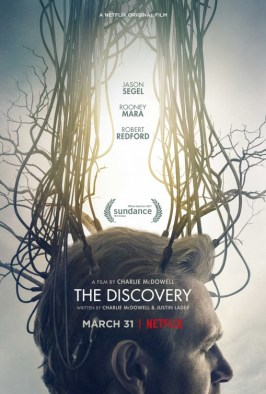
I was a bit peeved to learn that Netflix owned the rights to Charlie McDowell’s The Discovery after I had blown a portion of my precious ticket allotment to see the film at the festival. Most people will experience this film from the comforts of their own living room. That’s their loss.

McDowell’s follow-up to his audacious debut, 2014’s “The One I Love,” works from a similarly complex setup. Robert Redford’s Thomas Harber discovers proof of an afterlife, leading masses of people worldwide to commit suicide to get there. A few years later, his son Will (Jason Segel) navigates a “Children of Men“­­-like world so substantially depleted of human energy that a hashtag campaign using #nomoresuicides and #discoverlife exists. Against his better judgment, he ends up in a position to probe the boundaries of his father’s finding and expose some potentially unsavory truths about what really lies there.

Will also encounters the suicidal Isla, played by Rooney Mara in what might be the closest thing she ever plays to Clementine Kruczynski, which substantially deepens his knowledge of rapidly changing attitudes. We get out of this world what we put into it, and neglecting our imperfect existence in favor of some distant fantasy can only lead to ruin. Locating meaning in death rather than in life leads people in strange directions, such as the cult-like estate that the elder Harber establishes.

It was nice to know, too, that audiences still respond to the shock of suicide. Too bad that Netflix can’t include the audible gasps of a stunned Sundance crowd at many moments in “The Discovery” as some kind of supplemental audio track. McDowell makes perfectly clear that human life matters in the film. Sharing and reaffirming that feeling with others just serves to emphasize it all the more. B+

NOTE: A portion of this review ran as a part of my coverage of the Sundance Film Festival for Movie Mezzanine.


REVIEW: Trespass Against Us

2 04 2017

No law dictates that every movie about rural-based robbers must be compared to “Hell or High Water,” but it’s going to be a tempting comparison from hereon out given the way that film seamlessly connected geographic isolation with the self-defeating act. Director Adam Smith and writer Alastair Simmons try something similar with the dwellers of a secluded Irish mobile-home compound in “Trespass Against Us” to mixed effect. It’s passable as a crime thriller but genuinely compelling as the story of one father’s struggle.

That delinquent dad is Michael Fassbender’s Chad Cutler, the most put-together offspring of patriarch Colby (Brendan Gleeson), a Jim Jones-type who inspires a religiously-tinged devotion from his kin. Chad has entered the family trade of larceny, though with significant hesitation due in part to pressure from his wife Kelly (Lyndsey Marshal) to provide some semblance of normality for their two young kids. She wants stability, both in his profession and their living quarters.

There’s no grand moment of conscience for Chad in “Trespass Against Us.” He would rather find some way to please both masters in his life by continuing with extralegal measures away from the Cutler shantytown. But given the escalation of activity demanded by Colby, such a grand bargain becomes exceedingly elusive. Fassbender gives the movie real weight as he ponders which side of the divide Chad would like to fall. It’s a more repressed, bottled-up version of the characters he typically animates, and the more internalized portrayal works for Chad, a man who projects authority without really ever experiencing much autonomy. Discovering who he is proves the greater draw than what he does. B


REVIEW: The Blackcoat’s Daughter

29 03 2017

When it comes to horror genre fare, I’m the first person to rail against the overuse of the jump scare or other lazy techniques designed to get a quick, visceral reaction. Myself, and many others of the critical ilk, prefer tension and suspense. Or better yet – an atmospheric horror that seeps into dark crevasses of the psyche.
There’s a way for the pendulum to swing too far in the way of those aforementioned good things. When that happens, you get something that looks a lot like Oz Perkins’ “The Blackcoat’s Daughter,” a technically sound machine that feels overly programmed to the point of becoming inorganic. It’s overthought to the point of being overwrought, akin to a student thesis film. (Perhaps no coincidence that it marks Perkins’ directorial debut.)

Perkins’ film is all foreplay and very little fun. “The Blackcoat’s Daughter” weaves together two storylines of young women in peril, Emma Roberts’ Joan on the open road and Kiernan Shipka’s Kat in a suffocating religious environment. We eventually learn the reason their tales are intertwined, but … well, no spoilers. It’s half-decent because of a twist at the end. The journey there is quite tedious, filled with opportunities for true terror that too often go unconsummated. Perkins clearly has the brains for the genre. Hopefully he gains confidence to add in the nerves for it, too. C


REVIEW: Song to Song

28 03 2017

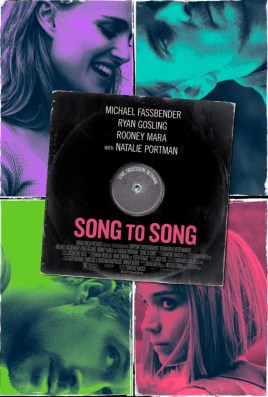
If life is a song, as narration from Rooney Mara’s Faye in “Song to Song” suggests, then rest assured that writer/director Terrence Malick is following the spasmodic tune in his own head with dogged determination. In what appears to be the final feature film made in his post-“The Tree of Life” productivity period, the cinema’s philosopher laureate continues to push himself further into avant-garde, non-narrative forms of storytelling. This latest work might be the definitive achievement of the bunch as Malick probes and roves more than he presumes and pronounces, making the spirit of the film match his intellectually curious aesthetic.

Not one to slow down in his seventies, Malick expands the scope of his deeply interior characterizations to encompass an entire ensemble. His past films normally only allow audiences entry to a select few characters’ headspace through pensive narration. In “Song to Song,” that applies to aspiring musicians Faye and BV (Ryan Gosling) as well as teacher-turned-waitress Rhonda (Natalie Portman) dragged into their orbit.

Each of these three tries to follow their motivating forces – love, art, protection – by trusting their instincts. Yet these often decisions lead them back to a sinister music producer Cook, played with a primate-like ferocity by Michael Fassbender. He’s commercialism incarnate, simultaneously abhorrent and alluring. Cook provides, but he also demands. When the impulse to love crosses into lust, he’s there to cash in.

“Song to Song” hums by on the inclination of Malick’s emotional logic, with Emmanuel Lubezki’s camera (seemingly unresponsive to the laws of gravity) there to capture his vision in all its grimy intimacy. He’s not big on traditional beauty here; long lens shots flatten out the images, and jump cuts within the same scene provide a jarring jolt to the mundane. But there’s something more honest about the ever-searching indeterminacy of the film. Malick seems less fixated on answers and more interested in simply tracing the development of a musical movement. The end result is far from melodic, though that matters not. For all the seeking and yearning in the story and the form itself, the free-flowing riff makes for a perfect means of expression. B+


REVIEW: Wilson

27 03 2017

Sundance Film Festival

Somehow, despite it being my most anticipated film of Sundance, I wound up at the second screening of Craig Johnson’s “Wilson” while virtually everyone else I knew got tickets to the premiere. More than one person cautioned me that Woody Harrelson’s eponymous character, based on graphic artist Daniel Clowes’ creation, was so intensely dyspeptic that he was basically unlikable.

Now, to be clear, I often love unlikable characters. And when I sat down to watch the film, I did not find Wilson difficult to watch or enjoy. In fact, his particular brand of thorniness was quite a welcome contemporary spin on the garden-variety curmudgeon. In typical Harrelson fashion, the character is a foul-mouthed prankster determined never to take a moment too seriously or treat a person with full respect. But Wilson is something different. As he repels nearly everyone with whom he makes contact, he also tries to cure them of the modern malaise of isolation. Whether in the form of phones, technology or a hermetic bubble of their own choosing, Wilson violates arbitrary decorum to highlight the absurdity of our perpetual estrangement.

I read Clowes’ graphic novel over a year ago anticipating a 2016 Sundance bow for “Wilson” (full disclosure: I am well acquainted with the film’s director), and my faint recollection of the text relies on a simple joke structure where Wilson reacts with predictable atrophy at whatever situation thrown at him. Clowes’ script for the film, which included some input by Johnson, takes the character in a much more interesting direction. It’s similarly episodic, though the narrative quest of reuniting with his estranged wife Pippi (Laura Dern) to track down his previously assumed aborted daughter Claire (Isabella Amara) does provide “Wilson” with some structure.

The differentiating factor is that Wilson himself feels much freer and open as a character, which in turn makes his exploits far more interesting to observe. In Harrelson’s hands, he’s more than just a human incarnation of Oscar the Grouch. Wilson has some inner joy, some of which simply manifests itself in caustic comments that make others uncomfortable. Johnson and Clowes create a world in which everyone else is far too comfortable, perhaps even complacent, that they need Wilson to shake them out of their stillness. Watching the disruption proves quite entertaining. B+


REVIEW: Donald Cried

22 03 2017

SXSW Film Festival, 2016

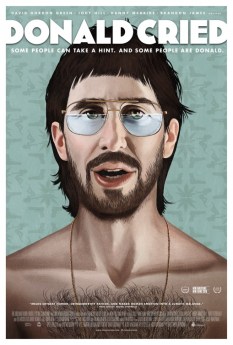
There’s something to be said for working within familiar genre tropes and hallmarks … and still managing to turn out something interesting. Kris Avedisian’s understated yet subversive take on the coming home indie dramedy, “Donald Cried,” provides just that – but not just that. The story of these two estranged former friends, reunited when one returns to their working class Rhode Island neighborhood, sneaks into some unpleasant crevasses of a fraught relationship.

Repeated interactions between visiting Wall Street hotshot Peter (Jesse Wakeman) and attic-dwelling Donald (Avedisian, in front of the camera) do not rekindle nostalgic memories. Rather, illusions shatter with each successive encounter, and past events that both recall rather innocuously are recast to show the hot-headed Peter outright disparaging the odd Donald. To their credit, neither Wakeman or Avedisian play the roles as traditional “types” that play into an established power dynamic of bully and victim. Watching them flip advantage based on humiliation or ignorance makes “Donald Cried” a live wire watch from minute to minute, with the settling position of their relationship never obviously discernible.

Avedisian, a first-time director, achieves all of this without reaching for emotion in close-ups or relying heavily on reaction shots. He trust his instincts and his actors to do the work right and create a tense atmosphere on their own. The harmoniously executed discord that ensues leaves a bittersweet taste – just as he wants it. “Donald Cried” lingers by frustrating our expectations just enough to wonder why we’re still a little upset by the end. B+


REVIEW: Frantz

21 03 2017

Sundance Film Festival

Cinema still runs low on great films about the Great War this side of “All Quiet on the Western Front.” Though more people ought to give another look to Derek Cianfrance’s “The Light Between Oceans,” roundly dismissed after being dumped in theaters over Labor Day weekend, they should also look at François Ozon’s “Frantz,” a film which debuted just a few days later at the 2016 Venice Film Festival. Rather than steeping his post-war milieu in melodrama like the former director, Ozon stages a dimly austere meditation on forgiveness in continental Europe.

The pared back simplicity of the black and white visual scheme, recalling the crispness of Haneke’s similarly two-toned “The White Ribbon,” might come as shocking to any Francophile cinema fans who know Ozon for his fizzy, vivacious filmmaking. The occasional stylistic flourishes do make their way into “Frantz,” punctuating the tense silences by reminding us of a joy seemingly absent in the wake of World War I’s devastation. But the overwhelming majority of the film is a masterclass in controlling ambiance and delicate unravelling of repressed emotion.

Of course, little of this occurs while letting the film wash over. “Frantz” begins as a simple mystery as Anna (Paula Beer), the widow of a German solider, observes a Frenchman repeatedly visiting her departed husband’s grave. He eventually introduces himself as Adrien (Pierre Niney), and he claims to have come in order to pay respects to the soldier he too knew. Showing up to a small, provincial town little over a year after the Armistice is a bold move for Adrien given that, as someone declares, “every Frenchman is my son’s murderer.”

The ensuing engagement and estrangement between he and Anna illustrates the difficult process of healing and remarrying while the wounds of armed conflict are still fresh. 1920 was still a time of hope for a brighter future; maybe the Great War would live up to its title of “The War to End All Wars” after all. But Adrien, Anna and Europe as a whole know the temptation of a comforting lie to paper over difficult fissures in a relationship. Ozon never shows these chasms in “Frantz,” though they loom ever larger as the post-war tranquility appears increasingly illusory. B+


REVIEW: Beauty and the Beast

20 03 2017

From their first moments, all movies start establishing a contract with their audience to set the framework of guidelines and conventions through which to view the work. This might sound like advanced film theory – it’s not. And for all those who just want to know if Disney’s live-action remake of “Beauty and the Beast” is worth seeing, this is relevant. These implicit contracts are some of the first things you factor into your decisions about a movie’s quality because they relate to whether or not you believe their created worlds.

Fictional films present distortions of observable reality that ask for various suspensions of normal existence. Conveniently, one of the easiest illustrations of this principle resides in the musical genre. We generally accept that people do not burst out into song as a mode of expression. If they do in a film, though, why? Is it a sung-through musical like “Les Misérables,” where music is the only mode of communication? Is it like “La La Land,” where song and dance numbers provide an expressionistic commentary? Is it more akin to “Into the Woods,” where moments of heightened emotion cause the characters to break out in a catchy melody?

The animated musicals of the so-called “Disney Renaissance” from 1989 to 1999 hinged on a fairly interesting set of conventions. The films borrowed heavily from the Broadway musical format but also took wild flights of animated fancy. Their limitation was not the confines of a stage but the edges of imagination. It’s no wonder these films carved out such a special place in the millennial consciousness.

But when it comes to adapting “Beauty and the Beast” into a live-action feature, musical numbers and all, director Bill Condon had a special challenge that Kenneth Branagh did not face in his 2015 version of “Cinderella.” Fans of the 1991 animated classic expect a certain fidelity to the original film. But so much of what made that film so effervescently delightful simply does not translate easily to a world that more closely resembles our own.

Read the rest of this entry »


REVIEW: Kong: Skull Island

7 03 2017

“Am I the story of the Negro in America?” asks a German major in Quentin Tarantino’s “Inglourious Basterds” as he tries to guess the name written on a card affixed to his forehead in a bar game. He gets a resounding “no” after running through a series of questions that could just as easily describe the importation of slaves. But he quickly pivots and rattles off, “Well, then, I must be King Kong.”

Traditionally in cinema – and fiction as a whole – our monsters mean something. They reflect the deep fears and anxieties of a society, ones that might not obviously rear their heads but can find vicarious expression through metaphor and transitive representation. In 1933’s version of “King Kong,” Tarantino saw a deeply symbolic tale about race in America. It’s too bad that “Kong: Skull Island,” the latest spin on the giant ape, arrives at a time of no racial tension and the complete absolution of prejudice based on ancestral origin. (Ha.)

But what kind of monster is Kong in Jordan Vogt-Roberts’ film? At first, the behemoth primate seems to be something between a colonialist allegory given the backdrop of the Vietnam War and a cautionary tale for human overreach in a technology-heavy era. The longer the film goes on, the more these aspects reveal themselves as clear offshoots of Vogt-Roberts’ key touchstones, “Apocalypse Now” and “Jurassic Park.” Then the real question of “Kong: Skull Island” arises. Is it worse if the filmmaking team (which includes four credited writers) have an undercooked meaning of the monster … or if there’s just no meaning at all?

We get the answer – it’s the latter of the two options – in a post-credits zinger. No spoilers about the contents of the scene, but Warner Bros. deliberately robs King Kong of any allegorical meaning to strip him down to pure commercialism. He’s now just another branded property, another franchise toy who can be trotted out in any number of series without being weighed down by cultural baggage. The ape who loomed large in the American imagination is now just another large CGI creation in a veritable zoo created by the VFX wizards that be. The whole film amounts to a less neon-bathed “Avatar,” a creature feature full of empty spectacle (and even less politicization).

Kong’s presence in the film is practically nonexistent, too. That includes implied appearances, a method to which Spielberg acolyte Vogt-Roberts fondly makes homage. The majority of “Kong: Skull Island” consists of a ragtag band of people who have been in too many action movies (Samuel L. Jackson, Tom Hiddleston, John Goodman) and those whose careers could use an action movie (Brie Larson, Thomas Mann, Corey Hawkins, Jason Mitchell) trying to make it to the top of a mountain for rescue after a military mission goes south. Their journey has its enjoyable moments, but who really buys a ticket to a King Kong movie for pithy banter between photojournalists and cagey war veterans? B-


REVIEW: Table 19

6 03 2017

Even as it resorts to some familiar tropes about the forced cohesion created within a band of misfits, Jeffrey Blitz’s “Table 19” still manages to do enough within a familiar framework to create a memorable moviegoing experience. There are some good running gags, like the ubiquity of the wedding photographer’s flash and how one character’s outfit looks suspiciously like the waitstaff’s getup. The script, which shares a story credit with the Duplass Brothers, also throws a major wrench in the expected turn of events at the midway point which proves truly surprising.
It’s a shame that Blitz bites off a little more than he can chew in an 87 minute film. Setting up and resolving six different narrative arcs for a wedding rejects table proves a lot to handle in such a short amount of time, and the sheer volume of events and conversations often overwhelms and clouds out quality. The quantity also overshadows some of the more intriguing storytelling that Blitz attempts in “Table 19.” For example, the pattern of conflict resolution takes on a much less straightforward direction, and the general story propulsion comes from strung-together tension and awkwardness.

The film is at its best at the outset when the characters are defined by how they relate to the room, not by how they relate to each other. In one of the most enjoyable sequences in “Table 19,” Anna Kendrick’s Eloise narrates a self-aware taxonomy of the wedding reception table layout. It’s genuinely perceptive about the unwritten rules of nuptial rituals, so it’s too bad that the characters largely lack the depth of thought given to the roles they play in the ceremony. B


Margarita with a Straw + ReelAbilities Film Festival

24 02 2017

margarita-with-a-strawReelAbilities Film Festival – Houston

In his 2016 book “But What If We’re Wrong?,” cultural critic Chuck Klosterman attempted to predict where our age’s great hidden text lies. What future generations tend to remember about bygone eras are works that did not receive proper due in their own time – in part because cultural archaeologists have an esoteric’s activist mentality when canonizing art. His guess was a Native American writing on a message board on the Dark Web, citing the relative paucity of attention given to each.

Far be it from me to make such a sweeping prophecy, but I do think there’s a decent chance that disabilities could factor into that conversation about overlooked, undervalued culture. There are countless courageous Americans fighting daily for the disability community, though their efforts never seem to pierce the public consciousness in the way that movements surrounding civil rights or marriage equality have. To be clear, it’s the people on the ground working for substantive policy gains who make the real change – yet popular culture can also play a large role in changing hearts and minds.

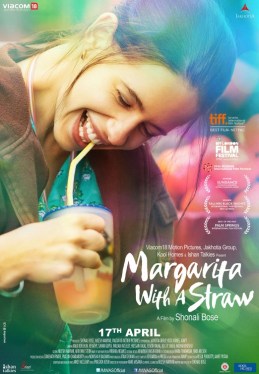
Margarita with a Straw,” which I saw as part of Houston’s ReelAbilties Film Festival, could help reverse the trend. I so often associate narratives surrounding disability with clichéd struggles and hokey uplift. We’re regularly encouraged to see these individuals as victims, afflicted with some condition they cannot control and acted upon rather than serving as active agents in their own stories. Shonali Bose’s film, which also played such prestigious festivals as Toronto and London, does none of these things. (Although I should add that it does contain some elements of wish fulfillment to the detriment of the overall film.)

The protagonist Laila is a person above all, a young adult with a passion for music and a little bit of wanderlust that directly conflicts with her provincial Indian family’s desires. While pursuing a degree abroad at NYU, Laila’s openness to life and unbridled enthusiasm brings her into the romantic orbit of peers from both genders. The film never downplays her disability and the way it affects her story, but “Margarita with a Straw” is not about that part of her. It’s about her journey of self-discovery in her bisexuality. Not to take away from what Bose accomplishes here, but I spent much of the film thinking about the range of stories still left to tell in this community. I look forward to seeing what lies ahead for ReelAbilties in the years to come.


F.I.L.M. of the Week (February 23, 2017)

23 02 2017

I first saw Ryan Fleck’s “Half Nelson” a few years ago and, admittedly, was not impressed. Perhaps the film fell victim to high expectations. Critics and cinephiles put it on a pedestal for so long, citing Ryan Gosling’s Academy Award-nominated work as evidence that he amounted to more than just a Tumblr heartthrob. Yet I was unmoved.

For whatever reason, I decided to check it out again given Gosling’s recent Oscar nominated turn in “La La Land” – and a general reversal of fortune for his career altogether. Further inspection of “Half Nelson” reveals a remarkable two-sided performance that fully captures the actor’s versatility. From my early ’10s vantage point, I probably saw a reflection of what I consider Gosling’s worst tendencies: an exaggerated machismo where his smolder goes hand in hand with the stoicism. When contextualized within his films of that time – “Drive,” “The Ides of March,” “Gangster Squad,” “The Place Beyond the Pines,” “Only God Forgives” – the turn as a junior high history teacher who resolutely refuses intimacy and embraces drug needles feels like the genesis of a dour period.

But after the exuberance of “The Nice Guys” and “La La Land,” Gosling’s cheerier streak opened up another side of “Half Nelson” that now vaults into “F.I.L.M. of the Week” territory. His Dan Dunne has a streak of incorrigible impetuousness, particularly when digressing from the assigned curriculum to instruct with a more philosophical slant on the past. He projects such confidence when he dwells in his element, a fitting and necessary contrast to his moments of vulnerability to cocaine. Reconciling the highs with the lows presents a difficult task for any performer, and Gosling nailed it at just 26 years old. He’s also fortunate to create this character under the auspices of a thoughtful script from Fleck and Anna Boden, who avoid all the pratfalls of drug addict or other self-destructive protagonist narratives.


REVIEW: A United Kingdom

22 02 2017

History is rarely tidy enough to have personifications of complicated systems of belief like racism and colonialism, but movies nevertheless tend to present the past in such a way to simplify what seems unfathomable to modern audiences. Amma Asante’s “A United Kingdom” lies among these crisp-edged period pieces and stands out as one of the better of the bunch.

The film succeeds at depicting high-level concepts of segregation and prejudice that are still relevant today. Yet it also works when pinpointing the ethos of a specific moment in the late 1940s where the sun was setting on the empire in which the sun never sets. British-born Ruth Williams (Rosamund Pike) falls head over heels for African tribal king Seretse Khama (David Oyelowo), who studied in London to prepare himself to assume the throne in Botswana.

The grumblings from her ardently colonialist father could sufficiently set in motion the drama of an entire film altogether. But don’t worry, “A United Kingdom” charts the vast geopolitical complications arising from their marriage. What begins as mere disruption in a community presents an opportunity for the waning British powers to destabilize an entire region.

Guy Hibbert’s script front-loads the film’s most explosive moments – a refreshing change of pace. A fiery speech from Seretse in defense of his wife feels like the climactic moment of a more conventional story, but Hibbert situates it towards the beginning. The shocking segregation of blacks in their own country also appears primarily at the outset. These micro-level moments are just drops in the bucket of a larger narrative, one whose ever-expanding scope consumes “A United Kingdom.” Seeing how far those ripples extend proves the most fascinating component of Ruth and Seretse’s history, although little moments such as Ruth’s limp imitation of Queen Elizabeth’s wave to appear more regal to Botswanans delight along the way. B2halfstars