REVIEW: Joshy

9 08 2016

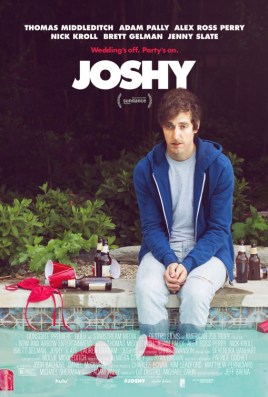
JoshyAs predicted by myself and many people smarter than me, the so-called mumblecore movement shot to cultural prominence in the wake of 2013’s “Drinking Buddies.” These low-budget, short production films began attracting some bright talent from television and cinema. With their unscripted, improvisation style and lived-in qualities, it’s no wonder that comedians and dramatists alike rushed to appear in their own.

With a large cast featuring small screen scene stealers like Thomas Middleditch and Adam Pally, sketch performers like Nick Kroll and Brett Gelman, indie dream girls like Jenny Slate and Alison Brie, and even filmmakers like Alex Ross Perry and Joe Swanberg themselves in front of the camera, Jeff Baena’s “Joshy” feels a bit like “Mumblecore: The Movie.” (Or at least what our culture has decided it will be today.) The simple pleasures of watching this group interact for an hour and a half cannot be understated.

Yet recent films of a similar ilk such as “Digging for Fire” felt like a hangout for hangout’s sake, with thematics tacked on and a narrative throughline threaded in as an afterthought. The conversations and group dynamics of “Joshy,” however, are baked into the films reason for existing itself. After the eponymous character suffers a tragedy that lays to waste his marital plans, his motley crew of buddies use the house reserved for his bachelor weekend as the venue and occasion for a cheer-up mission.

It quickly becomes obvious that while his trio of bros attempt to play the role of fun-loving therapists, they too are all undergoing hardcore emotional stressors of their own. Each attempts some level of macho posturing – whether in relation to booze, drugs or strippers – to mask the pain. Their buddy makes it all too easy to feel superior; the pet name Joshy suggests both femininity and childishness.

If the film feels at times meandering, it’s because Baena both admirably gives the main men space to work out their issues while also providing ample space to critique them. By being at the center of the film, Joshy and pals are inevitable magnets of symapthy and understanding. But Baena never lets the men of “Joshy” off the hook for what could come across as tunnel vision or indefensible behavior. A more “grown-up” family, played by Joe and Kris Swanberg, drops in on their retreat and delivers a pretty firm scolding. Similarly, a group of call girls makes reference to the gang as resembling creepy serial killer types. It’s a pretty satisfying way to balance the competing impulses of developing the characters and indulging the actors. B2halfstars


REVIEW: Florence Foster Jenkins

8 08 2016

Earlier in 2016, discerning art-house audiences might have seen a thinly repackaged French version of the Florence Foster Jenkins legend, Xavier Giannoli’s “Marguerite.” The concept of an aging socialite determined to become a well-renowned opera singer, despite having no natural vocal gifts, presents many fascinating angles of examination for art, class and power. Giannoli chose neither of these; as I wrote in April, “Apathy and ambivalence, more than ambiguity, drive the proceedings.”

The story makes much more sense, anyways, in its native United States. Here, our national mythology declares that if you can dream it, you can be it. Our social structures also tend to dictate that those with the money can exert an inordinate influence over what qualifies as “art” and tip the scales in their own favor wherever they choose. Florence Foster Jenkins’ ruse for aesthetic beauty and admiration feels like a true creation of her country – only in America, right?

Yet Stephen Frears’ film “Florence Foster Jenkins” suffers from the same affliction as “Marguerite.” With so many doors from which to choose, the filmmakers linger in the lobby. By placing Florence at the center of the narrative, she becomes a de facto object of our pity and sympathy. The extent of Frears’ challenges to her is cutaways to the aghast expressions on all those indulging Florence’s pipe dreams. It’s the equivalent of replying to a tweet with a witty reaction GIF, and these shots feel cheap compared to the committed physicality Meryl Streep puts behind Florence.

If any question of note is raised by the film, it’s that of the vitriol directed at Florence from a disapproving public. The crowds who gather to hear her screeches express their disgust in varying degrees of openness, ranging from murmured snickering to outright boos. Of course, everyone should expect a certain decorum and humanity when responding to art. But when the primary justification for her shrill attempts at opera is merely that she exerts an honorable effort, the crowd has a right to get a little irate. Yes, the banal can besmirch the extraordinary.

In many ways, “Florence Foster Jenkins” resembles another character in the film more than the one for which it is named. That personality would be Hugh Grant’s Sinclair, the jaded lover of Florence as well as her chief apologist and enabler. If anyone were to make a stand for great art and put an end to her stunt, it would be him. Yet Sinclair is in no position bring Florence down to earth because he himself has not relinquished the charade of becoming a great actor in his own right. He embodies the inherent contradiction of the film: what looks like the American Dream could merely be the American Sham. B-2stars


REVIEW: Café Society

7 08 2016

Woody Allen haters, whether for his personal life or his professional output, need only look at the basic plot summary of “Café Society” to turn themselves away. On its face, the film repackages one of the most unfortunate clichés propagated by his body of work.

This, of course, is the doomed love triangle where a young, sexually blooming woman is courted by two men; one is an older and more distinguished gentleman, while the other is a younger but more intellectually and romantically capable match. Such a formation often seems like Allen wants to have it both ways, where his older and younger personas form a kind of sexual yin and yang.

This risible, repetitive plot invention looms over “Café Society,” imbuing every gorgeous frame from Vittorio Storraro’s lens with a faint stench of retrograde gender politics. In that way, the film plays a role similar to that friend you know has substance issues but dispenses valuable nuggets of drunk wisdom.

Look past the love triangle and beyond the outmoded attitudes, and “Café Society” marks Woody Allen at peak nostalgic autobiography. A few of the bad elements are here, sure, but much of the beauty and torment that marks Allen’s best work is present as well. From his culturally Jewish upbringing to his loathing of Hollywood and even his bleakly optimistic outlook on life, the film feels somewhat akin to a superhero origin story.

Read the rest of this entry »


REVIEW: Richard Linklater: Dream Is Destiny

6 08 2016

Richard Linklater Dream Is DestinyCurrent discourse surrounding auteur theory seems to presuppose a lone genius whose singular vision contains in it the power to overwrite all other contributions and supersede all commercial influence. There’s something to be said for raw talent in moviemaking, but such a collaborative and expensive art form seems to demand a more complex explanation of creation.

Louis Black and Karen Bernstein’s new documentary, “Richard Linklater: Dream Is Destiny,” provides a necessary corrective for a generation of film fans learning about directors through tabloid-infused cults of celebrity or video essay supercuts that celebrate visual repetition as proof of self-evident virtuosity.

Their subject, Texan troubadour Richard Linklater, has had a career that would baffle anyone looking for a straight-shot trajectory of accelerated accomplishments. His most well-regarded films have defined generations, yet others in his filmography barely registered with anyone. Linklater hit and missed with both studio and indie films, critics and audiences. So why is he worth making a film about?

Black and Bernstein look for the secret sauce of Linklater not in some inherent brilliance, but rather in his hard work. The director (and often times writer) regularly earns plaudit for how effortlessly his films can replicate and recall our visible reality; the underlying assumption is often that such a conjuring requires no effort on his part. Clearly, such a statement could not be farther from the truth.

“Dream Is Destiny” features quite a remarkable coterie of guests paying tribute to Linklater, drawn from collaborators, critics and contemporaries. The documentary is far superior to 2014’s “21 Years: Richard Linklater,” a film with a hagiographic adoration of the director that never jived with his unassuming style. Black and Bernstein do not soften the edges or sugarcoat the realities of Linklater’s decades in filmmaking. At far too many points in his career, someone has doubted Linklater’s abilities – and often precisely because he is so difficult to neatly classify. Thankfully, he perseveres on the strength of his modest self-certainty and proves in true Texas style that the coastal – I mean, polar – extremes are not the only modes of operation for filmmakers. B+3stars


REVIEW: Embrace of the Serpent

5 08 2016

Embrace of the SerpentThe story at the heart of Ciro Guerra’s “Embrace of the Serpent” is nothing particularly out of the ordinary. Stranger in a strange land ventures into the heart of darkness with the help of a native shaman? Yeah, been there, done that.

What sets the film apart, however, is the perspective the film provides. Rather than telling a story of colonialism through the eyes of the colonizers, Guerra and co-writer Jacques Toulemonde Vidal look through the viewpoint of the colonized. Karamakate, an indigenous resident of the Amazon rainforest, takes two white men on a journey along the river as they search an elusive botanical bounty. These treks are separated by four decades, though the charade of caring that masks earnest exploitation remains the same.

It’s a shame that Guerra has little of note to see through Karamakate’s eyes. The hunt for a plant believed to have magical powers provides scant cinematic magic. While lushly shot in stark black and white by David Gallego, “Embrace of the Serpent” invites only the most lukewarm embraces of its jungle world. The film primarily states what most educated viewers already know about colonial incursions into unwelcome areas as well as the wisdom of that land’s native inhabitants. B-2stars


F.I.L.M. of the Week (August 4, 2016)

4 08 2016

A Field in EnglandWhatever one thinks about the quality of Ben Wheatley’s films, the sheer variety of his work is commendable in and of itself. From gangster flicks to romantic road trips and loaded social allegories, his pitch-black comedic sensibilities never seem to settle. For me, that makes him one of the most exciting filmmakers working today.
“A Field in England” might not have the most perfect execution, but its sheer audacity alone makes it an easy candidate for the “F.I.L.M. of the Week.” You need not know all the details of the 17th century politics that caused the English Civil War, the conflict in which the film is set. All that matters is the knowledge that the film’s characters are deserters, wandering off the battlefield in search of something more.

Amy Jump’s script feels like a road movie as the soldiers – three Englishmen and a curious Irishman – amble through the countryside. Wheatley manages to keep the walk-and-talk interesting for at least an hour, which is no small feat. Though the film is shot in monochrome black-and-white, “A Field in England” never feels monotonous or monotone. The almost episodic misadventures of this crew recall Swedish philosopher-director Roy Andersson with its musings made around the rim of the burning pot that is modern society.

The film does take a bizarre detour towards the end that takes it into the realm of the surreal, leaving the overall effect to be akin to a mushroom morality play. “A Field in England” manages to be naturally evocative in the way Nicolas Winding Refn would like his belabored art films to be. So for purity of intent and sheer gall alone, check this one out.


REVIEW: Captain Fantastic

3 08 2016

Most movies about adventures into the wilderness center around the themes of getting in touch with one’s primal instincts or returning to some sense of balance with nature. Matt Ross’ “Captain Fantastic” is not most movies, though.

Viggo Mortensen’s Ben Cash raises his family of six children to live in harmony with the environment to an extent, but this is far from the traditional feral child model. They live in somewhat of a liberal arts experiment taken to a logical extreme where, removed from the supposed silliness of socially constructed rules and traditions, Ben can provide the kids with an environment of pure rationality and intelligence in which to develop. We’re talking people who celebrate Noam Chomsky Day over Christmas, people.

Ben’s ascetic cult of authenticity, cast as a utopia, may well be a vision of the world in a not-too-distant future should the slow march of progress continue in its current direction. While “Captain Fantastic” does often assume the posture of defending the inherent virtues of the idea, Ross hardly lets Ben off easy. What Ben might envision as a microcosm of a perfectible society also looks a lot like a more rustic version of the ivory tower mentality. A portion of America has let their rationality drive them into enclaves of self-selected intellectual peers, where cognitive gifts fan the flames of their own egos rather than stoking necessary social change.

Mortensen’s performance comes to embody the tough realization of the film. As he confronts the passing of his wife and the grief of his family, Ben’s plain-spoken literalism creates more problems than it solves. Years in the wilderness indoctrinating his children with the intelligence of textbooks has left him blinded to the need for emotional intelligence and empathy in the wake of tragedy. Despite some real quirks in his character, Mortensen keeps an impressively even keel as he slowly comes to realize the impracticality of many principles to which he has dedicated his life.

“Captain Fantastic” does not implode Ben’s self-confidence all at once. The film erodes it gradually to devastating effect. Ross favors slowly peeling off the band-aid that covers decades of resentment, equivocation and hurt. The process stings for everyone involved, characters and audience. But expression is ultimately more valuable than repression, and something tells me that Ben could find a philosopher to cite in regards to why that is so. B+3stars


REVIEW: Suicide Squad

2 08 2016

At the time of this review’s publication, there are a whopping seven untitled DC Comics films with dates on the calendar but no titles announced. It seems likely that at least one, if not more, of those slots will be filled by a character from “Suicide Squad.” The latest ten-car-pileup from the comic book studio plays like an extended audition for a standalone film. Individual characters distinguish themselves, sure, but they do so by essentially acting in little regard to the plot and tone around them.

This is the most obvious with the film’s resident crazies, Jared Leto’s The Joker and Margot Robbie’s Harley Quinn. The former, never quite fully breaking from the iconic Heath Ledger performance, feels like he waltzed his way out of a Miley Cyrus video. The latter, a rainbow bomb-pop comes to life, breaks free to some extent and makes for raucous fun. But most of Harley’s shining moments come in cutaways or disruptive asides. Robbie does not feed off the energy in the scene; she mostly just crushes the line she’s been given.

All the internal one-upmanship feels oddly fitting for a film whose sole purpose appears to be one-upping Marvel. “Suicide Squad” feels like the inevitable byproduct of a DC boardroom who decided to blend their favorite parts of unlikely smash hits “Guardians of the Galaxy” and “Deadpool,” which they then serve in a neon-lit package. The film has smart-mouthed, villainous protagonists who form an unlikely coalition to save the world, and their romp is set to a Spotify playlist of frequently used trailer songs. (The fact that “Spirit in the Sky” made it onto the soundtrack is as plagiaristic as Melania Trump’s RNC speech.)

“Suicide Squad” is an emblematic film for the kind of products made by committees and algorithms as opposed to champions of artists. DC and Warner Bros. know what has worked for these types of films in the past, and they are not necessarily wrong to assume that audiences want something like it. Indeed, “Suicide Squad” works in fits and spurts where writer/director David Ayer’s dark comedic or war battle sensibilities can come through. But more often than not, he is forced to do too much in too little time. And a good chunk of that overextension does not make it the kind of movie that another corporate committee will try to emulate in a year or two. C+2stars


REVIEW: Jason Bourne

1 08 2016

As the Hollywood star machine continues to run on empty, feeding in no-name indie stars hungry for a career boost that can increase their international value to fund passion projects, we probably have to get used to a new cliché known as the “distinguished gray.” These films are third, fourth or maybe even fifth installments of long-running – primarily action – franchises which would rather turn the age of their leading men into a pivotal plot point than invest the energy to recast, reboot or otherwise retool the series. (And yes, I say men because seniority is generally a negative attribute for women over 40.)

Jason Bourne” ditches whatever the heck Jeremy Renner’s spinoff was and resurrects the titular character with Matt Damon, now pushing 46 and not attempting to hide those light streaks of hair near his ears. He’s in hardbody shape, though more out of necessity for the character and less out of an unspoken invocation to gawk at his figure. Bourne seems more tired and weary than his formerly spry, curious demeanor in the original trilogy.

In a sense, can anyone blame him? In this iteration of “Jason Bourne,” the world outside the frame seems to weigh heavier on the proceedings than ever before. The CIA must deal not only with the post-Snowden scrutiny of their surveillance behemoth but also with the whims of capricious Silicon Valley tech magnates, whose often radical views pushing for a more open society pose a threat to the agency’s very existence. No wonder Bourne seems content to bare-knuckle box in the sandy outskirts of Athens like Daniel Craig’s James Bond luxuriated in womanizing and heavy drinking in “Skyfall.”

Read the rest of this entry »


REVIEW: Star Trek Beyond

31 07 2016

I took a bit of an unconventional route to “Star Trek” fandom: academia. Ok, fine, a high school mini-course. A history professor’s class, called “Making The World Safe for Democracy,” used the original Gene Roddenberry television series to illustrate the kinds of political tensions being played out in America during the ’60s … only on the small screen.

Perhaps more than any series, I have always approached “Star Trek” with tinted glasses. J.J. Abrams’ first two trips down an alternate timeline contained some faint elements of this social consciousness. But as both fans and malcontents of “Star Wars: The Force Awakens” know, the director often spends more time paying fan service than charting bold new territory.

Abrams left the “Star Trek” series in entirely different hands when he departed for that galaxy far, far away. (Fear not, he retains a producer credit.) Director Justin Lin, along with writers Simon Pegg and Doug Jung, make a compelling case for the more frequent shuffling voices in franchise with their take expressed in “Star Trek Beyond.” While the film may lack the polish of the Abrams entries, it excitingly pushes the universe into both classic and unfamiliar territory.

Pegg’s influence most clearly rears its head in the startling humor of “Star Trek Beyond,” far more self-effacing and tongue-in-cheek than any portion of the canon I have experienced. Perhaps now that a new generation is more familiarized with Kirk, Spock and the Enterprise crew, more opportunities present themselves for character-driven humor. The gags are more developed than the plot, which often plays like a good outline still in need some additional finer details. The story often proves difficult to follow beyond generalities, a direct reversal of what made the last two scripts from Robert Orci and Alex Kurtzman glisten.

Read the rest of this entry »


REVIEW: Tallulah

30 07 2016

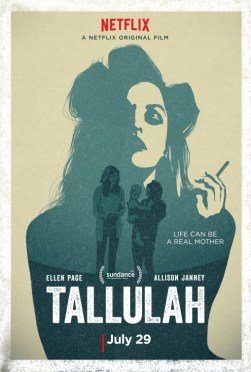
Tallulah“Juno” still ranks among the top 10 quoted movies at my house, so it should come as no surprise that the on-screen reunion of that film’s mother-daughter pair (Allison Janney and Ellen Page) in “Tallulah” came as a welcome development. And, even better, the film centers around issues of maternity!
In Sian Heder’s new film, Page stars as the titular character, a nomad who scoops an infant from drugged-up trophy wife Carolyn (Tammy Blanchard) during a babysitting gig. The point of departure for the story provides an intriguing counterpoint to “Juno.” Page claims a child here uninvitedly and receives one in her Oscar-nominated role unwittingly.

There’s a bit of standard police procedural – involving Uzo Aduba as a child services officer! – investigating the victim and plaguing the conscience of the perpetrator. But “Tallulah” is far less about the intrigue of what will happen to the child in question than it is about the issues raised by its presence or absence for the trio of grown women in the film. Amidst some of the tonal and plot issues, raw emotions bubble to the surface as each grapples with the thorny personal issues.

Most moments of duress revolve around the characters’ insecurity over feeling needed by someone else and the overwhelming sensation that they are replaceable – even disposable. It’s often jarring how quickly “Tallulah” can pivot from light-hearted banter to soul-baring confession, but no one pulls it off better than Janney as Margo, the woman unknowingly caught in the middle of Tallulah’s scheme. She navigates a narrow path between assertiveness and apprehension, unsurprisingly finding her bearings with gusto. B-2stars


REVIEW: Indignation

29 07 2016

IndignationSundance Film Festival

When it comes to films surrounding schooling periods, a certain set of general guiding principles undergirds nearly story. High school movies are about the competing impulse of individuation and socialization, finding oneself while also navigating the locker-lined corridors of the pecking order. College movies primarily center on free expression and discovery, like a trial run for adulthood with few of the responsibilities or consequences.

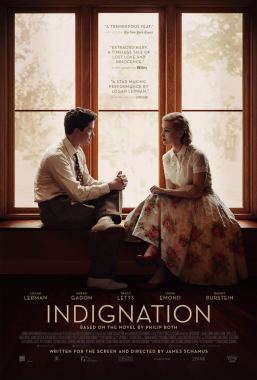
2016 has a pretty stellar roster of college movies between “Everybody Wants Some” and “Neighbors 2” – but a bit of a black sheep with James Schamus’ “Indignation.” The film, adapted from a novel of the same name by Philip Roth, follows university-bound protagonist Marcus Messner (Logan Lerman) as he puts his hand to the plow in his studies. He scorns social contact, even from like-minded individuals such as the school’s Jewish fraternity that comes to earnestly recruit him. Marcus comes to school a skeptic and a deep religious doubter, two positions in which he only entrenches himself further upon arrival.

Whether the position comes from Schamus or Roth, it matters not – “Indignation” indulges Marcus’ cynicism rather than interrogating it or demonstrating the philosophy’s value. Vindication comes cheaply as the puritanical hypocrisy of the school administration, chiefly Tracy Letts’ Dean Caudwell, tries to clamp down on his rebellious streak. Marcus begins to see the same values in his own family, whose middle-class emphasis on diligence and industriousness leads them to disapprove of his budding relationship with the haunted yet wealthy Olivia Hutton (Sarah Gadon).

The romance between these two wildly different students begins, ironically, with Olivia’s performing oral sex on Marcus while his vehicle is parked in a cemetery. His genitals receive more stimulation than his mind throughout the film. And, to be quite honest, they probably receive more stimulation than the audience as well. “Indignation” has nothing pushing it forward but the fervent stagnation of its protagonist. Though one long, refreshingly theatrical-style spar between Letts and Lerman helps to break the rhythm towards the middle, the film is primarily a sterile exercise in self-satisfaction. C+2stars


7 years later, and still at it.

28 07 2016

Holy cow. 7 years ago today, I started Marshall and the Movies. Then, I was 16 years old approaching my junior year in high school with trepidation. Today, I’m 23 and rounding the corner towards my first year in the “real world” … which is scary in its own way.

In many regards, the famous saying from Joan Didion, “I have already lost touch with a couple of people I used to be,” rings accurate today. I don’t recognize the writer who often laid out reviews in the same blueprint as an academic essay. I don’t recognize the film enthusiast whose passion for the art barely extended past the 1970s. I don’t recognize many of the insecurities and the doubts of that person. (For good measure, I also don’t recognize some of that teenage presumptuousness.)

But after rewatching “Julie & Julia,” the film that launched me on this journey, I was also reminded that some things haven’t changed. As Amy Adams’ Julie Powell declares, “I can write a blog. I have thoughts!” I did (and am) because I had (and have). Sometimes, it really is that simple.

Though admittedly, I have let a lot of things slip – traffic, SEO, social cross-promotion, comments, reading the words of others, etc. – I cannot fully express my gratitude for those who continue to come back and read. Whether you know me personally or just found me floating in cyberspace, THANK YOU! Through your continued readership and encouragement, I can push my form on this blog and prepare to make a big impact in the freelance world.

In just the past year of expanding my writing beyond this site, it has been one heck of a ride. I have interviewed two Oscar-winners, the directors from two of my top 10 films of 2015, and three actors from my favorite movie of 2016 thus far. I have covered three film festivals, including the cream of the crop here in America: Sundance.

So … let’s fight the seven-year itch together! Here’s to bigger, better things here on the site and beyond.


REVIEW: Equals

27 07 2016

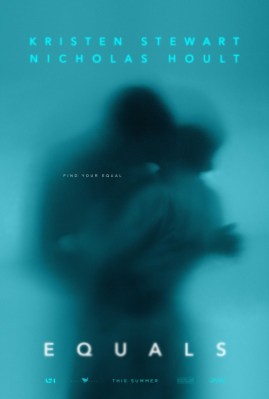
EqualsDystopian sci-fi often tends to paint in broad strokes as it outlines a vision of an alternate reality. But in Drake Doremus’ “Equals,” however, the focus is on the minutiae and the barely perceptible.

Though its color-drained, emotionless milieu exists somewhere on the spectrum between “Pleasantville” and “The Giver,” the pleasures hardly derive from the gradual revelations of the imagined premise’s limitations. In fact, the film often stumbles when it ventures into thriller-style intrigue around the “escape” from oppression. “Equals” soars when Doremus allows the incredibly specific, gently realized acting of stars Kristen Stewart and Nicholas Hoult to shine.

As cogs in an industrial machine that has sought to biologically eliminate emotions in the name of productivity and peace, Hoult’s Silas begins to feel the stirrings of affection for Stewart’s Nia after observing – ironically enough – her distinct mannerisms like lip biting and unusual eye movement. In these initial flirtations, their attractions scarcely register as the most minor of gestures. Doremus shows an eye for the subtle, the virtually unnoticeable that proves so unique to the cinema.

The chaste, hidden-in-plain-sight romance that plays out in public possesses a truly beautiful nuance and a wonderful correlation to the world all of us inhabit. The small graze of a crush’s hand or the intercepted glance often packs the most profound emotional wallop. It’s a shame that when their relationship moves into the more physical, sensual realm that “Equals” loses this bliss. In their fumbling for sexual intimacy, Doremus presents Silas and Nia as darkly silhouetted and reduced to mere grunts, gasps. Yes, they are discovering sexuality on a primal scale. But there has to be more to it.

Actually, there is more to it, as Hoult and Stewart so clearly demonstrate. With each passing scene, we can see the gradual expansion of the emotional pallets available to Stewart and Hoult – mostly in the latter. Stewart maintains a primarily leveled tenor as Nia, but Hoult grows into an emotionally sensitive character on par with his deeply empathetic turns in films like “Mad Max: Fury Road” and “Warm Bodies.” Doremus may spin in circles doing a kind of Harmony Korine-esque haze of words, fragmentary shots and trance-like score, but the actors of “Equals” keep the film centered. B2halfstars


REVIEW: The Finest Hours

18 07 2016

There’s something odd about Disney’s “The Finest Hours.”

This ’50s-set high-seas rescue does everything it can to recreate that era in the filmmaking. Director Craig Gillespie operates at a more methodical, easygoing pace in land-bound scenes. Period detail is all there, even down to the sound of the time as composer Carter Burwell provides a similarly moody post-war ambiance that he endowed to last year’s “Carol.” Heck, they even filled the role of Coast Guard crewman Bernie Webber with Chris Pine, the rare working actor today who can comfortably assume the style and mannerisms of a golden age Hollywood studio star.

And yet, “The Finest Hours” is the kind of disaster caper only possible to achieve at this level in the 21st century with computer graphics. The films of the 1950s – even the epics – were limited by the technology available at the time and bolstered by a grounded grandiosity. Seeing is believing here when technicians can show, in great detail, the destructive storm and waves that strand a vessel off the coast of Massachusetts. When the filmmakers try some of the more magical elements of a bygone period, such as suggesting a quasi-spiritual connection of Bernie’s sea navigation to his romantic interest’s journey on the open road, it falls completely flat.

“The Finest Hours” is a film caught between two styles of moviemaking and two schools of thinking. Gillespie and company can never quite figure out how to resolve this tension from the beginning, and as a result, the film sinks before it even has the chance to doggy-paddle.  C2stars