REVIEW: Eden

21 10 2015

EdenMia Hansen-Løve’s 2012 film “Goodbye First Love” might have been awash in cliches, but her latest directorial effort “Eden” feels refreshingly free of them.  The film follows Félix de Givry’s Paul Vallée, a DJ on the cutting edge of the Paris EDM scene, as success constantly eludes him while pursuing the dream.  While Daft Punk makes it big, Paul scrapes the bottom of the barrel just to keep hope faintly visible.

An easy temptation might be to play into tropes about starving artists, yet Hansen-Løve shows no interest in such a story.  In reality, the momentum of the film is never predicated on Paul’s forward – or backward – progress.  “Eden” is more a landscape of an emerging youth music scene in the 1990s and early 2000s; Paul is merely our access point through which we can experience the soaring heights and crushing disappointments of the cultural moment.

This desire to take it all in gets reflected in her visual schema, too.  Hansen-Løve’s shot of choice in “Eden” is the long pan, which allows us to filter and select information from these massive concerts on our own.  Rather than dictating the specific details for our focus, she liberates us to find a personal point of interest.  The camera becomes like the sober friend at the party, capturing everything on behalf of those who might not remember anything later.

The pacing of “Eden” maintains a similar steadiness, mimicking Paul’s journey rather than the music he creates.  Heck, sometimes it even feels like that Hansen-Løve and editor Marion Monnier were on downers assembling the final product.  But in their more measured approach, they find an interesting morsel of wisdom.

Sure, Paul never makes it big.  Is that an excuse to wallow in self-pity?  They seem to argue that it is not.  The end result was not optimal, yet the process and the ride were fun while they lasted.  Perhaps most importantly, he got to create music that mattered to him.  To some extent, isn’t that what art should be?  External validation is nice, but it’s nice for movies like “Eden” to remind us that it should not be everything.  B+3stars


REVIEW: The Assassin

20 10 2015

The AssassinNew York Film Festival

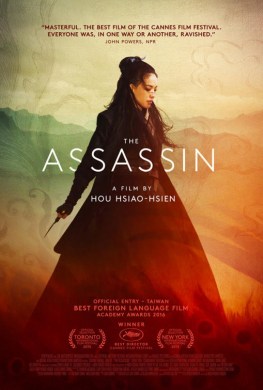
I would be lying if I said I could explain all any of Hou Hsiao-Hsien’s “The Assassin.” I am woefully unversed in Asian cinema, so much so that the term wuxia was something I had to frantically Wikipedia in my seat prior the film starting.  There’s a great tradition that this film is conversation with, a rich history of which I am almost entirely unaware.

So what to do watching – and subsequently reviewing – such a film?

I can only compare the experience to walking through an art gallery, in particular a curated collection.  The film’s emphasis is not necessarily to barrel through plot points but simply to achieve a delicate forward motion that propels constantly forward.  The cumulative effect is entrancing and beguiling, if not altogether breathtaking.

While taking in “The Assassin,” time does feel suspended, for better or for worse.  I felt trapped to take in Hou’s painterly compositions and wound up somewhat exhausted by the sheer saturation of stunning imagery.  My only somewhat intelligent observation at first glance is the way the film concerns violence but rarely depicts in a literal or graphic way.  Hou’s fight sequences manage to thrill and excite by letting us simply hear the slash of the sword and observe its human impact – not just relish in bloodshed.

Perhaps one day, after reading a book on the politics of 9th century Chinese provinces, I’ll reapproach “The Assassin” while also clutching a detailed plot summary and a character chart.  I am not such a fool that I can dismiss the obvious artistry at play here.  One day, I hope that I can reach a level of knowledge to where I can fully appreciate this esoteric piece of cinematic craftsmanship.  B+3stars


REVIEW: Freeheld

19 10 2015

FreeheldFreeheld” is the most unfortunate of contradictions.  This weepie issues drama about the dark age known as 2002 wants to applaud all progress achieved in the past decade for LGBT Americans.  Yet when it comes time for the film’s chief characters, partners Laurel Hester (Julianne Moore) and Stacie Andree (Ellen Page), to show affection after securing a domestic partnership, their kiss literally makes no noise.

Director Peter Sollett and screenwriter Ron Nyswaner love having a good round of self-congratulatory outrage and inspiration for lesbian couples like Laurel and Stacie.  They just don’t really care for gays as people all that much.  If they did, they might realize that the battle against discrimination and stigmatization is not over just because of the Supreme Court’s decision regarding Obergefell v. Hodges.

“Freeheld,” perhaps from bad storytelling but also likely because of bad marketing, wants to insert itself in the debate on marriage equality.  This might make the film appear more “timely,” sure, but it is completely incorrect.  Laurel and Stacie’s battle was never about marriage.  It was about equality under the law, even though their legal union was the 21st century equivalent of “separate but equal.”  To redirect the righteous outrage of a woman who fought for her rights even on her deathbed for pure opportunism feels disgraceful to her memory.

Laurel remained closeted as an occupational hazard on the New Jersey police force, fearing that any strain of moral indecency would only enhance the sexism she already faced.  But once stricken with late-stage cancer, she risks backlash in order to secure the transfer of her pension to Stacie.  The law covers domestic partnerships, yet that does not stop her county’s board of freeholders from refusing her request.

Read the rest of this entry »


REVIEW: Bridge of Spies

18 10 2015

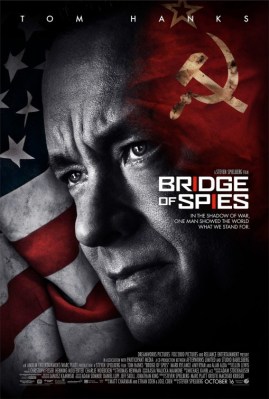
Bridge of SpiesI’m young enough that I cannot remember a time when director Steven Spielberg’s name was not synonymous with cinematic excellence at the highest echelon. I am also of the age that I have never been able to experience the kind of film that earned him such a reputation in any manner other than through the lens of retrospection.
That is, until “Bridge of Spies” came along, the first Spielberg effort since 2005’s “Munich” that serves as an adequate calling card for a generation-defining artist.  Making the sort of mid-range budget ($40 million) adult drama that have all but gone the way of the dinosaur, he issues a strong reminder that his formidable skills should not be undervalued or underestimated.

It’s fitting, then, that this film should star Tom Hanks, another already minted national treasure whose cultural footprint often dwarfs the power of his work. While both director and actor could easily coast on their merits, neither does in “Bridge of Spies.” The film operates at an impeccably high level of craft and precision because Hanks and Spielberg flex their muscles so potently.  Calling it a return to form feels wrong since neither has precipitously declined, but this is clearly them at peak performance.

Hanks plays William Donovan, an idealistic Brooklyn lawyer given the thankless task of providing legal counsel in a sham trial meant as a PR play.  His client is Mark Rylance’s Rudolf Abel, a suspected Soviet spy captured at the peak of Cold War mania.  Donovan’s task recalls the central case in “To Kill a Mockingbird,” and it’s a good thing that Hanks can channel Atticus Finch (pre-racism) so deftly.

Only a few actors could pull off this unironic, unashamed portrait of the nobility all Americans like to believe is woven into our national fabric.  Hanks, with his steady hand and calm resolve, makes a better case for the Constitution’s guiding light than anyone currently in public office.  In fact, many of them could learn a thing or two from Donovan regarding Edward Snowden, the Middle East, and immigration.

Read the rest of this entry »


REVIEW: Crimson Peak

17 10 2015

Crimson Peak” presents an unfortunate irony for most reviewers like myself.  The movie is essentially what we clamor for day in and day out: the chance for a great auteur like Guillermo del Toro to work on a sprawling canvas with a large budget of $55 million.  Yet, at the end of the day, the end product feels lacking in substance.  So how to respond?

If it felt like an ambitious endeavor in pursuit of a singular vision that just never quite finds its footing, I might be inclined to judge it more kindly.  While del Toro’s exercise in merging the Gothic romance with haunted house horror is interesting, “Crimson Peak” does not derive its strength from such a union.  In fact, most of the film’s memorable moments come from well-placed homages to classics like “Psycho” and “The Shining.”

del Toro’s immaculate eye for costume and design keep “Crimson Peak” stunning to look at, even if the events that unfold in this milieu are boring enough to encourage some shut-eye.  The film shows its hand far too early as two eerily close British siblings, Thomas and Lucille Sharpe (Tom Hiddleston and Jessica Chastain), arrive in Buffalo, NY, to seek a capital injection.  Thomas conveniently falls for the main financier’s daughter, Mia Wasikowska’s Edith Cushing, and takes her back to their family estate known as Allerdale Hall.

“Crimson Peak” manages to elicit the odd thrill or chill here and there, but a moment where the Sharpes are seen plotting some unknown scheme towards the beginning of the film robs the experience of suspense.  There is not nearly enough heat between Hiddleston and Wasikowska to enliven the stale romantic beats they are doomed to hit.  Only Jessica Chastain, in a delightfully demented turn, manages to really excite when the final act finally allows her to come unhinged.

She’s almost too good for the movie.  While it’s hard to fault her for wanting to collaborate with a director like Guillermo del Toro, I can’t help but wish all this wrath was channeled into a more exciting work.  C+ / 2stars


REVIEW: Time Out of Mind

16 10 2015

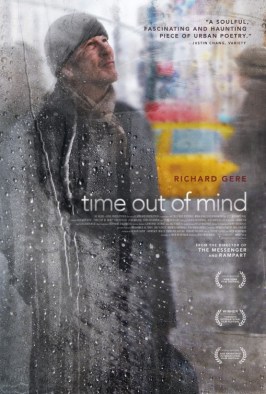
Time Out of MindThe urban poor are so often exoticized or romanticized on screen (see “The Soloist,” “Gimme Shelter“).  The issue of how our society can allow such a tragedy to befall a person usually gets passed over in favor of our comfortable Horatio Alger rags-to-riches story.  By convincing ourselves one person can supersede their circumstances, we gain the illusory certitude that all possess such a capacity.

Oren Moverman’s “Time Out of Mind,” on the other hand, does not even offer the familiar luxury of a traditional narrative.  The camera simply trains itself on down-and-out George, played by Richard Gere, as he ambles aimlessly through the streets of New York.  Moverman and co-writer Jeffrey Caine never really attempt to penetrate his mind, which has begun to mimic the drifting action of his body, nor do they offer a sociological tract on how he arrived where he is.

The film mostly just presents homelessness as it really is, making its point by not explicitly making a point.  “Time Out of Mind” uses George as a protagonist to lead the proceedings, but he’s arguably the least important element in any frame. It’s an outstanding display of incredible humility that Gere allows himself to become such a wallflower, never letting an actor’s vanity get in the way of conveying a greater truth about homelessness.

In a manner simultaneously clinical and deeply felt, the film details both the free range of the streets and the complex bureaucracy intended to capture all in its safety net.  Though a detailed audio collage always lets us know what happens in any given scene, Bobby Bukowski’s camera is usually located on the other side of the glass, across the street, or even above George.  He sometimes even goes so far as to shoot characters in reflected surfaces, giving us visages of people instead of their actual flesh and blood.  Might this be a replication of our own default position towards the homeless?

These long, distant shots of poetic power give “Time Out of Mind” a naturalistic rhythm that proves difficult to shake afterwards.  The paradoxes by which it operates lend the film both an intellectual and emotional heft.  While it might slightly betray its aesthetic integrity by moving in close in its final scene of emotional confrontation between father and daughter (Jena Malone’s Maggie), this is the only time it rings with a hint of falsity.  A-3halfstars


REVIEW: He Named Me Malala

6 10 2015

He Named Me MalalaHad 18-year-old Malala Yousafzai stayed on the same life course as an average girl in the Swot Valley of Pakistan, she would already be a mother of two.  But thank goodness that the now-Nobel Laureate embraced her destiny as someone extraordinary.  Thanks to a new documentary by Davis Guggenheim, “He Named Me Malala,” her message of hope and equality can reach even more people.

Malala became an international icon when the Taliban occupiers of her town shot (and nearly killed) her for attempting to attend school.  For them, enlightened women threaten their orthodoxy, so this occupying force has attempted to relegate them to purely religious education that will reify their current gendered arrangement.  But by trying to silence Malala’s vocal opposition, the Taliban created a worldwide movement to guarantee the right for all children – especially girls – to receive the education they deserve.

Perhaps most extraordinary about the entire ordeal is that Malala bears no ill will or resentment towards her attackers.  (I, on the other hand, still carry a grudge towards the person who cut me off in traffic last week.)  To simply call her inspirational just does not even begin to explain the impact of her grace.  Personally, as someone who often grapples with how to reconcile their religious convictions with a concern for basic human decency, her effortless deployment of Islam’s tenets as a guiding force behind her compassionate worldview is truly moving.

Guggenheim also makes sure that “He Named Me Malala” does more than saint worship.  In some of the documentary’s most memorable moments, we can see Malala acting like any other teenager.  She giggles at Minion videos, struggles to feel accepted by her classmates, and gets bashful when talking about boys.  Feminist icon though she may be, the thought of asking a boy out still embarrasses her.

The film itself lacks some cohesion as it jumps erratically around to different times in Malala’s life.  Guggenheim relies on animated sequences to depict what would normally be portrayed as recreations, though the unconventional choice works just fine.  Ultimately, any structural quibbles are easily forgotten in the wake of a figure that can so easily bring out the common humanity in all of us.  Heck, she even got Queen Elizabeth II to smile!  B+3stars


REVIEW: The Walk

5 10 2015

“To be on the wire is life – the rest is waiting,” opines Joe Gideon at the start of Bob Fosse’s 1979 film “All That Jazz.”  That quote is attributed to Karl Wallenda, a circus performer who, ironically, died from a fall the year prior to that film’s release after a stunt performed with no net.  Yet after watching Robert Zemeckis’ “The Walk,” Gideon’s words seem more in the spirit of Phillipe Petit, the wire-walker who traversed a cord strung between the Twin Towers in 1974.

Though structured like a standard heist flick – and providing all the expected thrills that should come along with the genre – the film is about more than just a clever plan or a physical accomplishment.  Petit (Joseph Gordon-Levitt) similarly equates the wire with life, and his life is his art.  The “coup,” as he repeatedly refers to it, makes for a fun exercise, but the plot to hang a wire between the Twin Towers is merely the means to the end of his performance.

Perhaps those who do not wish to think much into his daring piece deride Petit’s walk as empty exhibtionism or some kind of stunt that prioritizes style over substance.  For this precise reason, he earns the sympathy and identification of co-writer and director Robert Zemeckis.

In “The Walk,” the subject and the storyteller are practically one and the same in their aesthetic philosophies.  Both view spectacle as a component of art, not its opponent. There’s a reason Zemeckis opts for a variation of Beethoven’s “Fur Elise” as Petit glides along his wire as opposed to dramatic, triumphant underscoring. For these two artists, the purest beauty comes from achieving the previously unthinkable while operating at the highest of stakes (Petit with his a hundred-story height, Zemeckis with a hundred-million dollar budget).

Read the rest of this entry »


REVIEW: Sleeping With Other People

4 10 2015

Sleeping with Other PeopleThough the first two words in the title of writer/director Leslye Hedland’s “Sleeping With Other People” are a polite euphemism, that semantic choice probably represents her most cautious choice regarding sex.  Unlike so many others dealing with romance and courtship on screen, she leans in to the thorniness that most choose to sugarcoat.  She embraces the mess created by the libido’s interference with the heart.
Her two main characters, Jason Sudeikis’ Jake and Alison Brie’s Lainey, are even admitted sex addicts.  Early on in the film, the two even reunite after a collegiate one-night stand at a meeting for those struggling to rein in their urges.  “Shame” this is not, but it’s at least a more nuanced portrayal of sexuality than 2011’s pair of hookup movies, “Friends with Benefits” and “No Strings Attached.”

Yet sadly, Hedland also seems to borrow one too many plot points from said movies.  Even as she resists reducing love into sex, Jake and Lainey’s drifting back towards each other as they try to push apart feels like a page ripped right from the rom-com playbook.  There’s at least some good humor as Hedland blends in some battle of the sexes humor a la “When Harry Met Sally,” but Sudeikis and Brie lack the chemistry to sell their relationship beyond a few choice scenes.  The two always feel like they are operating on different comedic frequencies.

Despite a winning ensemble that includes fantastic actors like Adam Scott, Natasha Lyonne and Amanda Peet, “Sleeping With Other People” just never coheres its parts into a satisfying whole.  I suspect the only time I’ll ever think about this film again is when taking an overview of films that show how technology inhibits intimacy – Hedland does include one powerful split-screen shot of Jake and Lainey texting each other from their own beds.  Though they look and connect as if they were right next to each other, their phones still make them worlds apart.  B-2stars


REVIEW: Unfriended

3 10 2015

Movies – in particular the horror genre – are great at tapping into our digital anxieties, and “Unfriended” may very well be the ultimate representation to date.  The action unfolds entirely on a computer screen in real time over the course of roughly 85 minutes, following a group of teenagers who get terrorized by an online presence. This omnipotent force takes the name of a girl, Laura Barns, who everyone thought had committed suicide after some particularly vicious bullying.

Laura threatens them primarily with the disclosure of secrets that each individual kept from the group, usually of duplicitous or just plain malicious nature.  In particular, she uses the leverage from social media where images can be deleted but never really die.  If ever there was any doubt why teenagers are flocking to apps like Snapchat where images supposedly disappear, “Unfriended” has the answer.

Writer Nelson Greaves and director Leo Gabriadze execute the daring formal conceit well, even managing to throw in some interesting micro-observations about the way people communicate with divided attention and crossed alliances.  Yet no clever presentation can hide the fact that the story plays out like an episode of “Pretty Little Liars.”

At its core, “Unfriended” is still a bunch of whiny, obnoxious adolescents clawing at each other because of someone unknown, supernatural force.  The film is sure to make Laura some kind of technical wizard, able to control the computer’s mouse and rewire the Internet at will.  This makes her a little bit more frightening but a whole lot more ludicrous and unbelievable.

Still, “Unfriended” emerges as more positive than negative.  This feels like the best case scenario for the kinds of assembly-line horror movies cranked out overt at Jason Blum’s prolific Blumhouse Productions.  It’s entertaining and lowbrow enough to satisfy the lowest common denominator of moviegoers while also offering a little something to chew on for those who need a more existential terror to really scare them.  B-2stars


REVIEW: Finders Keepers

2 10 2015

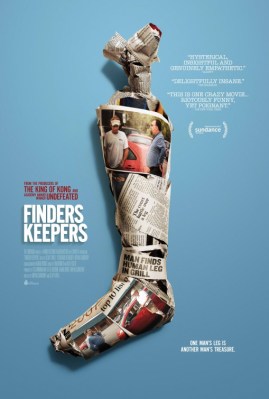
Finders KeepersThe people who populate the documentary “Finders Keepers” might look like the people from a reality show in the rural South.  But if you hope for moments of YouTube-worthy laughs at their expense, look elsewhere.  Directors Bryan Carberry and J. Clay Tweel are not interested in allowing the audience to look down at their subjects.

Instead, they request and allow empathy for folks who might otherwise get derided as a circus-like sideshow.  And given the dispute they document, this is a lofty task.  Small-town North Carolina dweller Shannon Whisnant just thought he bought a grill at a flea market, but when he opened it up, he also found a human foot.  To say he gets more than he bargained for is an understatement.

The foot is not just any human foot but one that belongs to a still-living person, John Wood, who ambles now with a prosthetic.  He wants the amputated limb back, though not for the reason anyone would expect.  Wood lost the foot in a plane crash that also took the life of his father, so it represents the last little bit of him that he can keep on earth.  For many filmmakers, this anecdote might be played for laughs or scorn.  In “Finders Keepers,” however, Wood’s story gets to play as sincere as he means it.

Whisnant does not oblige his request, invoking the legal concept of finders keepers and ginning up the kind of local broadcast publicity that would make any low-polling Republican presidential candidate green with envy.  Once the tussle gets settled (by Judge Mathis, no less), the rest of the film lacks the same level of intrigue.  Without the foot to drive a wedge between the principal personalities and represent a microcosm of their differences, Whisnant and Wood are not nearly as compelling to observe.  But the first hour of “Finders Keepers” deserves lauding for its relatively radical humanism towards people who usually receive little of it.  B2halfstars


REVIEW: Hot Pursuit

25 09 2015

The easy insult to hurl at “Hot Pursuit” is that of a hot mess – because you know how us writers love wordplay, especially in movie titles that seem to invite clever barbs.  But in this case, such a label fails to describe what really goes wrong.

A hot mess implies there is something interesting or oddly compelling in its failure.  Anne Fletcher’s film could not be farther from that.  Within minutes, it becomes obvious that everyone involved just wants to play it safe.  And that makes for one wickedly boring 87 minute pursuit of mediocrity.

“Hot Pursuit” pits the formidable talents of Reese Witherspoon and Sofia Vergara against each other but fails to realize either of their potential.  Vergara, as often seems to be the case, gets reduced to her looks and her naturally thick accent.  She plays Daniella Riva, the widow of a drug lord, who agrees to testify in a case against a kingpin.  But when her police transport goes haywire, she gets stuck with Witherspoon’s straight-laced cop Rose Cooper.

To get a frame of reference on Rose, imagine Tracy Flick levels of Type A behavior without all the self-confidence and a thick, put-on fake Texan accent.  (As a native Southern belle, Witherspoon could have just used her regular vocal cadence and no one would have batted an eyelid.)  I can see how maybe the star’s entourage thought “Hot Pursuit” might make for an interesting career move since Rose is a veritable man repeller.  For Witherspoon, who so often plays heroines forced to choose between two men, perhaps this character marks her attempt at subverting her own image?

She should just stick to “Wild,” though, as “Hot Pursuit” offers her nothing but a tired, predictable premise and one-note jokes.  The comedic pairing with Vergara yields disappointingly little heat.  For a fraction of the price tag, they could have just gone on talk shows together and gotten more laughs.  C2stars


F.I.L.M. of the Week (September 24, 2015)

24 09 2015

The epithet of “morality play” gets tossed around a lot when describing issues-based dramas – and usually in a negative connotation.  How dare a movie tell us what to believe, the undertone of their phrase rings out.  (Side note: these are often the same people who cry outrage when a film does not line up perfectly with their own worldview…)

But I believe the term can, and should, be applied positively to a movie if it offers provocative, challenging commentary on an ethical question.  Sam Raimi’s 1998 film “A Simple Plan,” my pick for the “F.I.L.M. of the Week,” offers just such an experience.  Before he offered the be-all and end-all nugget of wisdom in “Spider-Man” – Uncle Ben’s “with great power comes great responsibility” – Raimi got down in the mud with human greed.  It should come as no surprise that we often fail to live up to that infamous aforementioned maxim.

“A Simple Plan” concerns morality in the aftermath of three buddies discovering a downed plane with $4 million inside.  The trio lives in rural Minnesota where the “rich” one of the bunch, Bill Paxton’s Hank Mitchell, works as a clerk at a feed mill.  Needless to say, they could all use some extra money and are willing to contemplate the dubious decision of keeping the cash.

As they debate the right course of action, their back-and-forth tussle somewhat resembles the expressive dialogue one might find in a play.  But never does the film take on the aura of superiority that one might associate with a preaching, instructive morality play.

So what differentiates it from the pack?  Credit director Sam Raimi, who smartly emphasizes the noir-like complexity in aspects of the story’s surprising turns.  Scripter Scott B. Smith also finds a simplicity in their internal tussles that resembles a parable, like the duffel bag of money is some kind of forbidden fruit that disrupts a moral universe.  These two sensibilities may sound clashing, but they harmonize masterfully in “A Simple Plan” – no doubt aided by the performances of Paxton and Billy Bob Thornton as Jacob, Hank’s less educated sibling who harbors reserves of both resentment and nobility.


REVIEW: The Intern

23 09 2015

If I could live within the universe of a single filmmaker, I would probably choose Nancy Meyers.  For the two hours or so when I watch one of her movies, the noise of the world goes silent and her soothing presence reassures me that good people and common decency will ultimately prevail.  Her latest cinematic creation, “The Intern,” continues her grand tradition of optimistic wisdom worth embracing with wide arms and an open heart.

In a cynical age, dismissing such a hopeful vision as naive or simplistic would be all too easy, but Meyers’ film never feels facile.  If “The Intern” seems like sunshine and rainbows, it’s merely a retraining of the eye to see the sunshine through the clouds and rainbows through the rainstorm.  Her characters know pain and must draw the strength from within to come out on top.

Meyers’ protagonist of choice is Ben Whittaker, played by Robert DeNiro as the polar opposite of Travis Bickle or Jake LaMotta.  A 70-year-old widower, Ben tires of retirement and looks for a way to become needed once more.  He finds that at About the Fit, an e-retail start-up with an internship program for senior citizens.  After an inspiring video lands him the position, the old company man quickly charms the entire company.  Ben even manages to command a trio of younger workers, including Adam DeVine’s chummy Jason, into a posse that Meyers often photographs like the boys in an “Entourage” episode.

The only person unenthused by Ben’s presence is the site’s embattled founder and CEO Jules Ostin, who is played by Anne Hathaway.  She had the right idea at the right time yet struggles to inspire confidence among investors.  They think a more seasoned executive can help sustain the company’s growth, and try as she might, they do not buy that Jules has the business acumen of a Mark Zuckerberg.

Still, she is an enormously capable businesswoman just trying to find a more sustainable balance between the demands of work and home life.  Ben sees right through her smoke screens, and it absolutely terrifies Jules.

Read the rest of this entry »


REVIEW: Goodnight Mommy

22 09 2015

Goodnight MommyLike many a great horror/thriller film, Severin Fiala and Veronika Franz’s “Goodnight Mommy” makes for tough conversation around those yet to experience its unnerving power.  Key twists and turns dominate the conversation after the film’s disturbing final shot, but they alone are not responsible for the overall impact. The shocking conclusion does not need to redeem what comes before; it just gets to further drive home the prior eerie effectiveness.

Fiala and Franz pack “Goodnight Mommy” full of red herrings and MacGuffins to throw us off the scent of what is actually going on in the film.  (That’s all I have to say – see it for yourself, don’t let me spoil anything.)  At a certain point, it becomes clear that the writer/director pair do not intend to answer all the bizarre occurrences in the film.  Those include, but are not limited to, kids keeping a tank of live cockroaches and traipsing through a cave full of presumptively human skulls in their Crocs.

Twin brothers Lukas and Elias (played by the two Schwarz kids who bear those names) lash out in an increasingly disturbing manner at the occupying force in their household who wears a veritable headdress of bandages.  She (Susanne Wuest) claims to be their mother, but the children remain unconvinced.  As tension mounts between the opposing parties, both sides act with increasingly erratic behavior.  Over time, however, Lukas and Elias clearly begin preparing for an all-out war against their so-called mommy.

Fiala and Franz shooting style adapts with the twins’ bellicosity, beginning with an apparition-like remove from the proceedings and then moving to an all-out cinema of cruelty approach that rivals the best of Michael Haneke.  They also love the quick cut to black after a tense scene, which also mimics the general sensation of watching “Goodnight Mommy.”  We follow along, treading carefully, only to have our stomachs plunged into the abyss by a startling punctuation mark.  Good luck getting a good night’s sleep after this one…  B+3stars