REVIEW: Wonder Woman

31 05 2017

“You expect the battle to be fair. It will never be fair!” exhorts Robin Wright’s Amazonian mentor to her trainee, Gal Gadot’s warrior princess in “Wonder Woman.” It’s tempting from an early point to view the film through a purely ideological standpoint, and cues like this almost seem to encourage it.

While writing this review, butt-hurt “men’s rights activists” (yes, those concerns are so imaginary they deserve to be put in quotations) are still complaining on Twitter about woman-only screenings of this film. The urge to lacerate prejudice through cultural consumption as if we were casting a ballot to vote is an alluring, but ultimately empty, one. Praising the disjointed “Ghostbusters” like a dutiful gesture of feminist solidarity really solved all our issues in 2016, right?!

The underlying hope of these actions is to foster a world where “Wonder Woman” will no longer be the most expensive film ever directed by a woman or the only major superhero film with a female protagonist; instead, it will be just one of many. So let’s start acting like it today by treating the film as what it can become, not merely what it means in the deeply politicized 2017 environment into which it is released. As the great critic Pauline Kael remarked, critics too often praise “movies that are ‘worthwhile,’ that make a ‘contribution’ —’serious’ messagy movies. This often involves […] the praise in good movies of what was worst in them.”

So if you’ll pardon my existential opening, I’ll spare you another analysis about how progressive (or not) the gender dynamics are, whether or not director Patty Jenkins’ gender might “influence” the way certain scenes play out and if certain on-screen moments carry feminist undertones from off-screen drama. It was hard to squint past these things and just see the movie because, as a film writer, firebrands like this can so often be reduced to multiple start-points to an ideological thinkpiece. But there is some there there, so to speak, in “Wonder Woman.”

Read the rest of this entry »


REVIEW: War Machine

30 05 2017

Admittedly, I am not that interested in how David Michod’s “War Machine” plays into cinema’s canon of films about the Middle Eastern conflicts of our century. I am, however, very interested in how it plays into Brad Pitt’s filmography over the last decade or so.

Pitt was once (and still is, to an extent) a major tabloid sex symbol with a charisma so potent that it could ensnare a co-star. His macho swagger could level city blocks in Hollywood. But now, he’s been playing a different type … over and over and over again. As General Glen McMahon, a lightly fictionalized version of infamously terminated General Stanley McChrystal, Pitt adds another chapter to what can most charitably be described as a moment of clarity. Some, less generously, might also call it a mid-life crisis.

McMahon follows in the footsteps of Billy Beane from “Moneyball,” Jackie Cogan from “Killing Them Softly,” and Ben Rickert from “The Big Short” – among other characters – as Pitt’s new favorite archetype. These ponderous veterans of their respective trades are straight shooters with a radical approach to their field greeted with skepticism by those still trapped by conventional wisdom. Gradually, they increase their risky maneuvers for personal vindication, only to meet fierce pushback from the established vanguard. And usually some kind of character flaw, usually pride, serves a major Achilles’ heel along the journey.

McMahon’s quest involves getting a broader sign-off on his counterintelligence strategy in Afghanistan, a cause for which he’s even willing to enlist a civilian PR director (Topher Grace’s Matt Little) in order to ruffle some feathers in the Obama administration. Michod mostly operates in a satirical mode to display his hubristic “hearts and minds” campaign, though “War Machine” has plenty of genuine moments of real introspection about America’s conflicted role in enduring conflict.

Perhaps to give the proceedings some groundings in actual war, the third act takes a huge detour into actual armed combat with characters we haven’t received enough information on to feel invested in. We do, however, have plenty to intellectualize the United States’ peacekeeping and democracy-spreading operations through McMahon. This comes from both the movie itself and everything Brad Pitt brings to the role with an earned stoicism and world-weariness – but a penchant for innovating and retooling moribund strategies. B


REVIEWS: The Square (not the Palme D’Or winner)

29 05 2017

Remember when Harvey Weinstein manufactured a PR stunt for “The Butler” by juicing a scandal over the name of the film, eventually making a big hubbub and changing it to “Lee Daniels’ The Butler?” (Nope? Good for you. I still refuse to call it that.) Hopefully Magnolia Pictures will spare us the drama when it comes to getting the word out about Ruben Östlund’s “The Square,” which won the Palme D’Or at the 2017 Cannes Film Festival. Just in this decade, there have already been two films by the same name!

Nash Edgerton (brother of Joel, who co-wrote the film) goes full Aussie neo-noir in his debut feature “The Square” (B / ). It’s got many of the hallmarks of the genre: unfaithful spouses, torrid affairs, money issues, crooked businessmen, staged crimes, doomed escape. It’s almost as if the characters should know they’re in a noir movie, that’s how closely it fits the genre script.

Edgerton has clearly done his homework here and knows how to do right by the rules of noir. But those rules are meant to be bent, even broken, a little bit in the modern era. Otherwise, why not just go watch a classic noir on TCM? “The Square” can be exciting at times, yet anyone who knows the genre patterns will be able to predict what’s coming from a mile away.

Still, it’s a promising start for a director – and it’s a little shocking that it took him a decade to get another feature off the ground. (Per IMDb, he’s currently filming “Gringo,” a star-studded production for Amazon Studios.)

Jehane Noujaim’s documentary “The Square” (B+), on the other hand, feels like something vital and fresh at every turn. Her camera captures the democratic uprising of the Arab Spring in Egypt as protestors demand the downfall of the autocratic Mubarak regime. It begins with the demonstrations and continues as their optimism and idealism gradually weans when the realities of governance begin to set in.
Don’t come to “The Square” expecting a “Frontline” style special breaking down the progress of the protests or providing an extensive primer on Mubarak’s reign. Noujaim’s film has all the vitality of a primary source document, one that’s focused entirely on the sensations of the actual revolution. It’s a present-tense documentary, one full of raw emotion and intense fervor.

The film is a bit messy, though perhaps a more tidy edit would betray the sensation of “The Square” in the first place. Form matches content quite nicely. While a more conventional streamlining might have made the documentary a better film, those moments of pure, unfiltered emotion break through nonetheless. This is more than just a movie. It’s history, filmed.


REVIEW: Wind River

28 05 2017

Sundance Film Festival

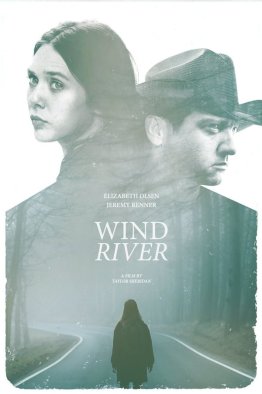
“You should move to a small town, somewhere the rule of law still exists,” stated Benicio del Toro’s Alejandro in the final lines of Taylor Sheridan’s “Sicario” script. “You will not survive here. You are not a wolf, and this is a land of wolves now.” As if picking up exactly where he left off, “Wind River” continues following the journey of a law-abiding law enforcement official into the heart of darkness.

It’s almost a little too eerie how many parallels exist between Emily Blunt’s Kate Macer in “Sicario” and Elizabeth Olsen’s Jane Banner in “Wind River.” Both are female FBI agents sent to perform their duties in a place outside their jurisdiction where previously all-encompassing authority means nothing. For Jane, that’s an Indian reservation in the remote regions of Wyoming. In order to survive, both agents must rely on a more experienced, world-weary male who can serve as her shaman to a more questionable legal territory.

Jane’s guide is Jeremy Renner’s Cory Lambert, who unlike Alejandro in “Sicario,” does not belong to the group with whom he liaises. He is a white man who has gained the trust of the Native American communities by taking the time to understand how they live, a marked contrast from Jane’s treatment of a murder case on their land like it’s just another Las Vegas or Ft. Lauderdale homicide. The film’s most poignant scenes show how Cory can code switch and compartmentalize the many facets of his life. Going from a hunter to a father to “Cap,” as he’s known, takes a toll on his psyche – even if his stoic expressions never reveal such turmoil.

Otherwise, “Wind River” plays like a “Sicario” spinoff with far fewer surprises. The tone, attitude and general plot progression are familiar now and remain mostly unchanged. While the United States’ relationship with the Native American reservations is one that definitely deserves more attention, it lacks the searing topicality of a story set on the Mexican border. Without that heft, Sheridan’s signature terse one-liners like “Luck is in the city” come across as more risible than bone-chilling. B-


Deux Par Ozon (Ricky, Potiche)

27 05 2017

Ever since his “Young & Beautiful” beguiled me at Cannes in 2013, I’ve been a fan of Francois Ozon’s peculiar blend of French cinema. His blend of camp and noir traditions provides for unconventionally satisfying watches in “Swimming Pool” and “In the House” – and, for something totally different, he made a stunningly classical film recently with “Frantz.” That’s not to say I find him perfect, though.

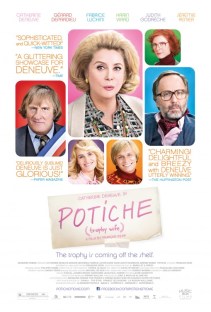
Potiche” (B-) casts icon of French cinema Catherine Deneuve in a role fitting of her status. As Suzanne Pujol, matriarch of a business-owning family, she often keeps her dysfunctional family functioning while receiving little credit. She’s the titular trophy wife (the literal English translation of “potiche”) in a late ’70s era when such was a high honor to which a woman aspired.

But out of necessity, she must step in to manage her husband Robert’s umbrella factory while he falls ill – and during a classic French workers’ strike, no less. Her feminine wiles turn out to be just what the doctor ordered for the factory, so much so that her temporary custodianship begins calcifying into a more permanent management. Her newfound purpose divides her families and galvanizes French society, then still in shock over a woman exerting such authority in the business world so openly and unabashedly.

“Potiche” is a mostly enjoyable romp, although it eventually begins to drag as Ozon hits the same notes on his satirical social commentary again and again. We get the point pretty early on about female empowerment in a patriarchal society, and it’s not exactly a novel idea. Still, the fun of Deneuve letting loose in classic Ozon style makes the film worth a watch.

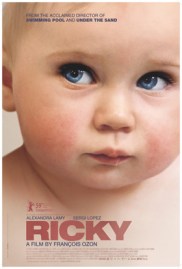
Now, I have seen Ozon make a movie about a teenage girl who chooses to be a prostitute, a widower who changes gender identity, and two tales about an obfuscated boundary between fiction and reality. These have been exciting takes indeed, though neither promise the sheer spectacle of “Ricky” (D / ). The film quite literally features a baby that sprouts wings (that resemble the kinds you’d see on a Butterball turkey at the supermarket).

It’s told with no urgency, no energy and no vitality – an especially shocking thing to say regarding Ozon, whose films are usually zany expressions of his twisted desires. Every moment rings false and every scene feels phoned in. To call it melodrama implies that there might be a moment resembling dramatic tension. There isn’t.

In fact, the cherubic titular character isn’t even the focus, he’s just the means for the mother to realize herself – but Ozon doesn’t develop her enough for us to give a damn. It’s just a bizarre spectacle and a head-scratcher of the worst variety.


REVIEW: Paris Can Wait

26 05 2017

Eleanor Coppola’s “Paris Can Wait” amounts to little more than a middle-aged French retread of “Leap Year” – rack your brains and see if you can remember that 2010 Amy Adams romance. The setup is simple: a charming American woman needs a ride to meet up with her romantic partner, so she must enlist the help of a native of a charming European man to whisk her across the rural backroads of his native country. Along the way, however, she begins to doubt her allegiances as the extended car trip softens her stance towards the courier.

“Paris Can Wait” offers many gorgeous views of scenic French vistas, but if that’s what Coppola wanted to shoot, then perhaps her energies are better spent filming a promotional spot for the country’s tourism bureau. With all due respect, I’ve seen half-hour TV specials with more meat on their bones than this film. The only bit of content worth serious deliberation is when Anne (Diane Lane) and Jacques (Arnaud Viard) discuss what separates the Americans from the French.

Otherwise, “Paris Can Wait” is a lavish nothingburger of a travelogue that is every bit as self-indulgent as an Adam Sandler comedy set in Hawaii or Africa. The cast and crew get to enjoy the majesty of France’s countryside – the culture, the food, the sheer joy of getting caught up in a moment of inexpressible beauty. We’re left to experience it from afar through the eyes of Anne and her digital camera, which she uses to take Instagram-style foodie pictures that she is too sheepish to share. I couldn’t even get a vicarious thrill from observing. C


F.I.L.M. of the Week (May 25, 2017)

25 05 2017

No book I’ve read in the past few years has changed the way I think (and thus, the way I write) quite like Chuck Klosterman’s “But What If We’re Wrong?” The text is worth reading for a number of reasons, but what’s really stuck with me are his notes on canonical thinking. This weekly column is, by definition, an attempt to set aside movies and put them on some kind of elevated pedestal above the riff-raff of the multiplex. And in time, very few of these will be remembered.

The Kafka of our time, Klosterman argues, “will need to be a person so profoundly marginalized that almost no one currently views his or her marginalization as a viable talking point.” His chief example? Native Americans. They are out of sight and out of mind for most of the country. Their vantage point on so many issues is so underrepresented that we scarcely even notice it missing. Rhetorically, he asks, “When the Academy Awards committee next announces the nominations for Best Picture, how many complaints will focus on the lack of films reflecting the Native American experience?” To answer, odds are very few.

And yet … this is their country. Americans like myself, descended from Europeans, are mere immigrants.

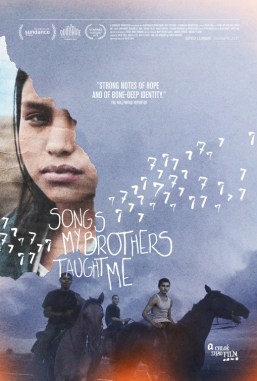
To be fair, “Songs My Brothers Taught Me” is not written or directed by a Native American. The creative force behind the project is Chloé Zhao, who made her feature film debut delving deeply into reservation life and culture. There’s not a moment that feels inauthentic, though. In a remarkably assured first film, Zhao illuminates a portion of the country that many people forget exists. And, ironically, that very fact makes her film far more likely to stand the test of time than many others I have heaped praise upon in the “F.I.L.M. of the Week” column.

In her lyrical interpretation of a South Dakota Native American reservation, Zhao adopts the roving, windswept look we come to associate with Malick. But that’s where the conversation should start, not where it should end. “Songs My Brothers Taught Me” is incredibly grounded and less ethereal. Zhao’s interests are noticeably more tactile. In a sex scene, for example, she hones in on tangible elements in the frame: the hymen blood, the friction of the sheets, the shimmering surfaces of two teenagers discovering the possibilities of their bodies.

The film is far from plotless, though it’s definitely not plot-driven or thematically motivated. Zhao simply gets us into the state of mind of two teenagers, free-wheeling John and his green younger sister Jashuan, as they watch the dust settle following the death of their largely absent father. Most events chronicled in “Songs My Brothers Taught Me” are actions taken by John, which are then observed or secondarily experienced by Jashuan. But the perspective of the film belongs to her.

Technically, this narrative could fall under the “coming of age” category. Zhao, however, seems less concerned with charting progress and more interested in extracting one vivid cross-section. In “Songs My Brothers Taught Me,” we come to understand her naïveté and curiosity inside and out. Through it, we also receive a filtered look at the poverty and neglect that run rampant through Native American reservations. It’s a glance that could replicate Zhao’s own in studying this community – but very likely resembles far too many in the country.


REVIEW: Baywatch

24 05 2017

In the opening credits sequence of “Baywatch” – unoriginally set to the tune of Notorious B.I.G.’s “Hypnotize” – Dwayne Johnson’s Mitch converses with a surfer bro on the beach where he lifeguards. The chat has to be subtitled because, of course, Florida English is practically unintelligible to the untrained ear. It’s one of the few subversive or creative tricks the film has up its sleeve in a waterlogged two hour runtime.

What passes for clever throughout “Baywatch” is Mitch and the rest of his bathing suit-clad team engaging in middle-school level taunting by pulling out some new name to taunt Zac Efron’s Matt Brody, a Ryan Lochte-esque “him-bo” has-been swimmer. (The film appears to have wrapped before that Olympian’s robbery scandal in Rio, so the parallels do feel a little eerie.) “21 Jump Street” this most definitely is not. Seth Gordon’s film, which passed through the hands of six writers, takes far more pleasure in fitness porn and over-the-top humor than any kind of satirization or interrogation of its source television show.

There are hints here and there of a movie “Baywatch” could have been. Various instances of fraternizing between men display the faintest whiff of parodic homoeroticism – only to fade into a low-grade gay panic joke. The film plays like a studio-massaged bauble, selling products (shout-out to the Tag-Heuer product placement) and its stars’ chiseled physique above all else. It’s like a two-hour aquatic Equinox ad with some narrative propulsion added in for good measure – even complete with an unearned feminist zinger in its climax! The hit-or-miss humor is a generous life preserver to keep us from drowning in their consumerist ocean. C+


REVIEW: The Wedding Plan

23 05 2017

As one afflicted by chronic singleness syndrome (mostly by choice, or for lack of trying – look, this isn’t about me, ok?), many of the emotions along the journey in Rama Burshtein’s “The Wedding Plan” felt all too familiar. There’s the isolation of being an adult who hasn’t found a life partner as everyone else finds theirs, the impatience and judgment of everyone around you, and the occasional spurts of anger directed at the cosmic authorities for imposing what feels like a curse.

Burshtein’s protagonist, Michal, treks on towards the goal of a wedding in the ultimate act of defiance against these internal and external pressures. She holds a date for her nuptials on the final day of Hanukkah without a groom in place. Trusting in both her own charm and determination as well as divine providence, Michal bends the will of love to her own timeframe.

Michal’s oft-hapless desperation lends some levity to “The Wedding Plan,” though labeling Burshtein’s film a “rom-com” doesn’t do the experience justice. This trek towards the altar assumes continued gravity as Michal puts the cart before the horse in the matter of love. The unconventional move garners a wide variety of reactions from Michal’s suitors, though Burshtein’s lens on events also collects valuable information on her female counterparts. The men of this orthodox Jewish society espouse patriarchal beliefs, but the women also internalize and parrot them. One woman tells Michal that of course all men want an obedient wife; Michal, and Burshtein by extension, cast back a doubtful and inquisitive glance. 


REVIEW: Dheepan

22 05 2017

Jacques Audiard’s “Dheepan” tells an extraordinary tale rather ordinarily. The titular name does not technically refer to the protagonist but rather a man whose identity he must assume in order to flee Sri Lanka. Dheepan must enter France with the passport of a deceased man, along with a fake wife and daughter, in order to get past the country’s vetting. He’s willing to work hard for the future, but that future would likely not be possible if they knew his past involvement in the wars of his native country.

Most of the film takes place in their shanty housing in the outskirts of Paris, where the makeshift family attempts to survive in their new environment. The best moments of “Dheepan” take place when Audiard’s camera catches the moments of realness behind their adopted guises. It’s here we get the whole of the immigrant experience summed up in a glance. We can see the gratitude for a new country to take them in and the yearning for a country where they could no longer stay. We notice the desire for normalcy coupled with the constant fear of disapproving neighbors watching their every move with suspicion.

Where the film starts to sputter is when Dheepan gets drawn into the local drug and gang violence of his area. We know this story of hard choices in ignored, underprivileged areas outside the purview of urban hubs. Even with a topical, political spin, the back half of “Dheepan” lands with a thud. It’s not enough to blow all the goodwill from Audiard’s perceptive look at the perils of entry into France’s hostile environment. But it comes perilously close. B-


REVIEW: Daddy Longlegs

21 05 2017

Josh and Benny Safdie were not the first people to assume verité-style camerawork guaranteed emotional authenticity, nor will they be the last. But their Cassavetes clone “Daddy Longlegs” might just be the film that made me far too aware of how low-budget filmmakers can hollow out techniques just as easily as their studio counterparts.

The Safdie brothers obtain a remarkable quality of naturalism that pervades their shaky camera and grainy look … but in service of what? The filmmakers are so focused on the how that they lose sight of the what. “Daddy Longlegs” tells the story of a deadbeat dad that essentially amounts to little more than a cross between the first act of “Kramer vs. Kramer” (pre-Dustin Hoffman’s redemption) and “Blue Valentine.” He’s a mess to the point of being a danger for his two young children, but he does love them! That’s true in both the first frame and the last.

The film feels less like a character study and more of a chain of cringe-worthy events that further convince us of his complete lack of qualifications to be a parent. Narrative journeys are not a mandatory feature of cinema, and the stasis of a character often speaks just as loudly as a drastic evolution. But given the self-conscious naturalism the Safdies work so hard to obtain, it’s a shame that “Daddy Longlegs” amounts to little more than the latest variation on a familiar stock character. B-


REVIEW: Prince of Broadway

20 05 2017

The working class appear a decent amount in contemporary cinema, but few directors take the time to understand their world like Sean Baker. His technique is more than just an aesthetic superiority of neorealism or “poverty porn” meant to coddle the bleeding hearts of the audience. Baker gets down into the weeds and grapples with poverty on its own terms, examining how getting dealt a single bad hand can trigger a cascade of negative outcomes.
At the beginning of “Prince of Broadway,” the Queens street vendor Lucky (Prince Adu) sees his life take such a turn when an old girlfriend shoves a baby into his arms. She needs childcare for two weeks for some unexplained reason while she jumps town, and we get the sense that Lucky is her last resort. Not only does he have no parenting skills under his boat, but he lives by the seat of his pants hocking off-brand designer bags and, as an undocumented immigrant from Ghana, Lucky can scarcely fall back on a network of extended family to shoulder the burden of watching the baby.

Leaving an ill-equipped individual in possession of a baby has classically entailed the trappings of comedy (“Three Men and a Baby”) or poignant drama (“Kramer vs. Kramer”) … so long as the protagonist comes from means. In “Prince of Broadway,” the same inciting incident triggers the basic mechanisms of economic survival as Lucky wonders how to feed, house and monitor his son. The sacrifices and trade-offs he must make in order to fulfill the most basic human compassion to the young life in his care involve his very livelihood.

Baker understands that a story as seemingly commonplace as this one in Lucky’s world cannot involve mere transposition from an upper-middle-class milieu. Every decision carries enormous weight. Every event comes with massive aftershocks, many of which cannot be met with adequate preparation. He’s taken the time to understand the mechanics of Lucky’s situation, and while “Prince of Broadway” might not necessitate its full 100 minute runtime (subplots involving his boss could easily have been streamlined), there’s not a moment that does not demonstrate his empathetic eye for detail. B


REVIEW: Mediterranea

19 05 2017

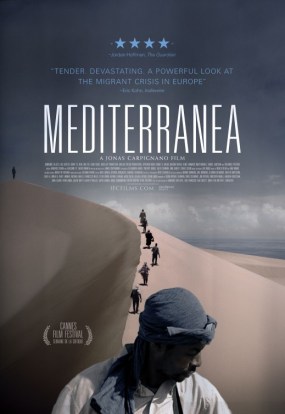
As the refugee crisis in Europe continues to persist, we’re starting to see its effects in the continent’s cinema. Documentaries like “Fire at Sea” and numerous Oscar-nominated shorts are paying attention to the harrowing voyage to shelter in Europe, while narrative filmmakers like the Dardenne brothers and Michael Haneke are crafting narratives around the influx of migrants.
Jonas Carpignano’s “Mediterranea” offers a perspective that, as of yet, seldom receives treatment on screen. It looks at refugees fleeing their homelands as more than just the physical incarnation of their tragedy. Carpignano surveys the whole of their existence, from low-wage labor to forming impromptu communities of support among fellow migrants. (As it turns out, one force that transcends national borders is an infectious pop ditty by Rihanna.) The characters complete the boat ride across the titular sea by the 30-minute mark of the film.

“Mediterranea” is far from revelatory in its narrative, but its simplicity and quiet dignity are worth the watch. When the fearful Italian villagers grow suspicious and disrupt the refugees’ shaky equilibrium, the effect is startling. More experienced, perceptive filmmakers will likely tackle similar stories to greater effect. But for now, Carpignano’s treatment provides a satisfactory window into a humanitarian emergency. B-


F.I.L.M. of the Week (May 18, 2017)

18 05 2017

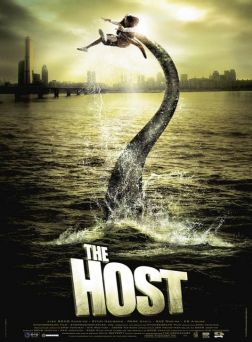
Recently, I waxed existential on Nacho Vigalondo’s “Colossal” in regards to what the monster represented thematically. To avoid reruns, I’ll spare the long introduction to symbolic genre interpretation and simply say my take on Bong Joon Ho’s “The Host” utilizes a similar analytical framework – but from a different angle. Sometimes it’s not just the monster we should be looking at. The victims are also worth further inspection.
When the strange Korean river monster emerges from under the bridge in “The Host,” the creature snarls a certain type of person. The girl distracted on her phone. The family too busy watching TV to notice something out of the ordinary. If you choose to interpret obesity as a product of personal laziness rather than genetic predisposition, maybe you could lump the guy in a jersey two sizes too small for him in with this group. The monster is pretty clearly targeting people who are impeding contemporary society with their habits.

That’s far from the extent of Bong’s commentary on the time, part of the reason “The Host” is my “F.I.L.M. of the Week” (as a reminder, that’s a contrived acronym for First-Class, Independent Little-Known Movie). He crafts a great action movie that’s thrilling to watch from an entertainment perspective. As a rip-roaring adventure for Gang-du to recover his daughter Hyun-seo from the sewer prison of the monster, it’s a blast.

But if you come for the genre fare, stick around for the ribbing political satire. At every step of the way on their rescue of Hyun-seo, some arcane bureaucratic procedure or cruel governmental intervention holds them up. (From a current perspective, it looks like a sharpening of the knives for “Snowpiercer” just a few years later.) There’s comedy, malevolence, malfeasance and terror lurking in just about every scene – often times all at once, a pretty remarkable feat for any director to execute.


REVIEW: The Cut

17 05 2017

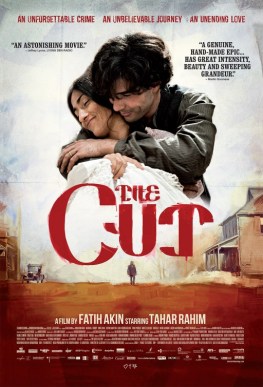
Perhaps the worst claim that can be leveled against Fatih Akin’s “The Cut” is that it fails to elicit a reaction proportional to the scope of its production. This story of a father, Tahar Rahim’s Nazaret, rendered mute during the Armenian genocide of World War I trying to reunite with his long-lost daughters has an epic scope. Take a look during the end credits, which run well over 10 minutes, at just how many crew members in how many countries came together to bring this story to life. This is a journey spanning decades, and Akin gives his film the sprawling canvas it needs.

And yet, while watching the film, I never really felt overwhelmed and enveloped by the sheer magnitude of “The Cut.” The film never flags in the forward motion of its storytelling or the firm humanist rooting of Rahim’s performance. I was compelled by every minute. Still … I wanted a little something more from it.

Akin’s direction is missing a sense of urgency. (It’s still leagues better than most filmic depictions of genocide – heck, many big-budget tentpoles downplay or flippantly dismiss it!) I’ll note that “The Cut” is not a film about the Armenian genocide so much as it’s a story of a father’s love diverted by the atrocity. But when you brooch such a weighty subject, you can’t just respond in the size of the production. It must also resonate in the gravity of individual decisions. B