REVIEW: My Golden Days

16 05 2017

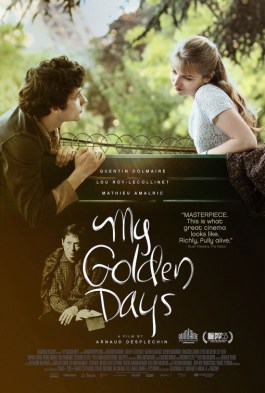
Maybe I’m missing something by not watching Arnaud Desplechin’s “My Sex Life … How I Got Into an Argument” before heading into “My Golden Days,” since both films revolve around Mathieu Amalric’s Paul Daedalus. (I blame the film’s lack of streaming availability in the U.S.) With no prior attachment to a character who spends the entire movie reflecting back on how three childhood and adolescent memories shaped him, the film felt self-indulgent and even a little self-serving.

And of course, the thread that I found the most fascinating – where a teenaged Daedalus sneaks into the USSR to give a forged passport to a Jewish dissident – lasts about just 20 minutes. Desplechin doles out a disproportionate amount of time to Daedalus’ first bombshell romantic experience with Esther (Lou Roy-Lecollinet). From my perspective, this seemed like the kind of coming-of-age story we’ve all seen a hundred times.

The distinguishing feature of “My Golden Days” is that Desplechin frames these experiences through the lens of memory, in all the ways it softens the edges of and selectively omits from the historical record. It’s present both in the hazy narration of Daedalus and the techniques he uses, such as the early-cinema iris effect. But these memories were just that – memories – for me. If they were hinting at some kind of larger truth or grander developments in the Daedalus character, they were lost on this viewer. C+


REVIEW: Graduation

15 05 2017

It’s only natural for parents to wish that their children fare better than they do, but I would be genuinely curious to see how many would act with the vigor of Adrian Titieni’s Romeo in “Graduation” to ensure such a thing. Locked in a loveless marriage, trapped in a dead-end romantic affair and bored professionally, Romeo is Romania’s equivalent of a tiger father to his daughter Eliza (Maria Dragus). She has the opportunity to spend her collegiate years on scholarship in the “more civilized” United Kingdom pending a passing grade on her final exams, and he will do everything in his power to ensure she escapes the mire of their native country.

Except, on the day before the test, a stranger batters Eliza on the way to school and wounds her as he attempts rape. For whatever arcane reason, the authorities simply cannot accommodate her at a later date, so Eliza must take the multi-part exam with her writing hand severely injured. Faced with the threat of his daughter’s escape route vanishing, Romeo decides to take independent measures to ensure she passes.

Romeo and his wife Magda (Lia Bugnar) are no stranger to rigged systems that present themselves as fair. After all, they fled the Communist regime in Romania and returned to raise a child in a post-Soviet Bloc nation. But Eliza comes from a generation that only knows democracy, and she does not take kindly to knowing fingers are on the scale for her benefit. This divide over who sets the rules and when those rules are enforced proves a fascinating fissure to observe throughout “Graduation” as it increasingly isolates Romeo from his family and community.

Mungiu, in classic Romanian New Wave fashion, takes his time delivering the audience to such realizations. Two hours of wading through such intense moral morass is a bit much, especially given the time spent on a subplot of broken glass on Romeo’s belongings. These incidents amount to little more than a red herring, a projection of Romeo’s fretting over the precariousness of his situation. They’re a bit at odds with the studied naturalism of the film – which, for the record, feels a bit de rigeur for Mungiu by now. B /


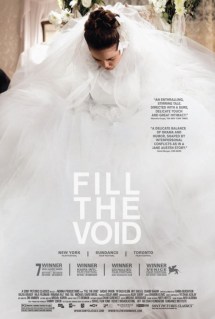
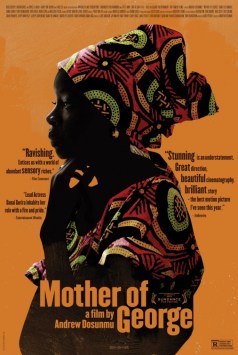
Multicultural Motherhood (REVIEWS: Fill the Void, Mother of George)

14 05 2017

For two years, I’ve been thinking of running this piece on Mother’s Day. And twice, I’ve put it off in favor of posting something else. The procrastination ends in 2017!

I watched Rama Burshtein’s “Fill the Void” and Andrew Dosunmu’s “Mother of George” in short succession and was struck by some surprising parallels. Both are films that explore the complications of maternity outside of a dominant Western understanding but do so in wildly different – yet tellingly effective – ways.

“Fill the Void” unfolds in an orthodox Jewish community following the tragic death of Esther during childbirth. In the wake of her passing, Esther’s younger sister Shira (Hadas Yaron) faces a difficult choice. At 18, she has her whole life ahead of her and looks forward to an arranged marriage to a man she quite fancies. But the hole in the community demands her action, and Shira’s family comes to her with an unconventional plan: marry her former brother-in-law Yochay and raise her nephew Mordechai as she would a son.

The film’s tightly contained action and deliberation have the dimensions of a stage drama, yet Burshtein films it as anything but. She trains her director of photography Asaf Sudry to direct the lens towards Shira’s face, framing it tightly and making her internal tussle play out in prolonged close-ups. With this technique, Burshtein achieves that strange paradox of cinema: the film becomes more universal as it delves into the specifics of its insular community.

Mother of George” takes place on the opposite side of the world, in a Nigerian community nestled in Brooklyn. A newly married couple, Ayodele and Adenike Balogen (Issach de Bankolé and Danai Gurira), begins working towards building a family since expecting is the expectation for them. But their pregnancy journey hits a rocky patch primarily due to male-factor infertility from Ayodele. His patriarchal attitudes make him stubborn and reluctant to receive any kind of help since, in his mind, any impediment to conception comes from the female end.

Unlike the searing intimacy of “Fill the Void,” Andrew Dosunmu’s film takes a much wider look at his character’s struggles. Cinematographer Bradford Young (who has since shot “Selma,” received an Oscar nomination for “Arrival,” and is currently filming the Han Solo spinoff) uses long shots to reflect just how small Adenike feels in her time of anguish. Stricken by the seemingly arbitrary force of infertility, she’s left with few options – and one involves Ayodele’s brother.

So as we celebrate mothers today, in all shapes and forms, let us never forget the many paths that women can forge towards maternity. And, on the flip side, there are plenty of women who are not celebrating Mother’s Day but so desperately wish to be. Let us be understanding of their current standing not as a final destination, but rather just one point on their journey. Shaming women who do not follow conventional trajectories, whether by choice or by chance, helps no one.


REVIEW: Alien: Covenant

13 05 2017

Comparisons are inevitable when it comes to long-standing movie franchises, particularly when they tell standalone stories. More than, less than, greater than, better than … “Alien: Covenant” is all over the map as it relates to the other films in the series, particularly the 1979 original and Ridley Scott’s last outing with the xenomorphs, 2012’s “Prometheus.”

The film boasts two obvious strengths. The first and most obvious is its fidelity to the body horror of “Alien,” moving away from the more restrained suspense and action-style trappings of its predecessor. “Alien: Covenant” is unabashedly trying to scare us, and it works – especially given the airborne alien pathogen that quickly infects the Covenant crew. You know, in case the tactile terror of the usual entry wasn’t frightening enough.

Screenwriters John Logan and Dante Harper also endow the film with a keen sense of cosmological curiosity. “Prometheus” dabbled in issues of faith through the character of Dr. Elizabeth Shaw, a devout Christian forced to confront her notions of God in the wake of both scientific discoveries and the cruelty of nature. Though there’s one overtly religious character in “Alien: Covenant,” Billy Crudup’s Captain Oram, the existential questions are more deeply rooted in the story than just one character’s experience. The film locates something more terrifying than chest-bursting extraterrestrial life: artificial intelligence with a God complex and an intent to create (and thus destroy).

*mild spoilers after the break – continue at your own risk*

Read the rest of this entry »


REVIEW: Hounds of Love

12 05 2017

The words of Roger Ebert often rattle around in my head when thinking about how to process a movie – especially during ones that don’t seem to register with me. (Better than tuning them out entirely.) I keep coming back to the way he wrote about Robert Bresson, the great French director who made films of intensely repressed emotions. In an obituary for Bresson, Ebert wrote:

“He shunned displays of emotions in his work, rehearsing and shooting a scene over and over, until the actors seemed to be going through the motions without thought. Oddly, this style created films of great passion: Because the actors didn’t act out the emotions, the audience could internalize them.”

When movies make feel nothing, and I sense that’s the point, I force myself to wonder if the filmmaker is pulling a kind of Bressonian perverse inversion of emotion. By distancing us from our feelings, are we forced to examine them all the more? This was the big question for me during Ben Young’s “Hounds of Love,” a fictional depiction of a real-life crime story in 1980s Australia.

The film centers on a teenage girl’s abduction by a depraved couple; when they officially make Vicki (Ashleigh Cummings) their captive, Young films the imprisonment an extreme long shot of a door frame within the frame. It’s the kind of shot meant to intentionally create a remove from the action, drawing attention to the cinematic qualities of the moment and asking us to react in kind. Instead of plugging into our fear and terror, it simply suggests such emotions.

Yet far too often in “Hounds of Love,” this kind of effect suggests ambivalence rather than ambiguity. It’s not a film of submerged emotion – heck, the kidnapper Evelyn (Emma Booth) goes from flogging her victim to fellating her co-conspirator John (Stephen Curry) with a minute! It’s a film of someone who’s studied lots of films with submerged emotion, which admittedly is understandable given that “Hounds of Love” marks Young’s debut feature. His strength lies in understanding of the power of slow-motion camerawork. He uses it to suspend motion and grab our attention in a fast-moving world, morphing the familiar activities of life into something strange, horrifying and oddly beautiful. C


F.I.L.M. of the Week (May 11, 2017)

11 05 2017

I watched Michael Haneke’s “Code Unknown” on the day far-right wing Marine Le Pen was on the final ballot for the French presidency. Yes, I’m fully aware that’s a weird way to phrase it since she lost resoundingly to her more progressive rival. But Le Pen’s ability to make it as far as she did on a nationalist platform that demonized immigrants feels like the fulfillment of Haneke’s bleak conclusion in this film. It’s as if the tectonic plates he discovered ruptured with her candidacy.

Haneke’s film debuted at the 2000 Cannes Film Festival, making it technically a product of the 1990s mentality. But darned if it doesn’t feel like an emblematic film of the 9/11 era – or, at the very least, Haneke senses that the fragile post-Cold War peace is about to come crashing down. Watching “Code Unknown” in 2017 feels akin to viewing cinematic prophecy, a “F.I.L.M. of the Week” if ever there were one.

The general flow of the film feels familiar to anyone who saw ~serious dramas~ in the early 2000s. It’s “hyperlink cinema,” the mystical plot device that finds ways to connect disparate storylines. Most academics trace its origin to the rise of the Internet, the electronic tool that held the promise of bringing the world closer together. Haneke’s “Code Unknown” shows a Paris teeming with immigration following the break-up of the Soviet bloc, which only adds further complications to an already tense and festering race problem. Most of the characters avoid direct conflict. After all, it was the ’90s. There was still reason to be optimistic!

But Haneke sees through the papered-over peace. This new world order might look like the natural resting place of a post-Soviet planet, but the evaporation of national boundaries and radical coexistence will not come without its consequences. The very format of “Code Unknown” bears out this truth. Rather than showing how the many characters who cross paths are connected, Haneke depicts their lives in jagged, dissonant fragments.

He hops from a Parisian actress ironing clothes alone in her apartment to migrants from Mali struggling to gain acceptance in their new country and then to a Romanian beggar on the street. Nothing connects them except for geography. They lead lives of pain in isolation, unknowing of the plight of the people they cross and uncaring of their struggle. As we’ve now seen, this myopia can be powerfully weaponized as a force to divide ethnic groups against each other.


REVIEW: King Arthur: Legend of the Sword

10 05 2017

Let’s have a little thought experiment, shall we? Think of an action movie in the last decade or so that you enjoyed. Say, “The Bourne Ultimatum” or “The Lord of the Rings” franchise. How would you like to see that movie … but medieval?!

That’s pretty much the gambit on which Guy Ritchie stakes his entire film “King Arthur: Legend of the Sword.” Observers of the director know to expect a certain cheekiness and self-awareness from the rebellious Brit. But here, Ritchie crosses a line. He’s self-aware to an almost Seth MacFarlane-esque self-referential point.

His “Game of Thrones” fan fiction film doubles down on all the worst qualities of his “Sherlock Holmes” films and discards most of the team chemistry that made them great. Ritchie has always been one to show the strings, making you aware of his stylistic baubles every time he brandishes them. Given his post-modern, ironic sensibilities, the aesthetic butts heads with anything set before the mid-20th century. The effect is always one of removal from the film itself, reminding us of the dissonance between the subject and its presentation.

His take on the Camelot myth, pitting a paranoid King Herod-like Vortigern (Jude Law) against a messianic sword-wielding Arthur (Charlie Hunnam), brings little to the round table other than zippy editing and flashy VFX. Hunnam does little to liven up “King Arthur” as well; he looks more likely to be headed to a rugged Scotland-themed GQ shoot than into serious battle. But I don’t mean to reduce the film to mere appearances in order to dismiss it. Let me put it simply: this is the same superhero origin story of dead parents and internal power struggles we’ve been forced to endure for about 15 years now. But medieval. C


REVIEW: Manifesto

9 05 2017

Sundance Film Festival

Philosophically inclined critics (myself included) love to bloviate about the specific properties that separate cinema as constructed from other forms of art. It’s usually in regards to distinctions from the stage, but given the amount of visual artists utilizing pixels like paint, comparisons of the movie theater to the gallery space deserve consideration as well.

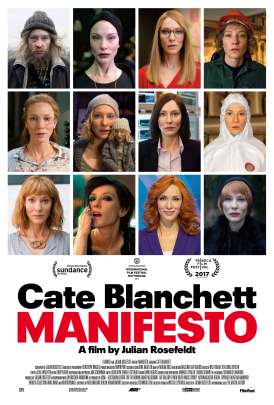
Julian Rosefeldt’s “Manifesto” cannot be fully understood without its origins as an art installation. The project began as a gallery exhibit where viewers walked through the space and encountered 13 screens, each of which featured Cate Blanchett manifesting the tenets an artistic manifesto. Viewers received guidance on how to proceed based on the order of the screens, but they were largely free to consume the segments at their own leisure. For all intents and purposes, they had the option to control their spatial and durational experience. (For those interested in learning more, allow me to shamelessly plug my interview with the director Julian Rosefeldt.)

I found myself envying those lucky enough to attend the gallery version of “Manifesto,” though Rosefeldt did assure me it would eventually resume touring. The feature length version does have plenty of merits, of course, namely its democratization. Millions more will have access to Rosefeldt’s audacious undertaking given its restriction to a single-screen experience. And in any form, a rigorous and creative attempt to breathe life into academic texts about the very nature of art is a welcome and worthy enterprise.

But “Manifesto” the narrative film is akin to sipping water from a firehose. It’s mainlining an entire semester of art history in 95 minutes. Watching the film becomes mentally taxing in the best kind of way. At countless times when my exhaustion threatened to overwhelm my comprehension, I desired the gallery experience of “Manifesto” where I could take in individual movements at my own pace. Undoubtedly, I could spend hours inside Rosefeldt’s world. I probably will. But I couldn’t at Sundance. B+


REVIEW: Get Out

8 05 2017

“I think it’s important to recognize that the African American community is looking at this […] through a set of experiences and a history that doesn’t go away,” then-President Barack Obama stated upon the occasion of George Zimmerman’s acquittal for the murder of Trayvon Martin. “There are very few African-American men in this country who haven’t had the experience of being followed when they were shopping in a department store. That includes me. There are very few African-American men who haven’t had the experience of walking across the street and hearing the locks click on the doors of cars. That happens to me.”

The terror that white people feel when a black man enters a space they historically dominate has gotten a surge of attention in recent years. (Some might say it’s the underlying narrative of the 2016 presidential election.) This tension appears most in the police shootings of unarmed black men, though it also appears in dialogues surrounding everything from cultural appropriation to #OscarsSoWhite. The issues, of course, are nothing new. The means for traditionally underrepresented voices to make their opinions heard, however, are.

With his feature debut “Get Out,” writer/director Jordan Peele finds yet another method of expression: the thriller genre. From its ominous opening scene in which a black man ambles uneasily through a Stepfordian suburb, the film engrosses us in the acute and hyperaware perspective of a minority navigating a predominantly white culture. That also requires shining a light on the dark flip side of the equation that helps construct blackness – white myopia or blindness.

As Chris (Daniel Kaluuya) prepares to meet the parents of his white girlfriend Rose (a perfectly cast Allison Williams), we become painfully aware of how the vast gulf of racial privilege affects their read on certain situations. She cannot understand why Chris simply gives his license to an officer calmly by the side of the road when it’s clear he did nothing wrong. She has a post-racial mindset that makes her think it’s unnecessary to specify Chris’ race before arriving. Race is something Rose can forget about. It’s not that easy for him.

Read the rest of this entry »


REVIEW: Risk

7 05 2017

One must balance principles with pragmatism if the former is to survive intense scrutiny, opines Julian Assange at the start of Laura Poitras’ “Risk,” a documentary with unprecedented access to the WikiLeaks founder at the height of his early ’10s infamy. It’s an ironic, fitting statement from a man who sees much of his work for international transparency eclipsed by charges of sexual assault. Rather than applying the principles of radical openness to his own life, Assange embarks on a scorched earth campaign to shift blame onto his accusers rather than accept any personal responsibility.

Poitras casts a suspicious eye towards Assange’s behavior, a stance likely influenced by allegations of sexual harassment and abuse leveled against fellow “hacktivist” Jacob Appelbaum after their brief affair ended. Appelbaum features prominently in both “Citizenfour” and the opening chapters of “Risk,” and the impassioned, largely unfiltered speeches he gives railing against online censorship demonstrates some form of support for the ideas. But can we excuse abusive behavior in men whose core ideas and values we primarily support? (It’s not exclusively a male problem, though cultural and institutional sexism tend to relegate these unchecked ego issues to a single gender.)

Poitras’ film bears the marks of intense internal deliberation in its very fiber; the version of “Risk” most audiences will experience differs dramatically from the version initially presented at the 2016 Cannes Film Festival. It’s a gripping examination of the double-edged sword forged by the cult of personality. On the one hand, complex dialectic struggles between freedom and control on personal and international scales become much more comprehensible when distilled into a human essence. Assange. Snowden. Appelbaum. They move these theoretical issues into the realm of the real by giving them a face. Yet people are complicated, and they lack consistency. Anything less than perfect representation of an ideology seemingly grants permission to throw the baby out with the bathwater in this day and age.

Read the rest of this entry »


REVIEW: Guardians of the Galaxy Vol. 2

6 05 2017

The summer season means sequelitis with few exceptions. One of these outliers, to an extent, is James Gunn’s “Guardians of the Galaxy Vol. 2.” It appears that after the surprising smash success of his series opener, Kevin Feige and the powers that be at Marvel decided to loosen his leash to continue pushing his aesthetic. Though the enormous potential of the irreverent “Guardians” series seems self-evident from our vantage point in the era of “Deadpool,” it was far from a sure thing when the studio greenlit the film in the heat of “The Avengers” universe-building craze. “Kick-Ass” hardly served as a reliable indicator that audiences were ready to follow the superhero genre into a parodic cycle.

From the outset, Gunn shows that he was far from operating at full throttle in the first film – and that he still has plenty of tricks up his sleeve. The way he stages the opening battle sequence is pure subversive brilliance. Some mysterious octopus-like space creature drops out of the sky and onto a landing pad where Chris Pratt’s Star-Lord and the Guardians are waiting for it. We have no idea what it is or why it poses a threat, in typical Marvel fashion. Gunn capitalizes on that unfamiliarity, staging the fight out of focus in the background while an adorable Baby Groot dances to an Electric Light Orchestra jam in front of our eyes. He knows people operate on sensation and feeling more than linear plot development, and he crafts an ideal anti-action scene.

So it’s a little disappointing when, by the end, Gunn still has to direct in lockstep with the Marvel mold. We’ve still got to have the obligatory third act “blow everything up for 20 minutes” portion of the screenplay, unfortunately. “Guardians of the Galaxy Vol. 2” at least imbues an otherwise mindless spectacle with deeper stakes. Every aspect of the film harkens back to its central themes of family, from the gold-hued eugenicist Sovereigns to Gamora (Zoe Saldana) and her sister Nebula (Karen Gillan). And, of course, there’s the match made in intertextual heaven: Star-Lord reuniting with his long-lost father, Kurt Russell’s Ego.

It’s too bad that anything relating to blood dynamics sounds like the notes from a family psychologist’s notepad. The dialogue sounds far too on-the-nose for a film so fluent in 13-year-old boy humor. (That’s not to knock the jokes, which would have gone over gangbusters with me 10 years ago. Some still do, to my reluctant chagrin.) But thankfully, Gunn still give us plenty of the franchise’s ragtag family, the Guardians themselves, rocking out to another awesome mixtape. B


REVIEW: After the Storm

5 05 2017

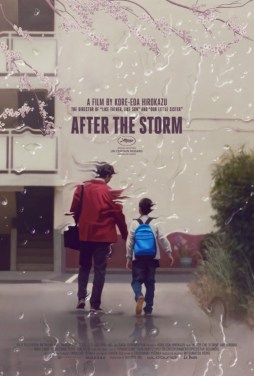
“Every year, men are becoming less manly,” says Hiroshi Abe’s Ryota, a pot calling the kettle black if ever there were one. He’s a man who’s not ready to have a family yet, as stated by the woman who bore his child in a misguided effort to nudge him to such a place. And yet, this prolonged adolescence provides a career in private investigation of cheating husbands for failed novelist Ryota.

Kore-Eda Hirokazu’s “After the Storm” takes some time to acquaint us with Ryota’s life. It’s not a plot-driven film, which is not to say that nothing happens. A fair amount does, particularly surrounding his continued affection for his ex-wife as she moves onto a new beau and tries to consolidate custody. Meanwhile, Ryota is mostly stuck trying to stay above water financially and musing to his son, “I’m not who I want to be yet.”

It’s not Kore-Eda’s most consequential work, but since “After the Storm” never aspires to “Like Father, Like Son” levels of profundity, it never feels slight. The film provides another great showcase of the writer/director’s perceptive understanding of human interaction. Even without great thematic heft, spending two hours observing the world through his eyes is a worthwhile use of time. B


F.I.L.M. of the Week (May 4, 2017)

4 05 2017

It’s gonna be May, which means one thing for this cinephile: the Cannes Film Festival! Unfortunately, I’m not going, but the official selection titles give me plenty to watch from the comfort of my own home. Cannes confers international auteur status on plenty of up-and-coming directors who were previously flying well off my radar.

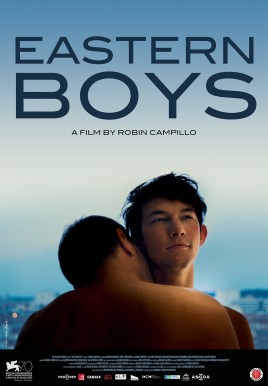
Such is the case for French director Robin Campillo, whose third film “120 Beats Per Minute” marks his competition debut. (He did have a connection to the festival through 2008’s Palme d’Or winner “The Class” – another film featured in this column – which he co-wrote with director Laurent Cantet.) “Eastern Boys” marks his most recent film, and it too earns its stripes as a “F.I.L.M. of the Week.”

Campillo’s departure point is a familiar place, or so it appears to me from my somewhat limited knowledge of global LGBT cinema. (The plot bears many similarities to Lorenzo Vigas’ 2016 feature “From Afar.”) A lonely older man, sexually repressed, seeks erotic fulfillment from a scruffy, edgy youngster furtively dabbling in the world’s oldest profession. From there, these two unlikely lovers begin a tender relationship that exposes generational differences in sexual freedom and shame.

But Campillo takes his time to arrive there in “Eastern Boys.” The relationship is teased in a masterful opening sequence where Rouslan (Kirill Emelyanov), a Ukranian immigrant living in the shadows of Paris, lurks around a metropolitan train station with a band of fellow hoodlums. The camera yo-yos between extreme wide shots painting him as just another body moving in a space and tighter angles where we get a sense of how he’s scouting his next mark. Eventually, the soft-spoken businessman Daniel (Olivier Rabourdin) tracks him down and requests his services.

Only it’s not just Rouslan who shows up – it’s his entire gang there to strip the apartment down for parts. The holdup isn’t the end of their story, though. Rouslan returns to consummate his original offer and winds up becoming a regular guest. As their bond deepens, Rouslan feels compelled to tell his host more details of his former life in eastern Europe – stories which Daniel dismisses and downplays. This information threatens to usurp his own sexual angst and reminds of him of the privilege he carries.

From there, it’s fascinating to watch how the provider-client relationship morphs into a more paternal-filial one. “Eastern Boys” loses some steam in its final act when some of Rouslan’s companions grow suspicious of some conspicuous symbols of wealth he mysteriously comes to possess, though it’s hardly enough to derail the film. The fascinating ever-shifting connection between Rouslan and Daniel, expertly conveyed by Emelyanov and Rabourdin, more than redeems any missteps.


Random Factoid #581 / A Remembrance

4 05 2017

I hope you’ll forgive me a brief personal aside here. Though my personality pervades just about every review I write to some extent, I rarely indulge in biographical babbling. (At least, not as much as I used to.) But sometimes I just need to write. It’s often times the best way I have of communicating thoughts that bubble up inside of me – especially ones that I find challenging to express emotionally or vocally.

Margaret Stratton died today. That name probably doesn’t mean a lot to you, if you’re reading this. (It might if you’re a friend of mine who’s been to see an advanced or press screening with me in Houston – which, granted, is probably the majority of my audience these days.) But she’s deeply woven into the fabric of this blog, and thus, my life.

I’ve hinted at it here and there, but when I’m not writing this blog, I’ve been pursuing a career in publicity, public relations and promotions. (I think it’s enhanced my writing innumerably and deepened my appreciation for how culture disseminates.) Margaret is a key figure in that career journey. She used to run the Houston publicity office where I had my first internship during high school, and though she had retired from most of her duties, she kept a large presence there. She could always be counted on to provide support for big events and activations – and, of course, serve as the screening rep for advanced screenings.

Some of my fondest memories come from working with her during the summer before I went to college. We were promoting “The Smurfs,” and even at my modest 5’8″, I was mercifully too tall to fit in the giant Smurf suits that Sony sent us to parade across town. Thankfully, Margaret was willing and able to pitch in. Bless her heart, she suited up in that costume in some of the hottest Houston heat I can remember. And these suits were THICK.

Yet even in what had to be a walking inferno, I cannot recall her complaining even once. In fact, I can barely even recall a moment when she didn’t have a grin from ear-to-ear. In typical teenager fashion, I didn’t realize it at the time, but that’s when I learned a pivotal lesson about work. If you’re going to do any task, even the smallest and seemingly most insignificant thing, it’s not worth doing unless you put your all into it. You can always affect someone for the better with it. The smiles (and, ok, the occasional terror) came about on the faces of so many young children because she was radiating enthusiasm through the costume.

And my gosh, I don’t even think I can count how many movies I saw with Margaret. It has to be well into the hundreds. Though I first knew her from publicity, our professional relationship later evolved into a more standard publicist-journalist one; I showed up at the screenings she worked, and she took my comments on them. Except it was anything but standard. From the beginning, when a young and timid 18-year-old me made his first forays into the big leagues of the entertainment press, Margaret believed in me. More than that, she championed me. In smaller venues, she’d introduce me to the more established members of the Houston press and sing my praises with the kind of enthusiasm you normally expect from family members. That vote of confidence meant more to me than I knew at the time.

During breaks in college (and the year and change after while I lived at home), I saw her countless times at screenings. She’d ask me all about what was going on in my life – I specifically remember her jubilation when I returned from Cannes – and then ask me what I thought about the movie afterwards. Margaret was such an optimist that she could find the good in just about any movie. I can probably count the number of films she outright rejected. So I always found it tough to tell her when I didn’t like something. After a few years, I found my cheat word to get around expressing outright disdain for a film: alright. Last September, she caught on after a string of particularly bad movies. I remember her putting her foot down and exhorting, “Oh Marshall, you and your alrights!”

Thankfully, the last movie we watched together was a great one: “Manchester by the Sea,” my favorite of 2016. We both walked out singing its praises and feeling emotionally invigorated. It’s now, in retrospect, a rather poetic final film given its subject matter of lives broken by a sudden death and how the living reassemble the pieces when they’re gone. You can never quite put it back together, and sometimes you can’t fill the lonely void. But the very act of trying opens up places in ourselves unbeknownst even to ourselves and lights the way to deeper and more meaningful relationships with the ones we love.

I’m in the middle of a screener for Oren Moverman’s “The Dinner” right now. It’s pretty dreadful. But darn it, I’m going to push myself to find something nice to say about it because that’s what Margaret would do. It’s now up to me, and the many people she touched, to keep her infectious optimism alive in a world that could sorely use it.


REVIEW: The Dinner

3 05 2017

I’ve racked my brain for days. Still, I cannot find a scenario in which the same person who masterfully threaded the seven-character Bob Dylan opus “I’m Not There” could also write something as clunky as “The Dinner.” Pardon this casual dismissal, but just … woooof.

Oren Moverman’s film is a cheap knockoff of “Carnage” – both Yasmina Reza’s play and Roman Polanski’s cinematic adaptation – as it gathers wealthy individuals to gnaw at each other over the sins of their children. That film wasn’t even anything to write home about, but it at least found a claustrophobic consistency and stuck to it. Moverman hacks away at any building tension between the two couples by frequently cutting away with flashbacks and expository scenes.

Even when Moverman does center the action on the open loathing between a successful politician (Richard Gere) and his cynical brother (Steve Coogan), “The Dinner” falls flat. They don’t sound like people. They talk like characters. Every bloviating pontification reeks of unrealistic grandiloquence. I don’t buy that this manner of speaking is some kind of class marker, either. Moverman just cannot find the humanity in the people he puts on screen.

When evaluating films, director David Fincher says he operates on the following logic: “First I’m looking for the technical. Then the believable. Then the connection.” Moverman’s film never makes it past the first criterion. C-