Robert Pattinson roundup

2 05 2017

I recently penned a piece over at Film School Rejects entitled “Robert Pattinson: From Behead to Bushy Beard,” where I ran through the actor’s career and found some pretty surprising things. I began coming around on Pattinson with “The Rover” back in 2014, but I discovered that his acting chops didn’t just magically grow once he excited the “Twilight” world. He refined them over time, though the raw talent was there.

I watched (almost) all of his filmography to write the essay, and rather than write individual reviews of them all, I’ve decided to do a little round-up here for those. It’s a little more manageable than trying to pen three separate posts.

“Little Ashes”
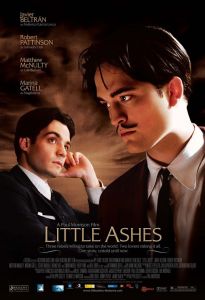
Robert Pattinson’s Salvador Dalí in “Little Ashes” undergoes a similar arc as Daniel Radcliffe’s Allen Ginsberg in “Kill Your Darlings.” These films find ways to intertwine the coming-of-age story with the artist biopic. Both are future groundbreaking artists in the making, but when we meet them, they are young men curious to explore their intellectual and sexual boundaries in a collegiate atmosphere.

The differentiator between the two (admittedly an unfair comparison since “Kill Your Darlings” came out five years later) is that in “Little Ashes,” Pattinson has much more of a public persona into which he must play. We know Dalí as a quirky eccentric, and that’s where Pattinson goes off the rails in the film. He’s better as an actor of small gestures and concealed emotions, not painting in a craze with a shaved head or tucking his genitals in front of a mirror. Dalí’s political awakening by way of his peer Federico García Lorca (Javier Beltrán) at a puppet show is a far better showcase for Pattinson’s gifts. We can observe the slow radicalization of his ideas through the gradual lighting up of his face.

And as a story of could-be lovers and artistic rivals, “Little Ashes” hardly fairs better. Director Paul Morrison never really determines the film’s identity, and the whole work suffers for it. C+

“Remember Me”

If you have some conception of Robert Pattinson as a disinterested, dispassionate slacker with chronic bedhead, chances are it comes a lot from “Remember Me.” It’s the film that best bottles up the essence of his late ’00s/early ’10s stardom, one that fits itself around his persona.

Pattinson plays Tyler Hawkins, an NYU student in fall 2001 dealing with daddy issues while romantically pursuing the daughter of the cop who recently gave him grief. (But don’t worry, he’s still a genuine sweetheart to his grade-school aged younger sister.) There’s constant tension in the film about how little both Pattinson and Tyler seem to care about what’s going on around them and the deep pain in his heart stemming from the suicide of his older brother Michael.

Allen Coulter’s film is what it is – a sappy, emotions-on-its-sleeves young adult romance – and I give it some credit for not aiming for much more. I’m still a little on the fence about the film’s ending, which milks tragedy in an arguably exploitative way. But as a by-the-books melodrama, it’s serviceable. C+

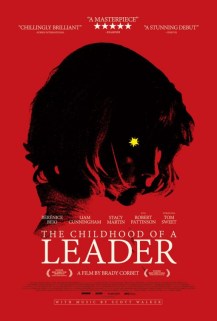
“The Childhood of a Leader”

Admittedly, including Brady Corbet’s “The Childhood of a Leader” in a roundup of Robert Pattinson movies feels a little wrong. The actor only makes a brief appearance at the tail ends of the film. At the outset, he’s a French professorial chap giving pre-Hannah Arendt musings on the banality of evil in the immediate wake of World War I’s devastation. In the ending, he’s … someone different. (Sorry, spoilers.)

The main focus of the film is Tom Sweet’s Prescott, a young child who forms his understanding of the world against the backdrop of the fragile peace. The film runs nearly two hours, a time in which little happens but Corbet establishes heavy atmosphere and deep foreboding. He only releases the built-up tension in the aforementioned finale.

As a film, “The Childhood of a Leader” is a bit of a strut, more style than substance. But as a debut film, it’s a little something different. This feels like an aesthetic calling card for Brady Corbet, a declaration of intent for many great things to come. He hasn’t made his great movie yet, but I left this one with full confidence that it will arrive one day. “The Childhood of a Leader” is like a feature-length proof of concept for it. B-


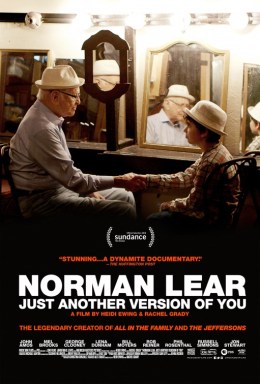
REVIEW: Norman Lear: Just Another Version of You

1 05 2017

Norman Lear is, to borrow a term used by the President to describe Frederick Douglass, being recognized more and more these days. But unlike the abolitionist hero, Lear is still alive! Luckily for us, his work and enormous contributions to shaping American society by revolutionizing the sitcom are receiving their proper due. Lear himself is not content to go gently into that good night, either; the nonagenarian just kicked off a podcast this month!

A few years ago, however, Lear penned a memoir, and documentarians Heidi Ewing and Rachel Grady came along for the book tour. Their observations on the journey form the backbone of “Norman Lear: Just Another Version of You.” It’s definitely a puff piece, though the halo is dim enough that it falls short of hagiography. Their film lands somewhere in Sunday morning news magazine segment territory, just at a feature length, which is a fine place to reside.

Ewing and Grady assemble an impressive array of talking heads to interview, ranging from obvious contenders such as comedic peer Mel Brooks and famous showrunners like Lena Dunham and Phil Rosenthal (“Everybody Loves Raymond”) to some genuinely surprising faces like George Clooney. For those who want to understand Lear’s importance and don’t have the time to binge-watch “All in the Family,” this documentary will provide an important primer to his historical importance and continued relevance. Ewing and Grady aren’t pushing the documentary form like Lear stretched the TV sitcom, though that’s hardly an issue. B


REVIEW: Soul Surfer

30 04 2017

I’ll go ahead and warn you that a good portion of this review won’t be dealing with the movie “Soul Surfer” at all. This inspirational sports movie about Bethany Hamilton, the 13-year-old who lost her arm to a shark while surfing, is so clichéd and by the book that it really isn’t worth discussing in depth. In short, it’s instantly forgettable because you’ve already seen it. You know what’s going to happen, so much so that I don’t even need to scream spoiler: she’s going to get back on the board, and she’s going to succeed.
At this point, you either know that you are going to be moved by this storyline or you aren’t.  Maybe there’s the exception for the sport that’s closest to your heart, but from “The Blind Side” to “Secretariat” to “Soul Surfer,” it’s all the same buttons being pushed. (Although now thanks to “The Blind Side,” these movies can delve into Christianity and religion without being thrown in the “Christian art” ghetto.) I’ve come to resist this maudlin and melodramatic sentimentalism because it’s just plain lazy filmmaking.

But in one of the final editions of Sports Illustrated in 2012, Brian Koppelman (writer/director of the decidedly forgettable “Solitary Man” – but also the showrunner of “Billions”) penned a passionate plea for Hollywood to keep churning out these color-by-numbers underdog stories. He talks about how sports movies “have a purity and truth that all too often professional and college sports no longer do” and that he’s “rooting for Hollywood to find a way to do the right thing and give us a few more of the transcendent film moments that only a sports movie can bring.”

Well, Mr. Koppelman, allow me to retort. (NOTE: I wrote this in 2013 and left it unpublished for four years. Retorting made more sense then.) I understand what good sports movies are supposed to do, and believe me, I’ve been moved by plenty of them from “Remember the Titans” to “Miracle.” But by now, the underdog champions have been crowned on screen for just about every sport.  Now, with “Soul Surfer,” we even have surfing.

The inspirational sports movie has run out of steam, and the formula has been hackneyed into a shell of its former self. When the western and the musical told all the stories people could stand, they slipped quietly into obscurity. I think it may be time for the sports movie to do the same, particularly those of the inspirational brand.

Now, a sort of revisionist strand of sports films have taken center stage. “The Fighter” is more about family than boxing, just as “Moneyball” is more about creative thinking than baseball. They have succeeded with audiences and critics because they use the familiar warmth of competitive athletics to bring about an entirely different sentiment.

So, Mr. Koppelman, there will always be the sports movie “classics” of the past for you to enjoy. With something for just about everyone now, the underdog story may have exhausted itself – but that’s only a natural progression. Whether it was the audiences or the industry that gave up on sports movies around the time of release of the generic “Soul Surfer,” I don’t particularly care. I just hope that we have all moved on to bigger and better things because the sports movie as it stands today is weighing us down in unnecessary banality.  B- / 2stars


REVIEW: Casting JonBenet

29 04 2017

What are we talking about when we talk about true crime? It’s rarely the victims, and it’s seldom even the criminal act in question. So often, these cases that play out in the media and catch a foothold in American culture provide a convenient release valve for other societal anxieties. As two 2016 projects explored, the O.J. Simpson trial was about race, gender and class in American life, and the case was hardly an outlier. Recently, we’ve seen the Casey Anthony trial about negligent millennial parenting and the Travyon Martin/Eric Garner cases about race relations and implicit bias. History books are lined with mass public hysteria over legal disputes going back centuries.

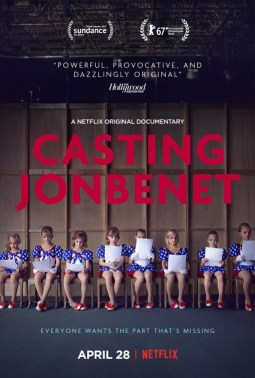
Kitty Green’s “Casting JonBenet” contorts the conventions of documentary cinema to observe this phenomena at the granular level. Under the guise of filming a fictional piece about the mysteries surrounding the murder of 6-year-old beauty queen JonBenet Ramsey, Green interviews town locals of Boulder, CO (the site of the crime) who audition to play key figures in the story. Many of the amateur actors are not approaching the JonBenet case with remoteness or remove; most adults are within a degree of separation from the Ramsey family. Some even interacted with them directly.

With so many questions still remaining about the involvement of JonBenet’s mother Kitty, her father Jon and a costumed Santa Claus, each performer must bring a certain amount of judgement to the role. What do they believe about the case? Unheard and unseen, Green interrogates her coterie of aspiring actors about the biases and assumptions they bring to the part. Their answers, revealed plainly to the camera in front of them, reveal convictions based less on facts and more on personal experiences as well as cultural assumptions about the roles available to the person they are auditioning to play. The actors, like most of us who get drawn into crime stories, turn real people into fictional characters by projecting our own fears onto them.

Green has no interest in solving the JonBenet Ramsey murder, deliberately eschewing procedural or investigative tropes in favor of an open-ended lack of resolution. Was it the brother? The mother? The Santa? The father? Green answers, yes. “Casting JonBenet” allows for a radical coexistence of all these interpretations and theories. In the absence of evidence, all we’re left with to adjudicate the cases is our internal compass in an attempt to restore the balance of morality shattered by an immoral act. A- /


REVIEW: Colossal

28 04 2017

Historically in monster movies, the imminent threat stands in for a more existential fear. From foreign invaders to nuclear weapons and screen addiction, we’ve seen any number of external forces terrorize the cinema. But starting in the 1960s (as compellingly chronicled by Jason Zinoman in his book “Shock Value“), some of these monsters came to represent parts of ourselves. They were manifestations of some internal demons, not some societal hazard.

Nacho Vigalondo’s “Colossal” is the latest film in this tradition as Anne Hathaway’s trainwreck of a character, Gloria, manifests as a godzilla-like beast in Seoul when she gets blackout drunk in a certain radius. The premise sounds a little risible, admittedly, but Hathaway and Vigalondo sell its spirit with gusto. This is not the kind of movie devoted to detailed scientific explanation. You accept the oddly specific rules under which it operates and then delve into its rich metaphorical terrain.

A mid-movie turn in the plot should go unspoiled in a review, but I’ll hint at it by saying it opens “Colossal” up to be more than just a metaphor for alcoholism. The monster is all of us and whatever baggage we carry that makes us act impulsively. It takes a physical manifestation of these forces to make Gloria realize that her actions can cause collateral damage harming people around her. Vigalondo adds plenty of contemporary touches – in particular how the Internet can find a way to turn tragedy into memes instantaneously – but this classical dilemma lies at the very heart of the film. The satisfying resolution shows why Hathaway is uniquely equipped to play the part. It requires creativity, determination and a brushing aside of the haters. B+


F.I.L.M. of the Week (April 27, 2017)

27 04 2017

For whatever reason, I found James Gray’s “Two Lovers” cold, remote and distant on first watch. Perhaps it was just too close to the release of the director’s film “The Immigrant,” my favorite film of 2014 (and potentially the decade). I knew to expect classical-style melodrama yet still found myself desperately searching for an access point that I couldn’t locate.

I don’t know what changed between then and now – more familiarity with Gray’s reference points, better understanding of melodrama, knowing the plot, general life experience – but I’d now easily put “Two Lovers” in “F.I.L.M. of the Week” territory. The passion, disappointment and affection lurk beneath the surface of the film, not always palpable but constantly dictating the limited choices of the characters. Watching the film a second time opened my eyes to the straightjackets of expectation they all inhabit – and how difficult embracing another person must be with arms tied.

Joaquin Phoenix’s quiet, subdued Leonard Kraditor is not the lightning rod of easy sympathy in the way Marion Cotillard’s Ewa was in “The Immigrant.” For heaven’s sake, the beginning of the movie shows him moving back in with his parents after encountering a setback in his mental health. This gives them the excuse to propose the closest 21st century equivalent of an arranged marriage with the daughter of a business partner, shy but stable Sandra (Vinessa Shaw). Of course, this comes at the same time Leonard meets fellow building tenant Michelle (Gwyneth Paltrow), a shaky yet spunky woman who draws a more carnal reaction from him. She’s a bit of a mess between a drug habit and an ongoing affair with her philandering coworker; Leonard pursues her all the same.

“Two Lovers” centers around the push and pull between the two competing impulses in Leonard’s life, most notably personified in the two women. Though desire and feeling are so often kept repressed in the film, I found myself inexorably drawn into the dramatized reality. Gray locates the tragedy in the common man’s story, a daunting feat that would ring as pretentious if it failed. It doesn’t, and “Two Lovers” emanates with Gray’s wisdom of the complexities of human behaviors and relationships.


REVIEW: Unforgettable

26 04 2017

For the better part of a decade, Katherine Heigl has struggled to shake off a reputation of being disagreeable. Much of this stems from a 2007 interview about “Knocked Up” where she chided the film’s supposed sexist treatment of female characters. (Inner publicist note: had she just waited and made the comment in retrospect, it’s likely no one would have found it controversial.) But ever since, many in the culture have projected their worst ideas about outspoken women onto her. She often wears the dreaded label of “unlikable.”

After countless attempts to correct the narrative by starring in sunny rom-coms, network television procedurals and a few indies, Heigl finally leans into the bad rap as the villain of “Unforgettable.” In Denise Di Novi’s domestic thriller, she plays Tessa Connover, the eerie ex-wife who torments her former flame’s new dame, Rosario Dawson’s Julia Banks. The film’s twist on the catfight genre is that Julia herself is not purely a victim or object of terror. She’s a survivor of domestic abuse dealing with lingering distress of her own.

Tessa plays manipulative mind games behind a placid exterior, though in Heigl’s hands, it often comes across as wooden. For these films to successfully scare, there needs to be some element of mystery behind the machinations of menace. Tessa is essentially an open book; in Heigl’s defense, the obvious broadcasting of her character’s motivations and actions is also a fault at the script level. But just as she could have spoken up and changed things with “Knocked Up,” Heigl could have added some mystery to her performance to strengthen the film. Tessa is her way of winking at the audience and admitting she knows what they think of her. Little in “Unforgettable” makes a compelling case for why people should change their minds. C+


REVIEW: Buster’s Mal Heart

25 04 2017

Fantastic Fest

I don’t know why it took me over six months to connect Sarah Adina Smith’s headscratcher “Buster’s Mal Heart” to Richard Kelly’s cult classic “Donnie Darko,” but alas, the two have linked in my head. Both are films that it’s possible to show to a group of people, all of whom agree on the content shown yet diverge widely over whether it’s genius or madness. In such debates, I usually tend to fall somewhere in the middle – neither pole has a monopoly on good idea – and this instance is no different.

Smith puts star Rami Malek to chilling use as Buster, a soft-spoken family man who ends up working a “The Shining”-esque gig as the night desk man at a small hotel. The film does not just play on reserves of feeling carried over from his similarly reserved work in “Mr. Robot,” either. It’s a sensitive performance that reflects a quiet, shy man whose desire to please crosses paths with a grifting loon with an intent to deceive. Said shady figure, DJ Qualls’ Brown, spews apocalyptic rhetoric about a coming day of reckoning known as “The Inversion.” Whether out of boredom, politeness or curisoity, Buster never shuts down Brown’s babbling.

But eventually, tolerating Brown’s presence has consequences. While we witness his inability to rid himself of the negative influence, Smith intercuts glimpses of two other storylines involving Buster – or is it just Malek? One is a drifter making himself at home in the winter vacation houses of the rich during off-season. The other is a sunburned Jesus-looking fellow floating the open sea in a small boat. They’re connected, of course, but Smith never convincingly sells their tenuous linkage.

Standard linear, narrative cohesion is not the endgame, though even a more complex thematic relationship seems like a stretch. “Buster’s Mal Heart” stretches for cosmic, spiritual connections that I just couldn’t sense on the wavelength where I felt like the film operated. That does not mean they do not exist, nor does it discount the intriguing main section with Buster and Brown. B


F.I.L.M. of the Week (April 20, 2017)

20 04 2017

We’ve all seen our fair share of time travel movies ranging from the fantastic (“X-Men: Days of Future Past,” the “Terminator” series) to the comedic (“Hot Tub Time Machine“) and even the romantic (“About Time“). But there’s a special class of scrappier films, like Shane Carruth’s “Primer” and Rian Johnson’s “Looper,” who rely less on stars and visual effects for this particular blend of sci-fi. Instead, they involve us in story by putting a creative spin on the mechanics of their time manipulation.

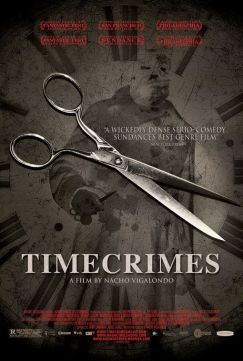
Nacho Vigalondo’s 2008 debut feature, “Timecrimes,” is another welcome entry into this esteemed group. Admittedly, I avoided the film for quite some time because I judged the book by its cover. (The gauze-wrapped head on the poster made me feel some kind of way.) But after the rapturous acclaim Vigalondo’s latest film, “Colossal,” received, I thought it only right to go back to the beginning with the director. What I found was a sharp, succinct time travel tale that is deeply concerned with human agency and free will in a world where delineations between past, present and future cease to exist. It’s an obvious choice for the “F.I.L.M. of the Week,” and it’s certainly one I’ll be mulling over for weeks to come.

Going too deep into plot details would only inhibit full intellectual access to “Timecrimes,” so I’ll describe the experience as something close to “Harry Potter and the Prisoner of Azkaban” or “Edge of Tomorrow.” The outcome is certain in all these films, despite the ability to make directional shifts along a chronological timeline. For the characters making these journeys to the past, they slowly come to realize that their actions are not their own. Instead, they must play a predetermined role in maintaining reality.

For Héctor in “Timecrimes,” this involves piecing together the seemingly non-sensical relationship between a naked girl in the woods, a gauze-wrapped man wielding scissors and an invasion of his home. In order to make sense of it all, he must make several trips back to the past with the aid of a mysterious neighbor’s contraption. Though we might lose our footing in time, we never unlock ourselves from Héctor’s desire to return to normalcy and restore some order in life. It’s this connection that makes the film so memorable and distinctive among its peers.


REVIEW: King Cobra

19 04 2017

There’s plenty of “period” footage in Justin Kelly’s “King Cobra” to date the film back to the mid-2000s. Videos have that digital grain from the middling quality video camera available at the time. A character turns the lens of a digital camera to face him for a selfie, pre-front facing touchscreen.

Yet of all the things that locate the film in the time, there was one indelible image. Shockingly, in a movie set in the world of gay pornography, it was not something involving explicit sex. (And for those looking for that kind of thing, this isn’t some low-budget Skinemax flick.) It’s the news showing footage of Hurricane Katrina’s devastation, summoning a cascade of memories of what it was like to be alive in 2005. The odd mix of malaise, shame and embarrassment provides a fitting backdrop for “King Cobra,” where gay characters of various comfort levels in their sexuality grapple with the era’s repression.

It’s too bad that the film doesn’t just borrow the mood of the Bush era. It also takes the stereotypes. Though based on a true story, every gay character in “King Cobra” fits into some kind of tired, lazy archetype: the young and nubile stud, the predatory porn producer, the aging diva, the jealous lover. The actors play them as clingy, feminine and sexually voracious. We’re talking pre-“Brokeback Mountain” style caricatures here.

If Kelly gave his characters the same texture he granted their milieu, the film might amount to something. Instead, it plays like a traditional show business tale of a young talent (Garrett Clayton’s Brent Corrigan) who allows himself to get sweet-talked by a lecherous Internet porn mogul (Christian Slater’s closeted creep Stephen). The film takes an interesting turn when a rival producer/star duo (James Franco and Keegan Allen’s Joe and Harlow) intervene, but by that point, it’s tough to get invested in anything that’s happening. C+


REVIEW: The Handmaiden

18 04 2017

Fantastic Fest

Park Chan-Wook’s “The Handmaiden” boasts absolutely stunning costumes, set design and cinematography – not to mention some truly devoted actors to make magic happen in the frame. This is all very necessary for a film that makes its audience watch the same story play out three separate times over the course of nearly two and a half hours. Every section adds perspective to the other, but getting to that enlightened place is equal parts exhausting and rewarding.

This Korean-set caper details the exploits of Sook-hee, a handmaiden who enters the home of the occupying Japanese heiress Lady Hideiko, as she attempts to guide her employer to marry a conman who will then commit her to an asylum and steal her family’s fortune. What ensues is something akin to a more erotic “Gone Girl” with stunning reversals. But wait, there’s more – “The Handmaiden” features some screwball comedy flourishes that make the proceedings even wilder! There’s also erotic fiction reading, kinky sex and some savagely violent beatdowns.

Park maintains a sharp feminist eye throughout, paying close attention to the female solidarity that emerges between Sook-hee and Hideiko as they realize how men attempt to play them off each other for selfish ends. Each section of the triptych adds more dimensionality and intrigue to their relationship. While “The Handmaiden” may occasionally drag in redundancy, it never gets boring to observe their unconventional power dynamic shift around.  B+


REVIEW: Free Fire

17 04 2017

SXSW Film Festival

Ben Wheatley is not the kind of director to slowly ease you into the milieu of the world he creates. He simply plunges you into the deep end with piranhas, primarily through the use of stylized and highly specific situational dialogue. “Free Fire” does not wait for you to catch up. The loquacious characters simply start spitting out Wheatley and co-writer Amy Jump’s words at a mile-a-minute pace, as they naturally would. You either start running or get left in its dust.

The only time Wheatley slows down is not for our sake. It’s to commemorate the first bullet fired of what must be thousands over the course of the film. In suspended animation, we watch it travel and have a moment to consider its impact. Then the full playground game breaks out between two rival Boston gangs in an arms deal, and it becomes absolute pandemonium.

Wheatley uses the film’s singular warehouse location to its absolute fullest, utilizing it like an adult jungle gym occupied by men (and Brie Larson’s Justine) who showed up in what looks like costumes for a trashy ’70s party. Every move to advance around the space requires at least four bullets, and the gunfire eventually immobilizes every participant one limb at a time. Towards the end, Justine relies on a firearm to serve as a combined cane and replacement appendage. Yes, “Free Fire” is that kind of movie.

It’s also a film that leaves behind little but empty bullet cases. Enjoyable though it may be to watch these bumbling gangsters unleash load after load on each other to period tunes (executive producer Martin Scorsese must have lent his personal jukebox), those pleasures prove fleeting. “Free Fire” unyokes the hysteria of Wheatley’s last film, “High-Rise,” from any form of social commentary. This is a very different movie with no pretensions of intellectual depth, yet even adjusting for the difference, it still fires a few blanks. B /


REVIEW: Silence

16 04 2017

Like I do with many great films, I approached reviewing Martin Scorsese’s “Silence” with a reverence tinged with trepidation. No matter how many seemingly objective angles I took to evaluating it, I could not find a path that did not somehow cross with my own experiences and beliefs as a person of faith. Though this underscores just about every review I write, rarely does it bubble up to the surface. But since today is Easter, I thought it made sense to craft a hybrid akin to Scorsese’s work: a personal statement and a prayer.

I’ve been grappling with the film for the past three months; as Matt Zoller Seitz astutely observed, “This is not the sort of film you ‘like’ or ‘don’t like.’ It’s a film that you experience and then live with.” Scorsese himself has wrestled with Shusaku Endo’s novel for longer than I have been alive. Christian thinkers themselves have wrestled with these issues since the religion began two millennia ago. To project any kind of intellectual authority or issue some kind of vast, sweeping statement about the ideology and thematics of “Silence” is naive and preposterous. In its searing specificity, the film gets beyond the simplistic discussions of religion that predominate our polite culture and delves headfirst into the questions that demarcate contemporary Christianity.

It goes without saying that Scorsese’s involvement in the film ensures “Silence” does not issue the kind of self-congratulatory pat on the back and reaffirmation of most religious films. He zooms past the “what” of faith and immediately wades into the murkier waters of the “how,” specifically as it pertains to evangelism and discipleship. 17th century Portuguese fathers Rodrigues (Andrew Garfield) and Garrpe (Adam Driver) set sail for Japan, where their mentor Ferreira (Liam Neeson) disappears and allegedly disavows the Catholic religion.

Their rescue mission brings them into contact with persecuted Japanese Christians practicing their faith in private, an experience that tugs the fathers’ beliefs at opposite directions with equal force. On the one hand, their torture at the hands of Japanese inquisitors makes the abstract concept of martyrdom painfully real, humbling them tremendously. Yet these supplicants also view the priests as direct conduits to God to the point that they take on a God-like status, inflating the latent self-righteousness undergirding many of their actions.

Read the rest of this entry »


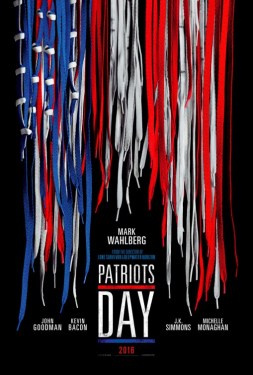
REVIEW: Patriots Day

15 04 2017

The narrative elements of “Patriots Day” show Peter Berg at the top of his game. As a film that recreates the terror of the 2013 Boston Marathon bombing and the frenzied search to catch the perpetrators, it’s every bit as taught and harrowing as “Lone Survivor.” Critique ideology all you want – and I had my fair share of issues with the comforting yet alarming deployment of the surveillance state – but objectively speaking, Berg and his technicians know how to edit for maximum tension around an event whose outcome we already know.

Now, you might have noticed that I specified “narrative elements.” That was intentional. “Patriots Day” ends on a lengthy postscript of talking-head style documentary footage with survivors of the bombing. It’s stirring, sure, but it left me wondering – why not just make a non-fiction film? The appetite for documentaries exists now thanks to platforms like Netflix and HBO.

In “Patriots Day,” fictionalization began to feel like trivialization. If the words of real people are powerful enough to end a film, they ought to be powerful enough to sustain a film. Why does Berg think we need Mark Wahlberg sermonizing from the back of a truck bed over sappy, inspiring music to care about the heroism of Boston’s finest? Why does he feel the need to compress the valiant actions of several police officers into one composite, Teddy Saunders, for Mark Wahlberg to play?

Berg tries to have it both ways in the film, leaning on both the authenticity of the survivors’ pain while also shoehorning reality into a convenient narrative device about one police officer who cracks open the case with a hobbled leg. (At times, his lickety-split reactions don’t even make logical sense!) If recent yanked from the headlines stories are going to continue to serve as fodder for cinema, we need to have a larger debate about how filmmakers can and cannot rely on actual participants. B+


REVIEW: Their Finest

14 04 2017

“Authenticity informed by optimism” – that was the motto of Britain’s wartime Ministry of Information when it comes to creating films, according to Lone Scherfig’s “Their Finest.” Around the time that “keep calm and carry on” came into common parlance through Tube posters, the government was also hard at work shaping the national consciousness through the medium of cinema. In 1940, filmmakers came together to convey the seriousness of the war effort while also inspiring confidence and patriotism.

“Their Finest” specifically follows the course of one picture shoot about the sacrifices made at Dunkirk (luckily Scherfig got this out before Christopher Nolan’s epic). Welsh screenwriter Catrin Cole (Gemma Arterton) approaches the evacuation with a creative, novel approach to a story whose validity and heroism do not immediately signal the traditional Hollywood ending. Her job gets even harder when the government hijacks the film to subtly goad the United States into helping the war effort – primarily through the addition of American actor Carl Lundbeck, a  blonde bombshell of machismo played with spunk by Jake Lacy. Before WikiLeaks, this was how covert influence worked. (I like this way a lot more.)

Gabby Chiape’s screenplay balances more than just a straightforward tale of film production in wartime. “Their Finest” also includes a significant feminist slant concerning women’s contribution to the war effort and their mounting preemptive fears about men relegating them back to the home as soon as combat ceases. That tension plays out in the dimly lit government buildings where Catrin toils over a typewriter with the charming curmudgeon Tom Buckley (Sam Claflin) as well as at home with her husband Ellis (Jack Huston), a disabled veteran whose “brutal and dispiriting” paintings don’t exactly jive with the national mood. This central tenet of the film bobs back and forth between serving as subject and subtext, and after nearly two hours, Chiape and Scherfig never quite figure out where it belongs. Between that and an enjoyable B-plot featuring Billy Nighy’s washed-up character actor Ambrose Hilliard, “Their Finest” simply fights on one too many fronts to come out on top. B-