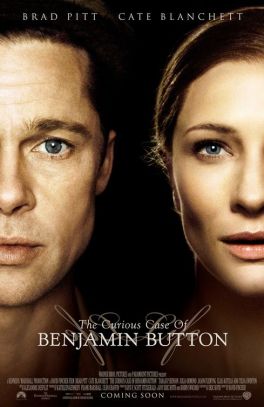
FINCHERFEST: The Curious Case of Benjamin Button

30 09 2010

As part of a deal with Paramount and Warner Bros. to make “Zodiac,” David Fincher took on the $150 million production of “The Curious Case of Benjamin Button.”  The result was his first nomination for Best Director and the most Oscar-nominated movie of the decade.

“The Curious Case of Benjamin Button” is a masterpiece.

YES, I used the dreaded m-word.  Do I regret it?

Absolutely not.  I stand by assertion 100%, and I will argue my side until you see it.  Fincher’s adaptation of F. Scott Fitzgerald’s short story is the closet thing I think we will ever get to a 20th century epic.  It’s a sweeping story of love, time, and life, not to mention the single most beautiful movie I have ever seen.  Aside from the typical splendor of a period piece, Fincher’s film has the greatest visual effects I have ever seen.

When I first saw “Benjamin Button,” I was under the impression that the younger (as in newly-born) Benjamins would only be voiced by Brad Pitt, not acted by him.  Yet after doing some research, I found out that aside from the last five minutes of the movie, Benjamin Button’s face was always animated by Pitt.  It’s completely possible to not notice that it actually is him because the effects are so subtly incorporated, and doing such is such an incredible achievement in film history.

I’ll address two common criticisms of the movie, the first being its similarities to “Forrest Gump.”  These concerns might be valid had the two not shared the same writer, Eric Roth.  I see no problem with an author exploring similar issues, especially when he delves deeper into more profound revelations.  “Benjamin Button” gets to the heart of what it means to be alive in the grandest of fashions.

And then there are those who claim that the movie’s 166 minute runtime is absolutely unbearable.  To those poor, impatient souls, I say that our journey is Benjamin’s journey.  We don’t just watch time go by; we feel it with him.  Glancing through an inverted lens gives us a fascinating look at the passage of time and its effect on one man fated – or perhaps doomed – to live it that way.  Just because I say this is a masterpiece doesn’t mean that I think it is perfect.  I don’t think any film can be entirely perfect, but when a movie is truly great, it has many beautiful, fleeting moments of perfection.  Some claim that the movie drags, and I’ll agree that certain scenes could have used a little more time in the editing room.  However, the pacing is not slow.  It is deliberate, and only at this wistful speed can we truly appreciate Benjamin’s world.

Everything about this movie got so much attention, but I’d like to draw attention to one element that got completely and unjustly overlooked: Cate Blanchett’s performance.  She received absolutely no awards or nominations for her performance as Daisy Fuller, Benjamin’s love interest, which is a shame because this is by far her most emotionally compelling and sensitive performance ever.  What I found particularly remarkable about her in “Benjamin Button” was her ability to turn small moments into things that can stick with us.  When I think of her in this movie, I keep coming back to a small scene where Daisy looks plaintively at a young girl with all of her physicality intact and suddenly just finds herself overcome with despair.  It’s as much her story as it is Benjamin’s, and Blanchett wins our hearts just as quickly as Pitt does.

It’s a marvel that Fincher can transition so seamlessly from his violent thrillers and dramas to this romantic vision of the 1900s.  In my mind, it’s his best and most thoughtful work, displaying more of his top-notch precision than ever (albeit in a totally different form).  There are very few movies that have the power to stun us into silence, and “The Curious Case of Benjamin Button” is one of them.  It has the power to make us feel light as a feather and make us fly in a gentle wind, full of emotion and with a new appreciation for life.


REVIEW: Robin Hood

29 05 2010

I almost gave up hope on “Robin Hood,” but I’m glad I didn’t allow myself to become entirely disengaged. I’ll get right to the point: the first 45 minutes are absolutely brutal. They are boring and they seem completely pointless. They don’t do much to develop a story, yet as we see later, they are more like a prologue, providing crucial information to prop up the rest of the film.

But out of nowhere, the movie reverses the slump and becomes genuinely entertaining. Everything suddenly clicks: the story begins to make sense; the pace picks up; and Russell Crowe begins acting. It takes him a while to kick his performance in gear, like he’s finally fought off the hangover that plagued him at the beginning. He’s pretty good when he decides to act. When Crowe doesn’t, he lifelessly walks through the motions and mumbles every line, rendering them incoherent.

But maybe it’s not all his fault. The character in this movie is tough because it’s Robin Hood before he was Robin Hood. Have no doubt about it: this is not the Robin Hood we have come to know, and it’s not the one I anticipated. I wasn’t expecting the jolly fox in the green suit, but I was expecting a little more of the “steal from the rich and give to the needy” spirit that we most often associate with the character.

I assume we will see this aspect played up if a sequel is made, yet at the moment, the character is awkwardly undefined. In this movie, Crowe’s purpose is to establish the roots of the legendary defender of the weak. He doesn’t explore where this commitment is derived from so much as he gives us a Maximus rehash with a little more discretion. He’s chomping at the bit to be the legend that we see very little of the man.

Where Crowe has issues, co-star Cate Blanchett has none. Strangely, the movie only seems to reach its full vitality when Blanchett is on screen. She picks up on whatever tiny nuances the script has, and her acting always hits precisely the right tone. Blanchett has graced the screen with many of the preeminent male actors of our generation (DiCaprio, Pitt, Damon), so her history alone makes it impossible to say that her chemistry with Crowe ranks among her best. However, the two do make a great pair, and their scenes are easily the movie’s most memorable that don’t involve the impaling of bodies by arrows.

Read the rest of this entry »


Oscar Moment: “Robin Hood”

18 04 2010

The lineup for the prestigious Cannes Film Festival was announced on Thursday, but we have known for several weeks now that “Robin Hood” would open the festival. While screening out of competition, it still deserves serious talk as an Oscar contender.

If “The Dark Knight” was part of the reason that the Oscars moved to ten nominees, then they are still looking for that popcorn flick with enough brain to atone for their horrifying omission.  “Robin Hood” could be that movie.

It’s directed by someone who has plenty of respect in the filmmaking community, Ridley Scott.  He has been nominated three times for Best Director and has helmed a movie that won Best Picture, “Gladiator.”  It’s hard not to take a look at “Robin Hood” and see a few similarities.

It clocks in at just under two and a half hours – big, long movies have scored with the Academy in the past.  The length lends it that sweeping epic feel that the Oscars tend to love.  Then again, so did “Kingdom of Heaven,” Scott’s 2005 drama about the Crusades that had huge expectations and failed to meet any of them.  In fact, since his last nomination for Best Director with “Black Hawk Down” in 2001, all of his movies have been considered Oscar contenders – and flopped.  “Body of Lies.”  “American Gangster.”  “A Good Year.”  Is “Robin Hood” the movie to put Scott back on the Oscar track or veer him further off of it?

He has certainly teamed up with Academy Award winner Russell Crowe enough times to know how to direct the star; keep in mind that Scott directed Crowe to his Oscar win.  And this cast is filled with plenty of other extraordinary acting talents, namely Cate Blanchett (winner of the 2004 Best Supporting Actress Oscar for “The Aviator”) as Robin Hood’s female companion, Lady Marian.  He also has winner William Hurt and nominee Max Von Sydow in his arsenal – but is that enough?

For a blockbuster to be nominated for Best Picture, it has to be extremely well-written.  The screenwriter of “Robin Hood” is Brian Helgeland, who won the Oscar for Best Adapted Screenplay in 1997 for his work on “LA Confidential.”  He also wrote the adaptation of “Mystic River” and received another nomination.  But he has also written some duds, including “The Postman” which won him a Razzie for Worst Screenplay.  It’s hard to draw conclusions from such a polar career.  What will we be getting with his latest?

I have to quote Sasha Stone from Awards Daily here because she put it so eloquently: “…’Robin Hood’ is going to be a movie for right now. Wall Street catastrophes and corporate-owned health care – it has never seemed more like a divided country between rich and poor. And, as history has shown us again and again, that never works very well for very long. The people can’t really tolerate it.”  And Universal is really playing this angle up, recognizing “real-life Robin Hoods” who selflessly give back to the community.  Anyone can nominate one of these people, and that person can win up to $10,000.

But I’m just not feeling the buzz around “Robin Hood,” something that I think it really needs.  Otherwise, it seems doomed to underwhelm – critically, financially, and in respect to awards.  I think the only certainty is contention in the technical categories; we’ll just have to wait another month to see what happens with the bigger categories.

BEST BETS FOR NOMINATIONS: Best Art Direction, Best Costume Design, Best Cinematography, Best Makeup, Best Sound Mixing/Editing

OTHER POSSIBLE NOMINATIONS: Best Picture, Best Director (Ridley Scott), Best Actor (Russell Crowe), Best Actress (Cate Blanchett), Best Original Screenplay

So, do you think “Robin Hood” is going to go the path of “Gladiator” or “Kingdom of Heaven?”  Are we looking at a potential Best Picture nominee or merely another summer popcorn blockbuster?


Random Factoid #105

10 11 2009

Today’s factoid will again be building off the revelation of my former days of cutting the movie ads out of the newspaper and plastering them across my wall. I recently discarded over 5 years of ads, leaving only one. I opened it up to guesses, and since no one replied, I’ll just go ahead and tell you.

The ad was from the day after Oscar nominations were announced this January. It was from “The Curious Case of Benjamin Button,” and it showcased all the laurels that the cast and crew had been nominated for or awarded. The ad is in color and has a small shot of Cate Blanchett and Brad Pitt riding on a motorcycle.


F.I.L.M. of the Week (October 2, 2009)

2 10 2009

“Notes on a Scandal” is this week’s F.I.L.M (First-Class, Independent Little-Known Movie).  The movie opened in 2006, and it barely received a wide release.  It didn’t exactly light the box office on fire, but the right people took notice and nominated it for 4 Oscars, including Best Score, Best Adapted Screenplay, Best Supporting Actress (Cate Blanchett), and Best Actress (Judi Dench).

I watched “Notes on a Scandal” with very little knowledge of the plot, but little did I know that a shockingly provocative movie was awaiting me.  The movie revolves around the themes of passion, jealousy, and greed, but it uses pedophilia, lesbianism, and adultery to highlight them (yet another movie I recommend with discretion).  The script is practically immaculate, but the movie soars to great heights mostly because of its incredible performances.  Dench takes the lead and creates a character that you can really loathe, yet she infuses the crotchety old hag with enough warmth to make you feel the tiniest bit of sympathy.  Blanchett reminds us why she is one of the most respected actresses in Hollywood with an absolutely dynamite performance.

The movie will undoubtedly remind you of “Doubt,” but replace doubt with certainty.  Barbara Covett (Dench) catches her fellow teacher Sheba Hart (Blanchett) involved in a sexual act with one of her teenage students.  Rather than report the relationship, Barbara decides to befriend Sheba and help her.  Sheba reveals all to her colleague, and her deplorable rationale will assuredly lead you to hate her.  But as events continue to unfold, Barbara’s true motives begin to surface, exposing her to be practically The Joker with wrinkled skin.  Unfortunately, Sheba is so distraught that she falls right into Barbara’s web of deceit.  But as the film draws to a conclusion, we are never sure who is the hero or villain, much less who is doing the right thing.

“Notes on a Scandal” is a movie that will remind you of Hollywood’s dearth of thought-provoking films.  Guaranteed to get your mind racing and your heart pumping, it provides an intimate portrait of emotions that we so often try to hide.  At a slim 92 minutes, it is a good rental if you want to watch a movie that you can still be pondering next week.