Pick some earwax and you’ll miss it, but a news anchor in the background of David Leitch’s “Atomic Blonde” makes a telling remark as he pivots away from the Berlin Wall’s collapse toward entertainment news. “Sampling,” he asks, “is it art, or is it just plagiarism?” It’s an amusing pop culture callback that functions, likely unwittingly, as a moment of self-interrogation.
“Atomic Blonde” careens back and forth between pastiche, homage and outright theft in its late-’80s espionage romp through a divided Berlin. There’s value in having the agent behind these actions be an unapologetically badass Charlize Theron, a spy who knows few boundaries be they legal, moral or sexual. Also, her first hit to her (primarily) male assailants is typically in the groin region.
But why, oh why, is her opening credits strut set to David Bowie’s “Cat People (Putting Out the Fire)?” That song is now clearly associated with Shoshanna’s empowerment montage in “Inglourious Basterds?” The film boasts a soundtrack full of Reagan-era rock touchstones, and finding another one that did not so immediately recall the work of a superior filmmaker would not be hard.
Screenwriter Kurt Johnstad also insists on a “True Detective” Season 1 style framing device with Theron’s Lorraine Braughton, beaten and bruised, recounting her story in a dark room to two interrogators. It’s a stark contrast to the film’s otherwise blue and pink neon-soaked action, so fluorescent you can’t help but wonder if Nicolas Winding Refn is lurking in some corner offscreen silently brooding. The one exception to the otherwise humdrum proceedings is an ornate combat and escape sequence meant to look like one take (but look closely and you’ll see plenty of cheat cuts masked by whip pans). It’s not a crime to be unoriginal; heck, plenty of other summer 2017 release would be in movie jail if so. But “Atomic Blonde” manages to be that as well as uninspired. C / 
 “
“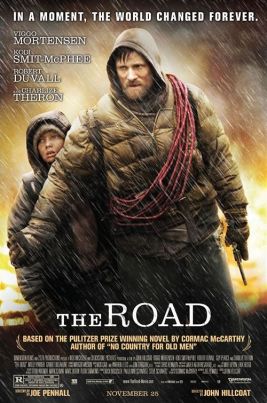 I’m in a semi-minority when I say that John Hillcoat’s film “The Road” is a dreadful movie. However, I know I’m in a vast minority when I say that Cormac McCarthy’s novel “The Road,” the book Hillcoat’s film is based on, is just as bad – if not worse. Yes, I’m taking issue with the novel that won the Pulitzer Prize and Entertainment Weekly‘s distinction of the best book of the past 25 years.
 The “F.I.L.M of the Week” is not independent, just to get that out of the way. “North Country” is, however, first-rate. The movie’s critics will probably say, “Haven’t I seen this movie before? Oh, right, every two hours on Lifetime and Hallmark channels!” To them, I say – yeah, maybe a little bit. Sure, it doesn’t stray too far from the stock story of courage in the face of terrible circumstances. But it has a tremendous power which can make you forgive the formulaic nature of the movie.

 Marshall and the Movies
Recent Comments