F.I.L.M. of the Week (February 9, 2017)

9 02 2017

wadjdaAs firm of a believer as I am in the transformative power of cinema, I do not believe any film contains some kind of magical power that can rid the world of hatred and bigotry. What they can do, however, is gently nudge the needle of individual opinion in the way empathy and humanity. The act of experiencing a narrative arc through the perspective of someone different can open new insights into a world different from our own.

I think this is especially important now when the qualities of compassion and cultural awareness feel scarce, if not entirely imperiled. As the United States flirts with cutting off connections to the Muslim world, we should know what that world looks like from something other than the limited imaginations of the mass media gatekeepers. These countries contain people like us, living their lives under entirely different circumstances but grappling with a sense of self and their place within society.

Haifaa Al Mansour’s “Wadjda,” my pick for the “F.I.L.M. of the Week,” gives us a glance into a space likely encountered by very few American viewers: a young Saudi Arabian girl. If a film’s background can attest to authenticity, then it marks the first time a Saudi female has directed a feature film. (It’s also the first feature shot entirely in Saudi Arabia.) Fittingly, Al Mansour uses the opportunity to put a plucky protagonist front and center with her titular character. Wadjda yearns to buy a bicycle but encounters both person financial difficulties and open resistance from community members that frown upon her desire to partake in a traditionally masculine activity.

Saudi Arabia, like most majority Muslim nations, abides by a patriarchal rule of order. Thus, many portrayals of women in narratives surrounding these regions treat them as silent companions or tacit witnesses. If they receive personhood in the narrative, they rarely possess agency. (To be clear, these are generalizations with plenty of exceptions. Asghar Farhadi, for starters.) Very few men populate “Wadjda,” yet their presence never seems far away. Even in spaces carved out for women, anxiety over what males might see or think pervades the atmosphere.

This environment helps explain Wadjda’s rebellious streak. She yearns for more than a private life away from the gaze of men, as her school and home provide. She wants the freedom to follow her heart and the kind impulses that spring from it, social norms and constructed boundaries be damned. We root for her free expression, not against her culture’s values – though Wadjda and Al Mansour have the real task of reconciling the two in their own lives.



F.I.L.M. of the Week (February 2, 2017)

2 02 2017

impolexAn oft-cited dictum of Karl Marx states, “History repeats itself – first as tragedy, then as farce.” There’s a pervasive sense that living through our current time is like watching the horrors of the 1930s and ’40s refracted through a funhouse mirror, albeit with the “fun” sorely missing. By accident, Alex Ross Perry’s debut feature “Impolex” seems perfectly positioned to capitalize on the moment.

The film supposedly takes inspiration from Thomas Pynchon’s postmodern classic “Gravity’s Rainbow” (I use qualifiers because I have not read the novel). Its protagonist, American soldier Tyrone (Riley O’Bryan) lugs German rockets around the forest after the end of World War II. He follows seemingly no clear path and shares episodic encounters with everyone from an escaped prisoner to a pirate and even a talking octopus. It’s an ambling journey where each step does not seem to build on or relate to each other, in part because Tyrone is extremely malleable to the message conveyed by the people he meets. He struggles mightily inside to also hold onto some vestige of his own personality amidst these encounters.

None of this makes sense. And yet, not making sense makes perfect sense. This pick for “F.I.L.M. of the Week” feels like a sketched line from the post-war existentialist dread to our present post-truth anxiety. Even if certain moments lack some spark or some scenes drag on, this thunderous 73-minute debut from Perry showcases his deep understanding of the psychological underpinnings of the film. “Impolex” marks a scrappy debut from a writer/director whose literary ambitions have informed some of the decade’s more audacious pieces of American independent cinema.


F.I.L.M. of the Week (January 12, 2017)

12 01 2017

it-felt-like-loveAs anyone who has taken an introductory-level film theory class can tell you, the camera is not just an object. It is an organism (most commonly referred to as the eye) responsive to the impulses and instincts of the person who wields it. The majority of current cinema reflects a male gaze, and the emphasis on diversifying talent sadly does not seem to be taking strides – a new report released this week shows that female filmmakers lost ground in 2016.

But outside the mainstream, there are some voices and visions who need to be amplified. One such talent is writer/director Eliza Hittman, whose feature debut “It Felt Like Love” only recently came to my attention as I did research on filmmakers presenting their newest films at this year’s Sundance Film Festival. It’s a shame that this film got buried because Hittman’s work, my choice for the “F.I.L.M. of the Week” is nothing less than transporting. She picks us up from wherever we are and puts us in the perspective of a teenage girl, Gina Piersanti’s Lila, as she tepidly steps into her role as a sexual being.

The roughly 8o minutes of the film are devoted more to Lila’s feelings than they are to any one thing that happens to her. Hittman masters conveying a female gaze, the way girls process the pleasures and pains of looking at an object and feeling rapt with emotion. There’s a special attention to the tactility of puppy love, a need to touch constantly as a display of infatuation. Lila’s tongue lacks the language that bodies trade in so fluently, and she frequently trips trying to express herself. But as she tries to impress her female friends and woo her male peers, we don’t need those words to tell the story of her anguish and confusion. We see the world through her eyes and eventually come to share in the emotions with her.


F.I.L.M. of the Week (January 5, 2017)

5 01 2017

old-joy“Vicky Cristina Barcelona” was one of the first movies to teach me that it’s entirely possible for characters to go on a journey and end up exactly where they started from, learning nothing. It’s an ending that has really stuck with me over the years, and I always admire filmmakers with the guts to acknowledge a fundamental truth about humans. We don’t always learn, adapt or change. We often times remain stubbornly ourselves.

Kelly Reichardt’s 2006 film “Old Joy” is one such film that offers little in the way of optimism about human relationships. Two friends, careerist Mark (Daniel London) and nomadic Kurt (Will Oldham), head into the mountains to escape their lives and reconnect. They go through the motions in seeming expectation that something they see, do or experience will move them – or, at the very least, jolt them out of numbness. No such luck. Things happen, just as they do in everyday life. They are not transformed.

Meanwhile, on talk radio that’s simmering on car radios, we hear Bush-era talk about liberalism in exile and bemoaning the hopelessness of the moment. The action on screen is, of course, connected to the droning, disembodied voices. Everyone in Reichardt’s universe seems paralyzed by the seeming inability of our actions and desires to noticeably alter the reality we must face. So, in other words, no reason to dust this movie off now. Clearly just a relic of its mid-aughts moment. (*chuckle*)

https://www.youtube.com/watch?v=tL1X_7jIcIM


F.I.L.M. of the Week (December 15, 2016)

15 12 2016

Gideon's ArmyAva DuVernay’s superb documentary about America’s failing criminal justice system, “13th,” does an excellent job providing a high-level overview of race relations from Reconstruction to Trump. She masterfully ties together many threads and connects many dots, although DuVernay does admit that a limitation of her perspective is that she cannot do the deep dive that many subjects deserve.

In an interview with Film Comment, DuVernay listed a few documentaries that gave a feature-length treatment to a topic she had to brush over by necessity. One such recommendation was Dawn Porter’s “Gideon’s Army,” which she cited as a detailed look at how the system of plea bargains turns our prison system into a modern-day slavery. The film does shine a harsh light on how predatory penal practices puff up our incarcerated population, but it also does so much more.

“Gideon’s Army” is a testament to the selfless, tireless and often thankless work of America’s public defenders. These underpaid, overworked men and women are foot-soldiers of democracy as they fight on behalf of the accused that the state would rather strong-arm into a guilty plea. The laws make attempts to push back extremely difficult with mandatory minimum sentences that discourage defendants taking charges to trial. But these brave public defenders dare to climb uphill.

Porter might be the first filmmaker who makes an overloaded narrative enhance a film, which makes “Gideon’s Army” an obvious choice for the “F.I.L.M. of the Week.” We get to see how many plates the public defenders must keep spinning at a time – often 180 cases at once – in the fractured editing that never lets us spend too much time with a lawyer or client. Their defendants are both black and white, mostly young, and often times unsure of how the system works. The lawyers we observe sometimes have the herculean tasks of rebuilding trust in their office after a bad public defender bungled a case for their defendant.

We see their struggles along with the successes and failures that punctuate their continuous toiling. But after watching “Gideon’s Army,” it’s hard not to be incredibly thankful that there are public defenders who want to serve as more than a rubber stamp on the path from arrest to incarceration. It may come as cold comfort to the defenders themselves, yet this film turns viewers into supporters.


F.I.L.M. of the Week (November 24, 2016)

24 11 2016

meeks-cutoffWith “Certain Women,” Kelly Reichardt took a move back toward the kind of stories that made her career – the quiet routines that define and confine the lives of Pacific Northwesterners. But earlier this decade, Reichardt made some notable forays into the world of genre filmmaking with 2014’s “Night Moves,” an eco-thriller, and 2011’s “Meek’s Cutoff,” a revisionist and feminist take on the Western.

I caught the former at the 2013 London Film Festival, which forced me to abandon all ties to the outside world and dive headfirst into her carefully constructed universe. I was not so lucky to see “Meek’s Cutoff” in a theater, however, which meant years of putting off watching the film since I knew it would command so much of my attention. I stopped and started the film several times, knowing that anything that took my brain out of the experience would make the viewing a wash. When I had the chance to interview Reichardt earlier this year, I knew I could wait no longer.

Once I finally plunged myself into “Meek’s Cutoff,” my latest selection for “F.I.L.M. of the Week,” I was rewarded handsomely for my patience and attentiveness. Reichardt does not subvert genre tropes, as many revisionist filmmakers do in a self-congratulatory exhibition of their own cinematic knowledge. Rather, she inverts them, ascribing the same respect and earnestness normally accorded to heroic white men to their muted female companions and Native American guides.

Reichardt tells “Meek’s Cutoff” from a woman’s point of view, which includes making certain information obscured or downright off-limits. When the men in charge are talking, she makes things intentionally hard to hear or keeps the camera at such a distance that we cannot help but feel entirely removed from the decision making process. When Michelle Williams’ Emily Tetherow is privy to some information from her husband, Will Patton’s Solomon, she receives it in a whisper during the utter blackness of the prairie nights.

Tensions of all kinds flare on this 1840s journey along the Oregon Trail as the wagon caravan’s guide, Bruce Greenwood’s Meek, inspires doubts among the group. Amongst themselves, the settlers begin to wonder if he has intentionally led them astray to their demise. Supply begins to run as low as spirit, leading to rash decisions and some surprising assertions of authority. As survival instincts kick in, the clamor of wisdom from the women grows louder and harder to ignore. While an adjective like “thrilling” or “exciting” may not apply given the pace of Reichardt’s film, “compelling” sure does. Anyone willing to stop everything and simply live in the frame will find a textured, intelligent and unique take on the Old West.


F.I.L.M. of the Week (November 3, 2016)

3 11 2016

street-fightThe 2016 presidential election has often felt like a daily race to the bottom with each day seemingly fighting to make the claim, “No, THIS is the worst it’s ever been.” And we still have days left to go – there haven’t even been the definitive post-mortem books where the really juicy stuff comes out! We’ve always known politics were grimy and nasty, though perhaps we underestimated the extent to which they reveled in the dirt.

Though perhaps if more people (myself included) had seen Marshall Curry’s documentary “Street Fight,” my pick for “F.I.L.M. of the Week,” the surprise might not have been so pronounced. This chronicle of the bitter campaign for Newark’s mayor in 2002 is a stunning display of politics at its worst. Like in this year’s “Weiner,” a present-day viewer can watch this nasty race and pick out undertones that eventually become overtones in the Trump-Clinton feud.

Less than 15 years ago, ascendant Democratic politician Cory Booker set out to make a big splash in Newark by challenging the town’s 16-year incumbent mayor, Sharpe James. While cities such as Chicago and New York conjure images of political corruption at the mere mention of their name, Newark does not lag too far behind. James somehow managed to ride out a major corruption scandal in the ’90s while many of his associates took the fall. He uses questionable means to hold onto his power, including intimidation of opponents and co-opting of the police for his own benefit.

But Booker, ever the inspiring figure, poses a serious threat to James by taking the high road. His optimistic message lobbying for change rather than accepting stagnation has appeal to Newark residents who feel their current mayor takes their support for granted. While James might lead a more lively rally, Booker can connect with voters and sell his story convincingly. His parents fought for equality in the Civil Rights era and were on the painful front lines of integration so Cory could get the education he deserved.

But what luck does a straight-laced candidate have when he goes up against a street fighter like James? His opponents pulls out all the stops, going full anti-Semitic to (falsely) smear his association with “the Jews” and accusing him of (gasp!) working as a covert Republican. Everyone seems to recognize these as blatant falsehoods, yet Booker is powerless to keep them from gaining media attention and reaching voters’ ears. Sound familiar? Curry’s camera, recording in spite of attempts by James’ political machine to stifle it, is there for the dispiriting longhaul. If Booker wants to make a run at the White House in 2024, we know from “Street Fight” that he’s battle-tested in the grimy game of political campaigns.


F.I.L.M. of the Week (September 8, 2016)

8 09 2016

year-of-the-dogAs someone who lives with two canine companions, I can certainly sympathize with Molly Shannon’s Peggy in “Year of the Dog.” Relationships with humans are tough. How dare they do this, but they actually want something in return from us. They make demands of our time and thought. Dogs like Peggy’s beloved Pencil simply live to please us, offering love and affection no matter our mood or deeds that day.

But, as every child in a film about a dog knows, we almost always outlive our dogs. Peggy faces this lesson sooner than expected when Pencil gets into some toxic chemicals and cannot be saved by a veteran. What comes next for someone who puts all her eggs into the basket of her beloved animal makes for quite a melancholy comedy from writer/director Mike White.

Rather than using her period of mourning to deepen or enrich her relationship with neighbors, coworkers or family members, Peggy entrenches herself even further into animal advocacy and obsession. She becomes a vegan, brings home abused shelter dogs by the carful to save them from euthanasia and even “adopts” farm animals in lieu of holiday gifts. It’s decidedly odd turn of events, yet Molly Shannon resists playing her character as some kind of lunatic. The performance resembles a quieter, more mellow version of her notorious “Saturday Night Live” characters – all of their insecurities without all the theatricality to mask the wounds.

“Year of the Dog” is my choice for “F.I.L.M. of the Week” not only because of Shannon’s raw performance but also because of where Mike White takes it. While he shows compassion for everyone, White is not afraid to steer the film into dark and bittersweet territory. He is unafraid to suggest that Peggy might not need the human connections we expect her to develop over the course of the film. She might just need the certainty of her own convictions and the courage to follow the path she thinks will bring her the happiness she seeks.


F.I.L.M. of the Week (September 1, 2016)

1 09 2016

Winter in WartimeWith the start of a new festival season, it has once again become that time of the year when I catch up with the old works of directors newly feted on the circuit. For whatever reason, a lot of acclaimed movies simply slip through the cracks for me. Gatekeepers like Venice, Telluride, Toronto and New York Film Festivals help highlight directors whose new work demands you examine their past films.

With his new film “Brimstone” landing a coveted premiere on the Lido for the Venice Film Festival, Dutch director Martin Koolhoven now has a new rarefied status attached to his name. With that, I decided to check out his last film, “Winter in Wartime.” Surely I was aware of the film when it entered the 2010 Oscar race as The Netherlands’ Foreign Language submission or when Sony Pictures Classics released it in 2011. While I missed it then, I’m glad to have caught up with it now.

“Winter in Wartime” is my choice for the “F.I.L.M. of the Week” because Koolhoven finds fresh life in the World War II homefront tale and morality play. Certain aspects recall “The Book Thief,” but this coming-of-age story has plenty to offer all of its own. The film really excels in capturing how young Michiel, a Dutch teenager enduring the bitter end of Nazi occupation in 1945, grows frustrated with the adults who try to rationalize or find gray areas in their situations.

To Michiel, anything except active resistance to their German captors serves to help them. His father, the mayor of their town, tries to placate the Nazi troops by maintaining deference for the people’s safety. He sees it as strength; Michiel, as cowardice. Rather than simply express his disgust, Michiel channels it into action by helping the Dutch resistance evacuate a downed British RAF pilot, Jack. His quest for liberation sticks it to the Nazis, sure, but it also doubles as rebellion against the wavering morality of the older generations who have grown content with a stalemate. Though I will not venture a direct comparison to the defenders of Hitler, there’s something quite liberating watching “Winter in Wartime” as a young American in 2016 when many elder statesmen lack the courage to abhor demagoguery, bigotry and authoritarianism.

https://www.youtube.com/watch?v=ujm_inlYeuQ


F.I.L.M. of the Week (August 25, 2016)

25 08 2016

ThumbsuckerMuch of Mike Mills’ “Thumbsucker” treads fairly standard young adult coming of age territory. Lou Pucci’s Justin Cobb, the protagonist whose titular habit serves an effective metaphor for his juvenility, must undergo familiar trials that provide him confidence and self-worth. He has to learn public speaking skills and romantic graces with a decidedly modern twist – Justin has just added medication for his recently diagnosed ADHD that totally transforms his personality.

But there’s something more to “Thumbsucker” that makes it my “F.I.L.M. of the Week.” Mills, working from a novel by Walter Kirn, does not stop the coming of age with Justin. As it turns out, his emotionally stilted parents have plenty of growing up to do in their own right. The film is just as much about their own slow maturation process as their son’s.

Vincent D’Onofrio’s Mike insists that Justin refer to his parents by their first names since the terms “mom and dad” make him feel old. He serves as the manager of a large sporting goods store while still nursing bitterness and resentment over a knee injury that thwarted his football career. His family serves as a daily reminder of what his life is not.

Meanwhile, his wife, Tilda Swinton’s Audrey, handles all the love and affection for their two kids. She’s genuinely curious and attuned to Justin’s issues. But Audrey cannot shake a girlish fascination with a soap opera actor Matt Schramm. The infatuation reaches levels that embarrass her children; they do not think she would literally cheat on their father, though she is not exactly quick to dismiss the possibility of her fantasy.

“Thumbsucker” shows everyone fumbling through this thing called life together in their own way, and that even includes Justin’s zany, hypnosis obsessed dentist Perry Lyman (played by none other than Keanu Reeves). With over a decade of distance since release, it feels very reflective of a mid-2000s suburban malaise that already feels like a time capsule. Mills is earnest in his explorations of what causes people’s unshakeable, throbbing sensation of vague discontent with their current situation. The sincerity goes a long way in making these unsatisfied characters ones that are worth spending time with to probe their pain.

https://www.youtube.com/watch?v=S7jMm4T2jHM


F.I.L.M. of the Week (August 18, 2016)

18 08 2016

IRMA.poster.1/2.output-finalMovies about movies are a dime a dozen these days, especially when three of the last five Oscar winners for Best Picture have centered on filmmaking. Understandably, many of these ultimately end up taking a stance or attitude that celebrates and valorizes the work done in the industry. (Otherwise, why make it – right?)

Olivier Assayas’ “Irma Vep,” on the other hand, is in a class of its own. The 1996 film plays like a backstage drama most commonly penned about the stage, but it highlights the inner workings and unglamorous minutiae of the collision of film art and commerce. There is far more discussion about international rights than talking through script mechanics, more trudging through the unglamorous technicalities of capturing image and sound than celebrating the magic of filmmaking.

Assayas does not resort to easy or obvious satire, either, that might lighten the blows he delivers. This pick for the “F.I.L.M. of the Week” is a scalding but well-considered dramatization of the issues plaguing French, American and world cinema in the mid-1990s. This time period is one where the Nouvelle Vogue began to fade, the blockbuster era in America began to crowd out artistry and the globalization of cinema spread more anxieties than ideas. “Irma Vep” captures a moment in high definition with the kind of clarity that usually comes only when examining a period retroactively.

Perhaps the situation at the center of the film was helpful in achieving such sharp commentary. Actress Maggie Cheung, playing herself, arrives in Paris to film an oddly conceived remake of a vampire-centric silent film. The role seems an odd fit for the actress, who prior to the film – both in the world of the film and reality – had yet to star in anything outside of her native Hong Kong. But it proceeds on thanks to the folly of over-the-hill director René Vidal (a perfect meta-textually cast Jean-Pierre Leaud of “The 400 Blows” fame) to hostility from the hard-working crew. The misadventures that follow raise fascinating questions about the state of cinema, many of which we have still yet to collectively answer – to our own detriment.


F.I.L.M. of the Week (August 11, 2016)

11 08 2016

Ain't Them Bodies SaintsWhen I first watched David Lowery’s “Ain’t Them Bodies Saints,” my initial impression was that it amounted to one of the better spate of Malick-lite films spawned in the wake of “The Tree of Life.” Look for that and you’ll see all the hallmarks: floating camera, internal dialogue drifting through scenes, bucolic settings, deep contemplation.

But seeing that and only that misses all the film has to offer elsewhere. (To be fair, this probably was not a great movie to watch while jet-lagged after just arriving for a semester abroad in Europe.) “Ain’t Them Bodies Saints” is more than just an explosion of technical virtuosity from Lowery and director of photography Bradford Young, who has since gone on to lens such notable works as “Selma” and “A Most Violent Year.” It is my choice for the “F.I.L.M. of the Week” because its outer beauty helps expose the inner beauty of its epistolary love story.

At the core of the film is Rooney Mara’s steely Ruth Guthrie, a Texas woman caught between the man who stole her heart (Casey Affleck’s Bob Muldoon) and the officer who helped put Bob behind bars (Ben Foster’s Patrick Wheeler). Don’t call it a love triangle, though. Mara remains stone-faced as if she has erected the ultimate shield to mask her internal bewilderment over all that transpires. The choice ahead is one of great magnitude, and her strategy for coming to grips relies on downplaying her decision.

“Ain’t Them Bodies Saints” does contain a storyline running parallel to its main plot involving Bob’s escape from prison and surreptitious journey back to reclaim Ruth. Affleck brings his usual grizzled intensity to the role, but make no mistake, the film is all Mara.


F.I.L.M. of the Week (August 4, 2016)

4 08 2016

A Field in EnglandWhatever one thinks about the quality of Ben Wheatley’s films, the sheer variety of his work is commendable in and of itself. From gangster flicks to romantic road trips and loaded social allegories, his pitch-black comedic sensibilities never seem to settle. For me, that makes him one of the most exciting filmmakers working today.
“A Field in England” might not have the most perfect execution, but its sheer audacity alone makes it an easy candidate for the “F.I.L.M. of the Week.” You need not know all the details of the 17th century politics that caused the English Civil War, the conflict in which the film is set. All that matters is the knowledge that the film’s characters are deserters, wandering off the battlefield in search of something more.

Amy Jump’s script feels like a road movie as the soldiers – three Englishmen and a curious Irishman – amble through the countryside. Wheatley manages to keep the walk-and-talk interesting for at least an hour, which is no small feat. Though the film is shot in monochrome black-and-white, “A Field in England” never feels monotonous or monotone. The almost episodic misadventures of this crew recall Swedish philosopher-director Roy Andersson with its musings made around the rim of the burning pot that is modern society.

The film does take a bizarre detour towards the end that takes it into the realm of the surreal, leaving the overall effect to be akin to a mushroom morality play. “A Field in England” manages to be naturally evocative in the way Nicolas Winding Refn would like his belabored art films to be. So for purity of intent and sheer gall alone, check this one out.


F.I.L.M. of the Week (July 14, 2016)

14 07 2016

It’s practically inevitable that the culture and thinking I absorb eventually seeps into my writing. But this week offered one of the best chances for application ever.

I’m about halfway through Chuck Klosterman’s “But What If We’re Wrong?” This collection of cultural criticism applies a futuristic lens to the present day, removing our contemporary moorings from the equation and attempting to predict how later generations will see us. One big thesis is fairly depressing: most culture gets forgotten, and often what lasts cannot be appreciated in its own time. A group of people must find something in the work that its original audience was not able to see or fully grasp.

Not even thinking about the potential connection to the book, I watched 2001’s “Josie and the Pussycats” this week. For whatever reason, I have been on a bit of a late ’90s-early ’00s culture kick recently, so this felt like a natural thing to finally see. And wow, was I in for a surprise. This choice for the “F.I.L.M. of the Week” has an additional sense of urgency thanks to Klosterman’s writing. 15 years after its release, we need to start reappraising the movie and appreciating it as an eerily prescient and wickedly smart comedy.

I was eight years old when the film was released, so I can do only the most basic reconstruction of the 2001 moviegoer. But I can imagine just how easy it would be to mistake “Josie and the Pussycats” for the kind of mindless schlock it mercilessly mocks. Just read the Rotten Tomatoes critical consensus, presumptively from the theatrical release: “This live-action update of ‘Josie and the Pussycats’ offers up bubbly, fluffy fun, but the constant appearance of product placements seems rather hypocritical.”

Even in the decade or so since this film hit screens, Americans are seemingly more aware of the consumerism in which our culture is so heavily steeped. It’s hard to imagine anyone saying with a straight face nowadays that “Josie and the Pussycats” is an endorsement of this relentless corporate bludgeoning; after all, we have endured the rise of Kardashianism as well as the reality show non-commercial product spotlights that surged as traditional advertising fell. And need any further proof of how insidious this ideology is? Don’t forget what George W. Bush told Americans to do in the wake of 9/11, just six months after the film was released – go shopping.

Writer/director duo Harry Elfont and Deborah Kaplan wisely chose to steep their modern Josie and the Pussycats story in this culture because, after all, rock has become more an empty signifier than a vital musical movement. It is dominated and controlled more by elites and executives than the people from whom it traditionally arose. This acknowledgement of a sad reality makes the traditional “behind the music” tale more than rote repetition of a cliché; it exposes the corporate logic behind that narrative becoming a cliché. When record companies can pre-package starlets into familiar stories, it dumbs down their consumers and allows them to slip in some more subliminal messages to purchase other goods.

This kind of cynical, conspiratorial thinking might have seemed far-fetched in 2001. Sadly – or perhaps encouragingly, depending on your vantage point – it feels oddly plausible in 2016. And if you have any doubt, pay attention to the record executive Wyatt Frame, played by Alan Cumming, and his frequent fourth wall-breaking winks to the audience. It’s a look that says, “you hate this, but you know you’ll be buying Starbucks later today because of this.” There are signs for hope that our society has latched onto some of the thinking espoused by “Josie and the Pussycats.” But is it too late to reverse the cultural direction that relegated this film to the sidelines of discussion for so long?


F.I.L.M. of the Week (June 30, 2016)

30 06 2016

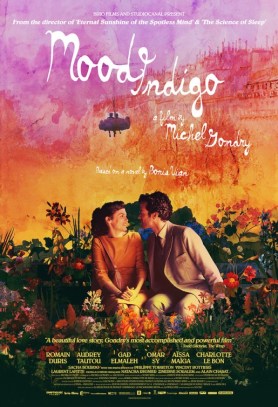
Mood IndigoMichel Gondry’s name is among the rarefied few that can serve as an indicator of sophisticated whimsy and off-center delights. Be that in his seriocomic collaboration with Charlie Kaufman with “Eternal Sunshine of the Spotless Mind” or even working within the Hollywood machine to produce a film adaptation of “The Green Hornet,” he puts an indelible stamp on anything he touches.

Yet even though Gondry made a film that many experts consider among the best of the 21st century, his film “Mood Indigo” hit a bit of snag in the United States. Despite opening in the director’s native country in April 2013, the film took another 15 months to wash up ashore here. And when it did, courtesy of Drafthouse Films, roughly 35 minutes did not make the voyage over.

Normally, I would not complain about a movie getting shorter; many auteur-driven projects could use some fat-trimming. But I would (and likely will) sign up for more of “Mood Indigo.” The film is a playground for the imagination staged within the confines of a beautiful, touching love story. Think of this “F.I.L.M. of the Week” as what might spring from the meeting of the minds between Jacques Tati and the Pixar brain trust.

This is a world where the fancy-free Colin (Romain Duris) can occupy his time trying to make the perfect “pianocktail” – a drink made and refined by how finely he can play the tunes on a grandiose piano set. Where he can float over the city of Paris in a cloud-like Ferris Wheel booth with the girl that catches his eye, Chloé (fittingly played by Audrey Tautou of the charming “Amélie“). As their tragic love story progresses, Gondry never wastes a moment to take our breath away. Virtually every frame is packed with some kind of gadget, gizmo or trick that reminds us of the ingenuity behind the film. Perhaps others could have told this tale of star-crossed lovers, but I remain unconvinced that anyone could make it more of a marvel than Gondry.