F.I.L.M. of the Week (December 3, 2015)

3 12 2015

SightseersI must admit, I was skeptical of delving into some of the deeper cuts in director Ben Wheatley’s filmography after nodding off on two separate occasions during his cult favorite work “Kill List.” (It’s more me than the movie – I was tired both times and got further exhausted by working to understand the thick accents.) But after seeing his 2013 film “Sightseers,” I must say, I feel far more confident that I will like what I see going further back.

Funny enough, I actually saw Wheatley in person while he was promoting the film’s world premiere in Cannes back in 2012. Someone asked a question along the lines of, “What do you do while the movie plays?” Wheatley caustically responded that you could find him in a bar drinking away his nerves. Though why he would doubt that “Sightseers” could play like anything other than gangbuster escapes me. This bonkers road trip comedy is a creative, exciting blast from start to finish; as such, it’s my pick for the “F.I.L.M. of the Week.”

Alice Lowe and Steve Oram star as Carol and Chris, two lovebirds who embark on a road trip across Britain – hauling a caravan behind them, of course. Carol goes against the instructions of her well-meaning mother, who still infantilizes her at the age of 34. She’s reeling from the loss of someone special, too, and remains somewhat unstable. Though she has only dated Chris a few months, Carol seems to think he is that special someone.

That is until, of course, she realizes that he is capable of committing some intensely violent deeds while feeling very little remorse. But that does not seem to bother her. She’s along for the ride, no matter what strange turn or bizarre twist their journey takes next.

There are moments along the way when it feels like “Sightseers” will start to fall in line with some other similar movie. Yet the longer it goes on, the less it resembles something like “Bonnie and Clyde” or “Thelma and Louise.” Wheatley, working with a script by his two lead actors, manages to make a film that is wholeheartedly unique. It vibrates at such an odd comedic wavelength, mostly black but also silly and solemn in places.

Perhaps most fascinatingly, Wheatley makes sure that murder never becomes something commonplace. He presents each killing in a completely different manner, shocking us all the new and making us really think about what we are digesting. This is quite a sight to see, indeed, and I look forward to being entertained and challenged all the more by what Wheatley has to offer after “High-Rise.”


F.I.L.M. of the Week (November 12, 2015)

12 11 2015

Boy AWe still live in a time where deeply internal, emotional performances from male screen actors are rare – especially from younger ones. Perhaps because most major roles for men are written with external, goal-driven motivations as opposed to looking within, the smart career move is to position oneself for those. But every once in a while, a miraculous turn appears.

Such is the case with “Boy A,” which features a young Andrew Garfield at his most sensitive and powerful. Before he became a household name in films like “The Social Network” and “The Amazing Spider-Man,” Garfield got a chance to get in touch with a side of himself that is seldom seen from men these days. His contemplative performance, nestled within a story that asks tough moral questions, makes this an obvious choice for my “F.I.L.M. of the Week.”

I must admit, I tried to watch “Boy A” a few years ago and turned it off after about 20 minutes. I don’t know what changed from then to now, but I am so glad I gave it a second chance. From its opening moments, I found myself riveted and drawn into the headspace of Garfield’s character, Jack Burridge. Initially, we do not quite understand why he seems unable to supersede the guilt and shame that plagues him. But we can sense the weight of the past in Jack’s every word and action, burdening him so heavily that he cannot move forward into the future.

“Boy A” doles out the specifics of Jack’s situation in a very deliberate manner. We know that he has just been released from some sort of facility and a new identity to become a productive member of society. Some flashbacks to Jack’s childhood are intercut into the action, though they pale in comparison to the information we get just from looking at his face in the present day. The raw emotion captured by director John Crowley proves nothing short of gut-wrenching to watch play out. Jack is clearly a tender, wounded soul, yet he struggles to believe he is worthy of redemption. We, the viewers, feel no such ambiguity after observing just how poignantly Garfield bares his vulnerabilities before us.


F.I.L.M. of the Week (October 22, 2015)

22 10 2015

MAID_OneSheetfinalGenerally, when I read any piece of criticism that refers to a movie as some kind of “metaphor for capitalism,” I cringe inside. It usually feels like an easy fallback, a way to sound smart when they just purely enjoyed something. But in the case of Sebastián Silva’s “The Maid,” it actually applies.
My pick for the “F.I.L.M. of the Week” is a worker’s dilemma in a nutshell.  Silva, with co-writer Pedro Peirano, examine the dynamics of economic competition from the perspective of well-ensconced maid Raquel (Catalina Saavedra).  Her experience is highly personal, yet it also an excellent metaphor for what people are forced to do when efficiency trumps humanity.

Raquel has served a well-to-do Chilean family for over two decades, caring for their children and tending to their house. They have a great fondness for her, yet she also knows her place in the pecking order. After all these years, Raquel assumes a certain amount of job security, though that all changes when family matriarch Pilar decides she needs an extra set of hands around the house.

Raquel had gotten somewhat complacent and lackadaisical about her work, but this new threat jolts her into action. Knowing she needs to fight tooth and nail to keep her relatively comfortable position means the claws come out. Pilar tries out two maids to work alongside Raquel, one more seasoned and another of more spry youth. Neither is any match for the malicious attacks Raquel has in store for them as she tries to scare them off.

Somehow, Silva finds that tiny area between black comedy and borderline pathetic drama. Raquel is slightly sympathetic in her desired ends yet absolutely repulsive in her chosen means to achieve that goal. She’s ultimately only as good as the system that spawned her, one that forces her to get nasty to stay afloat.


F.I.L.M. of the Week (September 24, 2015)

24 09 2015

The epithet of “morality play” gets tossed around a lot when describing issues-based dramas – and usually in a negative connotation.  How dare a movie tell us what to believe, the undertone of their phrase rings out.  (Side note: these are often the same people who cry outrage when a film does not line up perfectly with their own worldview…)

But I believe the term can, and should, be applied positively to a movie if it offers provocative, challenging commentary on an ethical question.  Sam Raimi’s 1998 film “A Simple Plan,” my pick for the “F.I.L.M. of the Week,” offers just such an experience.  Before he offered the be-all and end-all nugget of wisdom in “Spider-Man” – Uncle Ben’s “with great power comes great responsibility” – Raimi got down in the mud with human greed.  It should come as no surprise that we often fail to live up to that infamous aforementioned maxim.

“A Simple Plan” concerns morality in the aftermath of three buddies discovering a downed plane with $4 million inside.  The trio lives in rural Minnesota where the “rich” one of the bunch, Bill Paxton’s Hank Mitchell, works as a clerk at a feed mill.  Needless to say, they could all use some extra money and are willing to contemplate the dubious decision of keeping the cash.

As they debate the right course of action, their back-and-forth tussle somewhat resembles the expressive dialogue one might find in a play.  But never does the film take on the aura of superiority that one might associate with a preaching, instructive morality play.

So what differentiates it from the pack?  Credit director Sam Raimi, who smartly emphasizes the noir-like complexity in aspects of the story’s surprising turns.  Scripter Scott B. Smith also finds a simplicity in their internal tussles that resembles a parable, like the duffel bag of money is some kind of forbidden fruit that disrupts a moral universe.  These two sensibilities may sound clashing, but they harmonize masterfully in “A Simple Plan” – no doubt aided by the performances of Paxton and Billy Bob Thornton as Jacob, Hank’s less educated sibling who harbors reserves of both resentment and nobility.


F.I.L.M. of the Week (September 17, 2015)

17 09 2015

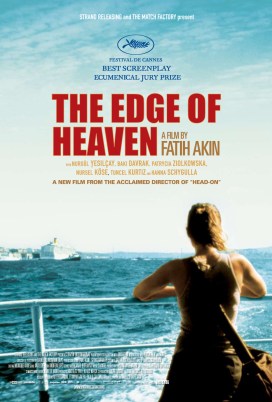
The Edge of HeavenFatih Akin had a bit of a rough go with the film festival circuit the last time around with his Armenian genocide drama “The Cut,” which received nearly unanimous pans out of Venice.  To my surprise, the film managed to secure U.S. distribution (I had all but given up hope of ever seeing it).

So in honor of throwback Thursday, I’ll take the “F.I.L.M. of the Week” column back to a time when Akin had much more success appealing to the festival crowds.  In 2007, his nation-hopping drama “The Edge of Heaven” took two prizes at the Cannes Film Festival and established Akin as a major name in European cinema. The film has the scope of a Soderbergh or Iñárritu multinational drama but does not aim for a grand global statement.

Instead, “The Edge of Heaven” resonates on a human scale.  Though the film jumps from Turkey to Germany and then back, the thematic focus is not on the borders that divide people.  Rather, Akin looks at the forces that unite and bind us together against the odds.  For these characters, those would be an odd combination of coincidence, missed opportunities, bad timing, and – ultimately – grief.

In its multiple segments, connected to each other by a character who appeared in another episode, “The Edge of Heaven” portrays numerous tragedies and calamities that befall people both good and bad.  There’s the tragic story of the prostitute Yeter (Nursel Köse), who just wants to help her estranged daughter Ayten (Nurgül Yeşilçay) back in her native Turkey.  But little does she know that Ayten fled Istanbul as a political dissident and seeks a country to grant her asylum.  Her quest to find a safe space ultimately draws in Ayten’s good-hearted German girlfriend Lotte (Patrycia Ziolkovska) as well as another German, Alisan (Baki Davrak), who seeks to help her as a service to Yeter.

If the web of interlocked narratives seems confusing in my verbose plot summary, it will not feel that way experiencing the nuances of story and emotion built into Akin’s script.  His is the rare film among the so-called “hyperlink cinema” trend that is more concerned with developing characters than finding ways for their paths to cross.


F.I.L.M. of the Week (September 10, 2015)

10 09 2015

A ProphetThe Toronto International Film Festival (TIFF) gets underway today, and plenty of films vying for Oscar glory will be seen for the first time.  Other holdovers from Sundance, Berlin, Cannes, and Venice will also get a moment in the sun, a reintroduction for North American audiences.

One film of the latter variety is Jacques Audiard’s “Dheepan,” the controversial Palme D’Or winner at this year’s Cannes Film Festival.  Many people chalked up the film’s unexpected victory to its director simply being due for the prize after coming up short numerous times.  One such missed opportunity was back in 2009 when Audiard debuted “A Prophet.”

I first watched the film after it received a nomination for the Best Foreign Language Film award at the Oscars back in 2010 … and found myself quite underwhelmed.  For whatever reason, I just could not connect with it.  But once “Dheepan” took the big prize in Cannes, I felt obliged to give it another go.  The second time around, I was actually quite taken by the film.  I still think “Fish Tank” deserved the Palme D’Or, but “A Prophet” is certainly worth of my pick for the “F.I.L.M. of the Week.”

Audiard’s film is a patiently paced prison drama that goes for slow, longitudinal change rather than explosive incidents.  Think “The Shawshank Redemption,” but as an art film instead of something so commercial.  “A Prophet” follows Tahar Rahim’s Malik, a most curious double agent, as he games both sides of a Corsican/Muslim prison gang tussle.  He wants to make a big move one day in the future – even though that forces him to assume a subservient position for the ruthless, spineless Corsican ringleader (Niels Arestrup).

Audiard was smart to cast Rahim, a novice actor when he filmed “A Prophet.”  A well-versed thespian might have tried to slip hints towards a greater intellect humming beneath the surface of Malik.  Rahim, however, plays him as a rather ordinary man of no particular intelligence, just sort of making it up as he goes.  He’s playing the long game, not necessarily because he focuses on the ends but mostly because he cannot sufficiently navigate the present.

Malik’s rise to power, when watched in the right state of mind, makes for truly riveting cinema.  While it might not always be pulse-pounding action, the novel-like breadth of its narrative provides a rich experience for serious-minded movie lovers.


F.I.L.M. of the Week (September 3, 2015)

3 09 2015

Afternoon DelightJill Soloway appears in just about any feature being published these days about the changing face of television for women behind the camera and trans representation in front of it.  Even before “Transparent” landed at Amazon, she was making waves as a writer and producer on shows like “Six Feet Under,” “Grey’s Anatomy,” and “United States of Tara.”  And somewhere in her schedule, she found time to make a narrative film.

Had I been paying attention to her feature debut, “Afternoon Delight,” I would surely have run instead of walked to “Transparent.”  This character-driven dramedy lives up to the latter word in its title … and would suffice at any time of day, for that matter.  Soloway serves as writer as well as director, and her voice shines through in the movie, my pick for the “F.I.L.M. of the Week.”

“Afternoon Delight” might mark the first film to fully realize the wealth of talent possessed by Kathryn Hahn, an actress dangerously close to becoming the next Judy Greer.  She’s almost too good at making her presence felt without overpowering the lead, be it dramatically in “Revolutionary Road” or comedically in a movie like “We’re the Millers” or television’s “Parks and Recreation.”  But Soloway grants her lead status here, and she runs away with the film.

Hahn’s character Rachel, a stereotypical L.A. Jewish carpool mom, needs something to get her out of a rut.  A lethal cocktail of sexual frustration and the white female savior complex leads her to “rescue” a stripper, Juno Temple’s McKenna.  If Rachel wanted something to shake up her relationships with her husband and friends, she certainly gets that and more with her new “nanny.”  McKenna becomes an object of pity for Rachel, yet her presence also draws out the green monster of jealousy.

The cumulative effect manages to spark some major changes, not all of which are good.  But if you need any indication of just how gifted a storyteller Soloway is, watch how much more you feel for Rachel as her behavior goes from erratic to desperate to practically indefensible.  Her characters, be they small or silver screen, never lose their solid steeping in humanity.  I can only hope “Afternoon Delight” is not the full extent of Soloway’s venture into feature filmmaking.  The world of indie cinema needs her gifts too much.


F.I.L.M. of the Week (August 27, 2015)

27 08 2015

The Wrecking CrewI will not attempt to argue that “The Wrecking Crew” is some kind of groundbreaking piece of documentary art.  Frankly put, it does not begin to approach those things.  But it probably made my jaw drop in awe-struck amazement more than any movie I can think of recently, and for that alone, the film qualifies to receive the title of my “F.I.L.M. of the Week.”
The documentary premiered at South by Southwest back in 2008, yet for some reason, it was only released this past March by Magnolia Pictures.  While I normally apply the criterion that the films in this column be at least a year past their theatrical release date, I am more than willing to make an exception for “The Wrecking Crew.”  This movie, like its subjects, is receiving its admiration at an unfair delay from when it was deserved.

Director Denny Tedesco does not hide the purpose of the film.  It is made to get proper recognition for his father Tommy’s band of studio musicians known as The Wrecking Crew, who are directly responsible for the soundtrack of your life.  That’s not hyperbole, either.  If I had actually acted on all the times I wanted to pause the movie, open iTunes, and play the song they discuss creating, watching the film would have easily taken me three hours to finish.

Their incredible talent and dexterity across so many genres of music is nothing short of astounding.  The Wrecking Crew did jazz, soul, R&B, rock, country, and entertainment underscoring with equal aplomb.  Crooners, rockers, surfers, cowboys, and singer/songwriters alike benefitted from their remarkable creativity and reliability.  And, often times, these groups faced additional obstacles on the road since their actual members were unable to perform at the level of the Wrecking Crew!

Tedesco cobbles together quite the sonic history of the 1960s and ’70s from archival footage, filmed interviews, and a spirited reunion roundtable of the group.  It provides an illuminating look into how so many of our favorite tunes came to be, which is sufficiently thrilling in its own right.  (Imagine the “Gimme Shelter” anecdote from “20 Feet From Stardom” times twenty.)  Now, those enraptured by their unheralded virtuosity need to make sure others see “The Wrecking Crew” so the group can finally garner the widespread acclaim they deserve!


F.I.L.M. of the Week (August 20, 2015)

20 08 2015

Lily Tomlin won the Presidential Medal of Freedom last year, yet she somehow still feels underappreciated. Or maybe that’s just because she kept a low profile after the peak of her stardom in the 1970s and was known mostly to members of my generation as the voice of Ms. Frizzle on “The Magic School Bus.” But thanks to perfectly tailored roles in Netflix’s “Grace & Frankie” and the new film “Grandma,” Tomlin definitely seems poised for a major moment once again.

But Tomlin’s career is not necessarily being “rescued.”  In fact, some of her best work has come from the slow and steady decades between her peaks of public interest.  Case in point: “I Heart Huckabees,” the film that landed David O. Russell in director jail after he went for Tomlin’s jugular on set.  In spite of that tension, the movie still turned out alright – even if I did not immediately recognize it on first viewing five years ago.

Russell has gained a reputation for stylish, quirky films with his so-called “reinvention” trilogy that began with 2010’s “The Fighter.”  But that idiosyncratic spirit certainly existed before then, and “I Heart Huckabees” might mark its most vibrant display.  Working with co-writer Jeff Baena, Russell crafts a so-called “existential comedy” that mines philosophy and ontology for laughs that might make Woody Allen green with envy.  As such, it merits my pick for the “F.I.L.M. of the Week.”

Beneath all the hilarious intellectual banter lies a very simple story about a man, Jason Schwartzman’s Albert Markovski, an environmental activist who just wants to know what it’s all about.  “It,” of course, is the very meaning of life itself.  After a series of odd coincidences, he turns to a pair of existential detectives, Dustin Hoffman and Lily Tomlin’s husband and wife team Bernard and Vivian Jaffe.  This duo claims that they can – with enough field research – determine how everything in Albert’s life connects.  They set out to find his place in the grand plan of the universe, optimistically sure that such a thing exists.

But after a while, Albert falls prey to the Jaffe’s nemesis and ideological counterpart, Isabelle Huppert’s Caterine Vauban. She offers similar services but with the nihilistic assertion that nothing relates to anything.  The longer Bernard and Vivian take to complete their assessment of Albert’s life, the more appealing Caterine’s services look.

Albert’s quest for self-knowledge gets complicated by others who seek out the detectives’ services, such as Mark Wahlberg’s Tommy Corn, a firefighter who can chew anyone’s ear off with his views on the harmfulness of petroleum.  Russell has utilized Wahlberg in three films now, and this is certainly his most ingenious performance among the trio.  While the actor is notorious for his authentic off-screen anger and street cred, Russell funnels those traits into a hilariously exaggerated character professing a hyper-verbal righteous indignation.  For Wahlberg, often more likely to rely on the swagger of his body than the power of his words, the performance feels revelatory (and perhaps indicative of even more untapped potential).

The quirky crew does not end there, with Jude Law also in the mix as Brad Stand, a corporate executive at the company Huckabees determined to take Albert down by figuring out the meaning of his own life.  Naomi Watts’ Dawn Campbell, Brad’s girlfriend and the star of Huckabees’ ad campaign, gets thrown in for good measure too.  Both are slightly minor players but still players nonetheless.

Russell throws some really dense, cerebral concepts out there in “I Heart Huckabees” – and at the lightning-fast speed of his dialogue, no less.  But so long as you can keep up, the film proves a rewarding, stimulating experience with something to say about the equilibrium between pragmatism and pessimism that we need to get through the day.


F.I.L.M. of the Week (August 13, 2015)

13 08 2015

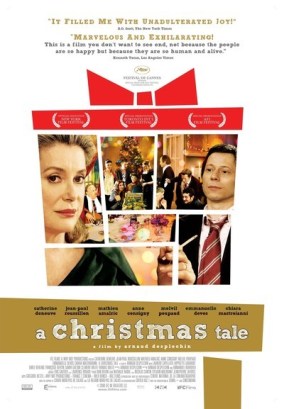
A Christmas TaleIt’s hotter than Hades here in Houston, so I ventured into Arnaud Despelchin’s “A Christmas Tale” for some escapism.  (Just kidding, I watched it mostly because the Criterion Collection deemed it worthy of inclusion in their hallowed ground of cinephilia.)  Despite the title, this is a film that should not be dusted off every December to watch ritualistically like “It’s a Wonderful Life.”

Rather, “A Christmas Tale” merely uses the holiday as its setting – not its subject.  A large French family needs to gather under the same roof for all this drama to play out, and what better occasion is there for that than Christmas?  Instead of celebration, this day brings bitterness, resentment, and sorrow.

The family’s matriarch, Catherine Deneuve’s regal Junon Vuillard, needs a bone-marrow transplant to treat her fast-progressing cancer.  She needs a match from one of her children or grandchildren, all of which seem to struggle with some sort of serious issue.  (Except the two toddlers, but one can only imagine what kind of misery awaits them when they are old enough.)  To list everyone’s baggage would just consume the word count of a whole other review, not to mention spoil the fun of watching everyone collide and implode.

Though two and a half hours for a family melodrama might seem excessive, “A Christmas Tale” never buckles under the weight of its runtime.  Despelchin’s epic sprawl and familial brawl recalls the ’90s works of Paul Thomas Anderson – a comparison anyone who reads my reviews is high enough praise to earn the distinction of the “F.I.L.M. of the Week.”  Here is a movie with a grandiosity to its mood that feels perfectly cinematic, never exaggerated or gauche, anchored in a sharply written script and fine performance by a stellar cast.  What more could one ask for underneath the tree?


F.I.L.M. of the Week (July 30, 2015)

30 07 2015

Code BlackLeave your feelings about Obamacare at the door and enter with nothing but your humanity for “Code Black,” my pick for the “F.I.L.M. of the Week.”  This documentary takes one of the most hotly politicized issues of our time and makes it about people again.  Healthcare is a far too important topic to blindly accept a party line, director Ryan McGarry suggests, and we all ought to seriously consider what steps are really necessary to ensure the simplest way to preserve the doctor-patient relationship.

The film follows a class of ER doctors in America’s busiest facility, Los Angeles County Hospital.  And not only do they have the highest patient volume, but they also take on some of the toughest clients that get dismissed by private facilities – in particular, the mentally ill.  On top of it all, their operating budget gets determined by county officials who can easily choose to allocate less to the hospital (and usually do).

The residents all enter with a great sense of hope and integrity in their chosen career path, much of which gets slowly drained out of them over the course of a year.  They all speak eloquently of how they want to spend time with the sick, getting to know what causes their pain and quickly determining treatment.  But the reality, they come to find, is just mountains of paperwork to comply with crushing privacy regulations as well as defense against malpractice lawsuits.

Is this the ideal resting heart rate of America’s healthcare system?

“Code Black,” at the very least, hands the microphone over to the doctors and lets them describe the situation from the frontline.  No Beltway blustering allowed here, just trained professionals trying to live their calling and do their jobs in spite of all the obstacles placed in their way.  If what McGarry captured in his film represents even half the truth, then anyone who wants to become a doctor in this climate must be some percentage crazy.

Let’s just hope the population of crazies stays replenished for a while, lest we end up in the position of one of the rare patient interviewees in the film.  The 58-year-old attorney, who appears to have attained a relative amount of success, saw her business go up in flames and her insurance evaporate with it.  When we see her in the film, she waits for treatment at LA County with plenty of the urban poor.  McGarry asks her what she’s going to do next, and she can only reply, “I don’t know.”  The look of utter panic in her eyes ought to scare the living daylights out of everyone watching.  Thank goodness the doctors profiled in “Code Black” care.


F.I.L.M. of the Week (July 23, 2015)

23 07 2015

WhiteyIn light of the recent spate of thinkpieces written without having seen the movie in discussion, I do not wish to continue this shameful trend by discussing the (at the time of publishing) unseen “Black Mass.” But, based on information released to the public, I think I can safely make two assumptions.

1. The film’s protagonist is notorious Boston criminal Whitey Bulger. Whether Scott Cooper decides to portray him as a hero, a villain, or an antihero, Johnny Depp’s character will be front and center, which will likely have the effect of encouraging the audience to see the events through his eyes.

2. The film presumes as fact the assertion that Whitey Bulger was an FBI informant.  It’s even listed in the one sentence logline on IMDb.

This constitutes a basis for great cinema, and I do look forward to reading the reviews out of Venice for Scott Cooper’s film (and then likely seeing it myself).  But great cinema does not always align with reality.  For that, thank goodness we have documentarians like Joe Berlinger willing to interrogate the established narrative.

He calls into question a key assumption about Whitey Bulger – namely, that he served as an informant for the FBI.  Sure, he was likely in leagues with federal agents like John Connolly.  But was his involvement officially sanctioned by the government, or merely part of a larger cover-up within the government to hide their implicit sanctioning of Whitey’s rampant murders?

That’s the key question in “Whitey: United States of America v. James J. Bulger.”  Though it might sound like the basis of a conspiracy theory documentary found in the dark corners of YouTube, Berlinger’s thought-provoking piece is my pick for the “F.I.L.M. of the Week.”  At the very least, he urges a look at the case with a critical eye that takes nothing for granted.  The film lays out the facts about a ruthless mob boss who knew how to play his cards right with every major party at the table, so we should discount no explanation.

Plus, Berlinger’s documentary focuses its attention on the people we should think about when we think about gangster stories.  “Whitey” scarcely ever shows its titular crime lord and never reenacts his horrible deeds.  Berlinger instead places a great deal of emphasis on the collateral damage taken by Whitey – the victims he claimed and the loved ones left behind.  These people deserve an explanation because they deserve justice.  Maybe “Whitey” cannot provide that definitive answer, but it’s at least a good start.


F.I.L.M. of the Week (July 16, 2015)

16 07 2015

COGHad I not known “C.O.G.” was based on a David Sedaris story prior to viewing the film, my reaction would probably have been less enthused.  I would have chided it for being slight and meandering, simply jumping around a bunch of mini-stories without ever settling.

But because I knew, Kyle Patrick Alvarez’s “C.O.G.” made for a most enjoyable watch – enough so that it has earned my pick for the “F.I.L.M. of the Week.”  Humorist and essayist Sedaris (perhaps the single biggest non-film critic influence on my writing) has gifted the world with quite the treasure trove of stories to adapt for the screen, and this film marks the first out of the gate with his source material.  Alvarez, and actor Jonathan Groff as Sedaris surrogate Samuel, set the bar high for anything to follow.

Perhaps the highest praise I can lavish on “C.O.G.” is that it perfectly replicates the joy of reading Sedaris on the page.  (Yes, I said page because I’m old-fashioned and prefer the feel of paper running through my fingers.)  The sardonic wit and dry observational comedy flows effortlessly from the film’s two key architects as Samuel, fresh out of Yale, ships out to rural Oregon in order to encounter some real, salt of the earth humans.

He gets just that in his encounters with pickers at an apple orchard, factory workers, and some rather pious churchgoers.  Groff plays Samuel as a good-hearted person who cannot help but look down on the folks with whom he half-heartedly tries to integrate.  No matter the scenario, be it an unwanted advance by his affable colleague Curly (Corey Stoll) or an instructive message from devout Martha (Casey Wilson), we can see the wheels turning in his head that will eventually convert life into prose.

In some sense, the payoff is knowing that everything leads to what we see on the screen in “C.O.G.”  And given how well Alvarez keeps the observations and clever comedy in tact, it feels worth the time.


F.I.L.M. of the Week (July 9, 2015)

9 07 2015

No matter how his projects turn out in the end, no one can accuse Werner Herzog of being lazy or complacent.  As he floats freely between fiction and documentary, Herzog always manages to find some unique angle to examine humanity and its place in both culture and nature.

“Grizzly Man,” though, marks peak Herzog.  This documentary is my pick for the “F.I.L.M. of the Week” because it exemplifies all his best qualities as a filmmaker: a distinct vision, an unlikely subject, and a clearly articulated worldview that shines through a narrative that fascinates the senses and enraptures the brain.

Herzog works mostly with the found footage of Timothy Treadwell, a self-styled nature expert and wannabe television personality.  For over a decade, he spent his summers observing and interacting with grizzly bears in the Alaskan wilderness.  And rather than writing something pedestrian like a journal or research text, Treadwell recorded his adventures like a Discovery Channel show.  Through Treadwell’s lens, he fashioned himself like an even greater version of Steve Irwin, toeing the line between bear and man, the animal and the human.

This treasure trove of footage discovered after Treadwell met a grizzly end (sorry, terrible pun) being mauled by one of the creatures he loved forms the backbone of Herzog’s “Grizzly Man.”  Though he pads the recordings with traditional documentary-style interviews of friends, family, and colleagues, neither they nor Treadwell get the final word.  Herzog himself actively narrates the film, offering his own commentary on what transpired from his removed yet engaged perspective.

Herzog’s presence over “Grizzly Man” makes the experience less like watching a film and more like a thrilling presentation of critical analysis about a filmmaker yet to exhibit a film.  That may sound dry and boring, yet it proves anything but. He dares to look beyond the surface of Treadwell’s recordings, which many would immediately dismiss as hubristic or insane.  When processed by Herzog, Treadwell serves as a cautionary tale about someone who processes life as characters and images rather than actual living things.

In addition, the filmmaker in Herzog sees something that most people locked in a perspective of pure humanism would be unable to discern.  Since Treadwell operates as a renegade cameraman without a unionized crew, he could shoot the world without being encumbered by regulations or safety concerns.  (Given his fate, however, he could have used some.)  Herzog lets some of this pure beauty shine through.

As F. Scott Fitzgerald once wrote, “The test of a first-rate intelligence is the ability to hold two opposed ideas in mind at the same time and still retain the ability to function.”  Herzog’s “Grizzly Man” is one heck of an intelligent film, then, as it allows for a portrait of Treadwell as both profound and profoundly stupid to emerge.


F.I.L.M. of the Week (July 2, 2015)

2 07 2015

The Color WheelMost people – well, most Americans – have a sibling.  So, naturally, sibling rivalry commonly appears as an aspect or subject in film.  This usually involves pairing off actors who scarcely know each other prior to the shoot and asking them to fill in a lifetime of close, personal experience with that person.  Almost inevitably, it feels forced and not entirely believable.

Alex Ross Perry’s “The Color Wheel,” on the other hand, might be the most convincing on-screen portrayal of siblings I have ever seen.  Perry not only directed the film, but also co-wrote it with his co-star Carlen Altman.  Every moment, every barb, every heartfelt appeal for approval struck a nerve with me.  Such seldom-found recognition makes this a perfect pick for the “F.I.L.M. of the Week.”

Perry’s naturalistic, grainy black & white film look nicely complements the raw emotional scabs being picked apart by the brother and sister at the heart of the film.  (Often times, those aesthetic choices just come across as showy and pretentious.)  Carlen Altman’s JR, an aspiring news anchor with exaggerated perceptions of her own talent, decides to make a move after breaking off a relationship with her former professor.  Since her prickly personality alienated most of her friends, JR has little recourse but her brother, Perry’s Colin, to help her make the journey.

I have taken many a long road trip in my day, and “The Color Wheel” captures the frustration and exhaustion that comes from the taxing mental tolls they exact.  After a long day of driving, patience is thin and emotional regulation is low.  JR and Colin trade really authentic and acerbic banter from either side of the center console.  Their digs wound deeply because siblings know each other perhaps better than anyone and can make brutally honest assessments of each other.  Every few minutes, I whispered to myself, “That’s something I might say to my brother.”

Family is a contact sport in “The Color Wheel,” both in terms of the pain of a tackle and the warmth of a hug.  JR and Carlen come to important realizations about where they need to move in their lives.  They see the disparity between how they present themselves to their peers and how they naturally act to a family member, which motivates them to make some changes.  Perry and Altman even prove willing to critique the narcissism that many accuse the so-called “mumblecore” movement of demonstrating so unabashedly, and the result is a film as enlightening as it is hilarious and frank.