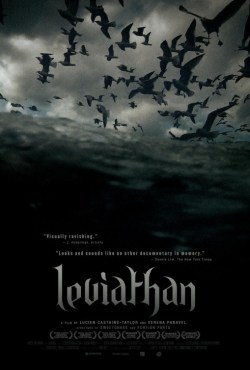
 If you’re at all a fan of documentaries (or care about seeing the future of film aesthetics), you ought to begin familiarizing yourself with the work of the Harvard Sensory Ethnography Lab. These groups of experimental filmmakers are beginning to push the form in exciting directions that are worth noticing. They have not entirely hit their stride, but two recent features, “Leviathan” and “Manakamana,” are worth examining as potential harbingers of great things to come.
I don’t intend to give an informational survey as if you were applying for admission, especially since there are two superb write-ups in The New York Times and Boston Magazine. But if I had to reduce their goals and aims into a single-sentence mission statement, the Harvard Sensory Ethnography Lab is aiming to document the wide range of experience on our planet through the use of uniquely innovative techniques.
I have a hard time figuring out what the actual first film of the lab truly was, but the first project of theirs that came to my attention was “Leviathan.” This documentary, directed by Véréna Paravel and Lucien Castaing-Taylor, takes a look at the work of commercial fisherman in the American Northeast. The approach to immersing us in that world is not to tell us about it, or even show it to us. We have to feel it on a visceral level.
Paravel and Castaing-Taylor stick GoPro cameras just about anywhere they can and splice together their footage into something that often achieves hallucinatory heights. No offense to your friends’ GoPro selfies on mountains, but “Leviathan” is the real deal in terms of utilizing the potential of these now seemingly ubiquitous compact cameras. Simply trying to discern where the filmmakers placed the camera to achieve a given shot seems a herculean effort.
That lingering question about camera position quickly fades away, however, as we simply accept that these mesmerizing sequences of “Leviathan” lack a conventional center of gravity. Freed from the constraints of traditional camera maneuvers, the film liberates us to allow the sensation of swimming through the water like a fish seize us entirely.
Sadly, “Leviathan” is not solely composed of these scenes. At the opposite end of the spectrum from these formally daring scenes are portraits of the fishermen’s daily life that are far too naturalistic. While the fishing is overwhelmingly kinetic, the still moments apart from the job are debilitatingly inert. “Leviathan” might have been best served as a short subject documentary, taking somewhere in the range of 30-40 minutes to really showcase the brilliance of its aesthetic conceit.


 Marshall and the Movies
Recent Comments