 Fantastic Fest
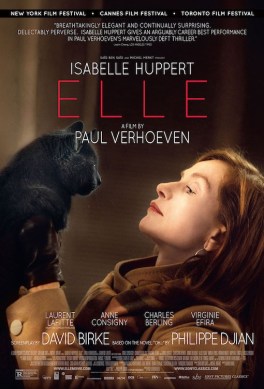
Both the film “Elle” and its protagonist, Isabelle Huppert’s Michèle, resist common tropes related to sexual assault (one of which occurs in the opening scene). Chiefly, neither dwells in victimhood or the battle wounds of a survivor. It does not galvanize the righteous anger of the audience back against the perpetrator through the vicarious thrill of revenge.
But here’s the thing: “Elle” is defined more by what it doesn’t do and not by what it does. Director Paul Verhoeven and screenwriter David Birke dwell in the murky gray areas of Michèle’s twisted psychology as she herself remains unclear as to how to proceed. She knows that she does not want to call the police, as she believes her position as the daughter of a serial killer would not lead to any semblance of justice. She does not want to make a fuss about the incident or let it overpower her thoughts and routines. But what does she do?
Huppert brings steely gumption to her character, a backbone necessary to even establish the most elementary semblance of realism in “Elle.” Her performance, and the film writ large, seem to lack a consistent, coherent internal logic. With her mental state intentionally obfuscated from us, we must interpolate from her actions. And Michèle’s behavior fluctuates vastly from scene to scene. She may seem alarmed by a prank video game scene depicting her rape to the point of conducting a secret witch hunt … only to turn around and engage in a sexual cat-and-mouse game with her own assailant.
No film is forced to answer to the demands of its viewers for answers and resolution. But when lack of clarity feels like an externality of the film rather than an essential narrative feature, the rules change a bit. The instability and unpredictability of “Elle” become its guiding light and driving force. With scant character detail and no real dialogue with issues, the film can only end in emptiness. Refusing a mode of thought is easy. Proposing a new one creates a much greater challenge, one that Verhoeven, Birke and Huppert do not seem up to fully meeting. B / 

 Admittedly, I know fairly little about climate change apart from what I learn in documentary films. (You didn’t ask for this, but I’ll provide two recommendations anyways – “
 I’ve been a fan of Sharon Jones and the Dap-Kings ever since the “
 What do you do when the scope of your filmmaking calls for a big screen experience but your story only has the breadth to sustain a short film? It’s a trade-off that filmmakers must consider when determining how to bring an idea to fruition. In an ideal world, short-form storytelling would have a place on in theaters apart from film festivals, but that world has not yet arrived.
 Poor Warren Beatty. The man has been trying to make a passion project about Howard Hughes for the better part of four decades. The film faced significant challenges, including 2004’s biopic collaboration between Martin Scorsese and Leonardo DiCaprio that nabbed double-digit Oscar nominations.
 Kelly Reichardt’s richly detailed cinematic canvases have changed little in composition in her two decades of filmmaking. The world in which that art gets displayed has grown increasingly fast-paced and task-oriented. Each successive Pacific Northwestern-set film with its unhurried pace and character (as opposed to action) driven story feels slightly more rebellious than the last.
 The 2016 presidential election has often felt like a daily race to the bottom with each day seemingly fighting to make the claim, “No, THIS is the worst it’s ever been.” And we still have days left to go – there haven’t even been the definitive post-mortem books where the really juicy stuff comes out! We’ve always known politics were grimy and nasty, though perhaps we underestimated the extent to which they reveled in the dirt.


 Marshall and the Movies
Recent Comments