REVIEW: Demon

31 10 2016

demonThe scariest horrors, as most well-schooled viewers know, comes not from momentary jumps but from a force burrowing deep into our subconscious that unearths painful truths. It’s those stories that recognize our biggest threats may not be from without, but from within, that haunt us. Marcin Wrona’s “Demon,” a taut tale of a despondent past casting a nasty shadow over a joyous celebration of the future, is one such film.

Buñuel-like in its fixation on a wedding that no one seems able to end, “Demon” follows the steady digression of marital bliss into nuptial nightmare. The groom, Itay Tiran’s Peter, enters not only into a domestic partnership but also into a Polish lineage that places a high value on the family home. That same house – the site of their union, no less – seems intent on denying him entrance. An edifice slowly becomes a character as bad omens eventually escalate into the release of a dybbuk, the scorned spirit of a dead loved one.

“There’s no man without society, and no society without memory,” advises a professorial family member during a toast. It’s a nugget of wisdom that inebriated attendees ignore at their own peril since the dictum later feels like a warning for all that is to come. Peter’s attempts to overhaul certain quaint aspects of the house prove his downfall, as renovations awaken the specter of the Holocaust both as a spirit battling him as well as within the memories of those around him. While some of the energy peters out by the end of “Demon,” the encroaching dread as steadily filmed by the late Wrona still makes for a truly unnerving watch. B+3stars


REVIEW: Inferno

30 10 2016

Dan Brown’s historically-inspired adventure tales have never felt more like a “National Treasure” movie than in Ron Howard’s adaptation of his most recent Robert Langdon tale, “Inferno.” What might pass as labyrinthine on the page proves laborious on the screen as the story runs in two opposite directions at once to cover 600 pages in 2 hours.

On the one hand, Langdon (Tom Hanks) tries to piece together two days he seems to have forgotten – during which time he went from Cambridge, MA to Florence, took a priceless artifact from the Uffizi and suffered massive head trauma. He lacks the luxury to sit down and calmly place all the puzzle pieces together, however, as a consortium of Italian police, World Health Organization officials, and corporate interests track him down. Langdon unwittingly possesses information from Ben Foster’s Bertrand Zobrist, a recently deceased billionaire who took Thomas Malthus a little too seriously and gives morbid TED Talk-style lectures about the grave dangers of overpopulation.

If it sounds like “Inferno” has one too many plates for Howard to keep spinning, that’s because it does. Screenwriter David Koepp ensures that none are ever dropped, which is a pretty remarkable feat, though plenty come close to breaking with all the character reversals upon which Brown insists. (Seriously, he makes the “Now You See Me” series look like a model of restraint in this regard.) There are worse things to watch than Hanks’ Langdon on the run with Felicity Jones’ Dr. Sienna Brooks, a child prodigy and early Langdon fan. Yet there are plenty better things as well, especially given the page-turning quality that Brown’s books possess. “Contagion,” but as a glorified chase movie, feels like settling for less. B-2stars


REVIEW: American Pastoral

19 10 2016

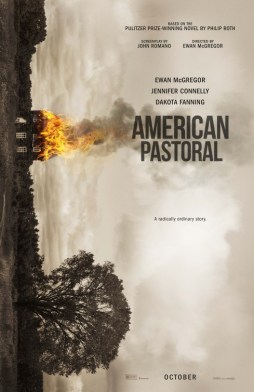
American Pastoral posterWithout any knowledge of the source material, it’s hard to draw a line between novelist Philip Roth’s grandiloquence and the bombast of the film adaptation of “American Pastoral,” the latest attempt to transpose his work on screen. For example, when Ewan McGregor’s Swede Levov drops a patently pretentious line like, “We can live where we want, this is America,” who’s supplying the sincerity? Who’s responsible for the irony? The delivery indicates a mix of both, and it’s unclear (at least to the uninitiated) whether McGregor as director is offering his own commentary on the novel or simply presenting it as written on the page.

John Romano’s script does a decent job at recreating the central generational dynamic at the heart of “American Pastoral.” In conflict-riddled 1968, tensions boil to a head among a nuclear family in rural New Jersey as free-spirited Baby Boomer Merry Levov (Dakota Fanning) rebels against her parents, Swede and Dawn (Jennifer Connelly). A discontent and rabble-rouser from an early age, Merry sets out to disrupt the idyllic outlook held by the jock and the beauty queen from the Greatest Generation. She commits an actual violent act, yes, but the most drastic rupture comes from their shattered contentment and complacency.

Though at times this conflict plays out like a bit of a Living History Museum, McGregor manages to find enough points of resonance to make “American Pastoral” a compelling watch. Well, at least for the first half. The broader, thematic story eventually gets whittled down into a smaller, more intimate psychodrama. The shifted focus might have worked had the film gone deeper into its characters from the beginning. Accepting each person as a human, not just a mouthpiece for a demographic group, proves a little difficult. The contradictions are clear, but like so much else in “American Pastoral,” it is uncertain whether these are designed for mere acknowledgment or full contesting. B-2stars


REVIEW: Christine

18 10 2016

christineSundance Film Festival

If “Nightcrawler” had a spiritual prequel, Antonio Campos’ “Christine” might fit the bill. This true story of 1970s news anchor Christine Chubbuck, played with masterful precision by Rebecca Hall, hinges on the maddening descent of local television into the “if it bleeds, it leads” culture. The downward spiral of Christine’s profession matches her own personal crisis as internal demons wrest influence away from her sanity.

Rebecca Hall, most likely known to audiences for bit parts in films like “Iron Man 3” or her memorable supporting turn in “The Town,” finally gets to shine like the talent Woody Allen recognized when he cast her as the lead in 2008’s “Vicky Cristina Barcelona.” Though Christine’s notorious final on-air stunt has come to define her in the public memory, Hall’s performance finds her deep, troubled humanity and recreates it to devastating effect.

Christine tries to make a name for herself doing positive human interest stories with the verve of a true filmmaker, positioning herself against the grain of exploitative pulp. We know it’s a losing battle, and for the most part, so does she. Both the character and the audience alike are caught in a mutual death pact of dramatic irony, sensing the tragic end ahead but unable to turn away or turn the tide. Watching Christine’s unease mount in everything from an ill-fated romance with more successful co-anchor George Ryan (Michael C. Hall) to decaying relationship with the mother (J. Smith-Cameron) that still houses her provides the true motor of the film. Individual events matter less than the escalating paranoia, both real and imagined.

Director Antonio Campos resists easy sympathy for Christine, making her neither martyr, victim or antihero. She is a vividly realized person to us, but she is also someone whose narrative we experience through the moderation of a screen. As such, he often adds distance to her within the composition of a shot, photographing her through another video inside the frame. “Christine” treads this tricky line between sympathy and alienation with remarkable exactitude, just as it balances personal dissatisfaction against cultural sensationalism. A-3halfstars


REVIEW: The Lost City of Z

17 10 2016

New York Film Festival

In 2014, while still in the thralls of my passionate obsession with James Gray’s “The Immigrant,” I attended the Telluride Film Festival where, lo and behold, Gray himself was attending to present a screening of Francis Ford Coppola’s “Apocalypse Now.” (I won’t go into too much detail about how I choked on approach to chat with him outside a screening.) He also penned an essay for the festival’s program lavishing praise on Coppola’s masterpiece, writing, “The film poses questions without any attempt to provide definitive answers, and its profound ambiguities are integral to its enduring magic.”

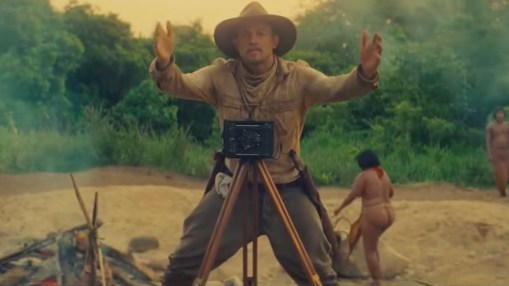
Of course, this only popped into my mind about an hour of the way through Gray’s latest work, “The Lost City of Z.” The film’s jungle trek in search of a mythic destination, of course, bears many surface similarities to “Apocalypse Now.” Going deeper, however, little else in the Amazonian journey of Charlie Hunnam’s Percy Fawcett corresponds to the descent into madness of Martin Sheen’s Captain Willard. Fawcett’s quest is one for pride, not shame. In his attempts to discover a lost civilization among the South Americans derided as “savages” by the Brits, he hopes to provide both a cultural corrective and a reputation restoration to his tarnished family name.

the-lost-city-of-z

There’s an earnestness to Fawcett’s trips (yes, plural, because it takes a trio of them) that feels entirely from before the moral malaise of “Apocalypse Now,” due in large part to Gray’s unabashed classicism. He’s even got his own match cut to pay winking homage to David Lean’s “Lawrence of Arabia.” Yet “The Lost City of Z” feels caught between two periods, the old-fashioned spectacle of the Hollywood cinematic epic and the more self-conscious, interrogative New Hollywood style. To return briefly to Gray’s own terminology, the film lacks some magic because its ambiguity exists within a structure that prefers resolution and triumph.

Gray always has a firm command of what’s happening on screen, and director of photography Darius Khondji captures it in luscious hues and sweeping movement. What exactly is meant by Fawcett’s multiple journeys, each of which test his commitment to his fellow explorers, country and family, is not always clear. Removed from the personal authenticity of Gray’s early work and the radical sincerity of “The Immigrant,” narrative resonance is somewhat lacking.
the-lost-city-of-z-2

Even so, “The Lost City of Z” is still a sumptuous delight of visual splendor. Thirty minutes could probably be trimmed to help sustain more momentum, though such cuts might sacrifice some of the delicate character arcs. As the film progresses, Fawcett’s right-hand man Henry Costin (Robert Pattinson, playing his supporting role with the humility of a great character actor) gradually grows uncertain that their mission to locate their missing city can bear any fruit. At the same time, however, Fawcett’s son Jack (Tom Holland, recalling his superb turn in “The Impossible“) moves from disenchantment with his father to full allegiance and companionship. Witnessing one rise as the other falls makes for a more unexpected journey within the film – and one of its few facets that’s not entirely straightforward. B2halfstars


REVIEW: The Birth of a Nation

7 10 2016

In Nate Parker’s “The Birth of a Nation,” many an incident between slaves and their white captors in early 1800s America feels like the first ripple leading to the tsunami of racial tension washing up today. A black man walking home innocuously who is greeted with distrust and violence from roving vigilantes recalls the charged interactions between minorities and police officers. The employment of selective Bible quotes to reinforce racial hierarchies draws attention to how religious groups often impede, rather than promote, equity and justice. Black women are commoditized and then made the targets of sexual violence – well, nothing much has changed there.

Parker’s message becomes apparent quite quickly: it’s a movie about Nat Turner’s rebellion in 1831, but it’s ~really~ about contentious race relations in 2016. Historicizing the present is, on its face, certainly nothing worthy of complaint; plenty of great films have used this technique to stirring effect. But “The Birth of a Nation” falters because in the relentless focus on contemporary concerns, Parker loses sight of what makes slavery so horrible.

By favoring present-day relevance over historical trauma, Parker denies us a full glimpse at the true terrors of slavery. It’s a pure spectacle, one that primarily exists to provide moments that propel Nat Turner’s ultimate transformation from plantation pastor to rebellious renegade. Parker’s parade of images meant to illustrate the brutality of the system do a disservice to the atrocity of slavery by avoiding anything that causes pain.

His sanitized glimpses at the violence include cutaways during forced teeth extraction, a painless whipping against the pole and an implied rape. Parker is so concerned about locating the pulse of “The Birth of a Nation” in modern times that he winds up taking a gallingly non-confrontational attitude about the subject of slavery. Placing his agenda on a pedestal over their pain rings both cheap and hollow.

Read the rest of this entry »


REVIEW: The Girl on the Train

5 10 2016

Arguably the most famous close-ups in cinema history take place in Carl Theodor Dreyer’s “The Passion of Joan of Arc,” the 1928 silent classic that elevated the expressively tight framed shot of facial contortions to the position of high art. Dreyer later said of the close-up, “Nothing in the world can be compared to the human face. It is a land one can never tire of exploring.”

It’s a blessing Dreyer did not live to see Tate Taylor’s “The Girl on the Train,” a film that puts the close-up to shame through bludgeoning and excessive use. This specific shot is the movie’s only language to convey the internal agony of its three leading female characters. No need to waste time detailing the multitude of other techniques available at Taylor’s disposal, so let’s just leave it at the fact that the close-up is lazy shorthand for emotional intimacy.

The camera tries to substitute the reservoirs of feeling hidden by the icy women, each with their own secrets to bury and axes to grind. Their blank stares into the distance are meant to convey restraint or secrecy; instead, they convey nothing. One only needs to hold up the work of star Emily Blunt in “The Girl on the Train” alongside her performance in “Sicario” to see the difference. In the latter film, the most minuscule movement in Blunt’s face communicates a complex response to the ever-shifting environment around her character Kate Macer. Here, as the alcoholic voyeur Rachel Watson, Blunt is reduced to gasps and gazes that do little to illuminate her psychology.

Read the rest of this entry »


REVIEW: Me Before You

3 10 2016

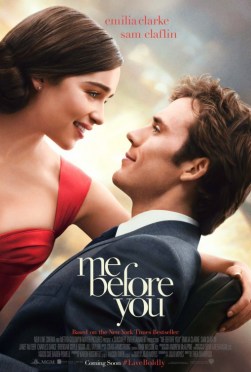
me-before-you-posterIt has been a long time since a movie infuriated me to the extent that “Me Before You” did. Strap in, folks, this review is chock full of opinions and passion. (Also, here be spoilers, but if you’ve followed any of the online discussion surrounding the book/film, you probably know what happens anyways.)
Let’s just lay down some ground rules before we begin: suicide is not a release. It is not an escape. It is not a relief. But for those who feel compelled to commit the act, it is almost never cowardice or selfishness.

Unless, of course, we are talking about Sam Claflin’s Will Traynor, the wheelchair-bound character at the center of “Me Before You.” After being struck by a motorcycle in the film’s opening scene, he resigns himself to moping about the house when the accident dashes any hopes of returning to his adventurous lifestyle. But Jojo Moyes, author of the source novel and screenplay, is content to explain away his surliness as largely stemming from being ensconced in wealth and privilege as well as the betrayal of his girlfriend. Any actual depression or pain never surfaces.

And how convenient that is – because the film needs Emilia Clarke’s Lou Clark (playfully referred to by her surname) to swoop in and make him happy. Clarke plays her character with the clumsy verve of a “Saturday Night Live” skit mocking Zooey Deschanel, begging both Will and the audience to wonder how someone can contemplate suicide in the presence of someone who squeals upon receiving a pair of striped tights. While it might avoid the “Silver Linings Playbook” cliché of love curing mental illness, something more insidious is happening.

Will moves forward with his decision to end his life while the film only shows us the forward-facing aspects of his growing fondness for Clark. What it omits is any sign of actual pain or real depression. “Me Before You” treats suicide flippantly, doing a disservice for quadriplegics and the mentally afflicted in the process. It really adds insult to injury when this euthanasia spurs Clark to make the bold life choices she is hesitant to make on her own volition.

Suicide is not a cute plot device. Someone who takes their own life does so because they see no other option. Presenting it as a tool to expand someone else’s options is shallow and misrepresentative. One person’s anguish does not translate to another person’s triumph. Presenting suicide as inspirational or aspirational is dangerous. Look up “suicide contagion” if you don’t believe me. C-1halfstars


REVIEW: Goat

2 10 2016

goatSundance Film Festival

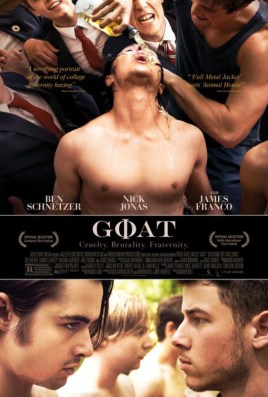
“The pledges have to go through hell, or what’s the f—ing point?” It’s a question posed toward the end of Andrew Neel’s “Goat” by cruel fraternity pledgemaster Dixon (Jake Picking), and the film provides no easy answer.

We live in isolating, estranging times that can often leave young people separated from their very essence. The pressures for college-aged men today, at a time when centuries of male hegemony are being upended by gender equality, can often take on a dark tenor that drives reckless behavior. The Greek system is meant to provide belonging, community and brotherhood. Its current practice frequently perverts these ideals into violence, sadism and outright cruelty.

When Brad Land (Ben Schnetzer) enters Phi Sigma Mu, it’s due in large part to the presence of his older brother Brett (Nick Jonas) already being a brother. But there’s more than just family loyalty behind the decision to rush – Brad is still recovering from a mugging incident that left bruises on his body and pride. The fraternity becomes a space in which he can reclaim the masculinity he feels those brutes took from him that fateful night.

The Phi Sigma Mu residence, in particular the basement where so much hazing takes place, houses many distinct personalities with their own issues they look to the organization to solve. Some are looking for validation of their future prospects. Others are trying to resolve their sexual frustrations with women, even going as far as engaging in acts with homoerotic undertones that replace the contact they miss. All taken together, the brothers create and perpetuate a system in which violence and humiliation only begets further violence and humiliation. Their credo states “All My Strength Is In My Union,” but the initiation rituals only sew discord and mistrust.

The target of Neel’s rage is not the fraternity system. It’s toxic masculinity. “Goat” offers little in the way of pointers as to how this can be overcome. But we do get a little bit of hope in observing the progressing relationship dynamics between the blood brothers Brad and Brett. The elder feels no need to help his younger sibling upon entering rush; in fact, he probably goes harder on him to avoid accusations of favoritism. Yet the more that hazing breaks Brad’s spirits, the more Brett begins to realize that so little about Phi Sigma Mu actually matters. Through Brett’s genuine compassion, they take strides toward making peace with the fraternity. That empathy provides a nice twinge of hope after being party to some misguided acts of true brutality. B+3stars


REVIEW: The Dressmaker

1 10 2016

the-dressmaker“I’m back, you bastards,” declares Kate Winslet’s Tilly Dunnage upon arriving back in her home town at the outset of “The Dressmaker.” It’s a fitting start for a movie that revels unapologetically in camp, from dialogue to literal barn-burning events (and perhaps even too far with Hugo Weaving’s sheriff with a flair for drag). And had the film stuck to its true colors, the whole thing might have held together.

But it doesn’t, largely due to writer/director Jocelyn Morehouse’s insistence on trying to play parts of the movie like a straight drama. At one point, Tilly and company watch Billy Wilder’s classic “Sunset Boulevard,” a film where Gloria Swanson’s Norma Desmond hams up the screen to set up a tragic turn. Trying to draw any kind of parallel to “The Dressmaker” to that iconic work only highlights just how far short it falls. Tilly is all smolder and swagger with a faint whiff of armchair psychologizing hat stems from a clichéd tragic misunderstanding in her past.

When this larger than life figure begins to show cracks in her facade, the turn just doesn’t feel right. The score may swell dramatically to signal legitimate dramatic intentions, yet “The Dressmaker” sends such mixed signals that prove baffling to decode. How can it really mourn a freak death in one scene and then humorously inflict a debilitating injury within five minutes? And then, soon after, another death meant to provide catharsis?

The film is fine when Winslet is allowed to revel in vengeance like “Django Unchained.” Watching her seethe while settling old grudges provides some modest pleasure. When the complexity comes in through the slow doling of new developments regarding the incident that drove her out of town, however, “The Dressmaker” falters. C / 2stars


REVIEW: A Tale of Love and Darkness

30 09 2016

A Tale of Love and Darkness posterI knew nothing about Amos Oz’s life or work before seeing “A Tale of Love and Darkness,” an adaptation of his autobiography that also serves as Natalie Portman’s directorial debut. In the absence of that knowledge, I was able to see the mechanics of a standard biopic as they grind out familiar beats. It was not a pretty sight.

The film centers around Oz’s childhood, far before he became the man Wikipedia claims is regarded as Israel’s greatest living writer. His father Arieh (Gilad Kahana) is an etymology wonk, constantly pointing out connections in disparate Hebrew words. His mother Fania (Portman), on the other hand, is an amateur bedtime parable teller. Most of the stories are shaded by pessimism from her own experiences escaping the decimation of Europe in the anti-Semitic early decades of the 20th century.

The protagonist of the story is quite clearly Oz – it’s an older version of himself that provides the framing device for the film, and he whose experiences form the majority of the action depicted on screen. Yet Fania’s struggles pull a considerable amount of attention away from his development, particularly in the back stretch of the film when she becomes struck by a mysterious illness. While Portman auditions for a Sylvia Plath character, Oz becomes a passive figure in his own life. And without his agency, “A Tale of Love and Darkness” can provide scant justification for why to tell his story in the first place. C / 2stars


F.I.L.M. of the Week (September 29, 2016)

29 09 2016

polytechnique posterLong before there was Columbine, Virginia Tech or Newtown, there was the 1989 massacre at the École Polytechnique in Montreal. Unknown to many (myself included), a shooter opened fire in an engineering school and shot 28 people, killing 14. His rationale recalls that of the 2014 shooter in Santa Barbara: an angry, entitled rage against the feminist ideology that threatens his comfortable dominance.

Denis Villeneuve’s “Polytechnique,” a feature-length reenactment of the events that transpired, makes a worthy exploration into the complex web of issues raised in this shooting. The film correctly places the shooter’s mentality into a larger cultural pattern of misogyny and male hegemony. Words and attitudes do the same damage to the mind and spirit that bullets do to the body.

For example, the masculine supremacist attitudes of the shooter are echoed by an interviewer at one point. When Valérie (Karine Vanasse) goes to apply for an internship in mechanical engineering, the man at the other side of the table register his surprise. It’s harder to raise a family when choosing mechanical over civil engineering, he reminds her. None of this explains the killer. But it does contextualize him.

Though the actual killing rampage is indeed frightening, Villeneuve ensures that we fear a pathology and a set of twisted tenants far more than any isolated violence. The film’s focus on the lasting scars from the realization that such hatred can exist leaves a lingering sensation of unease. While Villeneuve might overload the metaphors on occasion (Picasso’s Guernica painting, a lecture on the dangers of entropy), the overall effect is chilling enough to make this a pick for the “F.I.L.M. of the Week.” The fact that he achieves such a sensation in a slender 70 minutes runtime only adds to the wonder.


REVIEW: Deepwater Horizon

28 09 2016

deepwater-horizonPeter Berg has a knack for directing blue collar dialogue in a convincing manner. For films like his 2013 survival drama “Lone Survivor,” such exchanges lent the film an authenticity and humanity before its Navy Seals face life-threatening trials. In Berg’s latest directorial outing, “Deepwater Horizon,” the commonplace banter feels more like a counterweight to some of the complex oil industry jargon taking place on a Gulf Coast rig.

For much of the film’s first 40 minutes, the screenplay from Matthew Sand and Matthew Michael Carnahan overloads with technical terms explaining the operations on the Deepwater Horizon. And even with blatant expository scenes, they still have to dole out some more details in subtitles. It’s wasted air space in the film, which foreshadows the well-known explosion with obvious harbingers of doom. Be it an exploding Coke at the home of protagonist Mike Williams (Mark Wahlberg) or a BP big wig wearing a tie in the color of their worst level alarm, there’s no denying what’s coming.

Berg sets up “Deepwater Horizon” as an disaster flick, yet he fouls up some key ratios in establishing tension and connection. His energy goes disproportionately to setting up the crisis (roughly 50 minutes), which in turn makes the escape (roughly 35-40 minutes) feels like getting short changed. There’s some decent tension as wounded crew members navigate their way through a literal enactment of the burning platform metaphor, but Berg undermines it with weak characterization and pointless cutaways to Kate Hudson as Mike’s grieving wife back at home.

The film takes an interesting turn in the coda where surviving workers from the Deepwater Horizon rig are greeted in their grief by robotic crisis management professionals. Rather than seeking to ease their pain and embrace the souls who survive, BP adds a thin coat of dehumanization on top of a devastating loss of human life by locking them away from the world in anonymous hotel rooms. These scenes of the battered, tattered employees struggling to cope with the events that just occurred frustratingly dangle the potential “Deepwater Horizon” had in front of us. Were the critique of corporate malfeasance not so toothless, or were the rising action of the film built around developed characters, this lack of resolution might really sting. Instead, it just replicates the numbness of the setting. C+2stars


REVIEW: Queen of Katwe

20 09 2016

Triumphing over adversity in competitive environments is a Disney speciality, but the studio rarely pulls it off with the dignity and grace of Mira Nair’s “Queen of Katwe.” The film is less about dramatic reversals of fortune or epic journeys and far more concerned with how circumstances and biases can prevent such developments from taking place.

As the film’s young protagonist Phiona (newcomer Madina Nalwanga) states towards the end of the film, “I fear certain things will never change.” Yet if not for the perseverance and faith of her mentor Robert Katende (David Oyelowo), this chess prodigy might have let such doubts keep her paralyzed through inaction. He spots her incredible ability to see a whopping eight moves ahead on the board and fosters her intellectual development, a process which requires great sacrifice on his behalf.

The largest obstacle in the way of Phiona’s realization of her own potential is a surprising one – her mother, Harriet (Lupita Nyong’o). A widow forced to support several children by selling maize in the slums of Uganda, she is justifiably hesitant to authorize her daughter spending time on chess. If the pursuit of master status does not pan out, then Harriet views the loss as a frivolous waste that does nothing to prepare Phiona for making a living like her.

Portraying such a perspective presents a conundrum for Nyong’o, who is tasked with conveying both maternal grace and strict authority without coming off as a dream crusher. Her performance engages through its empathy, ultimately allowing for a fuller understanding of why she does not believe in silver bullets – be they chess championships or sugar daddies. While “Queen of Katwe” is primarily the story of Phiona’s rise in the world of chess, an equally important evolution takes place for Harriet as she analyzes her place in the world.

Nair shows that world, it should be noted, in stark detail without ever resorting to so-called “poverty porn.” Her camera, guided by Steve McQueen collaborator Sean Bobbitt, skips the grimy details and focuses more on the stratification of the two sides of Ugandan capital Kampala. Any long shot taking in Katwe also captures an urbanized, industrialized city center in the background.

Inequality, not destitution, is the real enemy in “Queen of Katwe,” and it makes for a more daunting foe. Hand someone a check, and they can hypothetically walk out of poverty. Alleviating inequality, on the other hand, requires systemic change and the devotion of resources to those given less. B+3stars


F.I.L.M. of the Week (September 15, 2016)

15 09 2016

A few years ago in my film history class, I was assigned to watch the first half of Mark Cousins’ epic historical overview of the medium, “The Story of Film: An Odyssey.” I wound up watching the whole 15-plus hour opus and learned quite a bit about important artists whose contributions to the art form I never even knew. And I also learned that Cousins would have us recognize Paul Verhoeven as one of the major filmmakers of contemporary cinema. Seriously, he devotes a solid 10-minute paean to the subversive qualities of his studio films.

At the time, I dismissed his claim as a lot of pretension and hot air. (The temptation for critics to make a bold statement that you can see something others cannot should not be doubted.) But after watching Verhoeven’s mega-budget 1997 film “Starship Troopers,” I can start to see Cousins’ point. The action flick functions both as good entertainment and subversive social commentary, a dual capability that more than qualifies it as my “F.I.L.M. of the Week.”

“Starship Troopers” takes the form of a traditional war film not unlike something Hollywood would churn out around World War II. As alien invaders threaten the security of the earth, an urge to defend the planet sweeps through students in Buenos Aires. (Yes, they’re all lily-white. This was the ’90s.) Casper Van Dien’s Johnny Rico, not the brightest bulb, ends up placed on the front lines of the conflict when assigned to the Mobile Infantry. The high aptitude of his girlfriend, Denise Richards’ Carmen Ibanez, earns her a spot in the prestigious starship piloting program.

Rico and Carmen go their separate ways after enlisting, each encountering their own struggles and forging their own camaraderies. The part they play in facing down the threat of “bugs” from Klendathu are interesting, but like in many a great film, the genius comes less from what is told and more from how it is told. Verhoeven cloaks the proceedings in a transparent artificiality, embracing hammy acting as a method for exposing how cinema can glamorize war. Snippets of “news media” interspersed throughout “Starship Troopers” help drive this message home; their throwbacks to the newsreel tradition highlight how thinly veiled propaganda can transmit fascistic and bigoted ideals. More movies should try to pull off this sneaky gambit, allowing you to enjoy what you’re watching while also critiquing your watching in real time.