REVIEW: Indignation

29 07 2016

IndignationSundance Film Festival

When it comes to films surrounding schooling periods, a certain set of general guiding principles undergirds nearly story. High school movies are about the competing impulse of individuation and socialization, finding oneself while also navigating the locker-lined corridors of the pecking order. College movies primarily center on free expression and discovery, like a trial run for adulthood with few of the responsibilities or consequences.

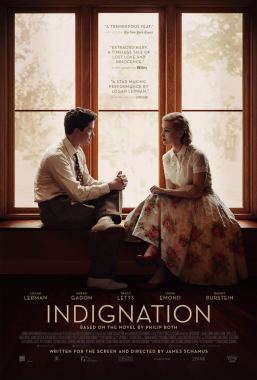
2016 has a pretty stellar roster of college movies between “Everybody Wants Some” and “Neighbors 2” – but a bit of a black sheep with James Schamus’ “Indignation.” The film, adapted from a novel of the same name by Philip Roth, follows university-bound protagonist Marcus Messner (Logan Lerman) as he puts his hand to the plow in his studies. He scorns social contact, even from like-minded individuals such as the school’s Jewish fraternity that comes to earnestly recruit him. Marcus comes to school a skeptic and a deep religious doubter, two positions in which he only entrenches himself further upon arrival.

Whether the position comes from Schamus or Roth, it matters not – “Indignation” indulges Marcus’ cynicism rather than interrogating it or demonstrating the philosophy’s value. Vindication comes cheaply as the puritanical hypocrisy of the school administration, chiefly Tracy Letts’ Dean Caudwell, tries to clamp down on his rebellious streak. Marcus begins to see the same values in his own family, whose middle-class emphasis on diligence and industriousness leads them to disapprove of his budding relationship with the haunted yet wealthy Olivia Hutton (Sarah Gadon).

The romance between these two wildly different students begins, ironically, with Olivia’s performing oral sex on Marcus while his vehicle is parked in a cemetery. His genitals receive more stimulation than his mind throughout the film. And, to be quite honest, they probably receive more stimulation than the audience as well. “Indignation” has nothing pushing it forward but the fervent stagnation of its protagonist. Though one long, refreshingly theatrical-style spar between Letts and Lerman helps to break the rhythm towards the middle, the film is primarily a sterile exercise in self-satisfaction. C+2stars


REVIEW: Equals

27 07 2016

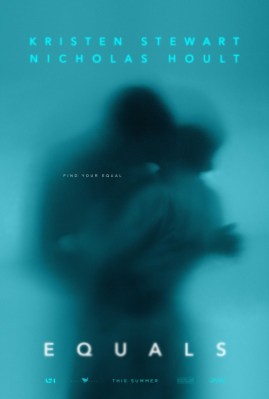
EqualsDystopian sci-fi often tends to paint in broad strokes as it outlines a vision of an alternate reality. But in Drake Doremus’ “Equals,” however, the focus is on the minutiae and the barely perceptible.

Though its color-drained, emotionless milieu exists somewhere on the spectrum between “Pleasantville” and “The Giver,” the pleasures hardly derive from the gradual revelations of the imagined premise’s limitations. In fact, the film often stumbles when it ventures into thriller-style intrigue around the “escape” from oppression. “Equals” soars when Doremus allows the incredibly specific, gently realized acting of stars Kristen Stewart and Nicholas Hoult to shine.

As cogs in an industrial machine that has sought to biologically eliminate emotions in the name of productivity and peace, Hoult’s Silas begins to feel the stirrings of affection for Stewart’s Nia after observing – ironically enough – her distinct mannerisms like lip biting and unusual eye movement. In these initial flirtations, their attractions scarcely register as the most minor of gestures. Doremus shows an eye for the subtle, the virtually unnoticeable that proves so unique to the cinema.

The chaste, hidden-in-plain-sight romance that plays out in public possesses a truly beautiful nuance and a wonderful correlation to the world all of us inhabit. The small graze of a crush’s hand or the intercepted glance often packs the most profound emotional wallop. It’s a shame that when their relationship moves into the more physical, sensual realm that “Equals” loses this bliss. In their fumbling for sexual intimacy, Doremus presents Silas and Nia as darkly silhouetted and reduced to mere grunts, gasps. Yes, they are discovering sexuality on a primal scale. But there has to be more to it.

Actually, there is more to it, as Hoult and Stewart so clearly demonstrate. With each passing scene, we can see the gradual expansion of the emotional pallets available to Stewart and Hoult – mostly in the latter. Stewart maintains a primarily leveled tenor as Nia, but Hoult grows into an emotionally sensitive character on par with his deeply empathetic turns in films like “Mad Max: Fury Road” and “Warm Bodies.” Doremus may spin in circles doing a kind of Harmony Korine-esque haze of words, fragmentary shots and trance-like score, but the actors of “Equals” keep the film centered. B2halfstars


REVIEW: The Finest Hours

18 07 2016

There’s something odd about Disney’s “The Finest Hours.”

This ’50s-set high-seas rescue does everything it can to recreate that era in the filmmaking. Director Craig Gillespie operates at a more methodical, easygoing pace in land-bound scenes. Period detail is all there, even down to the sound of the time as composer Carter Burwell provides a similarly moody post-war ambiance that he endowed to last year’s “Carol.” Heck, they even filled the role of Coast Guard crewman Bernie Webber with Chris Pine, the rare working actor today who can comfortably assume the style and mannerisms of a golden age Hollywood studio star.

And yet, “The Finest Hours” is the kind of disaster caper only possible to achieve at this level in the 21st century with computer graphics. The films of the 1950s – even the epics – were limited by the technology available at the time and bolstered by a grounded grandiosity. Seeing is believing here when technicians can show, in great detail, the destructive storm and waves that strand a vessel off the coast of Massachusetts. When the filmmakers try some of the more magical elements of a bygone period, such as suggesting a quasi-spiritual connection of Bernie’s sea navigation to his romantic interest’s journey on the open road, it falls completely flat.

“The Finest Hours” is a film caught between two styles of moviemaking and two schools of thinking. Gillespie and company can never quite figure out how to resolve this tension from the beginning, and as a result, the film sinks before it even has the chance to doggy-paddle.  C2stars


REVIEW: Hunt for the Wilderpeople

17 07 2016

Hunt for the WilderpeopleWriter/director Taika Waititi pulls off a rare feat with his film “Hunt for the Wilderpeople” – recreating an adolescent mindset without simultaneously infantilizing the audience. (No wonder Marvel wants him in their filmmaking stables.)

The movie adequately reflects the kind of “me against the world” headspace of troubled foster child Ricky (the riotous Julian Dennison) as he makes a last ditch stop with a rural-dwelling husband and wife before potentially ending up in juvy. Surprisingly, he ends up quite taken with the doting “aunt” Bella (Rima Te Wiata) and stoic “uncle” Hec (Sam Neill), so much so that he flees into the wilderness when extenuating circumstances lead child services to come back and collect him. Out here, “The Kings of Summer”-style, Ricky’s journey reconstitutes those who want to capture him as cartoonish villains and Hec, his reluctant forest companion, as a veritable folk hero.

“Hunt for the Wilderpeople” gets more mileage out of its central conceit than the director’s last film, “What We Do in the Shadows,” because Waititi leans into the absurdity rather than grounding it in reality. The larger-than-life humor of Ricky especially, but also the scenarios he imagines, really calls for the embrace of the ridiculous he provides. The film often glides by on charm over inventiveness or ingenuity, which is often just fine so long as Ricky’s potty mouth is running full speed. B / 2halfstars


REVIEW: Tickled

16 07 2016

TickledThe World Wide Web has been around now for roughly a quarter-century, which means that we’re probably about ready to start looking back to the technology’s early days for lessons pertinent to its present and future. Much in the same way that Ondi Timoner’s 2009 documentary “We Live in Public” provided scary context for the phenomena of social media, David Farrier and Dylan Reeve’s “Tickled” gives an early window into a new Internet dilemma: revenge porn.

Farrier, primarily a celebrity and entertainment journalist in New Zealand before the film, began the project like a typical human interest story. He stumbled upon bizarre videos of “competitive endurance tickling” and began making some preliminary inquiries into this unreported world. His questions are met with homophobia (striking, given how homoerotic the all-male videos appear) as well as threatened legal action, both of which only pique his interest.

Along with co-director Reeve, these Kiwis journey to America to take on the deep-pocketed bullies who will stop at nothing to halt their investigative eyes. Farrier and Reeve dig for the truth in the dark shadows of Hollywood, the economically scourged heartland of Michigan, the fetishistic corners of Florida and ultimately the privileged buttresses of New York privilege. From the veritable Wild, Wild West of the Internet of the late ’90s to the video-saturated web of today, they cut through layers of smoke screens and cash-padded baloney to reveal the scary truth about these “tickle cells.” The less you know before seeing “Tickled,” the better. That way, you can react both vocally and viscerally. B+ / 3stars


REVIEW: Central Intelligence

15 07 2016

Rawson Marshall Thurber’s “Central Intelligence” takes a tried and true premise – a mistaken identity thriller in the vein of Hitchcock’s “North by Northwest” – and finds a way to make it just mildly entertaining. The director’s past films, “DodgeBall” and “We’re The Millers,” were pretty straightforward comedies. As he ventures into the realm of the action-infused comedy, Thurber never quite finds the grooves and rhythms of this hybrid genre.

Thankfully, he gets some relief from the dynamic chemistry of the film’s leading men – two high school classmates on very opposite trajectories headed towards their 20-year reunion. Kevin Hart’s Calvin Joyner was the all-around stud that everyone loved and wanted to emulate; now, he flounders behind a desk as an accountant with dwindling prospects for advancement. Dwayne Johnson’s Bob Stone went through high school as Robbie Weirdicht, an affable but friendless face in the crowd relentlessly taunted for having more to love; now, he is “Jason Bourne with jorts.”

Though Calvin was not well-acquainted with Bob in his glory days, he agrees to meet up with him for drinks before the reunion and unwittingly gets drawn into a case of international espionage. The stakes and the object in question do not seem to matter so much (classic MacGuffin) as the constant back and forth between who Calvin can trust – Bob or the CIA agents (led by Amy Ryan) who tote real guns and badges. The changes in allegiance keep “Central Intelligence” on its toes, something that serves it well when gags land lightly or moments for emotional resonance lack power. Hart and Johnson compliment each other nicely, with the former playing more grounded and the latter doing a more ridiculous persona than normal. The talents of both actors, however, feel underserved here. C+2stars


F.I.L.M. of the Week (July 14, 2016)

14 07 2016

It’s practically inevitable that the culture and thinking I absorb eventually seeps into my writing. But this week offered one of the best chances for application ever.

I’m about halfway through Chuck Klosterman’s “But What If We’re Wrong?” This collection of cultural criticism applies a futuristic lens to the present day, removing our contemporary moorings from the equation and attempting to predict how later generations will see us. One big thesis is fairly depressing: most culture gets forgotten, and often what lasts cannot be appreciated in its own time. A group of people must find something in the work that its original audience was not able to see or fully grasp.

Not even thinking about the potential connection to the book, I watched 2001’s “Josie and the Pussycats” this week. For whatever reason, I have been on a bit of a late ’90s-early ’00s culture kick recently, so this felt like a natural thing to finally see. And wow, was I in for a surprise. This choice for the “F.I.L.M. of the Week” has an additional sense of urgency thanks to Klosterman’s writing. 15 years after its release, we need to start reappraising the movie and appreciating it as an eerily prescient and wickedly smart comedy.

I was eight years old when the film was released, so I can do only the most basic reconstruction of the 2001 moviegoer. But I can imagine just how easy it would be to mistake “Josie and the Pussycats” for the kind of mindless schlock it mercilessly mocks. Just read the Rotten Tomatoes critical consensus, presumptively from the theatrical release: “This live-action update of ‘Josie and the Pussycats’ offers up bubbly, fluffy fun, but the constant appearance of product placements seems rather hypocritical.”

Even in the decade or so since this film hit screens, Americans are seemingly more aware of the consumerism in which our culture is so heavily steeped. It’s hard to imagine anyone saying with a straight face nowadays that “Josie and the Pussycats” is an endorsement of this relentless corporate bludgeoning; after all, we have endured the rise of Kardashianism as well as the reality show non-commercial product spotlights that surged as traditional advertising fell. And need any further proof of how insidious this ideology is? Don’t forget what George W. Bush told Americans to do in the wake of 9/11, just six months after the film was released – go shopping.

Writer/director duo Harry Elfont and Deborah Kaplan wisely chose to steep their modern Josie and the Pussycats story in this culture because, after all, rock has become more an empty signifier than a vital musical movement. It is dominated and controlled more by elites and executives than the people from whom it traditionally arose. This acknowledgement of a sad reality makes the traditional “behind the music” tale more than rote repetition of a cliché; it exposes the corporate logic behind that narrative becoming a cliché. When record companies can pre-package starlets into familiar stories, it dumbs down their consumers and allows them to slip in some more subliminal messages to purchase other goods.

This kind of cynical, conspiratorial thinking might have seemed far-fetched in 2001. Sadly – or perhaps encouragingly, depending on your vantage point – it feels oddly plausible in 2016. And if you have any doubt, pay attention to the record executive Wyatt Frame, played by Alan Cumming, and his frequent fourth wall-breaking winks to the audience. It’s a look that says, “you hate this, but you know you’ll be buying Starbucks later today because of this.” There are signs for hope that our society has latched onto some of the thinking espoused by “Josie and the Pussycats.” But is it too late to reverse the cultural direction that relegated this film to the sidelines of discussion for so long?


REVIEW: The Measure of a Man

13 07 2016

The Measure of a ManBuzz words like globalizationrecession or underemployment are never spoken in Stephane Brizé’s “The Measure of a Man.” But even without saying as much, the film might make for one of the most powerful statements about the new world economy, one that has quickly displaced older middle-class laborers and given them little hope for recovery and readjustment.
Through Vincent Lindon’s passive, stoic everyman Thierry Taugourdeau, we can see the forces of this corporate climate. Since Thierry takes relatively few actions of his own, Brizé isolates and elucidates the ways in which he is acted upon by the system. There’s a marked contrast between the manner of his layoff, done however brutally in person with a human touch, and the frustrating process of getting hired elsewhere, carried out over Skype by people who remain faceless to the audience.

After time passes – apparently several months, which Brizé effortlessly elides – Thierry winds up in an entirely different profession altogether. No longer is he contributing physical products to the market with his labor. Thierry instead takes a job in security at a supermarket, creating nothing and simply protecting the financial interests of those perpetuating a system in which he must flail to stay above water.

Further, his surveillance efforts cover not only the customers but also the company’s own employees. Each group provides their own unique challenges in approaching and reprimanding, though confronting his colleagues requires an exceptional level of composure. Thierry understands the impulses that lead them to cut corners, and it leads to conflict. That conflict does not take place in the narrative, however, in a way that might push him towards an explosive plot point or climax. It simply occurs in his psyche, torn between what provides for his family and what is just.

Brizé does not turn this strife into an opportunity to push an agenda with “The Measure of a Man.” The film first and foremost observes, understands and empathizes as it exposes just how fragile the foundations are for the modern working class. And, by implication, he challenges us to ask ourselves if we are comfortable with this arrangement as a society. B+3stars


REVIEW: Ghostbusters

12 07 2016

While watching Paul Feig’s take on “Ghostbusters” (splitting hairs over remake vs. reboot just doesn’t feel worth it), I often felt like I needed to keep a tally chart. In one column, the header would read “one for progress;” the other, “one for fan service.”

One for progress: women are scientific masterminds and ingenious problem solvers. Chris Hemsworth’s secretary Kevin fills the traditional role of the dumb blonde objectified by the protagonists (with aplomb, I might add). The human villain is a socially isolated white male with a bone to pick. Welcome to 2016.

One for fan service: these newfangled characters are locked into hitting most of the same plot beats as the original film. Better than today’s hackneyed franchise origin stories, I suppose. Welcome back to 1984.

One for progress: acknowledging the differences between 1984 and 2016. With the rise of the Internet, computer graphics and the larger conspiracy culture, the Ghostbusters and the paranormal apparitions they hunt would be all too easily laughed off today. Feig and co-writer Katie Dippold reimagine the team successfully in a world that is more incredulous than ever – yet also more terrified of the random and the unexplained.

One for fan service: just giving us the ghosts we already know anyways. Feig brings back all the most familiar ghosts from the Marshmallow Man to the green slime monster. The latter even gets a female companion. Neither the characters nor the effects used to bring them to life feel particularly new, exciting or terrifying. I cannot put myself in the shows of a 1984 moviegoer, but this 2016 viewer saw a whole lot of bright blue light beams that look a whole lot like the ones in basically every other action movie these days.

Quick break from the rhetorical device, in case you’re getting tired … One for I don’t know who: fart jokes and a lame “your mama” line. Really? Did they throw those in the mix just in case the “Ghostbusters” bros who made the film’s trailer the most disliked in YouTube history actually decided to show up?

Now back to your regularly scheduled programming!

Read the rest of this entry »


REVIEW: The Secret Life of Pets

11 07 2016

Universal Pictures’ Illumination Entertainment has been collecting plenty of money in the 2010s thanks to films like the “Despicable Me” series, but what is their identity? Prior to “The Secret Life of Pets,” the answer was unclear. Now, they might have found their answer.

Each prominent animation division has its strengths – Pixar’s is packaging adult themes into child-friendly tales; Disney Animation’s, charming with old-school fairy tale morality; DreamWorks’, creating parallel humor tracks for children and parents. Illumination feels well-positioned to capture a middle ground between all three, should they follow in the example of “The Secret Life of Pets.” And they definitely should.

The film feels like their “Toy Story” in many ways, and not just because the premise, story and characters feel so obviously indebted to Pixar’s debut feature. What that 1995 film did for toys in the chest, Illumination does for pets in the crate. Coming over twenty years later, their work might not feel nearly as ingenious, but it is still quite imaginative nonetheless.

Much like Woody was threatened by Andy bringing home Buzz, comfortable house dog Max (voice of Louis C.K.) feels endangered when his big-hearted owner rescues the lumbering stray Duke (voice of Eric Stonestreet) from the pound. Rather than finding a way to coexist, the two wind up lost and endangered. Only for these conflict-riddled canines, the environment they must navigate is not a nondescript suburban neighborhood. It’s the sprawling metropolis of New York City.

Read the rest of this entry »


REVIEW: We Are Your Friends

10 07 2016

Zac Efron, at least until recently, was far more known for his impressive abs than his impressive acting. His actual body received more attention than his body of work. Beginning with 2014’s “Neighbors,” Efron turned his weapon of seduction into a weapon of self-deprecation, making his tabloid good looks the butt of the joke rather than an unironic selling point.

But what happens when Efron tries to be just … Zac Efron? Not a performance of himself, but just any other actor who wants to live and die by their work alone. As of publication, 2015’s “We Are Your Friends” is really the only film to date that allows Efron to be just any other performer. It never calls back to our cultural associations as a teen idol or sex symbol; in fact, the only time he appears shirtless appears incidentally and not as a deliberate courting of lust and/or jealousy.

As Cole, an aspiring EDM DJ awaiting his big break, Efron probably had to act more than ever to get into the mindset of the character. Talented though he may be, Cole dwells in mediocrity. He languishes in the San Fernando Valley, tucked away from the bright lights of Los Angeles, with three fiercely loyal but stagnant chums. (The illegitimate cousin of acting, pornography, thrived in this area during the ’70s.) Luckily for Cole, his medium of artistic expression rewards its participants on the basis of a single hit track.

Director Max Joseph sets up Cole as a sonic scientist behind the mix table before even establishing him as a creator or a person. His technique stems from an ability to physiologically affect his audience using principles of rhythm and frequency. It stands in marked contrast to the thespian in his friend group, who refers to himself as “a movie star” in a sea of actors. On a meta level, “We Are Your Friends” begs the question … is this calculated, methodical artist a reflection of the Efron that is? Or perhaps the one that could have been without the meteoric success of “High School Musical” that until recently hung like an albatross around his neck?

Read the rest of this entry »


REVIEW: Mike and Dave Need Wedding Dates

6 07 2016

Did we need a new “Wedding Crashers?” Serious question because I wouldn’t know if we do; my family stops it every time it plays on TBS and laughs all the way through to the finale. Over a decade later, it still has them cackling. (I have always been a little less sold, even from the beginning.)

Regardless of whether we need a new version of the film, we just got a Millennial-fied one in “Mike and Dave Need Wedding Dates.” Jake Szymanski’s raucous nuptial comedy replaces the successful thirty-something professionals with fresher, younger comedic blood in Zac Efron and Adam DeVine’s lovable yopro slacker brothers. Tied together by biology but living together supposedly still by choice, these hapless fools get a wake-up call from their family when told to curb their antics for the upcoming wedding of their sister.

Mike and Dave were the party crashers of family gatherings past but now must clean up their act with a classy broad on their arm to keep them in check. Rather than just showing up magically in the right place like John Beckwith and Jeremy Grey, they seek their magical connection in the classiest of fashions – the Internet. Mike and Dave’s destination date plea ends up in the lap of Alice (Anna Kendrick) and Tatiana (Aubrey Plaza). Semi-talented actresses, they respectively pass themselves off as a hedge fund manager by talking about Fannie Mae and Bernie Mac as well as a teacher from what feels like a schoolboys’ fantasy.

The film then takes off to Hawaii, where a dual “Step Brothers”-style dynamic takes place between each gendered camp. They all have hilarious internal bickering before attempting to put on a game face for all the guests. Then a further division of tracks appears in Andrew J. Cohen and Brendan O’Brien’s script, one that oddly mirrors “Wedding Crashers” once again. Dave and Alice play into a sincere, honest romantic plotline, while Mike and Tatiana end up playing ribald, raunchy broad comedy surrounding her decision to withhold sexual contact.

“Mike and Dave Need Wedding Dates” unfolds quite pleasantly and hilariously because it breaks off its four talented leads in such a way and allows each to play to their strengths. Efron and Kendrick are the actors of the bunch, just as Devine and Plaza are the comedians. But the film might have benefitted from just going for broke and keeping the all-out humor throughout. “Neighbors 2” demonstrated Efron has the comedic chops to rival a giant like Seth Rogen, and practically every Anna Kendrick film role or press interview shows off her immense wit and charm. Their balls to the wall material, assuming it exists, could easily have functioned in the finished film – not just as deleted scenes on a Blu-Ray extra. B / 2halfstars


REVIEW: The Shallows

3 07 2016

When the greatest stretch of plausibility in a film from “Unknown” and “Non-Stop” director Jaume Collet-Serra is that a picturesque beach is supposed to double for dumpy Galveston, TX, that’s a pretty big victory for moviegoers.

Collet-Serra’s latest outing, “The Shallows,” finds tense thrills at the intersection of maritime horror from “Jaws” and an improbably stranded adventurer similar to James Franco’s Aaron Ralston in “127 Hours.” Blake Lively’s Nancy, a recent med-school dropout, heads out to the secluded Mexican beachside site from a beloved picture of her recently departed mother. All the factors are in play for her to end up in a pickle: inability to speak Spanish, isolation, distance from communication technology and, of course, just plain naïveté.

Getting to Nancy’s stranding from shore is a necessary evil, though Collet-Serra makes it more exciting than it needs to be with some well-shot surfing scenes. He really takes it to the next level once the shark in the water reveals itself as a menace who will not let any human escape his feeding grounds without drawing blood.

Spielberg or Boyle this is not, but clever shot choice and editing make “The Shallows” exciting and taut throughout. Notably, Collet-Serra chooses to convey the terror of one key attack not through explicit depiction of blood and gore but rather through a close-up on Blake Lively’s startled, petrified face. He’s also quite attuned to the way technologies from smartphones to GoPros take people out of their surroundings and immerse them into the digital realm. Yet nothing compares to pulse-pounding moments where Nancy must go inside her own head and then summarily execute the latest unlikely effort to ensure her survival. B+3stars


F.I.L.M. of the Week (June 30, 2016)

30 06 2016

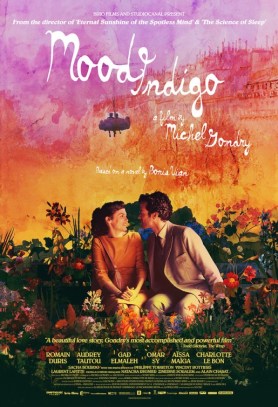
Mood IndigoMichel Gondry’s name is among the rarefied few that can serve as an indicator of sophisticated whimsy and off-center delights. Be that in his seriocomic collaboration with Charlie Kaufman with “Eternal Sunshine of the Spotless Mind” or even working within the Hollywood machine to produce a film adaptation of “The Green Hornet,” he puts an indelible stamp on anything he touches.

Yet even though Gondry made a film that many experts consider among the best of the 21st century, his film “Mood Indigo” hit a bit of snag in the United States. Despite opening in the director’s native country in April 2013, the film took another 15 months to wash up ashore here. And when it did, courtesy of Drafthouse Films, roughly 35 minutes did not make the voyage over.

Normally, I would not complain about a movie getting shorter; many auteur-driven projects could use some fat-trimming. But I would (and likely will) sign up for more of “Mood Indigo.” The film is a playground for the imagination staged within the confines of a beautiful, touching love story. Think of this “F.I.L.M. of the Week” as what might spring from the meeting of the minds between Jacques Tati and the Pixar brain trust.

This is a world where the fancy-free Colin (Romain Duris) can occupy his time trying to make the perfect “pianocktail” – a drink made and refined by how finely he can play the tunes on a grandiose piano set. Where he can float over the city of Paris in a cloud-like Ferris Wheel booth with the girl that catches his eye, Chloé (fittingly played by Audrey Tautou of the charming “Amélie“). As their tragic love story progresses, Gondry never wastes a moment to take our breath away. Virtually every frame is packed with some kind of gadget, gizmo or trick that reminds us of the ingenuity behind the film. Perhaps others could have told this tale of star-crossed lovers, but I remain unconvinced that anyone could make it more of a marvel than Gondry.


REVIEW: Swiss Army Man

29 06 2016

Swiss Army Man PosterFor what was likely the better part of a decade, I spouted off the line “Better out than in, eh?” from the movie “Shrek” without really knowing what it meant. The maxim refers to passing gas, of course, but the true and deeper meaning eluded me for quite some time. What the crude ogre really says relates to being yourself and embracing the stench rather than letting something you need to expel bottle up inside.

15 years later, “Better Out Than In” could be an alternate title – or at the very least a slogan – for the Daniels’ “Swiss Army Man.” (The directing duo Daniel Schienert and Daniel Kwan make it easy on everyone and go by just “Daniels,” like Madonna or something.) The movie has farts and flatulence to spare, but they are not some kind of sophomoric gag for easy laughs. Farts serve as a hilarious, self-effacing encapsulation of the film’s thematic heft. We have to embrace that which other people – and society as a whole – want us to keep inside. Sometimes, we even have to let it out, no matter how sloppy, stinky and unpleasant it might turn out.

Farts save the life of Paul Dano’s Hank, a depressed drifter about to hang himself in his beachfront isolationism. He hears them coming from Daniel Radcliffe’s Manny, a corpse (yes, you read that correctly) that washes ashore just moments before he tightens the noose. In many ways, the two men are ironic contrasts at first meeting. Hank may be the living, breathing and functioning human, but the involuntary toots make Manny’s lifeless body more animated than him.

From there, the film enters into a truly Gonzo realm – especially once Manny becomes more than a human-sized sack of potatoes for Hank to lug around on his back. The Daniels take daring absurdist leaps where the boundary between miracle and hallucination is never quite delineated. In a rustic playhouse of imagination that recall the most vividly realized creations of Michel Gondry, Hank begins instructing Manny on how to function in the world.

Read the rest of this entry »