F.I.L.M. of the Week (March 31, 2016)

31 03 2016

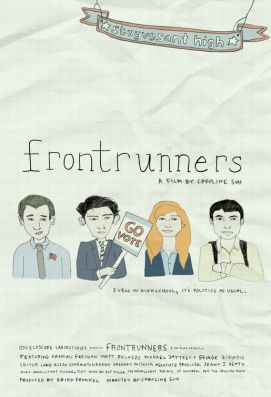
FrontrunnersPersonal attacks. Passive-aggressive jabs. Sexist insinuations. Classist assumptions. What a campaign, am I right?

Oh, did you think I was talking about the 2016 Presidential race? No, sorry, I was referring to Caroline Suh’s wonderful documentary “Frontrunners,” a document of a high school student union presidential election. This is hardly an ordinary educational institution, though; the film takes place at New York City’s Stuyvesant High, an elite specialized high school with a formidable alumni roster. The outcome of this race helps determines the future leaders of America. (Go Facebook stalk the subjects and see what they’re up to these days. Seriously.)

What elevates this account of a campaign turned venal to “F.I.L.M. of the Week” status is the seriousness with which Suh presents the proceedings. Fictional films like Alexander Payne’s “Election” use high school student government as a stage upon which to satirize the dysfunction at the federal level. “Frontrunners” views these events as important and worthy of consideration in their own right. One approach is not automatically better than the other, but it is nice to see adolescent civics dignified with such an earnest presentation.

Aside from the occasional input from the organization’s faculty advisor, “Frontrunners” is a film about the students told by the students. The profile of each of candidate essentially consists of what they reveal during in-the-moment interviews and how they act in public. All are making strategic calculations based on their understanding of the student body, both in terms of the platform on which they run and how they present their candidacy. Turns out, the Stuyvesant students are hard to pin down and predict. While it might not hold a candle to the unpredictability in 2016 thanks to the Donald, “Frontrunners” contains plenty of surprising developments and shocking moments to make the election a nail-biter up to the announcement of the winner.


REVIEW: Everybody Wants Some!!

30 03 2016

SXSW Film Festival

After completing the arduous shoot of “Apocalypse Now,” director Francis Ford Coppola famously remarked, “My film is not a movie. My film is not about Vietnam. It is Vietnam.” Writer and director Richard Linklater, brilliant though he is, seems to lack Coppola’s penchant for bombast or self-promotion. So, if I might, I would like to say what I doubt Linklater ever would about his latest film, “Everybody Wants Some!!

“Everybody Wants Some!!” is not a film about college. It is college.

For the roughly two hour runtime of Linklater’s so-called “spiritual sequel” to “Dazed and Confused,” I did not merely watch a representation of college-aged males running amuck. I was transported back to my own college days – never mind that the film takes place in 1980, when my dad first enrolled. The cars, the hair, the music and the outfits might have shifted in the four decades between then and now, but the more things changed, the more they stayed the same.

I have praised many a college movie, from Noah Baumbach’s sardonic “Kicking and Screaming” to Lord & Miller’s farcical “22 Jump Street” and even the animated with Pixar’s “Monsters University.” Those movies can hardly hold a candle to “Everybody Wants Some!!” I recognized every single character in the film as having some analogous counterpart in my own life. This may have a little something to do with the fact that Linklater is, like myself, a Houston native and very familiar with that distinctly Texan strain of the “bro.”

I suspect, however, that my reaction comes less from geography and more from ethnography. The film is not rooted in place or time, though each definitely leaves a stamp. Rather, it is about the full college experience and all it entails. “Everybody Wants Some!!” celebrates that very unique freedom of the period between being someone’s kid and being someone’s parent. It’s the rare occurrence where liberty comes with hardly any repercussions or responsibilities. The now matters more than the future, and everyone collectively agrees to enjoy it.

Read the rest of this entry »


REVIEW: Batman v Superman: Dawn of Justice

29 03 2016

I miss Christopher Nolan. Never mind that it has been less than four years since his final Batman film and fewer than 18 months since his most recent directorial effort, “Interstellar.” He understood that the scope of a sprawling comic book movie could be an epic canvas for ambitious thematic and aesthetic content, not just an excuse for bombast and branding.

He has, inexplicably, turned over the keys to the kingdom to Zack Snyder, a director full of sound and fury that signifies nothing. He has an eye and a knack for style, to give him some credit, but Snyder never deploys it in use of a story or an idea. He’s all showmanship for its own sake – surfaces above substance, declaration over development.

As if 2013’s “Man of Steel” was not nauseating enough, he arrives with an “Avengers”-ified sequel in “Batman v Superman: Dawn of Justice.” It’s roughly the cinematic equivalent of Kim Kardashian’s “Break the Internet” magazine cover. Call it “Break the Box Office,” if you will, as it’s already crushing at the box office this year. The film is practically incoherent and only gets more pointless and frustrating with each new turn. With each successive insipid development, the experience is as numbing as it is infuriating.

Snyder is more concerned that we notice the giant CGI pearls snapped at the murder of Bruce Wayne’s mother than providing context or rationale for this universe in which the film takes place. So two superheroes, Batman and Superman, have been living across the water from each other … and that was not worth mentioning in “Man of Steel?” While it’s nice that the film does not waste time rehashing an origin story, clearly Ben Affleck’s Batman is much different than Christian Bale’s. He’s more overtly villainous and cynical – but why?

Perhaps these questions might have been answered in the many scenes left on the cutting room floor. These crucial contextual bits are more important than ever as they could give the franchise a headwind as it launches a bevy of spinoffs and sequels. Marvel movies are bearable because their brain trust actually cares about their characters. They might ultimately succumb to formulaic plots, sure, but they at least understand that audiences want to get attached to these larger-than-life figures. Come and forget the action, stay and remember the characters.

Read the rest of this entry »


REVIEW: Kill Your Friends

28 03 2016

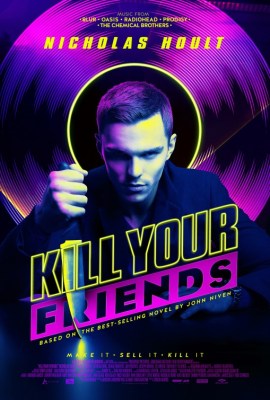
Kill Your FriendsThe black comedy “Kill Your Friends” might bill itself as satirical, though it hardly ever veers into farcical or absurd territory. In fact, many parts of the film feel all too real and accurate. The lead character, Nicholas Hoult’s loathsome yet endearing A&R rising star Steven Stelfox, speaks boldly about how the keys to his success mainly involve ignoring artistry and holding listeners’ taste in contempt.

Sound exaggerated? It shouldn’t. Heck, it should sound familiar. That same mentality drives not only the music business but also the movie industry … and probably just about any mass-produced art form, for that matter. It’s far easier for the powers that be to manufacture and then force-feed a style or product down the public’s throat. Tell them what they need; do not take the time to listen to what they want.

As can be gleaned from the film’s title, “Kill Your Friends” follows Steven as he lets the insecurities of a fear-based industry drive him to illogical extremes. The transformation is hardly accidental or unconscious, either. Steven has a winking, knowing participatory role in his moral descent and corporate ascent. He functions quite a bit like Jordan Belfort in “The Wolf of Wall Street,” our slithering guide through the underbelly of an industry thriving on the pursuit of pleasure (and copious controlled substances).

Hoult’s performance, however, recalled another actor for me – a young Tom Cruise, maybe circa-mid 1980s. His Steven is cocky, self-assured and somehow completely magnetic. The confident attitude is merely his shield, albeit one that he wields well, to fend off any doubters of his performance. Yet he is far from perfect in maintaining the ruse. Tough as he may seem, the thought of having to substitute smarts for swagger absolutely terrifies Steven. “Kill Your Friends” proves most compelling during the moments when Hoult allows Steven to let his guard down and lay his insecurities bare … though his unhinged mayhem comes in a very close second. B+ / 3stars


REVIEW: Alex of Venice

27 03 2016

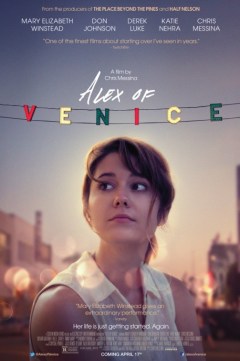
Alex of VeniceAlex of Venice” is the filmic version of the kind of “sad comedy” that thrives on a basic cable or streaming service. Perhaps, after binging five hours, it would feel like a satisfying, whole portrait of a woman rocked by the twin disasters of her marriage dissolving and the health of her father deteriorating. But it’s really just the first two episodes.

We get a decent idea about who Mary Elizabeth Winstead’s Alex is as a person, though we never get the kind of deep dive that a filmic character study normally provides. There is something quietly courageous and inspiring about her tenacity through all the responsibilities she must juggle. As mother, daughter/caretaker and de facto head of house, Alex barely has time to do her job as provider. She does not just have one of those bogus movie jobs either; Alex is waist-deep in trying a major environmental case.

Director Chris Messina has worked with a number of great female talents in his time – Nora Ephron, Gia Coppola and quite extensively with Mindy Kaling on television’s “The Mindy Project.” It’s clear that he wants to replicate their earnestness in addressing what it means to be a woman in today’s world. But good intentions are not enough to salvage this undercooked, underdeveloped script from Jessica Goldberg, Katie Nehra and Justin Shilton. “Alex of Venice” feels halfway onto something good. Too bad it stops so short of its potential. C+2stars


REVIEW: 10 Cloverfield Lane

26 03 2016

I scarcely remember anything that happened in 2008’s “Cloverfield,” though I will never forget the nausea-inducing vertigo its constant shaky-cam gave me. I have a vague recollection of seeing the monster at the end (sorry if that spoiled something for anyone) and some kind of government cover-up of the whole thing. In other words, nothing had me clamoring for a sequel or offshoot.

Yet along comes “10 Cloverfield Lane,” directed by Dan Trachtenberg, written (to some extent) by “Whiplash” wunderkind Damien Chazelle and presumptively overseen by producer J.J. Abrams – and all of a sudden, they showed me that I did not know what I wanted. How refreshing to see a brand extension that serves as a brand revitalization. Rather than relying on the formula, mythology or beats of its predecessor, this bold new path in what now is supposedly a franchise delivers exactly what we need by giving us nothing we expected.

Most people remember “Cloverfield” chiefly for its marketing campaign. “10 Cloverfield Lane” arrived like Adele’s “25,” a teaser out of nowhere with the full product dropping shortly after. Ironically, the lead-up hardly presaged the experience. While the anticipation “Cloverfield” ultimately revealed thin substance, the somewhat muted hype machine surrounding “10 Cloverfield Lane” was only scratching the surface of the film’s tremendous impact. Trachtenberg’s film is like a master-class in suspense building, expertly and tautly edited to ratchet up the heat in every scene until it reaches a boiling point. In many ways, it could not be more different from “Cloverfield,” whose verité live video style relied on overwhelming the senses to communicate urgency and danger.

Read the rest of this entry »


REVIEW: Krisha

25 03 2016

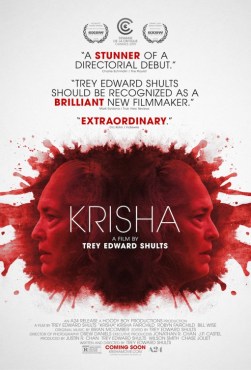
KrishaAs much as I would like to say that I watch all films as they are meant to be seen, in a theatrical venue with an audience, that is not always the case. I saw upwards of 200 new releases in 2015 alone, which means that not all of them got such a favorable viewing experience. Some are squeezed in across several days; others, endured at the end of a five-film day at a festival.

I gave Trey Edward Shults’ “Krisha” perhaps the ultimate short shrift: an iPad viewing on a Monday night (Tuesday morning) at 12 A.M. by necessity before a digital screener link expired. I wanted to go to sleep after a long weekend but needed to watch the film, so I curled up in bed with my iPad and hit play. Yet, oddly enough, this quasi-dreamlike state proved quite the perfect state in which to experience this surreal yet all too real drama.

The film, just 80 minutes in duration, follows the struggles of the hot mess Krisha (Krisha Fairchild) as she fumbles her way through a Thanksgiving at the home of some estranged relatives – including her son. What unfolds is far from the standard kitchen-sink family melodrama. “Krisha” goes back and forth between two opposite sensations. Shults can make the viewer feel like an active presence in the room, observing the proceedings and recognizing their painful dialogues as ripped from real life. But he can also provide the perspective of an outsider watching Krisha’s meltdown through a funhouse mirror.

The constantly shifting pendulum induces slight whiplash, though it also brings about a masterful disorientation. Using the same technology most filmmakers employ to capture the world exactly as it is, Shults produces a hallucinatory and fantastical effect that frequently eludes creators working with eight-figure effects budgets. He turns the limitations of his ultra low-budget indie into the very essence of its strength, either by creatively maximizing his minimal resources or finding ingenious workarounds.

And I fought off my tiredness to marvel at the wonder that is “Krisha,” I found myself frequently wondering whether I had just watched something in Shults’ film or just dreamed it up in my sleep. I often rewound the film by a few minutes to make sure. Most times, the crazier, riskier and downright unbelievable things were on the screen – not in my head. B+3stars


F.I.L.M. of the Week (March 24, 2016)

24 03 2016

A Royal AffairI’ve been pressed (in person) by two loyal readers who want to know the rationale behind my aversion to period pieces, in particular the so-called “costume drama.” I do try to elucidate when I hold an entire genre or subgenre in contempt – see my pans of “The Young Victoria” and “The Invisible Woman” as well as my praises for “Mr. Turner” and “Far from the Madding Crowd” for examples.

It essentially boils down to this: save your threads for the museums and the palaces. If you have something to say about the past that has some relevance to contemporary society, then tell your story as extravagantly as you like. Nikolaj Arcel’s “A Royal Affair,” which depicts the painful struggle to enlighten Denmark, is such a film with real heft for modern times. As such, I am happy to name this lavish costume drama my “F.I.L.M. of the Week.”

Prior to Alicia Vikander winning the Oscar, and being in every other movie you see, she starred here as British royal Caroline Matilda, who gets unceremoniously married off to Danish king Christian VII (Mikkel Følsgaard). Once she produces an heir to secure the political bond between the two nations, Caroline mentally checks out in their marriage having fulfilled her duties. It’s not like she gets anything in return from the mentally unstable – and actually, quite disturbed – Christian.

Enter Mads Mikkelsen’s Johann Friedrich Struensee, originally brought in as a personal physician to Christian but ultimately a man of much greater influence. A disciple of Rousseau, his reason and rationality begins to inspire Christian to pass progressive reforms in his own country. Struensee also finds a captive audience for his learned views in Caroline, who is also in need of romantic and sexual fulfillment. The resulting fracas that plays out in “A Royal Affair” feels entirely relevant as, sadly enough, governments still reject common sense legislation and subjugate (or at least fail to prioritize) the needs of women. So, indeed, I found a reason to care about these people in lush wardrobes. Our struggles are still theirs.


REVIEW: My Big Fat Greek Wedding 2

23 03 2016

At this point, anyone who goes into the sequel of a decades-old comedy expecting it to rival the original ought to have their head checked. After “Anchorman 2,” “Dumb and Dumber To” and “Zoolander 2” each spent more time paying homage to the original as opposed to breaking from it, perhaps the best audiences can hope for is something that does not spoil the legacy. As sad a thought as setting the bar low might be, at least it can help mitigate the disaster.

Thankfully, “My Big Fat Greek Wedding 2” seems to avoid most of the pitfalls of the previously mentioned films. The answer to the question of “is it better than the original?” is, of course, no. But to “is it good enough?” Yes, it pretty much is.

Writer and star Nia Vardalos brings back all the familial tensions, marriage anxieties and Windex that people loved in her unexpected 2002 smash hit comedy while also leaving plenty of room for new jokes and humor. It might not flow as effortlessly the second time around, but the characters show impressively few signs of rust after 14 years.

The chief difference in the film is that Vardalos’ Toula is now on the other side of marriage and courtship. After the ordeal that was tying the knot with a non-Greek “xeno,” she must now contend with her teenage daughter, ironically named Paris (Elena Kampouris), reaching the age where the Portokalos family deems her ready to waltz down the aisle. But, in a twist similar to “Father of the Bride – Part II,” she winds up dealing with an unexpected life course event from some older relatives.

The antics of the family, who remarkably all returned for the sequel, remain consistently hilarious. Even if they do not reach the instantly quotable levels of the original “My Big Fat Greek Wedding,” Vardalos can still deliver the lines and the laughs. She wisely embraces just how many deep cuts there were in the first film, making some references that only the die-hard fans who watched the movie a hundred times on HBO and TBS will catch. (Guilty as charged.) Watching as she continues to mine these characters for humorous moments remains a delight – certainly enough to redeem the occasional plot contrivance or corny line. B+3stars


REVIEW: Knight of Cups

22 03 2016

Knight of CupsWith “Knight of Cups,” wunderkind Terrence Malick frees himself even further from a plot-based cinema than he had in art-house darling “The Tree of Life” and head-scratcher “To the Wonder.” In many ways, it is refreshing to see him further embrace the kind of elliptical, free-floating style that he seems to dabble in more and more with each film. At last, he has devised something from his footage that feels fully and truly avant-garde, where the motif is the basic building block of understanding rather than events in the story.

If “The Tree of Life” was Malick’s version of the Gospel, then “Knight of Cups” is his most vividly realized visual Psalm. Everyone consistently seems to acknowledge or call upon the divine, a presence they can sense but onto whom they never fully latch. This anguished yearning even changes Malick’s most recognizable visual device – the close-up of the hand running through some sort of greenery. In “Knight of Cups,” characters stretch out their hands yet reach for air as if to make it palpable to no avail. Rather than connect with God through the earth, as plenty an ethereal Malick character has done, these empty Hollywood types grasp at straws.

Beyond some of the blatant religious symbolism, it’s hard to tell where purposeful planning ends and happy accidents captured by the lithe camera of Emmanuel Lubezki begin. A shot of three men arguing on a roof that is interrupted by both a plane and a helicopter flying overhead – which the camera tilts up to capture – cannot be pre-visualized, right? As beautiful as his floating mobile shots can be, they often capture levels of acting on par with a commercial for a local car dealership. (This is especially prevalent in the film’s big house party scene, which improbably features Thomas Lennon, Joe Lo Truglio and Nick Kroll among the more high-minded likes of Antonio Banderas and Jason Clarke.)

There are plenty of mixed Biblical metaphors, too. Malick seems to dance around between Cain & Abel, Sodom & Gomorrah and more along with plenty of other admonishments of licentious behavior. The false angel presiding over the simulacra known as Las Vegas pretty much says it all. But ultimately, the “what” feels less important than the “how,” the form and experience more relevant than the content or comprehension.

Why on earth Christian Bale’s movie mogul lothario needs six different women to reach a point of self-actualization and reckoning with his family tragedy seems beside the point. So long as one can place themselves in the right frame of mind, the abstract delve into his world proves quite immersive, immediate and impactful. B+3stars


REVIEW: The Good Dinosaur

21 03 2016

Pixar charted course for a brave new world in 2015 by creatively mapping out the mind in “Inside Out.” Oh, and they also released “The Good Dinosaur.” Perhaps in a different context, the film might feel like less of an afterthought for the animation studio. In reality, though, this lovably sweet movie is roughly on par with “Brave” or “Monsters University.”

If the 2015 Pixar films were siblings, then it could be said that “Inside Out” got the brains and “The Good Dinosaur” got the looks. The former seems to have hoarded the brain trust and story department, while the latter monopolized the visual technicians. Neither severely lacks in one area – though their strengths are definitely distinct. “The Good Dinosaur” probably represents some of Pixar’s most photorealistic animation to date; several scenes looked as authentic as Disney’s 2000 film “Dinosaur,” which placed CGI creatures in scenes shot by real cameras.

While the trademark Pixar creativity and ingenuity might not be on vivid display in the film, at least they got that same heart. “The Good Dinosaur” refers to Arlo, an apatosaurus who was the runt of his litter and thus struggles to prove himself among his more able-bodied siblings. He makes for a true underdog, yet the Pixar team somehow finds a way around the lazy assumption that audiences will just automatically rally behind his improbable journey which has become de rigueur in filmmaking these days.

No matter toys, robots or emotions, Pixar finds the humanity in each of their characters. This truth is especially ironic in “The Good Dinosaur” given that the dinosaur is the loquacious one and the human is the non-verbal, primal creature. The film takes place in an alternate reality where the big meteor that scientists believe wiped out the dinosaurs failed to make impact, allowing humans and dinosaurs to coexist. A little silly, sure, but the gambit works for plot purposes as the young feral caveboy Spot becomes necessary for Arlo to find his way home after getting separated from his family. As it turns out, the uncivilized and the civilized have something to offer each other after all.

Their adventures might not reach the heights of previous Pixar classics, but “The Good Dinosaur” is still authentically sweet and truly genuine through and through. Even outside of their game changers, Pixar’s indisputable charm is still worth the time to experience and enjoy. B2halfstars


REVIEW: Baskin

20 03 2016

BaskinFantastic Fest, 2015

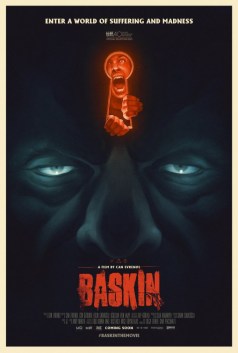
Can Evrenol’s “Baskin” was billed at Fantastic Fest as a new vision of hell from an exciting young filmmaker, just the kind of thing you go to festivals to discover. I mostly just discovered how tired I was at the end of that day. But even if “Baskin” was movie #1 at 8:30 A.M. instead of movie #5 at 11:15 P.M., little would change.

The film is somewhat like “Drag Me To Hell,” except maybe more aptly titled “Put Me To Sleep.” For all the talk around the film’s originality, Evrenol’s hell sure felt a whole lot like a standard-issue haunted house. After five Turkish cops plunge into the afterlife following a car accident, they get treated to a compendium of gross-outs in a confined edifice.

“Baskin” does not rely on the classic jump-out scares, at least, but the only thing Evrenol offers in place of it is shock value. And that isn’t much better. One of the minor pleasures of the film is Evrenol’s commitment to his unapologetically whacked-out envisioning of the devil’s domain. But the absence of taste does not always guarantee the presence of art. C2stars


REVIEW: Hello, My Name Is Doris

19 03 2016

Hello My Name Is DorisAs a child, I got quite a bit of enjoyment from watching Sally Field’s face become animated with emotion – chiefly, in “Mrs. Doubtfire.” (That dinner scene. Priceless.) Michael Showalter’s “Hello, My Name Is Doris” recognizes her gift for telegraphing emotion and amplifies it. The problem is that he allows scarcely any of her considerable talents to shine through.

As Doris Miller, a quiet accountant and caregiver for her late mother, Field’s performance is half authentic emotion and half GIF-able moments. Whatever humanity might be in the script for Doris gets squandered by her overly burlesqued acting that turns the character into more of a joke than an object of our sympathy and affection.

After her mother’s funeral in the first scene, Doris’ attention can go in any number of directions. (Her brother and sister-in-law hope she will clear out all the items she hoards away.) She choose to invest her energy in pursuing a much younger co-worker, Max Greenfield’s John Fremont, for whom she has the hots. Far too often, his boyish good looks reduce her to little more than a fantasizing teenage girl. That’s not to say all women of a certain age on screen must conform to a narrow model of proscribed behavior, but she is the joke of the scene far more often than she is the heart of it.

The flimsiness of character’s personality is only hampered by the silly, cliche-riddled script of “Hello, My Name Is Doris.” Bonus points for not having the slightest idea of how Facebook works in 2016. Field deserves something better to work with for her first step into the leading woman spotlight in quite some time. C+2stars


REVIEW: The Bronze

18 03 2016

The BronzeUnlikable characters do not automatically guarantee an unwatchable film (see, for example, Jason Reitman’s criminally underrated “Young Adult“). But the keys to success in such an uphill battle for sympathy lie in encouraging identification. These people are like some part of us, whether we want to admit it or not. Flawed figures allow us to embrace, and perhaps even correct, such shortcomings.

The chief issue with Bryan Buckley’s “The Bronze” is that it does not understand this fundamental truth about the prickly protagonist. Instead of placing us at eye level with Melissa Rauch’s heinous Hope, a jaded bronze Olympic medalist turned complacent hometown hero, the film puts us at a position above her. We are meant to look down at her pathetic, juvenile antics. The experience is less like watching indie cinema and more akin to reality television, complete with absurd dialogue (“Are you insane? Why are you insane?”) and hokey plot twists visible from a mile away.

Rauch gives her all to the character, constantly contorting her face into a snarl that makes infinitely meme-worthy Kayla Maroney look friendly. The expression would feel like an extended parody of Olympian attitudes were it not such an accurate representation of her pitch-black soul. As she selfishly tries to sabotage the chances of a potential protege, “The Bronze” adds insult to injury to the experience of watching by primarily indulging her childish whims. This might work as a teen movie, but we are watching an adult.

To be fair, “The Bronze” does earn some points in the final round by exposing a surprise and slightly enlightening motivation behind her appalling actions. But by that point, the film is so far away from the medal stand that it makes scant difference in the grand scheme of things. C+ / 2stars


REVIEW: Deadpool

9 03 2016

Deadpool” begins with an opening credits sequence that lists each member of the creative team not as people but rather as their archetypes – along with plenty of gratuitous winks to star Ryan Reynolds and the celebrity culture at large. The montage more or less represents the film as a whole: clever but not ingenious, distinct but not original.

Reynolds struts around the film like he is the first person to don a superhero suit and not fit the mold of a straight-laced all-American macho man. The foul-mouthed average joe act was done in 2010’s “Kick-Ass,” and the relentless smart-ass routine has been beaten into the ground by Robert Downey, Jr. beginning with 2008’s “Iron Man.” There’s nothing particularly novel about the “merc with a mouth” (that stands for “mercenary,” apparently) although Tim Miller and his band of four credited screenwriters certainly try their best to convince audiences otherwise. The level of self-satisfaction and self-effacement proves irritating to a fault, though.

For all the Deadpool character tries to subvert the superhero cliches, his story sure plays out a lot like one. “Deadpool” is a garden variety origin story, from Wade Wilson’s humble beginnings to love interest (Morena Baccarin’s Vanessa) down to acquisition of special power and, ultimately, mastery of that gift. The film relies on formula as a narrative throughline so it can indulge in self-referentiality and humorous sideshow diversions. If “Deadpool” is a reaction to the banality of the genre, it does little to improve upon the recognizable flaws.

That also goes for the character of Deadpool, supposedly a more “progressive” superhero with his ambiguous sexuality. But he speaks with a higher voice. He totes around a pipe cleaner penis. He makes frequent Freudian slips about anatomy. For heavens’ sake, HE PLEASURES HIMSELF WITH A STUFFED PONY. This is not the introduction of a pansexual hero. “Deadpool” just repackages old prejudices and appeals to homophobic instincts by making any non-normative behavior from Wade into the butt of a joke. It’s comedy as con artistry. C+2stars