REVIEW: Mustang

2 01 2016

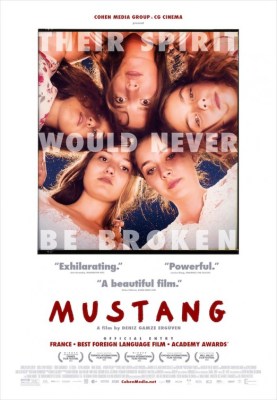
MustangDeniz Gamze Ergüyen’s “Mustang” tells the story of five orphaned sisters trying to girls when the societal forces around them are conspiring to turn them into women. In their oppressively provincial Turkish town, the overwhelming sentiment becomes that each sister needs to be married off for their own sake. After a harmless incident with some local boys, their reputation could forever become that of harlots if not wrangled into polite deference.

Ergüyen, along with co-writer Alice Winocour, nicely illustrate just how old-fashioned assumptions and attitudes towards women are in the girls’ milieu. Be it voices on the radio demonizing working mothers or the concept that a legitimate punishment for a soccer team could involve playing a game in front of a solely female crowd, misogyny abounds in their northern Turkey community. With all due respect to “Mad Max: Fury Road,” I think “Mustang” may just be the 2015 release that best exposes the stifling hegemony of patriarchal power.

Perhaps it is just the nature of reading subtitles, but these larger structures and institutions limiting the sisters feel presented with very little subtlety. The sexism and outdated customs become so obvious that it makes their rebellion a rather obvious development. They also take up so much attention throughout “Mustang” that it depersonalizes the girls, making them better as instruments to illuminate important themes than as deeply realized human characters. B2halfstars


REVIEW: Sicario

30 12 2015

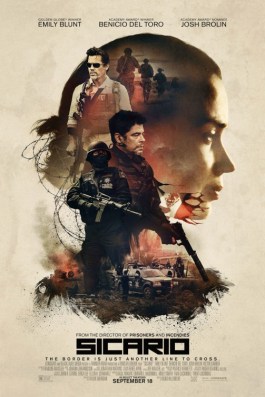
SicarioIn Denis Villeneuve’s “Sicario,” the border is not a mere setting. It is the very subject of the film.

And not just the U.S.-Mexico border, either. Of course, that line serves as a shorthand for a number of the film’s dialectical battles: chaos vs. order, civility vs. barbarism, domestic vs. foreign. But none of these provide any easy demarcations like the fence does; these divisions prove far more permeable.

The uncertainty, and even dread, that comes with such free exchange gets echoed in every aspect of “Sicario.” It starts in the script and gets amplified in the direction, the acting and even the photography. Cinematographer Roger Deakins tells the story primarily through two contrasting shots: hovering aerial landscapes and tightly-held close-ups. The first showcases a vast, unfeeling terrain that dwarfs all human activity. The second, though a smaller canvas, provides an equally robust commentary on the men and woman traversing the territory.

Though mere chess pieces in a much larger board game, the minute details of how each characters processes information and suppresses emotions provide a second layer of story running throughout “Sicario.” No face receives more attention than that of Emily Blunt, who plays the film’s protagonist, FBI agent Kate Macer. Practically every scene in the film happens twice, first as it unfolds and then again as reflected through Kate’s face.

Blunt’s performance is screen acting at its finest. Villeneuve and Deakins maximize ability of the camera to pick up the smallest of twitches and motions, which might otherwise be imperceptible to the naked eye. Rarely has the quiver of a lip as it gulps down the smoke from a cigarette registered so much. Blunt makes her character the farthest thing from a blank slate, ensuring that each infinitesimal shift of her face reveals her fast-racing mind. To that end, Kate’s big, explosive scene unfolds in a shot taken from a great distance where her emotions remain obscured. She’s a compass, steadfast but still a little shaky.

Read the rest of this entry »


REVIEW: Steve Jobs

27 12 2015

I have no qualms in saying that, in high school, the discovery of Aaron Sorkin’s writing completely changed the way I thought about how people could talk in fiction. Here were characters that spoke with purpose in every line, both illuminating their inner thought process and highlighting the themes of the work. (If you doubt its influence, just read the play I wrote my senior year that falls somewhere between a love letter to and ripoff of Sorkin.)

The more I rewatch “The Social Network,” however, the more I realize that the heft of the content is the real star of that script. The delivery in “Sorkinese” – as many have come to call it – serves to enhance, not replace, that treasure trove of insights into class, status and social structure in contemporary America. The hyperexpressive dialogue feels justified practically by the bulk of commentary that the characters must convey – and, remarkably, tomes are still left unsaid.

Sorkin’s latest script, “Steve Jobs” (adapted from Walter Isaacson’s authorized biography of the same name), narrows its focus from the revolutionizing of society to a man with the vision to spark such revolutions. As the man whose inventions shook up telephones, personal computing, animation, publishing and music, Jobs feels like a natural subject for Sorkin given his obsession with grandiloquent geniuses. Even his work on the script for 2011’s “Moneyball,” which praised the empirically driven philosophy of Oakland Athletics manager Billy Beane, evinces his fascination with people who innovate in spite of steep institutional pressure to maintain an inefficient status quo.

Yet, at the same time, choosing Jobs as someone to speak Sorkinese fluently smells a bit like a man trying to cast God in his own image – and not the other way around. The stylized dialogue flies rapidly in “Steve Jobs,” which is not entirely dissimilar from “The Social Network.” But here, the metaphors and arcane cultural references are delivered in a continual walk-and-talk, not in such visibly formal settings.

Sorkin chooses to stage his drama within the confines of a backstage drama (as opposed to the courtroom drama of Zuckerberg’s saga), a style which generally portrays characters with their guards down and speaking with their guards down. Jobs was undoubtedly smart enough to talk as Fassbender’s portrayal of him does, though it feels somewhat stilted and artificial.

Read the rest of this entry »


REVIEW: 45 Years

26 12 2015

45 YearsAndrew Haigh’s “45 Years” provided me a joyously maddening experience the likes of which I can honestly say I don’t think I had felt since “The Wolf of Wall Street” back in 2013. As these movies rolled into their conclusion, I thought I had completely made up my mind about them after seeing a relatively homogenous product throughout.

Then, a brilliant final shot flashes before the credits, and I am left reeling. Given a new picture with which to reframe everything, I have no choice but to dwell on it much longer than I had anticipated. Haigh’s film has the benefit of being literally half the length of Scorsese’s, so the bait-and-switch feels a little less frustrating. But what to make of a film that feels relatively monotone for 90 minutes only to crescendo out of the blue?

I don’t think this qualifies as a “spoiler” to discuss the close of “45 Years” so heavily; this stunning shot is not any kind of plot twist. It simply casts the rest of the film’s events in a much different light, and it does so with forceful impact.

Most of “45 Years” unfolds like a chamber play between the greying Mercer couple, Kate (Charlotte Rampling) and Geoff (Tom Courtenay). His declining health prompts the celebration of their anniversary at a rather odd interval – the 45th year – and things only getting stranger with a bombshell revelation that comes in the post the week of the event. This news, seemingly simple, sends shockwaves through their long marriage that have profound, lasting implications.

The inciting event is nothing too spectacular or far-fetched, and it only serves to inspire a muted, grounded reaction from the principal cast. Haigh stands back and lets the camera observe them taking in the ramifications. This has a particularly haunting effect when following Rampling, whose character recalls Jimmy Stewart’s Scottie from “Vertigo” in her determined wandering. The tone gets established early and remains consistent throughout, almost allowing the film to lull the viewer into a certain complacency…

…only to receive the jolt of the final shot, carried by Rampling in an extraordinarily devastating fashion. I feel like I could watch this scene on YouTube again and again, and part of me wonders how much I really need the hour-and-a-half vamp of “45 Years” to receive the gut punch at the same strength. B+3stars


REVIEW: The Mend

25 12 2015

The MendMovies that toy around with genre, tone and mood rarely sit well with me. (Uneven is my choice word for such experiences.) Occasionally, such experiments work, and I am more than happy to garner lavish praises on films that do. The vast majority, however, are just scripts with issues that needed fixing prior to cameras rolling.

Writer/director John Magary’s “The Mend,” on the other hand, is a film trying its hand in a number of different styles not to see how well they can blend. Rather, Magary attempts to see how porous the borders are between genres. He looks less for fluidity and more for malleability.

“The Mend” starts off like a literate Baumbach comedy both celebrating and mocking the New York intelligentsia. Once it seems settled, the film shifts into the character study of a slacker, Josh Lucas’ hapless Mat. This is the first movie I can think of that subverts Lucas’ good looks, not using them as an easy signifier for success or good favor. He’s all the better for it, drawing on darker parts of his persona to bring a more abrasive character to life.

Mat leeches off the success of his brother Alan (Stephen Plunkett), whose material successes continually attract the presence of his semi-estranged sibling. Tensions ratchet up slowly between the two of them, eventually reaching a boiling point in Alan’s cramped apartment. The explosion feels like something out of an Edward Albee play.

Does this mixture always work? Not necessarily. Certain sections are more compelling than others, making “The Mend” somewhat akin to that New York cabbie who alternates rapidly between the gas and the brakes. It’s a memorable ride – though definitely one that could have been a little smoother. B2halfstars


Social Scientists Behaving Badly (REVIEWS: The Stanford Prison Experiment and Experimenter)

24 12 2015

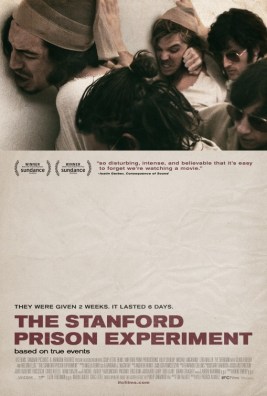
The Stanford Prison ExperimentIn my first semester of college, I took an introductory sociology class on a whim and wound up loving it so much that I added fifteen additional hours to my schedule to make it my second major. Ironically, in my final semester of college, two infamous experiments in the field of social science that captivated me in that first class made their way to the big screen.

Both premiered at the 2015 Sundance Film Festival, garnered respectable reviews and picked up distribution from heavy-hitting indie distributors. Though I’m reviewing them in tandem because the opportunity was too good to pass up, that’s pretty much where the similarities end.

Kyle Patrick Alvarez’s “The Stanford Prison Experiment” depicts a study in which professor Philip Zimbardo (Billy Crudup) threw college students looking for a little extra cash into a staged environment deemed unethical by most in his field. The assignment was simple: in a lab-created prison, each received an assignment of prisoner or guard which they were to act out. To say they began to take these roles a little bit too seriously is the understatement of the century as harmless animosity spirals out of control into actual violence.

At one point during the experiment, a colleague interrogates Zimbardo and asks him what independent variable he was measuring – that is, what change he was hoping to observe in his study. Zimbardo does not have an answer, and it’s hard not to feel like the movie is similarly grasping at straws when it comes to what exactly the experiment was trying to examine. Beyond mere power relations and the willingness of humans to commit atrocities against each other, “The Stanford Prison Experiment” does little to illuminate the intellectual concepts that make its titular event worth studying to this day.

It abandons academia for entertainment which, admittedly, it does a very good job of providing. Though audiences may not feel the film’s ideas piercing their brain, they will likely feel the emotional impact of the solid turns from this extraordinary cast. People will no doubt look at “The Stanford Prison Experiment” like people today look at “The Outsiders,” seeing strong performances from rising male actors. If you haven’t already, remember these names – Ezra Miller, Tye Sheridan, Michael Angarano, Jack Kilmer, Thomas Mann, Johnny Simmons, Logan Miller, Keir Gilchrist, Ki Hong Lee – because it will not be the last you hear from them.
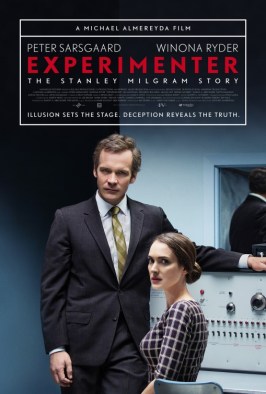
ExperimenterAlvarez would have done well to lean on the findings from the subject of Michael Almereyda’s “Experimenter,” Stanley Milgram. A social psychologist working at Yale in the 1960s, Milgram sought answers to how ordinary German people became complicit in the Nazi machine. In other words, he sought to find in science and data what Hannah Arendt described in theory as “the banality of evil.”

Almereyda’s film puts a heavy emphasis on process, using large chunks of the film’s beginning to detail just how Milgram (Peter Sarsgaard) went about obtaining his – pun fully intended – shocking findings. He meticulously devised an experiment in which an unsuspecting person would be asked to administer escalating electric shocks to someone else. No matter the pain that other person seemed to endure, the subject with the power to dole out the shock almost always continued if given the instruction to do so from an authority figure in the room.

Notoriously, Milgram was so horrified by the levels of obedience he found in America that he decided against testing his hypotheses in Germany. He controlled for any number of factors – the proximity of the person receiving the shock, the proximity of the authority figure in the experiment, even removing the subject from the setting of an academic laboratory. He got the same results nearly every time.

As a film, “Experimenter” loses a little luster with its less interesting forays into Milgram’s personal life and some didacticism. Milgram frequently breaks the fourth wall to go deeper into his findings, somewhat similarly to Frank Underwood in “House of Cards.” It starts off weird but eventually becomes normalized. Plus, Almereyda does plenty of showing the experiment that a little bit of telling to make sure no one misses the point feels fine.

But as a work about my other passion, social sciences, “Experimenter” reminds me of what I loved about the discipline. It celebrates the questioning of underlying assumptions we hold about social arrangements and then putting them to the test. I only wish it was around to show in a class or two when I was still in college. Hint to professors: this would make for a great Friday activity!

The Stanford Prison ExperimentB2halfstars
ExperimenterB+3stars


REVIEW: The Danish Girl

23 12 2015

In spite of the crusade by presidential candidate Donald Trump and his so-called “silent majority,” I still care about political correctness to the extent that it preserves the basic dignity of threatened groups. (Overreach is a separate conversation, however.) Words and language are powerful tools because they serves as outward reflections of inner ideas and beliefs. How society talks about a person as a part of the group with which they identify is important.

One such group that rightfully points out inadequacies in our vernacular is the transgender community. Many activists seek nothing less than the implosion of gender-based assumptions in the way we speak, a prospect as liberating for some people as it is uncomfortable for others. Every time it forces me to pause a little longer before speaking, I use that time to remind myself that these are above all people who just want the same respect to live their lives as any other person in society.

I try to stay on top of the latest developments in acceptable language – so this could be out of date – but the last I checked, it was a dubious practice to link anatomy to gender. (If this is no longer true, I welcome someone politely educating me.) Gender is a social construct, which may or may not correspond to a person’s biologically determined sex.

Tom Hooper’s “The Danish Girl” arrives in the heightened era of trans visibility; 2015 alone brought cultural prominence to Caitlyn Jenner, “Tangerine” and “Transparent.” The film tells the story of Eddie Redmayne’s transgender pioneer Lili Elbe, formerly Einar Wagener, as she seeks a then-radical surgery to remove the male organ that ties her to the sex she was given at birth. For someone so ahead of her time, it strikes me as rather ironic that the movie telling her story seems so behind its own time. Its assumptions surrounding gender and sexuality feel only slightly progressed from the 1930s setting.

Read the rest of this entry »


REVIEW: The Night Before

22 12 2015

If anyone is skeptical that our culture may be reaching a saturation of Christmas narratives, Jonathan Levine’s “The Night Before” ought to dispel that last shred of doubt. The film, co-written with Seth Rogen’s creative partners Evan Goldberg, Ariel Shaffir and Kyle Hunter, is a loving ode to just how much Americans love their holiday movies. The film pays homage to everything from “Home Alone” to “Elf” and even “Die Hard” during a crazy Christmas Eve shared by three old friends.

The Christmas movie appreciation leaks into the very fabric of the script, a half-baked attempt at making a stoner version of Dickens’ classic “A Christmas Carol.” (And with a bit of “It’s A Wonderful Life” as a cherry on top, to boot.) Only, instead of following one character, “The Night Before” splinters into three separate narratives bundled together.

The film follows Seth Rogen’s soon-to-be new father Isaac, Anthony Mackie’s recently famed pro quarterback Chris and Joseph Gordon-Levitt’s hapless musician Ethan on what could be their last Yuletide celebration … and not just because each is lucky to survive the shenanigans. Each guy gets their hilarious moments with a very game supporting cast, especially Isaac’s unnaturally supportive expectant wife Betsy (Jillian Bell), streetwise bandit Rebecca (Ilana Glazer), Ethan’s straight-shooting ex Diana (Lizzy Caplan) as well as Sarah, a character so Mindy Kaling-esque she had to be played by Mindy Kaling.

The film plays to the strengths of its ensemble so well that it becomes hard to spite the movie providing little more than the good time such a cast portends. “The Night Before” does not add up to more than the sum of its parts, mostly because the fragmented narrative never quite coheres by the end. It’s good for a laugh, but those hoping for a new adult holiday classic to play after the kids go to bed should probably just go for a repeat viewing of “Bad Santa.” B2halfstars


REVIEW: Concussion

21 12 2015

Peter Landesman’s “Concussion” is barely good enough to avoid a pun about the film causing its own kind of head trauma. It is not successful enough, however, to avoid one about the film’s facts and message hitting with unnecessarily blunt force.

Even though the message of this sports-related film rings depressing (rather than the usual uplift), “Concussion” can not avoid the temptations of the genre’s heavy-handed filmmaking. Like many a tale of this ilk, the film features an unlikely protagonist who must persevere against intense obstacles and opposition. Here, that person is not a player but a doctor, Will Smith’s Bennet Omalu. This Nigerian immigrant, perhaps more educated than an average bucket full of American citizens, lets his intellectual curiosity lead him to the discovery of a particular brain condition endemic to one group of men: ex-football players.

When Omalu breaks it down in the parlance that comes most naturally to him – science – the issue proves quite captivating. Framing the game of football as a series of shocks that the human body was not built to absorb makes his case strong. But when “Concussion” frames his struggle as one against a shadowy, monolithically evil NFL, the film falls completely flat. The silencing by commissioner Roger Goodell and the rest of the league probably happened, if I had to conjecture based on Goodell’s rather reckless actions over the past few seasons. Yet even as someone staunchly opposed to the league’s head honcho, the film comes off like a half-baked, crackpot conspiracy theory.

When a two-dimensional character goes up against a one-dimensional enemy, no one wins. Not the film. Not the issue. And certainly not the audience. C+2stars


REVIEW: Star Wars: The Force Awakens

20 12 2015

J.J. Abrams is perhaps the chief nostalgist of our time, and he often executes this fascination with such panache that we might as well call him a classicist. The reverence he pays to the films that inspired his own work serves to elevate those movies to a higher cultural plateau. And, as if anyone had not noticed the influence of “Star Wars” on a generation of moviegoers, they have definitive proof in the second relaunch of the franchise, “Star Wars: The Force Awakens.”

Abrams, working with original trilogy writer Lawrence Kasdan, finds that sweet spot between paying homage to the old and forging ahead with the new. The film’s action is primarily driven by two new heroes – the orphan girl Rey (Daisy Ridley) soon to discover extraordinary powers and ex-Stormtrooper Finn (John Boyega) who gains a conscience after witnessing the slaughter of innocence. They go up against a new sinister antagonist in Kylo Ren (Adam Driver), who works in tandem with the eerily fascist politician General Hux (Domhnall Gleeson).

Yet for all these new characters, there are also the old ones there in supporting roles – Han Solo, Luke and Leia Skywalker, Chewbacca, C3PO and R2D2 are all back. John Williams’ score livens up the film. The Millennium Falcon is back. Heck, Abrams even maintains the distinctive wipes and editing transitions from the original Lucas films. Anyone who feared drastic change in the series with the passing of the reins ought to be more than reassured by “The Force Awakens.”

The coexistence of the old and the new provides every bit as much tension as the plot, which I will continue to avoid discussing in any depth lest I reveal a spoiler. (I kept my head in the sand as much as possible regarding “Star Wars” news in order to experience the film with as fresh of eyes as possible, and it paid off.) Yet even with Rey and Finn as the primary engines of action in “The Force Awakens,” the film feels practically like a mirror image of the original 1977 “Star Wars.” This was no doubt intentional, I assume, but the amount of bowing Abrams performs before the mythology of the franchise keeps his film from standing as tall as it could.

Certainly future installments in the new “Star Wars” will go deeper and bolder, making an even greater case for the series’ relevance and importance. For now, though, this served its purpose to reawaken the vanguard of longtime fans and excite a new generation. I must say, I am on board for what comes next. B+3stars


REVIEW: Sisters

16 12 2015

The pure bliss of simply seeing Tina Fey and Amy Poehler reunited on screen for something other than an awards ceremony makes “Sisters” worth the price of admission. These two comediennes feed off each other in a way that no other pair can match, and there is never a dull moment since their live wire energy can always produce sparks.

Whether the material they work with is as good as they are, however, is another matter. “Sisters” piles on the raunch and the craziness, which is slightly out of their usual wheelhouse of safe for network TV antics. Paula Pell’s script is a hard R, and those laughs come somewhat at the expense of genuine characters.

The duo’s last big screen outing, 2008’s “Baby Mama,” found that sweet spot of believable exaggeration for both women, stretching responsibility and irresponsibility to rational extremes. “Sisters” casts Poehler as the good egg of the siblings, the youngest child who strove to overachieve out of genuine compassion for others, and it’s almost like getting to watch her play Leslie Knope again.

Fey, on the other hand, throws everyone for a loop by playing the callous, selfish older sister. It proves surprising, even jarring, to watch scenes where she is not the smartest person in the room. Heck, sometimes it even seems like it throws her for a loop. Tossing out insults and profanities – rather than receiving such barbs from the “30 Rock” cast – is something she gradually grows into over the course of “Sisters.”

Read the rest of this entry »


REVIEW: Macbeth

13 12 2015

MacbethRoger Ebert once famously quipped, “No good movie is too long and no bad movie is short enough.” This maxim seems to apply doubly so to Justin Kurzel’s take on the Scottish Play, William Shakespeare’s “Macbeth.”
Scripters Jacob Koskoff, Michael Lesslie and Todd Louiso take five acts from the Bard and condense them to under two hours on screen. Though no film need overstay its welcome, these screenwriters seem a little too eager to abridge the rich source material. Part of the experience of “Macbeth” is being able to observe the gradual changes in Macbeth and Lady Macbeth as the quest for power corrodes their souls. With fewer opportunities to see that conflict play out, it follows that their journeys feel a little less complete.

Having less Shakespearean verse tossed around plays to the strengths of Kurzel, a director whose films thrive on mood and ambiance. In both “Macbeth” and his debut, 2012’s “The Snowtown Murders,” collaborations with director of photography Adam Arkapaw have set brooding, haunting tones from expertly calibrated shots. Here, they focus on the landscape of the Scottish Highlands and how effortlessly it dwarves the characters who pass through it. At the very least, this helps differentiate his take on “Macbeth” from anything one could see on the stage, shrinking actors to mere cogs in the cosmos.

Unfortunately, he never quite finds a cinematic language that makes Shakespeare’s soliloquies feel as natural as the countryside vistas. Try as he might, Kurzel still remains at a bit of a loss as to how to present long stretches of uninterrupted dialogue, a convention audiences have decided to accept when framed inside a proscenium arch. The challenge has escaped many filmmakers, so he’s in good company. Fortunately, Kurzel has two incredible actors in Michael Fassbender and Marion Cotillard to deliver the dialogue and distract from any staginess.

Read the rest of this entry »


REVIEW: Hitchcock/Truffaut

12 12 2015

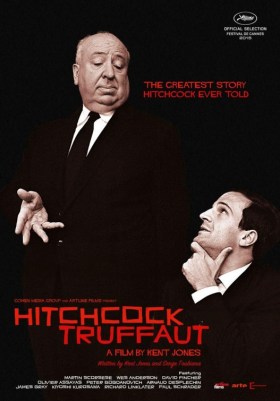
Hitchcock:TruffautThough Kent Jones’ documentary “Hitchcock/Truffaut” may bear the name of two deceased titans of the cinema, but make no mistake about it: this film is focused on those still living and producing vital work.

Of course, the consummate critic and historian Jones does present the the subject in more than sufficient detail. French New Wave founding father Francois Truffaut idolized the British filmmaker Alfred Hitchcock, whose work was popular yet not necessarily given much clout as art. Truffaut set out to prove it was just that in a series of conversations with the Master of Suspense, which he later transcribed into “Hitchcock/Truffaut.” The book became a seminal text in the field of film studies and, as Martin Scorsese personally attests in the documentary, inspired the next generation of filmmakers.

In recounting the making of the book and the influence which it exerted, Jones himself crafts a documentary likely to be studied as often as “Visions of Light.” (That reference means everything to anyone who has taken an Intro to Film class and nothing to everyone else, by the way.) “Hitchcock/Truffaut” provides an excellent primer on auteurist theory while also delving into Freudian, historical and economically determinist readings of Hitchcock’s work. If any of this sounds complex, it all feels effortless to understand when explained by today’s masters David Fincher or Wes Anderson.

The most exciting moments of the documentary come from hearing these contemporary filmmakers delving into the theoretical questions raised in Hitchcock and Truffaut’s conversation. Plenty of times, these directors have to answer questions about the influence of cinema’s giants, but it is usually only in conjunction with how it manifests in their latest film. Here, people like Richard Linklater and James Gray, two directors who rarely make films that resemble Hitchcock’s suspenseful thrillers, can talk about the surprising ways in which his work and his methods affected the way they understand their own work.

This kind of in-depth discussion gives “Hitchcock/Truffaut” a profundity far beyond the sound bites we normally get from filmmakers on a press tour. At times, Jones seems to lose sight of the original conversation in favor of letting Scorsese geek out over “Psycho,” but these joyful nuggets prove his point that Hitchcock and Truffaut’s dialogue is one still worth studying. This celebrated past has clearly exerted its influence in the present, and now, thanks somewhat in part to this documentary, it will continue doing so in the future. A-3halfstars


REVIEW: Chi-Raq

11 12 2015

Chi-RaqSubtlety has never been a strength of Spike Lee’s, and his latest film “Chi-Raq” is all the better for him not even attempting. From its opening scene, where big red letters and a booming voice declare “THIS IS AN EMERGENCY,” we know exactly how he feels about his chosen subject – the epidemic of gun violence in urban Chicago. Removing any guesswork just makes the political commentary come through all the more clearly.
Lee reworks the Greek comedy of “Lysistrata” into the modern day. Now, the women are not on a sex strike to end a war; they are withholding their carnal secrets to stop the carnage on their streets. Admirably, he tries to keep the sounds of verse in tact from Aristophanes’ plays, though they often times strain or falter altogether. Many times, a line will pierce with its accuracy. But at others, the exaggeration and hyperbole becomes unintentionally comical.

Though Lysistrata (Teyonah Parris) and the movement she leads are undeniably the primary focus of “Chi-Raq,” Lee also has other balls in play. Chiefly, he follows a grieving mother, Jennifer Hudson’s Irene, who seeks justice after her young daughter was shot down in the streets by an unknown gunman. These segments have nothing outlandish or overblown about them. Hudson brings genuine, moving pathos to her character’s struggle (perhaps informed by what happened in her own life).

The inclusion of both stories might serve as a testament to the urgency Lee feels in getting people angry about this issue. Heck, the film shot over the summer and includes reference to the Emanuel AME shooting in Charleston and the Cecil the Lion kerfuffle – meaning he got it out of the editing bay in just months. Viewers would likely find one character more interesting and identifiable, meaning Lee could maximize his reach with a single film. Yet as a result, “Chi-Raq” feels wildly uneven … and that’s not even mentioning the musical numbers that constantly disrupt any narrative momentum.

Nonetheless, it’s encouraging to see Lee legitimately up in arms about something once again. His recent work, disciplined thought it might have been, has felt somewhat passionless. In “Chi-Raq,” he’s mad as hell and very much alive in letting us know. He provides, with rather blunt didacticism, solutions to Chicago’s bloodshed from both without and from within. And he even seems hopeful that a change is going to come, which might be the most shocking turn of the entire movie. B2halfstars


REVIEW: Son of Saul

8 12 2015

Son of SaulThis review originally appeared on Movie Mezzanine, for whom I covered Fantastic Fest in Austin, TX.

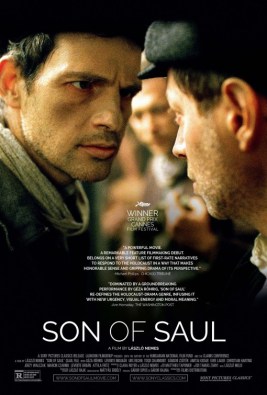
László Nemes’ “Son of Saul” boasts one of the most rigorously committed aesthetics in recent memory. Without subduing the roving camera of DoP Mátyás Erdély to the limitations of first-person photography, Nemes finds a radical method of plunging the viewer into the subjective experiences of the protagonist: Géza Röhrig’s Holocaust prisoner Saul Auslander.

Two shots prevail throughout the proceedings. The first is a rushing handheld shot taken over Saul’s shoulder while he is in motion, usually with an extremely limiting shallow depth of field. The other is a close-up of his stoic face, stark in how little it emotes. Imagine the kinetic immediacy of Emmanuel Lubezki combined with the claustrophobic intimacy of Dreyer’s “The Passion of Joan of Arc.”

It’s the kind of choice that can only be made by an established auteur who has earned complete autonomy, or a brash newcomer yet to learn the so-called rules. Nemes is the latter, which only adds to the wonder “Son of Saul” inspires.

His technique hardly constitutes some kind of self-imposed artistic chastity belt, however. Nemes uses his form to illuminate the complexities of his content (co-written with Clara Royer), allowing for a more nuanced understanding of these unimaginable atrocities. Saul, a member of the Sonderkommando group that was forced to become cogs in the Nazi machinery of mass murder, never falls into a clear cut category. He is neither entirely hero or villain, victim or perpetrator. Saul is just a human trying to survive inhuman conditions in any way possible, and the camerawork suggests his method of coping is to block out the world beyond his nose.

Read the rest of this entry »