REVIEW: Person to Person

24 07 2017

Sundance Film Festival

Connection seems like an awfully vague term to declare a main thematic thread for a film festival – it’s a bit like “love,” deployed as a convenient catch-all in cursory analysis. But far more than 2016’s edition of the Sundance Film Festival, where I saw several films about protagonists trying to connect with themselves, many in 2017 showed a greater concern for how we connect to each other and the world around us.

This was most apparent in Dustin Guy Defa’s New York-set feature “Person to Person.” I made a conscious effort to avoid the kinds of films that might pertain primarily to the so-called “coastal elites,” which can present themselves as microcosms for America while only showing a narrow slice of existence. That’s not to say that these movies are meritless or rendered useless in this brave new world. But after the primal electoral howl of November, some perspective on the limited application of what Judd Apatow deemed “west-of-the-405 problem” films (and their East Coast counterparts) does not hurt. That said, I still had to see some. Forgoing them entirely would be akin to a cinematic Atkins diet, taking out an entire component of the pyramid structure for quick change.

“Person to Person” starts off feeling like a Jim Jarmusch-Noah Baumbach hybrid, a series of vignettes that send signals that they will converge in a manner we’ve come to expect from “hyperlink cinema.” Some of them do. The center of gravity is a murder case that involves the victim’s wealthy Brooklynite wife (Michaela Watkins), two clueless investigative reporters at a no-name tabloid (Michael Cera and Abbi Jacobson), and a watchmaker (Philip Baker Hall) with the clue that could hold the key to the entire case. On the periphery, Defa also follows a vinyl collector (Bene Coopersmith) dealing with a dishonest client, a wandering boyfriend (George Sample III) who gets shaken down by the angry brother of his partner, and a verbose young woman (Tavi Gevinson) probing the boundaries of her toleration and sexuality.

Defa has built up high regard, making short films for several years, even earning a retrospective at the Film Society of Lincoln Center in 2015. (Take four minutes to watch “Review” instead of that Jimmy Fallon clip your friends have shared on Facebook.) That background does rear its head in “Person to Person,” which can play more as a compendium than an omnibus. Still, the old pan that something is “less than the sum of its parts” does not quite apply here. There is loose connective tissue for all the stories: violence, unseen but affecting all of the characters in significant ways. Not the cheeriest take on human relations, but it’s hard to deny given that many of 2016’s most fervent moments of collective emotion came in the wake of celebrity deaths. B

NOTE: A portion of this review ran as a part of my coverage of the 2017 Sundance Film Festival for Movie Mezzanine.


REVIEW: Dunkirk

23 07 2017

In a typical war movie, the 400,000 men stranded on the beaches at Dunkirk would command the lion’s share of attention. Their rescuers who arrived by sea in small personal and commercial boats requisitioned for the war effort might get an extended arc in the final act. Their protectors in the air might get a few shots during a climactic battle scene as they fended off the German Luftwaffe.

Director Christopher Nolan, however, is anything but typical. (You probably already knew that.) In his take on “Dunkirk,” each of these three threads takes on an equal narrative standing. Though they span a week, a day and an hour, respectively, their experiences unfold in a simultaneous, but not parallel, manner. The lengths of their contribution might be different, yet their weights are equalized – and their fates are intertwined.

This isn’t immediately obvious from the start of the film. Title cards spell out the duration of each section, but it takes their individual narratives overlapping or colliding for that time to really resonate. Remarkably, the gambit never feels like a gimmick. Nolan pays tribute to each prong of the Dunkirk evacuation by sustaining their story for as long as their lives were on high alert … and then gently ratcheting things down a notch once the end is in sight.

Read the rest of this entry »


REVIEW: Landline

18 07 2017

Sundance Film Festival

Gillian Robespierre’s “Landline” prominently features a 1995 speech where Hillary Clinton claims, “However different we may appear, there is far more that unites us than divides us.” Unlike many time capsule items in the film — CD listening stations at music stores, Blockbuster Video, payphones, floppy disks — 5this line doesn’t feel like it’s just been lifted out of a BuzzFeed listicle about “25 Things You’d Only Know If You Were Alive in 1995.” It’s a dictum simple to say yet difficult to practice, as shown by the family in the film.

Robespierre and co-writer Elisabeth Holm craft an indelible portrait of the women in the Jacobs family, each at different life stages yet all struggling to feel the love with important companions. Matriarch Pat (Edie Falco) puts so much effort into maintaining family structure and function that her relationships have frayed with everyone, especially her charming but wishy-washy husband Alan (John Turturro). Adult daughter Dana (Jenny Slate) waffles on a marital commitment to fiancé Ben (Jay Duplass), even going to the extent of acting out an alter ego named “Bedelia” that indulges her pent-up desires. Teenage daughter Ali (Abby Quinn) takes to surrounding herself with drugs and dancing to dull her disinterest with the traditional roadmap laid out ahead of her.

If “Obvious Child” showcased that Robespierre could helm a character study, then “Landline” exhibits her talent with an ensemble piece. There are many complicated relationships to juggle in the film, each of which she handles with specificity and tenacity. (On a personal note, I found the tension between Dana and Ali spot on; as someone with a much younger sibling, Dana’s negotiation between being a quasi-parent and friend resonated tremendously.)

Robespierre is not afraid to have the tough, awkward conversations – and then dwell in the messy resolution, or lack thereof. For all the times I worried in the first 30 minutes that the film would be little more than a nostalgia-dripping scrapbook, she met them with incisive observations about how difficult it can be to connect with the people closest to us. B+

NOTE: A portion of this review ran as a part of my coverage of the 2017 Sundance Film Festival for Movie Mezzanine.


REVIEW: Presenting Princess Shaw

17 07 2017

If it were possible to present an Upworthy article in documentary form, Ido Haar’s “Presenting Princess Shaw” would be it. This fable of the social media heralds the virtues of technology that enables an Israeli music producer to connect with a New Orleans-based YouTuber. In reality, the story is just creepy when you really stop to think about it.

And you’ll have plenty of time to think about it, believe me. “Presenting Princess Shaw” should be one of those 3-4 minute videos you see in your Facebook news feed that a news site posts to play into the site’s algorithm. Instead, it’s an 83 minute slog extending a simple collaboration between two geographically distant people into a feature-length bore.

Samantha Montgomery, the real woman behind the golden-voiced Princess Shaw persona, is the main subject of the film. Haar gives us way too many moments of her plaintively pondering the changes to her life coming through her discovery by Kutiman, an international producer. She’ll just amble the streets, and one of her songs will play in the backgrounds. Then Haar will cut to Kutiman’s musical direction from afar, and the film just feels a little too “Catfish“-y for its own good. I can honestly say I don’t know if I’ve ever seen something meant to feel empowering come across as downright predatory. C+


REVIEW: War for the Planet of the Apes

16 07 2017

Though its title may lead you to believe otherwise, Matt Reeves’ “War for the Planet of the Apes” shows precious little war. There are extended action sequences, but nothing rises to the level of a full battle. This is not a war movie, at least not in the traditional sense in which audiences are conditioned to perceive one. It’s not about the fights; rather, it’s about what we seek to preserve by fighting them in the first place.

Caesar (once again masterfully brought to life by Andy Serkis) and his band of apes that believe in their right to receive dignified treatment find themselves in an asymmetrical fight with the humans. The original intelligent inhabiters of earth, backed into a corner after the Simian Flu decimates their kind, do not exactly take kindly to sharing their planet with another sentient species. The apes are fighting a war of ideals – for peace, unity and solidarity. The humans are fighting a war of extermination, one where the only measure of victory is the complete degradation and eradication of their opponent.

As a viewer in 2017, I could not help but see parallels between the ape-human conflict and the current war against ISIS. The men who pervert Islam’s tenets can claim a win on their battleground when their actions force the western world to abandon their principles. If we choose to fight as they fight, responding to barbarity with inhumanity, we cede to their strategy and expose our own hollowness.

But as “War for the Planet of the Apes” drew on (and it does so perhaps more than it should), it became clear to me that Reeves had far more on his mind with the film than just the conflict du jour. This entire iteration of the franchise smartly avoids tying itself entirely to the events surrounding its making. Indeed, recent rewatches of 2011’s “Rise” and 2014’s “Dawn” already indicate the series’ malleability to the whims of the present; both films feel as if they refer to something entirely separate from what they did upon release. The “War” of Reeves’ film is not a war but all wars. It’s a rap sheet against human atrocity justified by armed conflict from, one could argue, biblical times to our contemporary ones.

Read the rest of this entry »


REVIEW: Baby Driver

12 07 2017

I saw Edgar Wright’s “Baby Driver” twice in the span of a month and fixated primarily on how it functioned as a new take on the movie musical. (If you want my full thoughts on that aspect, check out my piece on Little White Lies – I do far more heavy lifting with the film there.) It is that, but like any great movie, it’s so much more.

It’s a kickass action flick where, for once, the terms “balletic” and “choreographed” are not critical hyperbole but apt, justified descriptions. Wright’s tightly edited escapes, whether by car or by foot, fall in lockstep with their musical inspirations as they play diegetically through the headphones of Ansel Elgort’s titular driver. Is this what it felt like to watch the “Ride of the Valkyries” sequence in “Apocalypse Now” back in the 1970s? “Baby Driver” is a giddy rush of cinephilia as Wright treats us to impeccable execution of a bold gambit.

It’s a film about how we relate to culture and to each other. Baby, an archetypal stoic stalwart, suffers from ailments both emotional (still traumatized from being orphaned in a tragic car crash) and physical (tinnitus leaves his ears constantly ringing). As such, he’s never one to communicate in a straightforward fashion. He signs with his deaf foster father. He pulls dialogue from the snippets of movies he sees on TV. He times his vehicular getaways to the music on his iPod (and one with a clickwheel, to boot). He’s more likely to block people out with his headphones and cheap sunglasses than let anyone in – until, of course, he catches a few bars from diner waitress Debra (Lily James).

I could sit here and bang out another few paragraphs trying to convince you of how much “Baby Driver” has to offer. But that might make you feel obliged to sit here and read my words, which will only serve to rob you of the experience of discovering the film’s ecstasy for yourself. There’s probably something you’ll find that did not even occur to me, and the film will motivate you to do so. Wright provides the perfect blend of originality, dazzling technical craft and emotionally invested storytelling to inspire a deeper dive into his movie’s pleasures. A-


REVIEW: The Big Sick

11 07 2017

I’m all about a good cross-cultural romantic comedy (I can probably recite every line of “My Big Fat Greek Wedding” by heart), so “The Big Sick” was right up my alley to begin. Kumail Nanjiani’s true story ups the ante, though, by adding significantly greater dramatic stakes. An early dinner scene with his Pakistani family contains discussion of a relative who dared to marry outside the Muslim faith and have a mixed baby – “it’s like he’s dead,” someone says. “No one will visit.”

Despite half-heartedly entertaining his mother’s parade of eligible wives, Kumail (playing himself) falls for Zoe Kazan’s Emily after she gently heckles him during a stand-up set. She’s a stark contrast to the bland, eager-to-please Pakistani women, to say the least. Willing to push back on his requests and call out his good-natured mansplaining, Emily overwhelms him, as he does for her.

Like any relationship, Kumail and Emily’s faces setbacks … not the least of which being a mysterious illness that forces doctors to put her into a medically-induced coma. (With a chilling montage of Kumail walking through the hospital, director Michael Showalter immediately and effectively shifts the tone in a more somber direction.) This development puts him into contact with her parents, Ray Romano’s calmly neurotic Terry and Holly Hunter’s frazzled mama bear Beth, who do not exactly hold him in the highest regard. Over time, though, Kumail comes to learn from them and appreciate the geographic, cultural and gender hurdles they had to surmount to make their relationship work.

“The Big Sick” is not reinventing the wheel of the dramedy, but it’s still worth commending for a number of reasons. Nanjiani and Emily V. Gordon, his real wife (spoiler alert!), tell a story that’s specific and personal but never too precious. It’s distinctively theirs with a little something to offer all of us. And while a good chunk of the film deals with Kumail’s comedy career, Showalter’s camera is judicious. He knows the value of a quick reaction shot. The way he captures the full lay of the land in any given scene demonstrates how the non-verbal alchemy of an actor can enhance a great story beyond the words on a page. B+ /


REVIEW: City of Ghosts

10 07 2017

Matthew Heineman’s “City of Ghosts” can, and likely will, be reduced to platitudinous headlines about its timeliness and topic. “The movie we need right now,” “the document out of Syria that will make you feel and care,” or some variation that harps on its relevance to get well-meaning but geopolitically disengaged consumers to watch. And that’s fine, so long as we don’t lose sight of what this documentary represents as a piece of filmmaking.

Heineman’s film documents follows the members of Raqqa Is Being Silently Slaughtered (RBSS) in exile, as their hometown is now the titular town of apparitions. ISIS moved into Raqqa and began quickly silencing dissidents, many of whom ended up in Europe. In relative safety (Heineman filmed them at safe houses), RBSS began by raising awareness of ISIS’s brutality among the citizens still under their oppressive thumb. But with the terrorist group cracking down on satellites and other forms of online communication, they must also work to amplify civilian voices to the international community.

“City of Ghosts” is a film made by a journalist about other journalists, and the admiration shows. “In my opinion,” states an RBSS member, “a camera is more powerful than a weapon.” Heineman appears to emphatically agree. He’s on the frontline of a war fought less with ammunition and more with aesthetics, as ISIS uses Hollywood-style filmmaking to win over impressionable young men to their cause.

Crucially, Heineman never loses sight of the human cost of this battle on RBSS. This is no superhero movie where the heroes are invincible or impenetrable. Their fight exacts a toll on them, and “City of Ghosts” makes sure we remember that these extraordinary efforts are being undertaken by ordinary men. They have families, friends and attachments just like any other person on the planet. Though they manage to keep a straight, courageous face for most of the film, the little cracks in their resolve are as powerful a humanistic image as any footage they receive from inside Syria. B+ /


REVIEW: A Ghost Story

9 07 2017

Sundance Film Festival

I knew little about “A Ghost Story” prior to the moment when A24’s bumper was projected onto the screen, apart from a cryptic tease on director David Lowery’s Instagram and his opening statement at the theater’s podium claiming that he couldn’t wait to talk with us about it afterwards. I intend to convey as little as possible in order not to spoil “A Ghost Story” for others, although words could scarcely convey what must simply be experienced cerebrally and emotionally.

This pensive, plaintive drama floats freely through time with the ghost of a man credited as C (Casey Affleck), but otherwise never named in the film. After a car crash takes his life, C emerges from the autopsy table and returns to his old dwelling underneath a white sheet with dark eyeholes. He stays and watches what remains of the time his partner M (Rooney Mara) spends there and then some – imagine spending an entire film in Kubrick’s Renaissance Room from “2001: A Space Odyssey.” On a moment-to-moment basis, “A Ghost Story” captivates simply (though not entirely) for lack of knowledge over where it might go next.

The ghost mills about, and we are never entirely sure what motivates his actions. The sheet serves as a blank slate onto which we can project our own ideas and assign our desired motivations. It is abundantly clear that he does share a special bond with both M and the plot of land they bought together, one with a history that transcends the impermanence of life that Lowery so carefully depicts. He does with image and montage what a film like “The Curious Case of Benjamin Button,” to pick an easy example, does with narrative.

Lowery introduces a narrative conceit to remove us from our traditional comprehension of time and leaves us to ponder what forces still operate in these conditions. His film achieves the rare balance of technical precision and emotional honesty. “A Ghost Story” gives audiences plenty to unpack in every camera angle, edit and sonic accompaniment, but Lowery also slips in a certain weightiness that instills a desire – if not compulsion – to want to undertake such an effort. B+

NOTE: A portion of this review ran as a part of my coverage of the 2017 Sundance Film Festival for Movie Mezzanine.


REVIEW: Life (2017)

8 07 2017

I fell in and out of sleep during Daniel Espinosa’s “Life,” a fact I feel comfortable sharing because it did not seem to have any bearing on my comprehension of the film. As it turns out, I could zone out for 10-15 minutes at a time and jump right back in feeling like I had not missed out on anything.

This is probably attributable to two factors: 1) I’ve seen “Alien,” the seminal space horror film from which “Life” cribs heavily, and 2) a line of expository dialogue recaps any major development, including big action sequences. As loud and technically complex as these set pieces are, I found myself drifting off during them with stunning ease.

“Life” (not to be confused with the James Dean quasi-biopic from 2015) takes a familiar premise – discovering life in space – and fails to take it anywhere new. “Calvin,” as their amoeba-like alien foe is named by a young schoolgirl back on earth, proves a dangerous foe for the astronauts on board the International Space Station. There’s no particular joy in watching him outsmart the crew because he adapts to surmount their weaknesses at light-speed. Not even a sardonic Ryan Reynolds or a laconic Jake Gyllenhaal can bring some – wait for it – LIFE to the screen. C


REVIEW: The Founder

7 07 2017

There’s an emerging type of film perniciously stinking up theaters every winter. Let’s call it “Weinstein-core.” (But don’t, just indulge it for the sake of the review.)
This type of movie was developed at Miramax but perfected at The Weinstein Company. It’s a film with the prestige of high-caliber awards contenders but the cynical, commercial calculations of a Marvel project. It’s provocative and edgy, but only to a point; go too far, and they might be off-putting for an audience. These are made not solely for the sake of telling a story but with the consideration of and desire for an ancillary prize baked into creation.

Sometimes these are actually decent, and it clouds our ability to see “Weinstein-core” films for what they are. “The Founder” is perhaps the best viewpoint into their mechanics, in part because it’s a smattering of good and bad moments. But chiefly, it’s a paradigmatic case because the motives are so transparent.

“Increase supply, demand will follow,” repeats Michael Keaton’s Ray Kroc at the start of the film. It’s his elevator pitch straight out of an economic textbook, yet the real purpose is to signal something to the audience: this an important movie about important things. It’s the story of the founding of McDonald’s, but it’s really about bigger concepts that we should put in quotes. It’s about “business.” It’s about “negotiation.”

Kroc is the perfect subject for a “Weinstein-core” film because, like this sub-genre, he’s never short on platitudes to disguise and sell a completely self-promotional idea. The smooth talk ingratiates him with the McDonald brothers as they seek to expand their finely tuned and mechanized burger restaurant. Eventually, however, the duo’s obsession with quality control butts heads with Kroc’s vision for aggressive economic expansion through real estate acquisition.

“The Founder” manages to squeeze some interesting drama out of that tension in the first half, but it really sags in a second half that consists almost entirely as a series of contentious phone conversations. These are written with little imagination and shot with even less. It’s a reminder of how much David Fincher and Aaron Sorkin could make this kind of material sing in “The Social Network,” a film that exists in the province of artists. “The Founder” is pure commercial product, a cinematic Big Mac – a standardized and unsatisfying meal, even if it might quell your stomach’s hungry grumblings for a short time. C+


F.I.L.M. of the Week (July 6, 2017)

6 07 2017

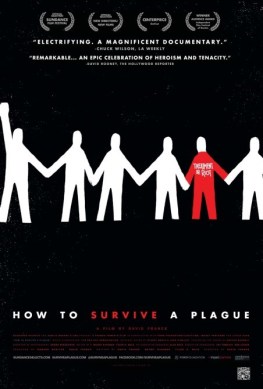
I first saw the documentary “How to Survive a Plague” in 2013, a time when its history of the LGBT community’s fight against bigotry for recognition and support in the face of a health epidemic felt like just that: history. The Supreme Court had yet to issue either of its landmark rulings, but the White House had come out in support of marriage equality. Prejudice still clearly existed, to be clear. Yet we seemed past a tipping point.

Fast forward to 2017. The White House didn’t issue a statement even acknowledging the existence of Pride Month. Amidst cries for justice from our most vulnerable citizens, we see a similar strategy from the government: avoidance, deprioritization and even outright lies. Suddenly, the members of ACT UP in the 1980s look like a great model for resistance. They organized and rallied around a clear call for action. They put pressure on organizations to make concrete steps in combatting the AIDS crisis. They carefully selected targets to mobilize public opinion in their favor.

For a viewer watching in the Trump administration, “How to Survive a Plague” meets the criteria of “F.I.L.M. of the Week” (First-Class, Independent Little-Known Movie – your occasional acronym refresher) on the basis of its existence as a resistance toolkit. But David France’s documentary is so much more than just its practical applications. It strikes the delicate balance between recounting events via talking heads and letting them unfold authentically, just as it nimbly shifts between group dynamics and individual stories. The film bears its late ’80s-early ’90s lo-fi digital aesthetic on its sleeve, yet it feels searing, pressing and urgent. For someone like me who became aware of the AIDS epidemic around the time it was no longer a public death sentence, this rendering is vital both in remembering the past and preventing it from repeating in the future.


REVIEW: Spider-Man: Homecoming

5 07 2017

The “Spider-Man” series, in both its prior cinematic incarnations this millennium, have dealt with the consequences of giving extraordinary power to ordinary men. The web-slinger’s modern persona is the product of an individualistic Bush-era America where heroes were lone actors grappling with authority and treading near the line of vigilantism. He’s a symbol of the power of the one, overcoming self-made obstacles, vanquishing doubts and conquering evil menace.

But by the time that the lifeless 2014 iteration of the character, “The Amazing Spider-Man 2,” arrived in theaters, actor Andrew Garfield even acknowledged the hollowness of this interpretation. “The danger of these superhero films is that they maybe propagate a lie that what’s going to change the world is one man, or one woman, just being the beacon of light,” he told The Daily Beast. “That’s not the way that it’s ever happened and it’s not going to be the way that it ever happens — I think it’s going to take every single person doing their small, massive bit to create a world, to create a society and a culture, that if we can imagine it we can do it.”

While Tom Holland’s Peter Parker in “Spider-Man: Homecoming” is far from the cooperative hero of “The Avengers,” he’s a step in the correct, more honest direction. Holland actually looks like the high school-aged kid that Spider-Man is; Garfield, by contrast, was 31 when his Peter Parker accepted a high school diploma. And from that starting point, director Jon Watts and a stable of six writers craft a superhero narrative around a lesson that resonates for adolescences both radioactive and regular. (We need not discuss the ending point, yet another reminder of the endemic inability for comic book adaptations to wrap up in anything other than a mind-numbing CGI pyrotechnics demo.)

Read the rest of this entry »


REVIEW: Collide

4 07 2017

What do you do when you’re making a vehicular-centered action thriller but you don’t have the stunt budget of a “Bourne” film or the pyrotechnic capabilities of the “Fast & Furious” franchise? Hopefully not what Eran Creevy does in his film “Collide,” which is to do a low-key version of those series and not to compensate by adding onto another element.

The easiest thing to do would have been further developing Nicholas Hoult’s Casey, an American living in Germany and participating in its seedy underbelly – until he falls in love with Felicity Jones’ Juliette. They enjoy a brief courtship and fall in love quickly only for her to develop a medical condition requiring dialysis and a hefty sum of cash. In order to cover the cost of her care, Casey delves back into the Cologne black market. One simple task, however, gets him caught in the crosshairs between two kingpins.

The vast majority of “Collide” details Casey’s escape, evasion of capture and ultimate showdown with his pursuers. That makes sense: look at the poster, watch the trailer, read the logline – this is a car chase and explosions movie. But I so desperately wanted them to mean more. Creevy fails to connect them back to the human core of Casey’s mission, which makes the scenes feel like soulless metal clanging and gears shifting.

He had incredibly capable actors in Hoult and Jones to hold the emotional center, too! Jones rarely gets to be more than an accessory in “Collide,” but there are moments when Creevy rests the camera on Hoult’s shifting eyes and restless face that speak volumes for his character. The film needed about twice the length of exposition on Casey and Juliette’s relationship to make the film work. That would be just 15 minutes added onto a movie that only runs an hour and 30 minutes, and it would have made all the difference. C


REVIEW: The House

3 07 2017

A government official yanks away a college scholarship promised to a local girl, deeming it “an indulgence we can no longer afford,” in the same breath as he rewards wealthy townspeople with luxurious new facilities. Is this a scene in Andrew J. Cohen’s comedy “The House,” or just another day on Capitol Hill? Show audiences in 50 years, and they will likely be unable to discern any difference.

As a series of gags loosely tied together by a hair-brained concept – Will Ferrell and Amy Poehler’s would-be empty nesters opening an underground casino to pay their daughter’s college tuition, the film leaves a lot to be desired. Like most studio comedies, “The House” throws together big comedic stars, a winning logline and a few stabs at thematically and socially relevant humor. The latter works when satirizing police surveillance in the smartphone era and stumbles when attempting a few jokes about date rape.

Ferrell and Poehler tend to take movie roles written for them, or at least well-tailored to their strengths. Nothing about “The House” indicates the screenwriters penned the film with them in mind. Ferrell’s outsized physicality and Poehler’s acerbic verbal wit go sorely underutilized.

Yet, on the other hand, they’re great avatars for the kind of well-off urban angst “The House” so deftly sends up. These are people who, for the most part, have achieved prosperity but still feel let down. “We tried to play by the rules,” laments Poehler’s Kate Johansen, “and it got us nowhere.” This disappointment and dissatisfaction leads them towards criminal enterprise, fight clubs for soccer moms and insurance fraud. It’s worth considering why this premise does not collapse immediately.

Oh, and “The House” takes place in this imaginary, fairy tale world where public officials face consequences for stealing money from the public! Must be nice. B-