At this point, I am unsure how much good it does me to review “Avengers: Age of Ultron” as I would a movie. I feel like it would be more useful to write up the experience of the film as a writer for Consumer Reports would describe a car – with matter-of-fact bullet-points and statistics. What is the point of trying to capture the artistry of a film in the intricacies of prose when that film is little more than a top-of-the-line product?
The latest item off the “Avengers” conveyer belt amounts to little more than an 150 minute billboard for the Marvel Cinematic Universe. Perhaps the one notable difference between “Age of Ultron” and its predecessor is that the events tend to sow discord that cleaves a wedge between the heroes as opposed to uniting them. (I can only assume that was a decision that arose organically from the material and not as some kind of tie-in to the impending “Civil War.”)
Maestro Joss Whedon ensures that the film matches all the tech specs any fan looks for in a comic book movie. It has action sequences the way cars have cupholders. To top it all off, he assembles a climax that feels like it could (and maybe should) just exist as its own movie and is probably fetishized in the same way automotive aficionados value a powerful engine. Maybe some of this would be exciting if it were not so painfully predictable. Rather than inspiring me to marvel at the screen, it just made me feel numb.
I will not attempt to argue that “The Wrecking Crew” is some kind of groundbreaking piece of documentary art. Frankly put, it does not begin to approach those things. But it probably made my jaw drop in awe-struck amazement more than any movie I can think of recently, and for that alone, the film qualifies to receive the title of my “F.I.L.M. of the Week.”
The documentary premiered at South by Southwest back in 2008, yet for some reason, it was only released this past March by Magnolia Pictures. While I normally apply the criterion that the films in this column be at least a year past their theatrical release date, I am more than willing to make an exception for “The Wrecking Crew.” This movie, like its subjects, is receiving its admiration at an unfair delay from when it was deserved.
Director Denny Tedesco does not hide the purpose of the film. It is made to get proper recognition for his father Tommy’s band of studio musicians known as The Wrecking Crew, who are directly responsible for the soundtrack of your life. That’s not hyperbole, either. If I had actually acted on all the times I wanted to pause the movie, open iTunes, and play the song they discuss creating, watching the film would have easily taken me three hours to finish.
Their incredible talent and dexterity across so many genres of music is nothing short of astounding. The Wrecking Crew did jazz, soul, R&B, rock, country, and entertainment underscoring with equal aplomb. Crooners, rockers, surfers, cowboys, and singer/songwriters alike benefitted from their remarkable creativity and reliability. And, often times, these groups faced additional obstacles on the road since their actual members were unable to perform at the level of the Wrecking Crew!
Tedesco cobbles together quite the sonic history of the 1960s and ’70s from archival footage, filmed interviews, and a spirited reunion roundtable of the group. It provides an illuminating look into how so many of our favorite tunes came to be, which is sufficiently thrilling in its own right. (Imagine the “Gimme Shelter” anecdote from “20 Feet From Stardom” times twenty.) Now, those enraptured by their unheralded virtuosity need to make sure others see “The Wrecking Crew” so the group can finally garner the widespread acclaim they deserve!
When I was in middle school, Will Smith was the man. Any conversation about movies seemed to inevitably drift towards his spotless record (most of us were too young to remember 1999’s “Wild Wild West”) at the box office and in quality. His named practically guaranteed a fun ride.
Fast forward to today, where Smith is no longer the summer staple or inherently bankable star he once was. Since 2008, he has only three non-cameo film roles: “Men in Black III” (admittedly, not terrible), “After Earth” (which I dutifully avoided like the plague), and now, “Focus.” For someone who so seldom works these days, it seems unfathomable that this was the best Will Smith could do for a rare starring vehicle.
Writer/director duo Glenn Ficarra and John Requa’s conman film has so little taste and flavor that it really needed Smith to bring his A-game. But never has he appeared so off his game. As Nicky, an aging pro in the field, Smith seems tired. Not weary or exasperated like Paul Newman in similarly themed “The Sting.” Just plain exhausted and out of gas. His flair and charisma are completely missing in action.
The movie does not even boast any particularly exciting heist scenes or elaborately planned schemes that could help overcome this deficit. All it really offers to offset Will Smith’s lusterless performance is Margot Robbie, who gets the chance to show that she has more to offer than the sex appeal and histrionics she was reduced to in “The Wolf of Wall Street.” The movie is too boring to really make a definitive statement as to whether she is the real deal, but as Jess, she did make the difference between me turning off the film and seeing it through to a rather humdrum conclusion. C /
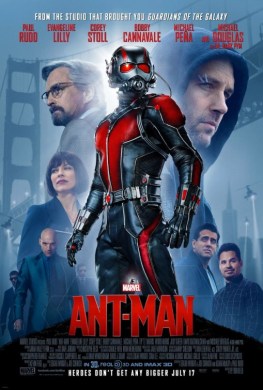
“Ant-Man,” the final piece in Marvel’s so-called “Phase Two” of their Cinematic Universe, invites us all to do what I have done for the past five years: not to take any of this too seriously. With the constantly winking and self-effacing charm of Paul Rudd (and co-writer Adam McKay), the best Marvel movie in years is ironically the one that spits in the face of what the studio signifies.
This is the first film from the comic book behemoth since the original “Iron Man” back in 2008 that feels entirely sufficient as a film in its own right, not just a placeholder for the next super-sized sequel. Granted, some of that might be a response to its iffy economic viability at the green-lighting stage of the process (and some concerns over authorship following the departure of writer/director Edgar Wright and his screenwriting partner Joe Cornish). Nonetheless, “Ant-Man” earns a second installment by virtue of its tongue-in-cheek spirit and fun sense of scale.
Rather than set up some cataclysmic battle of the fates where the powers of good do battle with a terrifying evil that beams a big blue light up into the sky, “Ant-Man” builds up to a fight between two men for one important thing. This climax engages rather than numbs (as “Avengers” final acts tend to do) because it takes place on the human level where the rest of the film registers. It also helps that the final clash is essentially the only major one in the movie, going against Marvel’s general tendency to throw in a major action set piece every 30 minutes or so to placate the thrill-seekers in the audience.
And every time it seems like “Ant-Man” is turning into a conveyer belt of Marvel tropes, Paul Rudd’s humor kicks in to disrupt the moment and make a joke at the studio’s expense. He plays on admittedly shorter leash than someone like Judd Apatow or David Wain gives him, but his sardonic wit proves a welcome reprieve of Marvel’s faux gravitas that proves suffocating in their more commercial products.
When analyzed literally within the context of Christian Petzold’s film “Phoenix,” the title refers to a Berlin club where Nina Hoss’ Nelly once crooned with her husband Jonny (Ronald Zehrfeld). Yet to stop there only scratches the surface of meaning within this richly realized piece.
The phoenix, as many know from mythology (or the “Harry Potter” series), is a bird that can rise from the ashes of its own funeral pyre and give birth to itself once again. This could easily apply to Nelly, who survived the Nazi concentration camps but emerged with severe damage done to her face. With the help of some gifted surgeons, she reemerges – but as someone who looks distinctly different from before since the doctors suggest anything to close to the original will only recall painful memories.
For Petzold, the personal is also writ political as the issues Nelly must confront closely mirror those that face her religion, nation, and continent. Amidst the deep shame and regret that hangs over every scene, they must decide whether to move forward into an unknown future or attempt to recreate the past. The latter option, while risking a repeat of its imperfections, at least provides some small sense of comfort and recognition amidst a seismic shift in geopolitics that still produces aftershocks today.
Nelly experiences these dangers firsthand when she seeks out her Jonny in spite of good intelligence that suggest he turned her into Gestapo. Since her facial reconstruction proves enough to incite his curiosity but not enough to trigger recognition, Jonny launches a seemingly hair-brained scheme to pass this woman off for his late wife to get her inheritance money. And Nelly becomes willingly complicit in making it happen.
Credit Hoss for making this decision feel like it comes from a place other than pure masochism. She gets down in the mud with Petzold and co-writer Harun Farocki’s script to grapple with the messiness of identity on scales large and small. With their commitment, “Phoenix” makes for the ultimate exploration of the paradox of trying to move forward while casting a glance backwards. Thanks to Nelly, we can feel our away through some tricky contradictions facing both people and nations – not just ponder them with an academic remove. B+ /
People like myself willing to live and let live when it comes to the unconventional relationship between Woody Allen and Soon-Yi Previn may experience a bit of cognitive dissonance while watching “The Diary of a Teenage Girl.” (Or those who condemn the aforementioned relationship may have an entirely different reaction and feel the same inconsistency of ideology I felt.)
Marielle Heller’s film, adapted from Phoebe Gloeckner’s graphic novel, tells a story of sexual pleasure and liberation first achieved by a 15-year-old through statutory rape by her stepfather figure. Reason it away all you want so it sits well in your stomach – it was the 1970s, it was San Francisco, the initiator of the acts are not always clear. But at the end of the day, the ongoing physical relationship meets the criteria for criminal prosecution in the United States.
I usually prefer not to check my morals at the theater door, largely because such an act is why the world gets parties inanely styled after reprehensible behavior in films like “Fight Club,” “Project X,” and “The Wolf of Wall Street.” So, keeping that in mind, I often found it tough to get on board with the message of “The Diary of a Teenage Girl.” Is this kind of borderline exploitative relationship actually supposed to be liberating?
The film gets away with some of this questionable mindset by framing the film within the subjectivity of its protagonist, Bel Powley’s Minnie. At such a young age, of course she views any sort of sexual content as exciting and pleasurable no matter how transgressive it might be. “I guess this makes me an adult now,” she proclaims into a tape recorder after losing her virginity, making it perfectly clear that she widely overestimates her own maturity. As carnal relations continue with her mother’s boyfriend Monroe, played by Alexander Skarsgard, we see just how quick she is to conflate sex and love.
Lily Tomlin won the Presidential Medal of Freedom last year, yet she somehow still feels underappreciated. Or maybe that’s just because she kept a low profile after the peak of her stardom in the 1970s and was known mostly to members of my generation as the voice of Ms. Frizzle on “The Magic School Bus.” But thanks to perfectly tailored roles in Netflix’s “Grace & Frankie” and the new film “Grandma,” Tomlin definitely seems poised for a major moment once again.
But Tomlin’s career is not necessarily being “rescued.” In fact, some of her best work has come from the slow and steady decades between her peaks of public interest. Case in point: “I Heart Huckabees,” the film that landed David O. Russell in director jail after he went for Tomlin’s jugular on set. In spite of that tension, the movie still turned out alright – even if I did not immediately recognize it on first viewing five years ago.
Russell has gained a reputation for stylish, quirky films with his so-called “reinvention” trilogy that began with 2010’s “The Fighter.” But that idiosyncratic spirit certainly existed before then, and “I Heart Huckabees” might mark its most vibrant display. Working with co-writer Jeff Baena, Russell crafts a so-called “existential comedy” that mines philosophy and ontology for laughs that might make Woody Allen green with envy. As such, it merits my pick for the “F.I.L.M. of the Week.”
Beneath all the hilarious intellectual banter lies a very simple story about a man, Jason Schwartzman’s Albert Markovski, an environmental activist who just wants to know what it’s all about. “It,” of course, is the very meaning of life itself. After a series of odd coincidences, he turns to a pair of existential detectives, Dustin Hoffman and Lily Tomlin’s husband and wife team Bernard and Vivian Jaffe. This duo claims that they can – with enough field research – determine how everything in Albert’s life connects. They set out to find his place in the grand plan of the universe, optimistically sure that such a thing exists.
But after a while, Albert falls prey to the Jaffe’s nemesis and ideological counterpart, Isabelle Huppert’s Caterine Vauban. She offers similar services but with the nihilistic assertion that nothing relates to anything. The longer Bernard and Vivian take to complete their assessment of Albert’s life, the more appealing Caterine’s services look.
Albert’s quest for self-knowledge gets complicated by others who seek out the detectives’ services, such as Mark Wahlberg’s Tommy Corn, a firefighter who can chew anyone’s ear off with his views on the harmfulness of petroleum. Russell has utilized Wahlberg in three films now, and this is certainly his most ingenious performance among the trio. While the actor is notorious for his authentic off-screen anger and street cred, Russell funnels those traits into a hilariously exaggerated character professing a hyper-verbal righteous indignation. For Wahlberg, often more likely to rely on the swagger of his body than the power of his words, the performance feels revelatory (and perhaps indicative of even more untapped potential).
The quirky crew does not end there, with Jude Law also in the mix as Brad Stand, a corporate executive at the company Huckabees determined to take Albert down by figuring out the meaning of his own life. Naomi Watts’ Dawn Campbell, Brad’s girlfriend and the star of Huckabees’ ad campaign, gets thrown in for good measure too. Both are slightly minor players but still players nonetheless.
Russell throws some really dense, cerebral concepts out there in “I Heart Huckabees” – and at the lightning-fast speed of his dialogue, no less. But so long as you can keep up, the film proves a rewarding, stimulating experience with something to say about the equilibrium between pragmatism and pessimism that we need to get through the day.
J.P. Sniadecki begins his rather free-form documentary “The Iron Ministry” in pitch-black darkness, laying down an aural landscape of screeching trains for several minutes. My screening companions, both exhausted by a taxing NYFF 52, took this as an invitation to nap. I, on the other hand, found myself all the more drawn in.
Sniadecki’s work recalls the Harvard Sensory Ethnography Lab’s groundbreaking docs “Leviathan” and “Manakamana,” albeit with even less adherence to narrative principles. “The Iron Ministry” is like a collage, both aural and visual, of what happens in the cars of a Chinese locomotive. Sniadecki’s camera feels chillingly removed from the human activity on board, making his role more akin to objective field researcher than an empathetic documentarian.
As such, “The Iron Ministry” often feels a little bit more like a historical document than a piece of cinema. If someone wanted to know what early 2000s working-class China looked like, this will be a valuable resource. The train itself is arguably the main character of the film and, not unlike Bong Joon-Ho’s “Snowpiercer,” functions as a microcosm of their society itself.
Sniadecki does start to verbalize these politics toward the end of the film by training his lens on passengers who choose to talk about such issues, a conversation that proves detrimental to the observational style that dominates the rest of the documentary. But even though “The Iron Ministry” clunks along to its close, the bumpy ending does not erase the power of the images that came before. The sight of trash strewn everywhere as well as people shoved into every nook and cranny of the train cannot be so easily dismissed. B /
“The D Train,” while technically and functionally a comedy, might be one of the more depressing movies ever made about high school. Like Jason Reitman and Diablo Cody’s seething 2011 film “Young Adult,” the film takes place several decades after the diplomas get handed out. Yet, all things considered, time stays relatively frozen.
For this rather cynical writer/director duo, Andrew Mogel and Jarrad Paul, high school locks people into the parts they must play for the rest of their lives. At 38, Jack Black’s Dan Landsman has not amassed any more esteem from his peers, who routinely ostracize him from their plans … after an alumni telethon of all things!
Determined to rewrite the script of his life, Dan hatches a half-brained plan to bring back a mildly famous alumni for his class’ twentieth reunion. Yes, for them, the appearance of James Marsden’s Oliver Lawless (apparently not a stage name) in a Banana Boat commercial constitutes fame. Dan even goes out to visit him in Los Angeles to formally recruit his appearance…
…and then a funny thing happened on the way to the reunion: the coarsely cool Oliver entices the happily wedded Dan into an evening of sexual intercourse. Everything up to this point felt like a compact cinematic narrative in its own right, fully satisfying and surprising. Afterwards, though, “The D Train” really falls off the rails.
Jack Black layered queer undertones into his performance in “Bernie,” but he flops when playing it overtly. After his night with Oliver, he becomes single-sighted and uncomfortably unhinged. It becomes actually painful to watch how far his idiocy will extend to gain the favor of his new crush. Some of this awkwardness stems from the script, which treats homosexuality like some kind of pathology that takes over one’s system through exchanging fluids.
Marsden, on the other hand, delights in a role that does not exploit his dashing looks to turn him into a dreamboat. Oliver’s attractiveness, if anything, made him complacent to treat others like dirt. Such a disposition does not fly in a place like Hollywood, although it still passes amongst high schoolers past and present. B- /
Morgan Neville and Robert Gordon’s “Best of Enemies” invites you to remember a different era, the 1960s. While one could dub this decade a crisis of authority, as my AP US History textbook did, it certainly had its advantages. At this moment in history, people actually trusted their network news anchors to tell the truth (cough, Brian Williams) and clashing pundits drove ratings by the threat of violence, not its actual exercise (ahem, Bill O’Reilly).
Many of these ills we now associate with television news started in the events Neville and Gordon document: the 1968 debates between conservative pundit William F. Buckley, Jr. and liberal icon Gore Vidal. These men were not running for president themselves and had only marginal ties to electoral politics. The flailing network ABC just could not keep up with the juggernauts CBS and NBC, so they resorted to using Buckley and Vidal as a sideshow to get some attention. Their snide side chatter, however, quickly became the center of the conversation.
These two well-spoken gents do more than trade spars and jabs. They stand for more than themselves because they can fully articulate the central tenets of their respective ideological movement’s very essence. And ideology is culture, states one interviewee. So wonder when the shot heard ’round the world in culture wars took place? Neville and Morgan would have us believe it was on the half-moon stage with Buckley and Vidal.
“Best of Enemies” is at, well, its best when focusing on their butting heads – not the heads doing the butting. Buckley and Vidal are interesting figures in their own right, but they just go better together in the same way that salt and pepper shakers should never be separated. Listening to Buckley and Vidal recalls the kind of academic banter tossed about between professorial colleagues … until, of course, it detours into petty squabbling.
(Their closest modern counterparts are Bill O’Reilly and Jon Stewart, although those two play on such different playing fields that they almost fail to respond adequately to the other.)
And beyond just who is saying these things, “Best of Enemies” also reminds us that what they are saying is worth our attention. The United States still fights the same battles and hashes out versions of the same conversation between Buckley and Vidal. The tensions in the 1960s surrounding the supposed gains of black Americans to the detriment of the white middle class are remarkably similar to the same resentments Donald Trump frequently exploits in his rhetoric around Hispanics. The more things change, the more they stay the same. B /
The celebrity interview in fiction is something that often gets fetishized, probably because it is so frequently fantasized. I have done a fewmyself, and it can be tough not to get carried away just by breathing the rarefied air of a talented artist. Rationalize the experience away as journalism, but that does not do justice to the nature of the interview.
It’s a transaction. An exchange of goods disguised as an exchange of words. A delicate dance. Chuck Klosterman, in his excellent book “Eating the Dinosaur,” offered a deft explanation of just how these performances work. “The result (when things go well),” he wrote, “is a dynamic, adversarial, semi-real conversation.”
“The End of the Tour” makes a movie out of a journalistic conversation for the ages, a battle of wits on a more even playing field than usual. Jesse Eisenberg plays David Lipsky, a minimally successful novelist who pays the bills for his aspirations of fiction writing by penning non-fictional articles for Rolling Stone. Somehow, he convinces his boss to let him go on assignment to profile another writer, the first time the magazine dares to feature a wordsmith in over a decade.
Lipsky’s subject is no average writer, though. He tags along with David Foster Wallace, played by Jason Segel, at the last stop of his 1996 book tour for “Infinite Jest,” a thousand-page tome that reaps hyperbolic praise and adulation. After publishing such a novel, a kind of literary legend status extended to very few authors looms on the horizon.
Jake Gyllenhaal trained hard to get ripped and toned for his role as boxer Billy Hope in “Southpaw,” yet the physical transformation may not represent most impressive facet of his performance. Underneath the chiseled six-pack of abs and behind the battered face does not necessarily lie the spirit of a champion. In fact, Hope most resembles a pitbull backed into the corner of a cage.
Gyllenhaal makes the truly courageous choice not to play his character with some kind of rough-hewn heart that always finds a way to break through his hardened exterior. Hope came up through the New York City foster care system, never making peace with his parents before they passed and ending up incarcerated more than once. To boot, he lacks some basic literacy skills (he’s unable to spell the word “incarcerted” with his daughter) and needs the firm support system provided by his wife, Rachel McAdam’s Maureen, to make even the most common-sense of decisions.
In Gyllenhaal’s hands, Hope becomes borderline unsympathetic. If his character were dropped into the self-destructive drug addict role that Christian Bale played in “The Fighter,” we might not root for him. Plenty of times in “Southpaw,” I questioned whether my desire to see him triumph came simply from the fact that writer Kurt Sutter made this character the protagonist.
When tragedy hits Hope, we feel pain not because we watch a good man drawn into a maelstrom of grief and anguish. We feel pain because Gyllenhaal makes sure we know that this a person clearly ill-equipped to come to terms with the enormity of his wealth, power, and standing. A 43-0 record in the ring has not transformed Hope in any way. He’s still the same kid from the shelters who did not have the smarts to stay out of trouble.
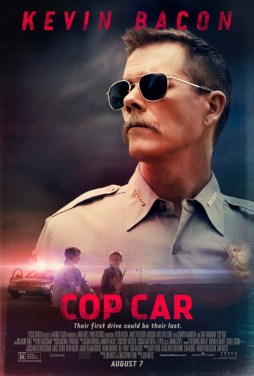
Jon Watts’ “Cop Car” opens with a familiar scene for anyone who escaped lower school: two kids tossing around swear words like a hot potato. They do it not as an organic reaction to any sort of stimulus; they do it just to wield the power of the taboo. This is the first of many examples that demonstrate just how well Watts and his co-writer Christopher D. Ford understand the mindset of kids.
Their two pint-sized protagonists, Travis and Harrison (James Freedson-Jackson and Hays Wellford), hardly fit the bill of the typical precocious on-screen youngster. They are just pre-pubescent pinheads engaging in the same dumb stuff everyone does around the age of ten. Here, they take it one step too far when they decide to go joyriding in an apparently abandoned police cruiser.
Because “Cop Car” is a movie and not the punchline of a Jeff Foxxworthy “redneck” joke, the vehicle obviously has an owner. Unfortunately for them, that man is the crooked Sheriff Kretzer, who is played by Kevin Bacon, the prolific actor perhaps best known for the “Six Degrees of Separation” game often played with him at the center. This is the first time Bacon has really cashed in on his iconography like Liam Neeson has in recent years, and he does it here to play gloriously against type. This role sees him sporting a full-on porn star ‘stache and a protruding gut that undeniably comes from convenient store beer.
Sadly, Kretzer gets precious little time to menace. At under 90 minutes, “Cop Car” never really lets him develop as a dynamic force. The film is meant to be told from the kids’ perspective and from their eye-level, to be sure. But that simplicity of spirit ultimately winds up working against the film as the childlike viewpoint just becomes little more than a downright childish caper.
“Straight Outta Compton” arrives a year (almost to the day) after the death of Michael Brown at the hands of a Ferguson police officer, and protesters screaming “black lives matter” are disrupting both Democratic and Republican presidential candidates on the stump. In terms of timing, the movie got lucky as America fortunately received repeated exposure to just what kind of unfortunate force the boys and blue could mete out with relative impunity. Yes, people clapped at the first beat of their controversial anthem “F-ck The Police.”
The film charts the rise of rap group N.W.A. (that’s N-s With Attitude, for those unaware of the acronym) from the streets of Los Angeles’ Compton neighborhood to music superstardom. The main distinction of their origin story from the run-of-the-mill music biopic is their repeated clashes with the neighborhood police force, which refuses to acknowledge any difference between them and deadbeat dads or drug dealers. The mere sight of black skin seems to trigger fear and a sense of entitlement to exert oppressive control.
The first half of “Straight Outta Compton” features as many brutal run-ins with the police as it does rousing rap numbers. Perhaps most strikingly, the groups’ worst harasser is black himself. Writers Andrea Berloff and Jonathan Herman recognize that the problem breaks down beyond mere racial fault lines; there are discriminatory attitudes and unchecked powers among the police that need to be reigned in to a sensible level.
Towards the end of where the narrative stops, the ’90s most notorious flare-up with police, the Rodney King beating, comes into frame. But the savage attack, unexplainable acquittal, and subsequent riots never quite tie in with the same zeitgeist expressed by N.W.A. in their truth-telling rhymes. The event plays out like little more than a marker in time, something in the background to ensure the audience remains aware that the years are 1991 and 1992. Rather than building to a glorious conclusion about the need for change then and now, “Straight Outta Compton” just cruises by and observes the rubble after the rumble.
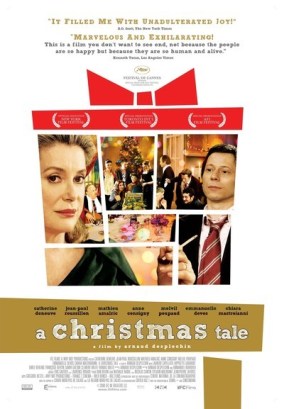
It’s hotter than Hades here in Houston, so I ventured into Arnaud Despelchin’s “A Christmas Tale” for some escapism. (Just kidding, I watched it mostly because the Criterion Collection deemed it worthy of inclusion in their hallowed ground of cinephilia.) Despite the title, this is a film that should not be dusted off every December to watch ritualistically like “It’s a Wonderful Life.”
Rather, “A Christmas Tale” merely uses the holiday as its setting – not its subject. A large French family needs to gather under the same roof for all this drama to play out, and what better occasion is there for that than Christmas? Instead of celebration, this day brings bitterness, resentment, and sorrow.
The family’s matriarch, Catherine Deneuve’s regal Junon Vuillard, needs a bone-marrow transplant to treat her fast-progressing cancer. She needs a match from one of her children or grandchildren, all of which seem to struggle with some sort of serious issue. (Except the two toddlers, but one can only imagine what kind of misery awaits them when they are old enough.) To list everyone’s baggage would just consume the word count of a whole other review, not to mention spoil the fun of watching everyone collide and implode.
Though two and a half hours for a family melodrama might seem excessive, “A Christmas Tale” never buckles under the weight of its runtime. Despelchin’s epic sprawl and familial brawl recalls the ’90s works of Paul Thomas Anderson – a comparison anyone who reads my reviews is high enough praise to earn the distinction of the “F.I.L.M. of the Week.” Here is a movie with a grandiosity to its mood that feels perfectly cinematic, never exaggerated or gauche, anchored in a sharply written script and fine performance by a stellar cast. What more could one ask for underneath the tree?
 I will not attempt to argue that “The Wrecking Crew” is some kind of groundbreaking piece of documentary art. Frankly put, it does not begin to approach those things. But it probably made my jaw drop in awe-struck amazement more than any movie I can think of recently, and for that alone, the film qualifies to receive the title of my “F.I.L.M. of the Week.”
 “
“ When analyzed literally within the context of Christian Petzold’s film “
 People like myself willing to live and let live when it comes to the unconventional relationship between Woody Allen and Soon-Yi Previn may experience a bit of cognitive dissonance while watching “
 New York Film Festival, 2014
 “
“ Morgan Neville and Robert Gordon’s “
 The celebrity interview in fiction is something that often gets fetishized, probably because it is so frequently fantasized. I have done a
  Jon Watts’ “
 It’s hotter than Hades here in Houston, so I ventured into Arnaud Despelchin’s “A Christmas Tale” for some escapism. (Just kidding, I watched it mostly because the Criterion Collection deemed it worthy of inclusion in their hallowed ground of cinephilia.) Despite the title, this is a film that should not be dusted off every December to watch ritualistically like “

 Marshall and the Movies
Recent Comments