REVIEW: It Follows

27 03 2015

It FollowsIn his soon-to-be classic modern horror film “It Follows,” David Robert Mitchell can even make a pronoun terrifying.  The word “it,” when standing alone in American slang, has referred to an appealing aura of sexuality dating back to Clara Bow’s 1927 romantic comedy “It,” which popularized the phrase “It Girl.”  But for Mitchell, “it” becomes practically a proper noun, one that refers to a haunting specter that stalks down a teenage victim after being passed on through sexual intercourse.

“It Follows” speaks the subtext that runs through a great number of films in the genre, turning implicit punishment for carnal impropriety into a tangible STD horror story.  Maika Monroe’s college-aged protagonist (or, dare I say, the “final girl”) Jay Height gets the story going by swapping fluids with her older boyfriend, Hugh, and subsequently contracting his condition.  Through this exchange, Jay becomes the main target of “it,” a spirit that can inhabit any body and is dead set on taking a victim, unless she passes the burden to someone else.

The story and premise almost sound comical when laid out in terms like those above, especially considering that Jay stubbornly and irrationally refuses to transfer the evil spirit.  Yet Mitchell’s impeccable technique make laughter practically unthinkable in “It Follows.” The film is far too unnerving to allow for such sentiments to bubble to the surface. Mitchell puts the typical, derivative offerings of horror to shame as he creates a work that stands as one of the best executed films in recent memory irrespective of genre. He combines the psychological madness of “Martha Marcy May Marlene” with the all-out bodily terror of “Black Swan” for one bone-chilling experience.
Read the rest of this entry »


F.I.L.M. of the Week (March 26, 2015)

26 03 2015

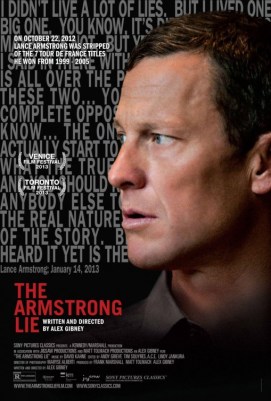
The Armstrong LieDocumentarian Alex Gibney is not only one of the most prolific directors in his field; he is also one of its most incisive.  Gibney tends to gravitate towards two extremes in his choice of subjects, macro level exposés of corrupt institutions (Enron, the Catholic Church, the U.S. military) and portraiture of fallen men (Jack Abramoff, Eliot Spitzer).  Many of his documentaries contain elements of both, but none blend them better than his 2013 work “The Armstrong Lie.”
The film plays somewhat like an ESPN “30 for 30” documentary (a series to which Gibney has contributed) yet with a killer twist.  Gibney’s initial premise for a documentary on Lance Armstrong began as an adulatory one, filming his improbable comeback with a rosy lens.  Then, a few years later, the approach changed thanks to the shocking revelation of Armstrong’s duplicity and doping.

Gibney then sits back down with the footage and examines how Armstrong was able to hoodwink him and the rest of the world.  Remarkably, Armstrong himself sits down for another interview with Gibney to bare his soul, too.  These interrogations, along with other extensive investigative reporting, constitute “The Armstrong Lie,” one of the most fascinating confessional documents ever produced.  It is my pick for the “F.I.L.M. of the Week” because Gibney puts himself in the shoes of the average viewer to tell it, trying to comprehend how we all fell victim to his deception.

As it turns out, Armstrong is basically the sporting world’s incarnation of Jordan Belfort from “The Wolf of Wall Street.”  He cheated with performance-enhancing drugs since the beginning of his remarkable run of Tour de France victories and essentially brought about his own demise with a cocky “victory lap” in 2009.  The sport of cycling needed a celebrity figure to drive interest, so the authorities looked the other way and became complicit in his scheme because they wanted him to be real.  As Armstrong says in the film, “It pays to believe in winning at all costs.”

Lance Armstrong’s story ultimately becomes a sort of microcosm for society as a whole.  He is just the latest hubristic male leader for whom power does not beget responsibility to a higher standard but rather rapacious recklessness.  Armstrong’s actions never take into account the potential effect on cancer patients, cycling fanatics, or anyone at all who ever looked to him as a symbol of hope and perseverance.  “The Armstrong Lie” does feel somewhat incomplete because Gibney assembled it in the immediate wake of Armstrong’s admissions, although it could definitely lend itself to a sequel to see if Armstrong has actually learned a lesson.


REVIEW: Magic Trip

25 03 2015

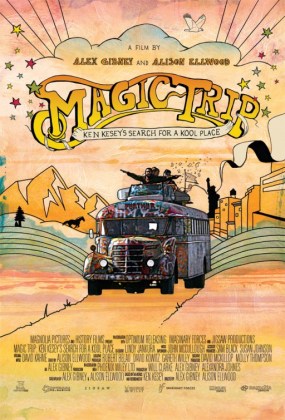
Magic TripIn the interregnum between the Beatnik era of “On the Road” and the hippies of “Inherent Vice,” there was Ken Kesey and his Merry Band of Pranksters.  The writer, best known for the counterculture classic “One Flew over the Cuckoo’s Nest,” rode around the country with a group of pals in a bus called “Further.”  They sought the creation of art and the consumption of drugs – it was the mid-1960s, after all.

Alex Gibney and Alison Ellwood’s “Magic Trip” documents their odd voyage, though not with the usual talking heads and ex post facto interviews.  The directors got their hands on the 16 mm footage that Kesey and company shot on “Further” and construct most of their nearly two-hour documentary out of the raw material, which had previously been unseen by audiences.

Admittedly, this is a film that will appeal most to those familiar with Kesey’s work and are curious to learn more about the man and the time that spawned them.  “Magic Trip” often sags under the weight of its embarrassment of riches; after all, those who want to learn more should be able to experience as much of it as possible.

But even for those unfamiliar with the author or the circles in which he ran, “Magic Trip” still provides an excellent document of what it was like to be on the fringes of society before the tumult of the decade pushed more people that direction.  Gibney and Ellwood also do a brilliant job depicting their drug usage, crafting a brilliant sequence of words and images to accompany audio footage of Kesey’s first LSD trip.  And, mind you, that partaking was not merely recreational.  It was sponsored by the CIA.  What a time.  B+3stars


REVIEW: Citizen Koch

24 03 2015

Citizen KochDirectors Carl Deal and Tia Lessin sell their documentary “Citizen Koch” as an exploration of the effects of the 2010 Citizens United case, which allowed an almost unlimited flow of corporate money into electoral politics.  The lawsuit, which began with a piece of propaganda disguised as a documentary called “Hillary: The Movie,” radically altered our democracy.

“Citizen Koch” attacks the decision reached in Citizens United yet is not all that different from the film at the center of the case.  It claims to be a piece of journalism, but it is really just a thinly-veiled partisan attack.  Poorly researched and selectively presentative of the facts, Deal and Lessin commits what is, in my mind, a cardinal sin of documentary filmmaking.  Rather than elevating the discussion to move beyond party divisions, they simply work to entrench partisan-infused rhetoric.

“Citizen Koch” crosses its wires on indignation for Tea Party’s racially charged rhetoric with the power of Citizens United.  They have every right to be angry, and I’m probably just as scared as they are of the prospect of “President Ted Cruz.”  But going after them for their oratory technique seems erroneous, and it detracts from the integrity of their argument on the whole.

Furthermore, Deal and Lessin make an overly simplified claim that Citizens United created the Tea Party.  I know for a fact that such an assertion is incorrect, as I knew parents of friends who started attending their rallies in 2009.  They also ignore the fact that Democrats are benefitting just as much from Super PAC spending, which became essentially unlimited as a result of the decision, as Republicans.  But based on the amount of time they devote to attacking the Koch Brothers’ puppet Scott Walker, anyone watching the movie with no knowledge of the issue would assume it was only the GOP exploiting the groups.

If Deal and Lessin really cared about ending the role of big money in politics, they would have made a film that did more than just preach to the choir and pander to the left.  Instead, they veer wildly off message to take potshots at Republicans for easy points.  This sham of democracy in this country will only continue to get worse if more films like “Citizen Koch” continue get a free pass for their ridiculous masquerade of non-fiction cinema.  C-1halfstars


REVIEW: Kingsman: The Secret Service

23 03 2015

Earlier in 2015, Matthew Vaughn hit a nerve with many movie fans when he took a giant crap on the face of reigning blockbuster king Christopher Nolan.  “People want fun and escapism at the moment,” said Vaughn in an interview, “I think Nolan kick-started a very dark, bleak style of superhero escapism, and I think people have had enough of it.”

I take issue with his statement for a number of reasons.  First of all, it just reeks of bitterness over Nolan’s success; the total worldwide gross of Vaughn’s combined filmography does not even come close to equaling the haul of “The Dark Knight Rises.”  Second, it implies that serious action films are shoving lighter fare out of the market on both the level of the corporation and the consumer.

For me, I tend to prefer Nolan’s films because they so boldly test the boundaries of what our entertainment can be.  But at the end of the day, I do not want to live in a world where I cannot kick back and enjoy a blissfully funny, irreverent, and exciting movie like Matthew Vaughn’s own “Kingsman: The Secret Service.”  There will always be a place for well-crafted entertainment that knows the role it wants to play and fulfills its duties with gusto.

Vaughn’s film, co-written with his frequent collaborator Jane Goldman, strikes a rarely found balance between spy movie classicism (like a Bond flick) and outright parody (a la “Austin Powers”).  They find the right times to shift gears, and the result is an experience that plays like all the fun of two movies for the price of one.  Overall, I found myself reminded of the hero’s quest of Luke Skywalker from “Star Wars” hybridized with “Agent Cody Banks” (throwback – bet you haven’t thought about that movie in a while).

Read the rest of this entry »


REVIEW: Goodbye First Love

22 03 2015

Goodbye First LoveIt’s easy for cinephiles like myself to put foreign cinema on a pedestal, praising it as superior to what the American system churns out year after year.  Much of that praise, however, comes from sampling bias.  Usually, a film has to be pretty good to cross the pond and make waves in the United States.  A visit to a movie theater in France will realign romanticism with reality.  For every “Amour” or “Blue is the Warmest Color,” they have two or three generic, culturally specific studio films.

I say this not to associate Mia Hansen-Løve’s “Goodbye First Love” with such bottom of the barrel but merely to make a point that not every French film is Palme D’Or quality.  Her third feature is artfully made, sure, but it has the sophistication of story that I would associate with a Nicholas Sparks adaptation.

The film follows Lola Créton’s Camille as she falls for Sebastian Urzendowsky’s Sullivan as a teenager, a romance stifled by his imminent departure to find himself in South America.  After he takes off, she seeks to fill the void he left behind – because, obviously, no woman is complete without a man.

Créton does a good job highlighting her character’s insecurities and susceptibility to the affection of the opposite sex.  Hansen-Løve just spends far too long registering her longing.  “Goodbye First Love” could have used less sentimentalism and more bold directorial choices, like that strange aquatic frolicking montage set to “Music for a Found Harmonium” (prominently featured at the close of “Napoleon Dynamite”).  C+2stars


REVIEW: Ride Along

21 03 2015

If anyone ever wanted to know what a mash-up of “Training Day” and “Monster-in-Law” would look like, “Ride Along” exists for their viewing pleasure.  Ice Cube stars as Office James Payton, an elder statesman trying to scare away a potential spouse for a loved, protected younger sister.  In order to vet his potential brother-in-law, Kevin Hart’s pint-sized Ben Barber, James gives him a taste of a day defending the law.

Their antics are nothing particularly noteworthy or hilarious.  “Ride Along”is a film of mild ambitions that results in only the most modest of payoffs.  The irony of featuring Ice Cube, the rapper who famously sang expletives at the police, playing a law enforcement officer has already been mined by “21 Jump Street.”

The film is only worth watching for Hart, who does his best to elevate all of his scenes.  The now seemingly ubiquitous star is a fun-sized Chris Rock with the falsetto of Chris Tucker, and the burst of energy he brings to “Ride Along” makes him rather endearing. Perhaps I sympathize with him innately, since I reside at the lower end of the height spectrum myself.

Personal feelings aside, Hart gets a nice showcase out of an otherwise forgettable film.  I might rewatch “Ride Along” if it happens to be on cable while I get my oil changed, but I doubt the scenario ever occurs where I’ll voluntarily rewatch this mediocre comedy. C+2stars


REVIEW: Kill the Messenger

20 03 2015

Michael Cuesta’s “Kill the Messenger” plays like an “All the President’s Men” for an era of the lone eagle rather than the journalistic tag team.  Jeremy Renner stars as muckraking journalist Gary Webb, a reporter who uncovers a 1980s CIA conspiracy that use the smuggling of crack cocaine into the U.S. as a front to launder weapons into Central America.  In essence, poor American communities are collateral damage to freedom fighting operations.

The first half features him uncovering the story, and the second half follows the fallout after publication.  Unlike Woodward and Bernstein, who had the backing of the Washington Post, Webb just wrote for a small outlet out of San Jose that lacked the resources or the confidence to stand with the controversial piece.  The CIA, of course, sought to discredit the story, and archival footage shows how the mainstream media ran with their smear campaign.

Renner is potent and forceful as the leading man of the film, clinging to his ethics and pride when all else around him seems to fail.  “Kill the Messenger” thrives because of his righteous anger.  His work also receives bolstering from a tremendous supporting cast with solid turns from character actors like Rosemarie DeWitt, Mary Elizabeth Winstead, Oliver Platt, and Michael Kenneth Williams.

I can scarcely think of a critique for “Kill the Messenger,” except maybe the fact that it lacks an X-factor to take it from very good to great.  Still, Cuesta turns Peter Landesman’s tightly wound script into an entertaining, enthralling watch.  I can’t complain about that at all.  B+3stars


F.I.L.M. of the Week (March 19, 2015)

19 03 2015

The Jarecki family features two prominent documentarians; recently, Eugene has been the more active of the brothers.  His acclaimed 2012 film “The House I Live In” sparked some debate around the topic of mass incarceration in America.  But, all of a sudden, Andrew Jarecki has arrived with his HBO series “The Jinx” that left the entertainment page and flew onto the front page.

Andrew flew under the radar for the past decade or so, although he is the only brother with an Oscar nomination.  He achieved that feat for his 2003 feature “Capturing the Friedmans,” another documentary centered around a monstrous criminal spawned by a well-off but unusual family.  Unlike “The Jinx,” where Jarecki consciously sought to make a judgment about his subject, he stays hands-off here.

“Capturing the Friedmans” is my pick for the “F.I.L.M. of the Week” because of this observational, judgment-free style.  Though Arnold Friedman and his son, Jesse, were charged and convicted of possessing child pornography and sexually abusing minors, Jarecki never treats them as subhuman.  In fact, he even extends them the benefit of the doubt as to whether they committed these acts in the first place.  No physical evidence was ever uncovered, so the case came down to the word of the children against the word of the Friedmans.

Jarecki manages to get some of the most personal, frank testimony from the participants in the story, especially those in the Friedman family themselves.  When the state brings charges against Arnold and Jesse, the matriarch and her other two sons hardly react in a conventionally supportive matter.  Home video recorded from the time of the legal action shows their bitter disintegration as a family unit, and the interviews shed light on why it all unraveled so easily.

As it turns out, the abuse goes farther back than just the assaults Arnold and Jesse reportedly committed in their basement to children signed up for a computer class.  (Horrifying and sickening, if it’s true.)  But by highlighting the legacy of sexual dysfunction that led up to deeds which resulted in two prison sentences, Jarecki never seems like he is attempting to excuse or apologize for the Friedman men.  In “Capturing the Friedmans,” he achieves just what his title indicates: nailing them down in their very essence to allow a greater understanding of how they could have done what they did.


REVIEW: Kumiko, The Treasure Hunter

18 03 2015

kumiko_the_treasure_hunter_ver2A shy, young office worker in Japan mysteriously stumbles upon a VHS copy of the Coen Brothers’ “Fargo” and begins to interpret it as a factual document pointing her to buried treasure in the snows of North Dakota.
That constitutes the basic premise of the odd, eccentric film “Kumiko, The Treasure Hunter” by the Zellner Brothers.  The duo certainly concocted a unique caper, one that allows a bunny and a tawdry motel duvet cover to dwarf the acting prowess of their Academy Award-nominated star Rinko Kikuchi.  She plays Kumiko as the introvert that her character is, although her timidity and ambivalence at times makes for a frustrating watch.  (For a while, I wondered if she was playing another mute character like she did in “Babel.”)

Kumiko makes for a particularly tough read because the Zellners, quite admirably, provide very little context with which to make sense of her.  Is she a naive, childlike protagonist on a quixotic quest like Thomas Schell from “Extremely Loud and Incredibly Close,” or is she driven by sinister demons like the two assassins who claimed that J.D. Salinger’s “The Catcher in the Rye” told them to kill people?  The question does not get answered until the very end of “Kumiko, The Treasure Hunter,” and it provides a precious sense of tension to hold flagging interest.

The curiosity generated by the Zellners’ novel concept gradually dissipates as their tedious pacing and unrelenting ambiguity steers the film.  “Kumiko, The Treasure Hunter” is worth watching through to the end, if for no other reason than to find out what on earth will happen with this strange character.  The rewards for enduring such a slog, however, hardly amount to bountiful treasure.  B-2stars


REVIEW: Deli Man

17 03 2015

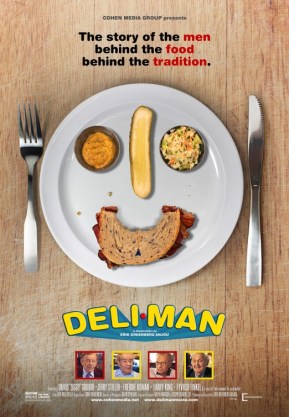
Deli ManErik Greenberg Anjou’s documentary “Deli Man” surveys the history and recent decline of the Jewish delicatessen in America from a very familiar vantage point to me: Kenny & Ziggy’s, a dining establishment located just blocks away from my childhood home in Houston.  I have made countless memories there … and probably consumed about as many calories of owner Ziggy Gruber’s food.

But the location alone can hardly account for how voraciously I devoured the film.  Anjou’s doc went down like a good pastrami sandwich – satisfying and extremely filling.  He weaves Ziggy’s personal narrative with the larger cultural and ethnic story with an ease that escapes many non-fiction filmmakers.  Furthermore, he manages to inform without ever boring the viewer.

I, for one, learned plenty from “Deli Man.”  The number of authentic Jewish delis in America has shrunk to about 150 from multiple thousands in their 1930s heyday; I would have thought the latter total was the accurate count (probably because my Jewish relatives always manage to find one in every town).  Most attribute the decline to ethnic assimilation, although there still exists a rare breed, like Ziggy, that persists in maintaining a connection to the ancestors who immigrated from Europe.

Ziggy takes the lion’s share of attention in “Deli Man,” though Anjou still provides a panoramic view of the delicatessen scene from Los Angeles to New York.  Each owner profiled has an interesting take on the business as well as a fascinating story as to how they managed to stay afloat.  If their dishes taste half as good as Anjou makes them look in the film, though, I cannot fathom any of them ever going out of business.  B+ / 3stars


REVIEW: What We Do in the Shadows

16 03 2015

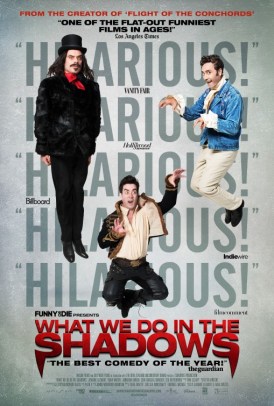
what_we_do_in_the_shadowsAfter the vampire boom of the late 2000s (all thanks to the “Twilight” saga), it makes sense that we now get a reactionary boom of revisionist bloodsuckers.  From action flick “Abraham Lincoln: Vampire Hunter” to hipster indies like “Only Lovers Left Alive” and “A Girl Walks Home Alone at Night,” it feels like culture has begun to reclaim the terrifying creature from the Cullens.

Now, add Kiwi mockumentary “What We Do in the Shadows” to the pile. The film comes from the team behind cult hit TV series “Flight of the Concords,” Jemaine Clement and Taika Waititi, and their latest effort seems destined to dwell in a similar realm of fandom.  The movie is undeniably clever and funny on a number of occasions, yet those moments come inconsistently (and a little too infrequently).

When Clement and Waititi realize their vision for three centuries-old vampires who are hopelessly out of place courting fresh blood in the modern world, “What We Do in the Shadows” recalls “This is Spinal Tap” in the hilarity of its pathetic mundanity.  But when they miss, the film feels like an improv sketch that cannot achieve liftoff from the very beginning and then crawls its way towards a far-off conclusion.  Even at under an hour and a half, the uneven mix of these two extremes makes the whole thing drag.  B2halfstars


REVIEW: Seymour: An Introduction

15 03 2015

Look no further, all those who wander aimlessly and wonder what the true meaning of life is, for Ethan Hawke seems pretty sure he has found it.  In “Seymour: An Introduction,” his first effort as a documentarian, Hawke profiles a former pianist and current piano instructor, octogenarian Seymour Bernstein.  But this is hardly a movie about music; the real subject is how to lead a wholesome life in the pursuit of art.

Hawke, after apparently hitting a wall of frustration in his acting, found renewed purpose from hearing the work and teachings of Seymour.  He mostly removes himself from the film, though Hawke does appear from time to time to gush ecstatic praises at his subject.  “Seymour: An Introduction” possesses the same amount of reverence that might be expected in a documentary about the Dalai Lama or Deepak Chopra.  I kept waiting for Gwyneth Paltrow to jump out at some point and endorse Seymour’s lifestyle brand.

None of this is meant to imply that Hawke is off-base in declaring Seymour a true savant at playing the keys of the piano as well as life, nor do I wish to ridicule the director for some kind of ridiculous insincerity.  I have personally witnessed Ethan Hawke speaking in person, both in private and public settings, and I truly believe that he cares deeply about meaningful art.  To someone without that context, though, “Seymour” might seem to drown under the weight of its hyperbole.

Plenty of Seymour’s wisdom is relevant, applicable, and deeply felt from a lifetime of lived experience.  Sometimes, though, his morsels of insight amount to little more than a well-phrased fortune cookie aphorism.  Hawke treats both like they are holy texts, unassailable because of their almost spiritual nature.  In fact, he passes off the only serious interrogation of his subject to a reporter writing a story on Seymour (convenient way to show undying loyalty to a deity).

“Seymour: An Introduction” works best when consumed like a self-help chicken soup as opposed to a practically religious message.  There is likely a great documentary lurking under the surface of this pretty good one, probably hiding behind the unceasing praise lavished on the film’s sage.  But if Seymour played any part in helping Hawke find the poignancy he lent to those final scenes in “Boyhood,” then this film’s existence is completely justified.  B2halfstars


REVIEW: Short Term 12

14 03 2015

Short Term 12“Look into my eyes so you know what it’s like, to live a life not knowing what a normal life’s like,” raps Keith Stanfield as Marcus in “Short Term 12.”  The musical moment occurs early on in the film, so the mood of momentarily subdued hopelessness is well established.  But his vulnerable profession of pain still feels like it comes out of nowhere, blindsiding us and leaving an aching bruise on our heart.
Writer/director Destin Cretton derived the film from his own experiences working in a home for troubled teens, so the scenes portraying the residents of the short term living facility are the most vividly realized.  They possess a potent, palpable authenticity that is rare to encounter outside of documentary film.  The kids do not come across as characters wandering around inside a story – they feel like people who happened to step in front of the lens.

“Short Term 12” would be a compelling enough film had it just focused on the backstories of the teenagers and what led them to the home, but that does not exactly lend itself handily to the narrative form.  Thus, to tie all the elements together, Cretton introduces Brie Larson as the home’s supervisor, Grace, into the script.

Larson is phenomenal in the role, bringing equal parts heart and grit to the table.  But the problem is, the rest of “Short Term 12” just lies on an entirely different level as her.  Everyone else appears to be inhabiting and living; Larson, unavoidably, always has to act.  They are authentic, while she is honest – two modes that are closely related but not quite synonymous.

Read the rest of this entry »


REVIEW: The Salvation

13 03 2015

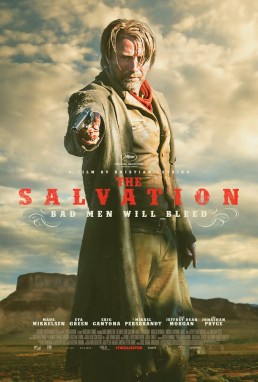
The SalvationSometimes it takes an outsider to really make a cinematic genre reflect the American character; I’m thinking specifically of Brit Christopher Nolan making the ultimate statement about post-9/11 USA with comic book flick “The Dark Knight.”  This is not necessarily the case with Danish director Kristian Levring’s western “The Salvation,” however.  (Yes, the American West.)

“The Salvation” has its modest thrills, like the classic “High Noon” bred with a modern Liam Neeson-style revenge caper.  The film sees Mads Mikkelsen’s Jon lose his newly immigrated wife and son at the hands of two gangsters, Jon’s retaliation, the gang leader Delarue (Jeffrey Dean Morgan) throwing down the gauntlet in the tiny Western town, and the townspeople cower in fear from offering Jon any assistance.  And all in a slender, 90 minute runtime, no less!

Mikkelsen is powerful as ever, but any fans of his should just reexamine the complexities of “The Hunt” or binge watch “Hannibal” for a more worthwhile use of screen time.  And as for those interested in or passionate about westerns, it’s hard to recommend something like “The Salvation,” a film rather average and unspectacular, when multiple watershed John Ford westerns are so readily available to stream.  B-2stars