REVIEW: Cinderella

12 03 2015

Kenneth Branagh’s biggest cinematic production to date has been “Thor,” but he established a reputation far before taking on a hot Marvel property.  Many consider him the Laurence Olivier of our time, perhaps the preeminent modern interpreter of Shakespeare.  Throughout the 1980s and 1990s, he stood at the helm of multiple acclaimed film adaptations of the Bard of Stratford-upon-Avon’s plays.

After delivering a dead-on-arrival reboot of the “Jack Ryan” franchise, Branagh turned back toward a source material that he could more faithfully reproduce: Disney’s “Cinderella.”  He approaches the fabled animated classic with the same tender touch he brings to a Shakespeare text, gingerly re-staging the action with careful attention to its original incarnation.  By not shaking anything up, Branagh ensures that his film will not ruffle the feathers of the die-hards.

But the downside of such a rigid reinterpretation is that his “Cinderella” also does not really excite anyone except the die-hards.  If the animated classic, 65 years later, still enchants children everywhere, why bother to remake it with such obliviousness to the many midnights passed?  (“Maleficent,” warts and all, at least took a stab at reimagining the “Sleeping Beauty” mythology.)  The answer seems simple: merchandising opportunities and brand awareness.

Branagh serves less as a director and more as a cookie-cutter, ensuring that all components of his “Cinderella” meet the pre-established mold.  In everything from the opening line of “once upon a time” to the traditional gender roles and ideology, the film adequately measures up.  The only worthwhile addition 2015 makes to the story is some CGI in the Fairy Godmother’s transformation of Cinderella, her escorts, and her carriage – effects that look quite magical.

Read the rest of this entry »


F.I.L.M. of the Week (March 12, 2015)

12 03 2015

Often times, the genres “action” and “adventure” get grouped together with a hyphen or a slash mark as if they were interchangeable terms.  It seems that not too long ago, Hollywood pumped out both kinds of movies in relatively equal measure.  Now, with the seemingly unstoppable rise of the comic book adaptation, action films have shoved out all the more epic, ambitious adventures.

Joachim Rønning and Espen Sandberg’s “Kon-Tiki,” on the other hand, serves as a potent reminder of just how captivating a real adventure is when done well.  It’s no surprise that Disney has quickly scooped up the directing duo to steer the “Pirates of the Caribbean” franchise back into safer waters. Rønning and Sandberg’s knack for balancing exciting storytelling and impressive set pieces makes their work a more than deserving pick for my “F.I.L.M. of the Week.”

The movie follows the simple yet truly extraordinary of Thor Heyerdal, an anthropologist whose ethnographic research on Polynesia suggests Peruvians settled on the island from the west.  His theory receives dismissal from the academic community, which suggests that such a feat was impossible with their lack of technology.  Thor, rather than giving up or just yelling, decides to disprove his detractors by sailing from Peru to Polynesia on a raft built only with the materials at the disposal of the settlers.

Thor, along with an eclectic crew of sailors and explorers, embark on a perilous, foolish, and admirable quest on the high seas that sees them facing down some of nature’s most dangerous foes.  All the while, “Kon-Tiki” makes for a refreshing movie to watch simply because it thrills without the weight of Hollywood star iconography.  Without the baggage brought to the film by well-known actors necessary to sell a film like this at a studio, we can really get to know the characters, not just analyze them in light of what we already know about the person playing them.

“Kon-Tiki” is the kind of movie that aims to do little more than entertain, but it achieves that aim without devolving into mindlessness or artlessness.  Rønning and Sandberg do not aim to leave any big questions, although I had one at the end: how did a movie with only a few lines of non-English dialogue manage to pull of an Oscar nomination for Best Foreign Language Film?!


REVIEW: Oz the Great and Powerful

11 03 2015

Sam Raimi’s “Oz the Great and Powerful” is home to a number of very pleasant elements.  James Franco’s Oscar receives accompaniment a heartwarming and adorable CGI china doll with a broken leg voiced by Joey King as well as a flying monkey hilariously played by Zach Braff.  The conclusion (no spoilers) also pays a wonderful tribute to the magic and power of cinema.

And … that’s pretty much it that I can remember.

“Oz” mostly strands a talented cast of actors against recycled graphics from Tim Burton’s “Alice in Wonderland.”  Raimi and screenwriters Mitchell Kapner and David Lindsay-Abaire (the Pulitzer Prize-winning playwright of “Rabbit Hole,” mind you) have to tiptoe around the iconography of “The Wizard of Oz” since Disney does not own the 1939 classic film, which means they cannot gush about its timeless qualities or rejuvenate the brand.  So the whole thing just feels rather awkward in principle, and then the film itself does nothing to alleviate that sensation.

James Franco is a great actor, but he is unfortunately miscast as Oscar.  His moral ambiguity in the role means nothing without the kind of earnestness and goodness that make up the bedrock of a Disney protagonist.  The part just seems too simple for him, as strange as that sounds.

Meanwhile, among the witches in the Land of Oz, Mila Kunis and Rachel Weisz appear to be having some kind of competition to see who can overact the most and bring the movie down more.  Shockingly, it’s the Oscar-winner Weisz who might tank “Oz” to a greater extent.

And then there’s also Michelle Williams as Glinda the Good Witch.  She’s very pleasant, too, I’m now remembering.  Williams brings the airy, gentle grace she endowed her Marilyn Monroe in “My Week with Marilyn,” and it does make the film more bearable when she appears on screen.  That is hardly enough to salvage the whole movie, though, or make it fun and entertaining. C2stars


REVIEW: The Myth of the American Sleepover

10 03 2015

American SleepoverI remember being 15 years old like it was just yesterday.  It was a time of excitement and newness as well as a period of confusion, longing, and frustration.  You begin to realize what it is that you personally want yet only have a rudimentary vocabulary to express it. The world seems so full of promise and potential, but so much of it seems locked away out of reach.
David Robert Mitchell’s atypical teen film “The Myth of the American Sleepover” captures this post-pubescent milieu with shocking accuracy.  He presents a vast array of characters in his ensemble, at least one of whom has to strike some sort of chord with a viewer.  They resist stereotypes and stock characterization quite ably, getting to the heart of what it really means to endure and enjoy this critical life juncture.

Mitchell’s script essentially consists of prolonged conversations between the characters, not advancing any sort of linear plot but rather chipping away at the facade they put up for others to view.  After a while, the film starts to run in circles and overstay its welcome as it ponders over the same adolescent conundrums.

Nonetheless, “The Myth of the American Sleepover” is a special kind of coming-of-age movie, simply because it does not show the process of change over a period of time.  Over the course of a single weekend at the end of summer, we learn all we need to know.  I just wish I had this movie to watch when I was still a teen and not discovered it as a twentysomething.  B2halfstars


REVIEW: Gett: The Trial of Viviane Amsalem

9 03 2015

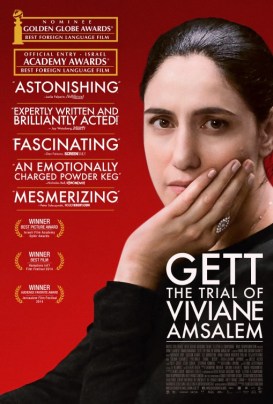
Gett PosterThe protagonist and heroine of “Gett: The Trial of Viviane Amsalem” may have her name in the title, but that could very well be the only advantage she possesses in the film.  Take the first scene, for example.  As Viviane seeks a divorce in court from her husband Elisha, all the other participants mention her several times in the first few minutes – yet she remains off-camera entirely.  Elisha even delivers a line directly to her, and he just looks right into the lens.

Brother/sister writing and directing team Ronit and Shlomi Elkabetz use “Gett” as an exploration of the ways in which women are degraded and disrespected in Israeli society.  Patriarchy is not just institutionalized – it’s codified in law.  When Viviane (played by the co-writer and director Ronit) and her lawyer present their petition for separation, the three male judges deciding the future of her union clearly have no intention of really listening to what she has to say. Any intents and declarations professed by a male receive obvious privilege in their eyes.

The entire two-hour film takes place inside the walls of the courtroom, a single location conceit starts off interesting but gradually grows somewhat tiring.  Some of the fatigue sets in because, surprisingly, the Elkabetz siblings do all their table-turning on the witnesses brought in to testify.  Normally, in a courtroom drama, the audience vacillates in opinion on the plaintiff and the defendant as new evidence brings about a clearer picture of each.

Even in spite of its flaws, “Gett” still makes a compelling watch for its fierce feminism alone.  Hearing such sexist remarks as “Know your place, woman” is painful enough, but observing Viviane’s relative silence in the face of such misogyny speaks volumes – especially when compared to all the long-winded men in the room.  She usually maintains a stoic facade, occasionally captured in a long take by the camera, and rarely breaks it.

Mostly, though, Viviane is just caught quietly registering the words of all the males around her and feeling a sense of hopelessness.  What chance does she have to fight for her own happiness in a world where a man’s flimsy word is stronger than a woman’s firm willpower?  Her occasional outbreaks, forcefully and urgently argued by Ronit Elkbaetz, feel rousing and righteous as a result.  B+3stars


REVIEW: Ballet 422

8 03 2015

Ballet 422The documentary “Ballet 422” follows the process of the only person concurrently serving as dancer and choreographer in the New York City ballet, Justin Kelly, as he mounts a new production.  But unlike the average non-fiction film, director Jody Lee Lipes features no talking heads – at least not ones commenting on the events from the privileged position of hindsight.

His editing style shows how the minutiae and tiny little components of the rehearsal process amass and eventually cohere into a ballet.  Lipes devotes several minutes to showing how a staff member works to get the right shade of blue for the costumes.  This is the kind of scene that would normally be left on the cutting room floor, yet in “Ballet 422,” it feels compelling and necessary.

At times, the documentary flirts with the self-indulgence of a “making of” film that would be a DVD extra for a recording of the ballet itself.  Yet, for the most part, Lipes resists succumbing to some easy trappings of such nonfictional pieces. By showing rather than telling, he indicates a level of trust in the viewers’ power to adequately process what they observe.

Perhaps most refreshingly, there is no tacked-on biography of Kelly as a person.  “Ballet 422” defines him simply by his work in the studio and nothing more.  It is definitely heartening to see a documentary so fully committed to a single focal point, although the almost inevitable downside of such an approach is the alienation of those outside such a tiny niche.  Still, I found the film mostly fascinating – and with a 70 minute runtime, the film certainly does not overstay its welcome. B2halfstars


REVIEW: Blackhat

7 03 2015

For a movie that features hackers who can access some scarily far reaches of the world’s computing system, in a time where cyberterrorists quite literally reached inside the American network and restricted our freedom of speech, the stakes in Michael Mann’s “Blackhat” feel remarkably low.  These unknown villains do not seem threatening so much as annoying, as if they were Clippy on Microsoft Word.

Some serialized dramas on basic cable networks possess more urgency in storytelling.  So the moral of the story is never send the year’s champion of World’s Sexiest Man to do Mariska Hargitay’s job, perhaps?

Hemsworth stars as Hathaway, the now-imprisoned programmer who served as the lead architect on the code that wreaks havoc on nuclear reactors and stock markets across the world.  (In spite of this brilliance, Hathaway still cannot manage to figure out how to button the top four buttons on his shirt.)  Since Mann sets the film on such a low simmer, it seems only fitting that their criminal adversary only seeks to hijack computers for the sake of making a quick buck off the manipulation of global trade.

To make matters worse, enduring “Blackhat” also involves tolerating Mann’s grimy, grainy digital aesthetic.  The movie looks like a crappy HDTV demo from a flat-screen at Sam’s Club, circa 2007.  It has no pretense of imitating the look of film stock (even if this sounds arcane and technical, this difference is obvious).  Not to mention, the camera feels about as loose as the buttons on Hemsworth’s wardrobe, and the entire thing looks cheaply re-lit in post-production.

Mann’s visuals are in service of a script from Morgan Davis Foehl, a writer getting his first screenplay credit.  His writing does not highlight relevant issues surrounding cybersecurity nor does it raise any intriguing ethical questions, a real bummer considering what just happened surrounding the release of “The Interview.”  In fact, the only question I left “Blackhat” asking was whether I found it tougher to follow the plot … or to care about what happened altogether?  C2stars


REVIEW: The Kill Team

6 03 2015

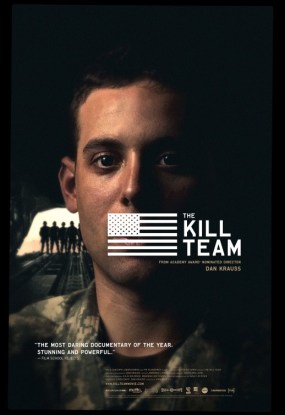
The Kill TeamThe Kill Team” takes place during the War in Iraq, but Dan Krauss’ documentary is not really about that conflict.  Most non-fiction films about American involvement in the Middle East try to take a more holistic view, contextualizing one story within a much broader frame of reference to argue the filmmakers’ thesis.  Krauss, on the other hand, simply tells a tale of humans and the society they construct around them.

His film opens with voiceovers of news allegations that of a “kill team” in Iraq that murdered for fun, and then it cuts to one of the men facing life in prison for a premeditated murder.  Krauss switches between Iraq and the courtroom effectively throughout the entire film, showing what led to the incidents in question as well as their consequences and repercussions in equal measure.  “The Kill Team” stays chiefly focused on the people directly involved in the killings under investigation and those immediately affected by it, and the film is all the better for maintaining such a tight, narrow scope.

The stark contrast between the battlefield and the courtroom provides a potent illustration of how morality is socially constructed.  What seems like a choice between following the rules and preserving your life becomes the ultimate catch-22.  The heart cannot help but break for Spc. Adam Winfield, who was the whistleblower for the unit, but not in the same way as Bradley/Chelsea Manning.  This soldier was motivated purely by what ought to be considered inarguable conscience as he strove to maintain a basic sense of humanity, and he faces punishment that devastates both he and his entire family.

The film might have benefitted from hearing the perspective of Gibbs, the sadistic military man responsible for intimidating soldiers into the mess depicted in “The Kill Team.”  But if anything Winfield and his comrades claimed about his actions is true, it is understandable why he would not want to speak in his own defense; simply put, his actions were indefensible.  A-3halfstars


F.I.L.M. of the Week (March 5, 2015)

5 03 2015

In the HouseFrançois Ozon made a big splash in 2003 with his film “Swimming Pool,” which follows the exploits of a novelist pulling generously from real life to write her next book.  A decade later, he circles back to the same themes with his adaptation of “In the House.”  It hardly feels like a rerun, however.

Ozon, here, concerns himself with the ethical position of the observer watching actuality being warped into literary fantasy.  This thrilling, dramatic work earns my nod for the “F.I.L.M. of the Week” because of the way it raises fascinating questions about the challenges and conundrums faced by all who write fictional tales.  While Ozon stops short of making the voyeuristic audience feel that moral weight, “In the House” nonetheless excites and enchants with its intellectual interrogations.

The film plays out as a serialized drama refracted through the experience of a teenage boy, the inquisitive student Claude (Ernest Umhauer).  His incisive description of the inner workings and desires of the real, banal middle-class home belonging to his socially awkward classmate Rapha Artole proves tantalizing to Claude’s teacher, washed-up writer Germain Germain (Fabrice Luchini).  Germain wants to develop and hone his pupil’s writing skills, so he begins to tutor him privately in order to discuss his compositions.

But Germain also pushes him to take surprising actions in his dealings with the Artoles to make Claude’s writing more daring in tone and content.  Thus, the always teetering fulcrum between art reflecting life and life reflecting art begins to fluctuate so rapidly that any distinction between the directionality become inpossible to discern.  Germain essentially turns Claude into a narrative Rumpelstiltskin, exploiting the beauty of the mundane for textual gold and personal gain.

“In the House” excellently illuminates the problems of narrativizing life as it plays out as well as how the writing of life ex post facto clouds and ruins the living of it.  Ozon’s smart plotting and direction makes these quandaries not only intriguing to mull over but also truly riveting to watch in action.


REVIEW: Scenic Route

4 03 2015

Scenic RouteExplicitly name-dropping influences within a movie is always a bad idea because it quite literally invites comparisons to the source. And it is an especially ill-advised move if that movie is a classic of the cinema like Martin Scorsese’s “Taxi Driver.”

Well, in Kevin and Michael Goetz’s “Scenic Route,” guess what they do when Dan Fogler’s Carter shaves the hair of Josh Duhamel’s Mitchell into a Mohawk? Yeah. Big mistake.

In “Taxi Driver,” Scorsese achieves fascinating results by playing around with the grammar and vocabulary of cinema itself. “Scenic Route,” on the other hand, feels rather stage-like in its setup. Two brothers, one car, driven slowly to insanity by getting stuck in the middle of nowhere for an obscene amount of time? Having just a pair of performers really seems like more of a theatrical conceit. Having the immediacy of their presence, combined with an unbroken temporal dimension of their escalating madness, sounds like a riveting play.

But on screen, it can feel rather excruciating. The Goetzs fail to use the confined space in any interesting way, and it makes the sub-90 minute runtime quite a chore. Not to mention, “Scenic Route” takes an odd, tonally inconsistent turn in its conclusion that feels totally unearned. So, to answer the question that Josh Duhamel is begging to ask – no, this film does not redeem his participation in the “Transformers” series.  C2stars


REVIEW: Olympus Has Fallen

3 03 2015

Lest we forget, the sight of the White House, the very icon of the American Presidency, in flames could have been a non-fiction tale (or a Paul Greengrass film). On September 11, 2001, United Flight 93 was likely headed to Washington, D.C. to take out the beloved building. So given that history, a modicum of respect – not even Christopher Nolan levels of seriousness – and reverence seems due for the landmark.

None of this registered with the makers of “Olympus Has Fallen,” however. Director Antoine Fuqua seeks to inspire anger by focusing on the sight of the edifice under siege, yet the film just feels too cartoonish in its destruction for any real emotions to register. (This is a movie where someone gets killed by trauma to the head inflicted by a bust of Abraham Lincoln, after all.)

Furthermore, the trigger-happy festival of gore devalues innocent lives taken by terrorists – NOT a smart move when trying to invoke the legacy of 9/11. As Gerard Butler’s Mike Banning seeks to rescue the prisoners of the North Korean attackers who take over the White House, the stakes feel rather low. In terms of hostage movies, this feels about on the level of a bank robbery.

“Olympus Has Fallen” will not even leave you chanting “USA! USA!” And, keep in mind, this is a movie that stars Morgan Freeman. What a squandered opportunity. C2stars


REVIEW: Elysium

2 03 2015

In April 2014, I started watching “Elysium” when I observed that it had arrived in my library. I grimaced my way through roughly 45 minutes and either fell asleep or became unavoidably detained. Then I just never got around to picking it back up again and wound up having to return the disc in order to avoid facing a fine.

I kept telling myself that I needed to pick it up just to finish it for the sole purpose of formulating some coherent thoughts to write a review. This internal conversation continued for nearly an entire year inside my head until, finally, I decided to give it another go since “District 9” writer/director Neill Blomkamp would soon unleash “Chappie” on theaters everywhere.

In short, I regret this decision.

The most interesting aspect of “Elysium” is how on earth something so violently anti-capitalist, anti-1% managed to find funding in the first place. Sure, some of these movies do manage to get through, but they are usually independently financed and then released without the help of a major studio. They also seem to temper their rage, at least enough to prevent the enterprise from seeming like an all-out vilification of the wealthy.

Blomkamp formulates a compelling scenario for his film, a world where the rich have fled a polluted, overcrowded planet to inhabit Elysium. Here, in this literal representation of what the Greeks mythologized as a paradise for heroes, those who can afford it can frolic around a ring orbiting the earth knowing that their health is always secure. Of course, anyone who lives up in the air has to resemble a cartoonish villain, even Jodie Foster’s Defense Secretary Delacourt.

Matt Damon’s Max Da Costa, ailing from a workplace accident that left him exposed to dangerous radioactive material, leads the small proletariat revolution against those hoarding access to medical care. It might have made for a fascinating, discussion-worthy visualization of the figurative “class warfare” narrative that gets tossed around quite a bit in the political sphere. Instead, it’s a boring, derivative action flick where the only thing more simpleminded than the ideology is the violent melee.  C2stars


REVIEW: Delivery Man

1 03 2015

A headline on The Onion anticipating the release of “The Internship” says everything that needs to be said about the present state of Vince Vaughn’s career: “‘The Internship’ Poised To Be Biggest Comedy Of 2005.”

Ever since that comedy went supernova in the summer of 2005, Vaughn has been spinning his wheels playing the same tall, loud-mouthed, fast-talking brash character.  “Delivery Man,” where he plays a man vacillating between whether or not to reveal his identity to the 533 children his sperm fathered, is no different from any other Vaughn film of the past 8 years.

Sure, I got a few laughs out of the endeavor.  Vince Vaughn is a gifted comedian, and he can usually provide some funny moments so long as the script isn’t a total nightmare (cough, “The Watch“).  But it’s an effort of increasing futility for him to hope lightning strikes the same place twice while he does the “Wedding Crashers” schtick yet again.  He misses the chance to delve deeper into the drama of “Delivery Man,” which could have been a fertile ground for an interesting character study.

Vaughn has not even managed to do anything subversive with his iconic persona.  Save a bit part in Sean Penn’s “Into the Wild,” all he’s done since 2005 are broad comedies cast from the same mold.  At least Owen Wilson has expanded his repertoire, continuing to collaborate with Wes Anderson (with whom he shared an Oscar nomination for “The Royal Tenenbaums“) as well as working with Woody Allen, Peter Bogdanovich, and Paul Thomas Anderson.  Wilson has had projects like “Hall Pass” too, but at least he’s making an effort to diversify.

And the fact that he’s eclipsed in “Delivery Man” by rising comedic star Chris Pratt marks the surest sign that Vaughn’s allure is fading fast.  Pratt plays a bozo on “Parks and Recreation,” but he’s also put in surprising turns in “Moneyball” and “Zero Dark Thirty” that may have led to his casting in a very different role for Marvel’s “Guardians of the Galaxy.”  Vaughn is surrounded by examples of how to branch out, yet he remains defiantly himself.

So get ready to toss his next film in the pile of the forgettable with “Delivery Man.”  And “The Internship.”  And “The Dilemma.”  And “Couples Retreat.”  And “The Break-Up.”  Banality loves company.  C2stars


REVIEW: Maps to the Stars

28 02 2015

MapsI have spent extended periods of time in Hollywood, and I really wish I had David Cronenberg’s “Maps to the Stars” by my side then to confirm all my suspicions and misgivings.  Director David Cronenberg and writer Bruce Wagner do not merely depict the shallowness and the narcissism dominant in the local culture so much as they diagnose it.  The film pinpoints a number of endemic ills in a town built on deception with the accuracy of a pathologist.

This saga of shameless self-promoters caught in a tangled web of ego bashing may not quite cohere in its explosive third act, yet it hardly detracts from the pleasure of simply watching them exist for an hour or so.  Cronenberg gets his cast to deliver performances tuned to the perfect channel: exaggeratedly hilarious without ever veering sharply into parodic or burlesquing territory.

Nowhere does this approach find better expression than in Julianne Moore’s brilliantly demented Havana Segrand, which – all due respect to “Still Alice” –  is the kind of work that should have netted the actress her first Oscar.  Nonetheless, she has the statue now, and we have this performance to relish forever.

Havana is Moore’s Norma Desmond, the fading and aging screen icon vividly realized by Gloria Swanson in “Sunset Boulevard.”  In an obvious attempt to jumpstart her career again, Havana tries desperately to land a coveted part in a remake of a movie that originally starred her late mother.  To settle her neuroses and ease her pain in the meantime, she hires a new “chore whore” at the suggestion of Carrie Fisher (playing herself, in a brilliantly ironic insertion by Wagner) – the mysterious burn victim Agatha (Mia Wasikowska) who recently arrived in town.

Read the rest of this entry »


REVIEW: Big Hero 6

27 02 2015

Disney Animation often tries to repackage tried and true formulas, although they usually pull their material from within.  “Tangled” and “Frozen,” of course, try to channel the hand-drawn princess magic.  “Big Hero 6,” on the other hand, appropriates from one of the best non-Mouse House animated films of recent years: “The Iron Giant.”

Baymax, the robotic spectacle of “Big Hero 6,” looks more like a giant marshmallow puff than a welded set of metal beams.  His function, however, proves virtually analogous to the Iron Giant’s.  Baymax arrives to help and to heal, not to inflict harm or wounds.  This mainly takes the form of ministering to a boy in a single-parent household still reeling from the loss of a family member; here, that would be the racially ambiguous Hiro.

Even though Baymax looks cushier and sounds more gently reassuring than the scratchily voiced (by Vin Diesel, no less) metallic behemoth, “Big Hero 6” feels lacking in the charm and emotional pull of “The Iron Giant.”  Heck, it falls short of even some of the mode mediocre Disney flicks.  And it certainly does not have the creativity of “Wreck-It Ralph” to fall back on when it cannot deliver on the feelings front.  While “Big Hero 6” crafts a clever world – San Fransokyo – in which its characters can roam and provides some flashy visuals, it skimps out on character development and thus cannot quite deliver that human spark when it needs to do so.

This might have something to do with the fact that the film started out as a Marvel property.  Even though they gave Disney full autonomy to make the movie they wanted, the influence of the comics juggernaut rears its head once more to spoil what could have been a great movie.  By the time “Big Hero 6” gets to some fairly complex moral deliberations from its simple-speaking robot in the final act, the stakes are not really established to make them feel of any consequence.  B-2stars