REVIEW: A Girl Walks Home Alone At Night

25 01 2015

A Girl Walks HomeWith “A Girl Walks Home Alone At Night,” writer/director Ana Lily Amirpour fuses together elements into a hybrid that likely never occurred to anyone else.  Her vampire film incorporates the western, the film noir, and tons of hipster cred (look no further than the vinyl records) – with dialogue spoken in Persian.  It’s essentially the best Sofia Coppola movie that Sofia Coppola didn’t make.

Amirpour’s film constantly exudes an ambience of coolness, which makes the experience mostly fun to absorb even when it gets dull to watch.  Like Coppola, she often falls into the trap of excessive stylization, especially when a killer tune is playing.  “A Girl Walks Home Alone At Night” thus often feels like a compilation of thematically related music videos.  The flesh-eating skateboarding girl simply seems to appear as a recurring character amidst the sea of drug dealers, prostitutes, junkies, strange old men, and curious kids.

Amirpour also has one heck of a strength to make the movie mostly work regardless: her exacting control.  Her eye for clean, classical visuals is remarkable.  In addition, she and cinematographer Lyle Vincent play with light and shadow with fitting and appropriate grace given the film’s theme of concealed identity.  While her directorial debut might boast all the style of a cult indie classic, it possesses the marginal storytelling of a student short overly obsessed with mood.  The combination leaves a little to be desired, though it certainly is not all bad nor a waste of time by any stretch of the imagination.  B-2stars


REVIEW: Crystal Fairy and the Magical Cactus

24 01 2015

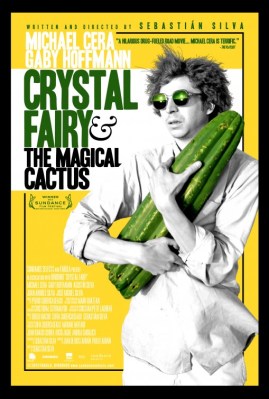
Crystal FairyMichael Cera and the titular plant might serve as the main selling points of the marketing materials for “Crystal Fairy and the Magical Cactus,” yet the movie hardly belongs to either of them.  The best compliment for Cera is that at least his performance does not recall his stock character too much.

Sebastián Silva lets comedienne Gaby Hoffmann run rampant to cause free-spirited mayhem in the piece.  And boy, does she capitalize on the chance.  She provides basically all the enjoyment the film has to offer.

Hoffmann’s hippy Crystal Fairy joins up with Cera’s Jaime, an American in Chile, to find a magic cactus and harness its hallucinogenic powers.  Their quest is not particularly funny, serious, or insightful.  It just kind of happens, and then the movie ends, leaving no real lasting impression nor making any strong case for its reason to exist.

The film feels rather ragtag and loose to the point of fault; Silva might have been better off saving thousands of dollars by just shooting the film on an iPhone.  Then “Crystal Fairy and the Magical Cactus” would truly have the verité feeling it longs for in prolonged sequences of awkward “naturalistic” dialogue.

Anyone looking for realness and authenticity will just have to find it in Hoffmann, whose Crystal Fairy fearlessly owns the screen.  She plays an entire elongated scene in the nude, comfortably and confidently carrying out a conversation while flashing her lady parts to a room full of men.  Cera, and everyone else in the film, should have followed her bold lead.  C2stars


REVIEW: A Most Violent Year

23 01 2015

A Most Violent YearThe twelve months referred to in the title of “A Most Violent Year” are those of 1981, a period that saw an unprecedented spike in crime within the boroughs of New York City.  This illegality is not the story of the film, though; it is merely an intriguing backdrop for the saga of Oscar Isaac’s Abel Morales as he attempts to expand his property holdings in order to become a more competitive player in the heating oil business.  All the world seems to be operating without regard to law or ethics, and it practically invites him to abandon moral high ground.

Abel clings stubbornly to his principles, refusing to arm his trucks even when they get held up and robbed.  The film rarely mentions this, but Abel is an immigrant from Colombia who married into a leadership role in the company.  While mostly masks the traces of his accent, the effect of his heritage is present in every decision he makes.  Abel realizes how far he has come, as well as how far he has to tumble with just a single prideful misstep.

Isaac makes this deliberative stoicism absolutely riveting, coloring Abel with shades of Al Pacino’s Michael Corleone from “The Godfather” series.  He knows when the character is weak, when he is strong, and, most importantly, when he has absolutely no idea why any of it is worth the trouble.  It’s one of the beautiful ironies of “A Most Violent Year” that Isaac seems so in control of Abel, yet each passing scene in the film slowly strips away the illusion of control of his destiny from the character.

Read the rest of this entry »


F.I.L.M. of the Week (January 22, 2015)

22 01 2015

The Sundance Film Festival arrives, like clockwork, at the beginning of each year to inject a fresh bit of hope into our outlook for the upcoming year in film.  While we tire of the year’s awards season crop, the system begins to harvest its plants to bloom over the months to come.  The festival is great at providing two specific kinds of films: discoveries of major new talents from completely out of the blue, and surprising indie turns from well-known stars.  (Without said talent, the films would never be able to receive any financing.)

“Kill Your Darlings” falls into the latter camp.  This 2013 film was a big step in Daniel Radcliffe’s career reinvention – or at least a full-fledged turn of the page – from only being recognized as Harry Potter.  He stars as a young Allen Ginsberg, far before “Howl” brought the beat poet into censorship as well as the national spotlight.

John Krokidas’ debut feature is so much more than just a showcase for Radcliffe’s talent, though.  It is my pick for the “F.I.L.M. of the Week” because it tells a compelling, human story that just happens to be about a renowned poet.  His script, co-written with Austin Bunn, never veers into the realm of becoming a portrait gallery for the nascent counterculture movement.  Sure, there are appearances by William Burroughs (Ben Foster) and Jack Kerouac (Jack Huston), but the script never loses sight of who they are as people.

“Kill Your Darlings” does not feel the need for reverence to the towering legacy of a figure, an advantage the film is able to possess in part because it takes place before Ginsberg and his pals went supernova.  The plot begins with a young Ginsberg entering Columbia in 1943, where he quickly bristles with the established order and the canonized poets.  Radcliffe’s performance teems with self-discovery and fully realizes the awakening of an artist; perhaps there is a meta connection responsible for

Yet Radcliffe is not even the movie’s scene-stealing performer.  That honor goes to Dane DeHaan, star of “Chronicle” and “The Place Beyond the Pines,” who has really begun to build a formidable résumé.  He plays livewire Lucien Carr, an obstreperous rebel.  He takes Ginsberg from a student merely curious about the iconoclasm of Walt Whitman into a full bohemian beatnik.  Lucien also lures him into a love triangle with an older outsider, Michael C. Hall’s David Kammerer, that turns bloody and forces Ginsberg to make a tough ethical decision.

“Kill Your Darlings” is part biopic, part drama, part thriller, and part exploration of an artistic movement’s birth pangs.  All these elements cohere marvelously into one wholly satisfying film.  It is one heck of a debut for Krokidas, and it makes a great case for Radcliffe and DeHaan to receive some meaty roles in the feature.


REVIEW: 99 Homes

22 01 2015

Telluride Film Festival

In 2002, President George W. Bush declared, “Here in America, if you own a home, you’re realizing the American Dream.”  Six years later, that unbridled spirit of homeownership at all costs led to a bubble of subprime mortgages bursting and contributing to the tanking of the nation’s economy.  This time of panic and crisis brought about pain for many hard-working Americans, and it also provides the foundation for writer/director Ramin Bahrani’s gripping look into the dark heart of capitalism, “99 Homes.”

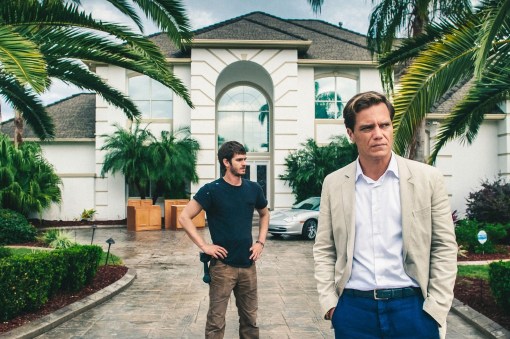
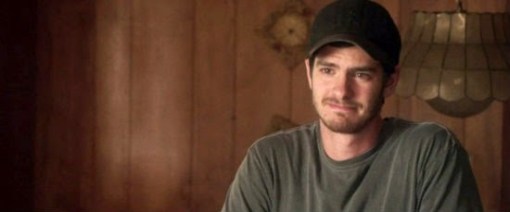
Over five years years ago, George Clooney’s Ryan Bingham arrived on screens to inform blue-collar workers they were out of a job in Jason Reitman’s “Up in the Air.”  A similar task falls to Andrew Garfield’s Dennis Nash, the protagonist of “99 Homes,” who enforces evictions in working-class Florida neighborhoods.  Bingham, however, could stay detached from the plight of the newly unemployed; Dennis can receive no such comfort.  Before becoming the man doing the evicting, he and his family were the evicted.
99 Homes

In order to provide for his son Connor and mother Lynn (Laura Dern), Dennis turns to the very person responsible for putting them in dire economic straits: the vile, e-cigarette smoking realtor Rick Carver (Michael Shannon).  While everyone suffers, his business booms, and Dennis is willing to sell his soul to his persecutor if it means putting food on the table.  Sure, he shares in some of the profits.  But, at the end of the day, Dennis heads back to the same kind of cheap motel to which he banishes countless other families.

Through Dennis, Bahrani brilliantly illustrates the sociological concept of false consciousness.  He buys into Carver’s policies and slowly deludes himself into believing he is of a higher class standing.  Carver, an unabashed believer that America only bails out winners like himself, takes the spoils and leaves workers like Dennis with the scraps.  Advancing out of their precarious position is merely an illusion.
Garfield

If this sounds pessimistic, Bahrani earns the right with his intellectual depth.  “99 Homes” also wisely focuses on characters whose very livelihoods are in jeopardy because of the financial crisis.  Most films that have tried to grapple with the effects of the recession – “The Company Men,” “Margin Call,” “Arbitrage,” “Blue Jasmine” – only dare to assume the perspective of the upper-class descending to the middle-class.  Dennis and his family are not worrying about losing the Porsche or selling off the jewelry.  If they descend any lower, it is outright poverty and destitution.

Stemming from this standpoint, the stakes feel appropriately extreme enough both to feel deeply and contemplate thoroughly.  Bahrani often scores the film with tense, thriller-like music, and it works exceptionally well.  If the lives hanging in the balance and the severity of the moral compromises being made do not merit an increasing heart rate, nothing does.

99 Homes

If the film feels exaggerated and over the top, the financial crisis was an absolute nightmare for many families that felt borderline apocalyptic, so grandiosity is justifiable.  If it feels like a preachy morality play, at least Bahrani has his heart and mind in the right place.  He understands that the home is a symbol of heritage, inheritance, legacy, and personal pride.

Yet “99 Homes” communicates something more important.  The home itself is not the American Dream.  It is the well-being of the people inside of the home.  A-3halfstars


REVIEW: Cake

21 01 2015

CakeJennifer Aniston stars in “Cake” as Claire Bennett, a woman struggling with chronic pain following a tragic automotive accident.  The poster and production stills almost completely hide it, but she sports a deep and instantly noticeable scar on her face stemming from the traumatic event.

And, per usual in an indie drama, the emotional scars run far deeper.  She attends group therapy as well as physical rehabilitation only to undo their progress in a toxic cocktail of booze and painkillers.  Claire further masks her agony through biting, sardonic wisecracks, deflecting anyone from exposing her pressing need for help.

It would be wrong to assign the character sole responsibility for her continuing struggles; the maelstrom of physical and emotional pain presents a tough obstacle for even the strongest individual to overcome.  Claire’s self-destructive tendencies do not disqualify her from receiving sympathy, either, yet the movie’s myopic focus on her pity party feels … well, pitiful.

Not to discredit or downplay her anguish, but Claire is a wealthy, white Angeleno living comfortably in unexplained luxury.  Her inability to function in society, shockingly, never seems to raise doubts about the continuance of her lifestyle.  She never seems to worry about having the funds to procure pain pills in Tijuana, and she never entertains the possibility of a world without the invaluable assistance of her inexplicably loyal Hispanic maid and driver Silvana (Oscar nominee Adrianna Barraza).

Read the rest of this entry »


REVIEW: Heartbeats

18 01 2015

HeartbeatsXavier Dolan’s “Heartbeats” amounts to little more than a schoolyard game between the straight female Marie (Monia Chokri) and gay male Francis (Dolan) for the affections of a sexually ambiguous Adonis, the flirtatious and friendly Nicolas (Niels Schneider).  Holding him up as a physical ideal, they objectify Nicolas as a prize to win.  And since Dolan casts himself, determining where his sympathy lies hardly proves daunting.

But the story is hardly the story of “Heartbeats.”  The precocious Dolan loves playing with speed, motion, and movement; on the latter front, he could rival the widely recognized master, David Fincher.  At times, the style threatens to overwhelm the film by virtue of its sheer virtuosity.  Fincher once said, “They know you can do anything, so the question is what don’t you do.”  Dolan, somewhat problematically, does everything he can do, and the movie comes off a bit like a highlight reel.

Still, “Heartbeats” tingles with the sexual energy of Alfonso Cuarón’s “Y Tu Mamá También,” mostly because of its powerful visual language. Dolan, impressively, manages to leave it unconsummated.  Possibilities and suggestions float through the air, yet they mostly just linger there.  Though Dolan goes all out with his bold technique, the beating heart of the film is anchored in this very authentic representation of love and desire.  Such a portrayal makes the film both watchable and enjoyable, even after the seemingly endless parade of mini-music videos.  B2halfstars


REVIEW: Virunga

17 01 2015

Virunga

Fortunately for the filmmakers of “Virunga,” but rather unfortunately for the sake of humanity, the titular Congolese park is a hotbed for a whole host of ills and tragedies.  At the start of the film, director Orlando von Einsiedel introduces a set of park rangers who literally put their lives at risk to protect a population of endangered mountain gorillas from poachers.  One ranger, rather touchingly, describes his relationship to them in these terms: “I am not a father. I am a mother [to these gorillas].”

As if that were not enough to keep them occupied, the multinational oil corporation Soco announces their intent to drill for oil within Virunga.  Oil exploitation conflicts directly with conservation, naturally, so their proposed operation is technically illegal.  But not to worry – Soco bribed the local officials to make it possible!  (In a statement shown before the final credits, the company vehemently denies any wrongdoing or unethical interference.)  The Congo, still sorting out its own internal sparring, never stood a chance to unite and block the destruction of their land.

When it comes to exploring the dirty dealings of Soco, “Virunga” relies heavily on the investigative journalism of French reporter Melanie Gouby and her hidden camera recordings.  Her presence, informative though it may be, does slightly throw off the equilibrium of the documentary.  von Einsiedel tackles so much, and at times, discerning the true center of gravity is tough.  Who is the subject – Gouby or the nature conservationists? What is the central concern – the business, the oil, the land, the animals, or the general status of Africa?

“Virunga” manages collapse all its issues and questions into one mostly convincing narrative of capitalistic colonialism and civil conflict.  It provides a wide view of all the issues without giving any of them short shrift, not giving an overly broad or cursory treatment to any of its individual components.  Most importantly, the stakes are appropriately high.  von Einsiedel structures many parts of his film like a thriller, and it feels even scarier because these are real people and animals at risk.  If the world does not stand up and stop this injustice, an entire species could vanish from the face of the earth.  B / 2halfstars


REVIEW: American Sniper

16 01 2015

Towards the beginning of “American Sniper,” Bradley Cooper’s cowboy turned Navy SEAL Chris Kyle receives the instruction to make pulling a trigger an unconscious effort.  Director Clint Eastwood and writer Jason Hall, however, ensure that the audience watching Kyle’s exploits are very conscious of the rationale and logic behind the dispatch of every bullet.  No kill feels sensationalized to satisfy bloodlust, even when that sentiment disguises itself as patriotism.

The film simply portrays one man’s experience during four tours in the post-9/11 Middle East, opting not for any anti-military statement (like “Green Zone“) nor for a chest-thumping jingoism (like “The Kingdom”).  Since Kyle is the protagonist and the eyes through which the viewer watches the film, of course “American Sniper” tilts in his favor.  But he is not celebrated merely because of his record 160 kills; the film lionizes Kyle because of the value he placed on leadership and loyalty.

At this stage in the cinema’s grappling with what happened in Iraq and Afghanistan, just telling stories from over there seems important.  And that basically sums up the extent of what “American Sniper” is: a presentation of Chris Kyle’s narrative.  Eastwood and Hall never fully commit to either showing the full terror of combating terrorism (a la “Lone Survivor“) or the grueling mental experience of the soldiers (in the vein of “The Hurt Locker“).  They pull elements from each effectively, yet they never really advance a thesis or a broader takeaway.

Read the rest of this entry »


F.I.L.M. of the Week (January 15, 2015)

15 01 2015

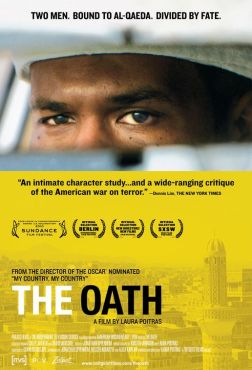
Layout 1In the wake of the Charlie Hebdo shootings in Paris, the world once again finds itself in a place of anger and fear towards the Islamic faith because of a few violent radicals.  So often, the media tends to “otherize” these jihadists, completely denying them any shred of humanity because of their barbaric acts.  Needless to say, any detailed attempt to actually understand why they do these things is totally off the table.
Thank goodness, though, for documentarians like Laura Poitras (who now seems almost destined to win the Oscar for her courageous and journalistic “Citizenfour“).  She dares to search inside the hearts and minds of the people often made out to be the enemy, simply portraying them for who they are without taking a judgmental stance.  Her second feature, “The Oath,” takes a long look at al-Qaeda operatists in Yemen.

Watching the film does not require sympathy with the terrorists.  Poitras simply asks that they not be deemed savages without hearing their worldview.  “The Oath” is my choice for the “F.I.L.M. of the Week” for the way it puts a human face on jihadists and Islamic fundamentalists, going beyond their violent suicide attacks.  Possessing an understanding of them based in knowledge rather than in fear and hatred can only elevate policy discussion, right?

Poitras focuses most of her attention on Nasser Al-Bahri, also known as Abu Jandal.  By day, Abu Jandal is a taxi driver in San’a.  Off the streets, however, he trains the next generation of jihadists.  As he explains, “We don’t need everyone working in TNT and C4,” and his gift of switching the primacy of mens’ paths from men to Allah makes him too valuable an asset to sacrifice.  He spreads awareness of why al Qaeda attacked, yet he is no longer actively involved in the prior planning or subsequent justifying of such attacks.

Abu Jandal is decidedly against America and the West, but Poitras does not hesitate the highlight the complexities of his background and character.  Prior to the events shown in the film, Abu Jandal had served as a bodyguard to Osama bin Laden himself.  Yet when he saw the events of 9/11, he reacted with shock and dismay.  Imprisoned at the time, Abu Jandal decided to share his knowledge with the American authorities and provided enough valuable intelligence to justify delaying an invasion of Afghanistan.

Meanwhile, Poitras also details the trial of Abu Jandal’s former companion, Salim Hamdan, who faces trial of questionable ethics in Guantanamo.  These scenes are colder and less intimate than the main narrative, playing like a classic political exposé documentary.  Nonetheless, the storylines still pair well with each other.

In “The Oath,” the subjects are neither lionized nor demonized.  Poitras simply allows to speak freely and openly about their beliefs without having to assume a defensive tone.  This is an opportunity to learn and listen like few others ever presented.


REVIEW: Evolution of a Criminal

14 01 2015

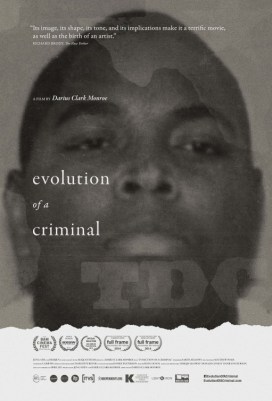
Evolution of a CriminalFilmmakers rarely employ the first person narrative style – the only fictional film that comes to mind is Gaspar Noe’s experimental art film “Enter the Void.”  It does occasionally crop up in documentary film, though, where films like Laura Poitras’  “Citizenfour” and Sarah Polley’s “Stories We Tell” directly involve their makers in the proceedings.  Now, add Darius Clark Monroe’s “Evolution of a Criminal,” which marks another successful entry into this small canon.
Monroe explores his life’s journey in the form of a cinematic memoir, tracing everything from his upbringing through the very making of the film.  Somewhere in the middle, he ends up spending five years in jail for a violent robbery he committed as a teenager.  Times were hard for Monroe’s family, and he admits that he made a terrible mistake in an attempt to help out his struggling parents.  With “Evolution of a Criminal,” he seeks to make amends and dispel certain myths along the way.

Chief among them, Monroe shows that criminality is not some kind of inherent character flaw, as is often presumed the case by the media.  In his mind, crime is merely an action one takes, a choice for which he can hopefully make amends.  (These conversations also carry an interesting and challenging racial subtext that deserves discussion amongst groups who watch the film.)

In order to reach the redemptive arc that makes the film so fascinating, though, Monroe does have to essentially restage the crime through filmic reenactment.  These portions play like a rather derivative heist film and take up too much of the runtime, but Monroe does ultimately demonstrate their necessity.  Seeing the honest expressions of shock from his family and friends, who never expected that the well-adjusted and successful boy they knew could be capable of such an act.

Knowing that the very subject of the film itself is on the other end of the camera registering and filming these reactions drives home just how real and personal this story is.  Documentaries about the criminal justice system and the people within its auspices so often take broader brushstrokes (like “The House I Live In“), losing sight of individuals along the way.  “Evolution of a Criminal” stays in a figurative close-up, and it delivers all the rich nuance that can be expected with such an intimacy of scope.  B2halfstars


REVIEW: Zero Motivation

13 01 2015

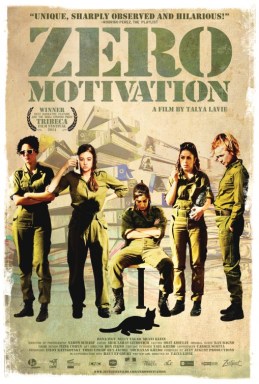
Zero MotivationAt the Tribeca Film Festival, “Zero Motivation” won the Nora Ephron prize, which honors distinctive female voices in filmmaking.  Were the great humorist alive today, it is hard to imagine her not getting a giddy kick out of the film.  Israeli writer/director Talya Lavie possesses the knack for a droll wit that would definitely tickle Ephron’s funny bone.

The Israel Defense Forces, which requires two years of service from all females of age, is not so much the subject of the film as it is the setting.  This is not a film about violence, war, or militarism.  “Zero Motivation” is about the challenges women face in their everyday battlefields: their romances, their friendships, and their workplaces.  Sadly, the women face a battle for respectability in them all.

The closest the women in the film come to combat is hitting a mine on their pre-installed copy of Minesweeper.   More than anything, “Zero Motivation” recalls the desktop drudgery of television’s “The Office.”  And, to boot, Jim Halpert would get some mad inspiration out of their outlandish pranks. Lavie deploys other humor styles throughout the film, including some very clever and expertly timed sight gags in a scene of half-joking suicide attempts.  She even manages to pulls off what seems like an impossible feat – making a joke about the Holocaust (besides the mean “Anne Frank-ly” line).

At times, “Zero Motivation” does feel like binge watching three episodes of a sitcom rather than a single, unified film.  But with the patterns of media consumption changing as rapidly as they are, that hardly even feels like a criticism anymore.  While her work might not be perfect, the world needs filmmakers like Lavie who are not afraid to put men in their place or call out a gendered double standard when they see one.  B2halfstars


REVIEW: Certified Copy

12 01 2015

Abbas Kiarostami’s “Certified Copy” feels like a 2-for-1 movie deal, which is not necessarily a good thing.  The film makes you think it’s one thing, then turns on a dime to transform into something else entirely.  Such an abrupt, jarring transition makes for an inconsistent, disjointed watch.

“Certified Copy” begins intriguingly, almost resembling the “Before” trilogy by Richard Linklater.  Kiarostami captures personal conversations between writer James Miller (William Shimell) and a mysterious French antiques dealer (Juliette Binoche) that quickly expand into the realm of the philosophical.  They cover such topics as the nature of fun and the dialectic of art and reality.  Not much pushes the film forward in this section, and it’s unclear what exactly brings the two characters together in the first place.

But out of nowhere, the plot moves in a direction where a case of mistaken identity turns into an unusual game of assuming and playing roles.  I really don’t know how to describe these almost non-sensical scenes where the dialogue feels like a series of non sequiturs.  If anything, the back half of “Certified Copy” resembles the surreality of “Mulholland Drive” or the absurdity of an Edward Albee drama.

Binoche gives it her all, and for that, she certainly deserves commendation.  But not even a committed performance can save “Certified Copy” from swamping itself and its audience confusion.  C+2stars


REVIEW: This Is Not a Film

10 01 2015

This Is Not a FilmWhen Americans complain about censorship, that’s usually a term being liberally applied by Harvey Weinstein while yelling at the MPAA to give him the rating he wants.  Be it “Blue Valentine,” “The King’s Speech,” “Bully,” or “Philomena,” the cry of censorship seems more like a PR maneuver in our country than an affront to human liberty.

Yet in “This Is Not a Film,” we get a glimpse at what actual censorship looks like in an authoritarian regime.  The voice of filmmaker Jafar Panahi has quite literally been squelched by the Iranian government.  After being convicted of propagandizing dissent again, he has been banned from making films for 30 years.

So rather than take it, Panahi creates a work that is, technically, not a film.  He brings in a cameraman to his apartment where he is confined to house arrest, and they go through the motions of the film he would be making.  Panahi describes what it would look like as he reads the script, staging and blocking various scenes alone in his living room.

The concept is a fascinating one – not to mention a courageous act of filmmaking.  “This Is Not a Film,” in its surface efforts to avoid being a film, actually becomes a powerful document of resistance that shows true exile.

Yet while it is unquestionably a bold premise, the execution leaves a little to be desired.  Perhaps Panahi would have been better crafting a short subject documentary out of “This Is Not a Film.”  The cleverness of the idea wears thin quickly and tries our patience as it moves forward with a rather dreary naturalism.

But, in a way, how it turned out is almost beside the point.  The most important aspect of “This Is Not a Film” is the simple fact that it was made.  C+2stars


F.I.L.M. of the Week (January 8, 2015)

8 01 2015

Now that Paul Rudd has officially debuted as Ant-Man, I expect that we’ll soon have to start referring to him as “Marvel’s Paul Rudd.”  Plenty of clueless fanboys will totally think of Rudd as the next Chris Pratt, a comedian that the comic-book magnate picks up from relative obscurity and turns into a bonafide action star.  And I will be sad.

But then, I will wipe away my tears and watch another one of Rudd’s hilarious comedies.  I will think of the time he and I shared a brief word in London, and I will remind myself of how his affable characters appear to accurately reflect his genial real-life personality.  I will remind myself that he is the perfect choice to play me in the movie of my life no matter what career move he makes next (although BuzzFeed recently told me that Benedict Cumberbatch would play me, another choice that suits me fine).

And finally, I will watch one of his comedies that stand head and shoulders above nearly all the other mainstream output.  For the most part, Rudd chooses projects with smarter wit and keener insight than the usual macho lineup of flatulence, misogyny, and homophobia.  Perhaps chief among these is 2009’s “I Love You, Man,” the bromantic comedy that serves as my selection for the “F.I.L.M. of the Week.”  (Yes, I am fully aware this is hardly independent or little-known, although it certainly deserves to be more widely known.)

Rudd, rather than erecting a cool facade, plays his character Peter Klaven as unashamedly dorky and unabashedly earnest.  Though he means well, Peter often stumbles over his own nicety into the verbal equivalent of a pratfall.  The film begins with the happiest moment in his life: proposing to his girlfriend, Zooey (Rashida Jones).  After the initial bliss dissipates, however, things get awkward as Peter seems unable to provide enough groomsmen to match Zooey’s seven bridesmaids.  In fact, he does not even really have a potential best man.

Rather than disappoint his beautiful bride-to-be, and apparently unwilling to suck it up and ask either his father (J.K. Simmons) or brother (Andy Samberg), Peter goes on the hunt for a male best friend.  After a series of hilarious misunderstandings, he comes across Jason Segel’s palatably absurd Sidney Fife, a friendly bachelor that stumbles into one of Peter’s open houses while scouting prospects for a wealthy divorcée.  They hit it off immediately, easily finding conversation topics and mutual interests.

Sidney and Peter’s friendship is purely platonic, yet writer/director John Hamburg replicates the experience of watching a romantic comedy.  We get the beginning stage of figuring out tastes as well as boundaries; we see the way that they bring fulfillment to each other’s lives; we have the classic blow-up fight that turns into a dissolution of an amicable partnership.  As “I Love You, Man” progresses, it exposes the parallels between forging friendships and romantic relationships as well as the absurdities inherent in both.

Peter and Sidney are not just the average dudebro BFFs – they are types to explore and investigate the very nature of human connection.  Although, in the hands of talented actors like Rudd and Segel, they are also fully fledged people that I’d love to slap the bass with any day.