F.I.L.M. of the Week (September 12, 2014)

12 09 2014

True Adolescents

Though the world of a great movie may feel hermetically sealed while you watch it, all sorts of factors outside of it have decided the manner in which you get to experience it.  I’ve made the argument before that the 2008 financial collapse has infiltrated the content of films, yet it probably exerted an even greater influence by limiting our access to a whole world of independently created cinema.

Back in 2009, a small dramedy by Craig Johnson called “True Adolescents” played the SXSW Film Festival.  It was well-received and went on to play some smaller local festivals, but it sat around for three years waiting for theatrical distribution.  Before the economic malaise (or even now in our platform-agnostic present day), this is the kind of film that would be a no-brainer for a company like Fox Searchlight to pick up.  Due to the unfortunate timing of its release, however, it wound up getting a minuscule release thanks to Cinedigm.

Perhaps with “The Skeleton Twins,” Johnson’s second feature which is getting a much wider rollout courtesy of Roadside Attractions, people will begin to discover the joy of which they were robbed years ago.  While the production is small-scale, the film pays off big with its richly observed script and properly defined characters.

The man-child is getting a little tired thanks to brute repetition by Seth Rogen and friends, but it feels good as new in “True Adolescents” thanks to a very authentic incarnation by Mark Duplass.  His Sam has clearly blown past the twentysomething mark and is well into his thirties, hapless and essentially hopeless.

Hoping for some easy sympathy, he goes to crash with his aunt (played by a pre-Oscar win Melissa Leo) and winds up being forced to work for her charity.  Sam gets the distinct pleasure of taking his teenage cousin Oliver and his friend Jake on a camping trip.  I’m not too far removed from that adolescent mindset to know that it takes a special kind of person to handle boys of that age; suffice to say, Sam lacks the requisite saintliness.

As with any narrative centering around a journey in the great outdoors, an inner journey takes place in the characters.  But that’s pretty much where “True Adolescents” stops falling in line with what you expect it to do.  Writer/director Craig Johnson provides a surprising amount of depth within the familiar framework, opting to explore deeper into the complex characters at every turn where melodrama or clichés would be easier.  It’s a real treat to watch him embrace the true in the title of his film rather than the latter word.


REVIEW: Joe

11 09 2014

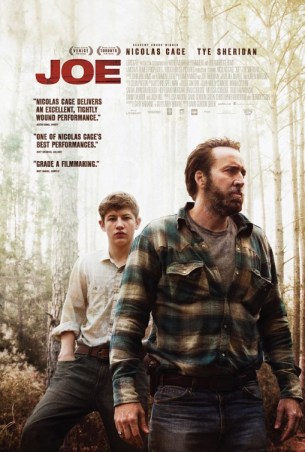
JoeDavid Gordon Green’s “Joe” gets off to a slow start, prompting me to initially wonder if it was going to be a complete non-starter like his prior directing effort “Prince Avalanche.”  He takes his time giving us the lay of the land and introducing us to the characters, a lax unraveling that teeters close to tedious.

It also doesn’t help that the premise feel quite similar to that of Green’s film school buddy Jeff Nichols’ recent success “Mud.”   A troubled man played by an actor looking to show off a more serious facet of his talent befriending a rough-hewn yet good-hearted teenager played by Tye Sheridan?  “Joe” feels like the younger brother of “Mud,” although perhaps only little due to the order in which it was released.

By all accounts, though, “Joe” is the better realized film.  It’s more emotionally charged and features more dynamic, complex characters.  Once Green kicked the film into gear around the 40-minute mark, I couldn’t take my eyes off the action.

After winning an Oscar, Nicolas Cage shouldn’t technically have to prove anything, so perhaps it’s best to say he reminds us that he is so much more than a meme.  As the eponymous ex-con Joe, he bares the bruises of his past with startling vulnerability.  While some might chuckle at the possibility of the same actor from the infamous “The Wicker Man” screaming video conveying a convincing paternal aura, Cage embodies and exudes a worn-down wisdom that feels completely authentic.

And Tye Sheridan as teenaged Gary, desperately in need of someone to look up to instead of his abusive alcoholic father, forges an entirely believable connection with Cage’s Joe.  Once again, Sheridan completely nails all the frustrations of adolescence.  He’s always remarkably in the moment on screen, which comes in handy when Green needs to communicate the urgency of the story.

We really feel the dire need for Gary to save his family before his father ruins it for good (credit the late Gary Poulter in an unhinged performance as the frighteningly destructive Wade).  Moreover, we see the need for Joe, flaws and all, to save the day.  It might take some time to reach that point, but “Joe” is worth watching for its gripping back half that leads up to an extremely intense conclusion.  B2halfstars


REVIEW: Borgman

10 09 2014

BorgmanIn Alex van Warmerdam’s “Borgman,” a mysterious figure rises from underground to perniciously infiltrate the home of an upper-class Dutch family.  His name is Camiel Borgman, and he’s played by Jan Bijovet (looking like a bearded Christoph Waltz) with a sort of pleasant warmth that intoxicates yet harms.  And over the course of nearly two hours, he completely turns the tables on his marks.

We see that he insidiously disrupts the dynamics, but what we don’t get is quite how … or more importantly, we never really get a hint as to why he does this.  Perhaps there’s something culturally assumed in the Netherlands that I am simply losing in translation.  The film feels like a regional parable about the chickens coming home to roost for the ignorant wealthy, yet it’s lacking a certain punch to really drive home a message.

There seems to be an almost supernatural power that Borgman possesses, and I’ll give van Warmerdam credit for keeping this strange effect a rather understated facet of the character.  But without any sort of explanation or tip-off, “Borgman” feels a rather tedious and frustrating watch.

Furthermore, we’re never clued into the film’s internal logic.  It’s as if all the scenes that make the parts of “Borgman” cohere were removed in the editing room, leaving behind a movie that’s just smugly enigmatic.  van Warmerdam’s emotionally detached filmmaking style means that we’re not entering the film emotionally through the charaters.  We’re just observers, watching a steady simmer of a movie that never feels like it’s going to reach a boil.

“Borgman” has its fair share of memorable images (heads in buckets of cement, anyone?) as well a sizable enough body count to keep our curiosity.  But once it ends, we’re left with precious little to hold onto.  I’m not quite sure what I was supposed to take away from the film other than Alex van Warmerdam wanting me to think he’s Michael Haneke and this is his “Funny Games.”  He’s a cold, calculating filmmaker, but what exactly he wanted the parts of “Borgman” to add up to is beyond me.  C2stars


REVIEW: Ida

9 09 2014

IdaRiverRun International Film Festival

Pawel Pawlikowski’s “Ida” is most certainly going to be one of the most gorgeously shot films of the year when all is said and done in 2014.  Each black-and-white frame is composed with a striking incredible attention to detail that they feel worthy of commemorating in a textbook.

His choice of imagery, though, is rather one-note.  Pawlikowski loves placing the characters in the bottom third of the frame, their heads dwarfed and engulfed by their surroundings.  It’s often as if the characters are shot in proportion to their importance.  At some points in “Ida,” this fixation gets to the point where the subtitles have to be placed at the top of the screen instead of their customary resting place at the bottom.

Once we get the hang of the film’s visual language, it feels like we’ve taken cinema’s equivalent of an Ambien.  “Ida” is but 80 minutes, but I wondered if I would be 80 years old by the time it concluded.  (For those who don’t know, I’m 21.  Hopefully that metaphor makes a little more sense now.)  The cinematography is stunning, but it eventually is not enough to carry the snail-paced story of the film.

The characters lack the development to sustain the film as well.  The titular character, Ida, begins the film as a Polish nun in the 1960s who goes by Anna.  She was removed from her Jewish roots at an age too young to remember them but receives a rude awakening when her biological aunt Wanda reveals this hidden past.

Ida is too painfully stoic – think more stone-faced than Ryan Gosling in “Only God Forgives” – and Wanda is not nearly colorful enough to make the journey worth investing in.  Pawlikowski doesn’t initially make the purpose of their voyage evident, leading to frustration right out of the gate.  Everything’s in its right place in “Ida,” except maybe some storytelling fundamentals.  B- 2stars


REVIEW: The Imitation Game

8 09 2014

Telluride Film Festival

As if the subject of “The Imitation Game” – a tender British soul misunderstood as an incompetent and bumbling fool – weren’t enough to draw comparisons to “The King’s Speech,” the film seemingly invites the parallel in its opening credits.  It’s only faintly discernible, but audio from none other than King George’s climactic speech at the dawn of World War II plays diegetically in the background.

To those who might recognize the snippet, it serves as a perfect barometer for the ambitions of “The Imitation Game.”  With maybe a dash of brash mathematical genius of “A Beautiful Mind,” Morten Tyldum’s film is very much this year’s “The King’s Speech.”  For those unaware of the construed meaning of 2010’s Academy Award winner for Best Picture, that means the film is an engaging and entertaining biopic made with high production values all around yet does not aspire to anything groundbreaking.

Benedict Cumberbatch in The Imitation Game

Maybe I can only give such an unabashed endorsement of the film from my privileged subject position of being one of the first audiences to see the film or because I saw it before the glut of prestige films later in the fall.  Indeed, I can already see myself holding truly great movies against “The Imitation Game” and wondering how on earth anyone could think so highly of it.  At least for the moment, however, I choose to see the film as it is: a quality piece of cinema that is not trying to reinvent the wheel.  It’s simply trying to turn some wheels in my head, and I thoroughly enjoyed it on those terms.

Certainly a film has some merit if it can collapse a two-hour act of viewing into feeling like an experience lasting half that duration.  “The Imitation Game” flew by, largely because of how engrossed in the story and the characters I became.  Benedict Cumberbatch turns in inspired work bringing the film’s subject, Alan Turing, to life.  His performance alone is worth the price of admission.

Read the rest of this entry »


REVIEW: The Look of Silence

7 09 2014

Telluride Film Festival

When I was in eighth grade, I had the remarkable opportunity to hear a Holocaust survivor recount his experiences surviving the cruelty of the Nazis.  After his speech was over and the whole room was crying, he stood at the front of the room and received hugs and other warm gestures from anyone who wished to embrace him.  No gesture of kindness could erase all the pain he endured, but it somehow felt like the only possible way to end the session.  The hug became a sort of promise to bear witness moving forward.

I had never seen anything like it again until I left my screening of “The Look of Silence” at the Telluride Film Festival, which the documentary’s protagonist, Adi Rukun, attended.  After a brief Q&A following the film, the crowd somberly filed out (appropriately, in silence).  And when the bright sunlight entered my eyes, I noticed a sight both moving and surprising: a queue had formed to embrace Adi.  One man seemed to clutch him firmly for well over a minute.

“The Look of Silence” is the kind of film that can inspire such a deep outpouring of emotion with its brutally pared-back power.

The Look of Silence

In the film, documentarian and humanitarian Joshua Oppenheimer revisits the subject of the 1960s Indonesian genocide that made him an Oscar nominee last year with “The Act of Killing.”  That film, as profound an impact as it had upon release, rubbed me the wrong way as it allowed (at least in my audience) repeated instances of laughter at the excesses of men who took joy in murdering large quantities of people.  “The Look of Silence,” its companion piece, thankfully operates under the appropriate sense of solemnity and reverence that is rightfully due to the victims of the extermination and their families.

The narrative journey Oppenheimer fashions in his second take on the subject is assuredly less flashy and entertaining.  It moves slowly and episodically towards its conclusion, never quite signaling where it will eventually deposit us.  “The Look of Silence” occasionally frustrates with its gentle, slow pacing, yet the periodically interspersed revelations more than redeem any plot sluggishness.

To elaborate on Adi’s travails in any great detail would only rob you of experiencing the intellectual and emotional impact of the film.  With Oppenheimer’s help, he embarks on a dangerous and painful quest for answers about the killing of his brother, Ramli, at the guns of a death squad.  What the two uncover is far more than just textbook examples of the social construction of morality or the banality of evil.

That the killers boast of their exploits is hardly news to anyone who saw “The Act of Killing,” but “The Look of Silence” still finds new ways to explore how that past continues to loom large over the present in Indonesia.  The perpetrators continue to perpetuate their revisionist narrative of history, not only by making ludicrous claims as “some of the communists wanted to be killed,” but also through more insidious means of controlling thought and expression.

Ultimately, the film is not about the killers, though; it is about Adi – and subsequently every other Indonesian citizen in his position.  Oppenheimer frequently circles back to a scene of Adi watching a video of two military men detailing how they committed Ramli’s murder.  The camera often lingers on his calm gaze, which contains so much more than merely the look of silence.  The same subterranean power gives haunting resonance to every moment in “The Look of Silence” on the whole.  B+3stars


REVIEW: Dancing Arabs

6 09 2014

Dancing ArabsTelluride Film Festival

NOTE: This film has since been retitled “A Borrowed Identity,” a moniker somehow both more generic and indicative of the content.

Dancing Arabs” begins with some profound quote musing on the nature of identity that flashed on screen far too quickly for me to transcribe accurately.  But it seemed to foreshadow a profound discussion on the longstanding Israeli-Palestinian conflict, and for that reason, I was quite intrigued.

What unfolds over the subsequent hour and 45 minutes never really fulfills the intellectual depth promised before the action even begins.  With the exception of a tacked-on, unearned conclusion, “Dancing Arabs” remains squarely in the realm of entertainment.  Any statement it tries to make about larger issues feels rather obvious or uninspired.

While the collaboration between Israeli director Eran Riklis and Palestinian screenwriter Sayed Kashua is certainly a commendable step towards reconciliation and understanding, their film does little to further their mission.  “Dancing Arabs” is a disjointed middlebrow drama, comprised of two essentially separate narratives tenuously tied together by a single character.  Riklis never provides any dramatic escalation, either, so the whole enterprise lands rather flatly.

The forbidden romance of protagonist Eyad, an Arab living within the state of Israel, with his Jewish schoolmate Naomi comes across as a slightly more serious retread of “My Big Fat Greek Wedding.”  Their relationship dominates the first half of the film, and then “Dancing Arabs” inexplicably forgets Naomi nearly altogether.  The focus shifts towards Eyad and his friendship with muscular dystrophy-stricken Israeli teen Jonathan, whose deteriorating condition is not entirely bad news for Eyad.

Perhaps each would be more interesting or enlightening if given feature length to develop.  But their loose connection and juxtaposition makes for an dissatisfying union.  In the words of “Parks & Recreation” scene-stealer Ron Swanson, “Never half-ass two things.  Whole ass one thing.”  C+2stars


REVIEW: Mr. Turner

5 09 2014

Telluride Film Festival

When I spent last fall in London, I often found myself wandering the halls of art museums (largely since they boasted free admission).  Quite often, I would walk past a painting on the wall without giving it much thought, admiring its remarkable craft but feeling rather unmoved emotionally.  One painter whose work struck me on a deep and profound level, though, was J.M.W. Turner, whose work with light and shadow predated the renowned Impressionist movement.

I was hoping that Mike Leigh’s “Mr. Turner,” a film who places J.M.W. Turner in the subject position, would stir me similarly.  Unfortunately, I can’t really say that I felt the same pull to Leigh’s film as I do to Turner’s paintings.  But simply because I did not respond deeply to it does not mean the work is entirely void of merit.  I simply appreciate it more than I like or enjoy it.

Timothy Spall as Mr. Turner

With the exception of 2011’s “Another Year,” I seem to be rather immune to being swept away of Mike Leigh’s uniquely derived products.  (For those who don’t know, Leigh formulates his screenplay in tandem with the efforts of his actors in a lengthy, laborious rehearsal process.)  The characters all seem well-formed, and the dialogue always feels quite natural.  It just never feels exciting to watch.

In a sense, though, that’s kind of the point.  “Mr. Turner” is a biopic in the sense that it covers the life of J.M.W. Turner, but Leigh resists all the clichés and conventions we are normally conditioned to expect from a movie about a true-life creative mind.  Turner has no flashes of mad inspiration, nor does every word he utters ring with capital-I “importance.”  In fact, we rarely get to see his creative process at all.

Leigh uses “Mr. Turner” not to show how his subject is extraordinary, but rather the many ways in which he is ordinary.  It’s a biopic hiding inside an ensemble drama where Turner happens to have the most screen time.  Timothy Spall, a consummate character actor perhaps best known for his turn as Peter Pettigrew in the “Harry Potter” series, certainly makes the most of the attention given his grimacing genius Turner.  It’s a physically committed, emotionally potent performance that gives him a much-deserved moment in the spotlight.

Read the rest of this entry »


REVIEW: Rich Hill

4 09 2014

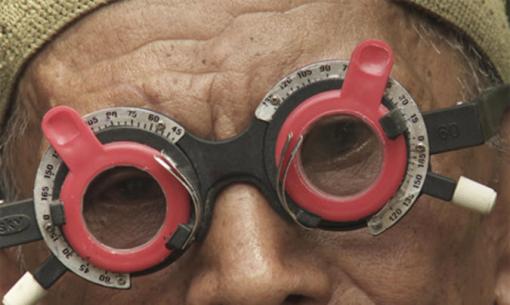
Rich Hill“We’re not trash – we’re people,” utters Andrew, a teenager growing up in the kind of town you’d only stop in to top off your gas tank.  He forms one portion of the triptych that is “Rich Hill,” a documentary that takes a startlingly unidealized look at what it means to grow up in the eponymous small rural community.
For all those who think the Hollywood intelligentsia do nothing but sneer at the flyover states as they peruse their box office reports, think again.  Directors Andrew Droz Palermo and Tracy Droz Dragos provides an extremely fair snapshot of their three young subjects, and they present it without the benefit of easy irony.  When prohibited from looking down on the boys of “Rich Hill,” we can look inside of them far more meaningfully.

The film peers in on life in progress, although not all the narrative threads inspire like innocent and good-natured Andrew.  “Rich Hill” also follows Appachey, a heavily medicated troublemaker who lights his cigarettes in toasters, as well as juvenile delinquent case Harley.  How to feel about them isn’t exactly straightforward since the directors avoid discussing the issue of societal forces battling personal agency.

Save for a brief interlude of waxing political on the nature of the prison system, “Rich Hill” steers clear of sweeping social statements altogether.  (You’ll certainly never hear the term “culture of poverty” being thrown around here.)  The documentary opts not to didactically tell us what to think, instead opting to show us something as it is and allowing our own thoughts to arise organically.

This method is certainly not the easiest way to consume factual information.  It may be, however, the most rewarding way to gain insight into a way of life.  “Rich Hill” pulls no punches when depicting the bleakness of poverty, and it can be gut-wrenching to watch these children get dragged through the mess of their parents’ lives.  Yet it also does not deny us the chance to see these young children enjoying the simple pleasures of life, such as the wonder of a firecracker on the Fourth of July.

These contradictions are at the very heart of the film, which toggles freely between a tone of hope and hopelessness.  As Palermo and Dragos refrain from large value judgments, we’re largely left to extract our own grand takeaway from “Rich Hill.”  No matter what you take away from the film, though, it would be nearly impossible to leave without a little bit more compassion for the kinds of people portrayed.  B+3stars


REVIEW: Alive Inside

3 09 2014

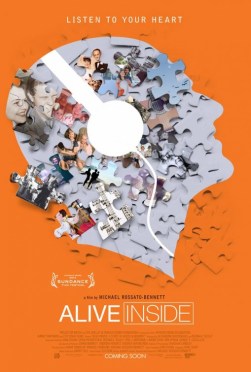
Alive InsideIn what appears to be the consensus pick for the favorite tearjerker of the past decade, “The Notebook,” audiences empty their tear ducts watching an Alzheimer’s patient momentarily regain touch with her lost memory.  That film features no “fantasy” elements, so to speak, but it feels like the kind of ending that could only occur in Hollywood.
The documentary “Alive Inside” proposes that the emotional experience of “The Notebook” doesn’t have to be relegated to the realm of fiction, however.  Social worker Dan Cohen, with nothing more than an iPod and a set of headphones, shows how music can reawaken long-dormant memories in Alzheimer’s patients.  Science has never felt so magical.

Cohen’s process isn’t just some funny mistake, though.  It’s rooted in neuroscience, which has shown that our capacity to process elements of music is one of the first things formed in an embryo … and also one of the last things to be effected by degenerative neurological diseases.  Time and time again, Cohen shows how music can resurrect the soul to moving effect.

Oddly enough, his process has not seemed to catch on with the retirement home industry, only finding use in roughly 0.19% of facilities.  Perhaps there are some potent naysayers that “Alive Inside” chose to exclude, but from this documentary alone, employing music for the dignity of these patients seems rather obvious.

Director Michael-Rossato Bennett does a less successful job lobbying for macro-scale change in the way that we treat our aging population and the manner in which retirement homes are run.  It’s not that he doesn’t make good points about them; “Alive Inside” just doesn’t feel like a documentary well-equipped to push for sweeping social reform.  The film is at its best when simply documenting these undeniably sweet and touching micro-level interactions between Alzheimer’s patients and the music that once moved them.  Because, as Cohen demonstrates, that music is inseparable from emotion and still capable of moving them.  B / 2halfstars


REVIEW: Night Moves

2 09 2014

Night MovesLondon Film Festival, 2013

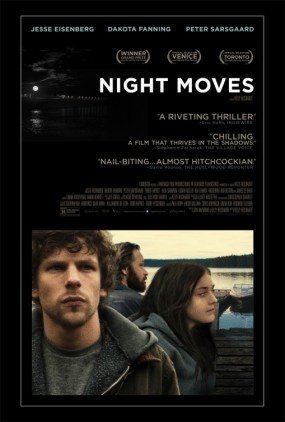
Kelly Reichardt’s ecoterrorist drama “Night Moves” starts off with all the right moves.  As she details the steps that a group of activists take to blow up a hydroelectric dam, the film holds us with the firm grip of a well-crafted procedural.  Reichardt never has to resort to the usual arsenal of cinematic tricks to create suspense because it arises organically from her laser-like focus on presenting the reality of the scene.

The film’s style works at first because we get a sense of who the characters are based on the way they act and react.  There’s no clunky exposition to give us an abundance of background information on them, yet these three resolute and very different figures just seem to make sense as they plot towards their bold action.

That’s largely due to the actors filling the nuances left by Reichardt’s script.  Jesse Eisenberg (yet again) plays the silent and bitterly angry type well, but “Night Moves” is more exciting for its surprising performances.  Dakota Fanning as a zealous untested college dropout and Peter Sarsgaard as a confident but somewhat shady ex-Marine make far more compelling characters because we aren’t sure the depths they can reach.

Once their planning is done and the deed is carried out (notice I didn’t say how successfully), the three split ways.  This occurs between a third and half of the way through the film, a rather odd structure given that we expect blowing up the dam to be the climax.  The unexpected plot development portends an exciting departure when it begins, but “Night Moves” sadly becomes an entirely different movie afterwards.

Reichardt, so ably steering clear of genre cliches at the start of the film, sets a course straight into them at the back half.  As the three characters struggle with guilt, responsibility, and many other feelings, “Night Moves” assumes the tenor of formulaic melodrama. Though this conventional chapter of the story ultimately caps off with a surprising plot development, the familiar waters taint the powerful experience of riding through such uncharted ones.  B2halfstars


REVIEW: Mommy

30 08 2014

mommyTelluride Film Festival

Fascination with portraying a particular kind of relationship on screen is not necessarily a bad thing – just look at how many compelling films Martin Scorsese has turned out about fathers and sons.  When that fascination turns to fixation, though, further exploration can just wind up being counterproductive.

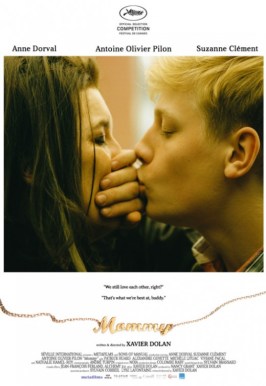
That’s the case with wunderkind Xavier Dolan, releasing his fifth feature film “Mommy” at the ripe old age of 25.  It’s certainly an accomplished work with plenty to laud: namely, Dolan’s mastery of music and montage.  To those unfamiliar with his work, the film may come across quite unique and fresh.

Yet dig back into Dolan’s filmography to find his debut feature, “I Killed My Mother,” which is essentially the same film as “Mommy.”  Both put a dysfunctional mother-son relationship at their core and takes a look at the way each party drives each other towards insanity.

In “Mommy,” Antoine Olivier Pilon plays a foul-mouthed teen, Steve, who suffers from ADHD and other afflictions.  He clearly tries the patience of his mother, Anne Dorval’s Diane, who’s no angel herself.  Dolan sets their misadventures in an alternative Canadian reality where Diane could have Steve involuntarily committed to a hospital, and it’s clear that easy route is never far out of mind.

“Mommy” also introduces a third character into the mix (“I Killed My Mother” was essentially a two-hander), Suzanne Clement’s friendly neighbor Kyla.  She agrees to help homeschool Steve while his mom is out working, which results in her becoming somewhat like a regular family member.  What exactly Kyla adds to the mix – or what Diane and Steve want to take away from her – is never expressly clear, giving “Mommy” its sole bit of tension.

Read the rest of this entry »


REVIEW: Birdman

29 08 2014

Telluride Film Festival

I hardly think it counts as a spoiler anymore to say that “Birdman” (sometimes also credited with the title “The Unexpected Virtue of Ignorance”) is edited to make the majority of the film appears as if there are not edits.  This does not, however, mean the film is intended to give us the illusion of unbroken action.  Breaks in time and space are quite clear, yet the effect of the long take remains.

Director Alejandro G. Iñárritu, as he would now have us call him, achieves the herculean feat of collapsing a timeline of roughly a few weeks into pure continuity.  He’s less interested in continuous action as he is a continuous feeling or sensation, an invigorating break from the oneupmanship that seems to come baked in with long-held takes.

Waiting for a cut or edit in a shot is like waiting for pent-up tension to be relieved, an indulgence Iñárritu refuses to grant.  (Leave it to the man who gave us the debilitatingly bleak “Biutiful” to make us writhe.)  “Birdman” follows Michael Keaton’s Riggan Thompson, a former blockbuster superhero star, attempting to win back his legacy in a flashy Broadway play.  He has struggles aplenty, both with his inner demons and the cast of characters around him, and the film certainly does not shy away from trying to replicate his anxiety in the viewing audience.

This is not just pure sadistic filmmaking, though; Iñárritu’s chosen form matches the content of the story quite nicely.  The film feels consistently restless and anxious, and not just because of the consistent drumming the underscores the proceedings.  These sensations are contributed to and complimented by Emmanuel Lubezki’s cinematography.

After his work on “Children of Men,” “The Tree of Life,” and “Gravity,” it’s a wonder Lubezki had any surprises left in store.  “Birdman” may very well be his most accomplished  cinematic ballet to date, though.  There’s an art and a purpose to every position occupied or every shot length employed.  Pulling off some of these constantly kinetic scenes must have required some intensely detailed blocking with Iñárritu and the cast, but the level of difficulty makes itself apparent without screaming for attention.

Read the rest of this entry »


REVIEW: Supermensch: The Legend of Shep Gordon

27 08 2014

SupermenschHe met Janis Joplin and Jimi Hendrix on his first day in Hollywood.  He entertains everyone from Groucho Marx to the Dalai Lama.  He invented the celebrity chef.  He is … the most interesting man in the world.  (Or he might as well be.)
Those are only a few high points from the unbelievable career of manager Shep Gordon, the subject of documentary “Supermensch: The Legend of Shep Gordon.”  He’s got a treasure trove of stories as well as a pretty remarkable track record in terms of what he accomplished.  Every savvy business move or serendipitous encounter leaves us all the more incredulously agape.

The film is essentially a greatest hits album for the backstage string-puller behind some of the biggest acts of the past five decades.  He’s like the Edward Bernays crossed with Harvey Weinstein, a master of grabbing the public imagination for his clients, who have included Alice Cooper, Teddy Pendergrass, and Emeril Lagasse (just to name a few).

“Supermensch” manages to be entertaining and even somewhat informative without feeling like an MTV special, a feat that should not be downplayed.  The film is directed by Mike Myers – yes, the guy who played Shrek and Austin Powers – in his feature debut, and he actually does a pretty bang-up job.  Perhaps most impressively, he doesn’t let his own ethos slip into the film and outshine Gordon.  I could have done without some of his corny graphics and B-roll, but Myers weaves a yarn that’s fun to watch whether you’ve heard of his subject or not.  B+3stars


REVIEW: Palo Alto

26 08 2014

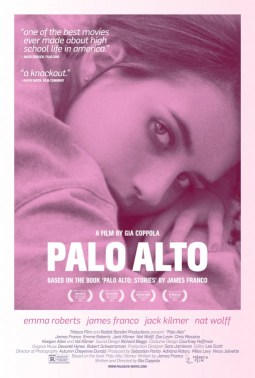
Palo AltoAt a high school party indistinguishable from any other, Emma Roberts’ April has a conversation of unusual candor with Jack Kilmer’s Teddy.  Though she acts confidently in front of others, putting on airs to impress her peers and returning volleys from flirtatious soccer coach Mr. B (James Franco), she’s sheepish and restless.  He, on the other hand, is a misunderstood rebel drifting from disaster to disaster but somehow retains an impeccable sense of self-worth.

All the stars appear to be aligning for them to take their connection to the next level; however, a communication breakdown as well as a few stray glances lead to misinterpreted gestures.  This party at the beginning of “Palo Alto” sets April and Teddy on separate courses, each taking them increasingly further away from converting the potential energy from that evening into a kinetic spark.

They wander aimlessly towards dissatisfaction and frustration, but they do so with an eerie sense of knowledge that each further step is to their deteriment.  April and Teddy are not quite sure what they seek, though it seems impossible to attain.  This indescribable yet palpable disparity between reach and grasp that makes “Palo Alto” such a searing film about being lost in the mess that is high school.

Though it’s tempting to write off these feelings as “teen angst,” first-time director Gia Coppola treats April and Teddy’s self-estrangement as a very adult matter.  With such a seriousness, “Palo Alto” comes off as a film more in the mold of domestic drama “Little Children” than YA weepie “The Perks of Being a Wallflower.”  Coppola treats the longing glances of high school students with empathetic solidarity, not with derision or patronization.

Read the rest of this entry »