F.I.L.M. of the Week (January 18, 2013)

18 01 2013

When you think of the films of Spike Lee, I can imagine some of the things that come to mind are didactic, pugnacious, and aggressive political commentary.  In other words, you would think of a movie that looks nothing like “Inside Man,” a tight thriller about the perfect bank robbery.  But precisely because it resists the trappings of a typical Spike Lee movie, it’s my pick for the “F.I.L.M. of the Week.”  (And also because it’s an AWESOME movie!)

You’ve seen plenty of movies about bank robbers, but none quite like Clive Owen’s Dalton Russell.  He’s got a master plan to pull off the perfect heist, one that slowly and cryptically unveils itself in Spike Lee’s film.  Russell is interested in more than just getting quickly in and out with the money; he’s willing to play the long game with the police and the hostages in unconventional ways.  The tension is high as you wait to see when, if ever, his master plan will unravel.

Remarkably, it manages to hold up as some curious players with some very powerful ulterior motives enter the fray.  Namely, there’s the wild-card of Jodie Foster’s power broker tampering with everything she can to keep some secrets hidden inside the bank.  With so many people operating in the shadows and shades of grey, it makes the the quest of the righteous Detective Keith Frazier (Denzel Washington) all the more urgent and compelling.

There’s rarely a dull moment in “Inside Man,” and Lee manages to pull it off without ever needing to pull out a boombox and blare “Fight the Power.”  There’s a little bit of commentary on multiculturalism in New York, but it’s hands-off and not particularly distracting from the point of the film.  Which is, of course, to entertain for two hours and then yank the rug out from underneath the audience.



SAVE YOURSELF from “Red State”

17 01 2013

Red State

Two years ago, one of the hottest properties at Sundance was Kevin Smith’s “Red State.”  The narrative unfolded as usual: high-profile premiere, studios deliberate buying it, bidding war commences.  Afterwards, however, Smith sold the movie to himself … for $20 causing a big hubbub and quite a few eye-rolls and head-shakes.

It was an attempt to make a statement on how backwards the studios’ distribution systems really are and how hard it is for filmmakers to tell the story they want.  But honestly, could there have been a worse movie for anyone to make that claim with?  If the studios keep all movies like “Red State” from getting made or distributed, you might not be too upset about that after actually watching the film itself.

It’s an absolutely dreadful movie that has no class or restraint.  Smith critiques the Westboro Baptist Church, the notorious anti-gay protestors led by Fred Phelps, as a bunch of backwards ignoramuses – as if the rest of the world didn’t already know that.  Perhaps a parody or a spoof would have been the more appropriate vehicle.  Though I’ve never seen “Clerks” or any of Smith’s other films, I’ve heard he’s quite the humorist.

This is the kind of unintentional humor that usually plagues bad movies such as these.  I’m sure some of it might have been planned, in which case Smith proved himself to be a poor imitator of Quentin Tarantino’s darkly comedic talents.  I think he probably wishes “Red State” was something like “Inglourious Basterds” with gratuitous violence aplenty dealt out to the hated villains.

And I suppose it’s a fairly vile turn from Michael Parks as the Fred Phelps surrogate, but it’s not like I got any satisfaction out of seeing all the massive bloodshed done to him and his lunatic disciples.  Mainly, I just wanted to see the conclusion of the horror story at the core of “Red State,” featuring Michael Angarano and his two buds following a sex ad but leading them to the Five Points Trinity Church. But by the time ATF shows up, all narrative and story are thrown out the window to let the bullets fly.  Oh, and there’s also some criticism of the corrupt government at the end that just feels totally out of place given the rest of the film.

When the dust settles, all that’s left are a lot of corpses and a lingering disappointment in the air.  Nothing to cheer about there.  And for the record, I don’t think I’d buy this movie for 20¢.


REVIEW: The Impossible

16 01 2013

The ImpossibleI can never imagine the pain and the agony of being put through nature’s crucible, but I can gain an ever so slight taste of it from movies that can bottle up their terror.  The latest of such is “The Impossible,” which ripped a hole in my stomach in a way no movie has since “127 Hours.”  Juan Antonio Bayona’s gut-punch of a movie takes us through the incredible journey of one separated family during the 2004 Southeast Asian tsunami, and boy, does it pack on the pain.
The film begins with an uneasy exposition, introducing us to the Bennett family that has come to Thailand for Christmas to release some steam from their hectic lives.  Just like in any movie headed towards disaster, you grit your teeth waiting for the inevitable to arrive.  With the dramatic irony escalating as they idyllically enjoy the calmness of their resort, the nervous waiting for these people to be thrown into hell on earth builds up.

And then when the tsunami hits, our first sign of devastation is a primordial wail from Maria, Naomi Watts’ benevolent matriarch, as she hangs onto a tree for dear life.  It’s a moment of paralyzing hopelessness that reverberates strongly and affectingly, setting the tone for what is to be a movie with a new agony at every turn.

Read the rest of this entry »


REVIEW: The White Ribbon

15 01 2013

The White RibbonI like to fancy myself somewhat adept at interpreting the meaning of movies, but sometimes, I get stumped just like everyone else.  It happened to me in “A Serious Man,” though with the proper context, some light has been shed on the directorial intent.  I was also pretty perplexed by Paul Thomas Anderson’s “The Master,” although I could sense vast levels of interpretation bubbling beneath the surface.

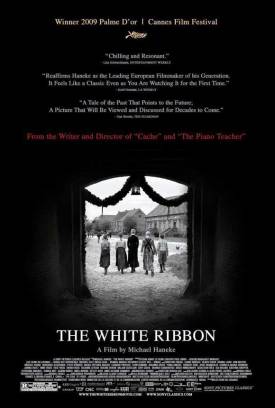
Michael Haneke’s “The White Ribbon,” on the other hand, has me totally bamboozled.  I have absolutely no idea what it’s really about.  Sure, ostensibly, it’s a movie following a pre-World War I German town as they are terrorized by a series of strange deaths.  But I don’t think Haneke means it to be taken at face value.  No one of that stature just makes a movie set in the past and means it to be just that.

The story, though extremely slowly revealed, is rather interesting.  I could scarcely keep track of the ten trillion villagers, much less give you any of their names, but I was always able to follow the events.  However, I was just blindsided by the ending – or lack thereof, making me doubt if I really understood what had happened in the movie’s first two hours.

I was a little angry that I left the movie with no sense of resolution, catharsis, or finality.  And perhaps that was what Haneke was trying to achieve with “The White Ribbon.”  But in a strange way, I almost feel like the film isn’t over, like I’m just missing the last chapter or something.  It’s the same way I feel about “Lost,” one of my favorite television shows of all time – even though I still haven’t watched the last season, perhaps because I don’t want it to end.

Certainly, I would like to be freed from the not-so-nagging frustration of not knowing quite what “The White Ribbon” is.  And maybe in a few years, I’ll re-enter that world of haunting visuals, intricate scripting, and deliberate direction.  Though I’m not sure if I will emerge with any sense of closure, after one rewatch or several.  B2halfstars


REVIEW: Hope Springs

14 01 2013

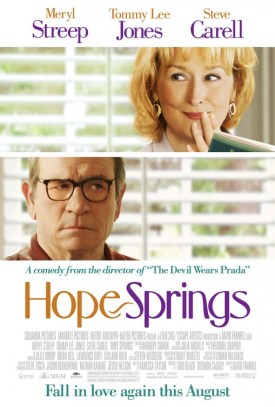
Hope SpringsBe careful, for “Hope Springs” is a wolf in sheep’s clothing.

David Frankel’s comedy disguises itself as a comedy in the vein of “It’s Complicated” where Meryl Streep has issues with her sex life.  But it’s anything but that.  Laughs are sparse, unless you find uncomfortable erotic fantasies being spouted by Tommy Lee Jones to be uproarious.

Instead, “Hope Springs” plays like “Blue Valentine” with an AARP card.  We see Streep and Jones’ married couple, but there’s no love or passion anymore.  Sure, they are held together by their children, their house, and 31 years of commitment.  But they don’t touch each other, kiss each other, or even sleep in the same bed anymore.

I suppose it’s effective as a drama, largely because the dynamic is devastating and depressing between the couple in question.  Channeling some of his Oscar-nominated performance as Thaddeus Stevens in “Lincoln,” Tommy Lee Jones constantly bullies his wife into submission and silence.  And when that wife is America’s sweetheart Meryl Streep, it just makes you angry.

When they go to couples therapy with an eerily stoic Steve Carell as their shrink, it’s hard to believe that this marriage can be fixed in anything less than a Hollywood movie.  And things get better, but I was hardly convinced or left smiling.  Between “Hope Springs” and “Amour,” 2012 has been a year where the movies have frightened me about where love and marriage eventually end up.  C2stars


REVIEW: The Hobbit: An Unexpected Journey

12 01 2013

At nearly three hours in duration, Peter Jackson’s “The Hobbit: An Unexpected Journey” plays like a director’s cut or an extended edition.  That is to say, the length feels like its been stretched out as if run through Willy Wonka’s taffy puller.  For Tolkien and “Lord of the Rings”/”Hobbit” enthusiasts, this overly generous runtime is probably a delight.

For people like me, who enjoy Jackson’s impeccable craftsmanship but fight to stave off boredom in his films, it truly is a test of patience.  The movie takes a delight in moseying and taking its time to let the events play out.  While at times, I found myself getting taken out of the movie by the obnoxiously slow pacing, I didn’t find it nearly as much of a chore as I would have expected.

For a movie I was nearly expecting to hate, ambivalence is a sort of victory for this first volume of “The Hobbit” trilogy in my book.  Perhaps the grand scope of the IMAX 3D helped as there were aerial shots aplenty to take my breath away.  The movie also features the same incredible technical achievement that won many Oscars for “The Lord of the Rings.”  Visual effects, cinematography, production design, makeup, sound … it’s all back to stunning effect.

“An Unexpected Journey” seems to be setting the stage for better things to come, and I am confident that they will in fact be delivered.  Though I couldn’t name you a single one of the dwarves, I found their quest for freedom moderately engaging.  Jackson’s script, co-written Guillermo del Toro along with his Academy Award-winning writing partners Fran Walsh and Philippa Boyens, also brings back plenty of thematic resonance to give some meaning to the wandering in this first installment.

But the movie’s best feature, and maybe the most unexpected triumph, is the performance of Martin Freeman as Bilbo Baggins.  He’s always fun to watch as a supporting actor, and with the spotlight on him, he doesn’t disappoint.  He brings all the charm of his typical unassuming wallflower to Bilbo, lending a crucial everyman vibe to a character operating in a fantasy world.

Freeman’s Bilbo Baggins is almost like a new-age (or Middle Earth, if you must) Hitchcock hero, an average joe caught by surprise in a web of events beyond his wildest imagination.  Although instead of the debonair suaveness of Cary Grant or James Stewart, Freeman provides a humble self-deprecation that makes him all the more delightful to watch.  Though I could do with a little less easygoing construction in future “Hobbit” films, I am very excited to see how Freeman will evolve the character.  B2halfstars


F.I.L.M. of the Week (January 11, 2013)

11 01 2013

Melquiades Estrada

Most people recognize Tommy Lee Jones’ calling as an actor.  The Academy sure does, giving him one Oscar in 1993 for “The Fugitive” and a chance at another one in 2012 for “Lincoln.”  But what few people know is that if Jones gave up his day job and took up directing full-time, he would be incredibly successful.

Just take a look at his debut feature, “The Three Burials of Meliquiades Estrada,” and tell me the man does not have serious talent.  While I was watching it, I kept thinking about all the reasons why I shouldn’t like it or that it shouldn’t be working.  But it did, and for that very reason, it’s my pick for the “F.I.L.M. of the Week.”

Jones’ film is based in a strong script from Guillermo Arriaga, one full of tenderness and deliberation.  And perhaps the best sign of a good director is to let the story shine brightly and take precedence.  Though maybe Jones’ style isn’t flashy, the appropriately ambling pace and quaintness of “The Three Burials of Melquiades Estrada” feels like just the right fit.

Jones also lends his acting talents to the film, bringing the movie an undeniable sense of Texas gallantry and steadfastness.  As Pete Perkins, a noble ranch hand, he goes to whatever means necessary to ensure that his friend Melquiades Estrada gets a proper burial.  It takes him across the border, crosses his paths with various interesting people, and entangles complicated alliances.  But he will keep his word to Melquiades at all costs.

He also manages to get fine performances out of his cast, which includes a very physically committed Barry Pepper along with January Jones and Melissa Leo well before they were mainstream names.  But the real triumph of “The Three Burials of Melquiades Estrada” is, well, Tommy Lee Jones himself.  He makes the film feel so natural and easygoing, almost as if every other movie is a NASCAR racer and his is a horse clipping along.  It’s that kind of brilliant direction where you almost think the film is directing itself.  Pretty impressive for a first film.


REVIEW: Gangster Squad

7 01 2013

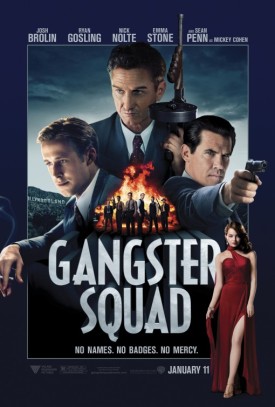
Gangster SquadThere were two clear paths to success for “Gangster Squad.”  The first would be to follow the “L.A. Confidential” pattern and take a hardboiled approach to period criminality.  Writer Will Beale crafts his screenplay with various neo-noir elements: the post-war moodiness and shadiness, a little bit of moral ambiguity, and of course, the femme fatale (Emma Stone’s red-haired dynamo Grace Faraday).

The second, and perhaps more reasonable, template would have been Brian DePalma’s 1987 “The Untouchables,” a movie that shares quite a few similarities with Ruben Fleischer’s “Gangster Squad.”  There’s the borderline insane crime lord of a major city who just happens to be played by a two-time Oscar winner (Sean Penn now, Robert DeNiro then).  Because of that de facto tyrant’s chokehold on that city, a team of top law enforcement officials is tasked with bringing him to his knees.

The only difference is Eliot Ness and the Untouchables stayed within the boundaries of the law.  Josh Brolin’s John O’Mara, Ryan Gosling’s Jerry Wooters, and the rest of the titular merry band of extralegal avengers have no such regard for the rules.  They go outside the law to stop a man who is above the law.  But in such a drastically different detail, little new conclusions are ultimately reached.

Read the rest of this entry »


F.I.L.M. of the Week (January 4, 2013)

4 01 2013

The recession has manifest itself in many obvious ways in American cinema.  There has been the vilification of the rich in movies like “Arbitrage” and “Wall Street: Money Never Sleeps,” excoriation of big business excess in “Tower Heist” and “Margin Call,” and glorification of the average joe worker-bee in “Win Win” and “The Company Men.”

Though “Take Shelter”, my pick for the “F.I.L.M. of the Week,” does not indulge in direct tapping of the zeitgeist, perhaps it best embodies it.  In a statement posted on the film’s website, director Jeff Nichols wrote:

“I believed there was a feeling out in the world that was palpable. It was an anxiety that was very real in my life, and I had the notion it was very real in the lives of other Americans as well as other people around the world.”

This brilliant realization of such post-recessional anxieties has made his “Take Shelter” a superb film that plays timely now but I suspect will ring timeless in the future.

“Take Shelter” opens with its protagonist, Curtis, experiencing a rain of motor oil.  This is quickly revealed to be a hallucination, but it feels like a very real way to bring some internal storms to expressionistic life.  The movie’s magical realism is a perfect compliment to the beguiling veracity of Michael Shannon’s performance as Curtis, a man who puts on a brave face for his family in tough times but ultimately struggles with some very deep demons.

As these apocalyptic delusions get worse, Curtis becomes a sort of modern-day Noah (nothing like Steve Carell’s hokey character in “Evan Almighty,” I’ll have you know).  He quietly sets out to protect his wife and daughter from a cataclysmic event that apparently only he is able to recognize on the horizon.  This tension builds until he ultimately explodes in a fit of rage directed towards a community that doesn’t understand his worries.  In the hands of Shannon, these harbingers of doom sound completely righteous, almost like the words of a prophet.

Grounding the film in an unfair and unkind reality, on the other hand, is Jessica Chastain as Curtis’ loving wife Samantha.  She plays a very different kind of Madonna than her mother in “The Tree of Life,” one fiercely committed to the safety and stability of her family and doesn’t hesitate to fight for it.  She’s the heart and soul of “Take Shelter,” trying to work through Curtis’ torments with patience and level-headedness.  Sweet as can be, it really makes an impact when she snaps after Curtis puts a preventative tornado shelter in their backyard above their own daughter’s health.

All the while, Nichols punctuates the superb performances of Shannon and Chastain with sporadic bursts of nightmarish imagery.  Whether it’s a biting dog, masses of birds, or the mysterious motor oil, Nichols sets the mood for a constantly shape-shifting modern American anxiety.  No matter who watches this and when they watch it, I believe they will find something floating in the ambience of “Take Shelter” that will accurately represent their inner fears.


REVIEW: Albert Nobbs

3 01 2013

If a movie is someone’s passion project, shouldn’t you feel – well, passion oozing out of every frame?

Don’t answer that rhetorical question because it’s what sounds the death knells for Glenn Close’s “Albert Nobbs,” a movie she fought for 30 years to get to screen.  You might notice that I attributed the movie to Close herself and not to Rodrigo Garcia, its director.  That was not an accident.  He doesn’t seem to have much of a vision for the movie, nor does he seem to care half as much as Close.

Over the summer, I got really into the TV show “Damages,” a superb drama starring Glenn Close.  I recommend it far more than I do “Albert Nobbs” as I would finish seasons in a matter of days.  And in the more recent ones, it was clear that she was masculinizing herself to prepare to play Albert Nobbs, the Irish woman disguised as a male butler in order to buy a tobacco shop and some freedom.

As I watched “Albert Nobbs,” I found myself wondering what about this story and this character was so appealing and enticing to Close.  It’s not as showy as some of her famous roles, although that’s not always a bad thing.  All movies don’t need to give their star the hypothetical “Oscar scene,” and this one sure does not.

But “Albert Nobbs” has no drama to entice us in, no multidimensional characters to gain our curiosity.  We mainly watch because we expect something big to happen, and it just doesn’t.  The most surprising revelation comes in the first act when the new butler, the large Hubert Page, pulls Albert into a side room and reveals what lies underneath her shirt: Janet McTeer’s breasts.

The movie moves along at the pace of the molasses that Close’s Cruella DeVille falls into in “101 Dalmatians.”  It’s brutally boring and a tedious watch, one that results in no ultimate emotional or intellectual payoff.  If it was some sort of commentary on the oppression of women, it was hidden far beneath the film’s self-constructed cocoon of miserable understatement.  C2stars


REVIEW: This Is 40

31 12 2012

Judd Apatow is quite a curious entertainer, and I’m fascinated by the trajectory he’s taken to put his stamp on comedy.  Lately, he’s been using his tremendous power to advance women’s voices in comedy through Lena Dunham‘s HBO series “Girls” and Kristen Wiig’s “Bridesmaids,” quite a noble thing to do.

Yet otherwise as a producer, he makes comedies largely by the status quo, albeit with a slightly Apatowian (is that the proper term?) spin of vulgarity opening up on a big heart.  Some are hits, and others are flops.  Some work; others, absolute disasters.

However, as a director, he’s on the cutting edge.  2009’s “Funny People” and his fourth feature film, “This is 40,” are bold experiments in genre.  In these two movies, Apatow is probing the boundaries of comedy and attempting to make sense of the murky gray area that is dramedy.

These two movies are flawed but noble ventures into the great unknown.  Both films attempt to find the kind of tender human drama that defines the works of Alexander Payne and Jason Reitman, two directors who make serious works with touches of levity.  Apatow strives to find that same pathos without losing his films’ firm rooting in comedy, and though he doesn’t find it in “This is 40,” I’m willing to sit and watch him decipher it out.  Because once he finds that balance, a true masterpiece will be the inevitable result.

Read the rest of this entry »


REVIEW: Looper

30 12 2012

It’s about time for a changing of the guard in science-fiction, and “Looper” heralds perhaps the sign that the genre is in young, fresh, and good hands.  Rian Johnson’s time-traveling tale is an intelligent film that hopefully points to revitalization by the people who grew up on the classics of the 1980s.  Its delicate construction and serious contemplation moves Johnson into the league of J.J. Abrams and Duncan Jones in terms of directors moving what was formerly considered kitsch into respectable art.

“Looper,” upon a little bit of pondering, feels very much inspired by James Cameron’s “The Terminator.”  Though we still watch that movie nearly three decades later, it’s mainly to be amused by the ex-Governator, not to be wowed by the script or the direction (and most definitely not by the performances).  And yes, it’s in the Library of Congress and is unilaterally praised, but “The Terminator” is able to get away with its unabashed Roger Corman, B-movie background now largely because of our fondness for nostalgia.

Johnson takes what worked about “The Terminator,” the time traveling plot device and the thematic weight, and sets it in a frame evoking “A Clockwork Orange” or “Blade Runner.”  His “Looper” takes place in a future not blatantly dystopian, but rather cleverly thought out with depth that doesn’t draw attention to itself.  Viewers willing to take the plunge into Johnson’s world multiple times will undoubtedly be rewarded by the subtle details he hides throughout the film.

Read the rest of this entry »


REVIEW: The Amazing Spider-Man

29 12 2012

The Sam Raimi Spider-Man movies have sure taken a dip in public opinion in the last five years, no doubt due in large part to the ill-received “Spider-Man 3.”  I’ll grant that the 2007 series entry had far too many villains, and the black suit of revenge came off a little creepier than intended.

Yet I’d still rank Raimi’s three films as the finest superhero movies of the new millenium after Christopher Nolan’s Batman films.  Their thematic depth is impressive given that the series was far more prone to let fancy CGI or long action sequences rule the day.  Revenge, responsibility, and duty were all explored to very great effect by Raimi, who did a great job in advancing what a comic book movie could be.  Unfortunately, his legacy has become leaving the franchise on a bit of a sour note with the public.

Marc Webb’s “The Amazing Spider-Man,” rather than reversing that decline merely accelerates it.  Like fellow summer action flick “The Bourne Legacy,” it fails to make a clean enough break with its predecessors and thus gets forced to live with its specter looming overhead.  James Vanderbilt’s story, adapted with the help of “Harry Potter” screenwriter Steve Kloves and original trilogy architect Alvin Sargent, feels like only a minor variation on the 2002 “Spider-Man” origins tale.

Perhaps I’m a little sensitive because the Raimi “Spider-Man” movies were some of the highlights of my middle school years, but a mere decade seems like far too short a window to reboot a series.  Especially given that the last “Spider-Man” film was released just five years before “The Amazing Spider-Man,” people have not had nearly enough time to forget the particulars of the series.  It’s that very painful awareness that dooms Webb’s update from the beginning.

Read the rest of this entry »


F.I.L.M. of the Week (December 28, 2012)

28 12 2012

There has been a lot of talk about Russell Crowe’s singing abilities in “Les Misérables,” and most of it has been negative.  While I will defend (although not without a few reservations) his voice as appropriate for the role, he was an excellent choice to act the part of Javert.  And if you need any reminder as to why he was cast, look no further than the brilliant drama “The Insider,” a crowning jewel of the Michael Mann canon and my pick for the “F.I.L.M. of the Week.”

As Jeffrey Weigand, a major whistleblower for Big Tobacco in the 1990s, Crowe more than adequately portrays the internal storm of a man torn by doing what is ethical and what is easy.  Dr. Weigand’s research uncovered just how addictive nicotine is and how the cigarette companies can amplify the delivery of that kick – at the expense of his own job.  Bound by a confidentiality agreement, he must sacrifice the safety and security of himself and his family in order to do the right thing.

Thankfully, that’s where Al Pacino’s Lowell Bergman comes in.  A producer for “60 Minutes,” Bergman is an expert at coaxing sensitive information out of unwilling informants.  Convincing them to sit down with Mike Wallace, played here with a firm conviction by Christopher Plummer, and spill their guts on television is no easy task, yet Bergman pulls it off with finesse by offering the vast resources of CBS to shield and protect the interviewee.

Everything seems to be working out for “60 Minutes” to run a searing exposé of the tobacco industry’s vicious practices, but the network cowardly balks just before airing, putting Weigand and Bergman both in a lot of hot water.  The journey to make the truth known the American people is made compelling in an “All the President’s Men” kind of way thanks to the bravura performances of Crowe and Pacino, a team deserving of dual Oscar glory.

And beyond the work of Pacino and Crowe, “The Insider” also boasts some of the most precise directing I’ve ever seen from the brilliant Michael Mann.  When he’s on his A-game, there is no one better than him at creating tense, thrilling moments.  His editing rhythms are enthralling and perfectly calibrated to have your heart beating to the pace he wants it.  If watching the movie makes you think of “The Dark Knight,” that’s not really a coincidence; Nolan has clearly taken good notes from a master and expounded upon what Mann does so well in films like “The Insider.”


REVIEW: Men in Black III

28 12 2012

Arriving 10 years (half my lifetime) after the last sequel, there’s really no reason for “Men In Black III” to have been made except for Will Smith to come out of hibernation into a safe franchise sure not to ruffle anyone’s feathers.  And indeed, Barry Sonnenfeld’s threequel about as harmless as they come.  It’s a nondescript blend of humor and action, friendly to those who don’t know the series as well as the apparently numerous people for whom Sony felt they needed to make this movie.

“Men in Black III” is essentially tied back to the first two films in the series by the presence of Will Smith’s J and Tommy Lee Jones’ K.  But it’s mainly the Smith show as Jones bolts quickly (probably off to film “Hope Springs” and “Lincoln“) as he gets killed off by a former foe … in 1969.  With J as the only person left in this alternate universe that remembers K, he decides to embark on a time-travel adventure back in time to save his partner and restore the natural course of history.

The mission takes him to Cape Canaveral, lingering racial discrimination, and most importantly, Josh Brolin’s younger version of K.  Brolin is totally game to do his best Tommy Lee Jones impersonation, which doesn’t feel all that different from another character of his that could go by a single letter: W.

Brolin is the highlight of “Men in Black III” since Will Smith brings nothing new to the table.  He’s played out K too much, and not just in the “Men in Black” franchise.  Smith turned down the lead in “Django Unchained” last year, a role that would have been quite a departure for him.  Though the two films barely overlapped in shooting schedules, it would be nice to see Smith put up the black shades and tie and don the garb of a new, surprising character.  C+2stars