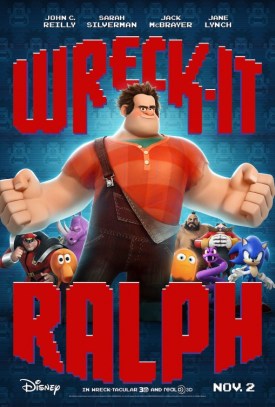
I think Disney got their brands switched up this year. “Wreck-It Ralph” felt like the real Pixar movie, and “Brave” felt like the kind of fun but unmemorable Disney animated movie from the people who brought you “Tangled.”
Much to my surprise, “Wreck-It Ralph” left me walking away with a wide grin and a full heart, something that the Pixar movies of my youth like “Monsters, Inc.” and “Finding Nemo” did so well. It’s a movie with undeniable charm and a winning spirit, one that envelops you in a giant bear hug. Not to mention, it also boasts a brilliant script with pop culture references and cleverly constructed worlds and humor not unlike what DreamWorks Animation did particularly well in the “Shrek” films.
It also rolls deep with an impressive voice cast, adding another dimension of enjoyment to the proceedings. They could not have picked a better person than John C. Reilly to play Wreck-It Ralph. As a video-game villain who just wants people to recognize him, Reilly is able to bring all the same sympathetic sad-sack pity that he used as Amos Hart (Mr. Cellophane) in “Chicago.” The innocence in his voice and the yearning to be accepted come across in Ralph’s first monologue, and we are on his side from the get-go as he tries to find someone to appreciate him.
It’s rare these days to find a taut, well-constructed thriller. Usually these genre pics fall victim to throwing on cheap frills and pointless scenes that disrupt the forward momentum of the picture towards a heart-pumping finale. Not Kathryn Bigelow’s “Blue Steel,” though. This pick for “F.I.L.M. of the Week” is an early example of the director’s incredible ability to build tension to nerve-wracking effect, making it an interesting companion piece with her Oscar-winning “The Hurt Locker.”
Beyond just a thriller, “Blue Steel” is also a remarkable movie to watch from a feminist perspective. Ironic that Bigelow would wind up being the first woman to win the Academy Award for Best Director as the film deals with many themes of male castration anxiety in the wake of female empowerment. Bigelow uses a common symbol for masculinity, the phallically shaped gun, and makes many powerful and provocative suggestions in the film’s subtext.
But even if you don’t really want to do an intellectual read on the film, there’s still plenty for you. “Blue Steel” also works as an grittier, pared-down “Fatal Attraction”-esque story, a narrative that captivates when combined with Bigelow’s remarkable ability to generate suspense.
The film begins with Jamie Lee Curtis’ policewoman Megan Turner gunning down an armed robber in a convenient store, but it quickly spirals into so much more as her bold gesture piques the interest of a bystander, Eugene Hunt (Ron Sliver). Bizarrely inspired – or threatened – by Turner’s aggression, he begins committing strange deeds in her name to get her attention. We never quite get a logical reason for his breakdown, but we don’t need one to be terrified and riveted by his sociopathic quest.
Even though it was released in 1990, “Blue Steel” still feels incredibly intense and gripping today. It might have something to do with the odd parallels Megan Turner bears to Kathryn Bigelow’s journey to notoriety. However, the more likely reason is that every scene in her film is essential towards progressing the film and not a moment seems wasted.
I think the ability to evoke real anger in me is something limited to documentaries. In a narrative film, when I start to feel such an emotion bubble up inside of me, I can quickly quell it by reminding myself the movie is just that. It’s fictional, not real.
But in a documentary, when I get mad, I can’t remove myself from the sensation. The banks ripped us off in “Inside Job.” The polar ice caps are melting in “Chasing Ice.” The adorable, innocent dolphins are getting poached in “The Cove.” And in “The Invisible War,” America’s bravest women are actually being raped at a level so frightening it could honestly be called a epidemic in the military.
The problem of rape is widespread and pervasive throughout the military. I won’t share the statistics here because seeing them in the context of the film will make you seethe with rage over them all the more. But in spite of how grand a scale this problem is, director Kirby Dick makes it all the more powerful by bringing it down to the most personal scale possible. Somehow, he manages to find several women brave enough to sit down, look into a camera, and give all the details of how they were sexually assaulted while in the service of their country.
I dare you not to feel devastated. I dare you not to feel burning rage. I dare you not to cry.
“The Invisible War” takes most of its driving narrative force from the story of one woman in particular, Kori Cioca. When she was raped in the military, she was also beaten in a way that destroyed her jaw. Several years after the incident, she is totally unable to eat solid foods and cannot go outside in the cold due to the searing pain it causes her. And her country, specifically the Department of Veterans Affairs, is finding every way possible not to acknowledge her injury.
Kirby Dick’s film exposes a great national shame, one which ought to make us all feel guilty. He does slightly fumble the ball at the goal line, though, leaving our call to action a little muddled. Perhaps, at the moment, there is little hope for these women because our government is in denial of their plight. But where do we go from here? How can we help these women?
I’d love to know, because after seeing “The Invisible War,” I feel compelled to do everything in my power to make their struggles visible. A- /
Oh, found footage movies, whatever are we going to do with you? With every new movie, you seem to reinvent your own rules. Everyone just has to be an iconoclast, I suppose.
In “Chronicle,” the story of three teenagers magically endowed with superpowers, the camera begins as a small handheld camera documenting the mundane happenings of life. But then the perspective widens. By the climactic fight scene, we are taking it in from every lens possible, be it a police car or a building security camera.
In a way, it makes sense for the number of cameras to grow as the magnitude of these three high schoolers’ decisions with their powers begins to affect people beyond the personal scale. In a movie like “Project X,” the action never really expands to such a wide scope, and it feels a little odd when the cameras begin to act as such. Yet even with a relatively justifiable reason to switch up the shooting style, “Chronicle” widens its lens at the expense of some of the intimacy that the found footage subgenre is designed to provide. And as such, it loses the punch of an “End of Watch” or “Paranormal Activity.”
But in terms of pushing the form beyond a single camera, I don’t think anyone has done it better than director Josh Trank. His “Chronicle” doesn’t hide behind the format as a front for lazy filmmaking. He uses the camera to provide a naturalistic portrait of high schoolers struggling with their issues, just on an extremely heightened scale. With close-ups and tight framing, Trank is able to pierce the psyche.
Trank is also fortunate to not only have the camera as his only weapon. “Chronicle” also features a thoughtful screenplay by Max Landis that resists mere surface-level discussions and childish gimmickry. He manages to make the relationships feel authentic and the events feel real even when they delve into the realm of the fantastic.
Much of the success of the film can also be credited to the trio of young actors, Dane DeHaan, Alex Russell, and Michael B. Jordan, who establish relationships that we feel extend far beyond what we see on the screen. They make the film feel as if we just happened to stumble into their friendship on any ordinary day … and then it just happens to turn extraordinary. B /
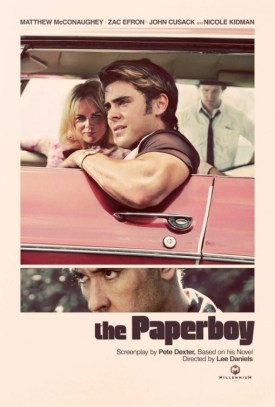
There’s no way Lee Daniels’ “The Paperboy” came from the same director as “Precious.” A film this sweaty, steamy, and trashy simply does not follow a movie so emotionally searing and poignant. And not only is the movie purely sordid, it isn’t even done artfully or tastefully.
I pray you haven’t seen director Lee Daniels’ debut film, “Shadowboxer,” because your eyes will never forgive you for it. There’s a reason you probably haven’t heard of it, and that’s because the movie is an absolute mess from beginning to end. Oh, and there’s also the matter of Cuba Gooding, Jr. and Helen Mirren having a pretty graphic sex scene. Thanks, but no thanks.
But it’s Lee Daniels of “Shadowboxer” who showed up to direct “The Paperboy,” not Lee Daniels of “Precious.” Now we are all left to wonder if Oprah directed “Precious” for him or something. I’m serious, watch “The Paperboy” and try not to let these types of conspiracy theories bubble up in your head. Well, actually don’t watch “The Paperboy” and just take my word for it that you would feel this way.
I could pound out reviews for movies I love or movies I hate like rapid fire. I know what works and what doesn’t in those films – the only challenge is figuring out the frame.
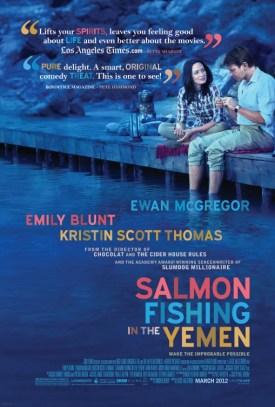
For movies like “Salmon Fishing in the Yemen,” a pleasant but unremarkable little rom-com, writing a review is quite a bit tougher. I just feel nothing but ambivalent towards the film, and I don’t feel the need to take a hard positive or negative approach. In fact, it’s easiest to inch towards 400 words or so just dawdling and musing about the craft of reviewing film.
“Salmon Fishing in the Yemen” exists – I can’t say that I would recommend it, but then again, I don’t hate it by any means. None of it is bad, unless you consider not being very good to be a bad thing. Lasse Hallstrom is content to make a movie totally by the books, not reaching for anything more or anything less. There’s no disappointment that way, but there’s also no potential for greatness.
I suppose the romance between Ewan McGregor’s brilliant savant Fred Jones and Emily Blunt’s Harriet, a finance expert for a Sheikh in Yemen, is nice and pleasant. No sparks fly, but it’s not as painful as Channing Tatum and Rachel McAdams in “The Vow” or anything like that.
As they work together to achieve a bizarre fantasy, making it possible to fish for salmon in the scorching country of Yemen, I suppose there is a slight feeling of uplift and happiness. But it doesn’t have the buoyancy of Hallstrom’s “The Cider House Rules,” and it doesn’t even come close to the transcendency of screenwriter Simon Beaufoy’s “Slumdog Millionaire.”
In other words, if you had to watch “Salmon Fishing in the Yemen,” there could be far worse things. But you will forget it almost immediately. In 10 years, if we still look at IMDb, I can imagine people will go, “OH! I remember that movie now,” when they look at the filmography of almost anyone involved with the film. B- /
This might feel like a bit of a rerun for those of you that read my review of “Lincoln,” and for that I apologize. But I do think it is possible to admire certain aspects of a movie and still not fully like it, and I will fight hard to defend that assertion.
In case you haven’t figured it out already, those are precisely my feelings on Ava DuVernay’s “Middle of Nowhere.” It’s an incredibly graceful, poised, and carefully restrained film. It tells a story that needs to be told about the African-American community, and for once, it actually comes from someone inside of it instead of a white man. And it feels all the more authentic and genuine for it.
But the whole felt like distinctly less than the sum of its parts; all the virtuosity didn’t add up to an emotional connection for me. Perhaps it was the film’s moseying, elegiac tone and pace that just kept me cooly disinterested in the proceedings. But for whatever reason, I just felt distanced from the characters rather than drawn towards them.
I know it has nothing to do with the acting, though, particularly Emayatzy Corinealdi (a name I happily copied and pasted from IMDb) in an impressive leading turn as Ruby. I had flashbacks to Michelle Williams’ character in “Take This Waltz” with Ruby, as both struggled with falling out of love with their husband and being tempted by a much more appealing man.
But in the case of Williams’ Margot, her husband was merely emotionally distant; Corinealdi’s Ruby, on the other hand, has a physical distance as well since her husband is spending five years in prison. She does her best to stay faithful and upright, but the years take their toll on her. And Corinealdi lets that show in moments of quiet breakdowns that allow us to marvel at her acting on a very technical level of precision. Perhaps in the next big role she lands as a result of her turn in “Middle of Nowhere,” she can add a layer of emotional resonance. B- /
I know it’s fruitless to spend too much time speculating “coulda been, shoulda been” over hypothetical questions. But for the 90 minutes of “First Position” – which somehow managed to feel like 9 hours – I couldn’t help but think what a wasted opportunity the documentary was. Bess Kargman could have really made an enlightening film about dance.
But instead, Darren Aronofsky’s “Black Swan,” a werewolf ballerina film, did a better job convincing me of the price of ballet and the dedication it takes to succeed. The physicality, the mental tenacity, the demands of time – all perfectly portrayed and stylized by Aronofsky in ways that subtly sneak up on you.
Kargman makes an entire documentary about these things, and they land so softly you barely notice them! “First Position” really could have been “The REAL Black Swan,” if you will, but instead it settles for mediocrity and tedium. It’s a hodgepodge of admiring the craft of ballet and a competition doc, committing to neither fully and as a result feeling wishy-washy.
(Sounds like Kargman could have used the words and wisdom of Ron Swanson in the editing room: “Never half-ass two things. Whole ass one thing.”)
I get that it’s an art and a sport, and I love that. But focus on the incredibly dichotomy there! Don’t give me two-second profiles on a few of the dancers that feel incomplete and erroneous … and then expect me to care or feel emotionally attached later. And know that the crowd who goes to see documentaries like this have most likely seen “Black Swan” and have intense pre-conceived notions about how grueling ballet is. Play with it, go with it, soar with it.
Don’t give me what ultimately arrived in my iTunes library on VOD as “First Position.” Because as of right now, it’s at last position among the documentaries I’ve seen in 2012. C- /
Documentaries about artists frequently devolve quickly into hagiography or niche journalism, failing to make the case for why that person matters – merely telling us that they exist and that they create. I’m happy to report that isn’t the case for “Ai Weiwei: Never Sorry,” Alison Klayman’s superb documentary on the titular Chinese iconoclast.
I was expecting something in the vein of “Waste Land,” the Oscar-nominated portrait of socially conscious artist Vik Muniz, who made incredible works out of garbage to draw attention to the outrageous levels of poverty in his homeland of Brazil. But Ai Weiwei is more than just an artist; he’s a social activist who brilliantly uses art to challenge the oppressive laws and customs in China. Just take a look at the poster and see Weiwei’s middle finger pointed towards the heart of China. Subtlety is not his strong suit.
The film does a fantastic job balancing Weiwei the artist and Weiwei the activist, showing how the two are inextricably linked that one cannot be accurately understood without the other. Klayman lost my interest a bit when she delved into his personal life, but that’s only a minor digression in this otherwise tightly focused documentary, assured of the importance of itself and its subject.
Her chronicle of Weiwei captures him at a very unique time. It begins right after he drew worldwide attention after calling out the Chinese government to their faulty response to the Sichuan earthquake around the time the country was trying to portray a positive image in the Olympics. This specific inciting incident guides the film and motivates Weiwei to use whatever means necessary, including social media, to get his message out there.
If you need to be assured of good in the world, know that his message has been received by plenty of people who have begun to demand change. If you need to be assured that such goodness is not enough, wait for the end of the “Ai Weiwei: Never Sorry” and see how the Chinese government responds to his message of government corruption and unresponsiveness reaching too many people.
But Weiwei will never stop, never shut up, and never apologize. They can try to silence his art, but they never will. It would take killing Weiwei himself since he has essentially transformed his life into performance art. Or protest. By the end of the documentary, you will scarcely be able to separate the two. A- /
Let that sink in. I know the last thing you want to do now that the nasty rhetoric and half-truths have ceased, and you have finally begun to realize that life can exist without vicious campaign ads. But since the political system has churned out another major crisis with the fiscal cliff, it seems that Alexander Payne’s 1999 film “Election,” a micro look at the American electoral system will never get old. In fact, it seems to have only gotten more and more timely – and that should scare you.
Though Alexander Payne’s last two movies have won him Oscars for Best Adapted Screenplay, I would still argue “Election” is his finest script. It works remarkably well as both a human story and an allegory for bigger things like American democracy and morality. And after a few viewings, you start to see how brilliantly and subversively he uses American iconography to poke at the problems corroding the foundation of our great nation.
While many have lamented Payne’s insistence of voice-over in films that might not need it (such as “The Descendants“), his twisted employment of archetypical characters with a whole lot hidden under the surface really makes their narration yield some surprising revelations. It allows us to penetrate deep into the characters beyond the functions they believe they should be functioning at Carver High School. Not to mention, Payne writes stream-of-consciousness dialogue with a fantastic accuracy and hilarity.
By all means, the president of the student body should easily by Reese Witherspoon’s Tracy Flick. She’s the epitome of high school perfect and has worked her butt off to be the most qualified (or at least ensures she’s the most passionate) for the office. But there’s also something incredibly annoying about her quest, and her teacher, Matthew Broderick’s Jim McAllister, is on a mission to stop it. As the faculty adviser for student government, he still believes it can do good – he just doesn’t want Tracy to be the one to get credit for it.
Rather than let her run for the office unopposed, Mr. McAllister manipulates popular football player Paul Metzler (Chris Klein) to challenge Tracy. He’s rich, handsome, and an absolute moron. But they both get more than they bargained for when Paul’s frustrated closeted lesbian sister, the frumpy Tammy, decides to run out of revenge. Her platform of anarchy, pointing out how stupid student government elections really are, catches on with the Carver High students … and what ensues as the three duke it out for the presidency is absolutely hysterical madness.
Who do we side with though? Who is the “right” candidate? Sadly, we are faced with this decision all the time. Do we vote for the appealing, good-looking candidate even though they might not be particularly qualified? Or the overqualified one who might rub us the wrong way? Better yet, should we go with the person who realizes how pointless and pathetic the electoral system is? These are just a few of the questions that keep Alexander Payne’s “Election” a truly exceptional movie, one more than worthy to be featured as the “F.I.L.M. of the Week.”
I know everyone has their own theories and preferences about what makes a good and cinematic documentary. For me, after “Inside Job” led to a massive documentary binge, I developed a simple litmus test. So simple, in fact, I can sum it up in two words: so what?
So what, I ask every documentary. If you’ve taken the time to document a small piece of the world I live in, what am I supposed to take away from it? How should this affect me? If it passes with flying colors, put it on a screen and plop it in front of audiences.
If not, then perhaps it’s best meant for an obscure cable channel – or the entire project ought to be reconsidered and reevaluated. After all, if you can’t convince an audience why something is important, why bother extending your efforts to make the fim at all? (This test is entirely applicable to fictional and narrative film as well, but there are far more shades of grey in that realm.)
“Jiro Dreams of Sushi” did not pass the test. It has such a small and limited scope – 85-year-old sushi chef Jiro Ono and his quest for perfection – that it especially needed a powerful so what. It feels like an overlong and unfocused Travel Channel special, geared towards exposing a niche for sushi die-hards or travelers to Japan with its detailed portrayals of what it takes to run a competitive sushi restaurant, from purchase to preparation of the fish. Give this film some commercial breaks as well as a slight dash of energy, and “Jiro Dreams of Sushi” would be a fun program to stop on while channel surfing.
Director David Gelb has something in mind beyond the sushi, though; he wants to go deeper into Jiro’s character. And I will grant Gelb that he does a great job at painting a complete portrait of a very peculiar perfectionist. But he fails to bring the message of “Jiro Dreams of Sushi” home for the audience on the other side of the screen. We can’t learn anything from Jiro that our parents haven’t already ingrained in us at the age of five. The taste buds activate in overdrive for the documentary, but the head and heart remain fairly disengaged. B- /
I think a more appropriate name for “Man on a Ledge” might have been “Baby’s First Thriller.” By that, I do not mean that you should go show this film to your infant. Rather, I am making a statement on how rudimentary and textbook Asger Leth’s film is.
His color-by-numbers genre pic is not the worst thing in the world to watch. There are plenty of predictably thrilling instances where the action heats up and the plot begins to sizzle. But it’s just so unambitious, reaching for all the buttons that so many better filmmakers have already pushed to death.
Even though I can’t think of any movie that shares the specific plot of “Man on a Ledge,” it felt nonetheless familiar and banal. Sam Worthington’s Nick Cassidy goes and stands on a ledge and puts on a show for a captive audience in the streets of New York City. He’s left to be talked down by archetypical police officer haunted by guilt of a prior incident, here played by Elizabeth Banks.
Meanwhile, a giant diamond heist occurs with Nick’s brother Joey and girfriend Angie (Jamie Bell and Genesis Rodriguez) inside the building across the street to prove his innocence. And of course, the greed of the big bad capitalist, played by the menacingly frightening Ed Harris! Both plots are interesting enough to keep our eyes on the screen, but neither really captivate at the level we have come to expect from say, a Soderbergh thriller. It does what it needs to do and nothing more.
And if that’s all you want from a movie, then perhaps “Man on a Ledge” is the perfect background music to you doing chores around the house. You don’t need to be paying too much attention to know what’s going on here. Because after all, you know the narrative.
Ultimately, what I walked away from “Man on a Ledge” with was nothing about the story or the presentation. To my surprise, it was that superb actors like Elizabeth Banks and Anthony Mackie were still being reduced to this kind of auto-piloted stock studio schedule filler crap. Casting agents, please sit down with a copy of “People Like Us” and “The Hurt Locker.” You will find Banks and Mackie, though not nominated for an Oscar (yet), are far above this type of movie. Find them something suitable for their immense talents, please! C+ /
There was a decent chunk at the beginning of “Haywire” when I was totally drawn in not by anything in the script or the story … but by Steven Soderbergh’s unique visual sensibilities. And all of a sudden, it actually begin to sink in that the director actually intends to retire from the craft of cinema and what a loss that could be to the film community.
Soderbergh’s canon of films ranges from the heist films of the “Oceans” series to the zany genre-bending intrigue tale of “The Informant!” to immensely moving biopics like “Erin Brockovich” to hyperlink cinema like “Traffic” to tense thrillers like “Contagion” and even into strange experimentation with whatever the heck “The Girlfriend Experience” was supposed to be. (Oh, and he also oversaw some movie about magic where Channing Tatum and Matthew McConaughey showed their butts.)
In just this one sequence where the protagonist of “Haywire,” played to dull effect by MMA fighter non-actress Gina Carano,” escapes from her captors, there are flashes of almost all of his different movies. They share a similar rhythm and vibe, achieved in a perfect harmony of cinematography, editing, and sound. It’s truly remarkable that across so many genres and types of filmmaking, something feels like it’s coming from a single mind.
Now just because he has unified conventions doesn’t mean that they always work or redeem an otherwise poor movie. Such is the case for “Haywire,” an action thriller that does some clever presentation and narrative organizing to brush up a conventional narrative. Perhaps the medium is the message for Soderbergh, and his mere repackaging of familiar elements is the point in and of itself. But the film just always feels like an all-too familiar experience.
Soderbergh does succeed in making it slick (for the ladies, he did get the eye candy of Michael Fassbender and Channing Tatum for brief scenes) and subversively political, though. Yet these victories seem small while watching and seem even smaller in retrospect. Watch some of Soderbergh’s elegant sequences that have the grace of a ballerina on YouTube some day and skip “Haywire.” It doesn’t go fully, well, haywire … but there’s got to be some new cinematic voice or story you can use your 90 minutes to hear and see. C+ /
Almost every comedy features a supporting cast of hilarious actors who can always be wheeled in front a camera to produce laughs. Unlike the romantic leads, who have to undergo a journey and serve plot functions, these characters can literally be poorly developed and have little motivations of their own – and no one minds as long as they make us chortle in delight.
“The Five-Year Engagement” does a very peculiar thing with its characters. Tom and Violet, the betrothed played by Jason Segel and Emily Blunt doomed to suffer the titular delay, are the ones who suffer from the pratfalls of the supporting characters. Sure, the two have chemistry and are fun to watch. But it’s Jason Segel and Emily Blunt, both of whom could charm a dishwasher into marrying them!
I definitely enjoyed the two of them in their playful engagement bliss and when they got into tough arguments; however, they got upstaged, outdrawn, and outshown in a major way by the couple that was supposed to be a comic relief and foil. Guess that means directors need to think twice before they cast the uproarious Chris Pratt (who steals every “Parks and Recreation” episode these days) and dynamic Alison Brie (who I’ve heard is just as good on “Community”).
Pratt plays Tom’s best friend Alex, who is of course the usual Pratt goofball (unless we are talking “Moneyball“). At the engagement party, he meets Brie’s sharp-tongued Suzie … who also happens to be Violet’s sister. The two have quite a night, and very quickly, a very different kind of wedding is on the horizon. A shotgun wedding.
Alex and Suzie provide most of the humor for Nicholas Stoller’s “The Five-Year Engagement” because of Pratt and Brie’s immense comedic capabilities. Yet they also carry most of the heart of the film, too. As Stoller’s running commentary on how hard marriage really is no matter how long and hard you’ve worked on it, I started rooting for them and becoming more emotionally invested in the two of them. Perhaps it’s because the marathon length of the film left me craving Alex or Suzie to get back on screen, but I think it was really just me wishing someone would make one of these movies with Chris Pratt as the leading man. B /
While I may not have read “Life of Pi,” I certainly know plenty of people who did in high school. Key words in that sentence: high school. Yann Martel’s book is meant for thinkers of a certain age, not eyes of a certain age. The material may be appropriate for people below a PG-13 audience, but that doesn’t mean they will appreciate it.
I admire Ang Lee’s faith in the importance and resonance of the “Life of Pi” narrative that he felt compelled to shift its impact downwards and outwards, making adjustments to make it play well to younger and less intellectual audiences. And indeed, it plays well as an adventure film, where “Cast Away” meets “Slumdog Millionaire” plus a tiger, and its brilliantly shot as such by Claudio Miranda (the brilliant lenser of “Benjamin Button“). Miraculously, the two hours fly by even with very little happening to drive the story forward. It’s a rewarding experience overall.
But what nagged at me was that Lee was aiming for something more with “Life of Pi.” Sure, his movie was sold as one about a boy and a tiger stranded on a lifeboat, but Lee’s intended film was one about some very deep existential questions. He didn’t want audiences to leave marveling over the special effects sequences; he wanted people to leave after having a mystical experience mulling over questions of spirituality.
These questions are raised early on in the movie, and I strapped myself in to really ponder them. Yet when I discarded my 3D glasses in the recycling bin on my way out of the theater like any ecologically friendly moviegoer, I couldn’t shake the feeling that Lee explored them with insufficient depth. By expanding the audience, he shrunk the real story of “Life of Pi” – its spiritual dimension.
The film’s rather juvenile and kid-friendly presentation seeps into the very fabric of the storytelling. (All those corny editing techniques ripped out of bad ’80s TV movies can’t help but affect every aspect of a movie.) The core ideas of “Life of Pi” get diluted, passed over in favor of a little more cinematic grandeur. Don’t get me wrong, Lee’s grand canvas for the movie is exciting and stunning. But I can get that in any movie; few dare to delve into the psyche like he meagerly attempted to do. I want more of that because I don’t think the next few $100 million budgeted spectacles will even consider touching anything spiritual.
Although maybe there’s a silver lining here. People have suggested I do something for five years or so now, and I have never felt inspired to do it. Ang Lee may have given me the biggest push yet towards accomplishing that thing: reading Yann Martel’s “Life of Pi.” Because perhaps there, my mind will be as sate reading as my eyes were watching. B- /
 I think Disney got their brands switched up this year. “Wreck-It Ralph” felt like the real Pixar movie, and “Brave” felt like the kind of fun but unmemorable Disney animated movie from the people who brought you “Tangled.”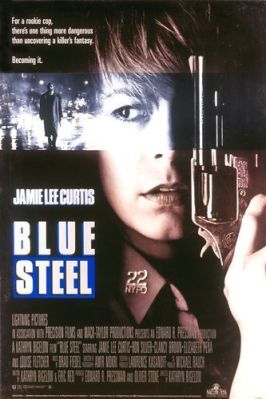
 I think the ability to evoke real anger in me is something limited to documentaries. In a narrative film, when I start to feel such an emotion bubble up inside of me, I can quickly quell it by reminding myself the movie is just that. It’s fictional, not real.

 There’s no way Lee Daniels’ “
 I could pound out reviews for movies I love or movies I hate like rapid fire. I know what works and what doesn’t in those films – the only challenge is figuring out the frame.
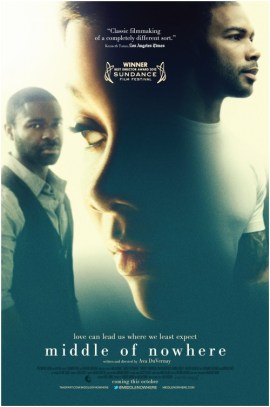 This might feel like a bit of a rerun for those of you that read my review of “
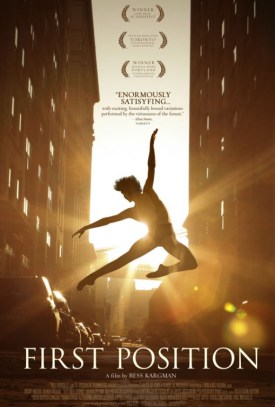 I know it’s fruitless to spend too much time speculating “coulda been, shoulda been” over hypothetical questions. But for the 90 minutes of “
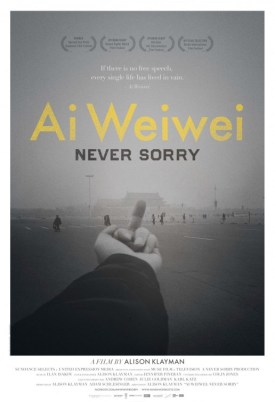 Documentaries about artists frequently devolve quickly into hagiography or niche journalism, failing to make the case for why that person matters – merely telling us that they exist and that they create. I’m happy to report that isn’t the case for “
 I know everyone has their own theories and preferences about what makes a good and cinematic documentary. For me, after “

 Marshall and the Movies
Recent Comments