REVIEW: Arbitrage

6 10 2012

If Adrian Lyne ever made a movie about Wall Street, I have a feeling it would look something like “Arbitrage” (OK, maybe with a little less steaminess).  Nicholas Jarecki’s debut narrative feature has high stakes, heightened emotions, and well over fifty shades of grey in every character.  It’s a world where every character is suspect and every decision deserves a screaming match debating the respective merits of the choice.

Don’t get me wrong, I like when movies give themselves a sense of weight.  Sometimes to create drama, you have to do a little dramatization.  But it’s done to a bit of an extreme in “Arbitrage.”  When you hit a high note in the first third of the movie and keep at the same pitch for nearly an hour, you lose a sense of forward momentum propelling both the film’s story and the audience’s interest.  Not to mention, watching a movie so high-strung and strung out gets quite exhausting.

This exaggerated acting leads to some fine performances, especially from Richard Gere as a ruthless, conniving greedy hedge fund executive (apparently the only kind these days).  He’s slick, slippery, and seriously stupefying.  Gere’s Robert Miller is motivated by deep, dark forces, ones that the actor digs deep to wrestle with.  Dealing with the collapse of his financial house of cards and the death of his mistress at the same time tend to make someone that primal, though.

While Susan Sarandon as his scorned wife and Brit Marling as his conflicted daughter can both shout at his level, neither can match Gere’s intensity.  I just wish “Arbitrage” had toned down a little bit to stay level with Gere.  A little bit of internalizing and a little less monologuing could have done wonders for the movie.  As is, it feels like an all too familiar yell that dilutes its own message with heavy-handedness.  B


REVIEW: The Grey

6 10 2012

At its core, Joe Carnahan’s “The Grey” desperately wants to be a “127 Hours,” a deeply personal and intimate drama about the pitting of the human will against an unforgiving wilderness.  And while elements of that thematic narrative creep through the cracks at times, the movie falls far short of achieving any sort of meaningful revelations about our humanity at its most raw.

“The Grey” begins like the television show “Lost” – a bunch of strangers survive a plane crash in the desolate non-continental United States – but then proceeds like a “Final Destination” movie … with wolves!   If the movie didn’t have such a massive stick up its behind, it would have been a fantastic “Final Destination 6.”  (Or maybe more like a “Final Destination -1” since it’s so humorless.)

I mean, it’s just hard to take a movie seriously when it moves so predictably towards its end as everyone meets their end … one … by … one.  Carnahan’s uneven direction doesn’t help matters, dulling any chance of sympathy we might have for Liam Neeson’s Oskar Schindler ruthless daughter-saving dad John Ottway, the group’s de facto leader.  Sure, Neeson has some moments where he gets to curse God and his fate, but those aren’t anything new.  Just like the rest of the movie.

And then there’s the matter of the ending.  Some will praise it because they perceive it to be poetic, lyrical, beautiful in its ambiguity.  I found it inconsistent with the rest of the movie and a reprehensible attempt to turn a horror concept into art-house drama merely by refusing to come up with a satisfactory ending.  C


F.I.L.M. of the Week (October 5, 2012)

5 10 2012

It’s getting down to the wire in the presidential election, meaning the facts are about to become so irrelevant it’s not even funny (that goes for both parties).  No one is going to say they want to fire teachers.  Everyone is going to say they love education and that fixing our schools is a priority for their term and for our future.  But when all that empty campaign rhetoric goes away, what then is left?

That’s the focus of “Waiting for Superman,” Davis Guggenheim’s stirring documentary about the American education is failing its students and setting up the country much bigger issues down the road.  It’s a fearless look at the issue not from a merely by-the-numbers, students as a statistics standpoint; it’s looking at education as a human calculation.  Emphasis on the human.  For that reason, it’s my pick for the “F.I.L.M. of the Week.”

The gripping documentary takes a look into the policies that aren’t working and then finds some common sense solutions.  Guggenheim provides far too many horrifying examples of dissatisfactory education, and I’ll leave the majority of them surprise you in the same way they shocked me.  But I will share some of the struggles of Michelle Rhee, the controversial D.C. Superintendent.

I do share a rather personal connection to Rhee as one of my cousins taught in her district (and to brag on my incredible relative, was feted by Rhee for her exceptional work).  She saw the biggest problem for these children was the district’s terrible teachers.  But she had to deal with the teacher’s union, which would not budge on the current agreement that provided tenure to teachers who had taught for only a few years.

Her efforts were unpopular, aggressive, and bold – but she did what had to be done in order to get rid of the teachers who were falling asleep on the job.  Thanks to people like Rhee, our school systems are making progress.  How many of us can say we are doing the same – or even doing anything to help?  As some would say, “if you aren’t a part of the solution, you’re a part of the problem.”  The future of our nation depends on it.


REVIEW: Pitch Perfect

4 10 2012

It took three years for the “Glee” high to trickle down into film? Surprising that Hollywood didn’t milk the a capella pop song earlier because now that goose is no longer popping out golden eggs … and now we’re left with “Pitch Perfect.”  It’s a movie happy to riff on the vocal talent Ryan Murphy assembled but wants none of the social responsibility.

It takes swipes at minorities, overweight people, homosexuals … really anyone who doesn’t fit in.  “Pitch Perfect” is stuck in the old normal, which may be gleeful fun for some but just makes me wince.  (I have to have set some kind of record for Ryan Murphy series wordplay there.)  If the film’s humor isn’t knocking down the little guy, it’s making some HEINOUS pun on the word a capella.  If you cringe at the thought of hearing someone say “A ca-scuse me?!” with a straight face, that’s only the tip of the iceberg.

I guess it’s also trying to adhere to the old normal of high school/college movies, trying to fashion itself as the new “Mean Girls” … which itself was trying to be a new John Hughes film.  “Pitch Perfect” even goes as far as to blatantly self-reference and name drop these movies!  I’m not entirely opposed to trying to make lightning strike the same place twice.  However, if you are going to so patently harken back to a classic, you have to be prepared to face the an apples-to-apples comparison.

And “Pitch Perfect” is no “The Breakfast Club.”  Heck, it’s more like a “Jennifer’s Body,” a comedy that inspires more groans than laughs and thinks it has a whole lot more insightful things to say about growing up than it actually does.  Not even the presence of Anna Kendrick, who won my heart in “Up in the Air,” can salvage this movie.  The only worthwhile segments in the bloated two hour duration were the well-orchestrated a capella pieces, but you can just listen to those on YouTube or Spotify or however the kids listen to music these days.  There’s no reason you need to see the whole rest of the movie just to get to those.  C- 


REVIEW: Sound of My Voice

3 10 2012

It’s curious that of the three films Fox Searchlight acquired at 2011’s Sundance Film Festival, two happened to star Brit Marling and two happened to be about the religious occult … and of those three, “Sound of My Voice” saw domestic release last.  It feels like a rather unfortunate afterthought after “Martha Marcy May Marlene” tantalized with its brilliant ambiguity and “Another Earth” provided a much more showy showcase for Marling.

“It’s a lonely road if a momma don’t think their child is pretty,” remarked Abileen in “The Help,” and “Sound of My Voice” sure feels like a forgotten stepchild for Fox Searchlight.  It’s evident right away from what’s on the screen.  As the leader of a strange religious movement, Brit Marling seems to be walking eggshells as she treads familiar ground as Maggie, the bizarre and disturbed leader of the cult.  She claims to be from the future – 2054, to be exact – and is allergic to everything in the current time.

Opportunistic documentary filmmakers Peter (Christopher Denham) and Lorna (Nicole Vicius) get word of Maggie’s magnetism and plan an infiltration … and a subsequent movie.  But – SHOCKER – they start to lose track of their objectivity as they grow closer to Maggie and get deeper inside the world of the cult, leading to a rift between the filmmaking (and romantic) couple.

Debut director Zal Batmanglij, who also co-wrote the film with star Brit Marling, does a half-decent job of keeping taut suspense throughout the film.  That’s largely due to the structure of their script; the content, however, is what makes the film second fiddle to “Martha Marcy May Marlene.”  The peculiarities of Maggie and the basement cult, ranging from a bizarre handshake to growing her own fruit, add nothing to the story.  Rather than drawing you in, they pull you out of the film, forcing you to wonder who the heck even thought of that.  The film leaves us to solve a puzzle without all the pieces, but it also leaves you so apathetic that it’s a puzzle you are all too happy not to extend the mental effort to solve.

That essentially concludes my “review” of the film, but before I end, I do have one more thing to say.  While I was watching the movie, I couldn’t help but giggle at the uninentional comedy of the film.  That’s nothing new for me as I often use humor as a tool to break a monotonous viewing experience, yet this was different.  The more I giggled, the more I realized that “Sound of My Voice” has some serious potential as the first major comedy to explore occult religion.

Thus, I propose a remake of “Sound of My Voice,” only this time as a comedy.  It’s the kind of movie we SHOULD be remaking: one that is perfectible, not already perfect.  So to Fox Searchlight (or whoever is looking at providing finance for the film), I will even do you the favor of casting the remake.  You’re welcome.

Amy Poehler as Maggie:

Charlie Day as Peter:

Aubrey Plaza as Lorna:

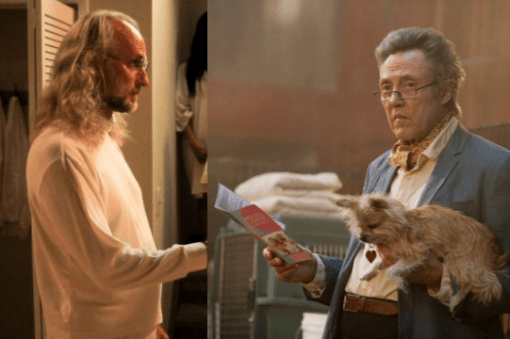
Christopher Walken as Klaus, Maggie’s old and creepy keeper:

Thank me later.  B- 


REVIEW: Dark Shadows

2 10 2012

I’ve been critical of Tim Burton’s artistic choices over the past decade or so, taking material already marked with an inexorable aesthetic and cultural stamp to put a slight Burton refinishing on the top.  With the exception of “Big Fish” (and “Corpse Bride,” I guess – but that movie was just atrocious), the last 15 years have been one big long commercial for a peculiar visionary, a selling out and a selling of the soul.

I’m not even a big fan of “Edward Scissorhands” or “Ed Wood,” Burton’s two most acclaimed movies that are renowned mainly for their originality and peculiar personality.  So calling “Dark Shadows” a return to form isn’t exactly the phrase I’m looking for, because it still falls into the typical Burton pitfalls.  But it’s a flash of vintage Burton, a film with winning personality and a sharp sense of macabre humor.

That’s largely due to the fact that he draws a fantastic performance out of his choice surrogate, Johnny Depp, whose been acting in a bit of a fog for the past decade.  He’s not the first superstar who’s fallen victim to becoming a great imitator of himself, and he certainly won’t be the last.  Save perhaps Sweeney Todd, we’ve been seeing 50 shades of Jack Sparrow for movie after movie, and that’s really selling Depp short.  His delivery is deliciously deadpan, his period acting totally self-assured in “Dark Shadows,” and that alone makes for a surprising amount of fun.

Depp’s baroque sensibilities as Barnabas Collins, a wealthy heir in the early United States turned immortal vampire, are uproarious when juxtaposed with the 1970s in which he reawakens.  Burton’s version of the decade, a gloriously campy nostalgic pop song, is a fantastic character in and of itself.  It serves as a marvelous foil to Barnabas, unaware of just how different the times have become (and how at times they can be eerily similar).

The script does Depp and the decade a disservice by being clunky, unfocused, and a bit too dragged out.  It inundates us with an ensemble – including the siren who bit Barnabas turned business rival of the Collins family (Eva Green), an austere matriarch (Michelle Pfeiffer), a moody daughter (the ubiquitous Chloe Moretz), and of course Helena Bonham Carter as … um, Helena Bonham Carter – that are never quite sure of how they fit into the story.  That’s particularly true of the governess Victoria Winters (newcomer Bella Heathcote), who begins the film as a lynchpin of the plot only to disappear for nearly the entire movie.  (But don’t worry, she’s back for the climax!)

I would not go as far as to call the screenplay a mere stringing together of events that holds the funny moments together, but those moments are what make the movie memorable and entertaining.  Burton has still yet to make a truly great movie in my estimation, but the man sure can direct some riotous scenes.  B


REVIEW: People Like Us

1 10 2012

“People Like Us” is the kind of tender, domestic drama that has become a specialty for writer/directors like Alexander Payne, Jason Reitman, Tom McCarthy, and Noah Baumbach.  It’s a story meant to provide insight into the human spirit by focusing on a tortured soul in a time of great duress and total life upheaval, lifting up the power of our relationships to either make or break us.  All achieved with the power of pathos.

Well, this movie doesn’t have the Baumbach brain.  Nor the McCarthy might.  And it doesn’t even come close to achieving Payne and Reitman heights.  But consider the two movies that writer/director Alex Kurtzman, along with his co-writer Roberto Orci, scribed prior to “People Like Us;” they were “Cowboys & Aliens” and “Transformers: Dark of the Moon.”  Not exactly tender, heartfelt human dramas.

I’m not a proponent of grading on a curve (although I am a staunch proponent when it comes to my test being graded), but I will say that I’m wiling to cut Kurtzman and Orci some slack because they didn’t churn out “The Descendants” or “Up in the Air” on their first try.  (I will note, however, that “Citizen Ruth” and “Thank You for Smoking,” their respective debut features, are both highly impressive.)  All things considered, “People Like Us” is an entertaining and fairly keenly observed film.  It hits a few flat notes along its journey, but there are enough powerful and touching moments scattered throughout the film to make it redeemable.

As Sam, a barterer whose shady dealings lead him into hot water with the SEC at the time of his father’s death, Chris Pine shines in a role that allows him to shed the cocky exoskeleton coating him from too long in rom-com purgatory.  Baring flashes of his raw soul, he’s fairly easy to sympathize with in spite of his character’s frustrating actions.  Like Robert Pattinson in “Cosmopolis,” it’s not an announcement that a true dramatic virtuoso has arrived on the scene, rather a signpost pointing towards greater things to come.

The real story of “People Like Us,” though, is Elizabeth Banks.  Her struggling mother Frankie, a former alcoholic trying to keep her world in orbit, is the key to Sam coming to peace with a painful and unacknowledged part of his past.  It’s absolutely heartbreaking to watch her in all good intentions trying to restore her faith in others while we know she’s headed down a path that can only lead back to an all too familiar pain.  And it’s Banks who makes her such a light on the screen.  Frankie is not merely a character in her gifted hands.  She’s a person, with troubles, with issues, with worries, with anxieties, with struggles, with small triumphs … like us.  B


REVIEW: Killer Joe

12 09 2012

Some people would say that a movie that makes you feel dirty and disgusting is an effective movie.  That may be true, because William Friedkin’s NC-17 “Killer Joe” made me want to take a shower as soon as I got home from the theater.  But just because the presentation of abhorrent material was equally abhorrent does not make the movie good, or enjoyable.

While I’ve started to reverse my thinking on Terrence Malick’s “The Tree of Life,” my original assessment seems to be applicable for Friedkin’s film.  I used such phrases as “the whole was less than the sum of its parts” and “While I can see the art […] I can’t see the clear execution of a vision.”  Other than the movie’s two shocking displays of perverse sexual behavior (which you don’t deserve to have spoiled for you in case you actually decide to watch “Killer Joe”), the film brings little else to the table.

The other hour and a half of the film is just filler to bring about the two discussion-worthy scenes.  I acknowledge that a movie that tries and succeeds to be shocking is an accomplishment.  But being shocking just for the sake of being shocking is nothing to be lauded.

A movie that exists solely to ruffle a few feathers and rattle a few cages doesn’t stick with you after the writhing and squirming in your seat.  The sordidness is ephemeral; it wears off quickly.  And once that feeling is gone, you look to see if it was justified or vindicated by the rest of the film.  Here, it is not.

The Tracy Letts’ screenplay is clunky and feel very stagey and distinctly non-cinematic.  The humor, dark and macabre, is extremely hit or miss; all the laughs come with a heaping side order of guilt.  I will give “Killer Joe” that it has two solid performances: a demonic leading turn from Matthew McConaughey in the year of his career renaissance as a sexually depraved hitman, and a delightful village idiot character played with an appropriate lack of urgency by Thomas Haden Church.  But that’s where my compliments come to a close because this movie isn’t about those things.  It’s about being knowingly repulsive for no other reason because they can be, indulgent art at its worst.  D+


REVIEW: Lola Versus

11 09 2012

Lola Versus” features Greta Gerwig as a poor, pitiful New York girl facing down all the number of challenges that confront her in the oh-so-austere loft life.  We get to listen to her talk about how much sodium she is eating during her post-breakup Pop Chip binge, putting all those other rom-com stars to shame with their tubs of ice cream!  We revel in her Whole Foods, granola-style quirkiness, exemplified by her love of macrobiotic food, her modern design tastes, and her charming mild case of flightiness.

Gerwig’s Lola is too much of a paradigm, too sanitized for us to really buy that she could have any real problems.  Even beyond the white, wealthy, whiny argument that pestered Elizabeth Gilbert’s “Eat Pray Love,” she’s been so watered-down to an essence that we don’t buy into her struggles because she really shouldn’t be having them.  She’s an ideal, and movies that call into question the validity of an archetype generally have much more magnified scopes and stakes than this.

In addition, this movie has basically been invalidated by Lena Dunham‘s “Girls” and feels even more irrelevant now that Zooey Deschanel has gone mainstream in “New Girl.”  (It would have merely been redundant in a post-“(500) Days of Summer” world.)  Lola’s journey has been tread a number of times in the past few years, and those who have gone on before her have done it with far more creativity, more spunk, more zeal, and more veracity.

Gerwig is far better when she can be a little bit mopey and downtrodden.  Real girls don’t face a sea change in their life at the age of 29 with the hopeful whimsy slightly tinged with vacuous sadness, and Gerwig shouldn’t be forced to sell this unconvincing lie.  It’s useless, throwaway boondoggle material that takes away the time you could have used to watch three episodes of “Girls.”  C


REVIEW: Reality

10 09 2012

In a way, I feel bad passing judgement on Matteo Garrone’s “Reality” given the circumstances in which I saw it.  And no, I don’t mean the sky-high expectations I had for it when I saw the film within an hour of it winning the Grand Prix prize at the Cannes Film Festival back in May.
I had read a fair amount about “Reality” before seeing it and generated a fair amount of excitement to see the film.  All the promotional material seemed to indicate that the protagonist, menial Sicilian fisher Luciano, was a contestant on “Grande Fratello” – the Italian version of “Big Brother” – who slowly lost his grip on what was real.  I was anticipating a hybrid of an absurdist drama with a timely zeitgeist piece like “Network,” “Broadcast News,” or “The Social Network.”

In a sense, I got what I was expecting.  The film does follow Luciano as he slowly goes mad enough that he might as well be living in an alternate universe where Orwell’s Big Brother is on patrol.  And it does make a statement about our times for our times: a society hooked on observing a false, camera-observed reality will eventually lose its grip on an observable reality.  But Garrone extracts this proclamation from Luciano all from before he sets foot on the set of “Grande Fratello.”  I’m not trying to ruin the ending, but don’t expect to see Luciano on the set of the show until the end.

So I was in essence watching a movie waiting for a plot point that doesn’t really ever occur.  Hopefully the marketing for the film prior to its US release will be a little  more to the point to avoid more bewildered reactions like mine.  I was essentially watching a movie thinking and waiting for one thing in total denial that it might be something else.

Thankfully, that something was a more coherent, enjoyable watch than “Gomorrah,” Garrone’s first film.  However, the film sags under the weight of a nearly two-hour runtime that could have easily been pared back by 30 minutes.  The story works if you know what’s coming.  The acting is fine, particularly from Aniello Arena, who delivers a performance so deranged as Luciano that I could easily see him murdering someone.  Oh wait, Arena did in reality.  B-


REVIEW: Celeste and Jesse Forever

9 09 2012

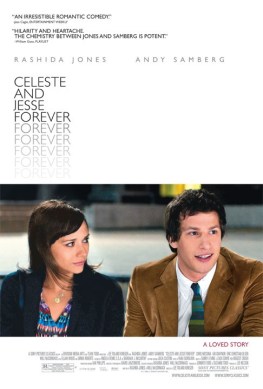
I won’t lie: I’m a little ready for the post-“(500) Days of Summer” boom of quirky romantic comedies to die down or at least start getting somewhat original again.  Not that Rashida Jones and Andy Samberg don’t make an infinitely watchable semi-couple in “Celeste and Jesse Forever.”  And believe me, I would much rather a movie buck the genre conventions than accept them completely.

But part of the charm of Marc Webb’s movie back in 2009 was that the anti-romantic comedy was not entire subgenre; it was just one movie that dared to be real.  Now, lack of formula has started to feel like a formula in and of itself.  This reactionary spirit is now starting to inspire that same thing that galvanized it to react in the first place: fatigue.

I have a feeling that perhaps the viewing climate for “Celeste and Jesse Forever” may be the reason why my reaction to the film was not quite as rapturous.  To be sure, Rashida Jones’ script, co-written with Will McCormack, of two best friends who get married and then have to separate to regain their friendship is well-developed and acutely perceptive about the nature of romance.  It’s even accompanied by surprisingly effective direction from Lee Toland Krieger, who uses the camera for powerful emotional impact in a way that humbly doesn’t draw too much attention to itself.

Read the rest of this entry »


REVIEW: Bachelorette

8 09 2012

When “Bachelorette” begins, it’s easy to see the structural similarities to “Bridesmaids” … and then just totally laugh them off due to the two films’ vast tonal differences.  Kristen Wiig’s comedy is like being tipsy on wine: wild, but also controlled and somewhat classy.  Leslye Hedland’s movie, on the other hand, is like what I imagine being high on cocaine would be like: messy, strung out, and utterly chaotic.

The three bridesmaids here have little in common with the Wolfpack of “The Hangover,”  rather, they all bear more than a passing resemblance to Mavis Gary, Charlize Theron’s protagonist of “Young Adult” whose mentality is stalled in high school.  The mean girls of the ’90s are back to wreak havoc on the wedding of poor Becky (Rebel Wilson), a girl that they didn’t really seem to run with then and don’t seem to care any more for her in the present.  I wouldn’t want anyone who called me “Pigface” at my wedding at all, much less as a bridesmaid!

But for a while, I was willing to overlook the plot holes and strap myself along for the drug-fueled shenanigans of harlot Katie (Isla Fisher), sassy Rashida Jones placeholder Gena (Lizzy Caplan), and their seemingly sober-ish ringleader Regan (Kirsten Dunst).  The humor is at first stingingly acidic and bitingly true in a way that recalls Lena Dunham at her most sour.  Caplan is the scene-stealer of the bunch, lighting up every scene even as she drains it of a significant portion of happiness.

Once again for the record, I’ve never been on cocaine, but I’ve been led to believe the high is followed by a big crash.  And like I said, “Bachelorette” is like a few lines of cocaine, so for all the fun it brings, it comes down with a large thud.  All the energy gets sapped out of the film’s second half as it veers away from a significant look at relationships and takes a turn down Formula Lane.  By the end, I had all but tuned out of the three bachelorettes’ stories, which is disappointing.  The characters were relatively interesting, but Hedland fails them with a predictable script that tantalizes with promise at the beginning.  C


F.I.L.M. of the Week (September 7, 2012)

7 09 2012

It’s football season again, now officially resumed on both the collegiate and the professional level.  And while you may think the sport is only a backdrop for the campiest of film (COUGH…”The Blind Side“), “The Wrestler” scribe Robert Siegel dared to take the popular game and craft a searing small-scale ethical drama that asks some challenging questions.  I’m such a big fan of his “Big Fan” that I’m naming it my pick for the “F.I.L.M. of the Week.”

I’m convinced “Big Fan” had to have been some form of audition for “Young Adult” for Patton Oswalt because these two performances work so well in tandem.  Here, Oswalt bares his dramatic chops as Paul Aufiero, another stalled thirty-something living in his childhood home.  He may be just a lowly parking garage attendant, but Paul has one thing that brightens his life and gives him purpose: the New York Giants.

He’s a reminder that the word fan comes from the word fanatic.  Paul calls into the local sports radio station with intricately pre-fabricated monologues and sees himself as at war with the dreaded Philadelphia Eagles.  And as these types of movies often do, a single event changes everything.  In “Big Fan,” Paul takes a big hit – quite literally, at the fists of his favorite Giants player, Quantrell Bishop.

Beyond just the questions of how it affects the way he obsesses over the team, it also brings up issues of criminal liability for Bishop.  Assaulting Paul could lead to jail time and suspension, thus harming the Giants.  But is he willing to take this hit for the team?  Paul Aufiero the fan and Paul Aufiero the human being can no longer coincide peacefully … one must vanquish the other.  So what will it be?  Oswalt’s starkly meditative performance keeps us on the edge of our seat until Paul takes decisive action.


REVIEW: Detropia

6 09 2012

Osama bin Laden is dead and General Motors is alive” has been a common rallying cry – okay, closer to a scream – on the campaign trail for Vice President Joe Biden.  I am not going to comment on the validity of the statement because to do such would only introduce a political debate into an aesthetic evaluation.  However, I will refer you to Heidi Ewing and Rachel Grady’s documentary “Detropia,” which shows the American automotive industry on life support and Detroit rotting around it.

The filmmakers provide a harrowing look at the detrital conditions of the city; at times, I caught myself wondering if their establishing shots were new footage or stolen from some horror film set in a decaying Motor City.  Ewing and Grady cut a cross a broad swath of post-recessional Detroit experience, ranging from the government to the business owner to the artist all the way down to your average citizen.

Everyone has an opinion, everyone has a spin, and everyone has a story.  Some people are there because of their pride, some are there to maintain order, some are there as opportunists to seize a bargain or fill a niche.  Though each subject comes from an entirely different point of view and frame of reference, they can all agree that Detroit is a fallen colossus, a sinking ship of which they are among the last to abandon.

“Detropia” is a devastating portrait of that city, and it twists a knife in the wound of the economic downfall in a way that really stings.  While “Up in the Air” and other similarly zeitgeist-tapping films merely graze the surface, Ewing and Grady use the power of documentarian veracity to make the rotting carcass invade all our senses.  Though they disappoint on a simple storytelling level by not following each story to completion and thus leaving a number of loose ends hanging, they serve up a slice of life that is searingly real … but deny us the last bite.  B


REVIEW: Keep the Lights On

5 09 2012

There is nothing about Ira Sachs’ “Keep the Lights On” that Andrew Haigh’s superb “Weekend,” another drama about a same-sex relationships, has not done with far more grace and skill.  Sure, you could say that Sachs’ film spans many years and thus deserves to be judged differently, but the byproducts of both movies are incredibly similar.

The portrayal of homosexuals is far superior in “Weekend,” which defines the two men by their fears, their misgivings, their hopes, and their humanity.  “Keep the Lights On” abandons true characterization in favor of stereotypes and archetypes.  Paul (Zachary Booth), a gay lawyer at first living in denial, at least has some complexity, but he’s still most defined by his drug use and infidelity.  Erik (Thure Lindhardt) is a whiny, grating character who seems to be motivated only by his insatiable desire for sex.

Haigh’s film is also far superior at analyzing society and deconstructing what it really means to have a relationship.  Sachs has his couple practically operating in a vacuum.  “Keep the Lights On,” beyond just the story, is also a far inferior film aesthetically.  It plods along at a dismally slow pace and the filmmaking brings very little exciting to the table.

I could extol the authenticity of “Weekend” here, but I’ll refrain since I’ve already written a review of that film.  And while you might say that I’ve hardly reviewed “Keep the Lights On,” I see no reason to dedicate any more of my time and thoughts to a movie that has been done before and has been done better.  No, IFC did not pay me to advertise “Weekend” with this post, but if you feel compelled to seek it out now … it’s on Netflix Instant Streaming, iTunes, Amazon Instant Video, and just about any streaming service out there as of this posting.  C-