F.I.L.M. of the Week (July 1, 2011)

1 07 2011

Back at the end of 2009, my first year of blogging, I caught some heat for including Tony Gilroy’s sophomore directorial venture, “Duplicity,” among my top 10.  To quote directly, “Duplicity? Really?”  There was also a slightly more detailed explanation of someone’s distaste for the movie, with that blogger describing the film as “dull.”

So now, with Julia Roberts headlining “Larry Crowne,” I have the perfect opportunity to defend the movie that charted as the 7th best movie of 2009 for me as the “F.I.L.M. of the Week.”  For my money, “Duplicity” was a fun, sleek, and stylish spy thriller that kept you on your toes every step of the way.  Coming after the flop that was “Quantum of Solace,” espionage was desperately in need of a facelift.  And at the beginning of 2009, originality wasn’t exactly plentiful at the theaters.

And in addition to being insanely well-written as an espionage movie, it also doubles as a romantic comedy with a dynamite couple in Julia Roberts and Clive Owen (who shared the screen as lovers in Mike Nichols’ “Closer,” a past F.I.L.M.).  The two play all sorts of games with each other, but since they are both corporate spies, all the lying, cheating, and stealing is for their job.  As the movie cuts back and forth between their history as lovers and their current scheming, it keeps us wondering where the line between work and play is drawn by these two spies.  Do they draw it at the same place?  What happens when this line is crossed?  By mixing the two genres, Gilroy gets us more engaged than ever in the business of these spies.  (Not to mention he cuts out all the contrived mumbo-jumbo we’ve been told to tolerate time and time again by Hollywood.)

Owen’s Ray Kovacks and Roberts’ Claire Stenwich are fascinating to watch unfurl courtesy of their nuanced portrayals.  First spies for competing governments, then from competing corporations, their alliances are never completely evident nor are their motives fully crystalline.  But as their quest to be the smartest guys in the room takes them on a crazy path that only a brilliant screenwriter like Tony Gilroy could imagine, their worlds and minds begin to unravel, ultimately laying them bare.  Some might call the movie’s never-ending plot twists excessive and ultimately self-destructive, but in the current Hollywood climate, “Duplicity” doesn’t have enough to compensate for the lack of complexity in a calendar year.  The twists can be electrifying if you choose to let them shock you, and the movie’s ride can be tremendously rewarding for those with the commitment to follow it.


REVIEW: The Tree of Life

30 06 2011

I saw “The Tree of Life” almost three weeks before publishing this review, and ever since, I’ve been so conflicted as to how I would approach reviewing it.  While I definitely wasn’t the biggest fan of the movie (more on that later), I didn’t want to insult those who loved it – and there were many of those, including the majority of critics.  As an amateur blogger, I’m straddling a delicate line between critic and average moviegoer, and I’m usually seen as standing on one side or the other.  But speaking as both, I recognize that writer/director Terrence Malick endowed his latest movie with a lot of meaning: for me, however, that meaning was hollow and ultimately didn’t parallel the amount of ambition on display.

I don’t care who you hear talking about how much they understand “The Tree of Life” or how much they realize every moment of the movie – unless they have a Ph.D. and have seen the movie multiple times, there is simply no way they can.  The movie is too overwhelming in scope for anyone to fully digest, much less comprehend.  Every frame is deliberate in its own right, and every image (except mopey Sean Penn) is endowed with an undeniable beauty by its creator, Terrence Malick.

But where I separate with the general critical consensus is that while I see the rapture of each shot, I don’t see them as contributing to the work as a whole.  To borrow an expression, the whole was less than the sum of its parts.  I have no doubt that in Terrence Malick’s head, this is an absolutely sublime movie, a thoughtful meditation on some of the biggest questions of humanity and religion.  Yet somewhere between his mind and what my eyes saw on the screen, there was a great disconnect.

Read the rest of this entry »


REVIEW: Larry Crowne

29 06 2011

The recessionary spirit has started to manifest itself in American cinema at full force, and thanks to “Larry Crowne,” it has entered mainstream romantic comedy.  While it’s less like “Up in the Air” and more like a double-length sitcom episode, the movie works as a reminder that dignity, integrity, and the will to work are three powerful weapons against the tough times facing our country.  This commentary mostly takes a backseat to the been there, done that genre tropes – but just the fact that it has subtext makes it deeper that just about every romantic comedy in the past decade.

Say what you will about the declining power of movie stars, but I don’t think this movie would have worked without its marquee names, Tom Hanks and Julia Roberts.  We’ve all seen the good-natured person melt the cold exterior of someone else, although “Larry Crowne” does invert it by making the man nice and the woman chilly.  The characters are one-dimensional; Hanks’ Larry being an embodiment of good while Roberts’ Mercedes Tainot representing a heart hardened by a bad marriage and the frustrating public education system.

Yet it’s watchable, even fun, because our heads process it as Erin Brockovich falling in love with Forrest Gump.  The romance isn’t good enough to be cared about if we were watching two no-name indie actors, and we accept it because we have a history with these two actors and we trust them.  We aren’t watching Larry Crowne; we are watching Josh Baskin, Andrew Beckett, Joe Fox, and Chuck Noland.  Similarly, we aren’t watching Mercedes Tainot; we are watching Vivian Ward, Julianne Potter, Maggie Carpenter, and Anna Scott.  Where the script lacks, the decades we have spent having these two actors entertain us compensates.  (So if you aren’t a fan of either of the actors, maybe it’s best to steer clear.)

When it’s not quietly extolling American virtues, “Larry Crowne” is light, breezy, and warm.  Its titular character meets an interesting cast of characters at the local community college, explores new hobbies and passions, and confronts the changes in his life with determination and willpower.  While I expect a little bit more from Nia Vardalos, the woman who had me in tears of laughter with “My Big Fat Greek Wedding,” in the way of humor, the movie has a sort of pleasant wit to it.  Combined with the likability factor of Hanks and Roberts, the movie makes for a nice and decently satisfying watch.  B / 


REVIEW: Transformers: Dark of the Moon

28 06 2011


Oh, Michael Bay, what on earth are we going to do with you?  The director’s latest venture, “Transformers: Dark of the Moon,” reminds me why I use his name metonymically to represent all that is wrong with modern Hollywood filmmaking.  I have come to believe that the director’s ambition is to make movies akin to hitting your head against a wall: that is, both should be experiences to kill a massive amount of brain cells.

To call the movie thinly plotted is a vast overstatement; it’s a jumble of events that gives Bay an excuse to blow stuff up.  In fact, using the word plot is insulting to the craft of writing.  If there was any sort of story to the movie, I couldn’t make it out amidst the deafening noisiness.  All I picked up on was some sort of Apollo 11 conspiracy that brings back more villainous Decepticons, thus allowing Bay to unleash the Autobots to fight them for prolonged periods of time while Shia LaBeouf’s Sam Witwicky runs around like he just escaped from an insane asylum and the new Megan Fox, Victoria’s Secret model Rosie Huntington-Whitley, stands there looking hot while managing to still have a perfectly unscathed face amidst the disaster around her.

It’s hard to believe now that this series used to be good.  The first “Transformers,” which came out four years ago, was a fun mix of action, humor, and excitement.  Since it did so well at the box office, Bay seems to have assumed it was only because of the action and dialed down every other aspect of the series to make the one non-stop.  I don’t mind watching buildings explode or bullets fly, but it gets old when you get pounded by it ceaselessly.  For this reason, the first sequel “Revenge of the Fallen” was a total disaster and one of the worst movies released in 2009.

Read the rest of this entry »


REVIEW: Life As We Know It

27 06 2011

It took me four days to finish the crummy dram-rom-com “Life As We Know It.”  Translation: I fell asleep watching it not once, not twice, but THREE times.  So not only is it bad, but it’s agonizingly boring.  Give me corny and derivative before boring because at least those movies are bearable.

The movie isn’t even worth me doing a Wikipedia search to be reminded of the plot and the characters.  From what I can remember, it revolves around the misadventures of Katherine Heigl and Josh Duhamel trying to take care of a baby, and they are totally incapable of doing so.  They aren’t married; they aren’t even together – it was some sort of cruel joke in the will of their mutual friends.  It’s a good thing they get to play repulsion most of the time because Heigl and Duhamel have about as much chemistry as a toilet seat and a pair of butt cheeks.

So if there’s no romance in this dram-rom-com, there must be some drama and comedy, right?  If you count sappy melodrama that soap opera actors could do better than Heigl and Duhamel, then sure, there’s drama.  And if you count Katherine Heigl having a big poop on her face, then there’s a minuscule shred of comedy.  But hey, speaking of poop, have you heard of “Life As We Know It?”  D / 


HITCHCOCKED: “Dial M For Murder” (1954)

26 06 2011

The perfect murder is always the perfect scenario for a Hitchcock movie.  “Dial M for Murder” is then by definition a quintessential Hitchcock, and watching it would give anyone a taste of the director’s style and methods.  In fact, all it’s missing is some Jimmy Stewart.

The perfect murder here is planned by former tennis player Tony Wendice (Ray Milland), who hires the perfect stranger – or old friend – to execute it for him.  Through blackmail and clever thinking, Tony coerces a Cambridge acquaintance, C.A. Swann (Anthony Dawson), to murder his cheating wife Margot (Princess Grace Kelly).  He has the perfect alibi to save him from any suspicion; while Swann commits the murder, he will be at the gentleman’s club.  Yet things go haywire thanks to a pair of scissors, and Tony has to cover his tracks to avoid being discovered.

Hitchcock makes this single-room thriller compelling and suspensful, which shouldn’t be a surprise to anyone who has seen “Rope.”  The only real complaint I could lodge against this one is that at times it feels a little too theatrical (the movie is based on a play) and less cinematic, almost as if he filmed it a live performance on a Broadway stage.  But I have no problem with live theater, nor do I have a problem with Hitchcock, and this elaborately plotted murder mystery ranks up there with the best of them.


REVIEW: The Tillman Story

25 06 2011

Many documentaries explore worlds we hardly know, exposing us to vast injustices and unimaginable horrors.  These are undeniably eye-opening, but they often don’t shock quite as much as documentaries that pull back the facade on stories we think we know.  “The Tillman Story” is in a class with the latter type of documentaries, showing us the truth about Pat Tillman’s life and death that the military didn’t want us to see on ESPN.

I remember being 11 years old and hearing the news that Pat Tillman, the man who gave up a career in the NFL to serve in the army for the love of his country, had been killed in Afghanistan.  Here was a man that was a symbol of patriotism, a banner for all the good in America.  I remember my dad telling me that Pat Tillman was a true American hero, and I think countless other parents told their kids the same thing.

Because of that, when Pat Tillman died in Afghanistan, the military saw the perfect martyr to regain some confidence in their mission and to give heroism a face that America could rally around.  They simply covered up the fact that he actually died by friendly fire (shot by his own men, for those unfamiliar with military jargon) and exalted him like a saint.  Little did they know that Pat’s family was not going to sit back and accept their version of events.  Motivated by justice and truth, two very American values, his mother Mary Tillman and various others pursue accountability from the military and acknowledgement of the reality of Pat’s death.

It’s hard to reexamine a story like Pat Tillman’s since it had become like a truth for me.  Now, we have to adjust the events in our mind: he can remain a hero for the choice he made, but he can no longer be seen with the same heroism in death.  Better yet, Amir Bar-Lev, with his fascinating “The Tillman Story,” doesn’t stop at asking us that question.  He challenges us to think about how much we need a hero or an inspiring tale.  Will we go so far as to accept fiction or ignorance to get it?  B+


F.I.L.M. of the Week (June 24, 2011)

24 06 2011

Documentaries often criticize institutions and expose corruption, garnering the genre as a whole a sort of muckraking infamy.  However, not all fit the stereotype.  Take, for example, “The Most Dangerous Man in America: Daniel Ellsberg and the Pentagon Papers,” a Oscar nominated documentary that’s my pick for this week’s F.I.L.M.  The movie celebrates the First Amendment right to the freedom of speech against the backdrop of an infamous incident in American history, focusing on one man who made a stand for the rights of American citizens to be informed.

Daniel Ellsberg is not your average Pentagon worker during the Vietnam War.  After becoming gradually disillusioned with the country’s mission after seeing the war both from a combat and administrative perspective, he began working at a think tank called RAND.  However, he still contributed to a study covering the conduct of the war; the documents would later be classified top-secret and known as “The Pentagon Papers.”

Knowing that these papers would implicate the Johnson administration in deliberately lying to the American people about the Vietnam War, Ellsberg decided to make copies of the Pentagon Papers and leak them to the media.  To the fury of Nixon and his staff, excerpts were published in The New York Times in June 1971.  The fallout eventually led to a Supreme Court case, which upheld the right of the newspaper to publish classified material without government censure.

“The Most Dangerous Man in America” also provides a very interesting portrait of Ellsberg himself, showing us what psychological forces led this man to take such drastic action in order to inform the American citizens of what their government was really doing.  But the beauty of the documentary is in the questions that it raises: what is the role of the media in maintaining transparency of the government?  Of the citizens?  Do we have a right to know everything the government does?  These questions are especially relevant now with WikiLeaks and their publishing of American defense secrets.  While the movie gives you Ellsberg’s answers, it also lets you ponder your own response to these big ethical questions all while celebrating the liberty our Constitution so vigorously protects.


REVIEW: Unknown

23 06 2011

Half “Taken” and half “The Bourne Identity,” Liam Neeson’s latest thriller “Unknown” lacks the scintillating sizzle of such like-minded thrillers but will pass for decent entertainment.  If you want a rental that offers a tiny bit of mental involvement, a fair bit of thrills, and beautiful women named Diane Kruger and January Jones, this might be a decent way to spend a Monday movie night at home.  You won’t complain or be disappointed; you’ll just be content.

The high concept thriller follows Martin Harris (Neeson), who awakes from a coma after a car wreck in a Berlin taxi driven by Gina (Kruger) to find that his wife Liz (Jones) doesn’t recognize him.  In fact, there is nothing other than a lost passport to prove his identity.  In order to get his life back, Martin must get to the source of this deep running conspiracy, and he will stop at nothing to reclaim what was once his.

It’s really an intriguing premise, and if you watched the trailer (or saw it a million times in theaters during December 2010), you can basically skip the first hour.  The set-up was done perfectly in two minutes there, and it was a little unnecessary to prolong the trailer.  The second hour is where things get interesting, yet by the time the movie’s “twist” comes around, I was just ready for it to end.  The movie squanders an opportunity to really cash in on the idea, which is a little disappointing, but at least it doesn’t totally tank.  There are much worse thrillers than “Unknown;” then again, there are also much better.  C+ / 


REVIEW: Cedar Rapids

22 06 2011

I don’t know if you have any romanticized notions about how bloggers watch movies outside of theaters, but let me dispel just about all of them right now.  Be it through Netflix, iTunes, Redbox, Blockbuster, or basic cable, watching movies is usually just us sitting in front of some sort of screen (and in rare cases, we can manage to net a friend or family member if the movie has wide appeal).  We generally just plop, watch, and write, sharing our opinions not verbally with the person we endured the movie with but digitally with people who read our site or happen to accidentally wind up here after Googling “did the kings speech win any oscars?”

This method of movie watching inevitably favors one genre and shorts another.  It’s easy to love a drama you watch at home because it’s hardly different than watching in the theater – that is, the audience is mostly silent for the duration of the movie.  It’s hard to love a comedy because you have no one’s reaction but your own to measure as audience laughter has a significant impact on how we perceive the humor of a movie.  Plus, no one really likes to laugh by themselves.

So when I come across a movie that can make me laugh while I’m curled up alone underneath my bed sheets, I rejoice!  Ladies and gentleman, “Cedar Rapids” is one of those movies.  Sure, it may be hopelessly pathetic and wallow in endless jokes of naïveté, but it’s actually funny!  I laughed!  A lot!  In bed!  Seriously, that doesn’t happen very often at all!

Ed Helms, best known as Andy Bernard from “The Office” and Stu from “The Hangover,” stars as Tim Lippe, the insular Wisconsin insurance salesman who gets a chance to go to the titular metropolis representing his company.  There, he is exposed to the dangers and pleasures of true urban living and meets an exciting cast of characters including the crude Dean Ziegler (John C. Reilly), mild-mannered Ronald Wilkes (Isiah Whitlock Jr.), good-natured Joan Ostrowski-Fox (Anne Heche), and the prostitute with the heart of gold Bree (Alia Shawkat in the first role of its kind likely to be snubbed by the Oscars).  Tim is totally clueless the entire movie, never really leaving his tighty-whitie turtle shell of ignorance.  But even the cheap laughs work here, and my reactions ranged from chuckles to belly laughs.  So what are you waiting on, book a trip to “Cedar Rapids” and enjoy comedy that can illicit a verbal reaction from you in the comfort of your own home.  Humor me.  (It’s also alright to laugh at the pun.)  B+ / 


REVIEW: The Adjustment Bureau

21 06 2011

I’m at a bit of a loss as to what I can write about “The Adjustment Bureau.”  I saw the movie nearly five months ago, and the fact that I can recall so little about it probably speaks the most about its quality.  It’s more than a halfway decent thriller featuring two very attractive leads in Matt Damon and Emily Blunt, but it’s not exactly remarkable or memorable.

Based on a Philip K. Dick short story – and to be honest, what high concept thriller isn’t nowadays – the movie revolves around Senatorial candidate and future Presidential hopeful David Norris (Damon) who goes off the set “plan” for his life as written by the Adjustment Bureau, a group of caseworkers who ensure the execution of their mysterious Chairman’s will.  This is largely due to his interactions with the avant-garde ballerina Elise (Blunt), which begin with flirtations but progress towards romance and a relationship.  As David struggles to sort out his feelings for her, he must also weigh the input of the Bureau, who insists that they never be together.  David decides that he must write his own life rather than submit to some pre-written script for his fate.

The movie has some religious implications through its plot and some undertones courtesy of new director George Nolfi, but they feel slightly exploitative and immature.  If you are going to draw comparisons to God or throw religion clearly and obviously on the table, you need to have the ideas fully fleshed out and clearly communicated, two things I don’t think Nolfi did.  Predestination and fate are big questions that have baffled theologists for years, so don’t think that “The Adjustment Bureau” will give you a definitive answer or break any new ground in the field.  At the end of the day, it’s still just an entertaining thriller.  B


REVIEW: Green Lantern

20 06 2011

The old adage traditionally goes “money can’t buy you happiness,” but in respect to the latest Hollywood comic book adaptation, “Green Lantern,” money can’t buy you quality. The higher the pedestal, the harder the fall, and with a $200 million price tag, this movie lands a hard face plant.  Even with Ryan Reynolds turning in one of the better superhero performances in recent memory, the movie’s unimaginative script and laughable special effects render it one step short of unbearable.

The first movie in any hopeful series has to do a lot of introductions, and the hero has to earn his stripes.  But here, the exposition just made me want to howl with laughter because of its corniness, and they even brought in Geoffrey Rush to do some of the narration to make it sound serious!  The whole universe they set up feels like some rejected, half-baked idea for a Disney Channel series with its Sectors of the universe, the wise sages known as Guardians, and the intergalactic police force called the Green Lantern Corps.

Hal Jordan (Reynolds) is the lucky human who gets to join their ranks thanks to being “chosen” by the green light after another Green Lantern crash-lands on Earth.  Cocky, rule-breaking, and daredevil Jordan has his work cut out for him as the Green Lanterns draw their power from the green light of will, while the menacing Parallax (and his new convert Hector Hammond, Peter Sarsgaard’s mad scientist with a nasty receding hairline) draws his power from the yellow light of fear.  He must learn to use willpower to overcome fear by using the power of imagination – which makes it all the more ironic that the movie’s big theme copies that of the poorly received “Spider-Man 3.”  Clearly it’s not Jordan who needs the green light; it’s the people who wrote the script.

The whole mess, which goes on for nearly two hours, is full of plot holes and ridiculous implausibilities (flying next to the sun?) that make it even more laughable.  But the icing on the cake is the movie’s visual effects, which are honestly the WORST that I’ve seen in a blockbuster made this millenium.  When Jordan harnesses the green energy and transforms, he looks so fake that it’s hard to take him seriously.  It’s made worse by the fact that his eyes are sloppily changed blue, making him look borderline possessed (not to mention that it does jack squat to protect his identity).  And don’t even get me started on those Guardians; they look like the offspring of trolls bred with Smurfs.

Truly, Reynolds deserves better than this.  He may be the “Sexiest Man Alive,” but he’s also out to prove that he’s more than just a pretty face.  He puts a lot of soul into this character, giving Jordan some depth and emotion, yet he’s stifled by a terrible movie that is unintentionally more like “Bridesmaids” than “Thor.”  Reynolds is a star here, but he can’t shine bright enough to overpower the ugly light that is “Green Lantern.”  From a critical perspective, it’s a big, fat red light for this movie.  C- / 


REVIEW: Unstoppable

19 06 2011

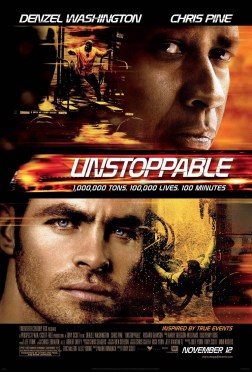
Unstoppable” is easily one of the best action films I’ve seen in a long time, and every filmmaker should be taking notes from Tony Scott here.  He takes a story that we all know very well – the worst case scenario coming to fruition – and makes it exciting again.  Scott keeps the movie paced as fast as the runaway train in the title and keeps us drawn in for the whole ride.  It’s solid entertainment done totally right, and even though it doesn’t engage the brain, it compensates by putting a pit in your stomach and keeping your heart racing throughout.

Thanks to the perfect storm of errors, a freight train carrying dangerous chemicals is barreling out of control towards Stanton, Pennsylvnia.  There are only two men who can stop it: old-timer Frank Barnes (the unbeatable Denzel Washington) and his trainee, new hire Will Colson (Chris Pine).  The two men, very different in their attitudes and approaches, must come together and grapple with the big issues of duty and death in order to save a hundred thousand lives.

Even without the movie being inspired by true events, we would already feel the inevitability of the ending.  Yet Scott’s high-octane cinema of adrenaline never lets up, still making us hold on to our seats until the exciting conclusion.  While we wait, he dazzles us with incredible aesthetics, which we can still appreciate even though they aren’t being thrown in our face like an Oscars “For Your Consideration” ad.  The film’s editing, cinematography, and sound are just as much responsible for the thrill ride of
“Unstoppable” as Washington or Pine.  By the time the credits roll, you’ll wonder why all action movies couldn’t have such impeccable production values and firm direction.  B+ / 


REVIEW: The Art of Getting By

18 06 2011

I never thought I would be so thankful for Woody Allen’s brand of cynicism and misanthropy than I did when leaving “The Art of Getting By,” an indie comedy revolving around a budding romance between two unlikable NYC teenagers.  This lame attempt at comedy is like watching the first draft of a script that Allen wrote on downers; it has all of his nihilism but none of his neuroses.  Gavin Weisen’s first feature lacks the palatability that makes Woody Allen’s personality bearable, and in just 85 minutes, he’ll make you wish you were sitting in a cookie-cutter rom-com.  (Yes, it’s actually that bad!)

Freddie Highmore, who you know from “Finding Neverland” and Tim Burton’s disastrous remake of “Charlie and the Chocolate Factory,” is now moody and emo because bangs cover his eyes and he reads Camus in the cafeteria.  As George, he’s a mopey defeatist who has Woody Allen-level pessimism at the age of 18.  He’s totally detached from school, doing no work, and from home, where he refuses to communicate with his caring mother (Rita Wilson).  Even on the verge of suspension and expulsion, he can’t bring himself to put anything on his homework other than demented doodles.

Enter Emma Roberts as his desert flower Sally, the child of a broken marriage who shares some of the same bitterness and insecurities as George without wearing it on her sleeves.  They begin a strange friendship that teeters on the brink of love, but he can’t ever snap out of his negativity and she can’t seem to say much other than “you’re really weird.”  It’s really uncomfortable, filled with poorly executed melodrama and even less appealing romance.  If there was any attempt at comedy, it wasn’t even visible.  By the end, you’ll discover that “The Art of Getting By” can’t even leave you with a half-hearted smile like other disappointing romantic comedies.  All you really feel is a slight numbness in your butt as you climb out of the seat.  C- / 


F.I.L.M. of the Week (June 17, 2011)

17 06 2011

In preparation for “The Tree of Life,” I made my way through the entire Terrence Malick filmography (which, by the way, isn’t hard since he has made all of four films in 37 years) for the first time.  I had heard so much praise for the director’s movies, yet the only one I thought was unequivocally worthy of it was “The Thin Red Line,” my pick for the “F.I.L.M. of the Week.”  Malick’s distinct style and imagery seem uniquely fitted for a movie like this, where men with killing machines are juxtaposed with the beauty of nature and the people who live in harmony with it.

Set in 1942 during the American offensive on Guadalcanal, Malick’s nearly three-hour film has the ambition and grandeur of an epic poem, and it certainly feels like one.  The beauty and the savagery Malick captures with the lens tells another story all on its own, and together with a script that plumbs for perspectives on the most primal questions of human existence, the movie’s visceral intensity can make for sensory overload.  In my opinion, it’s the only one of his films where I felt truly moved by the imagery and rambling philosophical narrations (both trademarks of his work).

Of course, I’m not going to pretend like I have a deep understanding of the movie, only that at surface level with some shallow analysis, it’s a satisfying watch.  It certainly doesn’t feel as esoteric or obscure as his other films.  I will say that I don’t think it’s any coincidence that the only one of his movies I really liked was his only adapted script.

The characters, although I’m sure still twisted for Malick’s own purposes, come from the novel of the same name by James Jones.  The men in the movie – with the exception of the now extremely famous – all look alike, so it gets a little confusing at times to separate the individual storylines of C Company.  However, as long as you are willing to accept “The Thin Red Line” as a movie of ideas and images instead of a movie of events, then you will be swept off your feet by Malick’s fim that doesn’t fall anywhere on the typical pro-war/anti-war spectrum.  It celebrates life in the most threatening settings known to mankind.