REVIEW: The Lady in the Van

16 02 2016

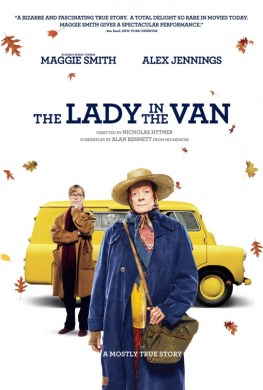
The Lady in the VanThe titular character of Nicholas Hytner’s “The Lady in the Van,” Maggie Smith’s Miss Shepherd, is simply a laugh riot. It seems as if all Smith needs is a camera to watch her, and crotchety comedy ensues. The vagabond Miss Shepherd, who lives like a pack rat in a van wandering the streets of London, feels like a brand extension of Smith’s “Downton Abbey” character. There could be worse things to watch.

At the ripe age of 82, Smith thrives off of stealing the show no matter which project she choose. “The Lady in the Van” is no different. Yet by indulging her for every crowd-pleasing laugh, it steals a little thunder from the quiet center of the film.

While Miss Shepherd is the film’s undeniable star, she is not the protagonist. That role belongs to playwright Alan Bennett, played here by Alex Jennings. The real Bennett harbored this curmudgeonly vagrant for nearly two decades and weaved her story into a best-selling memoir. He never intended to let Miss Shepherd park her van in his driveway for so long, but one thing just led to another – and neither found anything heinously disagreeable in their arrangement.

Though much is revealed about what led Miss Shepherd from a life of concert piano playing and convent living, “The Lady in the Van” is as much about what she reveals in Bennett. Sadly, he writes himself far too modestly as a character in his own life, becoming wallpaper for Miss Shepherd to prance around in front of. Bennett’s only attention-grabbing move is a device making a split self, a “liver” and a “writer.” One takes part in events while the other records them later for posterity.

There are hints that the film could have been as stirring as “Philomena,” a similar story about a privileged British writer who receives humbling at the hands of a quirky older woman. “The Lady in the Van” mostly just sticks with fun schtick from Miss Shepherd, though. That alone makes for sufficient entertainment, but a little more emotional and intellectual depth could have propelled it beyond mere diversion. B2halfstars


REVIEW: The Witch

15 02 2016

This review originally appeared on Movie Mezzanine, for whom I covered Fantastic Fest in Austin, TX.

Forms of storytelling never really die – the functions they serve simply migrate and reappear somewhere else. The folk tale is one such manner of expression that seems rather obsolete in the modern world, not yielding any overtly major works in the past two centuries or so. But director Robert Eggers identifies where they went in “The Witch,” a film that bears the subtitle “A New England Folktale.” The moral panic and blatant grandstanding on right and wrong has found a comfortable home in the horror genre.

Just drawing this parallel is a revelation in and of itself. In many ways, “The Witch” feels like the ultimate movie of its ilk, since it draws such power from returning to the roots of American anxieties. Horror films often stage dichotomies like destiny and fate or good and evil, pitting these two impersonal forces against each other in an often frustratingly nebulous fashion. Eggers finds the terror in calling a spade a spade, explicitly staging his film around the binary conflict to which all others really refer: God vs. Satan.

This open acknowledgment of the dueling forces not only puts us in the mindset of the film’s deeply religious characters – a Puritanical family living on the outskirts of their new colony – but also untethers the story from expectations of reality. Eggers devises a scenario where he can have it both ways, allowing “The Witch” to take place in a very gritty, grounded reality while venturing into the supernatural. The resulting tale plays like the mashup between “The Exorcist” and “The Crucible” that no one knew they needed to see.

Read the rest of this entry »


REVIEW: Trash

14 02 2016

Trash“Slumdog Millionaire” meets “All The President’s Men” in Stephen Daldry’s “Trash,” a tale of three Brazilian dumpster-dwelling children who uncover a plot of serious political intrigue from an inadvertently disposed wallet. The film provides a gritty look at their reality, though that comes more from the photography or the set design than anything in the story. Daldry uneasily balances the improbable conspiracy with the poverty expose, cobbling together a bland movie that satisfies neither aspect of its premise.

The bright spots are few and far between, though I suppose we all ought to be glad that Martin Sheen and Rooney Mara’s characters do not fulfill the “great white savior” tropes that plague movies of this sort. He serves as a priest, and she works for an NGO, but neither can protect or save the teenagers from the corruption and brutality of local law enforcement. Any small victories they achieve come from their street-smarts and intuitions.

But given the improbable journey set in motion by their discovery, “Trash” ought to feel more thrilling, entertaining – or at least illuminating about Brazilian society. Given the upcoming Olympics in Rio de Janeiro, the subject might once again prove of interest to audiences worldwide. Hopefully they choose to watch something authentic like “City of God,” not “Trash,” which feels obviously made by an outsider. C2stars


REVIEW: The New Girlfriend

13 02 2016

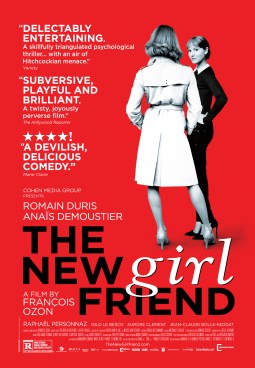
The New GirlfriendAnyone familiar with the work of French writer/director Francois Ozon knows to expect a certain level of twisted characters and crazy plots in any of his films. The latest, “The New Girlfriend,” does not mark any kind of departure for him. Transvestism and transgender issues are the main eccentricity here, in ways both enlightening and tiresome.

Romain Duris’ title character, Virginia, was known to the world as David, husband to Laura and father Lucie. But when Laura dies young, it leaves one grieving spouse – not to mention a best friend, Anais Demoustier’s Claire, equally devastated. Each takes on the grief of Laura’s passing in their own way, though David’s is perhaps a little less conventional. He always had a taste for cross-dressing (even letting Laura know), and he uses his wife’s death to further explore a female alter ego to provide the now-missing maternal care. Claire stumbles into David in full Virginia guise quite by accident, and she fully welcomes and encourages him to explore these repressed personality elements in the wake of Laura’s passing.

Virginia quickly becomes more than just a surrogate mother for Lucy, developing into a woman in her own right – not to mention a good friend to Claire and her husband Gilles. The sexual confusion and gender-bending antics that result from embracing the Virginia persona are not exactly coherent treatises on trans issues, however. Such is not a requirement for Ozon, but his blasé attitude towards deeper consideration of self-identity makes “The New Girlfriend” feel a little too flippant in some key moments.

Ozon is at his best when the events on screen reflect how each character looks to fill the void left by Laura in their lives. Claire needs a best friend. David needs a parenting partner and a lover. Try as each person might, neither can quite function as a fulfilling facsimile. These moments of unexpected mourning amidst resuming normalcy provide “The New Girlfriend” with its real dramatic heft. B2halfstars


REVIEW: Slow Learners

12 02 2016

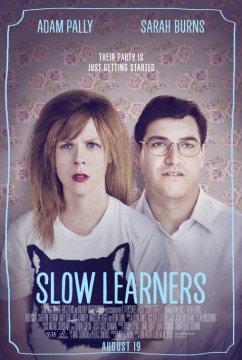
Slow LearnersTelevision comedy is in somewhat of a renaissance these days with premium cable and streaming giants funding some of the most radical, niche series ever seen. Too bad directors Don Argott and Sheena M. Joyce didn’t quite get the memo as their film “Slow Learners” feels like a natural fit for that medium. The movie feels quite a bit like a comedy pilot extended to feature length.

The two main characters, Adam Pally’s Jeff and Sarah Burns’ Anne, are the perfect odd couple for a small-screen romantic comedy story. Both have their issues connecting romantically with people of the opposite sex – Jeff more for his doughy looks; Anne, her zany personality. Over summer vacation, the two high-school teachers undergo transformations to make themselves more appealing partners, with each having their successes and setbacks. Of course, anyone who has ever seen a romantic comedy knows where they are really headed.

The ride to the inevitable destination has its fun moments, including some fun bit parts from underrated television actors like Reid Scott (Dan Egan from “Veep”), Kate Flannery (Meredith from “The Office”) and Cecily Strong (“Saturday Night Live”). But I could not help but wonder if these characters might make for more compelling television figures. Pally and Burns have the comedic versatility to operate on an episodic scale. Stretching them to meet a traditional narrative arc, like the one seen in “Slow Learners,” detracts from their gifts as much as it showcases them. B-2stars


F.I.L.M. of the Week (February 11, 2016)

11 02 2016

I’ve made watching writer/director Richard Curtis’ “Love Actually” into somewhat of a December pastime, returning each year to remind myself that love is all around us, we are all perfect to someone and many more lessons. I should probably do the same with his latest film “About Time,” a love story that with less breadth but far more depth.

I don’t quite know or understand how the film got so overlooked when Universal released it in November 2013. (I was in London at the time, where the film was released earlier to a more solid commercial reception.) But this is Curtis at his most profound, offering not just a solid romantic yarn but a legitimately valuable guide on how to maximize happiness through life. Maybe in making it my “F.I.L.M. of the Week,” I can will myself into heeding his advice more.

The film begins with a somewhat trite, if not completely hackneyed, premise: time travel. That tired plot device feels fresh when appropriated here by Curtis, who is far more interested in humanity than any of the mechanics. The men of the Lake family possess, somehow, the ability to travel back in time to places they have already been. Bill Nighy’s patriarch passes this information along to son Tim (Domhnall Gleeson) on his 21st birthday and allows him to decide how best to deploy the gift.

Tim, who at the time has relatively few graces with the opposite sex, chooses to focus on love. Ultimately, it leads him to pin down the perfect woman for him, Rachel McAdams’ Mary. While his courtship of her is sweet and entertaining, the traditional romantic arc only forms a portion of “About Time.” Curtis goes far beyond the traditional stopping point of the first kiss, the wedding or the birth of a child, examining the manifold pains and pleasures of everyday adult life. “Happily ever after” rarely feels as earned or sincere as it does here.

The film confronts some of the core tenets of how we find contentment and satisfaction in life by offering a look at how someone with boundless time might approach them. By walking in Tim’s shoes for two hours, we get the chance to view time travel not as a means of correcting the past or preventing a future. Rather, we can see how this fanciful premise might allow us to enrich and enjoy the present.


February film festivals around Houston

11 02 2016

It’s currently the dog days of winter at the movies – the awards movies have had their chance to relish in post-nomination success but we have yet to reach a point where the new year’s good films come out to play. (Sorry, “Deadpool,” you just don’t cut it for me.) For me personally, after the dual onslaught of end-of-year prestige films and Sundance, February has me wanting to dive into a book. Or catch up on all the TV everyone raved about for the past few months…

It’s the perfect time, in fact, to go off the beaten path for a little while and see what else is brewing on screen. For those in my native Houston, there are two great opportunities to see some things your multiplex would never program.

I’m talking, of course, about two film festivals, ReelAbilities and the Texas Christian Film Festival.

ReelAbilities_079

The first, ReelAbilities, is celebrating its fourth year of promoting inclusion and acceptance in town. Their programming focuses on those struggling with and overcoming disabilities of all kinds – physical or mental. Given that many conversations in the film world have recently focused on ensuring diverse representation of many races on screen, it’s important to see groups like ReelAbilities expanding the conversation. One of the great things film can do is provide a remarkable verisimilitude that sparks recognition. Seeing yourself reflected in the characters means the world to those who feel like no one understands their experiences.

The festival runs from February 14-18; the primary venue is Edwards Greenway Grand Palace. A variety of speakers, panels and talkbacks accompany screenings. Oh, yeah, and it’s free.

Get your free tickets here!

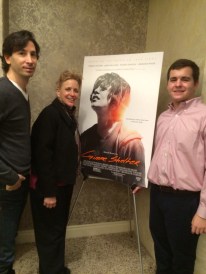
20140122-085721.jpgThe Texas Christian Film Festival runs a little later in the month: February 25-27. It’s another festival heavy on guest speakers and interactivity, kicking off with a screening of “9o Minutes in Heaven” with real-life subject Don Piper appearing in person for a Q&A. They will feature a number of other faith-based films, including 2014’s “Gimme Shelter.” Back when that film opened, I had the chance to interview director Ronald Krauss, star Vanessa Hudgens and real-life subject Kathy DiFiore.

While, admittedly, I had my issues with the film, I found DiFiore a true inspiration. Here’s an excerpt from my interview:

DiFiore stayed behind in the room to further elaborate on her mission through Several Sources Shelters.  When she opened up to talk about herself and not the movie, DiFiore’s incredible compassion becomes readily apparent.  She radiates an unflappable confidence that just makes you want to be a better person.  “I’ll find out when I go to heaven,” she stated without an iota of doubt, “but I think [Mother Teresa] is the patron saint of this movie.”

The shelter was only able to operate legally in New Jersey thanks to Mother Teresa’s help.  Quite literally an answered prayer, the Catholic icon threw her support behind the state’s DiFiore bill that would allow charities to run a boarding house.  The whole saga as narrated by DiFiore sounds like another compelling movie in and of itself, but it’s unlikely that you’ll see the story coming to a theater near you.  She’s far too humble to take center stage.

The Texas Christian Film Festival takes place at Bethany Christian Church. Tickets are free on their website while supplies last.

I’ve provided coverage from many world-class film festivals – Cannes, Telluride, New York, etc. – but I hope I have never radiated an aura that a film festival has to be some kind of elite institution. At its core, a film festival brings people together for an artistic communion around social viewing. It’s a very public reaffirmation of the power that a combination of images and sound can wield.

In fact, some of these more niche festivals provide for some of the more unique viewing experiences. If everyone has gathered at such an event, it means they share some interest in the subject with you. So start up a conversation, because festivals are fantastic incubators for compelling and necessary societal dialogue.


REVIEW: How to Be Single

10 02 2016

Far too often, Hollywood rom-coms problematize singleness. This genre portrays the lack of a romantic partner as a condition to be fixed – or even a disease to be cured. In many ways, coupling is somewhat of a biological imperative. But with lifespans getting longer and the nature of connectivity changing our expectations for others, singleness is becoming a more permanent fixture of the life course.

How to Be Single,” adapted from a novel by Liz Tuccillo (and seemingly loosely), provides many different avenues to explore just what this special period might mean. There’s the romantic monogamist type in Dakota Johnson’s Alice, the free-wheeling and fun-loving hedonist with Rebel Wilson’s Robin, and the maternally instinctual but careerist in Leslie Mann’s Meg. Each finds a path that is right for them as the film goes on, a refreshing change of pace from the “one size fits all” solution offered by far too many films.

The ride towards these conclusions gets a little turbulent, though, as the film plays into a few of the double standards or traps it wants to decry. It mostly just sticks to archetypes, which works just fine once each character finds themselves within one. Ironically, “How To Be Single” finds its biggest successes in the moments when someone’s archetype leads them to a moment of self-actualization.

The one character who does not fit this mold is Alison Brie’s Lucy, an algorithmically-obsessed serial online dater. Her connection to the core trio in the film is only tangential; the link comes from a neighborhood bar that Alice and Robin also happen to frequent. Lucy’s presence just clutters up “How To Be Single.” She feels like a shameless ploy for topical relevancy rather than a well-imagined addition to the story. Brie’s fire-tongued portrayal makes Lucy’s scenes fun, but they detract from the real core of the film. Her constant need to find herself in someone else clashes with the message offered by the rest of the film, which posits that extended time for solitary self-reflection can produce worthwhile discoveries. B-2stars


INTERVIEW: Ramin Bahrani, co-writer and director of “99 Homes”

9 02 2016

Adam McKay’s “The Big Short” has swooped into the public imagination and awards conversation, completely changing the way we think about how movies can portray the Great Recession. Perhaps that film signals a new era of storytelling about this fraught period in American culture. The 2007-2008 financial crisis now makes for period pieces, not current events.

A cinematic history that began with “Up in the Air” gets a bookend in Ramin Bahrani’s “99 Homes,” a film that made an immediate impact on me at the 2014 Telluride Film Festival and landed at #4 on my top films of 2015. I have called it a “gripping look into the dark heart of capitalism” as well as an illumination of “the mechanisms through which average citizens are bamboozled into thinking the interests of corporate bigwigs are always aligned with their own.”

I had the opportunity to talk with Bahrani, the film’s co-writer and director, about just how he used a hardened real estate agent, Michael Shannon’s Rick Carver, and a desperate evictee, Andrew Garfield’s Dennis Nash, to show the systems responsible for American middle-class misery. Our conversation clarified how “99 Homes” fits in with many years of films about the recession – but also how it stands apart and alone.

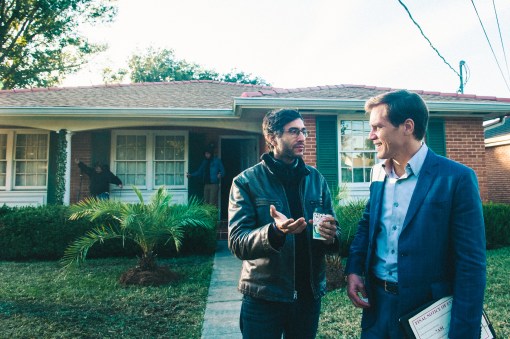
Ramin Bahrani and Andrew Garfield 99 Homes

I see Up in the Air as the first film to really talk about [the recession on screen].  I do think one thing that really sets 99 Homes apart for me is that Up in the Air uses the recession as the setting and not the subject.

Right.

At the end of the day, it’s really a movie about George Clooney’s character finding human connection.  Whereas 99 Homes made the downturn both the setting and the subject.  Was that something you felt was necessary to align?

For me, it was like why go into the situation and bring a story we’ve seen a hundred times before.  Why I referenced Up in the Air is that it surprised people – they thought it was going to be one thing in terms of tone.  And that’s what true here, people think it’s going to be a foreclosure film with a sad story.  But the tone is so different from what people expected.

You’re correct to isolate a major difference because my movie is actually about the foreclosure crisis and what it meant to people as opposed to just making a romantic comedy in a situation that has to do with that.  The story kind of originated from what was happening on the ground there, the entire plot came out of the corruptions that I saw in the housing industry and the foreclosure industry.

Jason Reitman talked a lot about how when he was surveying the people who lost their jobs, it shifted the tone.  It was originally a corporate satire and eventually became more of a heartfelt drama.  Of course, he even used some of those people who had been laid off and gave them a chance to act out their experiences. 

I know that you did a lot of research and went down to Florida to survey the situation for yourself.  Did that change the film in your head when you got on the ground?

I didn’t go down there with the script; I went down there to find the story. I try to stay open to the location and the people I meet to let that inform the story. I was surprised by what I saw. I had no idea real estate brokers carried guns. I had no idea there was so much violence, so many scams. It never occurred to me that there were scams like that on the ground. So that started to inform the script.

Of course, I’m using non-professional actors in the film, but I have a history of doing that. I make features where every single person is a non-professional actor; I made three films like that. So here, I weaved that into the story – we use a real sheriff who actually does evictions. When Andrew [Garfield, who plays protagonist Dennis Nash] knocks on doors, every other one is a real person. Every other one is an actor, but Andrew never knew who was who. He never knew what the people were going to say or do. I didn’t tell him what was going to happen, he just would knock on a door and then something would happen. He would have to deal with it.
99 HOMES

Are there any other post-recessional films that 99 Homes might have been in conversation with or in response to?  At Telluride, you said, “I wanted to make this film because no one else had made it.”  Anything you thought was particularly good (or, up to you, anything bad)? Was there anything 99 Homes needed to issue a corrective to?

I don’t want to say that because I think every filmmaker should make whatever film they want. I just knew this was a story that had never been told. I like stories that have never been told. I like in a world I’ve never been in – I have a history of that.

We know the Faustian story, that is archetypically true and we can connect to it. But we didn’t know the world of foreclosures. I didn’t know that world, and the audiences like going to worlds that they don’t know about.

In terms of films, I was very much looking at movies like The Hustler, Oliver Stone’s Wall Street, On the Waterfront, The Grapes of Wrath, All the President’s Men.

Is 99 Homes a continuation of At Any Price at all? I wouldn’t say they are siblings – maybe cousins?

Yeah, I think there’s a sense of that. I was conscious of it. I’m probably going to make the same film over and over and over again in a different setting. Somehow, The Age of Innocence, GoodFellas, and Mean Streets are all still Who’s Knocking at My Door? [Martin Scorsese’s first film].

I’ve found that most movies that tackled economic concerns post-recession tended to focus on upper-middle class white professionals losing their security cushion, but 99 Homes actually shows the people losing their homes and moving into motels. This tone-deaf depiction does not seem to be the case in Europe – the same day I saw 99 Homes in Telluride, I saw the Dardennes’ Two Days, One Night, which does a similarly excellent job of distilling the political into the personal.

Why do you think 99 Homes feels like such a rarity in American cinema –  do you think it’s a supply or demand side problem that’s leading to the glut of these movies?  Is it too hard to get movies financed about working class Americans, or is the older, affluent arthouse crowd only interested in seeing movies about people like themselves?

I don’t know, maybe you know more about that. The movie was extremely easy to get financed. I presented the script and the actors to my financiers, and in 24 hours they all said yes because they are desperate for stories that are actually about something AND happen to be really thrilling. The script was a page-turner, and it was about something.

Actors are desperate to be in something that are about real characters and real moral crisis. Exciting stories where they can connect to other actors as human beings. Not as General Zod and Spider-Man. I can tell you, Michael and Andrew don’t want to do this General Zod, Spider-Man thing. They want to be real people in films. I think audiences want to see them.

I can’t tell you why filmmakers don’t make them. I don’t really know. Again, I just think filmmakers should make whatever film they want. I’m sure the thing – this movie is showing a system. The real villain is the system, not Michael. The film industry is also a system, where certain people claim things to be true. Like, “Audiences want such and so thing.” I don’t believe that. But I think some filmmakers feel like they have to write certain things.

But I don’t believe that either. I think artists and filmmakers should make what they want. They want to see stories about real human beings, and actors want to be in stories about real human beings. No one wants to act in front of a green screen. It’s boring as hell; I can tell you that.
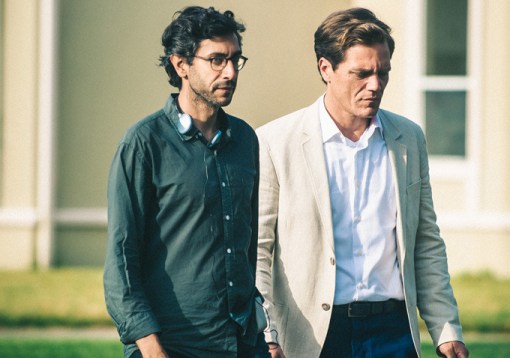
Ramin Bahrani & Michael Shannon 99 Homes

A lot of these movies have also used a “bad apples” framework to depict corporate executives, which condemns individuals like Gordon Gekko but not necessarily the system of power that enables them.  But in 99 Homes, it’s not just Rick Carver we should hate – it’s the entire system, which he points out is completely rigged.  How important was it for you to have him shine a light on macro level corruption?

The real heavy in any situation is a system – it’s not just one person. There can only be so many Iagos. Otherwise, you’ve just been begotten by the system you live in.

It’s not like real estate brokers as children told their parents, “I can’t wait to grow up and evict people.” Nobody had that dream. Nobody had the dream to be an executioner in a prison, but we live in a country that has capital punishment. We live in a country that is so rigged that these guys’ jobs became doing these foreclosures.

And if Shannon [who plays real estate agent Rick Carver] didn’t do it, somebody else would. And that would mean he’d be out of a job. Out of a job means no money. No money means no rent. No rent means he and his family move into a motel.

For me, the real villain is the system, and Michael is just a product of it. As they say in the nighttime scene on the dock, my favorite scene, Michael is talking about how he carries a gun even at 5 A.M. He’s looking over his shoulder all the time. Andrew says, “Is it worth it?” And Michael says, “As opposed to what?” And that’s the question of the film. As opposed to what? What else are you supposed to do?

You developed this movie, I presume, in 2012?                  

Yeah, I started working on the research in 2012 and 2013, then we shot in 2014.

You’re pushing it out to the majority of your audience in 2015.  Do you think all that time away from the film’s events has affected the way people respond to the film – I can certainly think of a very prominent real estate mogul who loves separating America into “winners” and “losers” and is keeps Rick Carver all too relevant?

Yeah, I know. In fact, Michael talks about Donald Trump in the film. He calls Andrew “Donald Trump” at one point in the film, and now a bunch of critics and audiences are saying, “My god, he sounds just like Donald Trump!” And it’s true, he talks about winners and losers.

We live in a country where, in elementary school, they plant the flagpole on the playground. At the top of the flag, it says SUCCESS. Winners. And from there on all the way to the bottom, it’s losers. It just doesn’t make much sense.

Characters like Trump, which I hope to God – Donald Trump, if you’re listening, WATCH THIS FILM! That kind of figure starts to get attention from people because they’re hungry. Because things aren’t working, and when things aren’t working, you start to fall into line with language like that. You start to look for people to blame. Extreme wealth inequality is only going to give rise to that kind of vitriolic language.

I hope everyone goes to see this movie, especially Donald Trump.

[chuckles] Put it down, he’ll go see it maybe!
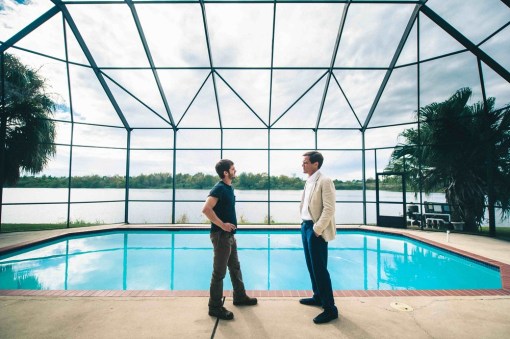
Michael Shannon Andrew Garfield 99 Homes

“99 Homes” is now available to purchase and rent on home video.


REVIEW: Hail, Caesar!

8 02 2016

Hail CaesarThe kind of auteurism favored by most today places a high priority on repeated patterns and frameworks within a director’s body of work. I, however, tend to prefer filmmakers who can produce a consistency of mood, tone and experience without ever allowing themselves to be easily pinned down. There is perhaps no better example of this than Joel and Ethan Coen, the writing, directing and editing duo who can bounce across genres and budget sizes without skipping a beat.

Audiences most recognize the Coen Brothers for their trademark deadpan wit, with perhaps a little more emphasis on the “dead” part. They may well hold court as America’s greatest living ironists. In fact, their gifts in this realm are so well established that just seeing their names on a film imbues the proceedings with dramatic irony. Anyone who knows the Coens and their tendencies likely recognizes that the journey of the characters will not be determined by their own actions so much as it will be guided by their cosmic fate.

The brothers’ latest outing, “Hail, Caesar!,” bears many of their hallmarks. The dry humor begins with protagonist Edward Mannix (Josh Brolin) doing his best efforts at a confessional and scarcely lets up for an hour and 45 minutes. But underneath all the laughter, a very serious undercurrent of sacrifice, redemption and salvation runs resolutely. More than ever, the poker-faced Coen Brothers are tough to read. Mind you, these are the guys who got an Oscar nomination for Best Adapted Screenplay in 2000 for turning Homer’s “The Odyssey” into “O Brother, Where Art Thou?” – and have claimed for 15 years now that they have not read the source text.

Where a gag ends and profundity begins provides the primary friction in “Hail, Caesar!” Their very interconnected nature seems to be the point of the film itself, and finding that point of intersection proves to be a joyous puzzle. It begins in each episodic scene as Mannix, studio head at Capitol Pictures, puts out fire after fire on the backlot for his pampered stars. This structure allows the Coens to dabble in the Golden Age of westerns, sword-and-sandals epics and musicals in both the Busby Berkley and Gene Kelly style. To call these a love letter to post-WWII Hollywood feels a little strong, but to declare it a satire or lampooning of the era’s excesses hardly feels appropriate either.

Read the rest of this entry »


REVIEW: Son of a Gun

7 02 2016

Son of a GunSon of a Gun” is a film about…

Well, actually, I’m not sure I can finish that sentence honestly. Julius Avery’s film is not really “about” anything. It’s yet another installment in a type of cinema that I call “things happening to people.” These types of movies are not automatically or categorically bad, but they are the cinematic equivalent of the simple sentence. They have the bare minimum necessary to get by and cohere. Any complexity beyond that is absent.

I could imagine a film where the journey of Brenton Thwaites’ JR is compelling like “A Prophet” or “Starred Up.” Both feature young men who enter prison with little to no affiliation or grounding and carve out a unique place in its social infrastructure. JR falls in with Ewan McGregor’s Brendan Lynch and quickly gets in far over his head, particularly once he exits the facility and faces expectations of continuing his role in their criminal enterprises.

But “Son of a Gun” mostly just watches as JR moves from scene to scene like the alphabet proceeds from A to Z. Avery adds none of the features – strong characterization, thematic heft or virtuosic artistry – that can elevate a “things happening to people” movie. The film does have some nice chemistry between Thwaites and Alicia Vikander’s Tasha, a path for his redemption. But otherwise, it’s less watchable and more just passable. B- 2stars


REVIEW: Love

6 02 2016

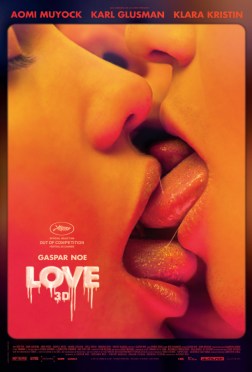
LoveWith an all-encompassing title like “Love,” one could expect Gaspar Noe to probe many different forms of love. The provocateur does explore many types of sex, but they all come back to one specific kind of a love – if one even wants to call it that. The film is little more than a collection of straight white American male fantasies, like an artful cobbling together of pornographic myths that dispenses with their artifice but maintains most of their misogyny.

“Love” follows the sexcapades of Karl Glusman’s Murphy, an American wannabe filmmaker living in Paris – presumptively because of the more libertine sexual attitudes. He loves fetishizing the openness of European women to meet all his carnal desire, be they in a three-way or at a public orgy. Noe frames most of Murphy’s debauchery in elegiac flashbacks to his penetrative glory days; not unlike “The Tree of Life,” he yearns for a paradise lost.

Murphy’s current misery is that he is unwittingly trapped in fatherhood after a broken condom during casual sex. Of course, it’s not with the woman he truly desires. Murphy happily embraces sex when it stimulates him but bemoans the act when it produces what is designed to do: produce a child. This shift in his view of sex also indicates a change in the way he sees women. They are wonderful when they only have to worry about being pleasure-makers but are nagging, cruel shrews once their focus shifts to their offspring.

Read the rest of this entry »


REVIEW: A Walk in the Woods

5 02 2016

In this media-saturated age, most of us go out of our way to avoid watching commercials. So it says something that during “A Walk in the Woods,” I found myself wishing I was watching a commercial. Specifically the Nick Offerman REI one slyly embedded into the film as “plot” but is merely product placement.

Otherwise, the film is as rough and unpleasant a slog as I imagine walking the Appalachian Trail would be. “A Walk in the Woods” repurposes “Wild” for the AARP crowd, giving the aging Baby Boomers played by Robert Redford and Nick Nolte a chance to hit the trails for one big mettle-proving hurrah. Redford’s Bill Bryson is a travel writer yet to explore his home country, while Nolte’s Stephen Katz is the one acquaintance he could snag to tag along.

Neither the estranged quasi-friends nor the difficulty of nature angle prove exciting in the film. In fact, their toughest battle with nature is so blatantly shot against a green-screen that it throws the authenticity of the entire film into question. It’s all predictable banter, predictable challenges and predictable outcomes. If people criticize actors like Robert DeNiro and Al Pacino for taking bad comedy roles to pay the bills in their twilight years, “A Walk in the Woods” demonstrates that they ought to include Redford and Nolte when casting stones. C2stars


F.I.L.M. of the Week (February 4, 2016)

4 02 2016

Medicine for MelancholyMost romances focus on the passion, the heat, the sparks and the sweet nothings. Barry Jenkins’ “Medicine for Melancholy” is not a typical romance. In an effort to seek out diverse voices in filmmaking, I stumbled into this 2009 film. Jenkins is only just now finishing up his follow-up feature, “Moonlight,” set up for production and distribution by A24. How it took 7 years for someone to give him a second chance in the director’s chair is unfathomable to me. (Well, actually, I have some idea why…)

My pick for the “F.I.L.M. of the Week” (First-Class, Independent Little-Seen Movie) is far more concerned with the silence between its would-be lovers. After a one-night stand, Micah (Wyatt Cenac) and Jo (Tracey Higgins) are simply not at the comfort level to carry out long conversations. They feel a connection, though neither is quite sure what it means or how to consummate that potential beyond physical intimacy. Picture a more awkward, grounded “Before” series.

But Higgins has more on his mind that doing a good Linklater knock-off. His film has flashes of Godard in technique and strategically uses color in a clever way that recalls “Pleasantville.” He also engages deeply with the political, not just the personal. The ambling about in “Medicine for Melancholy” takes place in San Francisco – and not the flashy ideal put forth in “Full House” or the one that gets destroyed in just about every action movie. Jenkins stares its gentrification issues plain in the face, even veering a bit into didacticism to get his point across. The conditions of inequality in the city are as much an issue for Micah and Jo as anything in their personalities.

As Todd Haynes said last year when promoting “Carol,” “Love stories need to have these obstacles between the lovers, or there’s no conflict or yearning.” Jenkins’ delicate handling of both the micro and macro level problems makes “Medicine for Melancholy” a truly magnificent love story indeed. The balance between the beauty of the pair’s flame and the ugliness of society makes the film memorable and impactful.


REVIEW: Rams

3 02 2016

RamsWondering what a film from Iceland has to offer someone in America? Quite a bit, actually. Though the world of sheep farming might be something most of us only think about in December when it comes time to hear the Christmas story, Grímur Hákonarson stages a wonderfully contemplative drama in this space with his film “Rams.”

Events occur less like a traditional causal plot and more like a parable, with each step shining a spotlight on a difficult moral quandry. Gummi (Sigurður Sigurjónsson) is just an ordinary man tending to his sheep who lets his worst angels briefly overtake his better ones. Resentment over his prize ram losing a competition leads him to snoop around the pen of his rival and discover something suspicious. But what looks like cheating was actually scrapie, a destructive virus, with ramifications affecting the entire community.

Hákonarson’s direction, both drolly humorous and poignantly dramatic, provides plenty of moments to take the pulse of “Rams” as it unfolds. We can watch the events take their toll on Gummi as his idle gossiping forces massive reckonings with forces he long kept submerged, including his estranged brother Kiddi (Theodór Júlíusson). Even amidst the familiarity of such a small rural community, he also struggles with the obligation to his beloved sheep – who he might love more than his fellow humans.

And because the film is so grounded in the specifics of Gummi’s experience, “Rams” resonates on a scale that transcends national borders. Hákonarson has his finger on many an important lesson surrounding jealousy, pride and familial obligation. They are more than worth reading the subtitles to glean. B+3stars