F.I.L.M. of the Week (January 7, 2016)

7 01 2016

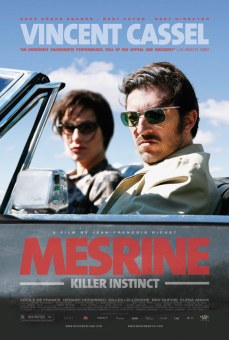
Mesrine Killer InstinctIt’s common to attribute all the attributes of high-octane, adrenaline-pumping cinema to the “Hollywood” style, as if big studios are the only entities capable of producing great action thrillers. But great classical genre films can came from anywhere in the world. Case in point: the French crime saga “Mesrine,” broken up into “Killer Instinct” (part 1) and “Public Enemy #1” (part 2).

These films may not rise to the standard of high art that normally defines my “F.I.L.M. of the Week” column, but I think it’s important to spotlight the many varieties of international cinema. Believe it or not, France has more to offer than austere Godard works or quirky Ozon films. They have people like Jean-François Richet, director of the “Mesrine” films, too! This is about as slick and thrilling as entertainment comes.

The movie makes a great showcase for Vincent Cassel, who stars as titular gangster Jacques Mesrine. After becoming disillusioned by France’s loss in the Algerian War, the ex-soldier enters the world of organized crime and quickly becomes a Pacino-like figure on the international circuit. Compared to some other recent mob movies (COUGH, “Black Mass“), Mesrine is always captivating to observe. He’s a man defined by his confidence, which earns him great success until it becomes the hubris that leads to his ruin.

When Cassel acts in English-language movies, he struggles to shed his thick French accent. That is not a knock against him, and it even served him well in “Black Swan.” But, often times, the cadences distract from the dialogue because it is so pronounced. In “Mesrine,” speaking in his native language, Cassel seems more comfortable and relaxed to act to his full capability. He sure does own the screen here.


REVIEW: What Happened, Miss Simone?

6 01 2016

What Happened, Miss Simone?In 2008, I was captivated by the trailer for “Revolutionary Road,” due in large part to the music chosen to augment its effect: Nina Simone’s “Wild is The Wind.” Ever since then, I have continually returned to her work when I am in need of haunting by art. Her raspy, husky serenading has an effect unmatched by any performing today.

The continual problem with art about artists is that the new work always has to measure up to that of the subject. Such is the case of Liz Garbus’ documentary “What Happened, Miss Simone?” It’s an informative look at this singular blues singer through the lens of her art, politics and personality. But does anything in Garbus’ narrative come close to approximating the raw power of just absorbing one of Simone’s songs? The answer there is no.

In a way, the film’s shortcomings are foreshadowed in its title. Garbus is preoccupied with the “what” of Simone, dutifully tracing a chronological story of her life from cradle to grave. “What Happened, Miss Simone?” is practically her Wikipedia page as a movie, with the occasional click away to events or personalities with which she frequently interacted. The film stays fairly surface-level throughout, never really interrogating the art or the society that spawned it. I so craved a foray into the “who” or the “why” questions that her music raises. Guess I’ll just have to keep listening there to find the answers. B2halfstars


Random Factoid #580

5 01 2016

Given that North Korea may or may not have detonated a hydrogen bomb, I figured it was about time for this anecdote.

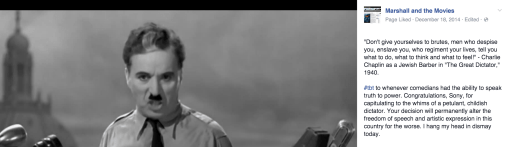
Back in December 2014, I was not afraid to get on my soapbox and decry what appeared to be cowardice in the face of a pernicious threat to free speech. In the wake of the Sony hack that nearly cancelled the release of “The Interview,” I even invoked Charlie Chaplin’s “The Great Dictator” to express my disgust.

Trying to walk and not just talk, I immediately purchased tickets for the first Houston show once Sony rescheduled it for release. I even made the purchase confirmation my cover photo.

Longtime readers of this blog, or personal friends, are likely aware of my predilection for holding onto movie ticket stubs. I have made no secret of this collection, even making it the subject of my first random factoid back in July 2009. So surely the ticket stub for “The Interview” holds a treasured spot in the folder, right? Seeing a movie has rarely been such a political act.

Well, if that’s what you thought, you thought wrong. I left arguably the most important ticket in my collection at the theater. Since Alamo Drafthouse requires that stubs be placed on the table in front of the seat, for whatever reason, I simply walked off without it. Normally, I slide the stub into my wallet after it gets ripped. But in this case, I forgot it. Driving home, I realized what I had done. This pretty much summarized my mood:

tumblr_m3yjrgDA1t1qar5tro10_r1_1280


REVIEW: The Treasure

4 01 2016

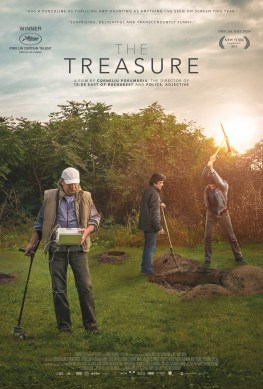
The Treasure posterNew York Film Festival, 2015

The financial collapse of 2008 might have originated in the United States, but it triggered a truly global recession. As in most instances of art reflecting life, the narratives we consume mostly resemble our own. Since these kinds of tales are primarily relegated to the independent or art-house realms, they tend to reflect the composition of that audience: American, well-educated, upper-middle class.

Yet it is fascinating to peer into how other cultures deal with the fallout of the recession through art. Admittedly, these require some intense seeking out, but Corneliu Porumboiu’s Romanian wonder “The Treasure” is worth all the effort. His film is not one that overtly grapples with the recession like, say, the Dardennes’ “Two Days, One Night,” but it nonetheless provides a fascinating setting for the events that unfold.

Cuzin Toma’s Costi is weathering the storm along with many working-class Romanians, though he is far from resigned to his fate. When his zany neighbor Adrian (Adrian Purcarescu) stops by with a get-rich-quick scheme, Costi is all ears. This plan, however, is far from the average hair-brained antics that have claimed the dignity of many a great film character. Adrian lets Costi in on a family secret about a buried treasure out in the countryside that he needs help excavating and unearthing. The job requires not only manpower but also an element of stealth as the Romanian authorities could seize its contents.

Adrian needs the riches to pay off a bad mortgage stemming from the financial meltdown. Costi could use a little extra money to support his family, and with Adrian offering a generous 50-50 split, he loses very little time yet has great rewards to gain. So the two set off, metal detector and all, to locate this buried bounty.

Read the rest of this entry »


REVIEW: The Riot Club

3 01 2016

The Riot Club“I am sick to [expletive] death of poor people,” exclaims Sam Claflin’s Alistair Ryle as he tops off a liquor-powered rant during a madcap evening of debauchery. It’s perhaps the most obvious moment in Lone Scherfig’s”The Riot Club” where pointed satire and heightened drama become so blurred that they are practically indistinguishable. But the film is chock full of such instances where the unbelievable and the believable intersect, making its vanguard of posh college-aged British males both entertaining and odious.

The sharpness of its social commentary is no doubt related to the story’s origins on the stage; Laura Wade adapts her own play for the screen. At times, the roots show as easily half the film transpires in one protracted scene at a single location. While this might count as a liability for many movies, it actually comes out as a net positive for “The Riot Club.” Once this long dinner gets set up, the focus can remain solely on the words and how they express simmering tensions as well as larger themes.

The film proves plenty interesting leading up to this climactic reckoning, too. “The Riot Club” begins as a tale of two aristocratic young men, in many ways foils for each other. Claflin’s Alistair enters Oxford as entitled as they come, though without the protection of his older brother on campus, he begins somewhat sheepishly. Max Irons’ Miles Richards, however, seems to draw out the smugness in Alistair with his laissez-faire attitude towards the nobility he can expect to claim with his social status.

Read the rest of this entry »


REVIEW: Mustang

2 01 2016

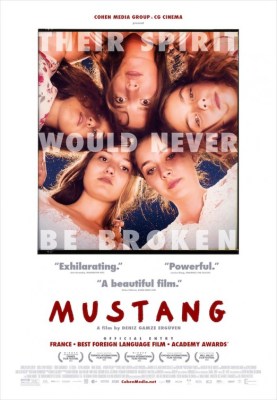
MustangDeniz Gamze Ergüyen’s “Mustang” tells the story of five orphaned sisters trying to girls when the societal forces around them are conspiring to turn them into women. In their oppressively provincial Turkish town, the overwhelming sentiment becomes that each sister needs to be married off for their own sake. After a harmless incident with some local boys, their reputation could forever become that of harlots if not wrangled into polite deference.

Ergüyen, along with co-writer Alice Winocour, nicely illustrate just how old-fashioned assumptions and attitudes towards women are in the girls’ milieu. Be it voices on the radio demonizing working mothers or the concept that a legitimate punishment for a soccer team could involve playing a game in front of a solely female crowd, misogyny abounds in their northern Turkey community. With all due respect to “Mad Max: Fury Road,” I think “Mustang” may just be the 2015 release that best exposes the stifling hegemony of patriarchal power.

Perhaps it is just the nature of reading subtitles, but these larger structures and institutions limiting the sisters feel presented with very little subtlety. The sexism and outdated customs become so obvious that it makes their rebellion a rather obvious development. They also take up so much attention throughout “Mustang” that it depersonalizes the girls, making them better as instruments to illuminate important themes than as deeply realized human characters. B2halfstars


LISTFUL THINKING: Most Anticipated Movies of 2016

1 01 2016

Well, guess it’s time to cast my gaze towards the horizon and start looking forward to a new year of moviegoing! I’ve slowly gotten better at making these lists, with more and more movies making it on my year-end top 10 list. 2015 was a bit of an anomaly as so many films got pushed back to 2016 – four out of the ten I picked last year will hopefully see release in the next twelve months.

In that period, some of my enthusiasm has dampened for “Everybody Wants Some” (then titled “That’s What I’m Talking About”), “Knight of Cups” and “Midnight Special.” But one title remains, and absence makes the heart grow fonder.

This year’s slate of most anticipated films feels rather odd, as there’s very little I’m crazily expecting. With relatively few of my favorite directors and series churning out work in 2016, I’m left grabbing at straws. Nonetheless, here are ten films that I’m very ready to see!

American Honey

#10
“American Honey” (TBD)
Written and directed by Andrea Arnold
Starring Shia LaBeouf, Arielle Holmes and Riley Keough

After “Fish Tank,” I’m on board to see whatever Andrea Arnold comes up with next. She’s one of the most vital voices working in film today, not only for females but also just in general. I really have no idea what the film is about, and I don’t want to know.

Brad Pitt:Marion Cotillard

#9
Untitled WWII Romantic Thriller (November 23)
Directed by Robert Zemeckis
Written by Steven Knight
Starring Brad Pitt and Marion Cotillard

This team speaks for itself. I could care less that the casting isn’t even complete.

Passengers

#8
“Passengers” (December 21)
Directed by Morten Tyldum
Written by Jon Spaihts
Starring Jennifer Lawrence, Chris Pratt and Michael Sheen

If there was no Jennifer Lawrence movie for me to look forward to, would the year be worth undergoing?

Fantastic Beasts

#7
“Fantastic Beasts and Where to Find Them” (November 18)
Directed by David Yates
Written by J.K. Rowling
Starring Eddie Redmayne, Ezra Miller and Katherine Waterston

Ready to geek out over “Harry Potter” again, and it hasn’t even been five years since the last one. No shame.

The Girl on the Train

#6
“The Girl on the Train” (October 7)
Directed by Tate Taylor
Written by Erin Cressida Wilson
Starring Emily Blunt, Rebecca Ferguson and Haley Bennett

Admittedly, I thought the hype on last summer’s big book was a bit overblown. But I’m still excited to see how this team translates the story into cinema; my imagination often wandered towards I might realize this thriller on the big screen. Can’t wait to compare my ideas with their visions.
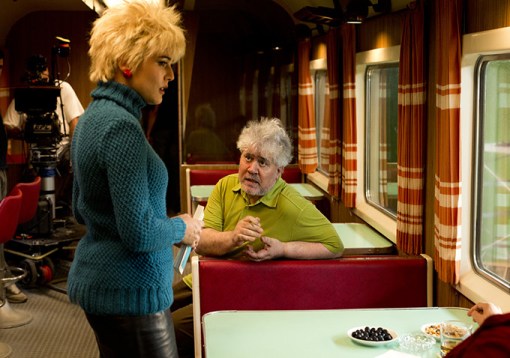
Julieta

#5
“Julieta” (TBD)
Written and directed by Pedro Almodóvar
Starring Adriana Ugarte and Emma Suárez

Even when playing in minor key, a new Almodóvar film is always interesting. Returning to his favored territory, stories about women, might provide his best since 2006’s “Volver.”
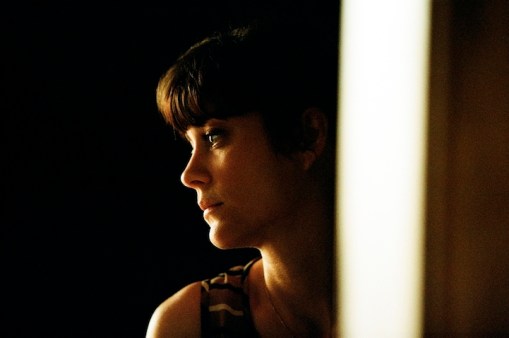
It's Only the End of the World

#4
“It’s Only the End of the World”
Written and directed by Xavier Dolan
Starring Léa Seydoux, Marion Cotillard, and Vincent Cassel

I am SO ready to see Xavier Dolan, the exciting emerging talent of the decade, tackle his first movie with global stars. That one such star is Marion Cotillard only amplifies my excitement.

Hail Ceasar

#3
“Hail, Caesar!” (February 5)
Written and directed by Joel and Ethan Coen
Starring George Clooney, Scarlett Johansson and Channing Tatum

I’m ready for any new Coen Brothers movie, but this one sounds like something special. “It’s about the movie business and life and religion and faith. Faith and the movie business,” Ethan said. Sounds like everything I could ever want from a movie and more.

La La Land

#2
“La La Land” (July 15)
Written and directed by Damien Chazelle
Starring Ryan Gosling, Emma Stone and Finn Wittrock

Chazelle’s follow-up to “Whiplash” was going to be exciting enough. He sweetened the deal by making it a musical that reunites the magnetic on-screen duo of Gosling and Stone.
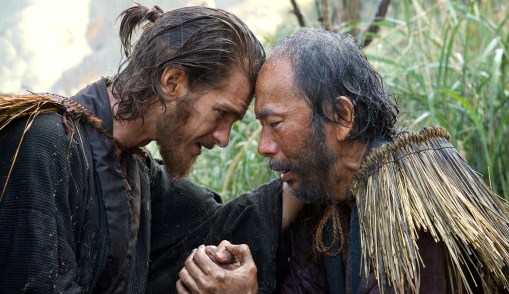
Silence

#1
“Silence” (TBD)
Directed by Martin Scorsese
Written by Jay Cocks
Starring Liam Neeson, Andrew Garfield, and Adam Driver

Last year’s #2, this year’s #1. I truly cannot wait to see the film that might be Scorsese’s ultimate statement on the religious themes that have pervaded his work for decades.


LISTFUL THINKING: Top 10 of 2015 (Individuals and Institutions)

31 12 2015

The end of the year has arrived once again in its typical fashion – surprising, jarring yet oddly welcome. On this occasion, per usual, it is time to celebrate 2015 in cinema. Thanks to a number of festivals as well as generous assistance from studio and regional publicists, I was able to see more movies than ever before. This year, the tally of 2015 releases alone soared to over 200. (I came so close to reviewing them all … but would rather provide well-considered commentary instead of rushing to meet an arbitrarily imposed deadline.)

When I sat down to pen my first top 10 list back in 2009, I doubt I had even seen 100 films, so the list represented roughly the top 10% of my year. With 2015’s edition showcasing less than 5%, I feel obliged to at least mention 10 other films that left an indelible mark on me this year but, for whatever reason, fell outside the upper echelon. These, too, are worthy of your time and attention. In alphabetical order, they are:

But the ten films that stood out above the rest this year all had one thing in common: they looked beyond their characters and plots towards larger, more difficult concepts to capture. Each in their own way spotlighted (pun fully intended) an institution or a system that guides, influences and even inhibits the actions that take place. I make no secret that my two fields of study in college were film studies and sociology, and to have such an exciting slate of movies that evinces how the former can shed light on the latter was a source of great joy (again, pun fully intended) throughout 2015.

Remarkably, each work never lost sight of the individual personalities that power our emotional engagement. The human element never detracts from the issues at hand, instead providing an entry point to ponder impersonal or intangible forces. In an era where television provides a depth of coverage that has become tough to rival, these films found power in a concentrated bursts of content where every second was carefully and wonderfully calibrated.

So, without further ado, here are my ten favorite films of 2015 along with the individuals and institutions featured within them.

Read the rest of this entry »


REVIEW: Sicario

30 12 2015

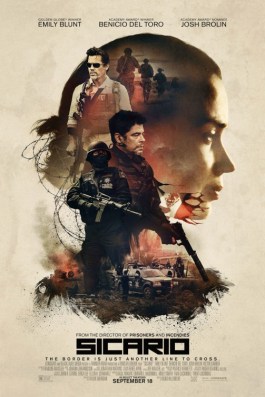
SicarioIn Denis Villeneuve’s “Sicario,” the border is not a mere setting. It is the very subject of the film.

And not just the U.S.-Mexico border, either. Of course, that line serves as a shorthand for a number of the film’s dialectical battles: chaos vs. order, civility vs. barbarism, domestic vs. foreign. But none of these provide any easy demarcations like the fence does; these divisions prove far more permeable.

The uncertainty, and even dread, that comes with such free exchange gets echoed in every aspect of “Sicario.” It starts in the script and gets amplified in the direction, the acting and even the photography. Cinematographer Roger Deakins tells the story primarily through two contrasting shots: hovering aerial landscapes and tightly-held close-ups. The first showcases a vast, unfeeling terrain that dwarfs all human activity. The second, though a smaller canvas, provides an equally robust commentary on the men and woman traversing the territory.

Though mere chess pieces in a much larger board game, the minute details of how each characters processes information and suppresses emotions provide a second layer of story running throughout “Sicario.” No face receives more attention than that of Emily Blunt, who plays the film’s protagonist, FBI agent Kate Macer. Practically every scene in the film happens twice, first as it unfolds and then again as reflected through Kate’s face.

Blunt’s performance is screen acting at its finest. Villeneuve and Deakins maximize ability of the camera to pick up the smallest of twitches and motions, which might otherwise be imperceptible to the naked eye. Rarely has the quiver of a lip as it gulps down the smoke from a cigarette registered so much. Blunt makes her character the farthest thing from a blank slate, ensuring that each infinitesimal shift of her face reveals her fast-racing mind. To that end, Kate’s big, explosive scene unfolds in a shot taken from a great distance where her emotions remain obscured. She’s a compass, steadfast but still a little shaky.

Read the rest of this entry »


REVIEW: Steve Jobs

27 12 2015

I have no qualms in saying that, in high school, the discovery of Aaron Sorkin’s writing completely changed the way I thought about how people could talk in fiction. Here were characters that spoke with purpose in every line, both illuminating their inner thought process and highlighting the themes of the work. (If you doubt its influence, just read the play I wrote my senior year that falls somewhere between a love letter to and ripoff of Sorkin.)

The more I rewatch “The Social Network,” however, the more I realize that the heft of the content is the real star of that script. The delivery in “Sorkinese” – as many have come to call it – serves to enhance, not replace, that treasure trove of insights into class, status and social structure in contemporary America. The hyperexpressive dialogue feels justified practically by the bulk of commentary that the characters must convey – and, remarkably, tomes are still left unsaid.

Sorkin’s latest script, “Steve Jobs” (adapted from Walter Isaacson’s authorized biography of the same name), narrows its focus from the revolutionizing of society to a man with the vision to spark such revolutions. As the man whose inventions shook up telephones, personal computing, animation, publishing and music, Jobs feels like a natural subject for Sorkin given his obsession with grandiloquent geniuses. Even his work on the script for 2011’s “Moneyball,” which praised the empirically driven philosophy of Oakland Athletics manager Billy Beane, evinces his fascination with people who innovate in spite of steep institutional pressure to maintain an inefficient status quo.

Yet, at the same time, choosing Jobs as someone to speak Sorkinese fluently smells a bit like a man trying to cast God in his own image – and not the other way around. The stylized dialogue flies rapidly in “Steve Jobs,” which is not entirely dissimilar from “The Social Network.” But here, the metaphors and arcane cultural references are delivered in a continual walk-and-talk, not in such visibly formal settings.

Sorkin chooses to stage his drama within the confines of a backstage drama (as opposed to the courtroom drama of Zuckerberg’s saga), a style which generally portrays characters with their guards down and speaking with their guards down. Jobs was undoubtedly smart enough to talk as Fassbender’s portrayal of him does, though it feels somewhat stilted and artificial.

Read the rest of this entry »


REVIEW: 45 Years

26 12 2015

45 YearsAndrew Haigh’s “45 Years” provided me a joyously maddening experience the likes of which I can honestly say I don’t think I had felt since “The Wolf of Wall Street” back in 2013. As these movies rolled into their conclusion, I thought I had completely made up my mind about them after seeing a relatively homogenous product throughout.

Then, a brilliant final shot flashes before the credits, and I am left reeling. Given a new picture with which to reframe everything, I have no choice but to dwell on it much longer than I had anticipated. Haigh’s film has the benefit of being literally half the length of Scorsese’s, so the bait-and-switch feels a little less frustrating. But what to make of a film that feels relatively monotone for 90 minutes only to crescendo out of the blue?

I don’t think this qualifies as a “spoiler” to discuss the close of “45 Years” so heavily; this stunning shot is not any kind of plot twist. It simply casts the rest of the film’s events in a much different light, and it does so with forceful impact.

Most of “45 Years” unfolds like a chamber play between the greying Mercer couple, Kate (Charlotte Rampling) and Geoff (Tom Courtenay). His declining health prompts the celebration of their anniversary at a rather odd interval – the 45th year – and things only getting stranger with a bombshell revelation that comes in the post the week of the event. This news, seemingly simple, sends shockwaves through their long marriage that have profound, lasting implications.

The inciting event is nothing too spectacular or far-fetched, and it only serves to inspire a muted, grounded reaction from the principal cast. Haigh stands back and lets the camera observe them taking in the ramifications. This has a particularly haunting effect when following Rampling, whose character recalls Jimmy Stewart’s Scottie from “Vertigo” in her determined wandering. The tone gets established early and remains consistent throughout, almost allowing the film to lull the viewer into a certain complacency…

…only to receive the jolt of the final shot, carried by Rampling in an extraordinarily devastating fashion. I feel like I could watch this scene on YouTube again and again, and part of me wonders how much I really need the hour-and-a-half vamp of “45 Years” to receive the gut punch at the same strength. B+3stars


REVIEW: The Mend

25 12 2015

The MendMovies that toy around with genre, tone and mood rarely sit well with me. (Uneven is my choice word for such experiences.) Occasionally, such experiments work, and I am more than happy to garner lavish praises on films that do. The vast majority, however, are just scripts with issues that needed fixing prior to cameras rolling.
Writer/director John Magary’s “The Mend,” on the other hand, is a film trying its hand in a number of different styles not to see how well they can blend. Rather, Magary attempts to see how porous the borders are between genres. He looks less for fluidity and more for malleability.

“The Mend” starts off like a literate Baumbach comedy both celebrating and mocking the New York intelligentsia. Once it seems settled, the film shifts into the character study of a slacker, Josh Lucas’ hapless Mat. This is the first movie I can think of that subverts Lucas’ good looks, not using them as an easy signifier for success or good favor. He’s all the better for it, drawing on darker parts of his persona to bring a more abrasive character to life.

Mat leeches off the success of his brother Alan (Stephen Plunkett), whose material successes continually attract the presence of his semi-estranged sibling. Tensions ratchet up slowly between the two of them, eventually reaching a boiling point in Alan’s cramped apartment. The explosion feels like something out of an Edward Albee play.

Does this mixture always work? Not necessarily. Certain sections are more compelling than others, making “The Mend” somewhat akin to that New York cabbie who alternates rapidly between the gas and the brakes. It’s a memorable ride – though definitely one that could have been a little smoother. B2halfstars


Social Scientists Behaving Badly (REVIEWS: The Stanford Prison Experiment and Experimenter)

24 12 2015

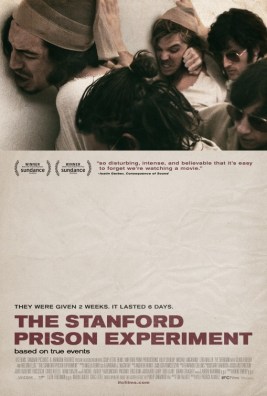
The Stanford Prison ExperimentIn my first semester of college, I took an introductory sociology class on a whim and wound up loving it so much that I added fifteen additional hours to my schedule to make it my second major. Ironically, in my final semester of college, two infamous experiments in the field of social science that captivated me in that first class made their way to the big screen.
Both premiered at the 2015 Sundance Film Festival, garnered respectable reviews and picked up distribution from heavy-hitting indie distributors. Though I’m reviewing them in tandem because the opportunity was too good to pass up, that’s pretty much where the similarities end.

Kyle Patrick Alvarez’s “The Stanford Prison Experiment” depicts a study in which professor Philip Zimbardo (Billy Crudup) threw college students looking for a little extra cash into a staged environment deemed unethical by most in his field. The assignment was simple: in a lab-created prison, each received an assignment of prisoner or guard which they were to act out. To say they began to take these roles a little bit too seriously is the understatement of the century as harmless animosity spirals out of control into actual violence.

At one point during the experiment, a colleague interrogates Zimbardo and asks him what independent variable he was measuring – that is, what change he was hoping to observe in his study. Zimbardo does not have an answer, and it’s hard not to feel like the movie is similarly grasping at straws when it comes to what exactly the experiment was trying to examine. Beyond mere power relations and the willingness of humans to commit atrocities against each other, “The Stanford Prison Experiment” does little to illuminate the intellectual concepts that make its titular event worth studying to this day.

It abandons academia for entertainment which, admittedly, it does a very good job of providing. Though audiences may not feel the film’s ideas piercing their brain, they will likely feel the emotional impact of the solid turns from this extraordinary cast. People will no doubt look at “The Stanford Prison Experiment” like people today look at “The Outsiders,” seeing strong performances from rising male actors. If you haven’t already, remember these names – Ezra Miller, Tye Sheridan, Michael Angarano, Jack Kilmer, Thomas Mann, Johnny Simmons, Logan Miller, Keir Gilchrist, Ki Hong Lee – because it will not be the last you hear from them.

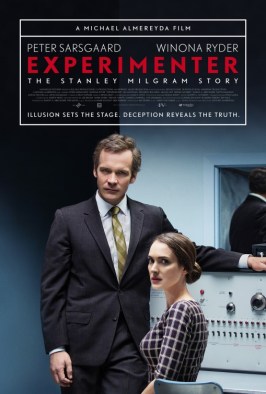
ExperimenterAlvarez would have done well to lean on the findings from the subject of Michael Almereyda’s “Experimenter,” Stanley Milgram. A social psychologist working at Yale in the 1960s, Milgram sought answers to how ordinary German people became complicit in the Nazi machine. In other words, he sought to find in science and data what Hannah Arendt described in theory as “the banality of evil.”

Almereyda’s film puts a heavy emphasis on process, using large chunks of the film’s beginning to detail just how Milgram (Peter Sarsgaard) went about obtaining his – pun fully intended – shocking findings. He meticulously devised an experiment in which an unsuspecting person would be asked to administer escalating electric shocks to someone else. No matter the pain that other person seemed to endure, the subject with the power to dole out the shock almost always continued if given the instruction to do so from an authority figure in the room.

Notoriously, Milgram was so horrified by the levels of obedience he found in America that he decided against testing his hypotheses in Germany. He controlled for any number of factors – the proximity of the person receiving the shock, the proximity of the authority figure in the experiment, even removing the subject from the setting of an academic laboratory. He got the same results nearly every time.

As a film, “Experimenter” loses a little luster with its less interesting forays into Milgram’s personal life and some didacticism. Milgram frequently breaks the fourth wall to go deeper into his findings, somewhat similarly to Frank Underwood in “House of Cards.” It starts off weird but eventually becomes normalized. Plus, Almereyda does plenty of showing the experiment that a little bit of telling to make sure no one misses the point feels fine.

But as a work about my other passion, social sciences, “Experimenter” reminds me of what I loved about the discipline. It celebrates the questioning of underlying assumptions we hold about social arrangements and then putting them to the test. I only wish it was around to show in a class or two when I was still in college. Hint to professors: this would make for a great Friday activity!

The Stanford Prison ExperimentB2halfstars
ExperimenterB+3stars


REVIEW: The Danish Girl

23 12 2015

In spite of the crusade by presidential candidate Donald Trump and his so-called “silent majority,” I still care about political correctness to the extent that it preserves the basic dignity of threatened groups. (Overreach is a separate conversation, however.) Words and language are powerful tools because they serves as outward reflections of inner ideas and beliefs. How society talks about a person as a part of the group with which they identify is important.

One such group that rightfully points out inadequacies in our vernacular is the transgender community. Many activists seek nothing less than the implosion of gender-based assumptions in the way we speak, a prospect as liberating for some people as it is uncomfortable for others. Every time it forces me to pause a little longer before speaking, I use that time to remind myself that these are above all people who just want the same respect to live their lives as any other person in society.

I try to stay on top of the latest developments in acceptable language – so this could be out of date – but the last I checked, it was a dubious practice to link anatomy to gender. (If this is no longer true, I welcome someone politely educating me.) Gender is a social construct, which may or may not correspond to a person’s biologically determined sex.

Tom Hooper’s “The Danish Girl” arrives in the heightened era of trans visibility; 2015 alone brought cultural prominence to Caitlyn Jenner, “Tangerine” and “Transparent.” The film tells the story of Eddie Redmayne’s transgender pioneer Lili Elbe, formerly Einar Wagener, as she seeks a then-radical surgery to remove the male organ that ties her to the sex she was given at birth. For someone so ahead of her time, it strikes me as rather ironic that the movie telling her story seems so behind its own time. Its assumptions surrounding gender and sexuality feel only slightly progressed from the 1930s setting.

Read the rest of this entry »


REVIEW: The Night Before

22 12 2015

If anyone is skeptical that our culture may be reaching a saturation of Christmas narratives, Jonathan Levine’s “The Night Before” ought to dispel that last shred of doubt. The film, co-written with Seth Rogen’s creative partners Evan Goldberg, Ariel Shaffir and Kyle Hunter, is a loving ode to just how much Americans love their holiday movies. The film pays homage to everything from “Home Alone” to “Elf” and even “Die Hard” during a crazy Christmas Eve shared by three old friends.

The Christmas movie appreciation leaks into the very fabric of the script, a half-baked attempt at making a stoner version of Dickens’ classic “A Christmas Carol.” (And with a bit of “It’s A Wonderful Life” as a cherry on top, to boot.) Only, instead of following one character, “The Night Before” splinters into three separate narratives bundled together.

The film follows Seth Rogen’s soon-to-be new father Isaac, Anthony Mackie’s recently famed pro quarterback Chris and Joseph Gordon-Levitt’s hapless musician Ethan on what could be their last Yuletide celebration … and not just because each is lucky to survive the shenanigans. Each guy gets their hilarious moments with a very game supporting cast, especially Isaac’s unnaturally supportive expectant wife Betsy (Jillian Bell), streetwise bandit Rebecca (Ilana Glazer), Ethan’s straight-shooting ex Diana (Lizzy Caplan) as well as Sarah, a character so Mindy Kaling-esque she had to be played by Mindy Kaling.

The film plays to the strengths of its ensemble so well that it becomes hard to spite the movie providing little more than the good time such a cast portends. “The Night Before” does not add up to more than the sum of its parts, mostly because the fragmented narrative never quite coheres by the end. It’s good for a laugh, but those hoping for a new adult holiday classic to play after the kids go to bed should probably just go for a repeat viewing of “Bad Santa.” B2halfstars