REVIEW: White God

4 05 2015

White GodIn “White God,” co-writer/director Kornel Mundruzco pulls one of the most ingenious bait-and-switch act to shame bigots everywhere.  Though his film may have deep roots in the Hungarian sociopolitical situation, it speaks to any group anywhere who must endure oppression or marginalization.  (Which, last time I checked, is still pretty much everywhere.)

When seeking to gin up support for policies that disenfranchise groups, politicians and pundits often use coded language that persuades citizens that such people are less than human – or even animals.  Vitriol in Europe towards immigrant populations seeking favorable economic conditions is currently reaching somewhat of a fever pitch in the wake of austerity measures.  The United States hardly performs better in this regard, with a congressman explicitly comparing immigrants to dogs in a town hall and refusing to back down on his comments.

Mundruzco takes this brand of rhetoric and subverts it, turning the victims of discrimination in Hungary into characters who are literally subhuman: adorable, lovable dogs.  Hagen, the canine protagonist of “White God,” finds himself on the streets when the apathetic single father of his owner, Lili (Zsófia Psotta), chooses to throw him out of a car rather than pay a “mongrel” fee to keep a non-pure bred Hungarian dog.  Left to fend for himself, the good-natured pup gets hardened by the hatred directed his way.

Read the rest of this entry »


REVIEW: Ex Machina

3 05 2015

Ex MachinaEx Machina,” from writer/director Alex Garland, marks yet another fascinating entry into the technophobic science-fiction genre – or, at the very least, the film has a skeptical stance towards the beneficence of technical advances.  Over the course of a week, Domhnall Gleeson’s Caleb must determine whether a robot, Alicia Vikander’s Ava, can pass the Turing Test.  (For those who skipped “The Imitation Game,” that exam measures whether an artificially intelligent being can pass for a human.)

The deceptively simple set-up gets more complicated when factoring in Ava’s creator, Oscar Isaac’s Nathan.  An irascible genius in the mold of Mark Zuckerberg (at least how “The Social Network” portrayed him) crossed with the unsettling articulation of Nurse Ratched from “One Flew Over The Cuckoo’s Nest,” Nathan has little regard for standard operation procedure or tradition decorum.  He handpicks Caleb to administer the test under unorthodox conditions as well as tight supervision.

Given all these factors, “Ex Machina” becomes highly unnerving once events start taking a turn for the unexpected.  Not since Martin Scorsese’s “Shutter Island” five years ago has a film made me so distrusting of every character’s motives or uncertain of whether an event was actually happening.  Remarkably, Garland achieves this terror with little more than the basic building blocks of cinema: tight editing, controlled and sparse staging, crisp camerawork.

Read the rest of this entry »


REVIEW: Clouds of Sils Maria

2 05 2015

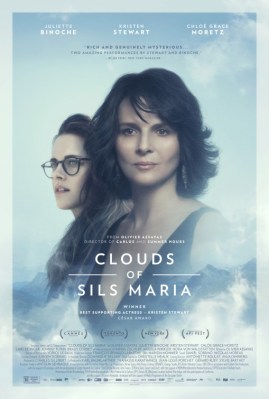
Clouds of Sils MariaBackstage-style dramas about actresses are common enough nowadays that an elided shorthand could almost certainly be employed to convey background information about the character in the spotlight.  In “Clouds of Sils Maria,” however, writer/director feels the need to relish the viewer with a whopping 36 minutes of exposition before getting to some real forward motion.

This gesture ushers in not only an aura of tedium but also an attitude of hubris.  Juliette Binoche’s Maria Enders, a star of stage and screen resisting a natural aging into a new generation of roles, is hardly a novel creation for cinema lovers.  Heck, just four days before the premiere of “Clouds of Sils Maria” in Cannes, David Cronenberg unveiled his “Maps to the Stars” with Julianne Moore playing an actress in an almost identical career conundrum!

Assayas’ film, on the whole, most closely resembles a Cannes competition entry from the year prior, though.  Like Roman Polanski’s “Venus in Fur,” much of the action (and inaction) consists of running through lines for an upcoming production and shifting imperceptibly in and out of character.  Maria, banishing herself to a Swiss mountain home with personal assistant Valentine (Kristen Stewart), must now get inside the headspace of the mother character in the play that made her famous for her interpretation of the daughter part.

The concept is certainly intriguing but is executed rather marginally.  Had the play “Maloja Snake” been real and not a fictional invention of Assayas, watching Maria struggle with the text might have been riveting.  Without a point of reference to the play, her verbal exercises benefit the character far more than the audience attempting to understand her.

Read the rest of this entry »


REVIEW: Lost River

1 05 2015

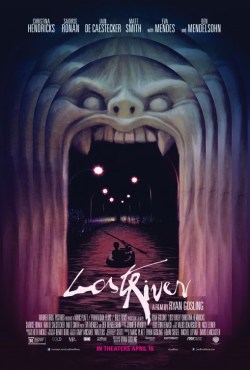
Lost RiverRyan Gosling’s directorial debut, “Lost River,” opens with a crooning Americana theme (“In the Still of the Night”) playing over alternating images of alternating suburban decency and urban decay in Detroit.  It might be the strongest sequence in the entire film – and definitely the most lucidly realized.

Gosling clearly aims for David Lynch and Nicolas Winding Refn (the DNA of disastrous “Only God Forgives” is obvious) but winds up in borderline nonsensical territory.  He has beautiful visuals and haunting soundscapes yet no discernible theme or thesis underlying the film.  “Incoherent” might be a little strong to describe the experience, but the images have the cohesion of a two-day-old bandage and the logical progression of a Tumblr feed.

“Lost River” also falters by introducing an aspect of magical realism into the proceedings.  Given that whatever semblance of a plot the film possesses takes place in a very real city of ruins, the ambience feels contradictory.  This reliance on mood becomes first obvious, then annoying, since it has to essentially replace story in the film.

The narrative is also rather fragmented, seemingly two short films layered over each other.  They have an obvious familial connection, as the protagonists are a mother and her son, but they go in wildly different directions.  Christina Hendrick’s matriarch Billy goes to work at a Club Silencio-esque joint to repay a loan, while young Bones (Ian de Caestecker) faces down a neighborhood criminal overlord Bully (Matt Smith) to protect his love interest, Rat (Saoirse Ronan).  Their struggles are supposedly illuminating the subconscious of the ghost town they inhabit, although I found them mostly illustrating the vacuous expanses of hipsterism.  C2stars


F.I.L.M. of the Week (April 30, 2015)

30 04 2015

A Touch of SinSadly, I missed Jia Zhangke’s “A Touch of Sin” when it screened at the 2013 Cannes Film Festival.  I caught up with the film recently from the comfort of my living room thanks to Netflix, though to just an audience of one.  What I would not give to go back and be able to experience this film with a crowd full of strangers – particularly the press screening at Cannes, which draws a diverse crowd from nations all over the globe.

The omnibus that is “A Touch of Sin” tells four stories of desperation and anger turned violent in modern China.  (And each has a real-life counterpart, to boot.)  Each explosion of rage triggers an odd mix of feelings, running the gamut from shock and disgust to schadenfreude and relief.  I would have loved to gather reactions by listening to the viewers during the screening and then stood out in the lobby to break down the responses by country.

But beyond a pseudo-social science experiment, “A Touch of Sin” still works well on an individual level.  These are not crazy vigilantes with a screw loose mentally – they are just mad as hell and not going to take it anymore.  Whether an average citizen who serves as a vocal critic of governmental abuse or a woman forced to endure constant demeaning by men, everyone has a reason for righteous anger.  Jia populates the film with a memorable cast of characters worth our attention and concern who also serve as surrogates for ourselves and the entire nation of China.

This is my pick for the “F.I.L.M. of the Week” because it manages to resonate on the personal and political wavelengths, at once specific and broad.  “A Touch of Sin” shows how the improperly, unsatisfyingly stitched social political and economic fabric of China can be ripped apart in one cathartic violent gesture.  Yet it’s easy to reimagine the action taking place in just about any country where inequalities based on wealth, power, and gender exist.  (Hint, hint, bold American filmmakers.)


REVIEW: My Life Directed by Nicolas Winding Refn

29 04 2015

My_Life_Directed_POSTER_FINAL_A_AIM.inddFor a while, I debated whether or not Liv Corfixen’s documentary “My Life Directed by Nicolas Winding Refn” merited a review on my blog.  Clocking in at 59 minutes, the film falls in the gray area between short and feature.  But given its interest to fans of “Drive” and haters of “Only God Forgives,” I figured I could spare a few hundred words for the sake of cinephilia.

After being put to sleep in Cannes by Refn’s critically reviled 2013 film, I described “Only God Forgives” as “a fetish meant only to please Refn and a few others who share his bizarre – and borderline irresponsible – penchant” while also claiming it lacked any internal logic.  This behind-the-scenes look at the filmmaking process, anchored by Refn’s wife, alerts us to the fact that Refn himself saw the trainwreck coming on set and found himself helpless to prevent it.

For the moviegoer, the film’s squandered opportunity represents a loss of 90 minutes and maybe a few dollars.  But for Refn, however, the flop of “Only God Forgives” jeopardizes his very livelihood.  I might have felt sorrow or pity for the director after “My Life Directed” had Corfixen allowed the documentary to function almost entirely as an apologia.  Yet she insists on using her footage as partial vindication for the project, a choice that makes her movie better and leaves his in stasis.

With the exception of its resigned and defeated (rather than triumphant) tone, “My Life Directed” more or less resembles a standard making-of special.  Since Refn allegedly would not let Corfixen shoot his blow-ups on set, it falters as a portrait of a director losing control of his film and as an autopsy of a failed filmmaking venture.  The film would make a decent Criterion Collection extra, if “Only God Forgives” were ever to get that treatment … though I do not think anyone expects that day to come.  C+2stars


REVIEW: Song One

28 04 2015

Song OneThere is really not too much to say about a film like Kate Barker-Froyland’s “Song One,” which seems to be the very definition of a film as trifle.  The story follows Anne Hathaway’s Franny as she tracks down a musician that her estranged brother intended to see, had he not fallen into a coma.  A forced romance with singer/songwriter on the brink, James Forester (Johnny Flynn), ensues, along with all the usual notes any film about grief and troubled families is supposed to hit.

“Song One” contains no notable screeches or strains, although it never makes a sweet sound either.  Barker-Froyland seems afraid to take a bold step and assert something unique about her film.  As a result, the movie becomes forgettable even as it is being consumed.

At this level of safe mediocrity, an actress like Anne Hathaway should be able to step in and effortlessly elevate the material.  Yet even her presence, a far cry from the raw torment she wore on her sleeves in “Rachel Getting Married,” cannot give this dull, dour ditty any character.  Like the rest of the movie, Hathaway is not actively bad, but the passively pedestrian “Song One” disappoints nonetheless.  C2stars


RiverRun 2015: the best (and worst) of the rest

27 04 2015

RRI wound up seeing 10 films (plus an archival screening of “The Wild Bunch”) at RiverRun, far more than I should have seen given how busy I was that week.  Was it all worth it?

Depends on what movie I was walking out of when you asked me the question.  There were some great films that I was glad to see, but there were also some rather miserable films.  Here’s a sampling of them both.

Stray Dog

Stray DogDebra Granik’s documentary “Stray Dog” follows biker and Vietnam veteran Ron “Stray Dog” Hall as he goes about his business in America’s heartland.  Granik throws us right into the action, providing no context or commentary to set the stage.  Her presence is never acknowledged and seldom felt throughout, making for a documentary essentially without a documentarian.

As a result, the film feels like a rather free-form portrait of salt of the earth americans like Stray Dog and his young Mexican wife Alicia.   Granik’s subject is just … there.  There is no need to provide standard documentary conventions like talking heads to provide information, though there ought to be something to approximate its effect.  Without anything to signal any importance in the proceedings, the film starts to feel like an interminable home video.

“Stray Dog,” all observation and no insight, might have been more aptly titled “Stray Narrative.”

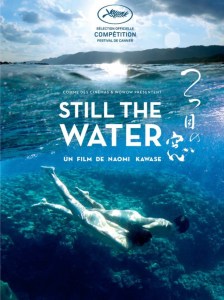
Still the Water

Still the WaterIn one of the first images in Richard Linklater’s “Boyhood,” a young Mason plays with the corpse of a bird in his backyard.  An audience of decent intelligence watching the film picks up on this symbol and intuits that it prompts the character to meditate on life and death.  No discussion, no line is necessary.

Naomi Kawase’s “Still the Water,” however, makes a two-hour film about what follows the discovery of a human corpse on a beach in Japan.  Its effect is largely measured through two teenage characters who begin to see the interconnectedness between life’s beginning and end.  Kyoko deals with the illness of her mother, while her boyfriend Kaito comes to grips with the separation of his parents.

The film mostly mills about as the unsteady couple trades empty philosophical musings amidst a beautifully shot landscape.  (Water as a metaphor?  Groundbreaking.)  Kawase’s direction is tender and sincere, to be sure, but it all goes to the service of a fairly banal story.

Welcome to Leith

Welcome to LeithA documentary like Michael Beach Nichols and Christopher K. Walker’s “Welcome to Leith” is the stuff of nightmares.  In a small North Dakota town, described by someone as “B-roll for ‘The Walking Dead,'” an aging neo-Nazi buys up parcels of property to attract his followers and gain civic influence.  And it’s not just any white supremacist, either; Craig Cobb was kicked out of countries as far-reaching as Estonia and is monitored by the Southern Poverty Law Center for leading hate groups.

Nichols and Walker document from both sides battling for the soul of the soil, resulting in a fascinating perspective on the events.  They begin with the conception of town’s denizens – all two dozen or so of them – as decent, humble, and rational people.  The residents of Leith basically consider the mayorship a “family business,” for heaven’s sake!

Watching Cobb and his cronies exact a toll from them makes for a tough watch.  Whether justified or not by the threats and vitriol lobbed their way, Leith’s citizens abandon the moral high ground to wrestle in the mud with those terrorizing their town.  After being pushed to the edge, they decide that the only way to fight insanity is with insanity – a choice likely influenced by the influx of attention on their municipality.

Gripping and downright terrifying, “Welcome to Leith” follows a volatile situation to the brink of explosion … and its impact cannot simply be shaken off by dismissing it as a movie.  This is reality, and even the most upright idealists cannot emerge from it unscathed and unbruised.

Yosemite

YosemiteJames Franco’s short story collection “Palo Alto Stories” has proven a very fertile source material for up-and-coming feature filmmakers.  Actually, that sentence should read, “Anything with James Franco’s name on it these days can find some financial backing and a few film festivals willing to exhibit the final product.”

Granted, the majority of indie projects Franco takes on possess sufficient quality, including Gia Coppola’s “Palo Alto.”  Gabrielle Demeestere’s take on Franco lore, “Yosemite,” is far less impressive.  This interlocking triptych of short stories offers a far less effective portrait of a fractured, disaffected suburbia than Coppola’s take on the material.

Much of Demeestere’s work on the film is solid, such as the precise sound design and attention to period detail.  She also draws three solid performances from the pre-pubescent boys leading the segments of “Yosemite.”  Where the film falters is in her patient, casual pacing.  Such a languid tone without sufficient payoff feels like quite a drag, especially because the normalcy observed along the way offers little accompanying profundity.  And do not even get me started on the painfully obvious mountain lion motif…


REVIEW: Manglehorn

26 04 2015

ManglehornRiverRun International Film Festival

Since hitting what most people would deem rock-bottom with the twofer of “Your Highness” and “The Sitter” in 2011, director David Gordon Green has rebounded with a tediously artful movie in “Prince Avalanche” and an intermittently brilliant movie in “Joe.”  His third film in the recovery, “Manglehorn,” falls somewhere in between those two poles.

Green, working with Al Pacino, gives the legendary actor what Bill Murray got in last year’s “St. Vincent” – a tender character study that highlights segments of the heart normally hidden from public view.  Although, to call “Manglehorn” a study implies something more academic than what actually appears on screen.  Paul Logan’s script runs in episodic circles, entertaining but sometimes a little enraging.

As the film chugs along, the film slowly parses out details about Pacino’s titular character and the past that looms largely and invisibly over his every action.  The small-town Texas locksmith, after a life full of disappointing and being disappointed by the people closest to him, attunes himself more to the needs of his beloved feline friend than any human around him.  He goes through his days pensively and mechanically as a gruff, “Birdman“-esque narration illuminates his inner thought process.

These hauntingly quiet moments allow “Manglehorn” to stand apart from the crowd of films featuring Pacino and other graying actors.  For an actor most known for violent outbursts (“SAY HELLO TO MY LITTLE FRIEND,” anyone?) or quiet fury (the final shot of “The Godfather Part II” comes to mind), a seldom-seen side of a septuagenarian makes for a satisfying sight.

Pacino soars not just in these silent soliloquies but also in vulnerable scenes with Holly Hunter’s romantic prospect Dawn and Manglehorn’s estranged son Jacob, played by Chris Messina.  Even amidst the sometimes discursive mess of the movie, Green still maintains tone and character with a fairly firm grip.  B2halfstars


REVIEW: I’ll See You In My Dreams

25 04 2015

I'll See You In My DreamsRiverRun International Film Festival

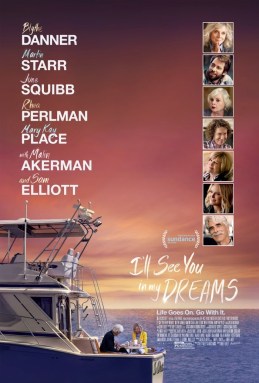
I’ll See You In My Dreams” features something increasingly rare in movies these days: an elderly protagonist.  (Writer/director Brett Haley just turned 30, which makes the film even more of a welcome oddity.)  Blythe Danner stars as Carol Petersen, a graying widow who resists moving into a home despite tons of social pressure from her bridge group.  Living in her own house grants her a certain sense of freedom and control that she stubbornly resists ceding to anyone.

But over the course of the film, Carol finds herself opening up in ways she has not in decades thanks to the entry of two men into her life.  The first, Sam Elliott’s Bill, assumes the role of a traditional gentleman suitor, drawing Carol into intimate situations she has avoided for decades.  The second, Martin Starr’s poolboy Lloyd, marks a decidedly more platonic bond; the two simply enjoy each other’s company and conversation.

Carol never gets explicitly romantically courted by Lloyd, although a few sparks definitely fly between them.  Thankfully, Haley resists exploitative territory with their relationship, just allowing it to shed light on what both parties have to gain from intergenerational communication.  Carol and Lloyd share some beautiful, sweet moments together in “I’ll See You In My Dreams,” and their exchanges are the kind of thing that deserve imitation and replication in mainstream cinema.

Since Carol does not technically involve herself in a love triangle, a comparison to “It’s Complicated” seems like a bit of a stretch.  But her dual male companions, the occasional ribald interlude (mostly with her bridge girls played by June Squibb, Rhea Perlman, and Mary Kay Place), and the keen emotional insight into one woman’s complex experience recall what writer/director Nancy Meyers does so well.  In its pared-down specificity, Haley’s “I’ll See You In My Dreams” delights and charms to a similar degree as the Streep-starrer.  B+3stars


REVIEW: People Places Things

24 04 2015

People Places ThingsRiverRun International Film Festival

To the surprise of everyone who goes to the movies today, Woody Allen tends to think he is not a very influential filmmaker.  In just the past year, however, I cited “Obvious Child,” “Begin Again,” “Wish I Was Here,” and “Listen Up Phillip” as bearing the stamp of his stylistic inspiration.  Yet none of those come close to how Jim Strouse’s “People Places Things” approximates Allen’s work.

Were it not for the cutesy classroom instruments score, I might honestly have thought Allen directed the film himself had there been no name listed in the credits.  I need to check and see if the repeated mantra, “Happiness is not a sustainable lifestyle,” is ever uttered by one of Allen’s curmudgeonly characters or surrogates.

“People Places Things” provides a deserved moment in the spotlight to Jemaine Clement, the Kiwi comedian, after thankless supporting roles in big-budget mediocrities like “Dinner for Schmucks” and “Men in Black III.”  In his character Will’s own words, he’s just having a bad life.  He catches his life partner cheating on him at their twin girls’ birthday party, feels professionally frustrated in his work as animator and professor, and still lives in Astoria.  There are only so many traumas a person can withstand before they take to the streets and start screaming!

Throughout the film, he tries first and foremost to succeed in his roles as father and teacher.  But romantic feelings for his ex as well as his student’s mother (Regina Hall) sprout up, usually leaving Will reeling.  In the mere 85 minutes of “People Places Things,” the character undergoes a full journey of juggling his many roles and figuring out what really matters.  Credit Strouse for keeping the film on thoughtful, measured footing.  It would have been all too easy for the whole enterprise to become as frenetic as its neurotic protagonist.  B+3stars


F.I.L.M. of the Week (April 23, 2015)

23 04 2015

Declaration of War

I am thankful for the arrival of the Cannes lineup every year, and not just for the great new films it promises to introduce to the world.  The official selection also serves to highlight great artists with past works that have gone unnoticed or underappreciated.  In the past, this festival has led me to encounter the cinema of the Dardennes, Andrey Zvyagintsev, Francois Ozon, and Abbas Kiarostami.  (Admittedly, these were all names I probably should have already known.)

With the 2015 edition of the festival, I am already eagerly exploring the new masters of world cinema that the Cannes programmers believe are worth our attention.  One pleasant find is Valérie Donzelli, a French actress turned director.  At this year’s festival, she will present “Marguerite & Julien” in the main competition, yet Donzelli is no stranger to the Boulevard de la Croisette.

Back in 2011, she presented her sophomore feature, “Declaration of War,” in the Critics’ Week sidebar at Cannes to wide acclaim.  Unfortunately, though, it never popped up on my radar until I was searching Donzelli’s name on Netflix after the competition announcement.  But I am glad to catch up with this remarkable film at any time, and I now absolutely count myself a fan of its director.

Donzelli tackles a decidedly unsavory topic in “Declaration of War” as two young parents grappling with their infant’s serious illness.  Yet somehow, the film manages to delight and enchant even in spite of its heavy subject matter.  Much of the success of the film stems from Donzelli’s directorial verve.  This is my pick for the “F.I.L.M. of the Week” because of her erratic, eclectic choices that adapt to meet the mood of the movie on a minute-to-minute basis.

From its opening irony of a man and a woman growing infatuated with each other at a party whose names are Romeo and Juliette to its closing nod to Truffaut’s “The 400 Blows,” Donzelli’s “Declaration of War” teems with excitement and unpredictability.  Like David O. Russell’s recent burst of work, the aesthetic changes as tonal shifts require it.  Need to convey Juliette’s trauma in the wake of devastating news regarding her son’s health?  Donzelli uses shaky cam action as she runs through the halls of the hospital.  Need to portray both Romeo and Juliette’s thoughts on an issue?  Donzelli opts for dueling voice-overs here and there.

Many directors try this mix-and-match approach, and it often results in sloppy, choppy final products.  “Declaration of War” never feels anything less than a fine-tuned, well-calibrated experience.  It conveys a poignant story rife with authentic emotion and utilizes a great deal of cinematic tools to bring that narrative to vibrant life.


REVIEW: The Hunting Ground

22 04 2015

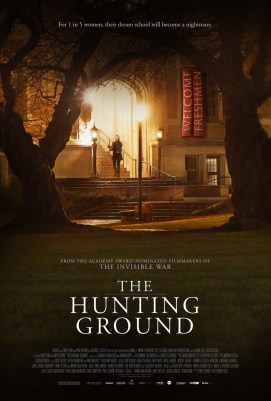
Hunting Ground posterKirby Dick opens “The Hunting Ground” with a montage of one of the happiest moments in a young person’s life – opening their college acceptance letter (set to “Pomp & Circumstance,” no less).  That euphoria quickly dissipates, however, as the attention shifts towards the campuses themselves.  These are, unfortunately, the ominous territories to which the title refers.

Sexual assault, of women and men, on college campuses constitutes nothing less than an epidemic.  An estimated 20% of college females will be raped in their college years, a statistic that alone ought to make you want to vomit.  But it is only the entry point into a culture and system that add insult to injury for survivors of sexual assault.  Dick wisely cites the sources of the information he presents in title cards, making it harder to refute any claim he makes.

“The Hunting Ground” does not make for an infuriating watch simply because of numbers like the astonishing ratio of reported rapes to expulsion at many elite universities.  (Hint: almost no one ever gets kicked out.)  Dick expertly dismantles a complex system of intertwined interests that prevent proper punishment for the perpetrators.  Over the course of an hour and a half, he skewers the fraternity industry (especially SAE), the NCAA sports business (especially at Florida State), and the ever-present need to keep donations high and reported crimes low.

Through it all, he never takes his eye off the real subject of the film – the survivors themselves.  While anger is necessary to dismantle a system of perverse incentives meant to keep these men and women silent, the compassion and empathy we feel for these courageous souls is what will ultimately motivate action.  Speaking personally, this issue only became real for me when two close friends of mine told me about their sexual assaults.  Hopefully “The Hunting Ground” will provide the same impetus for those who are not in a position to hear such things from an acquaintance; it certainly possesses that kind of power and potency.  A- / 3halfstars


REVIEW: True Story

21 04 2015

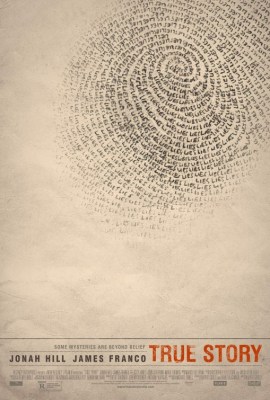
True StoryRupert Goold’s “True Story” begins with two men claiming to be Mike Finkel suffering from a painful, embarrassing exposure.  The first is Jonah Hill’s Mike Finkel – the man born with the name – losing his job at The New York Times after his editors uncover some dishonest reporting practices.  The second is James Franco’s Christian Longo – the man adopting the name Mike Finkel – getting arrested for the murder of his family.

Goold sets up the two men as doubles, practically dopplegangers, for each other.  This connection that extends beyond just a nominal level makes “True Story” quite a compelling story to observe unfold.  Finkel visits Longo frequently in prison and provides him with writing lessons in order to get the exclusive testimony from the accused killer.

The fascination quickly wears thin, however.  Goold utilizes hardly any variation to recurring scenes such as the interrogation scenes between the two leads.  He shoots Hill and Franco in tight close-ups and alternates between them in a predictable edit.  The performances of the duo are so sullenly subdued (which is admittedly somewhat admirable) that the unimaginative approach becomes rather monotonous.

Furthermore, “True Story” almost completely drops the line of thought about Finkel and Longo mirroring each other in the second half when the long-awaited trial of the latter finally begins.  At this point, the film veers into standard courtroom drama territory, a disappointing turn for a film that began with an intriguing cat-and-mouse thriller angle.  Since nothing too bizarre ever occurs between them, the torpid acting style never really pays off.

As a sidebar, “True Story” also features Felicity Jones in a shamefully underdeveloped role.  The film casts her as Finkel’s wife, one that is precisely the kind of conventional, passive spouse that Jones so brilliantly eschewed in “The Theory of Everything.”  Hopefully her new prefix of “Academy Award Nominee” will allow her to avoid such thankless parts in the future.  B-2stars


REVIEW: The Tribe

20 04 2015

The TribeRiverRun International Film Festival

Like Iñárritu’s “Birdman,” Myroslav Slaboshpytskiy’s “The Tribe” amounts to so much more than its novel logline.  The film centers around deaf students who speak in sign language, but the audience receives no subtitles to discern their exact words.  And since the film is from Ukraine, most trying to lip-read for meaning do so in vain.

With all due respect to masters like Hitchcock or Haneke, I do not think I have ever been more aware of my position as voyeuristic spectator than I was watching “The Tribe.”  Slaboshpytskiy grants us a layer of sensory detail unavailable to the characters, yet I still had to work twice as hard as them to make sense of what was occurring before my eyes.

The active participation I had to exert in order to understand character and story ought to serve as a potent rebuttal to Susan Sontag’s claim that film is a “fascist form,” guiding the viewer towards fixed systems of meaning.  Here, Slaboshpytskiy rarely moves the camera unless a character is walking, never cuts unless the scene changes, and always keep the camera at a safe, long shot distance from the action.  His aesthetic matches the nature of “The Tribe” perfectly, ensuring there is no passive way to consume this film.

Read the rest of this entry »