REVIEW: The Last Five Years

15 02 2015

The Last Five YearsTransferring a great musical from stage to screen is a loftier task than many viewers realize, and many a great show is rendered mediocre by the transition.  The challenge always remains the same: finding something cinematic in the piece and making sure that it never simply becomes “filmed theater.”

This was a particularly daunting leap for Richard LaGravenese when adapting Jason Robert Brown’s musical “The Last Five Years” for the big screen.  The show is quite literally a two-hander, allowing speech and song only from a man and a woman inside a romantic couple.  The theater provides a natural habitat for this kind of story since the intimacy and the immediacy of the medium corresponds with the sharp focus on the duo at the center of the show.

Further complicating matters, “The Last Five Years” is like “Les Misérables” in its nearly completely sung-through script.  Trying to embed an unnatural form of human communication into a completely natural situation can prove tricky indeed.  So a tip of the hat is due to LaGravenese for somehow managing to make most of the musical numbers feel believable enough not to raise major questions while watching.

The film’s writer and director does not deserve all the credit for that, however.  So much of “The Last Five Years” seems authentic and emotionally resonant because of the work done by Anna Kendrick.  She stars in the film as Cathy, an actress trying to get by doing what she loves while her boyfriend Jamie (Jeremy Jordan) soars to the top of the bestseller charts with his debut novel.  Technically, the songs are divided equally between the two of them, but make no mistake about it: this film belongs entirely to Kendrick.
Read the rest of this entry »


REVIEW: Last Days in Vietnam

14 02 2015

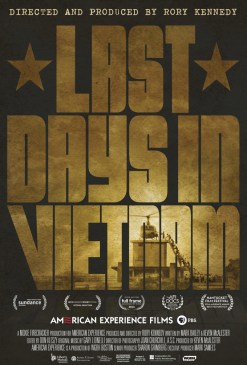
Last Days in VietnamUsually at the end of a high school AP U.S. History class, a teacher rushes to cram in everything after World War II as if a conflict like the Vietnam War were merely a footnote to the American story.  (Just for the record, I loved my junior year history teacher and blame the date of the AP exam, not him.)  If that period had some more time allotted for coverage, Rory Kennedy’s documentary “Last Days in Vietnam” would probably be a staple in those classes.

Her film chronicles the closing chapter of American presence in the region, beginning broadly and then focusing with laser-like precision on the final evacuations of Saigon.  She gathers quite an authoritative bunch of interviewees to talk about their experience, and each can recount what happened with a truly impressive amount of detail.  Watching “Last Days in Vietnam” thus feels like reading a well-written tome of historical literature.

The richness does overwhelm the story as a piece of cinema, though.  For nearly 100 minutes, the film stays mostly compelling yet sags a little bit under the weight of all the minutiae towards the end of the film.  Of course, a film called “Last Days in Vietnam” is going to spend most of its runtime focused on the closing ticks of the clock.  But Kennedy might have tightened up and prioritized all these narrative threads, lest we check the time ticking away on her own film itself. B2halfstars


REVIEW: Fifty Shades of Grey

13 02 2015

Fifty Shades of Grey” boasts a killer soundtrack of catchy pop tunes from some top artists – Beyoncé, Ellie Goulding, Sia – to spruce up what might otherwise be boring, forgettable montages.  But while I watched the dominant sadomasochist Christian Grey (Jamie Dornan) attempt to lure the innocent, virginal Anastasia Steele (Dakota Johnson) into a contract as his submissive, another song kept playing in my head.

Here’s an excerpt from that song, “Never Learn Not To Love” by The Beach Boys.

“Cease to resist, come on say you love me
Give up your world, come on and be with me
I’m your kind, I’m your kind, and I see

Submission is a gift given to another
Love and understanding is for one another
I’m your kind, I’m your kind, and I see”

The surfing rock group makes those lyrics sound pleasant, even romantic.  But they become rather frightening when considering who they essentially plagiarized the song from: Charles Manson.

There’s something decidedly demented (or, dare I say, “Haunted” like the Beyoncé track from the film) about Grey’s psychology.  He pulls heavily from pimp logic, the same rationale Manson used to lure and maintain his followers.  Grey obsesses over making Anastasia sign a contract that allows him free license, within mutually agreeable bounds, to exploit her endlessly for the purposes of whetting his niche sexual appetites.  He gets pleasure, while she gets an odd mixture of fear and love.  (Seems like a rather uneven balance of power, but I’m single – so what do I know?)

Getting her John Hancock serves as the conflict and obstacle that keeps the thin plot of “Fifty Shades of Grey” going, although there is a compelling case that the one-upmanship of the successive sex scenes is what really keeps the interest in an otherwise standard-issue “romance.”  Those just watching for skin should not even bother tuning in until the 45 minute mark, when the conventional courtship tale switches gears into the kind of soft-core porn film that plays around midnight on HBO.

Read the rest of this entry »


F.I.L.M. of the Week (February 12, 2015)

12 02 2015

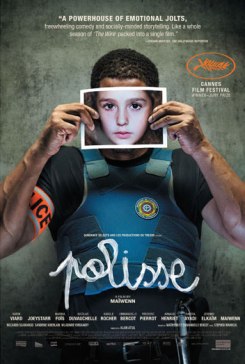
PolisseIn most stories about a workplace, colleagues become friends only with the greatest reluctance.  (Think “The Office.”)  The French film “Polisse,” however, shows co-workers in the Child Protection Unit who are so cordial that they could pass for a family.  When they eat lunch together, their conversations ring with an uncommon knowledge of and comfort with each other.

Writer/director Maïwenn makes these bonds and relationships formed in the line of duty the real subject of her story instead of the horrendous crimes against minors they have to investigate.  Sure, the film shows plenty of heartbreaking tales from the French underclass, and the woe of the children harmed feels distinctly real since Maïwenn based the script off of actual cases. “Polisse” is my pick for the “F.I.L.M. of the Week,” though, not because of the pity and disgust their cases generate but rather because of the familiarity it creates with its expansive ensemble of characters.

The children and their abusers are usually the subject when it comes to narratives like these, so Maïwenn provides a refreshing change of page by focusing on the effects of an oft-overlooked party.  There is no sense that the events of “Polisse” are anything particularly extraordinary, yet even so, they take a tremendous toll on the police unit.  No one seems capable of simply leaving their work in the office itself, and dealing with some of the worst in humanity tends to bring out the worst in them in their personal lives.

Maybe a certain kind of person is just naturally drawn to this line of work, but Maïwenn definitely suggests that their private dysfunction corresponds to their vocational hazards.  For proof, look no further than the photographer who joins the unit to document their job.  She begins as an outsider, clearly separate from the rest of the group as she timidly observes their collegial mingling.  Yet after a few harrowing experiences, she becomes one of them.  This seemingly natural proclivity for solidarity, even in the apparent absence of human kindness, provides a reassuring glimmer of hope in “Polisse” that shines brightly through the bleakness.


Random Factoid #574

11 02 2015

50I’m trying to kill some time before a 7:30 P.M. press screening of “Fifty Shades of Grey” tonight (currently posted up with my laptop in Whole Foods), so I thought maybe a factoid was in order.

Yes, I am about to watch the cultural hot potato itself.  No, I didn’t pack an extra pair of underwear, pregame, bring toys, etc.  I’m simply curious to see what all the fuss is about.  When something like this comes along and gains such traction among the masses, it has to be hitting some kind of nerve.

Thanks to landing on a press list in North Carolina, I am now about to catch a free advanced screening.  That’s the ideal way to watch “Fifty Shades of Grey,” I assume – with no payment required.  But, due to the “anticipation” of the film, I was not allowed to bring a guest.  (The only other times I’ve had to roll solo to an event like this was when the screening was strictly held for critics’ eyes only.)

So, I am seeing “Fifty Shades of Grey” alone.  I won’t be able to live snark or make sassy comments to a friend.  Instead, I’ll just feel smutty knowing that I am living out a glorified version of what perverts did in the ’70s when they wanted to watch titillating pornography.  The only upside is that I am an hour away from anyone who would recognize me seeing this movie.

Oh, well – can’t win ’em all!


REVIEW: Human Capital

10 02 2015

Human CapitalHuman Capital” begins with an unsuspecting waiter getting run off the side of an Italian road and being left for dead.  Surprisingly, this is one of the least interesting things the film has to offer.

Writer/director Paolo Virzì weaves a tale of two families in Northern Italy clearly separate by wealth and class, not to mention power and prestige.  The Ossolas are the middle-class striving for better status and standing, while the Bruneschis are comfortably entrenched in their lavish lifestyle.  When the husbands, wives, daughters, and sons get entangled in a dangerous game where personal vices put everyone’s position at stake.

Rather than crosscut all their stories into one sprawling opus, Virzì divides them into four sections from a different person’s perspective.  This more novel, unconventional approach breathes some wind into the sails of “Human Captial.”  Heck, it even somewhat recalls early films of Alejandro Gonzalez Iñárritu, such as “Amores Perroes.”

Overall, he provides a biting and quite incisive look at structural class differences that feels applicable to societies other than Italy.  That makes sense when considering that “Human Capital” is based on an American novel (written by an alumnus of my own Wake Forest University, no less) and transferred across continents.  These are the kinds of stories and themes that filmmakers in the United States are neglecting, and rather shamefully so in a post-Occupy Wall Street world.  For all those looking for a chronicle of class conflict after exhausting all the F. Scott Fitzgerald canon, this film would make a more than satisfying selection.  B+3stars


REVIEW: The Voices

9 02 2015

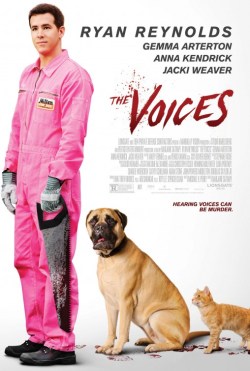
The VoicesThe Voices” takes a protagonist plagued by mental illness, as in “Silver Linings Playbook,” and combines him with the unsuspecting, mild-mannered murderer like in “Bernie.”  The film’s Jerry, as played by Ryan Reynolds, is an outwardly cheery factory worker whose schizophrenia makes him subject to violent impulses.  He can mostly suppress these urges, yet the invented voices of his cat and dog begin to lure him into violence against the women of his company’s accounting department.

As he knocks off characters played by Gemma Arterton and Anna Kendrick, director Marjane Sartrapi aims for a tone of black comedy that never really sticks.  Sartrapi showed with her Oscar-nominated “Persepolis” that she can make a character with only two dimensions feel as whole as any actual human, so the film’s lack of depth feels especially disappointing.  She does not deserve all the blame, though; Michael R. Perry’s rather bland, unfunny script does not set the stage for her and the cast to succeed.

Not to mention, the humor of “The Voices” also falls victim to forces outside the movie.  Sartrapi obviously does not condone murder, but placing a character who commits them at the center of a story does make identification and sympathy much simpler.  By making Jerry the protagonist, the film does glorify his exploits to some small extent.  In a time where mentally disturbed people come unhinged and tear holes in communities like Aurora and Newtown, serving as a party to their crimes just feels inappropriate.  Laughing at them seemed downright wrong.  C+2stars


REVIEW: To the Wonder

8 02 2015

To the Wonder” is probably the most Malickian (is that the right word – or would it be Malicky?) film that Terrence Malick has directed to date.  And that is not necessarily a good thing.

Like Quentin Tarantino or Wes Anderson, Malick’s stylistic hallmarks have transcended merely serving their story.  They are a recognizable brand.  Malick is so avant-garde and experimental, however, that his brand lacks a lot of commercial appeal.  (Though plenty of young filmmakers shamelessly try to imitate him.)

“To the Wonder” plays like a guide to make a Malick movie, rote and rather passionless.  It boils down what makes him distinct as a director into a series of clichés.  The film documents scenes from a love triangle (as portrayed by Ben Affleck, Olga Kurylenko, and Rachel McAdams) as well as a few from a Catholic priest (Javier Bardem) that crosses their path at some point.  As usual with Malick, the engine moving everything forward is the philosophical and existential musings spewed by multiple narrators rather than a traditional “plot.”

Having voiceover from more than one person is not a problem, but “To the Wonder” stumbles by not firmly deciding on a main character or protagonist.  The film does not just feel unfocused; it feels remarkably undisciplined.  By not providing an entry point to the proceedings, Malick leaves his audience in a position on the outside looking in.

Granted, simply observing the film could be worse since “To the Wonder” is shot by Emmanuel Lubezki, the cinematographer behind iconoclastic films ranging from “The Tree of Life” to “Gravity” and “Birdman.”  While Lubezki hardly breaks boundaries or explores bold new territory here, even watching him on autopilot proves fascinating.  His technical proficiency combined with Malick’s eye for the beauty of nature makes for quite the dynamic duo.  They could even make a Sonic drive-in look magical – and in “To the Wonder,” they do just that.  C+2stars


REVIEW: Cave of Forgotten Dreams

7 02 2015

In his documentary “Cave of Forgotten Dreams,” Werner Herzog explores a cave in southern France with some of the oldest known examples of human painting.  Naturally, he tries to invoke a sense of majesty, and he often amplifies the impact of the prehistoric drawings with a wondrous classical score.  A part of me wonders if he and Terrence Malick swapped contacts on a music supervisor since the film sounds quite a bit like “The Tree of Life.”

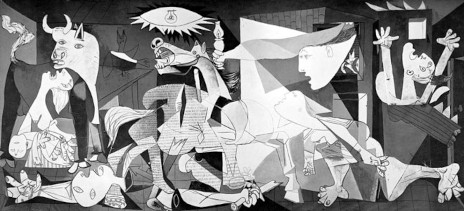
All jokes aside, Herzog makes some excellent points about art history, development, and evolution by delving deeply into these murals.  These early cave dwellers showed a remarkable awareness of contrast and contour.  (Gazing at them reminded me of my own experience standing in front of the sprawling “La Guernica” by Pablo Picasso, which hangs in Madrid’s Reína Sofia.)  Herzog even argues that their depiction of legs with movement represents humanity’s first attempt at cinema.  After all, they are called motion pictures.

Perhaps some of the grandeur and spectacle was lost on me since I watched the film on my couch at home, not in Herzog’s preferred 3D.  But I felt the film, fascinating as it was, could have been sped up at times.  If “Cave of Forgotten Dreams” ran under an hour, then it could be easily consumed by a cultural anthropology course (a prime target audience) in one classic period.  B2halfstars


REVIEW: Into the Abyss

6 02 2015

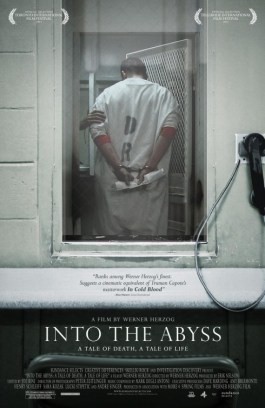
Into the AbyssWhen people think of documentaries, they often remember the most boring or the most didactic ones.  For many, non-fiction film is about telling you exactly what happened or, in the minds of the documentarian, exactly what needs to happen.  Werner Herzog’s “Into the Abyss” is neither of these.
Herzog does what most filmmakers set out to do – that is, to tell a story.  It’s one of true crime, a triple homicide in Conroe, Texas, resulting from complications in the robbery of a red Camaro.  A decade after the crime resulted in a life sentence for one and a death sentence for another, Herzog retraces the story from the beginning and allows the events to unfold rather slowly but still grippingly.

“Into the Abyss” isn’t selling any sort of viewpoint or moral cause, unlike most documentaries on law and order.  Herzog is a rather extreme case of laying all the information out there and allow the viewer to come to their own conclusions.  Some might prefer it if their documentary shouted to them that they should deplore the death penalty.  But I rather like being left to my own devices to ponder the movie as so many documentaries make their message clear from the get-go and being instantly forgettable.

Herzog gathers interviews from pretty much everyone involved in the story: the family members of the deceased, the law enforcement officials on the murders, the two robbers-turned-murderers, and even the man who will deliver the lethal injection.  With all these viewpoints, there’s a sense of comprehensiveness to the tale.  I don’t think Herzog’s film is perfect, but there’s something refreshing in its straightforward approach that leaves all the slanting to be done by the viewer.  B2halfstars


F.I.L.M. of the Week (February 5, 2015)

5 02 2015

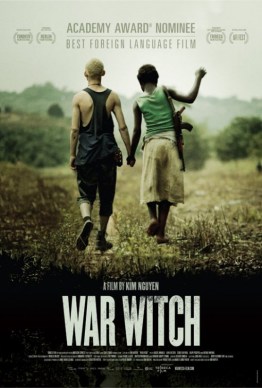
War WitchMany harrowing stories of child soldiers in Africa have found expression in art, exposing many Westerners to the ravages of the continent’s civil wars.  Few strike such a powerful and resonant emotional chord as Kim Nguyen’s “War Witch,” though.  This was one of the Academy’s five nominees for Best Foreign Language Film in 2012, and it is also my pick for the “F.I.L.M. of the Week” for the way it elevates discourse on its subject matter beyond victimization for the characters and easy pity for the audience.

Nguyen’s film, which he also wrote, tracks three years in the life of adolescent Komona (Rachel Mwanza, in a stunning debut performance) in sub-Saharan Africa.  Or, rather, Komona recounts them herself in a heartbreaking address to her unborn child.  When she foregrounds her life by stating, “I don’t know if God will give me the strength to love you,” Komona’s disembodied voice sets the stage for the depiction of some true horrors.

“War Witch” does not these nightmarish events in body count or in flowing carnage, however.  Nguyen shows his interest lies in exploring the emotional damage inflicted by the atrocities of war.  This is observable as early as the first time rebels force Komona to kill someone.  When she pulls the trigger, the camera stays fixated on her face alone.  If the film affords any attention at all to the life she took, it would be a hurried and unclear shot of the body as Komona runs away from it.

The movie mostly remains at that same level of anguish and distress, though Nguyen does allow for a few beautiful, tender moments.  “War Witch” is not about mysticism, but it finds a way to naturally incorporate its presence and influence into the proceedings.  The rebel leaders declare Komona, the improbable last person living from her village, a “war witch” since only the supernatural could explain her survival.  That status attracts the fondness of a young boy, the group’s “magician,” and his affection helps restore a small bit of hope for humanity.

But, sadly, “War Witch” is not a tender romance.  It is a film about the abominations of war, which Nguyen artistically renders with a sense of surrealism.  Often times, he takes away the soundtrack to a brutal act, simply leaving the image of what it is and nothing more.  Komona commits, and is often party to, these violent deeds, although she also suffers great losses because of them.  Her internal torment over these conflicting roles proves far more gut-wrenching than any other traumatic occurence in the movie (and “War Witch” has plenty of those to spare).


REVIEW: Wetlands

4 02 2015

WetlandsLet the record show that I am by no means an expert on foreign comedy since very little of it washes up on American shores.  Why is that, you ask?  To quote James Cameron, “As you go around the world, ideas of comedy change, ideas of beauty and romance change, but one man hitting another man plays the same way everywhere.”  So I speak only from knowledge of this side of the pond when I say that women are generally afforded fewer opportunities to be gross than men.

Seth Rogen sticks a probe up his butt in “The Interview” and no one thinks twice.  James Franco and Danny McBride verbally duel about ejaculation locations in “This Is The End” to nobody’s shock.  But when Melissa McCarthy dared to defecate in a sink during a hilarious scene in “Bridesmaids?”  It was, apparently, a watershed moment for women in comedy.  Talk about a gendered double standard.

If you think females should have the chance to go as nasty and coarse as their male counterparts in the name of a laugh, then the German writer/director David Wnendt’s “Wetlands” is a must-see.  The faint of heart or those with a working gag reflex might consider approaching with caution as something goes in and comes out of just about every orifice of its protagonist, Carla Juri’s Helen Memel.  She’s an odd, yet actually rather endearing, figure who relishes in shattering all social norms regarding sexuality.  That drive, unsurprisingly, leads to a number of zanily entertaining scenarios.

Yet, in spite of her unabashed unhygienic practices, Helen is mostly motivated by some rather sweet desires.  Above all, she wants her divorced parents to reunite; after that, the attention of an attractive male nurse attending to her after a freak accident involving hemorrhoids.  (That might slightly spoil the movie, but I think you also ought to know what you are getting yourself into by watching this movie.)

Without a genuine and likable guiding light, “Wetlands” might have played like a brutal taboo-breaking exercise that simply checked off potential offenses for the sake of checking them off.  But Wnendt makes them all serve a story, and it makes all the difference.  B2halfstars


REVIEW: The Guest

3 02 2015

The Guest

A new spate of American genre films that wear their influences on their sleeves often underwhelm.  After all, the downside of name-checking is having to weather comparisons to the source itself.  Adam Wingard’s “The Guest,” however, is the rare film from this revival that actually stands well on its own merits.

The plot could more or less be reduced to saying it’s “The Terminator” for the age of the Iraq-Afghanistan military industrial complex.  Dan Stevens stars as David Collins, the titular guest, a self-professed veteran who slyly ingratiates himself with the family of fallen comrade Caleb Peterson.  His stay just keeps extending due to the kindness of the Petersons and his insidiously winning charm.

Wingard plants the seeds of conflict and action in this idyllic sojourn of “The Guest.”  The movie jumps from a mostly dramatic piece to a tense thriller and then into an all-out action fest (whose ending nods cleverly to Stanley Kubrick’s “The Shining”).  Somewhat surprisingly, all these elements coexist rather well.  This is due in large part to Wingard allowing knowledge of cinephile cult classics to enhance the movie, not drive it altogether. It also helps that “The Guest” does not feel like a litany of references to his VHS collection circa 1993.

Wingard simply brings a fun amount of campy pulp to the table while also maintaining the movie’s integrity.  “The Guest” lands in the narrow strip between parody and believability.  It is serious enough to command and maintain attention without being so serious that it precludes a great, enjoyable time.  And that throbbing synth-pop score underneath it all?  Just icing on the cake.  B+3stars


REVIEW: Pride

2 02 2015

Perhaps the most tragic dissonance in film occurs when ideology and filmmaking prowess fail to match.  Say what you will about the frightening Nazi propaganda of Leni Riefenstahl’s “The Triumph of the Will,” but the picture is undeniably well-made.  More recently, “The Homesman” and “Big Eyes” offered appealing feminist viewpoints, yet both were rather tediously assembled.

Matthew Warchus’ film “Pride” details the unlikely coalition between British miners and LGBT activists to protest the destructive policies of the Thatcher administration.  These are good people fighting for what they think is right, so the natural reaction would be wanting to support them.  But, overall, the film fails to capture the swelling spirit of a fellow progressively minded film like Gus Van Sant’s “Milk.”

It is not a particularly enlightening look at the nature of successful activism.  It lack insight into discrimination and homophobia on both the institutional and the individual level.  It does not provide any strong emotional pull towards a character (though the story of closeted Joe embracing his identity has some touching moments).  Although, I will say, seeing Imelda Staunton (best known as Dolores Umbridge from “Harry Potter”) breaking it down at a gay club was quite a sight.

I simply watched “Pride.”  I did not feel it.  C2stars


Random Factoid #573

1 02 2015

For what it’s worth, I have actually stuck to my New Year’s Resolution to eat healthier for a whole month.  (No better way to jinx it than to put it in print, though.)  I now stock my tiny dorm room refrigerator with all sorts of healthier choices, in everything from 10 calorie Jello-s to fresh fruit to protein shakes.  And no Diet Coke, which is the bigger deal.  I still wonder what on earth I’m supposed to drink at movie theaters now…

Perhaps most surprisingly, I have also taken to eating string cheese after workouts, which is apparently a smart way to replenish your body after heavy exertion.  I used to scorn this style of consuming dairy, ranking it only slightly above aerosol spray cheese in the hierarchy of forms it can take.  But now, I find myself actually craving them.

Which, of course, always makes me think of one movie and one character.  Emily, my soul sister…

Diet

I also relate to “The Devil Wears Prada” now in many more ways than I did when I first saw it at the age of 13.  Back then, naïve Marshall had no idea what the corporate world was like.  If you want me to elaborate on how my life has resembled the movie, you’ll have to find me in person because there is NO WAY I will ever put that in print.