REVIEW: Escape from Tomorrow

31 01 2015

Escape from Tomorrow

Because Disney would never allow the filming of a nightmarish horror film on the grounds of its theme parks, Randy Moore had to shoot his film “Escape from Tomorrow” covertly.  The cast and crew, in order to avoid detection, remained practically indistinguishable from the average guest and their usual accoutrements.  The construction of the film is laudable, but too bad the final product turned out so lackluster.

As much as I wanted to admire and embrace the brashness of Moore’s guerilla filmmaking techniques, the story was just too generic and banal to engage on any level.  The 90 minutes of “Escape from Tomorrow” hardly feel like an escape from reality or even a mildly productive use of time.  They feel like the 90 minutes you can expect to wait in line for a ride at a Disney property; the only question worth asking is, “When will it be over?!”

Moore aims for surrealism with his filmmaking, yet it winds up feeling like he just completed a “Baby’s First David Lynch” kit.  Some of that might stem from the lackluster technology and less than ideal shooting circumstances, although he is certainly not helped by thinly-sketched characters running through a litany of tired scenarios.  Family vacations, job loss, marital tension, potentially unstable mind, a dash of magical realism … been there, done that.  No amount of brash production tactics can bail out a bad story, and “Escape from Tomorrow” even has brashness to spare.  C2stars


REVIEW: Project Nim

30 01 2015

Director James Marsh won an Oscar for combining archival footage, recreations, and present-day interviews around Phillipe Petain’s tightrope walk between the Twin Towers in “Man on Wire.”  (Good luck to Robert Zemeckis and Joseph Gordon-Levitt in their attempt to top it with their fictional “The Walk.”)  His documentary follow-up, “Project Nim,” plays more by the standard rulebooks, but it still works remarkably well.

The film follows a strange cast of characters surrounding one chimp named Nim who researchers believed could develop the capacity for language if raised like a human child.  The experiment occurs in the 1970s, and it naturally draws some very curious players from more radical countercultural and hippie circles.  Their experiment raises some fascinating questions as it progress, most of which relate to our own humanity and what separates and distinguishes us as a species.

Getting to those head-scratchers, though, proves a little more emotionally engaging for unconventional reasons.  Marsh is obliged to stay faithful to the events that transpired, although that does not make watching the cringeworthy actions of some of the participants any more palatable.  As many act in manners that are at best ill-advised and at worst completely unethical, “Project Nim” becomes just as much an exercise for the jaw (which will often hit the ground in awe) as for the brain.  Marsh ought to receive special commendation for somehow maintaining neutrality when talking to people who thought it was acceptable to give drugs and sexual stimulation to a chimp.  B+3stars


F.I.L.M. of the Week (January 29, 2015)

29 01 2015

FreewayI would count myself a big fan of actress Reese Witherspoon (see my personal anecdotes on my middle school crush in Random Factoids #49 and #88), yet I somehow managed to only learn of the existence of “Freeway” in 2015.  This film stars a younger Witherspoon as Vanessa Lutz, the daughter of a prostitute who has to do and say some unmentionables in the name of self-preservation and survival in a gritty urban environment.  She goes to prison, not to visit a client like Elle Woods but actually as an inmate.

This 1996 oddity might not fit Witherspoon’s squeaky-clean sweet Southern belle image, but it certainly gives her something out of the ordinary.  This modern retelling of the Little Red Riding Hood fairytale is a peculiar burst of energy from writer/director Matthew Bright, who has since done relatively little of note.  But his debut feature is my pick for the “F.I.L.M. of the Week” because it never holds back in its peculiar assessment of American culture as seen from the vantage point of its underbelly.

Witherspoon quickly asserts her pluckiness in “Freeway,” chaining up her social worker in order to seek refuge from her long-last grandmother.  On the way, however, she gets drawn into the clutches of the conniving serial killer Bob Wolverton.  Keifer Sutherland plays his wolf not as big and bad, but rather as eerily unsettling and deceptively meek.  (That was basically the mold of the ’90s murderer, so it makes sense.)

Somewhere on the path to grandmother’s house, “Freeway” changes up the script.  The film’s Little Red takes a step into the big leagues by gaining a welcome sense of agency, taking the film on an unexpected detour into courtrooms, prisons, and a trial by media.  The changes ought to prompt some stimulating discussion about what is and is not still relevant from the old tale.  By transplanting Little Red Riding Hood into modern society, rather than simply tweaking her story in a mythic milieu like “Into the Woods,” “Freeway” invites a freer dialogue.

Interestingly, when I went back to read reviews from the time of release, most critics reacted to the film as a satire.  “Freeway” still maintains a sense of exaggeration, sure, but it has lost a bit of shock after years of reality TV highlighting such unique specimens as Honey Boo-Boo, the Jersey Shore, and the Duck Dynasty family.  Nearly two decades after its Sundance premiere, though, its gentle mockery of the strange corners of America still entertains and excites.  Much of the film’s bite today comes from Witherspoon, who once again seems willing to explore these rough edges of her persona in “Wild” and beyond.


REVIEW: Don Jon

28 01 2015

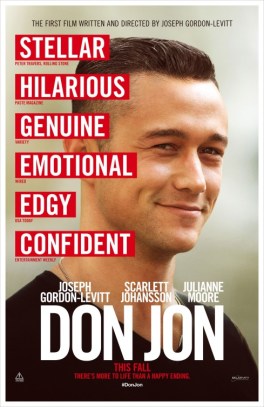
Don JonFor all those who might have found Steve McQueen’s sex addiction drama “Shame” too intense in either content or form, Joseph Gordon-Levitt’s comedic “Don Jon” may provide the perfect vehicle for discussing the same issues.  The film acknowledges many of the ills facing men in the age of internet pornography, such as the objectification of women and the notion that sexual satisfactions is deliverable on demand at the leisure of a Google search.

“Don Jon” will prove enlightening for anyone who has never thought deeply about masturbatory pleasures, especially because Gordon-Levitt’s script telegraphs his social commentary through heavy-handed voiceovers from his lead character Jon.  Anyone who has ever taken anything more than psychology or sociology 101 is likely to find the film’s observations shallow and skin-deep.  But if it gets people talking and consciously reconsidering their habits, then the movie at least serves some purpose.

And in case someone tunes out during Jon’s long-winded (and perhaps somewhat implausibly aware) confessionals on his porn addiction, the plot also effectively echoes the simple yet important message.  Though the womanizing, GTL-exuding Jon lands a smoking hot girlfriend Barbara (Scarlett Johansson), she quickly flees once she discovers the extent of his dirty secret and leaves Jon a wreck.  Only when he heeds the learned wisdom of Julianne Moore’s middle-aged Esther, who reminds him that sex is about satisfying two people, can he regain the same pleasure in the orgasm.

Though “Don Jon” may not speak fluently on matters on sexuality, Gordon-Levitt certainly understands gender politics quite well.  The film really nails some of what needs to change in our current conception of masculinity, and he begins to tackle the way that females reinforce that.  At one point while shopping, Barbara insists that Jon cannot, as a man, clean his own house because it clashes with the performance of manliness that she expects.  That, unfortunately, proves the extent of glancing at the other side of the gender divide, yet there is always time to explore further.  Gordon-Levitt ought to make a “Don Joan” movie to examine femininity as well since a little too much was left on the table in “Don Jon.”  B2halfstars


REVIEW: Computer Chess

27 01 2015

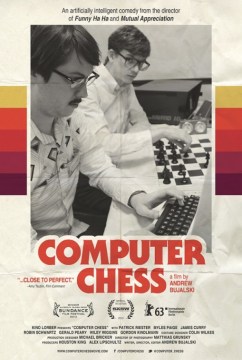
Computer ChessWriter and director Andrew Bujalski is largely credited with sparking the mumblecore movement in film.  This style of filmmaking aims to capture life as it is really lived, with all the sputtering and mumbling we do in the process of fumbling to communicate.

Bujalski released his watershed “Funny Ha Ha” in 2002, before digital filmmaking technology became truly and fully democratized.  Now, anyone with a camera – which is basically anyone with a phone – can create a film with the kind of naturalistic style that was previously so rare in the cinema.  The challenge for Bujalski and fellow mumblecore adherents is to remain relevant in the era of YouTube and self-distribution channels.  Far more so than a decade ago, they have to make the case for why their stories matter and deserve 90 minutes of our time more than something else.

That is precisely the stumbling block of “Computer Chess,” which just never really presents a strong rationale for the act of watching it.  To be clear, Bujalski most certainly has a better eye for aesthetics than the average Joe Schmo.  His film, set at a 1980 computer conference, captures the dominant analog videotape look of the time down to the difficulty with keeping images in focus.  It also boasts a few intellectually stimulating conversations about artificial intelligence, demonstrating that some clear thought went into making the film.

But overall, “Computer Chess” just proves a little too obtuse to really connect.  There is not much of a story to follow, and the film lacks any strongly developed characters with whom any rapport can form.  The experience gets boring after about 10 minutes once the general purpose of the cinematic endeavor makes itself clear.  Afterwards, finding any reason to care constitutes a herculean task.  C2stars


REVIEW: Room 237

26 01 2015

Room 237Aside from showing how far the “fair use” exemption of American copyright can be extended, Rodney Ascher’s unique documentary “Room 237” is a film that demonstrates how the cult of auteurism has run amuck to its point of logical absurdity.  The cinephiles and film analysts he spotlights stretch the theory that a director is responsible for every detail in every frame almost to farcical extremes.

The images of Ascher’s documentary, or potentially a feature-length video essay, come entirely from Stanley Kubrick’s cult classic horror film “The Shining” (as well as a few of his other films to play the part of B-roll).  The words are all provided by five people convinced they know the secret meaning underlying every minute of that film.  Depending on which one of them you ask, “The Shining” is really about sexuality, the Holocaust, the genocide of Native Americans, the entirety of the human family, history’s collective amnesia, or even an apology for faking the moon landing.

Each interviewee has to adopt a certain attitude to how playful or serious Kubrick was in his crafting of the film, selectively pulling from film criticism to make their arguments irrefutable.  All seem to agree, however, that Kubrick is infallible, completely incapable of making a continuity error, mistake or oversight.  Nothing could be chalked up to coincidence, for Kubrick oversaw every speck in every frame.  A so-called “impossible window” could not possibly a snafu given that there were two different sets for the film.

Read the rest of this entry »


REVIEW: A Girl Walks Home Alone At Night

25 01 2015

A Girl Walks HomeWith “A Girl Walks Home Alone At Night,” writer/director Ana Lily Amirpour fuses together elements into a hybrid that likely never occurred to anyone else.  Her vampire film incorporates the western, the film noir, and tons of hipster cred (look no further than the vinyl records) – with dialogue spoken in Persian.  It’s essentially the best Sofia Coppola movie that Sofia Coppola didn’t make.

Amirpour’s film constantly exudes an ambience of coolness, which makes the experience mostly fun to absorb even when it gets dull to watch.  Like Coppola, she often falls into the trap of excessive stylization, especially when a killer tune is playing.  “A Girl Walks Home Alone At Night” thus often feels like a compilation of thematically related music videos.  The flesh-eating skateboarding girl simply seems to appear as a recurring character amidst the sea of drug dealers, prostitutes, junkies, strange old men, and curious kids.

Amirpour also has one heck of a strength to make the movie mostly work regardless: her exacting control.  Her eye for clean, classical visuals is remarkable.  In addition, she and cinematographer Lyle Vincent play with light and shadow with fitting and appropriate grace given the film’s theme of concealed identity.  While her directorial debut might boast all the style of a cult indie classic, it possesses the marginal storytelling of a student short overly obsessed with mood.  The combination leaves a little to be desired, though it certainly is not all bad nor a waste of time by any stretch of the imagination.  B-2stars


REVIEW: Crystal Fairy and the Magical Cactus

24 01 2015

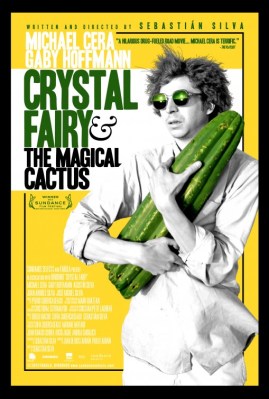
Crystal FairyMichael Cera and the titular plant might serve as the main selling points of the marketing materials for “Crystal Fairy and the Magical Cactus,” yet the movie hardly belongs to either of them.  The best compliment for Cera is that at least his performance does not recall his stock character too much.

Sebastián Silva lets comedienne Gaby Hoffmann run rampant to cause free-spirited mayhem in the piece.  And boy, does she capitalize on the chance.  She provides basically all the enjoyment the film has to offer.

Hoffmann’s hippy Crystal Fairy joins up with Cera’s Jaime, an American in Chile, to find a magic cactus and harness its hallucinogenic powers.  Their quest is not particularly funny, serious, or insightful.  It just kind of happens, and then the movie ends, leaving no real lasting impression nor making any strong case for its reason to exist.

The film feels rather ragtag and loose to the point of fault; Silva might have been better off saving thousands of dollars by just shooting the film on an iPhone.  Then “Crystal Fairy and the Magical Cactus” would truly have the verité feeling it longs for in prolonged sequences of awkward “naturalistic” dialogue.

Anyone looking for realness and authenticity will just have to find it in Hoffmann, whose Crystal Fairy fearlessly owns the screen.  She plays an entire elongated scene in the nude, comfortably and confidently carrying out a conversation while flashing her lady parts to a room full of men.  Cera, and everyone else in the film, should have followed her bold lead.  C2stars


REVIEW: A Most Violent Year

23 01 2015

A Most Violent YearThe twelve months referred to in the title of “A Most Violent Year” are those of 1981, a period that saw an unprecedented spike in crime within the boroughs of New York City.  This illegality is not the story of the film, though; it is merely an intriguing backdrop for the saga of Oscar Isaac’s Abel Morales as he attempts to expand his property holdings in order to become a more competitive player in the heating oil business.  All the world seems to be operating without regard to law or ethics, and it practically invites him to abandon moral high ground.

Abel clings stubbornly to his principles, refusing to arm his trucks even when they get held up and robbed.  The film rarely mentions this, but Abel is an immigrant from Colombia who married into a leadership role in the company.  While mostly masks the traces of his accent, the effect of his heritage is present in every decision he makes.  Abel realizes how far he has come, as well as how far he has to tumble with just a single prideful misstep.

Isaac makes this deliberative stoicism absolutely riveting, coloring Abel with shades of Al Pacino’s Michael Corleone from “The Godfather” series.  He knows when the character is weak, when he is strong, and, most importantly, when he has absolutely no idea why any of it is worth the trouble.  It’s one of the beautiful ironies of “A Most Violent Year” that Isaac seems so in control of Abel, yet each passing scene in the film slowly strips away the illusion of control of his destiny from the character.

Read the rest of this entry »


F.I.L.M. of the Week (January 22, 2015)

22 01 2015

The Sundance Film Festival arrives, like clockwork, at the beginning of each year to inject a fresh bit of hope into our outlook for the upcoming year in film.  While we tire of the year’s awards season crop, the system begins to harvest its plants to bloom over the months to come.  The festival is great at providing two specific kinds of films: discoveries of major new talents from completely out of the blue, and surprising indie turns from well-known stars.  (Without said talent, the films would never be able to receive any financing.)

“Kill Your Darlings” falls into the latter camp.  This 2013 film was a big step in Daniel Radcliffe’s career reinvention – or at least a full-fledged turn of the page – from only being recognized as Harry Potter.  He stars as a young Allen Ginsberg, far before “Howl” brought the beat poet into censorship as well as the national spotlight.

John Krokidas’ debut feature is so much more than just a showcase for Radcliffe’s talent, though.  It is my pick for the “F.I.L.M. of the Week” because it tells a compelling, human story that just happens to be about a renowned poet.  His script, co-written with Austin Bunn, never veers into the realm of becoming a portrait gallery for the nascent counterculture movement.  Sure, there are appearances by William Burroughs (Ben Foster) and Jack Kerouac (Jack Huston), but the script never loses sight of who they are as people.

“Kill Your Darlings” does not feel the need for reverence to the towering legacy of a figure, an advantage the film is able to possess in part because it takes place before Ginsberg and his pals went supernova.  The plot begins with a young Ginsberg entering Columbia in 1943, where he quickly bristles with the established order and the canonized poets.  Radcliffe’s performance teems with self-discovery and fully realizes the awakening of an artist; perhaps there is a meta connection responsible for

Yet Radcliffe is not even the movie’s scene-stealing performer.  That honor goes to Dane DeHaan, star of “Chronicle” and “The Place Beyond the Pines,” who has really begun to build a formidable résumé.  He plays livewire Lucien Carr, an obstreperous rebel.  He takes Ginsberg from a student merely curious about the iconoclasm of Walt Whitman into a full bohemian beatnik.  Lucien also lures him into a love triangle with an older outsider, Michael C. Hall’s David Kammerer, that turns bloody and forces Ginsberg to make a tough ethical decision.

“Kill Your Darlings” is part biopic, part drama, part thriller, and part exploration of an artistic movement’s birth pangs.  All these elements cohere marvelously into one wholly satisfying film.  It is one heck of a debut for Krokidas, and it makes a great case for Radcliffe and DeHaan to receive some meaty roles in the feature.


REVIEW: 99 Homes

22 01 2015

Telluride Film Festival

In 2002, President George W. Bush declared, “Here in America, if you own a home, you’re realizing the American Dream.”  Six years later, that unbridled spirit of homeownership at all costs led to a bubble of subprime mortgages bursting and contributing to the tanking of the nation’s economy.  This time of panic and crisis brought about pain for many hard-working Americans, and it also provides the foundation for writer/director Ramin Bahrani’s gripping look into the dark heart of capitalism, “99 Homes.”

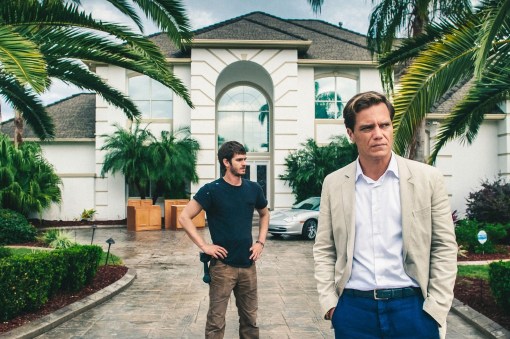
Over five years years ago, George Clooney’s Ryan Bingham arrived on screens to inform blue-collar workers they were out of a job in Jason Reitman’s “Up in the Air.”  A similar task falls to Andrew Garfield’s Dennis Nash, the protagonist of “99 Homes,” who enforces evictions in working-class Florida neighborhoods.  Bingham, however, could stay detached from the plight of the newly unemployed; Dennis can receive no such comfort.  Before becoming the man doing the evicting, he and his family were the evicted.
99 Homes

In order to provide for his son Connor and mother Lynn (Laura Dern), Dennis turns to the very person responsible for putting them in dire economic straits: the vile, e-cigarette smoking realtor Rick Carver (Michael Shannon).  While everyone suffers, his business booms, and Dennis is willing to sell his soul to his persecutor if it means putting food on the table.  Sure, he shares in some of the profits.  But, at the end of the day, Dennis heads back to the same kind of cheap motel to which he banishes countless other families.

Through Dennis, Bahrani brilliantly illustrates the sociological concept of false consciousness.  He buys into Carver’s policies and slowly deludes himself into believing he is of a higher class standing.  Carver, an unabashed believer that America only bails out winners like himself, takes the spoils and leaves workers like Dennis with the scraps.  Advancing out of their precarious position is merely an illusion.
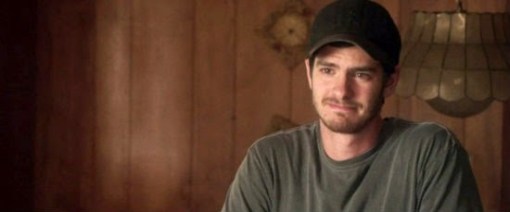
Garfield

If this sounds pessimistic, Bahrani earns the right with his intellectual depth.  “99 Homes” also wisely focuses on characters whose very livelihoods are in jeopardy because of the financial crisis.  Most films that have tried to grapple with the effects of the recession – “The Company Men,” “Margin Call,” “Arbitrage,” “Blue Jasmine” – only dare to assume the perspective of the upper-class descending to the middle-class.  Dennis and his family are not worrying about losing the Porsche or selling off the jewelry.  If they descend any lower, it is outright poverty and destitution.

Stemming from this standpoint, the stakes feel appropriately extreme enough both to feel deeply and contemplate thoroughly.  Bahrani often scores the film with tense, thriller-like music, and it works exceptionally well.  If the lives hanging in the balance and the severity of the moral compromises being made do not merit an increasing heart rate, nothing does.

99 Homes

If the film feels exaggerated and over the top, the financial crisis was an absolute nightmare for many families that felt borderline apocalyptic, so grandiosity is justifiable.  If it feels like a preachy morality play, at least Bahrani has his heart and mind in the right place.  He understands that the home is a symbol of heritage, inheritance, legacy, and personal pride.

Yet “99 Homes” communicates something more important.  The home itself is not the American Dream.  It is the well-being of the people inside of the home.  A-3halfstars


REVIEW: Cake

21 01 2015

CakeJennifer Aniston stars in “Cake” as Claire Bennett, a woman struggling with chronic pain following a tragic automotive accident.  The poster and production stills almost completely hide it, but she sports a deep and instantly noticeable scar on her face stemming from the traumatic event.

And, per usual in an indie drama, the emotional scars run far deeper.  She attends group therapy as well as physical rehabilitation only to undo their progress in a toxic cocktail of booze and painkillers.  Claire further masks her agony through biting, sardonic wisecracks, deflecting anyone from exposing her pressing need for help.

It would be wrong to assign the character sole responsibility for her continuing struggles; the maelstrom of physical and emotional pain presents a tough obstacle for even the strongest individual to overcome.  Claire’s self-destructive tendencies do not disqualify her from receiving sympathy, either, yet the movie’s myopic focus on her pity party feels … well, pitiful.

Not to discredit or downplay her anguish, but Claire is a wealthy, white Angeleno living comfortably in unexplained luxury.  Her inability to function in society, shockingly, never seems to raise doubts about the continuance of her lifestyle.  She never seems to worry about having the funds to procure pain pills in Tijuana, and she never entertains the possibility of a world without the invaluable assistance of her inexplicably loyal Hispanic maid and driver Silvana (Oscar nominee Adrianna Barraza).

Read the rest of this entry »


Paul Thomas Anderson’s On Cinema

20 01 2015

On October 4, 2014, I had the distinct pleasure of attending a talk where Paul Thomas Anderson elaborated on his inspirations and influences.  His knowledge and love of cinema shone brightly, leaving me quite rejuvenated in the power of the medium.  Basically, he would be the best film professor EVER.  Here are some highlights from that session.

Part 1

The program unfolded largely based on discussions following clips selected by Paul Thomas Anderson and, presumptively, moderator Kent Jones.  He began with an opening from “Police Squad,” a television show from the 1980s.  Not the first thing I associated with the director of “The Master,” I’ll be honest.

I knew the team behind “Police Squad” mostly for their inane “Scary Movie” installments, but I actually explored the older Abrahams-Zucker comedy on Netflix via “The Naked Gun” films.  Now I see where Anderson comes from when he descirbed the serious “hilarious, brilliant” and that it “doesn’t get any better.”

He rediscovered the joy of the show while watching videos on YouTube during smoke breaks, reminded how much the humor was ahead of its time.  Moreover, it made him remember that anything is possible.  That kind of energy plays out clearly in “Inherent Vice,” whether its Josh Brolin’s Bigfoot Bjornsen fellating a chocolate banana or Martin Short’s Dr. Rudy Blatnoyd doing lines of cocaine.  The gags are silly, but they are always clever.

Read the rest of this entry »


Random Factoid #572

19 01 2015

Welp, the Oscar nominations have been announced, and it looks like Jennifer Aniston is going to have to try again if she wants people to start calling her “Academy Award nominee Jennifer Aniston.”  (For what it’s worth, I am seeing “Cake,” her failed awards vessel, tomorrow night.)

A lot of people have hurled ridicule at Aniston for her formulaic rom-coms or her tabloid personality.  Some of the vitriol resembles the phenomenon of “Hatha-hate,” the extreme and baseless revulsion towards Anne Hathaway. I have certainly been critical of some of her less than stellar roles like the ones in “Just Go With It” or “The Bounty Hunter.”  For the latter title, I began my review with this sentence: “Have you ever watched a movie and wondered what could make an actor’s standards drop so low?”

But I have also noted Aniston’s slow move towards quality, such as her roles in “Horrible Bosses” and “We’re The Millers,” which are at least attempting to do something out of the ordinary.  Moreover, I featured an Aniston title in my “F.I.L.M. of the Week” column that highlights lesser-known films: “Friends with Money,” a superb indie that should have provided her with more credibility as a respectable actress.  (I thought I had written about “The Good Girl,” but I guess I did not.)

If I am just being honest, though, Aniston’s lasting impact for me consists of two scenes in two mediocre films, “The Break-Up” and “He’s Just Not That Into You.”  For whatever reason, the illustrations her characters give of complex situations are infinitely reusable and applicable to daily life.  Just ask anyone who knows me well, I have probably quoted one of these two scenes to them.

“I want you to want to do the dishes” works great when trying to explain that you desire a genuine gesture, not an empty one.

And “I just need you to stop being nice to me unless you’re going to marry me” works well for flaky, noncommittal people outside the realm of marriage and courtship.

I also love the line from “He’s Just Not That Into You” where Aniston is told by a friend, in a supposed gesture of comfort, “There are many people who never get married – look at Al Pacino, never been married, happy as a clam!”  And Aniston, flabbergasted, responds, “Would I be Al Pacino in this scenario?”  I also tend to feel like the Al Pacino in plenty of supposedly helpful illustrations about my life, though maybe that will change one day.


REVIEW: Heartbeats

18 01 2015

HeartbeatsXavier Dolan’s “Heartbeats” amounts to little more than a schoolyard game between the straight female Marie (Monia Chokri) and gay male Francis (Dolan) for the affections of a sexually ambiguous Adonis, the flirtatious and friendly Nicolas (Niels Schneider).  Holding him up as a physical ideal, they objectify Nicolas as a prize to win.  And since Dolan casts himself, determining where his sympathy lies hardly proves daunting.

But the story is hardly the story of “Heartbeats.”  The precocious Dolan loves playing with speed, motion, and movement; on the latter front, he could rival the widely recognized master, David Fincher.  At times, the style threatens to overwhelm the film by virtue of its sheer virtuosity.  Fincher once said, “They know you can do anything, so the question is what don’t you do.”  Dolan, somewhat problematically, does everything he can do, and the movie comes off a bit like a highlight reel.

Still, “Heartbeats” tingles with the sexual energy of Alfonso Cuarón’s “Y Tu Mamá También,” mostly because of its powerful visual language. Dolan, impressively, manages to leave it unconsummated.  Possibilities and suggestions float through the air, yet they mostly just linger there.  Though Dolan goes all out with his bold technique, the beating heart of the film is anchored in this very authentic representation of love and desire.  Such a portrayal makes the film both watchable and enjoyable, even after the seemingly endless parade of mini-music videos.  B2halfstars