Telluride Film Festival Diary, Day 2

30 08 2014

9:15 A.M.  Good morning from Telluride!  Looks like today is going to be an action-packed day of moviegoing and talking with filmmakers.  I had to be up for a discussion at the ripe hour of 7:15 A.M. today, which was just as much fun as a barrel of monkeys!

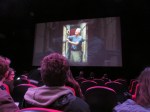
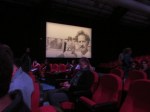
This morning’s festivities kick off with a screening of Mike Leigh’s “Mr. Turner,” which won the Best Actor prize at Cannes this year.  While you wait for my reaction, perhaps you’d like to see some of my pictures that I’ve been taking?!

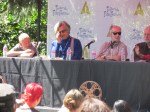
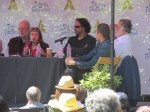
12:15 P.M.: I’m at a panel right now that includes…

Mike Leigh
Wim Wenders
Werner Herzog
Alejandro Gonzalez Inarritu
Francis Ford Coppola
Ethan Hawke
Walter Murch

HOLY CRAP.
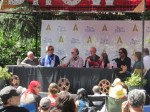
Also, “Mr. Turner” was quite good, too.

3:27 P.M.: So, where to begin on the past three hours. Getting to be in conversation with Francis Ford Coppola for an hour was insane. Hearing from the insanely normal and approachable Xavier Dolan was neat, too. Although it’s pretty hard to top getting to meet Leonard Maltin, whose movie guides were always on my bookshelf growing up. I told him how much those meant to me, and he was clearly very humbled to hear those words. Then we got to talk about film criticism for a few minutes … simply incredible.

3:45 P.M.: Not going to lie, I’m not the most excited for our next selection, some 40 year old German film called “Baal.” I should go in with more of an open mind, but knowing that I’m in here and “Foxcatcher” is out there…

9:45 P.M.: So “Baal” was awful and basically a waste of my time, as predicted. Then essentially none of my student group got into “The Imitation Game,” despite the fact that we were supposedly guaranteed seats more or less. Guess I’ll have to catch this flick that’s being hotly tipped for Oscars on Monday … add it to the list with “Foxcatcher.”
Bennett Miller, Channing Tatum, and Steve Carell

Bennett Miller, Channing Tatum, and Steve Carell

So now I’m in line for Ramin Bahrani’s “99 Homes,” a film starring Andrew Garfield and Michael Shannon that premiered to acclaim in Venice this week. Of course, there was a free outdoor screening of “Foxcatcher” that just had to overlap with this screening by 15 minutes. But no, I guess I’ll just have to keep hanging…

P.S. – Celebrity sightings today include Laura Linney (just chilling solo outside a theater) as well as Steve Carell and Channing Tatum outside the “Foxcatcher” screening.

10:28 P.M.: Laura Dern spotted at “99 Homes.”

1:13 A.M.:  Back in bed still reflecting on and reeling from “99 Homes.”  Not that I don’t want to immediately post a review (because I could probably cobble my thoughts together now), but I desperately need some sleep and have a rare chance to get two full cycles.  Good evening (though it’s doubtful anyone is reading this live)!
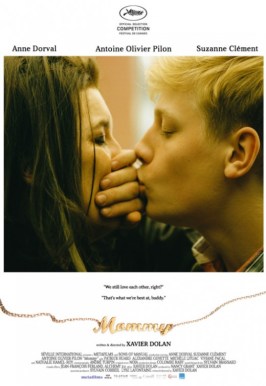


REVIEW: Mommy

30 08 2014

mommyTelluride Film Festival

Fascination with portraying a particular kind of relationship on screen is not necessarily a bad thing – just look at how many compelling films Martin Scorsese has turned out about fathers and sons.  When that fascination turns to fixation, though, further exploration can just wind up being counterproductive.

That’s the case with wunderkind Xavier Dolan, releasing his fifth feature film “Mommy” at the ripe old age of 25.  It’s certainly an accomplished work with plenty to laud: namely, Dolan’s mastery of music and montage.  To those unfamiliar with his work, the film may come across quite unique and fresh.

Yet dig back into Dolan’s filmography to find his debut feature, “I Killed My Mother,” which is essentially the same film as “Mommy.”  Both put a dysfunctional mother-son relationship at their core and takes a look at the way each party drives each other towards insanity.

In “Mommy,” Antoine Olivier Pilon plays a foul-mouthed teen, Steve, who suffers from ADHD and other afflictions.  He clearly tries the patience of his mother, Anne Dorval’s Diane, who’s no angel herself.  Dolan sets their misadventures in an alternative Canadian reality where Diane could have Steve involuntarily committed to a hospital, and it’s clear that easy route is never far out of mind.

“Mommy” also introduces a third character into the mix (“I Killed My Mother” was essentially a two-hander), Suzanne Clement’s friendly neighbor Kyla.  She agrees to help homeschool Steve while his mom is out working, which results in her becoming somewhat like a regular family member.  What exactly Kyla adds to the mix – or what Diane and Steve want to take away from her – is never expressly clear, giving “Mommy” its sole bit of tension.

Read the rest of this entry »


Telluride Film Festival Diary, Day 1

29 08 2014

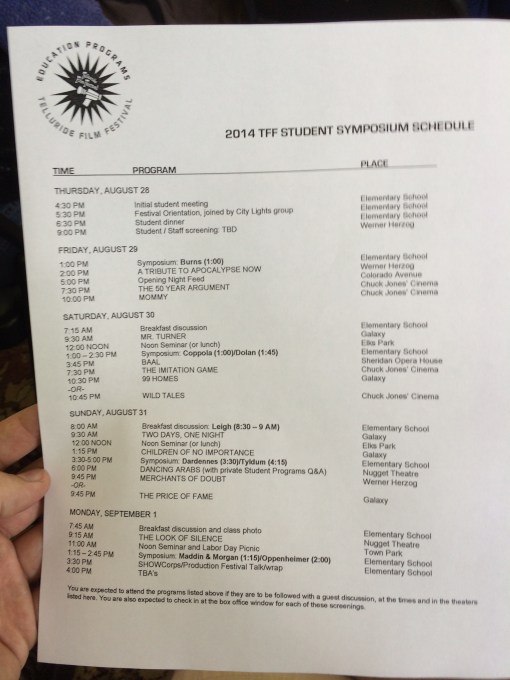
12:45 P.M.:  TGIF, everyone!  I’m headed into a packed day that will have me at some incredible events.  For all those who are really dying to know, here’s the schedule I’ve been given for the festival.

TFF Schedule

As far as I can tell, I will be at the world premiere of “The 50 Year Argument” (which is Martin Scorsese’s latest documentary) and the North American premiere of Xavier Dolan’s “Mommy.”  And then … a 35th anniversary tribute to “Apocalpyse Now” will have Francis Ford Coppola in person along with several below-the-line talent.  Incredible.  Geeking out so much.

1:00 P.M.: Ken Burns in the house!

1:49 P.M.: Only had about 20-25 minutes with Ken Burns, but he certainly had quite a lot to say! I’ll write up some of his profundities later. But meanwhile, I’m now at the 35th anniversary screening of “Apocalypse Now” with Francis Ford Coppola in the house!

2:00 P.M.: Spotted Mike Leigh at the “Apocalypse Now” screening.

5:30 P.M.: Left In stunned silence once again by “Apocalypse Now.” And learned so much about its construction and intention from FFC and gang.

5:50 P.M.: Now at the “feed” for the festival (basically a picnic for all badge holders, including talent). Free dinner and drinks. Plus sightings of Ken Burns again on a business call – and Chaz Ebert, Roger’s widow.

6:50 P.M.: Spotted Jon Stewart. Some people went to bother him in conversation, and apparently he was receptive enough to take a picture. I was not so bold, though.

9:22 P.M.: Just emerged from the Scorsese documentary on the New York Review of Books, “The 50 Year Argument.” Mike Leigh was sitting behind me, and after the film, he seemed to linger a tad bit when he heard me discussing the film with others.

This documentary is going to be broadcast on HBO in a few weeks, and I advise you to skip it. Or do laundry while you watch it. Unless you have a connection to the Review, you’ll probably find this self-congratulatory anniversary celebration a tedious and slow paced history lesson. (Still deciding whether or not I’ll give it a full review since it’s not made for a theatrical release.)

Anyways, back in line now for Xavier Dolan’s “Mommy.” Quite excited for this one, which took home the Jury Prize at Cannes this May.

12:45 A.M.: Wow, what a long and draining day. I must say, I did prefer “Mommy” when Xavier Dolan called it “I Killed My Mother” five years ago.


REVIEW: Birdman

29 08 2014

Telluride Film Festival

I hardly think it counts as a spoiler anymore to say that “Birdman” (sometimes also credited with the title “The Unexpected Virtue of Ignorance”) is edited to make the majority of the film appears as if there are not edits.  This does not, however, mean the film is intended to give us the illusion of unbroken action.  Breaks in time and space are quite clear, yet the effect of the long take remains.

Director Alejandro G. Iñárritu, as he would now have us call him, achieves the herculean feat of collapsing a timeline of roughly a few weeks into pure continuity.  He’s less interested in continuous action as he is a continuous feeling or sensation, an invigorating break from the oneupmanship that seems to come baked in with long-held takes.

Waiting for a cut or edit in a shot is like waiting for pent-up tension to be relieved, an indulgence Iñárritu refuses to grant.  (Leave it to the man who gave us the debilitatingly bleak “Biutiful” to make us writhe.)  “Birdman” follows Michael Keaton’s Riggan Thompson, a former blockbuster superhero star, attempting to win back his legacy in a flashy Broadway play.  He has struggles aplenty, both with his inner demons and the cast of characters around him, and the film certainly does not shy away from trying to replicate his anxiety in the viewing audience.

This is not just pure sadistic filmmaking, though; Iñárritu’s chosen form matches the content of the story quite nicely.  The film feels consistently restless and anxious, and not just because of the consistent drumming the underscores the proceedings.  These sensations are contributed to and complimented by Emmanuel Lubezki’s cinematography.

After his work on “Children of Men,” “The Tree of Life,” and “Gravity,” it’s a wonder Lubezki had any surprises left in store.  “Birdman” may very well be his most accomplished  cinematic ballet to date, though.  There’s an art and a purpose to every position occupied or every shot length employed.  Pulling off some of these constantly kinetic scenes must have required some intensely detailed blocking with Iñárritu and the cast, but the level of difficulty makes itself apparent without screaming for attention.

Read the rest of this entry »


Telluride Film Festival Diary, Day -1

28 08 2014

1:39 P.M.: Hello everyone! I’m typing this on my phone in a limo (read: dinky beat up van that calls itself a limo) somewhere in southwest Colorado on my way to the Telluride Film Festival! For those who don’t know, this small and intimate festival has been a launching pad for multiple Best Picture winners over the past several years. It’s a tightly curated selection that doesn’t release its program until the day before the festival (AKA today).

So I took a blind leap of faith coming here, not having a clue of what I would be seeing or doing. I’m at Telluride thanks to their Student Symposium, which selects roughly 50 students to come participate in a 4-day intensive of all-out cinephilia in the Rocky Mountains. (I’m also here thanks to the generosity of my parents and the flexibility of my teachers, who I’m sure couldn’t have been too thrilled with me peacing out from class after only one session.)

If you’re curious about what I have the opportunity to see, you can look at the program HERE. I’ve heard that apparently our staff screening tonight is Alejandro Gonzalez Inarritu’s “Birdman,” which just premiered in Venice to rave reviews across the board. I won’t have too much choice in what I see, but hopefully I’ll be able to catch “Foxcatcher” and “Two Days, One Night.” Seeing “Wild” or “99 Homes” wouldn’t bother me either.

Anyways, that’s all for this first update. l’m going to try to give as close to live updates as possible via my festival diary. Unlike at my two years of Cannes, I have a much more definitive schedule as well as access to cellular data.

8:40 P.M.: THE STAFF SCREENING IS BIRDMAN. All strapped in to be one of the first audiences for a sure-fire Best Picture contender.

11:40 P.M.: Solid B, maybe a B+ for “Birdman.” Stylistically fascinating but characters needed some work.


REVIEW: Supermensch: The Legend of Shep Gordon

27 08 2014

SupermenschHe met Janis Joplin and Jimi Hendrix on his first day in Hollywood.  He entertains everyone from Groucho Marx to the Dalai Lama.  He invented the celebrity chef.  He is … the most interesting man in the world.  (Or he might as well be.)
Those are only a few high points from the unbelievable career of manager Shep Gordon, the subject of documentary “Supermensch: The Legend of Shep Gordon.”  He’s got a treasure trove of stories as well as a pretty remarkable track record in terms of what he accomplished.  Every savvy business move or serendipitous encounter leaves us all the more incredulously agape.

The film is essentially a greatest hits album for the backstage string-puller behind some of the biggest acts of the past five decades.  He’s like the Edward Bernays crossed with Harvey Weinstein, a master of grabbing the public imagination for his clients, who have included Alice Cooper, Teddy Pendergrass, and Emeril Lagasse (just to name a few).

“Supermensch” manages to be entertaining and even somewhat informative without feeling like an MTV special, a feat that should not be downplayed.  The film is directed by Mike Myers – yes, the guy who played Shrek and Austin Powers – in his feature debut, and he actually does a pretty bang-up job.  Perhaps most impressively, he doesn’t let his own ethos slip into the film and outshine Gordon.  I could have done without some of his corny graphics and B-roll, but Myers weaves a yarn that’s fun to watch whether you’ve heard of his subject or not.  B+3stars


REVIEW: Palo Alto

26 08 2014

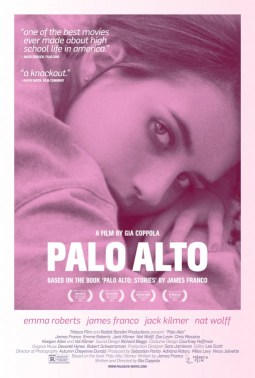
Palo AltoAt a high school party indistinguishable from any other, Emma Roberts’ April has a conversation of unusual candor with Jack Kilmer’s Teddy.  Though she acts confidently in front of others, putting on airs to impress her peers and returning volleys from flirtatious soccer coach Mr. B (James Franco), she’s sheepish and restless.  He, on the other hand, is a misunderstood rebel drifting from disaster to disaster but somehow retains an impeccable sense of self-worth.

All the stars appear to be aligning for them to take their connection to the next level; however, a communication breakdown as well as a few stray glances lead to misinterpreted gestures.  This party at the beginning of “Palo Alto” sets April and Teddy on separate courses, each taking them increasingly further away from converting the potential energy from that evening into a kinetic spark.

They wander aimlessly towards dissatisfaction and frustration, but they do so with an eerie sense of knowledge that each further step is to their deteriment.  April and Teddy are not quite sure what they seek, though it seems impossible to attain.  This indescribable yet palpable disparity between reach and grasp that makes “Palo Alto” such a searing film about being lost in the mess that is high school.

Though it’s tempting to write off these feelings as “teen angst,” first-time director Gia Coppola treats April and Teddy’s self-estrangement as a very adult matter.  With such a seriousness, “Palo Alto” comes off as a film more in the mold of domestic drama “Little Children” than YA weepie “The Perks of Being a Wallflower.”  Coppola treats the longing glances of high school students with empathetic solidarity, not with derision or patronization.

Read the rest of this entry »


REVIEW: The Double

25 08 2014

The DoubleIt’s always interesting to see how two different filmmakers approach the same text and wind up with completely different interpretations.  Richard Ayode directly derives his film “The Double” from a novella of the same name by Fyodor Dostoyesvsky, while Darren Aronofsky drew heavily from it to create his Oscar-winning 2010 masterpiece “Black Swan.”

These films are not cinematic siblings, so to speak, but they are blood relatives of sorts and provide a fertile ground for analysis in tandem.  The same blood runs through their veins, but they manifest its influence in divergent fashions.  At the very least, anyone who has seen “Black Swan” will come away from watching “The Double” with an appreciation for the many choices facing the artists tasked with adapting a text.  (And I make the assumption that the majority of people interested in the latter are the kind of moviegoers who made a point to see the former.)

Aronofsky’s take on the doppelganger tale results in a horror film replete with corporal anxieties, while Ayoade finds just about the opposite in the Russian yarn.  His film is a dark comedy that often times veers into the absurd.  Its bizarre flavor regarding the humor regarding the humdrum mechanisms of the workplace  is about as far from the werewolf-swan movie as one can get.

And yet, there’s still the same underlying fear of being replaced by a better version of yourself that resonates in “The Double.”  It’s somewhat clouded by the fog of Ayoade’s peculiar funnybone, but it’s nonetheless there.  Jesse Eisenberg, essentially playing the same stammering character that won him an Oscar nomination for “The Social Network,” is an inspired choice to convey this paranoia to an audience.  He begins the film as the timid Simon James and then later appears as the supremely confident James Simon to steal all the thunder in the world of work and romance with the alluring Hannah (Mia Wasikowska).

It’s too bad we’re used to seeing Eisenberg play this character because “The Double” comes off as a bit old hat for the actor.  Either James or Simon could pop up in any of Eisenberg’s other movies as a doppelganger to induce a similar identity crisis in the native character.  He’s really doubled down, so to pun-nily speak, on this bumbling neurotic everyman.  Once or twice more, and he may very well veer into the perilous grounds of self-parody.  B-2stars


REVIEW: Dallas Buyers Club

24 08 2014

It’s tempting to look at the flashy physical transformations of Matthew McConaughey and Jared Leto for “Dallas Buyers Club” and assume that the film’s allure lies solely on the surface.  (Not helping matters were the heaps of attention and awards for the actors while the below-the-line talent went virtually unrecognized.)  Director Jean-Marc Vallée actually does deliver a film, however, with a surprisingly deep amount of care in its crafting.

We first meet McConaughey’s tough-talking Texas cowboy Ron Woodruff as he womanizes, a scene which feels all too typical.  Yet pay attention to the way the sequence is spliced together, both visually and aurally, and you may notice how simply and effectively Vallée foreshadows Woodruff’s impending HIV diagnosis.  These flourishes, subtle as they may be, go a long way to prevent “Dallas Buyers Club” from hokey Oscar bait.

Flashy though their work may be, the beauty of McConaughey and Leto’s performances also comes from these smaller moments.  While it’s easy to marvel about how gaunt Leto appears or how seamlessly he disappears into AIDS-stricken trans woman Rayon, he’s at his most impactful when breaking down in tears over fretting imminent death.  The same goes for McConaughey, who gets to slowly peel away layers of calloused toughness to reveal humanity and empathy.

Read the rest of this entry »


REVIEW: The One I Love

23 08 2014

The One I LoveIt is not uncommon to see movies tackling troubled relationships, as human relationships and conflict are often two crucial building blocks of any great story.  “The One I Love” puts a couple on the verge, Mark Duplass’ Ethan and Elisabeth Moss’ Sophie, front and center from the very first scene.  We see them at a therapy session, only to be sent off immediately by their headshrinker (Ted Danson) to a secluded locale that has apparently worked wonders on other couples.
Yet after about the first ten minutes of the movie, all that we think we know goes flying out the door in Justin Lader’s ingenious script.  Writing any specifics about the premise might spoil all the fun of “The One I Love,” but think of it as all the dimension-defying surreality of “Alice In Wonderland” without the exaggerated acid trip.  In other words, there’s no way you could possibly mistake this movie for the 2009 Vince Vaughn comedy “Couples Retreat.”

The alluringly unique magical realism of the story also comes with a relatively fresh take on issues long debated in relationship movies, such as the things people look for in a relationship and the benefits they expect to derive from it.  The revelations of “The One I Love” may not be earth-shattering, but at least they feel profoundly felt thanks to the committed performances of Duplass and Moss.  The two actors play deceptively tricky characters, and they navigate every turn with brilliant poise.

Director Charlie McDowell, on the other hand, does not necessarily hit every note correctly in his feature debut.  “The One I Love” often jumps around in search of a genre, usually vacillating between a intimate, two-hander domestic drama and a suspenseful micro-thriller.  Lader’s script thankfully lends itself to some abruptly jarring shifts, and the lack of tonal unity winds up coming aiding the film’s unpredictability on a moment-by-moment basis.

Though I doubt any major studio would ever go this far out on a limb with a big project, “The One I Love” offers a fascinating example of a fairly conventional setup being executed brilliantly through a refreshingly unconventional script.  B+3stars


F.I.L.M. of the Week (August 22, 2014)

22 08 2014

As I said in my review of “Only Lovers Left Alive,” I have not seen enough of Jim Jarmusch’s work to make a definitive statement as to whether or not he is a great director. But I have seen Jarmusch’s 2005 Cannes prize winner “Broken Flowers,” which is enough to inform me that he has at least one great film to his name.

This dryly humorous pick for the “F.I.L.M. of the Week” is second wave Bill Murray at his best (yes, even better than “Lost in Translation“).  He seems to have reached a status where he seems to reject the need for validation through actively courting our laughs, instead just allowing the comedy arise naturally from the events.  Murrray can then just sit back, maintain a stolidly unruffled facade, and just let the bizarre run-ins of “Broken Flowers” guide his reactions.

In the film, Jarmusch casts him as an aging Don Juan – appropriately named Don Johnston – served with a letter that suggests he fathered a child 19 years prior.  Don would be content to never investigate any further, but his inquisitive neighbor Winston (Jeffrey Wright) insists that he go visit the potential mothers.  So, in a sort of inverted “Mamma Mia,” Don takes off on a series of painfully awkward encounters with former lovers.

The parade of women, including Sharon Stone, Frances Conroy, Jessica Lange, and Tilda Swinton, always entertains.  But Jarmusch isn’t just wheeling out stereotypes or stock characters.  “Broken Flowers” takes each of these women and sets them on an unpredictable but well-imagined path after their split with Don.  It can’t help but raise the question of what exactly his effect on these women was.

To say too much more of what each woman brings to the film is to spoil the fun.  But just dive head first into “Broken Flowers” for off-beat fun throughout and a startling conclusion that packs an unexpected punch.


REVIEW: Are You Here

21 08 2014

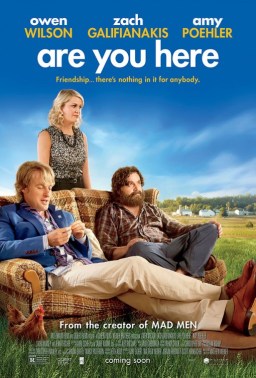
Are You HereBack in February, I got to see Matthew Weiner’s directorial debut at a special screening in Winston-Salem, NC, where the film was shot.  This event came about halfway between when the film known as “You Are Here” premiered to unanimous pans at TIFF and its eventual quiet theatrical/VOD rollout as “Are You Here.”
The film might have been recut some since that screening.  The level of retooling needed to save what I saw, however, requires change on a far greater scale than inverting the first two words of its title.  The film was a sloppy combination of slacker comedy, family melodrama, and improbable romance, a problem that is likely rooted in Weiner’s script.

It’s fruitless to size “Are You Here” up against an episode of”Mad Men” (the series Weiner created to the tune of all the Emmys) since the two aren’t even in the same league.  It might even be generous to say that the film is comprised of discarded ideas he had in the “Mad Men” writers’ room.  Better for his show’s legacy that he managed to put all the clichés on the silver screen instead of the small screen, I suppose.

Amy Poehler does redeem the film from being a complete trainwreck with a layered performance that gives her more dramatic depth than ever.  Her character, Terri, has lived by the rules and expects to reap the lion’s share of her father’s inheritance over her aimless brother Ben (Zach Galifianakis).  And whenever she gets screwed over by the will, it forces her to reexamine her values and priorities.

Read the rest of this entry »


REVIEWS: Leviathan, Manakamana (Harvard Sensory Ethnography Lab)

20 08 2014

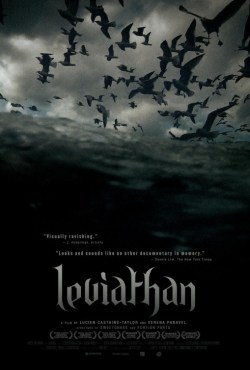
LeviathanIf you’re at all a fan of documentaries (or care about seeing the future of film aesthetics), you ought to begin familiarizing yourself with the work of the Harvard Sensory Ethnography Lab.  These groups of experimental filmmakers are beginning to push the form in exciting directions that are worth noticing.  They have not entirely hit their stride, but two recent features, “Leviathan” and “Manakamana,” are worth examining as potential harbingers of great things to come.
I don’t intend to give an informational survey as if you were applying for admission, especially since there are two superb write-ups in The New York Times and Boston Magazine.  But if I had to reduce their goals and aims into a single-sentence mission statement, the Harvard Sensory Ethnography Lab is aiming to document the wide range of experience on our planet through the use of uniquely innovative techniques.

I have a hard time figuring out what the actual first film of the lab truly was, but the first project of theirs that came to my attention was “Leviathan.”  This documentary, directed by Véréna Paravel and Lucien Castaing-Taylor, takes a look at the work of commercial fisherman in the American Northeast.  The approach to immersing us in that world is not to tell us about it, or even show it to us.  We have to feel it on a visceral level.

Paravel and Castaing-Taylor stick GoPro cameras just about anywhere they can and splice together their footage into something that often achieves hallucinatory heights.  No offense to your friends’ GoPro selfies on mountains, but “Leviathan” is the real deal in terms of utilizing the potential of these now seemingly ubiquitous compact cameras.  Simply trying to discern where the filmmakers placed the camera to achieve a given shot seems a herculean effort.

That lingering question about camera position quickly fades away, however, as we simply accept that these mesmerizing sequences of “Leviathan” lack a conventional center of gravity.  Freed from the constraints of traditional camera maneuvers, the film liberates us to allow the sensation of swimming through the water like a fish seize us entirely.

Sadly, “Leviathan” is not solely composed of these scenes.  At the opposite end of the spectrum from these formally daring scenes are portraits of the fishermen’s daily life that are far too naturalistic.  While the fishing is overwhelmingly kinetic, the still moments apart from the job are debilitatingly inert.  “Leviathan” might have been best served as a short subject documentary, taking somewhere in the range of 30-40 minutes to really showcase the brilliance of its aesthetic conceit.

Read the rest of this entry »


REVIEW: Carrie

19 08 2014

In terms of iconic decades-old horror movies, Brian De Palma’s “Carrie” probably ranks just beside Stanley Kubrick’s “The Shining.”  The 1976 film adaptation of Stephen King’s novel gave the world an unforgettable image – prom queen Carrie White soaked in blood – that most people recognize whether or not they actually saw the movie.

De Palma’s film has stood the test of time, however, not just on the stickiness of its imagery.  His take on “Carrie” is frighteningly well-made from a technical perspective, fusing eerie cinematography with a chillingly removed edit.  Not to mention, it is perhaps one of the best examples of fusing the ’70s “New Hollywood” spirit with the emerging commercial blockbuster.

So judging from the enduring strength of the original, there really appeared to be no reason for Kimberly Peirce’s remake of “Carrie” to come along 37 years later.  Thankfully, the film is not an overly reverent retread that matches its original nearly shot-for-shot.  But even so, this “Carrie” is a shadow of its former self that never quite successfully justifies its own existence.

Original “Carrie” screenwriter Lawrence D. Cohen updates the story effectively with co-writer Roberto Aguirre-Sacasa, taking into account factors like the rise of the Moral Majority as well as the sad phenomenon of cyberbullying.  In a way, it’s sobering to see how little change there has been in the high school experience for poor Carrie (Chloë Grace Moretz).  She is kept woefully uninformed about the real world by her fanatically religious mother Margaret (Julianne Moore) and is thus tormented by her peers for her naïveté.

Moretz’s performance brings all the tenderness from her work as a lonely teenage vampire in “Let Me In,” really allowing us to feel sympathy for poor Carrie.  And in stark opposition, Julianne Moore’s inspiredly demented work makes us absolutely despise Margaret.  (Also notable among the acting corps is Ansel Elgort of “The Fault in Our Stars” making a great screen debut as a popular classmate of Carrie’s who jokingly asks her to prom.)

Though the acting is good, it’s not enough to overpower the lackluster filmmaking.  Pierce relies far too heavily on CGI effects to provide the horror, and they feel particularly uninspired with their low intensity.  Without the unconventional, unpredictable filmmaking impulses of De Palma coursing through the veins of this “Carrie,” the film lacks greatly intensity and excitement.  C+2stars


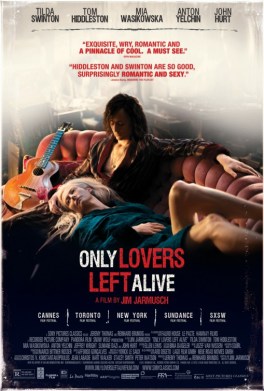
REVIEW: Only Lovers Left Alive

18 08 2014

Only Lovers Left Alive posterCannes Film Festival – Official Selection, 2013

I’ve listened to countless interviews with James Gray about his film “The Immigrant,” so many that I can’t pair a quote with a particular interview and thus cite it correctly.  But in one talk about filmmaking in general, Gray talked about how great directors are effective at conveying mood.

I haven’t seen enough of Jim Jarmusch’s filmography to make a definitive statement about whether or not he is a great director.  But I have seen his latest film, “Only Lovers Left Alive,” and I can say that simply because it has control of mood does not make it a great film.  Jarmusch favors ambiance over story development to a fault in his film that probably had its proper title, “Modern Vampires of the City,” stolen by Vampire Weekend’s latest album.

The film comes from an original screenplay by the director, and it certainly earns points for being clever.  “Only Lovers Left Alive” runs in a different direction with the current vampire fad,  portraying the bloodsuckers as hipsters hiding out in the latest haunt.  When we catch up with Tom Hiddleston and Tilda Swinton’s immortal lovers, wittily named Adam and Eve, he has shacked up in Detroit while she’s hanging in Tangiers.

It’s undeniably entertaining to get immersed in the distinctive universe Jarmusch has them inhabiting.  Watching them figure out how to get the blood they need to survive is cheeky fun, as is the creative ways they choose to consume it.  Not to mention, their demeanors and attitudes are so unexpected that it can’t help but be attention-grabbing.  (Hearing them name-drop some of their famous friends makes for a good chuckle, too.)

Read the rest of this entry »