REVIEW: Blue Ruin

20 07 2014

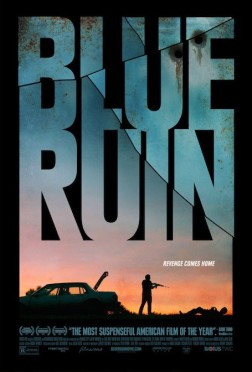
Blue RuinIn a current moviemaking climate where thrillers keep getting bigger, louder, and more involved, “Blue Ruin” provides a welcome change of pace.  Rather than rev his film’s engine to see how hard he can push it, writer/director Jeremy Saulnier holds his movie back with immense restraint.  It’s a fascinatingly controlled slow burn that’s executed with the utmost precision, resulting in a chillingly minimalist piece to watch.

At times, Saulnier’s extreme exactitude does come off a little cold.  We never really connect to the characters, nor do we really understand the psychology motivating them.  But that seems to be Saulnier’s modus operandi with the film, and it works just fine because he commits to it fully.

It’s not about this specific story but rather about what compels people in general to seek violent retribution.  (When they’re both available for home viewing, “Blue Ruin” would make a fascinating double bill with summer 2014’s “The Rover.”)  Saulnier provides precious little backstory on what’s compelling the film’s main character, Macon Blair’s Dwight, to seek revenge at all costs.  We keep thinking some giant explanation is coming, but it never does.

Normally, such vagueness in a film is equivalent to noncommittal or pure lack of imagination.  In “Blue Ruin,” though, it means exactly the opposite.  Rarely has so little meant so much.  B+3stars


REVIEW: The Congress

19 07 2014

The CongressAri Folman’s “The Congress” certainly cannot be faulted for any lack of ambition.  The director has fiddled with some seemingly unthinkable products in the past. “Waltz with Bashir,” after all, seems like an oxymoron (an animated documentary?!).

In that film, he used animation to explore questions of personal memory and conscience in the wake of a decades-old conflict between Israel and Lebanon.  Here, he’s shifted his focus westward to Hollywood.  Folman places his finger on the pulse of some very real anxieties in the City of Angels: motion capture replacing real actors, lingering fears of digitization, and the commoditization of celebrity, to name a few.

To explore these, he makes us of actress Robin Wright to play a fictionalized version of herself.  In “The Congress,” she’s an actress standing on the precipice of obscurity (the film was shot before “House of Cards” sparked a career revival) faced with a decision to sell her persona to the studios for digital “sampling.”

Folman’s commentary enters the realm of the satirical on many an occasion, recalling a justifiably little-seen film “Antiviral” where fans would inject themselves with viruses from stars to experience them further.  “The Congress” similarly follows its beginning concept, which doesn’t seem entirely out of the realm of possibility, logically into absurdity.  Along the way, Folman doesn’t hesitate to dole out copious amounts of shame to both the business that condones these developments as well as the public that consumes them.

Read the rest of this entry »


F.I.L.M. of the Week (July 18, 2014)

18 07 2014

GatekeepersWith flaring tensions between Israel and Palestine back on the front page, perhaps there is no better time to Dror Moreh’s Oscar-nominated documentary “The Gatekeepers.”  This selection for the “F.I.L.M. of the Week” is a rather unique look at the conflict from 1967 onwards, told through the eyes of six former heads of the Israeli internal security agency Shin Bet.

“The Gatekeepers” marks the first time that these important geopolitical figures have ever told their stories publicly, and their honest accounts show some of the reason why.  This account of history doesn’t hold back, showing fault and folly from all perspectives.  His subjects critique the effectiveness of their own actions as well as offering commentary on the successes and drawbacks of various leaders who ran the state.

While this is undeniably a film about Israel, the lessons learned from “The Gatekeepers” ought to hit home for American audiences as well.  We find ourselves in a position not unlike Israel’s as we strap in for the long haul in our war against terrorism.  They’re fighting what increasingly resembles a war of attrition, not a war to bring about peace – a situation which feels awfully familiar to us.

The frank discussions of these Shin Bet leaders about taking out their targets, even if it means collateral damage of innocent lives, are certainly not specific to their nation alone.  And as Moreh takes us through their tales, he makes us question how effective fire really is at fighting fire.  “The Gatekeepers” is remarkable in the way it takes one specific clash and makes us think about the nature of conflict in general.  Such deliberation and careful thought is perhaps now more important than ever.


REVIEW: The Purge: Anarchy

18 07 2014

Purge AnarchyWhen I was 6 years old, I visited my grandparents’ house while they were riveted to CSPAN coverage of the growing scandal embroiling then-President Bill Clinton.  Curious about what could possibly be so interesting, I asked everyone I came across who Monica Lewinsky was and what Clinton had done.
Just because I knew vague terms relating to what was happening in the headlines did not mean I was qualified to talk intelligently about political issues.  The same is true of “The Purge: Anarchy,” the sequel to last summer’s surprise horror hit.  This film, which went from studio greenlight to the multiplex in little over a year, tries to fool you into thinking it has some intellectual to say about contemporary society.

In reality, though, its social commentary isn’t half as deep as the ridiculous plot holes that mire the proceedings.  If the premise – all crime becomes legal for one night to ensure harmony for the other 364 – felt absurdly simple in “The Purge,” imagine a film where the studio puts the writer on such a time and money crunch that there’s no real time to think it through.  That’s “The Purge: Anarchy” in a nutshell.

Writer/director James DeMonaco really runs with the spirit of 2011, creating a film that would make many an Occupy member giddy with its vitriol directed towards the one percent.  He hints at tackling gun violence, economic inequality, and corporate control of government, but he’s incapable of forming a coherent thought about any of them.

Perhaps most tellingly of how facile “The Purge: Anarchy” really is, DeMonaco completely collapses the issue of class conflict into race war.  The rich are all white, and the poor are almost entirely black (and are led by a Samuel L. Jackson impersonator).  While race is undeniably a large part of discussions of social status, it cannot account for it entirely.  By discounting all other factors, DeMonaco squanders a chance to get his audience thinking about pressing questions.

It’s not likely they would do so, anyways, given how ridiculously the rest of the film plays out.  The proletariat protagonists are all too simple to elicit sympathy or our worry for their survival.  The rich villains, in DeMonaco’s rush to indict them, turn out to be little more than parodic figures.  The storyline does nothing to expand up on the original; in fact, “The Purge: Anarchy” really only serves to dumb down the future franchise so the films can be churned out like Big Macs.  C2stars


REVIEW: Elaine Stritch: Shoot Me

17 07 2014

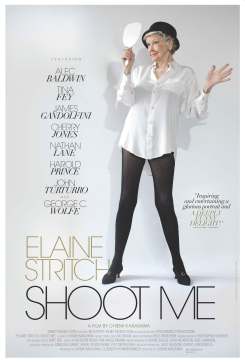
Elaine StritchJust last weekend, I curled up in bed with my laptop to watch “Elaine Stritch: Shoot Me” on Netflix.  I found myself pleasantly entertained, but in the midst of an onslaught of new releases, I didn’t have a chance to bang out a quick review.  Then, I was checking the news at work this morning and saw the sad news that Elaine Stritch had passed away at the age of 89.

Suddenly, a review the documentary that had her at its center felt like the most important thing for me to write.  Though I may have to write in a different tense about Stritch’s life now, her legacy lives on and will certainly never be forgotten.  “Elaine Stritch: Shoot Me” gives Stritch the proper bow for her twilight years, and fans of an old era of Broadway stars will no doubt find it rousing.

Chiemi Karasawa’s film captures some of her final years as she prepares for a swan song cabaret of Steven Sondheim’s classic tunes.  Her camera catches the infamously blunt Stritch at her most cantankerously acerbic best on many an occasion, generating quite a few great laughs.  But as Tina Fey puts it, people are willing to put up with her curmudgeonly charm because she’s so great at what she does.

Karasawa does a great job of showing Stritch’s incredible work ethic.  Even though disease and age hampered Stritch from being at full capacity, she still pushed herself to play a recurring role on “30 Rock” and give her fans one last chance to see her perform live.  The back half of “Elaine Stritch: Shoot Me” consists of mostly watching Stritch belt out some Broadway melodies, a delight for fans of musical theater (and likely a bore for anyone else).

The true strength of the documentary, though, is not watching Stritch’s pantless performances.  “Elaine Stritch: Shoot Me” is so much more than filmed theater; it’s a look at a performer confronting her own mortality.  Stritch preferred to say that she was not getting old – she was getting older, just like everyone else.  She approached the prospect of her aging with humor in public, often quoting Bette Davis’ maxim “getting old is not for sissies.”

Karasawa’s extreme close-ups, however, penetrate deeply into Stritch’s psyche and show a startling vulnerability.  These moments are nothing short of stirring as they reveal her deep fears of disappointing her audience.  Fans of Stritch will undoubtedly be moved by seeing a consummate actress let her guard down.  Playing herself was perhaps the most gripping part she ever had.  B+3stars


REVIEW: Wish I Was Here

16 07 2014

Wish I Was HereZach Braff’s “Wish I Was Here” caught a lot of flak for raising additional funds through crowdfunding on Kickstarter, so I found myself watching the film with an especially sharp eye on how the budget was being spent.  My friend and I found ourselves, perhaps cynically, coming to the conclusion that Braff was using the fans’ money on less necessary frills like a Maserati or the sporadic CGI-heavy sci-fi reveries.

Yet if these somewhat excessive flourishes are what it takes to get an otherwise deeply felt movie like this made, I will make that trade-off every day of the week.  “Wish I Was Here” is an uncommonly thoughtful dramedy about life and death, a breed of film that has sadly become an endangered species.  What Braff crafts is something akin to a Woody Allen film scored to the Bon Iver Pandora station.

That’s not to say, however, that Braff has quite the effortless mastery of Allen’s best.  He doesn’t quite grasp the often tricky economy of ensemble comedy, bungling subplots involving Josh Gad and Kate Hudson.  And at times, the film gets a little bit uncomely in its wild fluctuations of tone.

But even so, “Wish I Was Here” is rather endearing.  Its brand of messy is a lifelike one, not a lazy or sloppy filmmaking one.  Braff throws everything he’s got against the wall – I like to believe it’s everything he’s been thinking in the decade since “Garden State” – and not all of it hits.  What does stick, though, teems with such raw and poignant emotion that it’s easy to overlook the film’s faults.

Read the rest of this entry »


REVIEW: Sex Tape

15 07 2014

Sex Tape” plays (pun fully intended) like a filmed first table read of the script in many ways.

All the plot holes, inconsistencies, and just plain implausibilities have yet to be ironed out of the story.  You can see the promise of the premise, but it just hasn’t been realized yet.  Not to mention, someone needs to sit down and bang out another draft or three of the screenplay.

Some of the good jokes are there, too.  “Sex Tape” features a quite entertaining supporting cast, topped by Rob Lowe as a ridiculously eccentric and bizarre corporate exec, that carries the film.  It lifts gags liberally from other films (stealing rather egregiously from “Father of the Bride”), some of which work when grafted into the storyline.  Others feel rather tired and could have been replaced with fresher, more memorable laughs.

Perhaps the biggest indicator, though, that the film is stuck at table read status is the energy level.  “Sex Tape” is an hour and a half of unbridled energy, particularly from leads Cameron Diaz and Jason Segel.  Normally, that would be a compliment, but it’s a critique here as director Jake Kasdan mistakes yelling and exaggeration as a substitute for humor and humanity.

Hypothetically, if I had a sex tape of myself in the hands of friends’ iPads, I’d probably be ending all my sentences with five exclamation points like Segel and Diaz’s characters Jay and Annie.  But they are so over-the-top that it’s hard to connect to them in any way.  They don’t feel like real people, so it limits how much we actually care about whether or not they can keep friends and family from seeing their three-hour sexual odyssey.

In fact, if I had to guess, Segel and Diaz spoke all their lines in excitement after seeing the bonus check they were getting from Apple for all the blatant product promotion.  It would certainly explain why “iPad” is every other word in the movie; even reality TV writers can hide their corporate sponsors more subtly.  C2stars


REVIEW: Boyhood

14 07 2014

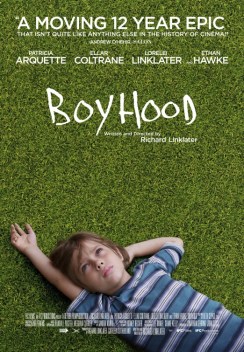
BoyhoodWriter/director Alexander Payne has said of cinema’s advent, “I think that mankind had been looking for this magnificently verisimilar art form which really mirrors life.”  And like an answer to an unspoken prayer, “Boyhood” arrives after over a century of narrative cinema to show that the medium has far from exhausted its capabilities of wondrously recalling life beyond the screen.

Richard Linklater’s film is at odds with notions of conventional fictional cinema, resembling a curated ethnography in its creation.  “Boyhood” condenses twelve years of shooting a young boy growing up through his grade school years into under three hours, not into a prescribed narrative arc but into a singular sort of time capsule.

It’s not crossing off significant life experiences of childhood and adolescence from a preordained bucket list.  It’s not out to provide an alternate cultural history through a child’s eyes.  It’s not trying to make some grand statement about the ever-changing nature of boyhood (nor about the various things that seem to stay the same).  It’s not even necessarily moving towards any sort of dramatic climax other than the ultimate one we all have to face, that of the end of time.

Instead, “Boyhood” focuses mostly on the mundane moments and the routine conversations, so literally portraying “slices of life” that no film can really lay claim to the phrase anymore.  Yet in the sheer act of capturing these everyday occurrences, Linklater elevates the profane to the level of sacred.  These brief and otherwise insignificant flashes of childhood are nothing, yet they are also somehow everything.

Read the rest of this entry »


REVIEW: Chef

13 07 2014

Summer 2014 might host the documentary “Life Itself” that exalts critics, yet it also boasts Jon Favreau’s “Chef” that tears them down.  In the film, director Jon Favreau steps in front of the camera as Carl Casper, a chef whose meteoric rise in the culinary world has coasted to a plateau preparing dishes for the elite by the time we meet up with him.  Critics help build his reputation, but they are also apparently responsible for tearing it down.

Forced by his boss to prepare a rather formulaic meal when an influential foodie blogger Ramsey Michel (Oliver Platt) stops by and subsequently receives a write-up indicating disappointment.  In his eyes, however, Casper might as well have received a review similar to that one of Guy Fieri’s restaurant penned by Pete Wells of The New York Times.  The now-notorious lambasting featured the critic mercilessly hurling rhetorical questions at the chef to the point where it seems like a personal vendetta.

Favreau bakes his opinions on the critical establishment following the roasting of his 2011 film “Cowboys & Aliens” into “Chef,” indicating an almost personal affront to the negative notices.  His attitude towards reviewers resembles that of a petulant child refusing to believe he can do anything wrong.  And despite a slapped-on ending to redeem the critics, Favreau never seems to acknowledge that he might just share a common goal with them – that of promoting and advancing a craft.

Read the rest of this entry »


REVIEW: Tammy

12 07 2014

With their collaboration on “Tammy,” writer/star Melissa McCarthy and writer/director Ben Falcone construct what may very well be the cinematic equivalent of Sarah Palin’s infamous “bridge to nowhere.”  It’s a film about a road trip to nowhere that gets everyone involved in its making nowhere.

Coming off an Oscar nomination and three box office hits, it’s a shame McCarthy spent what was likely carte blanche with the studios on a project that offers nothing new for her talents.  Even though she was so heavily involved with the film’s creation, “Tammy” offers little humor other than jokes at the expense of her character’s weight or lacking mental capacity.  It’s almost as if she wants the two characteristics to be linked, which baffles me.

Was the point is to prove that McCarthy can play the woman-child archetype as well as, say, Vince Vaughn can play the man-child?  Or that a character like McCarthy’s Tammy can pull in a romantic conquest in spite of her figure and eccentric personality?  I could maybe see “Tammy” sounding like a great feminist victory in its premise, yet in execution, the movie is every bit as bumbling as its titular character.  If McCarthy really wanted to do something radical, she should have made a film where her figure was never addressed at all.

Over the course of 96 minutes (that feel much longer), Falcone and McCarthy give us a whole lot of time on the road with Tammy and her grandmother Pearl, an alcoholic played by Susan Sarandon.  Tammy and Pearl don’t quite have any grand purpose to be road tripping in the first place other than … well, something had to give “Tammy” a plot!

The quite-literal journey in the story is the perfect opportunity to explore a similar progression in the protagonist, but they can never quite figure out what virtues or values Tammy is going to discover.  The film toys with the idea of her gaining self-appreciation while also contemplating a familial love angle, never taking the time to fully develop one or the other.  It ultimately slaps on an ending favoring a rediscovered bond between its two female leads, and the conclusion feels rather unearned.

That’s not to say that McCarthy did not earn the opportunity to make “Tammy,” though.  The fact that this is film she chose to make from that position, however, is likely to remain a question mark for the rest of her career.  C-1halfstars


REVIEW: Dawn of the Planet of the Apes

11 07 2014

Dawn of ApesThe dominant attitude that seems to prevail when making sequels is to give people more of the same.  If it functioned well enough the first time to justify a second helping, something had to be working, right?

Matt Reeves’ “Dawn of the Planet of the Apes,” on the other hand, completely defies the logic.  While Rupert Wyatt’s 2011 series reboot “Rise of the Planet of the Apes” focused on scientific ethics and human progress, its follow-up goes in a completely different direction.  If it weren’t for the astonishing motion-capture apes, the casual onlooker might not even be able to pair the films in the same series.

I must applaud Fox, the studio willing to front the $170 million budget, for allowing a new director to take one of their most vital franchises into uncharted territory.  Reeves uses no marquee names (unless you count Gary Oldman), focuses mainly on the apes, and never caves to a large-scale battle that could level an entire urban area.  That was likely not an immediately confidence-inspiring vision, especially given the tepid commercial reception to Reeves’ 2010 arty horror film “Let Me In.”

But “Dawn” works so well because it does not feel tethered to anyone’s agenda other than that of its creative team.  The film has the ability to explore what the series can be as opposed to how much it can stretch what it already is.  Reeves makes some exciting discoveries with this freedom that further energize what was already a fascinating franchise.  He leaves us excited for whatever sequel may follow, despite leaving no obvious indications of what the next film might entail.

Read the rest of this entry »


F.I.L.M. of the Week (July 11, 2014)

11 07 2014

Gimme the Loot

I saw plenty of crap on the Croisette back in 2012, mainly because I was so obsessed with seeing hyped Cannes official competition titles like “On the Road” and “Cosmopolis.”  Not only did those turn out to be duds, but the time I spent trying to see them precluded me from finding smaller gems at the festival.  Had I been smart, I would have sought out a film like “Gimme the Loot,” Adam Leon’s feature debut that percolates with an exciting energy.

This pick for “F.I.L.M. of the Week” (for those who might have forgotten, that’s First-Class, Independent Little-Known Movie) announces the arrival of a fresh new voice in cinema.  Leon, in just 75 minutes, crafts an engaging film that tells a more complete narrative than some films twice its length.  (Cough, “Django Unchained.”)

Leon also looks at New York, quickly becoming the hipster capital of indie cinema, from an invigoratingly different perspective – that of two teenaged graffiti artists.  “Exit Through the Gift Shop” this is not, though.  Out to prove they can accomplish the mythical feat of “bombing,” or tagging with graffiti, the big apple at Shea Stadium, Malcolm (Ty Hickson) and Sophia (Tashiana Washington) scour across the city to procure the necessary funds to gain the access they need.

Their quest takes them head to head with rivals, awkwardly phoning in old debts, and trying to swindle clueless upper-class whites.  Malcolm and Sophia split up for a good chunk of the film, but the joys of “Gimme the Loot” come from watching their interactions.  Hickson and Washington set up such a fun, interesting dynamic between their characters that feels nothing less than authentic.  The friendship is so believable that they might as well be siblings, bluntly bickering from a place of deep love.

Leon allows the film to play to the strength of his performers, yet it still reflects his prowess as a filmmaker.  It highlights a class and race divide in New York City without ever being preachy … or without really even calling attention to itself.  When it comes to cinematic treats, this is one sweet loot.


REVIEW: Life Itself

10 07 2014

Life ItselfFilm critic Roger Ebert inspired many people and touched countless lives, ranging from saving Martin Scorsese from self-implosion to many much smaller-scale interactions.  One such example is a brief response to a blog comment he made to a then-sixteen year-old movie writer who had just decided to try his hand at scribbling down his opinions about film.

In case you hadn’t guessed, that writer was me, and I still count that sentence among the greatest compliments I have ever received.  (It still, to date, features underneath the name of my site in the header of my blog.)  It likely didn’t take him more than five seconds to write, but it may very well have provided the fuel to sustain the site beyond just dipping my toe in the uncharted waters of the blogosphere.

Life Itself,” Steve James’ documentary on Ebert, provides the ultimate celebration of his life and work.  He gathers an eclectic group of friends and admirers, a tribute to just how wide-reaching Ebert’s influence and esteem truly was.  Anecodotes and commentary range from members of the critical establishment like A.O. Scott and Richard Corliss to filmmakers who he befriended over the years, such as Scorsese, Werner Herzog, Errol Morris, Ramin Bahrani (“At Any Price“), and Ava DuVernay (“Middle of Nowhere“).

Read the rest of this entry »


REVIEW: Jodorowsky’s Dune

9 07 2014

Jodrowsky's DuneCannes Film Festival – Director’s Fortnight, 2013

Is it possible that one of the most influential forces in the history of cinema as we know it was a film that wasn’t actually made?  That’s the case made by director Frank Pavich in his documentary “Jodorowsky’s Dune,” a celebration of a landmark in science-fiction cinema that never left pre-production.  And darned if we aren’t educated, entertained, and slightly awe-struck by the time the film ends.

The popular novel “Dune” ultimately did meet the silver screen in David Lynch’s 1984 cult classic.  But that would pale in comparison the version Alejandro Jodorowsky, Mexican master of the surreal, was planning in the mid-1970s.  Involving everyone from Pink Floyd to Orson Welles and even Salvador Dalí, his take on “Dune” would certainly be unlike anything the movies had ever seen.

But rather than mourning the midnight movie that could have been, Pavich uses his documentary as a platform for celebrating the boundless creativity of Jodorowsky and all the obstacles such a singular vision can create.  It’s undeniably fun to watch Jodorowsky interviewed about all his grandiose plans, and such energy serves as a wonderful reminder of how blissful it is to watch a director revel in the joy of moviemaking.

Pavich also takes care to show us all the ways in which Jodorowsky’s unfinished project trickled out into the industry and popped up in several landmark films.  Featuring appearances by acclaimed filmmakers like Nicolas Winding Refn (who dedicated his Cannes 2013 entry “Only God Forgives” to Jodorwosky) along with rabidly zealous journalists such as Devin Faraci and Drew McWeeny, “Jodorowsky’s Dune” makes for one heck of a party for the cinema.  Its allure is practically impossible to resist if you love movies.  B+3stars


REVIEWS: Nymphomaniac, Vols. I and II

8 07 2014

Nymphomaniac

There was understandably a lot of talk surrounding the alleged pornographic content of Lars Von Trier’s “Nymphomaniac,” a two-part, four hour opus on human sexuality.  It got plenty of coverage online – thank you, always horny Internet users who fall for the first click-bait title about sex – and I honestly was never quite sure if the actors were participating in live acts or not.

But I sat through the entire film (albeit in two sittings) and hardly found the explicit content to be the most off-putting thing about it.

In fact, it rather made sense for a movie like this to show sexuality so openly since it is literally about all the complications and eccentricities of the libido.  That doesn’t make it easy to watch, nor does it make portraying sex acts artistic.  It does, however, give them some sense of place (unlike the rather unnecessarily extended scenes in “Blue is the Warmest Color“).

No, what made “Nymphomaniac” tough to watch and downright insufferable at times is Von Trier’s seemingly never-ending supply of pretentious commentary.  He structures the film as a conversation about the travails of sex addict Joe, played with dogged dedication by Charlotte Gainsbourg, with professor Seligman (Stellan Skarsgard).  As they walk through her life, each provides intellectual commentary on the very nature of sexuality.

Von Trier clearly has a lot to say, and his appraisals can be quite enlightening.  Yet he writes the film in such a haughty, overblown tone that it can’t help but get quite aggravating at a certain point.  Von Trier supplies endless metaphors and then unpacks them completely rather than letting us explore them.  The experience of “Nymphomaniac” is akin to locking yourself in a room for four hours with Von Trier, who greets you from his ivory tower mentality with the exhortation, “sit down and let me educate you about sex because I know everything about it!”

Read the rest of this entry »