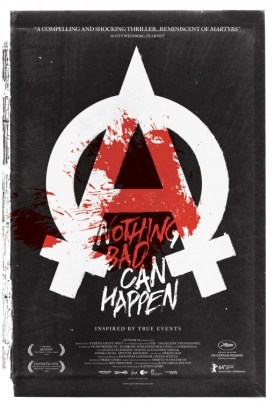
REVIEW: Nothing Bad Can Happen

23 06 2014

Nothing Bad Can Happen posterCannes Film Festival – Un Certain Regard, 2013

I was on a bit of a moviewatching bender that day I saw “Nothing Bad Can Happen” at the Cannes Film Festival.  (It’s still a bit of an ignominious personal record – I saw four movies in that day alone.)  I began the day with a 9:00 AM screening James Gray’s sublime “The Immigrant” and then quickly hit a mid-morning Director’s Fortnight showing of the instantly forgettable French film “Henri.”

Looking for something else to do with my day, I began to peruse the trades looking for yet another film to see.  As I perused Un Certain Regard, the section of the official competition for edgier and less renowned talent, I noticed a plot description that included the phrase “test of faith.”  Intrigued by that line alone, I went and tried my luck for the line at a repeat projection of “Nothing Bad Can Happen.”

Having very few ideas of what to expect save that brief synopsis, I entered the film rather naively and exited in a form of cinematic shellshock.  In her debut feature, director Katrin Gebbe got deeply underneath my skin and really disturbed me with her unflinching portrayal of the horrifying violence humans are capable of committing.  Her film lingers in my imagination, unsettling me profoundly still with just the thought of it.
Read the rest of this entry »


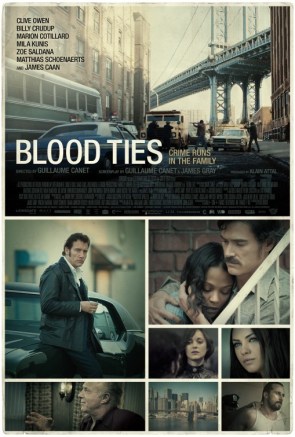
REVIEW: Blood Ties

22 06 2014

Blood TiesCannes Film Festival – Out of Competition, 2013
It’s clear from the beginning of “Blood Ties” that Guillaume Canet’s English-language feature debut is a Scorsese-lite New York ensemble drama.  Still, to so successfully channel a modern master right out of the gate is pretty impressive.  While Canet’s direction is hardly novel, he always keeps the film fun and compelling.

His ’70s saga follows the exploits of the two Pierzynski brothers squaring off on opposite sides of the law, Chris (Clive Owen) the criminal and Frank (Billy Crudup) the cop.  If the premise sounds familiar, well, it is.  In fact, the film is co-written by Canet with the help of James Gray, who himself wrote/directed a very similar tale of fraternal opposition called “We Own the Night” back in 2007.

Yet even though it felt like I knew these characters from other movies, they still thrilled me.  Gray, a consummate crafter of familial tension, completely nails the tricky dynamics between Chris and Frank.  They have always been pitted against each other, so a natural rivalry has been fostered between them.  Yet underneath it all, there’s the undeniable pull of – wait for it – blood ties that every so often overpowers all else.

Clive Owen is once again dastardly convincing in a brutish role, recalling his gripping performance in “Inside Man.”  However, it’s Billy Crudup who really carries the movie with a quiet strength.  He never really got a role to showcase all the talent he showed in “Almost Famous,” and now, 14 years later, Crudup arrives again with a bang. Read the rest of this entry »


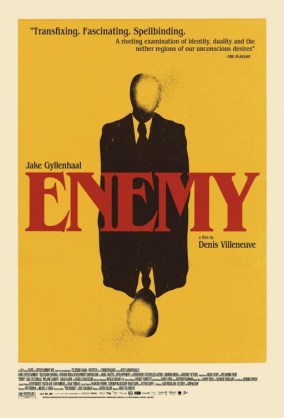
REVIEW: Enemy

21 06 2014

EnemyIn a discussion about the film “Enemy” a few days after seeing it, someone referred to it as “a particularly accomplished thesis film.”  To a certain extent, I do have to agree.  Denis Villeneuve’s film seems fixated on communicating mood and tone, doing so with such an intensity that it could easily be mistaken for his first time playing with it.

“Enemy” is far more successful at making you feel an overarching sense of gloom than it is at making you connect with its characters.  But that unrelenting dread in and of itself is a pretty remarkable achievement.  It’s more than just an atmospheric score recalling “Taxi Driver,” or the grays and faded yellows that dominate the color palette.  The film is the cinematic equivalent of a yoga pose held for 90 minutes straight, something to be admired for sheer poise alone.

Villenueve also manages to compliment his visual style with an equally controlled and subdued performance from Jake Gyllenhaal.  “Enemy” follows a meek history professor Adam Bell as he discovers an actor who looks exactly like him, Anthony Claire.  Both characters are played by Gyllenhaal, and they each feel distinct in demeanor as well as in the way that the events affect them.

The film is the definition of a slow burn, and Javier Gullón’s script keeps revelations rolling out at a similar pace.  Even when “Enemy” doesn’t have you completely emotionally engaged, it keeps you tense with its smoggy disposition and cryptic imagery.  Not that Villeneuve ever really loosens up in the film, but he does channel David Lynch on a few occasions.  So now that he’s accomplished this film, maybe it’s time to dabble in the surreal.  B+3stars


F.I.L.M. of the Week (June 20, 2014)

20 06 2014

Rian Johnson was announced this week as the next major architect in the “Star Wars” franchise, which was met with cheers from the fanboys.  And understandbly so, as Johnson is a brilliant creative mind who has recently given us the ingenious “Looper” as well as some of the best episodes of “Breaking Bad.”

But as for me, on the other hand, I found myself rather peeved.  The house that Lucas built will require non-stop attention for several years, leaving the cinemas without Johnson’s voice in peculiar but always memorable films.  He’s a master of mining subgenres for unexplored territory, be they high school movies or time travel sci-fi pics.  Johnson’s “The Brothers Bloom,” not your average heist flick, is a unique and underappreciated film that earns my pick for the “F.I.L.M. of the Week.”

Not unlike this year’s Best Picture nominated “American Hustle,” the film uses the art of the con as a means to explore individual identity as well as the nature of storytelling.  Filmmakers and hustlers often pull from the same theoretical toolbox, using the art of illusion to manipulate us into feeling exactly what they want us to feel.  As Mark Ruffalo’s Stephen puts it at one point in “The Brothers Bloom,” the perfect con is the one where  everyone involved gets just what they wanted.

While I’ll stop short of calling this a perfect movie, it’s certainly a very, very good one.  It’s thoughtful and entertaining, a mix that seems to be increasingly less common.  The performances are great, too – Ruffalo and Adrien Brody star as the titular fraternal con artists who pull bizarre stunts with the help of Rinko Kikuchi’s silent pyrotechnics companion Bang Bang.  The three make a hilarious pair, lighting up the screen with their off-kilter chemistry.

But the real dynamo of “The Brothers Bloom” is their target, Rachel Weisz’s cooped-up heiress Penelope Stamp.  Brody’s Stephen manages to win her affection, luring the quirky loner right into their trap.  They let her in on their chosen profession, and Penelope eagerly jumps right into scheme.  Who’s conning who and who’s being honest often gets a little hazy, but every moment is thrilling as we see simultaneously more and less of who the characters really are.  Johnson’s writing gives them so much to work with, and it saddens me to think we won’t be seeing another one of his movies like this for a long time.


REVIEW: Venus in Fur

20 06 2014

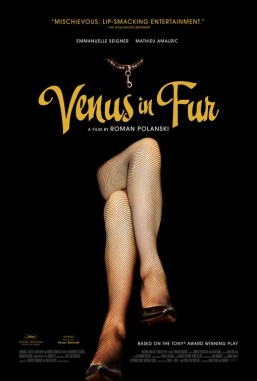
Venus in FurCannes Film Festival – Official Competition, 2013

We’re now witnessing the late films of Roman Polanski, whether we like it or not.  The director gave us one of the all-time great horror films (“Rosemary’s Baby“), neo-noirs (“Chinatown”), and Holocaust films (“The Pianist”).  Yet now, he seems content to draw his legacy to a close with a sort of artistic retreat into filmed theater.

His latest film, “Venus in Fur,” has more than a few similarities with Polanski’s previous directorial effort, 2011’s meekly received “Carnage.”  They are both adaptations of a stage play with a small set of characters locked in a continuous scene restricted to a single space.  And Polanski, who proved to be quite the consummate visual filmmaker in decades past, seems content to just yell “action!” and have the actors do their work.

He controls the chaos a lot better in “Venus in Fur,” although that could be due in part to the cast of only two – one of which is his wife, Emmanuelle Seigner, who he’s presumably on the same wavelength with to begin.  She plays Vanda, an aging actress who invites herself to audition for the director, Thomas (Mathieu Amalric).  He’s adapting the novel “Venus in Furs,” which is notable for introducing the phrase sadomasochism into the world brain.

Over the course of an hour and a half, Vanda and Thomas play a game of verbal chess over sexual politics and gender identity.  They arrive at more than a few interesting conclusions as their power dynamics and roles begin to shift.  Seigner and Amalric’s acting keeps “Venus in Fur” interesting whenever the location starts to feel boring or the whole enterprise just feels a little bit stalled.

“Venus in Fur” feels like many things, none of which is a Polanski film.  Although I have to give credit to a director who, at 80, is making us reconsider what exactly his movies are.  B-2stars


REVIEW: Dear White People

19 06 2014

Dear White PeopleLos Angeles Film Festival

Dear White People” calls itself a satire.  But quite often, the film has its finger on the pulse on such a vivid reality that it could pass for a straight drama.  The object of scorn at the center of the film is a controversial party on a fictional Ivy League campus where whites parade around as Obama, Nicki Minaj, or just a generic gangster rapper stereotype.

This hardly feels like an exaggerated universe: I’ve known two white girls who donned blackface to be Venus and Serena Williams for Halloween, and I’ve seen a ridiculously racist fraternity party invitation at my own university.  So what is intended as Juvenalian satire winds up sounding somewhat like the blistering, screaming anger of a Spike Lee joint.

A part of me wishes writer/director Justin Simien, making his feature debut with “Dear White People,” had dropped all pretenses of satire and just embraced the Lee model of didactic criticism.  He has a lot to say about the state of culture and race relations, much of it voiced through the film’s motormouthed protagonist Samantha White (played by Tessa Thompson).  Plenty of it is valid, though for those currently on college campuses, most of it will sound very familiar.

If the film is intended to start a conversation, the back-and-forth will only start once Simien is done airing all his grievances.  At times, conversations in the film are just superfluous scenes for him to further show off all he has observed.  He doesn’t pick fights he can’t win, save perhaps explaining the inexplicable success of Tyler Perry movies.

When he doesn’t talk at his audience, however, and just lets the characters be, “Dear White People” is actually quite intriguing.  Simien crafts an ensemble film with several interesting black archetypes that prove to be far more complex than just characters sketches with witty lines.  Be it the wannabe reality star Coco, the non-threatening male Troy, the anarchist Samantha, or the quiet observer Lionel, there’s surprising depth in their development that highlights the complexities of identity and identification.  They’d make the backbone of a great, hard-hitting straight dramatic piece, a mood I often wished the film would have just embraced. B-2stars


REVIEW: The Two Faces of January

18 06 2014

two_faces_of_january_ver5Los Angeles Film Festival

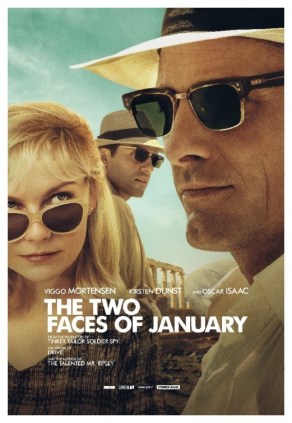
Hossein Amini makes his feature film debut by directing an adaptation of “The Two Faces of January,” an adaptation of a novel by “The Talented Mr. Ripley” author Patricia Highsmith. The film is understandably a natural cousin to Anthony Minghella’s Oscar-nominated 1999 dramatic thriller made from the latter of the aforementioned books. Amini did not, however, have to be so hopelessly indebted to the playbook that made that film work.

That’s not to say he made a carbon-copy; the two stories are very different. “Ripley” has shades of “The Great Gatsby” as it explores the psychology of the jaded upper class and one ambitious upstart whose desire to join them turns dangerous. “January,” on the other hand, is much more about the events and their sequence. There’s far less complex psychology or layered characterization to be found as a result.

The film’s three leads each play more of a type than a person. Oscar Isaac’s expatriate tour guide Rydal is quite a bit like Matt Damon’s Ripley but played with a penchant for larceny. He stumbles upon the MacFarlands, an American couple visiting Eastern Europe, and finds himself hopelessly drawn towards them.

Kirsten Dunst, as Collette MacFarland, has even less to do. She’s little more than an item for a childish game of tug-of-war between Rydal and her husband Chester, played by Viggo Mortensen. The film takes place in the early 1960s, and it would have been refreshing to see Dunst channel a screen icon of the time (say, Grace Kelly or Janet Leigh) to lend the film the feel of the period. But alas, Dunst retains the same sort of turn-of-the-millennium acting sensibility she normally brings to a part.

Mortensen also does a familiar act, although for him, what it recalls is his superb work in 2005’s “A History of Violence.” He’s great at playing collected everymen who prove themselves shockingly capable of savage outbursts, though it’s somewhat less exciting as a repeat in “The Two Faces of January.” His Chester sets the film in motion by retaliating brutally against an investigator sent on behalf of scorned clients, and he later carries the film by engaging in a battle of wits with Isaac’s Rydal.

Though Amini can get his actors to engage with each other, his direction doesn’t quite provide the spark necessary to light the fuse of the film. The tension dissipates quickly after the precipitating event of the film and then devolves into histrionics and cliches. Formulaic action film, beautiful European backdrop – sounds far less like “The Talented Mr. Ripley” and more like “The American.” Or dare I even say it … the much reviled (yet inexplicably Golden Globe-nominated) “The Tourist.”  C+2stars


REVIEW: Frank

17 06 2014

Los Angeles Film Festival

Early on in Lenny Abrahamson’s “Frank,” Domhnall Gleeson’s character Jon poses a question that might as well be on behalf of the audience: what’s the deal with the paper-mache head that Michael Fassbender’s Frank won’t take off?  Scoot McNairy’s Don, who has been working in a band with Frank for many years, tries to explain but ultimately admits, “You’re just going to have to go with this.”

The same mantra could apply to the rest of the film, where Abrahamson and screenwriter Jon Ronson string us along for a bizarre ride that offers very little explanation for itself.  It sometimes teeters on the verge of being a Dadaist piece, but it mostly just fizzles with forced quirkiness that never connects.  The scattershot tone of the piece makes it a real head-scratcher, too.

Frank

“Frank” is not without its amusing moments, nor is it an entirely meandering film.  At times, it feels like an ultra indie-fied version of “Almost Famous” as Jon attempts to be taken seriously by Frank’s bonkers band.  He takes over for a keyboardist who attempts to drown himself, presumptively because he is so frustrated with the unnecessarily rigorous creative process Frank demands.  I’ll stop short of saying I wished I could be in his position, being carted off in an ambulance rather than being forced to endure the whims of the giant head, but it’s overall pretty brutal.

I think many of the issues I had with “Frank” arose from the relatively minor progression of the plot.  It’s not a film carried by the characters; they all feel as if they’ve escaped from some “Saturday Night Live” skit mocking the esoteric kinds of hipster bands that play at Coachella.  (Not kidding, one song in the film sung by Maggie Gyllenhaal begins, “I want to marry a lighthouse keeper.”)

The performances aren’t particularly strong either, not even from Fassbender.  We don’t get to see him emote underneath the mask, which just made me realize how crucial his face is to conveying the inner turmoil of characters.  His nondescript body movements don’t communicate well in “Frank” either, and I found my thoughts drifting to ponder whether it was in fact Fassbender at all.

I don’t want to spoil the film, but there is brief confirmation that the Oscar-nominated actor did film a scene for the film.  Though a part of me does have to wonder if maybe the real joke of “Frank” is pulling a fast one on its audience by putting someone else under the big head.  It would certainly be in line with the odd sense of humor that pervades the rest of the film.  C2stars


REVIEW: Jimmy P.

16 06 2014

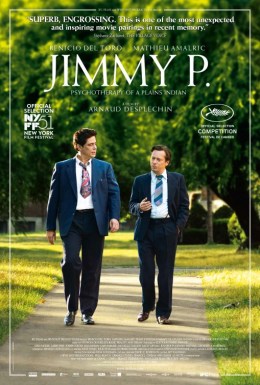
Jimmy PCannes Film Festival – Official Competition, 2013
Every year, Cannes is known to select a dud or two for its official selection, an honor bestowed upon “Jimmy P.” at last year’s edition.  Arnaud Desplechin’s English-language debut, sometimes subtitled “Psychotherapy of a Plains Indian,” is a tedious bore whose two hour duration feels like two years.  I found myself dozing off repeatedly throughout the film, yet I felt like I hardly missed a thing when I would wake up.

Psychotherapy doesn’t have to be boring – just look at the films of Woody Allen, which incorporate the process humorously and insightfully into their proceedings.  (Heck, even the forgettable “A Dangerous Method” made it somewhat intriguing.)  Desplechin’s snooze-fest, on the other hand, is a clunky procedural that focuses on the nitty-gritty psychology.  The film adapts unconventional source material – essentially a textbook on psychotherapy – and fails to find what’s cinematic about it.

Furthermore, it yields little revelatory light on either of its characters, therapist George Devereux (Mathieu Amalric) or patient Jimmy Picard (Benicio del Toro).  Amalric and del Toro are both great actors, so it’s disappointing that Desplechin has them playing at such an understated level.  Del Toro gets a few shining moments given the fact that his character sustained traumatic injuries in World War II, but Amalric is absolutely affectless.

Not every great performance has to be over-the-top scenery chewing, but it always feels like “Jimmy P.” is holding back the big moment we need to fully make sense of the characters.  Aiming simultaneously too high with its adaptation and too low with its excessively cautious directing, the film is a fairly thorough misfire.  C-1halfstars


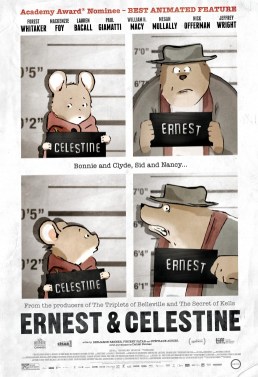
REVIEW: Ernest & Celestine

16 06 2014

Ernest and CelestineIn the effort to engage in the larger cultural conversation about “important” films, I realize that it must seem like I can only appreciate a movie if it tackles topics of great thematic heft or breaks some sort of cinematic mold.  But truth be told, I love a movies like “Ernest & Celestine” just as much because it possesses a remarkable sort of magic.  It has the power to return me to a childlike sense of spectatorship, allowing me a pleasant regression to a simpler state of mind.

The film’s story is nothing particularly extraordinary, but it charms from the get-go.  The indomitably curious mouse Celestine (voiced by Mackenzie Foy) wants to know what could really be so bad about the big, scary bears of whom all mice are warned to fear.  This very nearly ends her life when she goes above ground and winds up in the clutches of the hapless bear Ernest (Forest Whitaker).  Celestine doesn’t just convince him not to eat her; she makes him a friend.

Sadly, no one else is willing to accept their unconventional relationship.  It’s unnatural and scary to both species, unwilling to budge from their present ideologies.  And yet, the bear and the mouse persevere, teaching very important lessons about acceptance and affection.  As Abraham Lincoln once said, “The best way to destroy an enemy is to make him a friend.”  That’s a lesson “Ernest & Celestine” radiates with clarity as well as warmth, and I hope children from 3 to 93 everywhere take it to heart.  A- / 3halfstars


REVIEW: How to Train Your Dragon 2

15 06 2014

Stay long enough through the credits of “How to Train Your Dragon 2” and you’ll see an interesting member of the crew: Roger Deakins, on board as a visual consultant.  That name may not mean much to the casual film fan, but he’s the cinematographer responsible for the look of some of the past two decades’ most iconic films.  An 11-time Oscar nominee, Deakins has done remarkable work on films as varied as “The Shawshank Redemption,” “No Country for Old Men,” and “Skyfall.”

His presence on the film signals that DreamWorks Animation is giving the franchise the kind of serious attention that ought to be paid to all their products.  “How to Train Your Dragon 2” may very well be the most gorgeous animated film I have ever seen, no doubt thanks to Deakins’ keen eye.  The film is like a ballet of the skies where humans and dragons soar through the skies with stunning aerodynamic agility.

It’s not just the flight sequences that show off DWA’s fixation on fine details.  The film has a remarkable texture, particularly in the design of the dragons themselves.  I felt like I could envision just what they would feel like if my 3D glasses weren’t an illusion and I could reach out and touch them.

In fact, I loved looking at the film so much that I often found myself lost in the visuals and not in the plot.  For whatever reason, I just felt somewhat less engaged with the proceedings than I was in the original “How to Train Your Dragon.”  The sequel is still sweet and entertaining, though, and the addition of Cate Blanchett to the cast certainly doesn’t hurt.  But it didn’t capture my imagination in the same way, perhaps because it seemed more interested on action sequences and effects and less focused on characters.  B2halfstars


REVIEW: Hellion

14 06 2014

HellionRecently, the South has seen a bit of a revival at the cinema.  An emerging generation of filmmakers, headlined by Jeff Nichols and David Gordon Green, have found the region’s rich heritage to be fertile grounds for stories largely passed over by the coast-focused Hollywood.
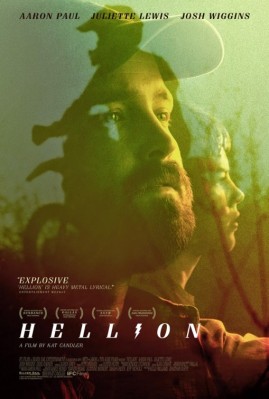
With “Hellion,” the latest film in this resurgence, it’s time to start including writer/director Kat Candler in the discussion of prominent figures produced by the movement.  Her latest film far outshines both “Mud” and “Joe,” two similar Southern coming-of-age stories, with the raw authenticity of its landscape and the affecting emotional vulnerability of its characters.  The only complaint I can muster about the film is a selfish one: I just wish the film had been made when I was still a teenager.

Candler sets “Hellion” just outside of my native Houston, and her portrayal of the area and its residents is absolutely pitch-perfect.  I felt as if I knew the foul-mouthed troublemaking adolescents at the center of the film from my own childhood.  These are not just character sketches, either; they rang so uncannily familiar that the teens seemed like real people pulled from dusty corners of my memory.

Though I never knew a family with the particular struggles faced by the Wilsons in “Hellion,” Candler’s impeccable script quickly made me feel deeply and passionately about their well-being.  It’s the rare film these days that jolts me out of being merely a complicit spectator and makes me feel like a stakeholder in the events playing out before my eyes.  Watching the drama as Aaron Paul’s Hollis attempts to get his act together, or as Josh Wiggins’ Jacob lashes out to keep his family intact unleashed reactions in me that were not only physiological but also physical.

Read the rest of this entry »


F.I.L.M. of the Week (June 13, 2014)

13 06 2014

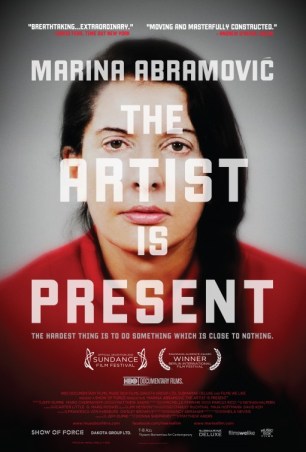
Marina AbromavicI’ve always been fascinated by people on the cutting edge of their art, and even more enthralled by those who are forming just what that art will be.  (Perhaps this explains my recent fascination with early film history.)   One such iconoclast is Marina Abramavic, a performance artist who is pushing boundaries that don’t even exist for her medium yet.

The intriguing documentary “Marina Abramovic: The Artist is Present” follows the titular artist as she prepares for a 2010 MoMA retrospective of her work while also embarking on a new piece, perhaps her most daring yet.  Directors Matthew Akers and Jeff Dupre ably balance both an introductory course in performance art as well as an intimate portrait of the artist herself, creating a satisfying piece that I have chosen as the “F.I.L.M. of the Week.”

Abromavic’s work is bold and confrontational, breaking down the conventionally accepted barriers between the artist and the consuming audience.  She often involves her body in the works she creates, usually in ways that draw attention to the ways we enact violence and sexuality.  The performances are important for her, but they also start an important conversation with the viewer that they will hopefully continue in their minds.

So what better way to have the ultimate conversation with her fans than making herself completely open to them?  In the centerpiece of her retrospective, she performs a new work entitled “The Artist is Present.”  Wearing a blank slate of a facial expression, Abramovic sat completely still for several hours per day at a table in an expansive space at MoMA.  Visitors could sit at a chair across from her and literally enter into conversation with the present artist.

As the film progresses, we get to see her astonishing effect on the exhibit’s guests.  (There’s also an oh-so-predictable cameo from James Franco at the exhibition because of course he would be there.)  Yet the documentary also grants us an intriguing look at how they in turn affect her.  The piece may seem simple; however, it slowly takes its toll on Abramovic.  In the end, though, it pays off in spades for her personally and professionally.  And hey, “Marina Abramovic: The Artist is Present” has converted a neophyte observer like me into a huge fan.


REVIEW: Love is Strange

13 06 2014

Love is StrangeLos Angeles Film Festival

A film that puts a big conceptual catch-all phrase in its title, such as “love” or “American,” should certainly be prepared to make a grand statement.  Ira Sach’s “Love is Strange” certainly has the ambition, providing three generations of characters whose problems play out on the screen.

From what I saw, though, the strangeness and conflict within the film did not come from love.  It arises, rather, from the complexities of the real estate market and overbearing taxes.  Or, as I like to call them, fates worse than death.

That’s not to dismiss the two lead performances at the center of the film by Alfred Molina and John Lithgow.  Respectively portraying George and Ben, life partners who finally get to legally tie the knot around the same time they qualify for the senior citizens’ discount at the movies, their bond of affection feels tender and sincere.  The kind of deep mutual understanding that couples strive for years to achieve is recreated effortlessly by these two great actors.

“Love is Strange” is at its best when it focuses on the two of them trying to navigate living apart after losing a cherished apartment they shared together for decades.  While they attempt to find a new place, George stays with some boisterous neighbors and Ben shacks up with some extended family navigating tenuous times of their own.  Lithgow is the film’s revelation (if he can be called that at the age of 68), portraying senility without a histrionic hint of burgeoning Alzheimer’s.

To the film’s detriment, Sachs expands his film and tries to encompass more experiences than it can comfortably portray in a 90-minute runtime.  The parenting tussle between Ben’s surrogate son Ted and his wife Kate (Marisa Tomei) and the vague growing pains of their teenage son Joey feel like distractions from the film’s emotional core, George and Ben.  Had “Love is Strange” stayed a little more intensely fixated on them, the micro-level relationship might have satisfied the title’s promise of illuminating something bigger in the macro-level experience of love.

But Sachs insists on lingering and wandering through the lives of an ensemble, disrupting the intimacy of a two-handed love story.  Even though he is unable to satisfactorily accommodate them all into the narrative, “Love is Strange” still retains the feel of the piano sonatas that score the film.  There’s a gentility about the film, though that placidity seems to come at the cost of a more fulfilling emotional resonance.  B-2stars


REVIEW: X-Men: Days of Future Past

12 06 2014

Thanks to the patience and planning of Marvel that culminated in “The Avengers,” now every franchise is rushing to super-size their output by converging as many properties into one film as humanly possible.  Among these stuffed tentpoles, “X-Men: Days of Future Past” is probably about as clever as we can expect them to get.  Bryan Singer’s latest entry in the franchise plays to its greatest strength, the strong ensemble cast, to help power what is otherwise a fairly average film.

In 2011, the series essentially rebooted with a cast of rising stars that included James McAvoy, Michael Fassbender, Jennifer Lawrence, and Nicholas Hoult as younger versions of the characters.  Not that the original cast was lacking in talent with Patrick Stewart, Ian McKellen, Hugh Jackman, and Halle Berry.

Since their timeline never really ended (not that this stops the studios nowadays), what better way to bridge old and new than with a little bit of time travel?  And who better to be the intermediary than Jackman’s Wolverine, the only character popular enough to inspire spin-offs?  It all makes perfect sense.

“Days of Future Past” also manages to incorporate Jennifer Lawrence’s Raven/Mystique into the proceedings quite a bit more.  That, of course, couldn’t possibly be because she’s the most loved actress in America at the moment.  It just so happens that she’s the key to preventing annihilation of mutants in the bleak future inhabited by the older versions of the characters.  Wolverine must travel back to the ’70s to prevent her from assassinating defense contractor Raymond Trask (Miles Finch himself, Peter Dinklage) and enabling the creation of the mutant-massacring Sentinels.

Read the rest of this entry »