REVIEW: Salmon Fishing in the Yemen

11 12 2012

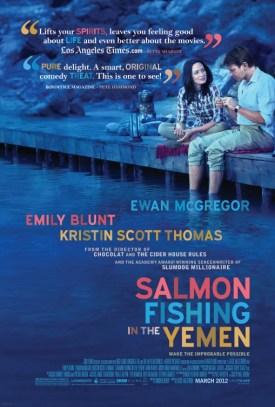
Salmon FishingI could pound out reviews for movies I love or movies I hate like rapid fire.  I know what works and what doesn’t in those films – the only challenge is figuring out the frame.

For movies like “Salmon Fishing in the Yemen,” a pleasant but unremarkable little rom-com, writing a review is quite a bit tougher.  I just feel nothing but ambivalent towards the film, and I don’t feel the need to take a hard positive or negative approach.  In fact, it’s easiest to inch towards 400 words or so just dawdling and musing about the craft of reviewing film.

“Salmon Fishing in the Yemen” exists – I can’t say that I would recommend it, but then again, I don’t hate it by any means.  None of it is bad, unless you consider not being very good to be a bad thing.  Lasse Hallstrom is content to make a movie totally by the books, not reaching for anything more or anything less.  There’s no disappointment that way, but there’s also no potential for greatness.

I suppose the romance between Ewan McGregor’s brilliant savant Fred Jones and Emily Blunt’s Harriet, a finance expert for a Sheikh in Yemen, is nice and pleasant.  No sparks fly, but it’s not as painful as Channing Tatum and Rachel McAdams in “The Vow” or anything like that.

As they work together to achieve a bizarre fantasy, making it possible to fish for salmon in the scorching country of Yemen, I suppose there is a slight feeling of uplift and happiness.  But it doesn’t have the buoyancy of Hallstrom’s “The Cider House Rules,” and it doesn’t even come close to the transcendency of screenwriter Simon Beaufoy’s “Slumdog Millionaire.”

In other words, if you had to watch “Salmon Fishing in the Yemen,” there could be far worse things.  But you will forget it almost immediately.  In 10 years, if we still look at IMDb, I can imagine people will go, “OH! I remember that movie now,” when they look at the filmography of almost anyone involved with the film.  B-2stars


REVIEW: Middle of Nowhere

10 12 2012

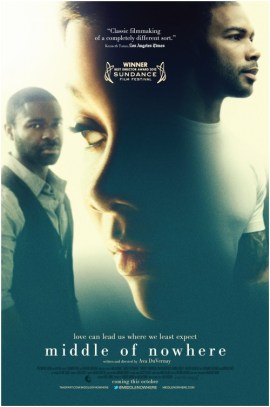
Middle of NowhereThis might feel like a bit of a rerun for those of you that read my review of “Lincoln,” and for that I apologize.  But I do think it is possible to admire certain aspects of a movie and still not fully like it, and I will fight hard to defend that assertion.

In case you haven’t figured it out already, those are precisely my feelings on Ava DuVernay’s “Middle of Nowhere.”  It’s an incredibly graceful, poised, and carefully restrained film.  It tells a story that needs to be told about the African-American community, and for once, it actually comes from someone inside of it instead of a white man.  And it feels all the more authentic and genuine for it.

But the whole felt like distinctly less than the sum of its parts; all the virtuosity didn’t add up to an emotional connection for me.  Perhaps it was the film’s moseying, elegiac tone and pace that just kept me cooly disinterested in the proceedings.  But for whatever reason, I just felt distanced from the characters rather than drawn towards them.

I know it has nothing to do with the acting, though, particularly Emayatzy Corinealdi (a name I happily copied and pasted from IMDb) in an impressive leading turn as Ruby.  I had flashbacks to Michelle Williams’ character in “Take This Waltz” with Ruby, as both struggled with falling out of love with their husband and being tempted by a much more appealing man.

But in the case of Williams’ Margot, her husband was merely emotionally distant; Corinealdi’s Ruby, on the other hand, has a physical distance as well since her husband is spending five years in prison.  She does her best to stay faithful and upright, but the years take their toll on her.  And Corinealdi lets that show in moments of quiet breakdowns that allow us to marvel at her acting on a very technical level of precision.  Perhaps in the next big role she lands as a result of her turn in “Middle of Nowhere,” she can add a layer of emotional resonance.  B- 2stars


REVIEW: First Position

9 12 2012

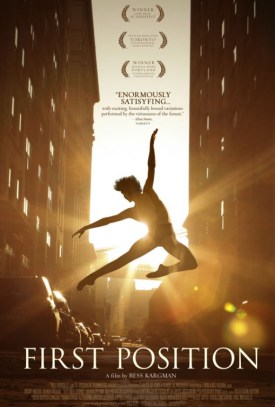
First PositionI know it’s fruitless to spend too much time speculating “coulda been, shoulda been” over hypothetical questions.  But for the 90 minutes of “First Position” – which somehow managed to feel like 9 hours – I couldn’t help but think what a wasted opportunity the documentary was.  Bess Kargman could have really made an enlightening film about dance.

But instead, Darren Aronofsky’s “Black Swan,” a werewolf ballerina film, did a better job convincing me of the price of ballet and the dedication it takes to succeed.  The physicality, the mental tenacity, the demands of time – all perfectly portrayed and stylized by Aronofsky in ways that subtly sneak up on you.

Kargman makes an entire documentary about these things, and they land so softly you barely notice them!  “First Position” really could have been “The REAL Black Swan,” if you will, but instead it settles for mediocrity and tedium.  It’s a hodgepodge of admiring the craft of ballet and a competition doc, committing to neither fully and as a result feeling wishy-washy.

(Sounds like Kargman could have used the words and wisdom of Ron Swanson in the editing room: “Never half-ass two things.  Whole ass one thing.”)

I get that it’s an art and a sport, and I love that.  But focus on the incredibly dichotomy there!  Don’t give me two-second profiles on a few of the dancers that feel incomplete and erroneous … and then expect me to care or feel emotionally attached later.  And know that the crowd who goes to see documentaries like this have most likely seen “Black Swan” and have intense pre-conceived notions about how grueling ballet is.  Play with it, go with it, soar with it.

Don’t give me what ultimately arrived in my iTunes library on VOD as “First Position.”  Because as of right now, it’s at last position among the documentaries I’ve seen in 2012.  C-1halfstars


REVIEW: Ai Weiwei: Never Sorry

8 12 2012

Ai WeiweiDocumentaries about artists frequently devolve quickly into hagiography or niche journalism, failing to make the case for why that person matters – merely telling us that they exist and that they create.  I’m happy to report that isn’t the case for “Ai Weiwei: Never Sorry,” Alison Klayman’s superb documentary on the titular Chinese iconoclast.

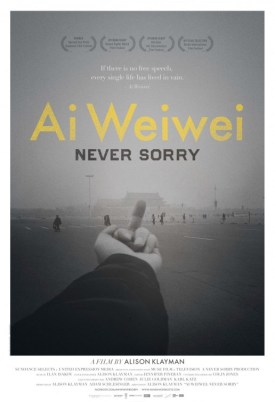
I was expecting something in the vein of “Waste Land,” the Oscar-nominated portrait of socially conscious artist Vik Muniz, who made incredible works out of garbage to draw attention to the outrageous levels of poverty in his homeland of Brazil.  But Ai Weiwei is more than just an artist; he’s a social activist who brilliantly uses art to challenge the oppressive laws and customs in China.  Just take a look at the poster and see Weiwei’s middle finger pointed towards the heart of China.  Subtlety is not his strong suit.

The film does a fantastic job balancing Weiwei the artist and Weiwei the activist, showing how the two are inextricably linked that one cannot be accurately understood without the other.  Klayman lost my interest a bit when she delved into his personal life, but that’s only a minor digression in this otherwise tightly focused documentary, assured of the importance of itself and its subject.

Her chronicle of Weiwei captures him at a very unique time.  It begins right after he drew worldwide attention after calling out the Chinese government to their faulty response to the Sichuan earthquake around the time the country was trying to portray a positive image in the Olympics.  This specific inciting incident guides the film and motivates Weiwei to use whatever means necessary, including social media, to get his message out there.

If you need to be assured of good in the world, know that his message has been received by plenty of people who have begun to demand change.  If you need to be assured that such goodness is not enough, wait for the end of the “Ai Weiwei: Never Sorry” and see how the Chinese government responds to his message of government corruption and unresponsiveness reaching too many people.

But Weiwei will never stop, never shut up, and never apologize.  They can try to silence his art, but they never will.  It would take killing Weiwei himself since he has essentially transformed his life into performance art.  Or protest.  By the end of the documentary, you will scarcely be able to separate the two.  A-3halfstars


F.I.L.M. of the Week (December 7, 2012)

7 12 2012

The election has been over a month.

Let that sink in. I know the last thing you want to do now that the nasty rhetoric and half-truths have ceased, and you have finally begun to realize that life can exist without vicious campaign ads.  But since the political system has churned out another major crisis with the fiscal cliff, it seems that Alexander Payne’s 1999 film “Election,” a micro look at the American electoral system will never get old.  In fact, it seems to have only gotten more and more timely – and that should scare you.

Though Alexander Payne’s last two movies have won him Oscars for Best Adapted Screenplay, I would still argue “Election” is his finest script.  It works remarkably well as both a human story and an allegory for bigger things like American democracy and morality.  And after a few viewings, you start to see how brilliantly and subversively he uses American iconography to poke at the problems corroding the foundation of our great nation.

While many have lamented Payne’s insistence of voice-over in films that might not need it (such as “The Descendants“), his twisted employment of archetypical characters with a whole lot hidden under the surface really makes their narration yield some surprising revelations.  It allows us to penetrate deep into the characters beyond the functions they believe they should be functioning at Carver High School.  Not to mention, Payne writes stream-of-consciousness dialogue with a fantastic accuracy and hilarity.

By all means, the president of the student body should easily by Reese Witherspoon’s Tracy Flick.  She’s the epitome of high school perfect and has worked her butt off to be the most qualified (or at least ensures she’s the most passionate) for the office.  But there’s also something incredibly annoying about her quest, and her teacher, Matthew Broderick’s Jim McAllister, is on a mission to stop it.  As the faculty adviser for student government, he still believes it can do good – he just doesn’t want Tracy to be the one to get credit for it.

Rather than let her run for the office unopposed, Mr. McAllister manipulates popular football player Paul Metzler (Chris Klein) to challenge Tracy.  He’s rich, handsome, and an absolute moron.  But they both get more than they bargained for when Paul’s frustrated closeted lesbian sister, the frumpy Tammy, decides to run out of revenge.  Her platform of anarchy, pointing out how stupid student government elections really are, catches on with the Carver High students … and what ensues as the three duke it out for the presidency is absolutely hysterical madness.

Who do we side with though?  Who is the “right” candidate?  Sadly, we are faced with this decision all the time.  Do we vote for the appealing, good-looking candidate even though they might not be particularly qualified?  Or the overqualified one who might rub us the wrong way?  Better yet, should we go with the person who realizes how pointless and pathetic the electoral system is?  These are just a few of the questions that keep Alexander Payne’s “Election” a truly exceptional movie, one more than worthy to be featured as the “F.I.L.M. of the Week.”


REVIEW: Jiro Dreams of Sushi

6 12 2012

I know everyone has their own theories and preferences about what makes a good and cinematic documentary.  For me, after “Inside Job” led to a massive documentary binge, I developed a simple litmus test.  So simple, in fact, I can sum it up in two words: so what?

So what, I ask every documentary.  If you’ve taken the time to document a small piece of the world I live in, what am I supposed to take away from it?  How should this affect me?  If it passes with flying colors, put it on a screen and plop it in front of audiences.

If not, then perhaps it’s best meant for an obscure cable channel – or the entire project ought to be reconsidered and reevaluated.  After all, if you can’t convince an audience why something is important, why bother extending your efforts to make the fim at all?  (This test is entirely applicable to fictional and narrative film as well, but there are far more shades of grey in that realm.)

Jiro Dreams of Sushi” did not pass the test.  It has such a small and limited scope – 85-year-old sushi chef Jiro Ono and his quest for perfection – that it especially needed a powerful so what.  It feels like an overlong and unfocused Travel Channel special, geared towards exposing a niche for sushi die-hards or travelers to Japan with its detailed portrayals of what it takes to run a competitive sushi restaurant, from purchase to preparation of the fish.  Give this film some commercial breaks as well as a slight dash of energy, and “Jiro Dreams of Sushi” would be a fun program to stop on while channel surfing.

Director David Gelb has something in mind beyond the sushi, though; he wants to go deeper into Jiro’s character.  And I will grant Gelb that he does a great job at painting a complete portrait of a very peculiar perfectionist.  But he fails to bring the message of “Jiro Dreams of Sushi” home for the audience on the other side of the screen.  We can’t learn anything from Jiro that our parents haven’t already ingrained in us at the age of five.  The taste buds activate in overdrive for the documentary, but the head and heart remain fairly disengaged.  B-


REVIEW: Man on a Ledge

5 12 2012

I think a more appropriate name for “Man on a Ledge” might have been “Baby’s First Thriller.”  By that, I do not mean that you should go show this film to your infant.  Rather, I am making a statement on how rudimentary and textbook Asger Leth’s film is.

His color-by-numbers genre pic is not the worst thing in the world to watch.  There are plenty of predictably thrilling instances where the action heats up and the plot begins to sizzle.  But it’s just so unambitious, reaching for all the buttons that so many better filmmakers have already pushed to death.

Even though I can’t think of any movie that shares the specific plot of “Man on a Ledge,” it felt nonetheless familiar and banal.  Sam Worthington’s Nick Cassidy goes and stands on a ledge and puts on a show for a captive audience in the streets of New York City.  He’s  left to be talked down by archetypical police officer haunted by guilt of a prior incident, here played by Elizabeth Banks.

Meanwhile, a giant diamond heist occurs with Nick’s brother Joey and girfriend Angie (Jamie Bell and Genesis Rodriguez) inside the building across the street to prove his innocence.  And of course, the greed of the big bad capitalist, played by the menacingly frightening Ed Harris!  Both plots are interesting enough to keep our eyes on the screen, but neither really captivate at the level we have come to expect from say, a Soderbergh thriller.  It does what it needs to do and nothing more.

And if that’s all you want from a movie, then perhaps “Man on a Ledge” is the perfect background music to you doing chores around the house.  You don’t need to be paying too much attention to know what’s going on here.  Because after all, you know the narrative.

Ultimately, what I walked away from “Man on a Ledge” with was nothing about the story or the presentation.  To my surprise, it was that superb actors like Elizabeth Banks and Anthony Mackie were still being reduced to this kind of auto-piloted stock studio schedule filler crap.  Casting agents, please sit down with a copy of “People Like Us” and “The Hurt Locker.”  You will find Banks and Mackie, though not nominated for an Oscar (yet), are far above this type of movie.  Find them something suitable for their immense talents, please!  C+


REVIEW: Haywire

4 12 2012

There was a decent chunk at the beginning of “Haywire” when I was totally drawn in not by anything in the script or the story … but by Steven Soderbergh’s unique visual sensibilities.  And all of a sudden, it actually begin to sink in that the director actually intends to retire from the craft of cinema and what a loss that could be to the film community.

Soderbergh’s canon of films ranges from the heist films of the “Oceans” series to the zany genre-bending intrigue tale of “The Informant!” to immensely moving biopics like “Erin Brockovich” to hyperlink cinema like “Traffic” to tense thrillers like “Contagion” and even into strange experimentation with whatever the heck “The Girlfriend Experience” was supposed to be.  (Oh, and he also oversaw some movie about magic where Channing Tatum and Matthew McConaughey showed their butts.)

In just this one sequence where the protagonist of “Haywire,” played to dull effect by MMA fighter  non-actress Gina Carano,” escapes from her captors, there are flashes of almost all of his different movies.  They share a similar rhythm and vibe, achieved in a perfect harmony of cinematography, editing, and sound.  It’s truly remarkable that across so many genres and types of filmmaking, something feels like it’s coming from a single mind.

Now just because he has unified conventions doesn’t mean that they always work or redeem an otherwise poor movie.  Such is the case for “Haywire,” an action thriller that does some clever presentation and narrative organizing to brush up a conventional narrative.  Perhaps the medium is the message for Soderbergh, and his mere repackaging of familiar elements is the point in and of itself.  But the film just always feels like an all-too familiar experience.

Soderbergh does succeed in making it slick (for the ladies, he did get the eye candy of Michael Fassbender and Channing Tatum for brief scenes) and subversively political, though.  Yet these victories seem small while watching and seem even smaller in retrospect.  Watch some of Soderbergh’s elegant sequences that have the grace of a ballerina on YouTube some day and skip “Haywire.”  It doesn’t go fully, well, haywire … but there’s got to be some new cinematic voice or story you can use your 90 minutes to hear and see.  C+


REVIEW: The Five-Year Engagement

3 12 2012

Almost every comedy features a supporting cast of hilarious actors who can always be wheeled in front a camera to produce laughs.  Unlike the romantic leads, who have to undergo a journey and serve plot functions, these characters can literally be poorly developed and have little motivations of their own – and no one minds as long as they make us chortle in delight.

The Five-Year Engagement” does a very peculiar thing with its characters.  Tom and Violet, the betrothed played by Jason Segel and Emily Blunt doomed to suffer the titular delay, are the ones who suffer from the pratfalls of the supporting characters.  Sure, the two have chemistry and are fun to watch.  But it’s Jason Segel and Emily Blunt, both of whom could charm a dishwasher into marrying them!

I definitely enjoyed the two of them in their playful engagement bliss and when they got into tough arguments; however, they got upstaged, outdrawn, and outshown in a major way by the couple that was supposed to be a comic relief and foil.  Guess that means directors need to think twice before they cast the uproarious Chris Pratt (who steals every “Parks and Recreation” episode these days) and dynamic Alison Brie (who I’ve heard is just as good on “Community”).

Pratt plays Tom’s best friend Alex, who is of course the usual Pratt goofball (unless we are talking “Moneyball“).  At the engagement party, he meets Brie’s sharp-tongued Suzie … who also happens to be Violet’s sister.  The two have quite a night, and very quickly, a very different kind of wedding is on the horizon.  A shotgun wedding.

Alex and Suzie provide most of the humor for Nicholas Stoller’s “The Five-Year Engagement” because of Pratt and Brie’s immense comedic capabilities.  Yet they also carry most of the heart of the film, too.  As Stoller’s running commentary on how hard marriage really is no matter how long and hard you’ve worked on it, I started rooting for them and becoming more emotionally invested in the two of them.  Perhaps it’s because the marathon length of the film left me craving Alex or Suzie to get back on screen, but I think it was really just me wishing someone would make one of these movies with Chris Pratt as the leading man.  B


REVIEW: Life of Pi

2 12 2012

http://www.movieposter.com/posters/archive/main/151/MPW-75769While I may not have read “Life of Pi,” I certainly know plenty of people who did in high school.  Key words in that sentence: high school.  Yann Martel’s book is meant for thinkers of a certain age, not eyes of a certain age.  The material may be appropriate for people below a PG-13 audience, but that doesn’t mean they will appreciate it.

I admire Ang Lee’s  faith in the importance and resonance of the “Life of Pi” narrative that he felt compelled to shift its impact downwards and outwards, making adjustments to make it play well to younger and less intellectual audiences.  And indeed, it plays well as an adventure film, where “Cast Away” meets “Slumdog Millionaire” plus a tiger, and its brilliantly shot as such by Claudio Miranda (the brilliant lenser of “Benjamin Button“).  Miraculously, the two hours fly by even with very little happening to drive the story forward.  It’s a rewarding experience overall.

But what nagged at me was that Lee was aiming for something more with “Life of Pi.”  Sure, his movie was sold as one about a boy and a tiger stranded on a lifeboat, but Lee’s intended film was one about some very deep existential questions.  He didn’t want audiences to leave marveling over the special effects sequences; he wanted people to leave after having a mystical experience mulling over questions of spirituality.

These questions are raised early on in the movie, and I strapped myself in to really ponder them.  Yet when I discarded my 3D glasses in the recycling bin on my way out of the theater like any ecologically friendly moviegoer, I couldn’t shake the feeling that Lee explored them with insufficient depth.  By expanding the audience, he shrunk the real story of “Life of Pi” – its spiritual dimension.

The film’s rather juvenile and kid-friendly presentation seeps into the very fabric of the storytelling.  (All those corny editing techniques ripped out of bad ’80s TV movies can’t help but affect every aspect of a movie.)  The core ideas of “Life of Pi” get diluted, passed over in favor of a little more cinematic grandeur.  Don’t get me wrong, Lee’s grand canvas for the movie is exciting and stunning.  But I can get that in any movie; few dare to delve into the psyche like he meagerly attempted to do.  I want more of that because I don’t think the next few $100 million budgeted spectacles will even consider touching anything spiritual.

Although maybe there’s a silver lining here.  People have suggested I do something for five years or so now, and I have never felt inspired to do it.  Ang Lee may have given me the biggest push yet towards accomplishing that thing: reading Yann Martel’s “Life of Pi.”  Because perhaps there, my mind will be as sate reading as my eyes were watching.  B-2stars


REVIEW: Lincoln

1 12 2012

I am by no means saying that “Lincoln” is not a smart movie.  I think the writing is very clever, the angle is interesting, and the words take the feel of political poetry.  And Daniel Day-Lewis gives a very meticulous and impressively restrained performance as the iconic 16th President.

But these two things do not necessarily a great movie make.  Director Steven Spielberg ultimately did not make a compelling argument as to why “Lincoln” is cinematic, and that is by far the most crucial component of a film’s success.  We don’t experience film on a page; we watch it on a screen.  And though I often sat wondering how much I would love to pore over Tony Kushner’s script, I never felt like I needed to see it on screen.  (Perhaps it would have been better served as a closet script, one meant to be read, not filmed.)

The history lesson is interesting in that it features a tight, narrow focus rather than the broad canvases in some of Spielberg’s earlier historical films such as “Schindler’s List” or “Amistad.”  Kushner’s grueling, often tedious procedural and insistance on parading new characters onto screen in rapid fire succession makes “Lincoln” feel more like an “Amistad,” meant to go straight into the DVD player in high school American history courses.  If it weren’t for the cavalcade of notable Oscar-recognized talent, it would feel no different than those dramatized History Channel specials that teachers show to give their students a break.

I have no problem with the Spielberg pendulum shifting towards education rather than entertainment and showmanship.  However, if such a changing dynamic is to work, Spielberg needed to shift his approach.  In “Lincoln,” he largely doesn’t.  In the first two hours of the film, we are bombarded with facts, details, and events.

Then, as the film comes to a close, the movie slows down and begins to amble.  We get generous close-ups of the people whose tireless efforts we have been following, as if Spielberg is telling us, “Here, feel for them … now!”  Perhaps after spending a semester watching all his films, I am hyperaware of his trademark shot and can fairly easily resist the pull.  But I wasn’t actively resisting or anything, they just didn’t work here.  The technique would have been great if “Lincoln” were more in the mold of “Schindler’s List” or “Saving Private Ryan,” histories built around deep emotions.  He can’t simply pull the technique out to achieve a similar effect for an entirely different film.

Read the rest of this entry »


F.I.L.M. of the Week (November 30, 2012)

30 11 2012

It’s once again the most wonderful time of the year … which means time to dust off the Christmas favorites again.  Though the most family-friendly choices might be “Elf” or “It’s a Wonderful Life,” and the most heartfelt movies might be “Love Actually” or the extremely underrated “The Family Stone,” sometimes you want something a little different.

If you need a raunchy comedy and a Christmas movie all wrapped up in one, you have basically only one choice: Terry Zwigoff’s “Bad Santa.”  Thankfully, it’s a really good choice and I’m featuring it as my “F.I.L.M. of the Week” to kick off the Christmas season. The movie has got laughs to spare thanks to an incredibly witty script and some kick-ass performances … and it’s even unexpectedly sweet.

Billy Bob Thornton plays a familiar sardonic role in the film, here embodying boozing con man Willie Stokes.  He makes his living as a mall Santa, but not from any salary or profits – he and his companion Marcus, a dwarf who acts as his elf, rob the mall where they work that year and then scoot out of town.

However, their year in Phoenix turns out a little differently.  Willie is a little more sex-crazed and erratic than usual, catching the attention of the pushover store manager Bob Chipeska (played with brilliant naïveté by the late John Ritter).  That also puts Chipeska’s top security guard, the stoic Gin Slagel (played by another late comic, Bernie Mac), hot on their trail.

But the more significant development is that Willie starts to develop a heart for “The Kid,” a dim-witted overweight youngster with an undying loyalty to Santa.  His kindness in the face of insult and injury at first annoy Willie yet eventually force him to see some of the error in his ways.  He even begins to give generously out of his greatest strength: his unfeeling toughness.

And isn’t that what Christmas is about?  Giving?  I’ll tell you one thing “Bad Santa” can give you this holiday season: an aching body from laughing so hard.


REVIEW: Hitchcock

30 11 2012

It’s such a magical feeling when a movie gets you intoxicated not only on itself but on the entire craft of cinema as well.  You go into a dark room and carry in whatever baggage from the day, but you emerge joyful, reinvigorated, and transformed.

That’s how I felt when I walked out of the theater after a rapturously good time with “Hitchcock.”  Sacha Gervasi’s slice-of-biopic flick, focusing on the time when the master of suspense struggled to get “Psycho” made, strikes the right chords throughout the film.  It respects the mastery of Hitchcock but does not fear him as an untouchable deity, treating him as a man and artist just like anyone else.

But Gervasi’s film is more than just about Hitchcock or even the artistic climate into which he released what is still one of the best horror films ever made.  Clear parallels are drawn to the current day world of film production.  You know, the world where an unambitious movie like “John Carter” gets greenlit and causes a $150 million write-down while a masterpiece like “Black Swan” has to scrap together a budget but reaps it back 25 times over.

We now know Alfred Hitchcock as the legendary Hitchcock, but in his time, he struggled to have studio support for a movie that did not fit neatly into convention – even when coming off the enormous success of “North by Northwest.”  Thankfully, Hitchcock had faith in his own vision and was willing to finance it himself at enormous financial risk.

And Gervasi has wielded the knife of excoriation to jab at executives who were only looking to make a profit out of movies.  There are also a number of well-placed ironic remarks about the supposed failure of “Vertigo.”  You know, that movie that recently replaced “Citizen Kane” as the best film of all time according to Sight and Sound.  The myopia of Hollywood is lade bare to be mocked and criticized.  History has repeat itself with a vengeance.

Read the rest of this entry »


Oscar Moment: Final 2012 Pre-Season Predictions, Part 2

29 11 2012

Best Actor

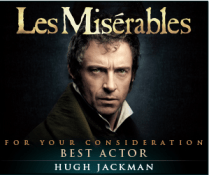
  1. Hugh Jackman, “Les Miserables”
  2. Daniel Day-Lewis, “Lincoln”
  3. Joaquin Phoenix, “The Master
  4. Bradley Cooper, “Silver Linings Playbook
  5. Denzel Washington, “Flight

The past two years have seen the leading man of the Best Picture winner take home Best Actor.  So I’m going out on a limb for Hugh Jackman.  I know it sounds illogical at the moment.  But the hope is that in a few months, we will all look back at this post and say, “Wow, Marshall!  I can’t believe you had such foresight!”  Although it’s very likely that we also look back and say, “Wow, Marshall, you were really dumb not to see the steamroller of Daniel Day-Lewis coming a mile away.”

And indeed, when Time boldly declares him the greatest living actor (take that, Jack Nicholson!), it’s kind of hard to deny an incredibly palpable sense of momentum of Daniel Day-Lewis for “Lincoln.”  It’s the role of the moment, and he’s gotten tons of press and raves.  It could be 2007 all over again where Day-Lewis leads the conversation from the get-go and never lets up.

Fun tidbit that just popped into my head: Meryl Streep will be presenting Best Actor this year.  Imagine the sight, a three-time winner handing the third Oscar to Daniel Day-Lewis.

I’m still hoping that the critics groups can revive the heat for “The Master,” and Joaquin Phoenix in particular.  His performance is mesmerizing and animalistic, and I think they should recognize that.  He’s also a two-time nominee, so that makes his edginess slightly more pallatable for them.  But if the movie flops on the precursor circuit, he could find himself in danger.  Heck, even if it does do well, it could fall victim to the same prudish mentality that snubbed Michael Fassbender’s incredible work in “Shame.”

Though Bradley Cooper may be best known for “The Hangover” series, he does great work in a fantastic attempt to get people to take him seriously.  An attempt that worked as well as the rest of the movie, I’d argue.  Though many consider him (and the rest of the movie) to be lightweight, I think it will touch the same nerve as “The Fighter” did in 2010.  Granted, Mark Wahlberg was not nominated for Best Actor … but Will Smith was a big marquee star when he went serious in 2001 for his nominated role in “Ali.”

And I know plenty of people fawned over John Hawkes’ committed physical performance in “The Sessions.”  But the film has tanked with audiences.  And Denzel Washington, whose “Flight” has done very well at the box office, is breathing down his neck.  I think it has to be considered advantage Washington at the moment.

But in summary: it’s the two locks, Jackman and Day-Lewis, in a battle royale.  Phoenix, Cooper, Washington, and Hawkes competing for three slots.  (Outside spoilers could include Anthony Hopkins in “Hitchcock,” Richard Gere in “Arbitrage,” and Jack Black in “Bernie.”)

Best Actress

  1. Jennifer Lawrence, “Silver Linings Playbook
  2. Jessica Chastain, “Zero Dark Thirty”
  3. Quvenzhané Wallis, “Beasts of the Southern Wild
  4. Marion Cotillard, “Rust and Bone
  5. Naomi Watts, “The Impossible”

It might be a little too soon, but I’m about ready to call the race for Jennifer Lawrence.

She’s had one heck of a year between heading up the $400 smash “The Hunger Games” – and actually giving a heck of a performance in it as well.  We will forget about “House at the End of the Street” and pretend she went 2-for-2.  She’s shown versatility this year, and that’s going to work big time in her favor.  It also helps that her character in “Silver Linings Playbook,” Tiffany, is a perennial favorite archetype at the Oscars: flawed, messy, but ultimately lovable and embraceable.

It looks like her main competition will be Jessica Chastain’s gritty, steely CIA agent from “Zero Dark Thirty.”  Chastain’s epic 2011 brought her an Oscar nomination for “The Help,” and her grace and cheer really went over well with everyone.  As far as I’m concerned, she’s the new Amy Adams, who was the new Julianne Moore/Cate Blanchett/Kate Winslet.

I think we are set for a battle to rival the Best Actor race.  Especially because at the Globes, Lawrence will compete in comedy and Chastain will compete in drama.  Unless one totally dominates the critics groups, I think the two could essentially be tied until the SAGs when they go head-to-head.  (BFCA will clarify some, but they could always tie like 2008/2009.)  That’s when the momentum shifted to Jean Dujardin last year, although they chose Viola Davis over eventual champion Meryl Streep.

And maybe I’m underestimating young Quvenzhané Wallis, whose spunk powered “Beasts of the Southern Wild” into the indie spotlight over the summer.  Had the Oscars been held after Cannes or at the end of August, she probably would have been the favorite to win.  But after Lawrence and Chastain’s performances were revealed, she’s lost some of her thunder.  Unless the critics groups and early precursors make a strong contribution to her campaign, she should be content with a nomination and all the attention it adds to her career going forward.

Marion Cotillard deserves score a nomination here as well, and given the incredibly weak field, it shouldn’t be a problem.  Upon seeing the film a second time last week, I realized that where “La Vie En Rose” was a total transformation, “Rust and Bone” is a radically different movie for her.  She’s so much subtler and rawer.  It’s enormously affecting.  See it when you get the chance.

I think Cotillard’s contention bodes ill for Emmanuelle Riva, whose work in “Amour” apparently has Academy voters talking.  Two French-language performances nominated for Best Actress in one year?!  That seems a little much.  So I think the few passionate supporters of “The Impossible” will get Naomi Watts to edge out Riva (or Keira Knightley for “Anna Karenina” and Helen Mirren for “Hitchcock”) and sneak into the race in a movie with very little overall buzz.  Just like she did in 2003 with “21 Grams.”

Best Supporting Actor

  1. Robert DeNiro, “Silver Linings Playbook
  2. Eddie Redmayne, “Les Miserables”
  3. Phillip Seymour Hoffman, “The Master
  4. Alan Arkin, “Argo
  5. Tommy Lee Jones, “Lincoln”

I have legitimately no idea how to call this category.  None.  Which is fun.  Last year, Christopher Plummer had the lead from the beginning of the summer and never let up.  And the other four nominees were a mystery until nominations morning.
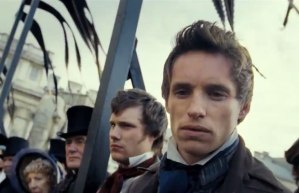
In 2012, we don’t even have the benefit of a frontrunner.  I’m saying Robert DeNiro has the lead at the moment because it’s the first time in decades he can be taken seriously by the Academy.  He hasn’t been nominated in 20 years and hasn’t won in 30 years.  And hey, guess what – the Oscars can make a Meryl out of him by giving him a third golden man!  It’s a lighter role for DeNiro yet still features plenty of depth in heart.  This category has been all about career achievement awards recently, making DeNiro a perfect fit.

On the other hand, young, upstart Eddie Redmayne is apparently the scene stealer of the supporting cast of “Les Miserables.”  With Russell Crowe apparently polarizing audiences, I think voters will likely rally around Redmayne.  He has a showy number at the end, “Empty Chairs at Empty Tables,” that will stick with viewers as they leave the theater.  If he can build consensus and doesn’t have to deal with vote-splitting, he could emerge a victor.
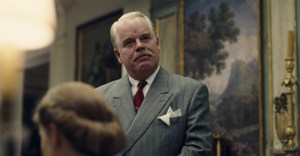
Philip Seymour Hoffman is just going for his second Oscar, but I think plenty of people would argue he’s an actor headed for the stature of Daniel Day-Lewis and Robert DeNiro.  He will get to two, and maybe “The Master” will get him there.  He won a prize at Venice (a tie with Joaquin Phoenix), and his co-lead status will help.

But I think his strength in the category will be largely determined by how well the movie does.  If it comes on strong (as I anticipate it might), he could be a serious threat to win.  But if it fires blanks, Hoffman will no longer be fighting to win and likely fighting to get nominated.

Alan ArkinAlan Arkin is likely in for “Argo,” but he’s only in the film for a handful of scenes.  He makes them the most funny and entertaining scenes in the film, though.  But I can’t help but wonder if he’s not as much of a shoo-in as some people think.  He’s already earned his lifetime achievement award – I mean, Best Supporting Actor prize in 2006 for “Little Miss Sunshine.”  And “Argo” may not be an actor’s movie.  So we will see.

As for that last slot, my brain says Tommy Lee Jones for “Lincoln” because a rising tide lifts all ships.  But I also wonder if Russell Crowe or Sacha Baron Cohen might make two nominations here for “Les Miserables,” the first time any movie would achieve such a feat in this category in over 20 years.

Or maybe Leonardo DiCaprio gets nominated for “Django Unchained” as so many are predicting.  I just can’t given how down to the wire the editing process is.

Best Supporting Actress

  1. Anne Hathaway, “Les Miserables”
  2. Sally Field, “Lincoln”
  3. Samantha Barks, “Les Miserables”
  4. Helen Hunt, “The Sessions
  5. Amy Adams, “The Master

Thanks for coming, everyone.  You did your best, but you weren’t good enough.  Anne Hathaway apparently gives a performance for the ages and makes everyone cry.  She has won.  It’s over before it even began.

So I just hope they don’t waste the other four nominations on people who don’t need them.  Since the other ladies aren’t really in contention to win, the word “Oscar nominee” could do wonders for a young actress’ career.  Like Samantha Barks, whose Eponine has plenty of tears she can jerk from her show-stopping “On My Own.”

And it could do a great deal to make the case for “she’s overdue to win” for Amy Adams, given that this would be her fourth nomination in her seven years since bursting on the scene.  That’s incredible.  At five, an eventual win becomes nearly guaranteed.

I don’t think she would have much of a chance to win, and probably wouldn’t be nominated if it weren’t such a weak year for the field.  “The Master” gives her very little to work with, but she’s fiercely intimidating and steely in what little she has.  I think unless the film totally collapses in the season, she will be able to squeeze in.

I bet Sally Field rides the coattails of “Lincoln” to a nomination, but she has won twice.  Would the Academy really crown two new Meryls in a year?  Past winner Helen Hunt will also probably figure into the race too, but I think her spot is at jeopardy given the film’s dismal box office performance.  She will need to stake a claim fast in the category or she runs the risk of getting forgotten.


REVIEW: The Cabin in the Woods

29 11 2012

Shhh … don’t ruin Joss Whedon’s big year, but have you heard of this movie called “Scream?”  It’s a little vintage, I know.  In 1996, Wes Craven unleashed his film on audiences to massive acclaim and success.  He deftly sent up horror movie tropes with humor and a sharply philosophical slant – at the same time delivering a chilling horror movie!

Now Whedon, the fanboy favorite, has given us “The Cabin in the Woods,” a film he wrote along with director Drew Goddard.  The film took three years from shooting to release, although the satire feels relevant still as the climate of the horror genre remains roughly unchanged (with the exception of the found-footage epidemic that struck with “Paranormal Activity“).

And indeed, I really did enjoy some of the things it had to say and the clever way it presents them.  The deconstruction of the horror genre, particularly the onslaught of torture flicks, is done deftly and swiftly.  While “Scream” was Craven talking merely about the archetypes and trademarks, “The Cabin in the Woods” expands to include the audience.

What does it say about us that in our heads we are rooting for the directors, played to droll hilarity by Richard Jenkins and Bradley Whitford, to inflict the strangest and most unimaginable pain on people we don’t even know?

If we think it’s sick that there’s a betting pool on how long these characters will survive and how they will die, isn’t that essentially what we do when we gossip with the person in the seat next to us in the theater?

These questions were fun to ponder for a while, yet I found that “The Cabin in the Woods” quickly got on my nerves.  It reminded me of the feeling I get when a Hermione Granger-like student thinks they are the smartest person in the room and wants everyone to know it.  Whedon and Godard act like their film is the most ingenious thing to be dropped into cinema in ages.  Granted, anything that deviates from convention in this depraved artistic moment feels original.  Yet I couldn’t escape a sense of arrogance being radiated from the film.

And my only response was that I wanted to get on Amazon, order the Blu-Ray of “Scream,” and mail it to Whedon’s house.  The message: it’s been done before, and it’s been done better.  That doesn’t mean you can’t try, but you can’t gallivant around as if you are God’s gift to the genre.  You’ve made your contribution to the parodic state of horror, and you should be content with that.  B