REVIEW: Higher Ground

4 10 2011

Anyone even willing to touch on the deep questions of religion that still loom large in life starts off a winner in my book.  The mere hint of discussing God on film sends people either hiding under a rock or complaining on the Internet, so it really takes someone with grace, eloquence, and poise to give their take in modern times.  Vera Farmiga, both acting on screen and directing behind the camera, lends a respectful voice to the conversation in “Higher Ground,” a movie about a woman truly wrestling with her faith.

As a first feature, it’s  impressive, yet there are some typical novice errors like uneven tone and inconsistent pacing that keep the film from being an impressive movie in its own right.  But Farmiga’s movie is still an effective in the sense that it asks – no, demands – its audience to ponder some incredibly deep questions.  She directs the film in such a way that it falls outside the normal pendulum of “religious” movies.  It definitely does not paint the best portrait of a Christian community, but it also doesn’t disparage them, either.  It doesn’t openly profess faith, but it doesn’t profess atheism.  Farmiga remains honest, neutral, and remarkably even-keeled so her movie can inspire conversation as opposed to complaints.

Read the rest of this entry »


REVIEW: Drive

3 10 2011

I don’t know whether “Drive” feels like such a radical movie because of its own merit or because Michael Bay and the “Transformers” culture have made violence and art antonyms in the cultural thesaurus.  Regardless, anyone who realizes that the two can coexist will rejoice in seeing someone approach the genre like a painter with a palette, not a 12-year-old with plenty of testosterone to exude.  Through his stylization and aestheticization of action, director Nicolas Winding Refn gives us hope that the “impending Dark Age,” as Roger Ebert coined it, is not inevitable at a cinema near you as long as people are still willing to take bold risks like combining the art film with the heist film.

Much like his viscerally charged “Bronson,” a career-launching vehicle for Tom Hardy, “Drive” is a dazzling visual experience that struts across the screen with swagger and confidence.  Refn’s film comes with that increasingly rare sense that every moment and every frame have been carefully and purposefully constructed, and as a result, his film will be watched again and again.  Maybe in a few years, this movie will be a textbook for how to actually direct – and not just supervise – an action movie.  (I can dream, can’t I?)  The times call for a new “New Hollywood” movement, and directors like Refn and Steve McQueen are entering mainstream consciousness at the perfect time to lead it.

Read the rest of this entry »


REVIEW: Warrior

2 10 2011

I had the benefit of seeing “Warrior” in August well before critics had really begun to weigh in on the movie, thus alleviating me of the responsibility of sorting out exacerbated expectations.  But after I watched it, rave reviews started rolling in by the dozen.  My response was a lot of head scratching.  What exactly did they see in the movie?

If we are really so desperate for an underdog story in these hard times that “Warrior” is exalted as a great film, then the recession has run a lot deeper than I thought.  Gavin O’Connor’s film is an over two hour snooze, hitting cliché after cliché with no imagination and even less personality.  It has no emotion, no character, no fire in its belly – something especially disappointing that O’Connor is the man who helmed the fantastic “Miracle,” one of the last truly great sports movies.

“Warrior” gives you no reason to care for anyone, not Tom Hardy’s washed-up soldier who wants to deny his heroism, not Joel Edgerton’s struggling teacher who boxes on the side for extra cash, nor their recovering alcoholic father who has estranged these two brothers played by Nick Nolte in a shameless “life imitating art” ploy.  They slowly – and I’m talking molasses slow – train towards the MMA Sparta tournament, Hardy’s Tommy with his father Paddy and Edgerton’s Brendan with an old buddy.  It’s about as moving as watching me type this review.

Read the rest of this entry »


Shameless Advertisement #25 – October 2011

1 10 2011

Well, it’s October!  Doesn’t it feel like just yesterday I showed you all those trailers for October releases and the month was still an abstract concept?  (OK, it was basically three days ago.)  Well, you all voted on what looked like the best bet being released this month, and the consensus was on “The Ides of March.”  Here’s how I primed you all to like it:

“The best of the month may come in its first weekend with ‘The Ides of March,’ a political thriller written, produced, and directed by George Clooney, who also puts in some time in front of the camera.  The real star is Ryan Gosling as a campaign manager torn between opposing sides of a presidential race.  The movie will surely have important and relevant implications for the way that the modern campaign is run and will no doubt be a major player in the Oscar race this year.  Even if it’s just an early check on your best of 2011 laundry list, this has to be a must-see for every cinephile.”

And since I didn’t give September its fair shake (sorry, college called), here’s what the readership of “Marshall and the Movies” thought would be best to highlight, “50/50.”  (It was a tie with “Drive” and I didn’t like it as much.)  Here’s an excerpt from my review, in case you missed it on Thursday.

“’50/50′ is of that transcendant category of movies about the human experience.  It takes us through all the messiness that ensues when cancer interferes with our everyday lives with an incredibly even keel.  The movie can switch from heart-wrenching to hilarious to heartening on a dime, largely to due to Reiser’s very personal script but also thanks to Joseph Gordon-Levitt’s incredibly powerful performance.”

Here’s what you have to look forward to this month from “Marshall and the Movies!”

The return of the OSCAR MOMENT.  It’s that time of the year.  Get excited.  First predictions of the year out on Monday.  I don’t know how I’m going to do the individual columns this year, but they will come fast and furious.

Review after review after review.  I have two Post-It notes on my dashboard with the movies I have left to review.  My goal is to get them all in before the end of the year.  We’ll see if that’s possible.

Lists.  They are easy to do.  Expect them to pop up more frequently.


F.I.L.M. of the Week (September 30, 2011)

30 09 2011

Some movies have such a powerful, heartbreaking intensity that you only need to see them once.  They don’t grab you by the shirt; they grip you body and soul.  “Revolutionary Road,” my pick for the “F.I.L.M. of the Week,” is one of these movies if you haven’t already figured that out.  In 2008, it was plagued with what I like to call the curse of the Oscar frontrunner – predestination for incredible levels of greatness that it couldn’t possibly live up to its hype.  But now with that season firmly behind us, we can now see it for its incredible capacity to captivate and move us.

Sam Mendes has a particular knack at peeling back societal façades of contentment and revealing the dark underbelly of suburban society, first with “American Beauty” and then with this adaptation of Richard Yates’ 1961 novel about the 1950s.  Frank and April Wheeler (Leonardo DiCaprio and Kate Winslet) are a typical couple – meeting after the war, they have big dreams and aspirations.  Yet Frank winds up taking a miserable desk job at his father’s company and moves them out to Connecticut when April gets pregnant.  A few years later, he has almost disappeared into a grey flannel suit and she into an apron.

However, neither can shake the idea that they have bought into an empty illusion, that there has to be more to life than to be just like everyone else.  Roger Deakins’ haunting cinematography emphasizes their Stepfordian conformity and echoes the story’s implication that they are trapped not only in this house but in this life.  However, April refuses to dismiss what Betty Freidan called “the problem with no name” in her manifesto “The Feminine Mystique,” proposing that the family move to Paris to reclaim their livelihoods.  While she brings in the money in a secretarial position, Frank would be able to relax and discover what truly makes him happy.

They start to go through with the plan, and for a moment, this ideal setup revives a failing marriage.  Even in spite of protests by friends and neighbors left aghast, particularly realtor Mrs. Givings (Kathy Bates) and their best friends the Campbells (Kathryn Hahn and David Harbour), they keep their heads held high.  In fact, the only person who seems to see their logic and rationale is John Givings (Michael Shannon), Mrs. Givings’ brilliant but possibly mentally ill son who has the best perspective on the times of anyone.

Nevertheless, the idea becomes just an idea, no longer a plan of action, leaving an embittered Frank and April to confront their problems with a pugnacious brutality.  In their arguments, Mendes and scribe Justin Haythe fully accomplish Yates’ goal of indicting the glorified hollowness of the 1950s.  While “Revolutionary Road” is beautifully written and directed, the film’s aims are best achieved through the tour de force performances by DiCaprio, Winslet, and Shannon.  As first the paradigm of suburban contentment and then its victims, the Wheelers truly needed to be personified by two actors who can fully realize the tragedy.  It just so happened to play out that these two people are world-famous star-crossed lovers thanks to James Cameron’s “Titanic.”

This may very well be the best work in the diamond-crusted careers of both DiCaprio and Winslet, which is saying a lot.  The fact that neither of them received Oscar nominations for the movie is absolutely criminal, although lack of awards recognition should hardly be the ultimate judge of their performances.  They both perfectly calibrate every scene, every emotion, every last movement so that it resonates with a scarily beautiful ring.  Kate Winslet is particularly striking as the active wife defying stereotype and lashing out against the image of the perfect housewife, making her final act devastatingly crushing.  And with powerhouse Michael Shannon as the mouthpiece for Yates and the Wheeler’s foil, the acting of “Revolutionary Road” is what drives that fist of furious emotion right into the gut.

For that very reason, I must warn you that this movie is not for the faint of heart.  Its mind-boggling emotional power doesn’t end when the credits roll; it may linger in the form of a depressing mood or a bleak outlook on life for anywhere from 1-3 days.  But don’t let that keep you from missing one of the best movies of 2008, and for my money, one of the most formidable films on society in recent memory.  You need only see it once to achieve the full effect – although if you want to see it twice like me, it’s still phenomenal.


REVIEW: 50/50

29 09 2011

The cinema of cancer is a curious thing.  The disease is usually a tack-on to the end of a movie, merely a plot device meant to make the audience appreciate the fragility and fleeting nature of life.  When the film is centered around it, the pathos is meant to unlock our most tucked-away, maudlin sentiments.

Cancer is less of a medical condition on screen than it is a transformative experience.  The victim is less of a human and more of a fighter or soldier, the underdog forced to do battle for their life.  Having known people who have been struck with this horrible disease – some emerging victorious, others not so fortunate – I can attest that they must indeed lace up their boxing gloves and pugnaciously duke it out.  But there’s more to the struggle than chemotherapy and radiation; there’s a desire for a Warren Harding-style return to normalcy as people insist on treating the patient as a different person living in a different world.

This is precisely where “50/50,” Jonathan Levine’s sophomore feature, excels.  Rather than hitting us with a tsunami of sadness, it takes us through all the emotions of living with and through cancer.  From Will Reiser’s moving script comes a story “inspired” (as the lawyers required it be advertised), by real experiences that is rooted in a startlingly authentic humanity.  His protagonist, Joseph Gordon-Levitt’s Adam, is never defined by his unpronounceable cancer; he is defined by his responses to a landscape that shifts much faster than he has anticipated.

Read the rest of this entry »


Classics Corner: Guess Who’s Coming To Dinner?

29 09 2011

Much of the U.S. racial history that I learned as a kid in school could be summed up with this sentence: “Then Martin Luther King had a dream, he made the civil rights movement happen, and suddenly everyone could go to school together and racism wasn’t a problem anymore.”

There’s so much wrong with that statement, but I’ll start out by pointing out that racial tensions can never be covered up, erased, or eradicated; they can only be soothed and toned down to the point that they no longer present a basis for discrimination.  And the tensions cannot be controlled by the government; they can play a significant role in the process, but racial tensions have to be fixed by society because that’s the place from where they were derived in the first place.  The Civil Rights Act and Brown v. Board of Education were important steps on the way to deinstitutionalizing racism, but they did not magically make the problem disappear.

It’s a quick, easy pat on the back to say that since there was once a time when segregation in schools existed, we are a progressive and equal society.  The fact is, however, that we are not a society void of discrimination.  It still exists.  Whether it’s directed towards homosexuals, blacks, whites, Hispanics, Christians, Muslims, Jews – it is still out there, and it’s still a big problem.

Not to digress too much, but that’s why I think “The Help” was such an important discussion piece over the summer.  By showing us how backwards the Southern attitudes towards their African-American maids were, dehumanizing them to the point that they needed separate toilets, it reminded us of how horrible discrimination is.  If you really wanted to meditate on the late summer breakout hit,  you could think about how much discrimination still exists in our society (positive or negative) on the basis of race, class, gender, sexual orientation, or just about any other categorical distinction you can make.

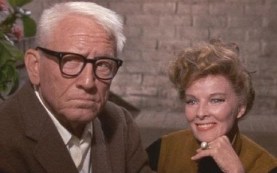
So now to the main point of discussion, the 1967 film “Guess Who’s Coming to Dinner?”  Stanley Kramer’s film was nominated for 10 Academy Awards in a legendary year for cinema, winning a third Best Actress trophy for Katharine Hepburn and another trophy for Best Original Screenplay.  The film deals with one question: is it actually acceptable for Joey, an upper-class white woman (Katharine Houghton), to marry John Prentice, a black man (Sidney Poitier) even if he is extremely well-off and accomplished?

The question is directed at three groups.  The first is Joey’s parents, well-off California liberals Christina (Hepburn) and Matt Drayton (Spencer Tracy in his final film). The issue tests how committed they are to their ideals by muddling their interests in with the final product.  The second is the other African-Americans in the film, John’s parents and the Drayton’s maid Tillie.  They seem to doubt the sincerity of the gesture, wondering if the move is motivated by power rather than love.

And the third group is us, the audience, be it in 1967 or 2011 or 2100.  Some considered it dated even upon release, according to The New York Times‘ Frank Rich.  “What couple would not want him as a son-in-law,” he asks upon restating John’s impressive résumé.  Some critics have said that he was too white and have thus dulled the movie’s impact.  But as Rich said, “[W]hat’s most startling about this archaic film is the sole element in it that proves inadvertently contemporary. Faced with a black man in the mold of the Poitier character — one who appears ‘so calm’ and without ‘tensions’ — white liberals can make utter fools of themselves. When Joe Biden spoke of Obama being ‘clean’ and ‘articulate,’ he might have been recycling Spencer Tracy’s lines of 41 years ago.”

We can pretend that by electing a black President, we’ve purged ourselves of a long history and assuaged our guilt (an explanation that many have proffered now that his approval rating hovers in the low 40% range), but movies like “Guess Who’s Coming to Dinner?” remind us never to stop questioning our values.  Taking place after the passage of civil rights legislation, I can assume many people would have liked to put their feet up and pretend equality had been achieved.

Sure, its script may not have much to offer, the music may be brutal, and it lingers for too long.  But amidst all of that, there are numerous challenges to think about our notions of equality that society needs to continue to ponder on if we ever intend to keep moving forwards.


WTLFT: October 2011

28 09 2011

Can I get a collective “WHOOP WHOOP” for my return from the first month of college hiatus? [pause] If any of you all are still out there (doubtful), you can be louder!  So I’ll need you to comment (shameless plug for commenting).

While I’m on my winning streak of humor, I’ll funnel this goodwill into making you read my post about what to look forward to in October.  Reviews will be coming soon for “50/50,” “Drive,” and “Warrior” with hopes that I’ll find time to squeeze in “The Debt,” “Contagion,” and “Moneyball” somehow between classes, homework, and a social life of sorts.

October is my probably my favorite month of the year, not just for the selfish reason that it’s my month of birth.  It’s a great month to be outside; I’m especially excited this year that I will be out of Texas and in a place where I can experience fall and changing seasons.  It’s also a time of changing seasons at your movie theater, out with summer leftovers and slightly dumpy September fare and in with late-year commercial fare and some early awards plays.  Here’s what 2011 has to offer us in the month of October:

October 7

The best of the month may come in its first weekend with “The Ides of March,” a political thriller written, produced, and directed by George Clooney, who also puts in some time in front of the camera.  The real star is Ryan Gosling as a campaign manager torn between opposing sides of a presidential race.  The movie will surely have important and relevant implications for the way that the modern campaign is run and will no doubt be a major player in the Oscar race this year.  Even if it’s just an early check on your best of 2011 laundry list, this has to be a must-see for every cinephile.

Meanwhile, “Real Steel” … yeah, can’t say I have the highest of hopes for that.  “Transformers” already gave me plenty of clanging metal this year.

On the other side of the tracks, there’s Juno Temple in “Dirty Girl,” a story of sexual mores in 1987 Oklahoma.  It stars Juno Temple, who will have a role in “The Dark Knight Rises,” so it may be worthwhile to see just to say you knew who she was before her breakout (if indeed she does do that).

In case you haven’t had enough Jessica Chastain this year between “The Debt,” “The Help,” and “The Tree of Life,” she also appears in “Texas Killing Fields,” which – no offense to the talent involved – looks like one of those C-list movies you’d find on the “just added” section of Netflix streaming between “Tangled” and “The Expendables.”

This weekend also brings a strange extreme with “The Human Centipede 2: Full Sequence,” which looks to overcome the sequel slump by presenting a story of life imitating art (if you want to call the gross-out horror film that shocked audiences last year art).  It’s a must for sadists and horror fanatics; others would do best to just stay home.

October 14

This Friday marks my birthday … and Hollywood celebrates by releasing two remakes and a Jack Black comedy.  Mental confetti just splattered the walls of my brain.

“Men of a Certain Age” gets a big-screen adaptation after cancellation – but directed by “The Devil Wears Prada” (I’m actually being serious here) – as two aging Frat Pack comedians and the guy who has hosted “Saturday Night Live” the second most times in history go on a trip to fight their ennui by taking a trip in “The Big Year.”  Wait, maybe this is a remake …

Meanwhile, ’80s nostalgia runs rampant as “Footloose” and “The Thing” both get updated.  Note to bloggers/columnists: the question “Why aren’t the originals sufficient?” has been asked and answered dozens of times before.

Off the mainstream, “Trespass” begs the question of whether or not the Academy can revoke Nicolas Cage’s Oscar.  But on a more positive note, one of my favorite modern directors, Pedro Almodóvar, is back with his latest film, “The Skin I Live In.”  It didn’t get the strongest reviews out of Cannes, but it looks haunting and beautiful.  Plus, I’ll see just about anything he makes.

October 21

I’m legally prohibited from sharing any thoughts on “Martha Marcy May Marlene” until it hits theaters in Houston – but for now, enjoy the trailer.  And if you are really that curious about the movie, listen to “Marcy’s Song,” a tune from John Hawkes that plays briefly at the end.

How many times can we remake “The Three Musketeers?”  I’m calling it now that in 2022, the kids from “Slumdog Millionaire” will star as Athos, Porthos, and whatever Jamal’s final guess was.  Last year’s October release “Secretariat” gets remade for 2011 as “The Mighty Macs,” this time featuring the woman ahead of her time as a college basketball coach.  “Paranormal Activity 3” gets slightly creative as it goes back to the origins of the horror from the original, but it’s still a sell-out.

On the indie circuit, “Margin Call” boasts a quasi-“Contagion” level of prestige but doesn’t seem to be generating much buzz.  I guess that post-“Inside Job” and “Too Big to Fail,” recession backstories may be old and tired.

October 28

One of my biggest pet peeves is hearing about amazing movies that play at Sundance in January and then having to wait to see them until the end of the year.  Hopefully my patience will be rewarded with “Like Crazy,” the movie that everyone emerged from the festival talking about.  Felicity Jones and Anton Yelchin are two hot talents rising in the industry; hopefully this catches on with the mainstream and helps their careers skyrocket.

“In Time” could be an interesting mix of high-octane popcorn blockbuster and political allegory … or the trailer just gave off false notions.  I’ll have to hover over this one for a little while before deciding what my schedule for seeing it is.

The director of “2012” and “Independence Day” is making a movie with Oscar buzz?!  In what world do we live now?  Might as well check out “Anonymous” … apparently Rhys Ifan’s performance is startlingly good.

I wasn’t a big fan of “Fear and Loathing in Las Vegas,” but “The Rum Diary” just looks like Hunter S. Thompson light.  Even with Johnny Depp back, this doesn’t look like it can drum up a lot of enthusiasm.  Speaking of not drumming up a lot of enthusiasm, how about “Johnny English Reborn?”  Waiting 8 years between installments doesn’t do you a lot of good when the original didn’t do particularly well.

So, are you more excited that I’m back burning up the blogosphere or that October is coming soon?  Take the poll, leave a comment, do whatever – but make your voice heard!


Classics Corner: “Some Like It Hot”

24 08 2011

As I talked about in my “Weekend Update” column two weeks ago, comedy with lasting cultural value is few and far between at the movies nowadays.  The genre has become heavily manufactured, producing standard-order products that entertain at the most basic level to turn a quick profit.  Ben Fritz of The Los Angeles Times wrote this about the state of the movies in July: “Increasing concern about the economics of comedies has also led studios to increasingly rely on well-known names with track records. That’s why Apatow, Adam Sandler and ‘Hangover’ director Todd Phillips remain among the busiest people on Hollywood’s comedy circuit.”

But as I am quite notorious for insisting, the instant gratification culture that began in earnest with the proliferation of the Internet is truly far-reaching, changing the way that the industry makes movies.  They want movies to make money so they can appear to be in the black for their shareholders.  The easiest way to do that is by producing a movie that barely has enough laughs to sustain a 150 second trailer and then building clichéd tropes as filler around it.  This makes for instant gratification, sure, but how many of our comedy favorites of this decade will be not only memorable but still funny in 50 years?  “The Hangover?”  “Superbad?”  “Wedding Crashers?”

To keep viewers for many years to come, studios should be patterning their comedies more like “Some Like It Hot,” Billy Wilder’s classic that was ranked the funniest American film ever by the American Film Institute in 2000.  I don’t know if I wholeheartedly espouse this choice, but I will say this: on first view at home, it made me laugh more than most modern comedies make me laugh in the theaters.  And on second viewing, it held up better than any recent genre effort.

The key is this, in my opinion: it’s all in the nuances.  Humor calibrated to please the culture of its time will rise and fade like a setting sun; take for instance 1973’s “Blazing Saddles.”  Yes, it’s absolutely a riot, but a scene of flatulence which was shocking then is now commonplace and incredibly tame compared to the nonstop easy scatological humor that Hollywood comedians insist on throwing at us like we’re nine years old.  (Looking at you, Happy Madison.)

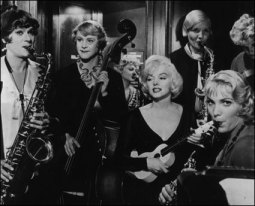
It all starts at the grassroots, namely with the writers and the actors.  This is where comedy flourishes, when everyone is game to generate something hilarious once and just as good afterwards.  Billy Wilder, perhaps one of the most diversified figures in cinematic history, co-wrote this story that lovingly pastiches multiple movie archetypes – the gangster flick, the screwball sex comedy, the slapstick humor popularized in the silent era by Chaplin and the Marx Brothers, and a non-tailored romance with some interesting twists and turns.  His excellent cast, which includes the enchanting Marilyn Monroe and “her bosom companions” played by Tony Curtis and Jack Lemmon, carries the movie to comedic transcendance.

Not too unlike “The Hangover,” Wilder’s film begins with a crazy premise: Curtis and Lemmon’s macho Prohibition-era Chicago musicians, fleeing the scene of a gang massacre, get in drag to join a women’s band on the road.  They fit in rather nicely on just appearance, but that’s the least of their problems.  There’s the issue of another smoking hot singer in the group (Marilyn Monroe) who’s voice is as stunning as her face.  There’s also the problem of them attracting other men to their new personas as the billionaire Osgood Fielding takes a special interest in one of them.

It’s a movie of twists and turns, mistaken identities, hilarious physicality, snappy dialogue, and just plain fun.  Now doesn’t THAT sound like the type of comedy you’d pay to see?


REVIEW: Everything Must Go

23 08 2011

I’m not quite sure who thought of casting Will Ferrell as the beleaguered everyman in the recessionary fable “Everything Must Go,” but the choice actually ends up working in unexpectedly pleasant ways.  It’s the perfect kind of art imitating life, one where the movie reflects the mindset of the actor and provides insight into their mindset.  It doesn’t distract from the story or the performance but makes for an interesting conversation point after the film stops rolling.  It gives us a glimpse of humanity itself as we can feel the juncture of character and actor in a non-invasive way, and with a movie like this celebrating the inherent decency of people in trying times, you couldn’t ask for much more.

Ferrell is definitely coming to one of those junctures in his career where things haven’t been going well, and they could soon balloon out of control if he doesn’t start making better movies.  The quality has gone down, and the audiences have been coming less and less.  Similarly, many Americans are finding themselves at a life juncture where things have gone from bad to worse thanks to the economy, and things could continue to go downhill.  Ferrell finds this connection with the audience and forms an easy rapport with them, despite playing a somewhat unlikable slob reeling from the world’s worst day.

If you think a double feature of “Semi-Pro” and “Land of the Lost” is agonizing, try losing your job and getting kicked out of the house by your wife in a matter of hours.  Now that’s pain.  Ferrell’s Nicholas Halsey is forced to face a new life, one where all of his possessions can be enumerated on the front lawn.  At first, he laments the hard times by kicking back in a La-Z Boy with can after can of PBR.

Read the rest of this entry »


HITCHCOCKED: “Vertigo” (1958)

22 08 2011

I’m fully prepared to take a lot of heat for what I’m about to say.  In fact, as I ponder making this statement in my head, I myself wonder if I’m a humongous hypocrite.  What I’m about to suggest could spark some serious outrage, perhaps on the level of suggesting “Citizen Kane” isn’t all that great (which I have gone on the record as saying is false).

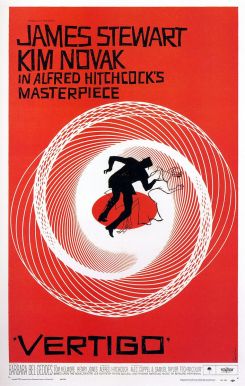
I’d like to see “Vertigo,” with the same script, comparable actors, and the same Hitchcock penchant for filmmaking, be remade in the present day.

There, I said it.  It’s out there, I can’t take it back.  But while watching “Vertigo,” I was struck by the powerful and affecting portrait of a mentally disturbed policeman played by James Stewart.  I found Kim Novak’s work as the woman who claims to be possessed by the spirit of a dead woman to be frightening.  I felt Hitchcock’s masterful storytelling with the camera to be totally present.  I was totally engaged by the smart writing, which harkens to a mystery of almost mythical proportions.

Yet the visuals just felt so … outdated.  Yes, this is obvious given that the movie is over half a century old.  Obviously, it was about as good as it got back then.  But this is 2011, and when the camera is stuck in the past while the story remains timeless, it can’t help but be distracting.  In fact, it goes beyond that – it detracts.  The movie’s style now alienates us from the movie, pulling us out to remind us, “Oh, this is a movie, and this is how they could visually represent the fear of heights back then.”

So to maintain that pervasive sense of acrophobia, why not remake “Vertigo” with modern technology that would make this classic story work so much better for the audiences of today?  Isn’t that why we should be remaking movies?  Not just to be lazy or to sloppily “update” it to market to younger crowds, a remake of “Vertigo” that preserved the timeless integrity of the acting and storytelling would be perfect.  Because, perhaps with the exception of historic visual achievements, the look of a movie is something that should hold power no matter if it’s being shown in 1958 or 2011.  I’m convinced that it would have rocked me to my core had my eyes been borrowed from that era.


(Kinda Belated) Weekend Update – August 21, 2011

21 08 2011

“How much does your life weigh? Imagine for a second that you’re carrying a backpack. I want you to pack it with all the stuff that you have in your life… you start with the little things. The shelves, the drawers, the knickknacks, then you start adding larger stuff. Clothes, tabletop appliances, lamps, your TV… the backpack should be getting pretty heavy now.

You go bigger. Your couch, your car, your home… I want you to stuff it all into that backpack. Now I want you to fill it with people. Start with casual acquaintances, friends of friends, folks around the office… and then you move into the people you trust with your most intimate secrets.

Your brothers, your sisters, your children, your parents and finally your husband, your wife, your boyfriend, your girlfriend. You get them into that backpack, feel the weight of that bag. Make no mistake your relationships are the heaviest components in your life.”

– George Clooney as Ryan Bingham in 2009’s “Up in the Air

“For what it’s worth: it’s never too late or, in my case, too early to be whoever you want to be. There’s no time limit, stop whenever you want. You can change or stay the same, there are no rules to this thing. We can make the best or the worst of it. I hope you make the best of it. And I hope you see things that startle you. I hope you feel things you never felt before. I hope you meet people with a different point of view. I hope you live a life you’re proud of. If you find that you’re not, I hope you have the strength to start all over again.”

– Brad Pitt as Benjamin Button in 2008’s “The Curious Case of Benjamin Button

In case you missed it…

It was a pretty slow week as I was incredibly preoccupied running last second errands before leaving for college on Wednesday.  Hopefully I won’t fall off the map too precipitously, but things might be running slow for a while – especially in terms of reviewing new releases.

I took this as an opportunity to run reviews for some older movies that tied into other releases this week.  With Jessica Alba headlining the new “Spy Kids” movie, I reviewed her “Machete” and “Little Fockers” from 2010.  James McAvoy’s “The Conspirator” hit video this week, so I took the opportunity to review “Gnomeo & Juliet,” the animated Shakespearean tale to which he lent his voice.

I also took a look at the September crop of releases, which has a few gems shining amidst the trash heap.  Kris Tapley of “In Contention” just updated his Oscar predictions to include “Moneyball” as a probable nominee for Best Picture, Actor, and Supporting Actor.  More reason to get excited.  Click on the picture below to see the September preview post.

And the end of the week saw a lot of emphasis on Anne Hathaway as “One Day” opened in theaters.  On Friday, the “F.I.L.M. of the Week” was “Rachel Getting Married,” Oscar-nominated because of her performance.  On Saturday, I reviewed “One Day” and for the most part liked what I saw.  Click the picture below to read the review.

Recommended Reading

Save a tree, read a blog. Unless you want to print out a review … in which case, you aren’t saving trees.

And Vulture asks the question we are all pondering: Why Do Studios Think There’s So Much Value in Old Titles?  After the flop of “Conan the Barbarian” and “Fright Night,” here was their best conclusion.

“‘Studios remake these movies because they often already own the title,’ says Ammer. But it’s more than that. After all, it wouldn’t cost a studio any more money to hire a writer to write an original screenplay than it would to have him or her write one based on an older film. The real appeal of an old title is more superstitious: The studios use them, says Ammer, because ‘they know it’s worked in the past.’ Even though it’s an entirely different movie made by different people for a different generation, the idea is, hey, the title worked before, why not give it another shot? For all of Hollywood’s supposed liberalism, studios, like their audiences, are quite conservative. Genre is the most predictive aspect of a film’s future results, and then title, so why not double down? A remake of a successful genre film allows a studio the greatest possible risk reduction.”

The Tree of Death

/Film said it best when they broke the story: Even Sean Penn did not care for Sean Penn in “The Tree of Life.”  However, I’ll give credit to where I saw this first, Guy Lodge of “In Contention.”

Sean Penn moping about in my hometown.

In an interview with the French magazine Le Figaro, Sean Penn had this to say about Terrence Malick’s enigmatic film:

“I didn’t at all find on the screen the emotion of the script, which is the most magnificent one that I’ve ever read. A clearer and more conventional narrative would have helped the film without, in my opinion, lessening its beauty and its impact. Frankly, I’m still trying to figure out what I’m doing there and what I was supposed to add in that context! What’s more, Terry himself never managed to explain it to me clearly.”

I’ll go ahead and add this disclaimer to those that love the movie or the fact-checking Gestapo that yes, I realize that’s not the full quote.  But for the sake of this post, it’s easier to just analyze this part.

Where to begin?  The fact that a two-time Academy Award winner would bash his own movie would be shocking even if it was a total sellout, but even I as a non-impressed watcher see “The Tree of Life” as anything but a sellout.  It’s high art, just not the kind of art that was to my taste.  He doesn’t exactly mince his words there, pretty openly stating his distaste for how his role in the movie turned out.

This is nothing new, of course.  Adrien Brody complained when he was largely cut out of Malick’s “The Thin Red Line” – while I don’t like when whiners get their way, he certainly got it with Roman Polanski’s “The Pianist” in 2002.  But Penn’s statement goes far beyond just a diva fit, although I do think it dabbles in a sort of self-centered sensibility.  He questions the very way that the movie was made!  Keep in mind that Sean Penn has stepped behind the camera before, even turning out an all-time favorite of mine with “Into the Wild.”

Penn gets to the core of my issues with the movie.  I’m even a little bit more flexible – I’d be fine without a conventional narrative.  But Penn points out that the movie was incredibly disjointed.  I’m sure that the movie was beautiful in Terence Malick’s head, just as Penn says it was beautiful on the page.  Interestingly enough, I’ve heard from industry insiders that Malick shot the script with the dialogue, even allowing Jessica Chastain to speak.  Then he would cut, walk over, and tell her to emote all of the dialogue just with her eyes.  An interesting philosophy that produced an interesting end product.

Still moping...

Yet when everyone on set is not working in sync with the same vision towards a final product, the movie inevitably suffers.  If an actor doesn’t understand his purpose on screen, how can he do a decent job?  Moreover, how can he contribute anything to the movie?  If a director can’t even articulate his vision to the people he entrusts to help him create art, how can he articulate it to an audience?  I’ll inevitably be hit with the “it’s subjective” argument, but give it up here.  You can’t honestly argue that Malick is such a visionary that he can’t even be on the same page with his fellow artists.

Even those that I’ve talked to who LOVE the film can at least admit that the Sean Penn segments were the weakest parts of the film, and the actor’s statements shed some light on why that is.  An actor just existing on screen because a character exists on the page doesn’t make for compelling cinema if he doesn’t understand the basic objectives and motivations.  It’s just … boring.

I guess my biggest question here is why didn’t Penn make a bigger fuss on the set?  It seems kind of cowardly to whip out these harsh words now, potentially even in “too little, too late” territory for those who feel they’ve wasted their life watching the movie.  I get the whole mindset that Malick is a genius and you don’t question him, but for such primal acting concerns as these, why wouldn’t you demand more from the master during production?  If he was really that dissatisfied, why not walk off the movie?  These problems Penn has should have been settled a long time ago, and by just bringing them up now, he’s either searching for attention or absolution for being the worst part of the movie.

Penn did close with this statement about the movie, something that I’d say I basically espouse:

“But it’s a film I recommend, as long as you go in without any preconceived ideas. It’s up to each person to find their own personal, emotional or spiritual connection to it. Those that do generally emerge very moved.”


REVIEW: One Day

20 08 2011

Romance movies aren’t always my thing, being a guy and a Woody Allen fan. “One Day,” however, is a pleasant surprise.  It takes a novel concept – from an acclaimed, best-selling novel – and makes a will-they-or-won’t-they friends or lovers story fun and engaging.  While it’s a step down for director Lone Scherfig, whose film debut “An Education” was nothing short of masterful, it’s not a terribly precipitous decline.

In addition, it’s the kind of movie that played perfectly well in the early weekend afternoon matinee setting in which I saw it.  “One Day” is like a very long stroll with two very interesting and complex characters.  Anne Hathway’s Emma is a strong-willed, slightly prudish peace activist totally lacking in self-confidence.  Jim Sturgess’ Dexter is a laid-back, entitled mess of a man who never seems to be lacking in excuses to doff his clothing.  After a few bottles on the evening of their graduation, they spend a night together and begin a friendship that continues throughout the years.

The movie is then driven by their change over the next twenty years as we see them on July 15 from 1988 all the way to the present.  This nifty device prevents the movie (and I guess, prevented the novel as well) from slipping into predictable melodrama as their metamorphosing and evolving is what keeps us interested.  One year, Dexter is a drug-addicted hack television host and Emma is in a happy relationship; soon after, he’s cleaned up and in love while she’s found herself in a dead end.

Read the rest of this entry »


F.I.L.M. of the Week (August 19, 2011)

19 08 2011

Anne Hathaway can do so much better than the romantic rut she’s leading herself into. The actress seems to have an incredibly fiery, passionate base of detractors, something that I really don’t understand. Clearly they haven’t seen “Rachel Getting Married,” Jonathan Demme’s 2008 film that is my pick for the “F.I.L.M. of the Week.”

Hathaway, in a stunning performance that deserved the Oscar nomination it received, plays not the title character but rather her sister, Kym, who is on furloughs for the weekend from rehab. She’s unlikable with a prickly exterior, something portrayed with gusto by the normally charming actress. Yet underneath her thick-skin lies a vulnerable and hurting person, still reeling from tragedy earlier in her life. Caught at a crossroads between moving on and accepting responsibility, she stands uncertainly and without confidence to face a world colored by the consequences of her actions.

Hathaway brings such a vibrant and visible contrast of these two sides of Kym to the screen, fully realizing her from her flaws to her fears to her love to her guilt. It’s one of those miraculous performances by an actress that carries such tremendous emotional nuance that it continues to reward those who dare to take the gut-wrenching roller-coaster ride with the movie again.

What makes “Rachel Getting Married” even better is that every aspect of the film is on par with Hathaway’s towering performance.  Jonathan Demme’s direction is impeccable, capturing the intensity of every moment with a fly-on-the-wall sensibility.  The tension and the mood is right in every moment, although I will give my one caveat in this glowing review: fast forward through the wedding reception dancing.  It’s a bloated sequence that offers a lot of excess with a few cutaway shots to Kym.  Surely it couldn’t have been that way in the brilliant script by Jenny Lumet, director Sydney’s daughter, which paints a portrait of a family torn asunder by a disaster yet forced to put aside the past and come together for a wedding.

The bride, Rachel, is burdened on what should be the happiest weekend of her life by her sister Kym’s re-entry into society, something that comes with many bumps.  With the skilled Rosemarie DeWitt behind the wheel, Rachel weathers these events with increasing emotional fervor until she reaches a breaking point.  It’s a tour de force to rival Hathaway’s work, snubbed of a deserving Oscar nomination – and maybe even a win.  She’s pitch perfect throughout as she tries to maintain her happiness and sanity in the presence of the self-proclaimed “God of Death.”

The sisters are also estranged from their mother Abby, played by Debra Winger, whose performance epitomizes art imitating life as the actress herself has been practically estranged from serious cinema for over a decade.  Her emotional distance echoes her reaction to the divisive family tragedy as she has tried to totally move on and forget the whole thing.  Winger’s quiet character is very mysterious and, like Hathaway’s Kym, holds much to be discovered in her work the second time around.  While Abby may not be easily embraceable, neither is the movie.  But the difference between the two is that “Rachel Getting Married” as a whole is truly endearing, a powerful portrait of the power of love and family through countless issues.


WTLFT: September 2011

18 08 2011

Summer comes to an abrupt halt in September as we shift from tentpole, blockbuster fare to dumpy, forgettable movies that studios drop here rather than release straight to video.  For the most part, that is.  You can decide for yourself if there are any bright spots in September.

September 2

Some claim Labor Day is the last “official” week of summer, but it’s now the perfect way to usher us into the month of September!  Take “Shark Night,” for instance.   I can imagine the rationale behind this movie: let’s stick a bunch of no-name teen actors in a lake, throw in a shark, film it with a 3D camera, call it a movie, and hope to come out in the black on it!  “Apollo 18” … yeah, “Transformers: Dark of the Moon” soured any small inkling of want I might have for another Apollo conspiracy.

And since it comes out on August 31, I’m going to technically classify “The Debt” a summer release.  If it’s as good as its trailer, it probably doesn’t deserve to be among these stinkers.  Jessica Chastain, Tom Wilkinson, Helen Mirren, the dude from “Avatar” (who has a name, Sam Worthington) – this is one I don’t plan to miss.

September 9

I haven’t watched the trailer for “Contagion” because apparently there’s a big spoiler in it.  But I’ll do my best to avoid it since I want to enjoy the movie as much as possible.  Steven Soderbergh, virus outbreak, Matt Damon, Marion Cotillard, Kate Winslet, playing at the Venice Film Festival – that’s like water in the desert.  Why ruin it?

I’ve seen “Warrior,” and you’ll hear my nonplussed comments on it later.  On the other hand , I will stay as far away as possible from the rank “Bucky Larson: Born to Be a Star.”  I’d rather bushido than sit through that torture.

Also, if you want to say you REALLY knew Rooney Mara before her humongous breakout role in December’s “The Girl with the Dragon Tattoo,” then maybe you ought to see “Tanner Hall.”  But I don’t know if it’s anything I’m all that interested in.  What might be more interesting is “We Were Here,” a documentary about the early days of AIDS, or “Where Soldiers Come From,” a documentary about some friends who join the National Guard together.

September 16

Another trailer I don’t want to watch is that of “Drive,” the Ryan Gosling vehicle involving vehicles.  Directed by Nicholas Winding Refn, who unleashed the massive testosterone rush that is “Bronson” on us two years ago, this September sleeper could be seeing Oscar gold.  He won Best Director at Cannes – but then again, “The Tree of Life” won their equivalent of Best Picture, so I’m not sure how much I trust the Robert DeNiro jury.

In case the chicks are tired of “The Help” (and I assume that “One Day” will be long gone by this weekend), they get fresh food in the form of “I Don’t Know How She Does It,” a Sarah Jessica Parker working mom comedy.  And the never-sleeping remake culture goes on with the ultra-violent “Straw Dogs” – not for the women.  Except maybe Megan fromBridesmaids.”

On another note, can you feel the love tonight?  I can feel childhood nostalgia stirring…

On the indie side of things, there’s “Granito: How to Nail a Dictator,” a documentary about a filmmaker who does research in an attempt to nail some Guatemalan military officials, and the super-angsty teen romance “Restless,” a long-delayed project from Gus Van Sant.

September 23

“Abduction” seems somewhat original from the trailer … don’t know if Taylor Lautner can carry a thriller by himself though.  Expect plenty of gratuitous shirtlessness.  However, I will give them props for playing Sleigh Bells at the end.

The weekend’s other high-profile release is potential awards candidate “Moneyball,” based on the best-selling book by Michael Lewis, the guy who penned Best Picture nominee “The Blind Side.”  It’s directed by Bennett Miller, who received an Academy Award nomination for his work on “Capote.”  It stars two-time Oscar nominee Brad Pitt, Oscar winner Philip Seymour Hoffman, and a trimmed-down but non-Oscar nominated Jonah Hill.  It’s co-written by Aaron Sorkin, who won the Oscar last year for writing “The Social Network.”  Hopefully it earns buzz on its own merits, not just on these incredible credentials.

On opposite extremes of the MPAA spectrum are sure-fire disappointments “Dolphin Tale” for the youngsters and “Killer Elite” for the bullet crazy.  How can I make this projection so assuredly?  Their trailers both make them look derivative and unnecessary.

The independent releases this weekend are actually pretty impressive.  There’s “Machine Gun Preacher,” whose impressive story of philanthrophy and bravery could transcend the presence of Gerard Butler.  There’s also “Puncture,” which doesn’t look like your average legal thriller.  Who knows, Captain America Chris Evans might be able to show he has real acting chops!

September 30

This indie takes precedence over all other releases this weekend because Jeff Nichols’ “Take Shelter” looks like one of 2011’s saving graces.  The vastly underrated Michael Shannon gets a chance to deliver the powerhouse leading performance we all want in this drama of seemingly biblical proportions.  I’m excited to see where this movie goes because the trailer makes my stomach churn.

I’ve already had the chance to see “50/50,” and you’ll be hearing my raves for Joseph Gordon-Levitt and company right before the film’s release.  But for now, know that I recommend it.

R-rated comedy looks to keep taking its nosedive with “What’s Your Number?,” starring “Scary Movie” staple Anna Faris.  You can watch the trailer for “Dream House” and get a tiny yet fully-fleshed out horror movie in less than three minutes, which beats paying for trite fare like this at a theater.  “Courageous” seeks to fire up the Christian base like “Fireproof” and “Facing the Giants;” I’m curious to see if their success keeps increasing.

In other news, Kenneth Longeran’s “Margaret” finally sees the light of day after half a decade sitting on a shelf.

So, what are YOU looking forward to in September?  Anything?  Just the high-profile releases like “Contagion” and “Moneyball?”  Or are you just planning on staying at home and watching some football?!  Sound off or take the poll!